

On the Road with Roger Robinson
BACKSTAGE AT BOSTON
BOSTON, Friday, April 17th, 9:00 A.M.—”The marathon? It’s great. I love it. All kindsa people run it. I’ve got friends who have run it. Two of them even had numbers.”
He was a college graduate, that articulate and friendly young cab driver, an ex-linebacker with bad knees. We talked football, marathons, and knees all the way from Logan Airport to Copley Square. His punch line, “Two of them even had numbers,” gave a glimpse of the Boston Marathon’s life in popular culture. The official race, with its qualifying times, lavish commercialism, invited stars, and microchip technology is still somehow the property of those pragmatic, sports-loving New Englanders. They watch it, cheer it, even run in it, but enter it officially? That’s like trying out for the Red Sox. I must remember those grass roots, I thought, as I stepped from the cab to enter four days in the refined air of elite running and sports journalism.
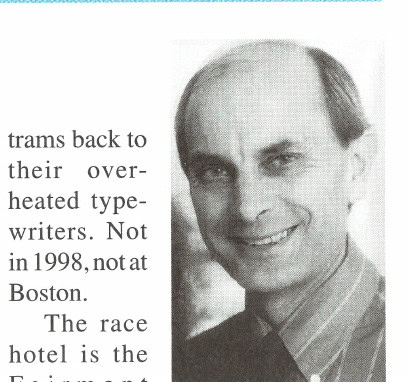
10 A.M.—I enjoy being an occasional sportswriter. As a boy I became hooked on English magazine stories of sleuth reporters with raincoats, trilby hats, and notebooks who clambered fences to watch secret training sessions in windswept soccer grounds or dusty boxing clubs, and then took trams back to their overheated typewriters. Not in 1998, not at Boston.
The race hotel is the Fairmont Copley Plaza, with a lobby more opulent than the ballroom on the Titanic. The walls and ceiling ooze gold and glass and glitter, and high above the lobby chandeliers twinkle. But today the people below are not the preening aristocrats this setting seems to require. Business people in suits check in and check out, but among them stand clusters of men and women in bright blue and yellow jackets, carrying clipboards and talking excitedly into cell phones. Other clusters are of quiet people in sports shirts, jeans, and running shoes, meeting and greeting and moving toward the inner room where coffee beckons. And weaving among this crowd, in and out, up and down the lobby, swerving around potplants and luggage carts, small, lithe men and women in tracksuits are running—yes, running, quietly, unobtrusively, but nevertheless purposefully running from one end to the other of this long, high, palatial corridor. It would be a strange, incongruous sight in any other context. Here, at Boston, in the race hotel, it’s normal. It goes on for three days. If groups of runners came jogging around the tables as you sat in the splendid dining room, you wouldn’t be surprised.
10:30 A.M.—The press conference is in the Gold Room, and the name says it all. The Emperor Nero would have felt at home here. In keeping with the setting, the occasion is seamlessly conducted by the John Hancock Corporation, honoring their sponsored athletes. It’s good to see running take on such class, such a sense of occasion and significance. For all that, the tone is in no way splashy. Those who talk about brash Americans or crass sportspeople should drop by this function. Here are some of the world’s supreme physical specimens, yet there is no flexing of muscles, no bragging, no vaingloriousness. They pay tribute to John Hancock, or to Jesus Christ, or to rival runners, but never to themselves. They also pay tribute to the Boston Marathon. “It was more than an Olympics to win here,” says Moses Tanui with quiet sincerity, “because of the history.”
The audience is also low-key, though equally elite. Sitting modestly with their notebooks out are more Olympic medalists and Boston champions than you could count, working now as writers, broadcasters, agents, race promoters, statisticians, photographers. They know this sport from the inside and they love it, but they are here to work, not to be seen and admired. When the elite runners move to the tables where they will be available for interviews, the journalists are out of their seats as if the starting gun had fired.
The Kenyan and Ethiopian tables instantly vanish behind a crush of polo shirts and microphones. Fastest to Fatuma Roba’s table is a vivacious woman with striking red hair whose attention I hope to attract later. A weekend can’t be all work. Meanwhile I move among the neglected tables of the lesser stars and have fascinating conversations with Brits Dave Buzza from Cornwall and Karen MacLeod from Scotland’s Isle of Skye (who will turn 40 four days after the race; she ran her first marathon at 34). From Colleen De Reuck I hear my first Afrikaans proverb—”Stille water diepe grond,” which translates as “On raceday she will run with a flourish rather than like still waters that run deep.” I listen to the newer Kenyans talking in their soft, shy way, like Peter Ndirangu, a 24-year-old Kikuyu farmer from a family of eight who trains with Moses Kiptanui and Daniel Komen. What does he make of the Gold Room, I wonder.
Unlike many of the journalists, I don’t have to scout out hot newsworthy stories, or make predictions. I hated that aspect of doing TV commentary, being judged by your prophetic powers. When the anchor would ask, “Who’s going to win?” I always wanted to say, “If I knew that, there would be no point in us all being here.” It’s nice to be less than cutting edge with the stats. On Monday morning all that will change anyway.
12 noon—If you want the latest running stats and news, have lunch with Tony Reavis. He’s a walking Web site. I mix a lot with experts in different fields—with scholars, researchers, and university professors, and the cognoscenti of running—but for expert information, Tony is in a league of his own. His awesome memory for detail (he could give you, for instance, every Kenyan runner’s tribe, coach, shoe company, and PRs) is matched by an insight into running that I can only call philosophical. We talk, for instance, about that strange, primeval empathy that exists between competing runners, the way you know when to make the break because, as I like to put it, you “smell the moment.” Tony understands.
On my other side is Running Stats editor Paul Christman, an old friend, author of a fine novel, The Purple Runner, and one of the most literate men you could hope to meet. We talk about writers Vikram Seth and Willa Cather, and Paul’s own novel-in-progress. With Sharon Barbano (race announcer for the new Avon circuit and a radio announcer at Boston) also there, and the vivacious red-haired woman who invited us all along (so far so good) catching my eye from time to time across the table, it’s a very good lunch. Kathrine Switzer is her name. She will cover the race for WBZ-TV, with Frank Shorter and Uta Pippig. If her TV schedule permits, I might make a private date with her later. Such things do go on backstage, even at Boston. After 11 years of marriage and our fifth or sixth Boston together, the prospect is still enticing.
8:00 P.M.—All around an occasion like the Boston Marathon groups of old friends are catching up, meeting, and eating. That night we drove with TV commentator Larry Rawson (whose rapid-recall knowledge of running rivals that of Tony Reavis) for a wonderful dinner with friends from sports television. Such feasts in our modern world are geographically movable, and we might next meet in London or Wellington. But events like Boston are fixed points in the mobile calendar of sport, annual recurrences that are part of our shared history. It’s like that for thousands who are with running friends tonight, having their last steak, their last beer, before the 48-hour countdown to the start.
SATURDAY, April 18th, 11 A.M.—Back in the Gold Room, the second press conference is a brunch hosted by the BAA. Yesterday’s conference focused on the new generation, the race to come. This is a celebration of history. The room is full of fame—Rosa Mota, the elder Johnny Kelley, Gelindo Bordin, Joan Samuelson, Amby Burfoot, Bill Rodgers, and many more. I meet Anne Audain, a New Zealand teammate from 1977, now creator of a major women’s run in Boise, Idaho. There are many, too, who may not be past winners but who fill roles in running at an equal level
of excellence, like scientist–statistician David Martin or administrator–statistician Basil Honikman. Two are specially honored: Tommy Leonard, who for many years ran the social center of Boston running, the Eliot Lounge, and BAA coach Bill Squires. Tributes are also paid in his absence to Lameck Aguta, last year’s winner, who was brutally injured in an assault after returning to Kenya. It reminds us all that life never guarantees the next annual reunion.
1:00 P.M.—The expo overwhelms me. Never happy in big crowds, as I shuffle from booth to booth I feel as if I’m jammed in a massed start where we don’t know which way to run. The energy level is overpowering. I watch the lines waiting for their moment of time with Bill Rodgers or Grete Waitz and marvel at the patient generosity on both sides. I make new friends, and I meet old ones—Mike Piper from Invercargill, New Zealand, and Henry Southworth from Birmingham, England. Both are Boston regulars who are here to run. I chat with Chester Polyester, tackily resplendent in his shiny yellow suit (in my first year of racing in America, 1980, he was Gary Fanelli, a top 10K racer). Then I give a little support to Marc Bloom, whose forthright New York Times article about the “Kenyan problem” is already getting him flak. Fanelli the jester and Bloom the soothsayer: both in their different ways save running from becoming complacent. One reminds us that it’s all play. The other reminds us that it’s serious, with moral implications. Both are right.
8:00 P.M.—Dinner that night is with friends from running journalism. In the cab I sit up front, and the driver and I cross-examine each other. I want to know where he’s from—Mexico? Turkey? I can’t quite place his features and accent. He wants to know what we have to do with the marathon. We chat about crowds and runners, and then he says, “But those people that run 2 hours 20, how can they do that? They are notta human.” I go quiet while he negotiates some jostling traffic. Then he says, “How fasta you fun?” “Um, well . . .er, in my best year at Boston . . .2:20,” I say. And we both burst out laughing. I think he believes me, because as I leave the cab he leans across and says confidentially, “I’m from Saudi Arabia.”
MONDAY, April 20, 10 A.M.
—The Copley Plaza has only one topic of news: Tegla Loroupe’s women’s marathon world record set in Rotterdam the day before. Kathrine and I hear it in the elevator, but it’s everywhere so fast it must be getting pumped through the heating system. We are overjoyed, Kathrine because Tegla is a friend, and in my case, I confess, because I had feared that the record would fall into the clutches of some testosterone-loaded hermaphrodite. The pacing issue begins to buzz around the corridors, and everyone has their own scenario for today’s race, which is less than two hours away.
The atmosphere is getting feverish, so I decide to take some air. I set off to walk the last mile of the course.
Boston Public Library, just handsomely restored, is proudly engraved with famous names and resonant phrases. Over the finish line the great names of American history face those of major British writers: Washington, Adams, Jefferson, and Madison opposite Edgeworth, Austen, Bronte, and George Eliot. A few yards away, in Copley Square, the Boston Marathon Memorial (dedicated in 1996) commenorates the names of every Boston winner in an impressive circular pattern. I like a city and a culture that can give equal recognition to these different kinds of achievement.
I walk on along Boylston Street, past a woman wearing a Jesus billboard (“His Pain Your Gain”), and then a cluster of brightly colored concession stands in front of giant inflated cans and bottles, banners, bunting and balloons and a giant screen where the indefatigable Johnny A. Kelley is already being interviewed on TV. He must have been cloned to get in so many places. The Marathon, too, is everywhere—on giant posters by the roadway high on bridges, on a bus resplendent with pictures of runners, Juma Ikaanga prominent, among the people gathering with their coffee and “GO DAD” banner, and at one Kenmore Square bar on the course, just over a mile from the finish, which displays a big sign: “Rosie Ruiz Started Here.” Well, it’s all history.
Twenty-six miles away at a quiet little New England township, 11,000 people are about to embark on an experience that will be engraved in their consciousness for the rest of life. Another 6,000 are out as volunteers to help them, and a million or so more are moving into prime positions in crowds so thick that later I could simply not get through them. Even among the professionals, the journalists back at the hotel, the excitement is mounting, as we position ourselves in the rows of desks and computer terminals facing the giant TV screen. There are two large rooms like that, with facilities for several hundred journalists. Lunch is provided, and a schedule of postrace press conferences is punctiliously followed. The days of scrambling over fences are truly over. But Boston is never just another day at the office. Nearly all of us working in the press center have known the bite of the Hopkinton wind and felt Heartbreak drag at our legs. Other professions might get blasé, but not the people in running. It’s a game; it’s significant: Gary Fanelli and Marc Bloom are both still right.
TUESDAY, April 21st, 10 A.M.
—Kathrine and I stayed on overnight after the race. We got our private date. The next morning I talked to Henry and Mike, the friends from England and New Zealand who ran in it, and heard their stories. Journalists and broadcasters move wearily now round the hotel, equally exhausted after the rigors of deadlines or hours on the air, and, like runners the day after the big race, unable to change their performance, good or bad. While Kathrine cleared her head with a well-earned run, I spent an hour in the hotel gym pedaling an exercycle and was joined by Tony Reavis, so we did a gasping kind of debriefing. It’s in the books now: Moses Tanui and Fatuma Roba, both running masterly strategic races. Those three days of fevered speculation and prediction as the race approached fade away, and no other result seems ever to have been conceivable. That is how history works.
Noon—Time to leave the gilded Fairmont Copley Plaza for another year. On the way to the elevator, we pass a maid’s cart in the corridor. Tethered above it, bobbing over the towels and replacement shampoos, hovers a red, helium-filled balloon. It carries a message that is now history: “Good luck.”
There are essentially three things a runner needs to know about approaching a marathon:
- You cannot run what you have not practiced during the build-up to the marathon. Certainly, the excitement of the race situation pumps you up to the point that you can potentially run the best race of your life, but that which has not been practiced beforehand cannot be applied to the race.
- There is no such thing as a “bank” into which you can deposit time and miles in the early going that will deliver dividends in the final miles. Actually, the opposite is true: Go too fast too early and you’re guaranteed to be bankrupt by the end of the race.
- The secret to running a successful marathon is summed up in one word: pace.
My favorite story about the converse of good pacing comes via Derek Clayton, the fierce Australian who held the world’s marathon record for 14 years: 1967–81 (2:09:36, set in Fukuoka on December 3, 1967, and 2:08:34, set in Antwerp on May 30, 1969). It was the early miles of the 1969 Antwerp Marathon, in which Clayton would break his own world’s record. He went into the race with the idea of going very fast, and he went out of the blocks that way, but very much under control. As he went through the 10K split in 30:06, there was an unfamiliar Kenyan with him. Clayton turned to the runner as they sped along. “Do you know what your best 10,000 meter time was?” Clayton asked.
“Well, that’s it,” the unfamiliar runner replied.
Clayton laughed.
“You’ve got to be in it to win it,” the runner said, defending his strategy.
“Well,” Clayton finishes the story, “he wasn’t in it for long, I can tell you.”
One of the most common laments I hear about pacing, or rather, about the lack of pacing, is this chestnut: “I run like I feel. I’ve never been able to run an even pace.”
Of course, that attitude is ridiculous. “Can’t” and “won’t” are two entirely different concepts. Running an even pace takes self-control and discipline. If you can be disciplined enough to put in the miles needed to race a marathon, you can call upon that discipline to learn even pacing. The concept of even pacing isn’t an alien thing.
This article originally appeared in Marathon & Beyond, Vol. 2, No. 5 (1998).
← Browse the full M&B ArchiveMore like this
1,000+ stories from 19 years of Marathon & Beyond
The complete archive of the legendary long-distance journal — digitized and free to read.
