

Show Me the Money
THE HISTORY of prize money in road racing is a complex tale filled with tragedy, politics, threats, money, sex, quid pro quos, the International Olympic Committee, and much more. Sounds like a plot from a John Grisham novel—or a recent past-president’s two terms in the White House. But it isn’t fiction. You couldn’t make this stuff up.
Tales from the road racing circuit pre-legitimate prize money are rampant, especially in the 1970s and 1980s when elite runners were getting tired of being treated as little more than indentured slaves of the almighty AAU, the Amateur Athletic Union.
When Grete Waitz came to New York in 1978 to run her very first marathon (and along the way set a world record), she walked away satisfied but without a cent in prize money. In fact, she had to borrow twenty bucks for cab fare to the airport. “I was just happy they covered my travel expenses,” she said.
Bill Rodgers has a similar tale: “I had just won the 1975 Boston Marathon, setting a course and American record. Fame finally came my way, but I was still broke. The next year I was invited to run the first out-of-park New York City Marathon and drove my beat-up wreck of a car down from Boston, taking the back roads because I couldn’t afford the tolls on the turnpike. After winning the race, I went back to my car, and it had been towed. My running buddies had to take up a collection so I could get it out of the pound and drive home.”
In contrast to their “no-frills but provide the thrills” running back then, today’s winners of the New York City Marathon can expect to take home up to $300,000 in prize money and time bonuses as well a car.
ENGLISH ARISTOCRACY SETS THE PACE IN AMERICA
The roots of road racing in the United States stem from nineteenth-century England. Collegiate runners from the English public school system (the elite system) held competitive events crisscrossing the English countryside following a paper trail. Known as a “paper chase,” they were competitive races primarily held between the upper-class schools such as Oxford and Cambridge Universities. The runners were known as “harriers” and besides being called “paper chases” for the paper trail left by the “hares,” they were also referred to as “hound and hare” races.
The prestigious prep school harriers didn’t have to run for money; they ran for the honor of the competition and would not degrade themselves with even the thought of taking money for their talents.
This patriarchal system came to the United States at the end of the nineteenth century under the auspices of the AAU, founded in 1888. The AAU attempted to keep working-class people out of athletics by eliminating any way to make a living through the sport. The founding officers were mostly members of America’s elite school system, the Ivy League, who also believed in running for honor—not money. Their rules specified that under no circumstances could an athlete compete for monetary gain; they would be amateurs, not professionals. But then, due to the family money passed down from one generation to the next, they didn’t need to make money.
The AAU governed with ironclad jurisdiction. Not only did they govern American amateur sports, they were guardians of the door to international competition, including the Olympics. At the very first Olympic Games, held in Athens in 1896, the Boston Athletic Association (BAA), which was governed by the AAU, sent 10 runners from their club to the Games.
At the time, the BAA was an autocratic sports club that accepted only members from the upper crust of society and barred the working class from their ranks. To belong to the club and be chosen to attend the Games was the mark of a gentleman, signifying they were above requiring monetary compensation for their efforts. The runners financed the trip from their own rather deep pockets.
These Draconian rules of the AAU stayed in place for more than 80 years. While other sports like baseball, basketball, and golf were beginning to go professional and pay their players, the AAU held steadfast to their anti-reality rules that flew in the face of the emerging world.
When Jesse Owens returned to the United States a hero after winning four gold medals at the 1936 Olympics in Berlin, he was impoverished. Although he was an Olympic hero who stood up to Hitler, he wasn’t allowed to do endorsements or accept sponsorship as per the AAU rules—and as a black man living under Jim Crow laws he was still relegated to sit in the back of the bus. He couldn’t get a decent job. He became so desperate he agreed to race horses for money, that is, to run against them. He knew that accepting the money damned him from all further AAU events, but he had reached such a destitute state that it was not a difficult choice.
Another target of the AAU was marathoner Clarence DeMar, who wrote about a humorous run-in with New England AAU (NEAAU) officials at a July 4th race in Massachusetts that they had not sanctioned. The newspapers gave an account of the race, listing him as finishing second, his brother Robert third, and a Charles DeMar taking fourth. They all received letters from the NEAAU indicating that they were suspended indefinitely for running in an unsanctioned event. The only problem was that there never was a Charles DeMar, until many years later when Clarence’s wife presented him with a son. In his autobiography, Marathon, Clarence puts it this way: “Owing to some reporter’s slip (and sloppiness on the part of the AAU), our poor baby was fired out of the AAU 19 years before he was born.” DeMar was reinstated 3 months later.
AAU AUTHORITY WAS OMNIPOTENT
John J. Kelley grew up under the unquestioning supremacy of the AAU. According to Kelley, “We were taught from the cradle never to question or oppose the axiomatic powers that be. If you wanted to run, you stayed the course. In 1947, I was 16 years old and a member of one of Connecticut’s hottest high school cross-country teams. We were so proud to be runners. I juggled my entire life just to run—college, jobs, marriage, my teaching position—everything was a hurdle to cross and overcome just so I could run.
“We ran because we loved the sport and had the necessary tunnel vision that blocked every other aspect of life from view.”
The AAU was, literally, the only game in town. If you wanted to run, you kowtowed to their rules. But just who were these men in the high castle?
AAU officials came from mostly exalted backgrounds: wealthy corporate types who never had to worry about money or consider where their next meal might come from.
Kelley recalls winning a 10-mile road race in Salem, Massachusetts, back in the 1950s. The array of prizes included suits, shoes, boots, and a few lamps. Just about to begin a teaching position and nearly broke, John jumped at the chance to grab the pair of leather loafers. The next thing he knew, an AAU official was telling him he could not accept the shoes because their value exceeded $35, which made the prize unavailable to AAU members.
“For a split second it dawned on me that here was a very wealthy man in a suit with stock in AT&T telling me to put back a pair of $35 shoes I couldn’t afford to buy on my own. It was a feudal society in the worst way. We were the footmen to their aristocracy. Our job was to perform but not get rewarded,” Kelley stated.
John was so obsessed with not breaking an AAU rule that when he was invited to run a race in southern Connecticut over Thanksgiving weekend, he had to decline as he didn’t have enough gas money to drive home to New London from Boston and take the detour to attend the race. He wrote the race director explaining the reasons for his decline. A few days later he received $5 in the mail to cover the extra gas. But John was still concerned that he might be breaking an AAU rule and agonized for days over whether he should accept the gas money.
THE BOSTON ATHLETIC ASSOCIATION RULES THE ROAD
Fresh from their success at the 1896 Athens Olympics, the BAA decided to put on their own marathon. Tom Derderian’s historical book, The Boston Marathon, gives vivid details of the famous marathon, starting with its first run in 1897.
“The Boston Marathons run in 1897, 1898, and 1899 were not little, humble affairs but big sporting news in Boston. In the first decade of the twentieth century, marathoners became major sports heroes in the world. They were the explorers, test-pilots, and astronauts of their era, boldly running where none had run before, and in their perceptions and the public’s, risking their lives and future health to do it.”
Eighty years later, the Boston Marathon would play a pivotal role in the history of prize money as the sport underwent a supersonic boom in allowing legends like “Boston Billy” Rodgers and Olympian Frank Shorter to use their fame, combined with perfect timing with the burgeoning running boom, to change the face of “amateur” road racing forever.
AAU Rules & Regs
The following rules and regulations are from the 1944 Official Track and Field Handbook of the AAU:
An athlete becomes a professional if he:
- Enters a competition for money or for prizes of more than $35 in value;
- Sells or pawns his prizes;
- Accepts a purse of money;
- Enters a competition under a false name;
- Enters a competition open to a professional, or knowingly competes with a professional (known as the “contamination” ruling);
- Teaches, trains, or coaches in an athletic sport for money or any valuable consideration.
An athlete is disqualified from competing as an amateur who has committed any of the following acts:
- Entering or competing against other than registered amateurs in good standing;
- Acting in a discourteous or unfair manner;
- Competing when knowingly under suspension;
- Competing in games not duly authorized;
- Entering open games when unregistered;
- Refusing to testify;
- Allowing his name to be used to advertise or promote the sale on or to act as personal solicitor for the sale, or as the actual salesman of sporting goods, prizes, trophies;
- Capitalizing on his athletic fame.
But it had taken seemingly forever to get that far.
The story of Jimmy Henigan was more the norm. Jimmy’s tale is typical of what a working-class runner who loved to run for the sake of the sport had to go through. Derderdian details the story in his book. Henigan, a three-time Olympian, tried for 13 years to win the Boston Marathon and finally did so in 1931. He had a job at the Post Office, which was fortunate since it was the depths of the Depression and he had eight mouths to feed. But he took a day off to run a race in Nova Scotia and was subsequently fired. Desperate and destitute, he agreed to do a commercial print ad for Lucky Strike cigarettes, for which he was paid $250. When he was found out, he was barred by the AAU forever from racing. He died at 57 in a VA hospital, his family left in poverty. Was the AAU to blame for Henigan’s downward spiral? It could be argued that if Henigan were able to capitalize on his running fame and accept even meager fees and endorsement monies, he and his family might not have ended up impoverished.
THE ’50S OPENS A FISSURE
The AAU reigned supreme over its members during the 1930s and 1940s, but by the ’50s undercurrents of a mutiny began to foment, although still strictly at the cloak-and-dagger stage. Runners were beginning to accept money under the table in compensation for showing up at races. Everyone knew about it, but no one dared speak it aloud.
According to Kelley, “It was common practice to take money under the table, but you had to be clever. A check could be traced, so most of the payoffs were in cash. The worst thing you could say about a runner was that he took money. You would swear on your mother’s grave that it didn’t happen, but it was happening.”
The AAU provided runners with housing and a per diem allowance if they were selected to attend a race. In the ’50s the stipend was $4 per day to cover meals, lodging, and transportation. If you were an elite-level runner trying to hold down a job and put in the required hours of training to stay elite, it wasn’t an easy life. Very few runners could juggle the stress and strain of a family and employment with the demands of a marathoner’s schedule.
Kelley was one of the fortunate few. “I was lucky. My employer at the Fitch School where I was teaching was proud of my running career. When I made the Olympic team in 1956, I had to take time out from teaching to attend the Games in Australia, and he supported me wholeheartedly. He realized the public relations benefit of having an Olympian on his staff and gave me full headway,” explains Kelley.
Others were not so lucky. Taking time off from a job to attend races, even the Olympics, was a good way to get fired.
Derderian explains in his Boston book that the ’50s brought a generation of better-trained runners who had the freedom and flexibility with their beat-up automobiles to travel the countryside in search of the ever-increasing number of road races. “Fast talented college runners replaced the old plodders,” he wrote. “The new marathoners experimented with speed training. Global communications made the running world smaller, and Americans embraced their foreign counterparts, discovering they liked each other. Roger Bannister broke the 4-minute mile, and Jim Peters set a marathon record of 2:20.”
The AAU was beginning to lose its hold on the new generation of runners who began to rebel against the Old World rules, especially regarding prize money and amateur status. By the late 1970s, runners no longer embraced the concept of running the Boston Marathon for the prizes of a bowl of beef stew and a laurel wreath.
THE ’70S SEES A NEW CONTROLLING FORCE
One of the greatest changes in amateur athletics was the changing of the guard from the AAU to The Athletics Congress (TAC) under the dictates of the Amateur Sports Act of 1978. TAC was established to preserve the Olympic eligibility of American track and field athletes and set out to liberalize the eligibility code of the International Amateur Athletics Federation (IAAF), which works closely with the International Olympic Committee (IOC).
This is the point where things start to get interesting. The reasoning behind the creation of TAC was to put American amateur athletes on a more equal footing with the subsidized athletes of the eastern bloc countries, who came out in force after World War II. In 1977, the IAAF allowed athletes to make commercials for sponsors and take endorsement contracts, but a percentage of the athlete’s fee was to be kicked back to the IAAF.
Prior to that, athletes could not lend their name for profit, as in the case of Jimmy Henigan. In 1979, TAC asked the IAAF to delete the word “amateur” from its constitution, but the motion was rejected. However, in 1982 the IAAF did revise its definition of an “amateur” from this: “An amateur is one who competes for the love of the sport and as a means of recreation, without any motive of securing any material gain from such competition” to this: “An amateur is one who abides by the eligibility rules of the IAAF.”
The ’70s was an era of flagrant under-the-table abuse of appearance and prize money at road races and also the beginning of big bucks flowing from corporate sponsorship. At the 1978 Boston Marathon, which was ironclad in its ruling not to provide any money at all to the runners, Frank Shorter made his Boston debut wearing shoes from his shoe sponsor, Tiger, as well as his own line of running clothes from his new company, Frank Shorter Sports. Bill Rodgers had just opened his running store in Cleveland Circle (along the marathon course) and was about to launch his own running clothing line as well.
Another runner in the 1978 Boston Marathon, Boston University graduate student Randy Thomas, received $1,000 from Nike for wearing an experimental shoe with the lure of an additional $2,500 bonus if he won; he also sported a LaBatt’s beer singlet. He came in fifth.
A 1981 Sports Illustrated article discussed the new running boom and the effect on the major players, corporate sponsorship, and the chasm between TAC rules and the obvious violations of under-the-table payments that had been going on for decades.
The running boom brought 25,000,000 Americans, most of them white and middle-class and often professionals, to road races. This mass formed a huge base of participators who had a willingness to spend money on running products. According to the Sports Illustrated article, corporations seized the moment, and suddenly there was sponsorship money for hundreds of road races a year.
The competition among race directors to secure the best athletes to attract masses of runners to their races was so fierce that under-the-table appearance fees for the finest runners rocketed from $3,000 in 1977 to $30,000 in 1981. The top athletes were getting tired of the secrecy and the threats but continued the game to protect their amateur standing in the IOC with the next Olympics only 3 years away.
RODGERS BECOMES MAJOR SPOKESMAN AGAINST AAU
When Bill Rodgers hit the running scene, he was working in a hospital in Boston delivering corpses to the morgue. He was broke and living on food stamps but began training up to 130 miles a week, becoming a force to be reckoned with. He subsequently became the icon of the running boom in America, the kid next door who exemplified the will to train hard and win easy.
But he was still poor. According to Rodgers, “Everyone was making money but the runners. The system was demeaning, insulting, unfair, and hypocritical. I couldn’t even accept a coaching position at the school where I was teaching because it was against AAU rules. The first time I ever asked for money to attend a race was in March of 1975 in New Jersey. I asked for $50 to cover gas expenses and was a bit nervous to do so. When I opened my first running store in 1977, I had to get permission from the AAU and also pay them a percentage of my income. When I started being offered under-the-table money for appearances, I took it. I was the number-one ranked runner in the world and still broke! It didn’t make sense.”
By the late ’70s the top runners were getting savvy about prize and appearance money. The idea of the noble starving athlete was crumbling, and the runners were demanding to be treated decently and fairly. But this seemingly valid cry fell on deaf ears. The media pounced on the battle between the runners and the AAU, mostly siding with the union.
Rodgers remembers being blasted in an editorial in Runner’s World magazine, which accused him of bringing dishonor to the sport. He was even threatened by NEAAU officials, who tried everything to catch him with his hand under the table so they could ban him. There was an ugly game being played within the running world, and the athletes were put on the spot. Race directors and sponsors were waving big bucks in front of their faces to attend events at the same time TAC was threatening expulsion if anyone was caught taking it.
1980 OLYMPIC BOYCOTT FUELS THE FIRE
One of the reasons that top runners like Rodgers did not want to be caught in violation of TAC rules was the quest to make the 1980 Olympic marathon team.
When the United States decided to boycott the Moscow Olympics, Rodgers was crushed and angry. The top runners all felt the same way. These Olympics were their big chance to shine. With the hopes of making an Olympic team gone, why should they bother with the restricted rules of TAC anymore? TAC was set up to pick who was going to Moscow, and nobody was. Once the carrot was removed, no one seemed to much care if they were banned or contaminated. It was time to band together and make a statement that would force the hand of TAC to free the runners from institutionalized slavery. Toward that end, the Cascade Run-Off in Portland, Oregon, in 1981 became the flash point.
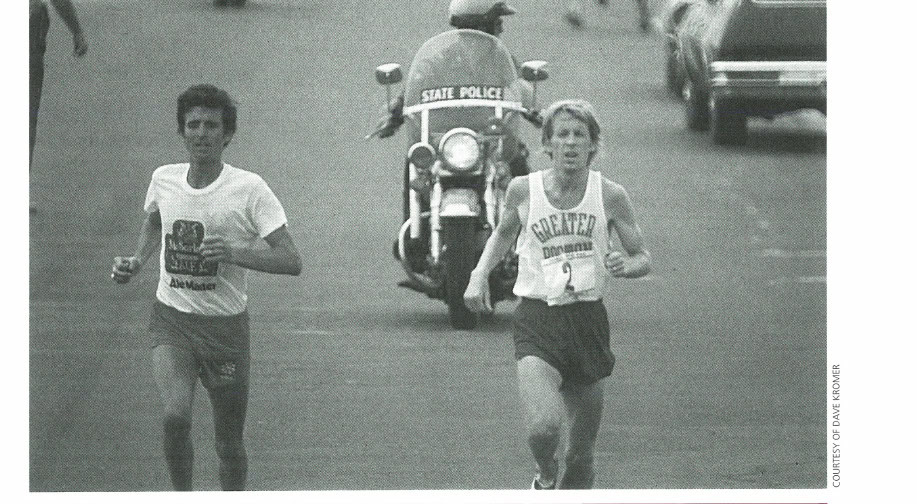
THE ARRA AND THE INFAMOUS CASCADE RUN-OFF
Don Kardong, who placed fourth at the 1976 Olympic marathon, agrees that the 1980 Olympic boycott gave birth to the more aggressive movement of the runners: “The Olympics was always the carrot that the governing bodies held out in front of us. If we didn’t follow the rules, we wouldn’t make the team. I think people were so angry at the boycott that it gave a lot of emotional boost to the effort to legitimize prize money. That, combined with the economic boom of the sport in the late ’70s, led to the formation of the Association of Road Racing Athletes (ARRA) and subsequently the showdown at the Cascade Run-Off.”
The ARRA was formed in 1979 in the basement of Bill Rodgers’s running store in Boston. The charter members included Kardong, Rodgers, Greg Meyer, Lorraine Moller, Patti Catalano, Joan Benoit, and Benji Durden, along with other top U.S. road racers.
Kardong stated the goals of the maverick group: “Our goals are simple. We’re after an open racing system in which prize money is paid directly to the athletes on the basis of performance, in which professionals can race against amateurs, and in which athletes can have a meaningful say in the governance of their sport.”
These were fighting words that caused a rippling effect all the way from the IOC to the IAAF, which governed track and field, to TAC. The IOC had always told the IAAF that to be eligible for the Olympics, runners could not take money. The IAAF, in turn, forced this ruling onto TAC, which forced it onto the runners with the added caveat that amateur runners could not even compete against those who take money; this was known as “the contamination rule” in which runners were contaminated by association on a race course.
According to Kardong, prior to the Cascade Run-Off he and a few others went to Ollan Cassell, the head of TAC, suggesting the use of a trust fund for prize money, but Cassell declined the suggestion. The gloves were off, and the Cascade Run-Off was set up to spark a resolution.
RUNNERS AGREE TO TAKE THE MONEY
Kardong and Cascade Run-Off race director Chuck Galford went to Nike for sponsorship money for the 1981 Cascade Run-Off and came back with $50,000 in prize money.
When Cassell got wind of the prize money being offered, he told Galford that for TAC to sanction the race, he would need a list of the declared “professionals” and two finish lines—one for amateurs and one for pros. Galford refused both requests, and the race was declared a field of contamination. All runners who participated would be at risk of being banned by TAC.
The top runners all knew what they were risking but felt it was worth it. Most of them wanted to get out from under the thumb of TAC and start legalizing what was going on under the table. Kardong called the whole prize money issue with TAC a major hypocrisy. “It was all going on under the table, but once we wanted to be up front and honest about it, we weren’t allowed. The great irony was that you had to remain an amateur to make money,” he recalls. He also emphasizes that most of the runners weren’t even interested in trust accounts; they just wanted to get out from under TAC and create an independent professional sport. The trust accounts were only important to athletes who wanted to stay eligible for amateur competitions like the Olympics.
On the other side of the amateur fence stood runners like Tom Fleming, an avowed pro who enjoyed his professional status and didn’t mind making honest money—as much as $25,000 in the Jordache Los Angeles Pro-Am Marathon in 1981. In 1980, Fleming said: “As a pro I make money in endorsements without having to pay an extortionate fee to TAC for permission.” But even Fleming was worried about the Cascade Run-Off runners who faced being banned. He lobbied for unity in their efforts. “The sponsors don’t care about the IAAF rules or TAC,” he observed. “They care about having the best runners at their races and that’s us. We’ve got Ollan Cassell by the tender parts. If we all go different ways, we’re not squeezing.”
Fleming believed back then and still believes now that money rules. Greg Meyer, who won the Cascade race and accepted the $10,000 winner’s check, was quoted as saying, “The cause was right.” Meyer and Fleming represented the zeitgeists of the movement.
THE CONTROVERSIAL KIWI
Lorraine Moller, who came to the American running scene from her native New Zealand in 1979, was always taught that money was a dirty word, that it corrupted the spirit of the runner. But she quickly caught on that to survive in the day-to-day world, you took what was offered under the table.
“It seems a little like losing your virginity. Maybe it has been something you cared about, but then it’s gone and suddenly you sense there’s a whole new world in front of you.” —Lorraine Moller
The first time she won a race, there was talk of $50, and she thought she had to pay someone $50 for winning. Very naive.
Coming off a win at Grandma’s Marathon in Duluth, Minnesota, she ran the Cascade Run-Off, taking third place; she accepted her check. When asked how she felt about the impact of the race, she said, “It seems a little like losing your virginity. Maybe it has been something you cared about, but then it’s gone and suddenly you sense there’s a whole new world in front of you.”
Today, Moller still stands by that infamous quote. “I was warned to stay away from the race, but I was young and wanted to be where the action was. I had also run the race before and liked it, felt a loyalty to it. Taking a stand against TAC was a big deal. All the top runners had a meeting the night before the race, and it was like a huge union meeting of runners.
“My fellow New Zealanders and friends, Alison Roe and Ann Audain, were also there. We were really spiriting each other on; Alison referred to it as the Christians going off to the Crusades. We had to declare up front to Nike that we would in fact take the money. We also felt there would be safety in numbers. After the virginity quote was picked up by the press and repeated just about all over the world, the New Zealand Federation banned all three of us. The ban then had to be ratified by the AAU in the states, and they banned me also. That August I planned to run a race in Michigan, but two elite amateur English runners refused to run with me because I would contaminate them.
“But all the Cascade runners were also there, and they said they wouldn’t run if I couldn’t, so in the end the race directors let me run, and I contaminated everyone! I spent a lot of time contaminating people. That act showed a great deal of solidarity among runners. It proved we could as a group affect change. Basically, this was my time to stand up and be counted. It was a powerful thing in my life.”
RAMIFICATIONS OF THE RUN-OFF
The Cascade Run-Off started the pendulum swinging, and it didn’t stop until prize money was allowed in the form of a trust fund. The runners of Cascade who publicly accepted prize money felt that their defiant act forced the hand of Ollan Cassell and TAC.
In an ironic twist of fate, the road racing circuit could not afford to have their top-notch runners banned from racing because they would lose money from the sponsors. A year later, in September of 1982, the IAAF approved the acceptance of prize money that would be put in a trust fund to be withdrawn only for training and living expenses. The ARRA felt they had made history.
Frank Shorter, a charter member of ARRA who subsequently pulled out of the organization right before the 1981 Cascade Run-Off, has a different take on the establishment of the trust fund. In fact, he showed up at the race but ran on the sidewalk, earning him the nickname “Sidewalk Shorter” by the other racers who officially finished, while Frank chose not to.
According to Shorter, “There was no way that these runners who thought they were so powerful in the media could actually sway the hand of TAC. That’s a very provincial way of thinking. The real story is that I was working with Ollan Cassell behind the scenes a full year before the Cascade Run-Off to get the trust fund issue going. Along with my law partner, Bob Stone, and Steve Bosley, whose bank was the first trust fund depository, we developed the concept of the trust, which had to be approved by the IAAF.
“Not many people knew we were doing this, but in effect Ollan Cassell was the one who saved the banned runners and got their prize money into trusts a year after the fact. Ollan got it approved by the IAAF, who didn’t change a thing in our formation of the trust. ARRA was under the delusion that they forced the trust issue, but it had been in the works all along. They didn’t have a clue. Their sense of protest was a throwback to the ’60s.
“The argument I put forth to the IAAF was all about the fact that everyone knew the Soviet bloc countries were already funding their athletes, which put the western runners at a disadvantage, and the IAAF had more western members voting, so the trust fund issue ultimately passed because it was a way for the west to gain parity, and no eastern bloc country could look the western members in the face and deny it.”
Shorter stands firm to this day that Cassell was the man who convinced the IAAF to let the tainted ARRA runners put their money in trust funds retroactively and thus not lose their amateur status. He states, “For the ARRA runners to think that they were not in trouble, that they could have lost everything, goes against common sense. Ollan saved their butts!”
OLLAN CASSELL’S VIEWPOINT
Any story about the history of prize money must include Ollan Cassell, who governed U.S. track and field for three decades, first as the AAU’s chief executive and then through membership on the IAAF Council and in 1979 as TAC’s chief executive.
Cassell’s humble beginnings mirror the background of many of the runners he was in charge of throughout his tenure. Growing up in a coal-mining ghetto in Virginia, he parlayed his determination and skills as an athlete all the way to the University of Houston, where he developed into a top sprinter. He also fulfilled a lifetime dream of becoming an Olympian, winning a gold medal on the world record-breaking 4 × 400-meter relay team at the 1964 Olympics.
Cassell was both vilified and rarified during his 30-year reign, and his viewpoint matters and needs to be heard. From his home in Indiana, Cassell gave a scenario of the origins of the TAC-Trust very similar to Shorter’s.
According to Cassell, “The formation of the TAC-Trust was part of a larger strategy that started with the 1977 agreement allowing for sponsorship of sports programs. I don’t think the athletes realized all the steps that had to be taken to get a ruling changed. Those things don’t happen overnight.
“We had a long-term strategy and knew it would take years to get it accomplished. It was never intended to be a plan formulated in secrecy with our intentions kept from the athletes, but the arena I needed to get approval from was international, not just the U.S. athletes. I couldn’t afford to have U.S. athletes voicing their opinions on these issues in the press and then face the heat from my international peers. It would have made my job in obtaining the critical vote to get the TAC-Trust passed that much harder.”
Cassell and Shorter had previously worked together to get the endorsement issue passed in 1977. They trusted each other, and others on the IAAF trusted Shorter, so it was a positive working relationship. And Cassell knew that Shorter was willing to put his eligibility on the line for him if needed.
Another reason they worked well together was mutual respect. Both gold medalists, they had experienced both sides of the issues; as world-recognized athletes and later on as a lawyer and a political leader. Cassell explains that by the late 1970s the issue of under-the-table payments put everyone at risk: race directors, sponsors, and athletes. And the risk was felt all the way from the local race to the IOC. He knew he needed to do something to stop the illegal payments, protect the runners, and put American athletes on equal footing with eastern bloc athletes who enjoyed state support.
As Cassell explains, “Frank and I took the TAC-Trust proposal to Greece in 1981 to present to the IAAF. The argument was that it would provide parity worldwide, since every country knew that the Soviets were subsidizing their athletes. We couldn’t state our case just from an American point of view. I worked day and night for 3 days holding seminars to explain the concept of the trust to the Federation. It was very difficult for them to understand the proposal, so we really had our work cut out.”
Why did it pass? Cassell feels that the 1981 vote was a small window of critical opportunity based on the boycott of the 1980 Olympics, the turmoil of drug accusations, everyone knowing the Soviets were financially supporting their athletes, and that the U.S. delegation had a great team of negotiators who were trusted and respected by the IAAF.
Also, Cassell was a member of the IAAF council and knew he had the support of the meet directors. Summarizing the conflicting viewpoints, Cassell offers the following: “Athletes always come from a different point of view. During the years I was an athlete, I knew what it was like. It was a hard life. So when I finally got into the political position to affect change, I wanted to make it better.”
1983: NEW YORK CITY AND CHICAGO DUEL FOR PRIZE MONEY
As rules regarding prize money opened up, a new war emerged on the road racing circuit. In 1983, The Big Apple and The Second City came out of the closet, put under-the-table monies on top of the table, and battled for the title of the world’s richest marathon.
Chicago had a slight edge: they openly offered $135,000 in prize money provided by their prime sponsor, Beatrice Foods Co.
Fred Lebow, then president of the New York Road Runners Club (NYRRC), which put on the New York City Marathon, had his hands tied by New York City mayor Ed Koch, who wanted to keep the race a not-for-profit event. Lebow’s dilemma was how to appease Koch’s no-prize-money rule while attempting to attract the top runners, who expected either appearance or prize money and were signing contracts right and left with Chicago.
But Koch was adamant that public money was not going to subsidize a commercial event (the city coffers provided $206,000 in police pay alone), and Lebow was just as adamant that New York City become the best marathon in the world.
Lebow, a running enthusiast who launched the New York City Marathon in Central Park in 1970, was elected president of the club in 1972 but didn’t take a salary for his work until 1983. Once a well-paid clothing designer in the garment center of New York, he ditched it all for his passion for running. He was also the perfect mixture of feistiness and chatzpa to take on Koch.
LEBOW FIGHTS CITY HALL
In 1984 Lebow decided he’d had enough and took off the gloves and came out swinging in support of open prize money for the 1984 edition of the New York
City Marathon. He wrote a tell-all book called Inside the World of Big-Time Marathon Running, disclosing specifics on appearance money, a hush-hush topic. He blew the lid off the under-the-table financing and came clean with the disclosure that he had paid more than $1 million in clandestine payments over the past years to elite runners such as Bill Rodgers and Alberto Salazar.
According to Allan Steinfeld, current president of the New York Road Runners Club, “Koch was furious and demanded $300,000 from the club to help pay the city expenses. The Board of Directors raised the money, and that was the first year the New York City Marathon publicly paid appearance and prize money of $32,000 and a new Mercedes plus bonuses for course, American, and world records.”
Meanwhile, back in Chicago, race director Bob Bright and Lebow were featured in the media as having a turf war for the best runners and best marathon. Steinfeld insists it wasn’t like that at all.
As he recalls, “Bob and Fred agreed to a list of runners they wanted and the amount they were willing to pay for them. It wasn’t in their best interest to create a bidding war, and they worked things out in a business-like way. It was the media that created the circus-like atmosphere.” Each race got the runners they wanted, and then Lebow went to Chicago and ran their marathon to help promote both events.
TODAY’S BIG BUCKS
Steinfeld explains the big business of prize money as it exists today: “First there is appearance money for the top runners, an up-front business deal between the runner and the club paid by check, and can be in the mid- to high-five figures. It is a private deal only known by the runner, the club, and the IRS. Our club insists on a 1099 form so the government knows of the money, and the runner is responsible for reporting it. Then there is the prize money, averaging around $500,000 with an $80,000 first-place prize for both men and women as well as a Pontiac Grand Am. And there are time bonuses for not only record performances, but also great performances such as sub 2:11 for men and sub 2:29 for women.
“On top of that, the NYRRC doubles the prize money for an American placing in the top six places. It’s not that much of a gamble, and it’s worth it. The money is built into the budget.”
There are also clauses in the elite runners’ contracts for DNF and not finishing in an allotted time frame based on previous times run. In these cases, the runner only gets 50 percent of the allocated money. As Steinfeld concludes, “Without question, it’s big business today. It has to be for the elites to survive. There are no more lucrative shoe contracts out there like in the ’80s. This is how they make their living.”
NEW CENTURY, NEW ISSUES
The long and winding road to legalizing prize money has been littered with all sorts of interesting debris—tragedies, politics, threats, money, and quid pro quos. Oh, about the sex thing mentioned in the lead paragraph? Bill Rodgers was once offered a woman in lieu of appearance money—but he turned down the offer. Smart fellow.
Nowadays, the issue isn’t about prize money itself, but about whom is entitled to it. With the onslaught of the Kenyans and other foreigners cleaning up at the finish lines, many American sponsors are complaining about giving away lucrative endorsement monies to runners who won’t “give back” in terms of press and media coverage and playing the spokesperson for the sport or product or race or whatever is being promoted.
Some of the issues lie in basic communications skills and language barriers. It’s hard enough for an elite American who crosses the marathon finish line to speak a normal sentence but most likely impossible for a foreigner with very little English at his or her command to say how grateful they are to their sponsors.
And with Americans lagging in the top 10 finishers of most major marathons, the structure of prize money is being rebuilt to compensate for their times. At the 2001 New York City Marathon, prize money was also being offered to the first American finisher.
Bill Rodgers and Grete Waitz may have missed out on some of the early years of prize money by retiring from the sport in the late 1980s, but they continue to earn fees for their appearances and talks at races worldwide. What makes them still marketable 20 years after their reigns as king and queen of the marathon is that they continue to give back to the sport they embraced and loved, and they still convey a sense of humanitarian spirit and zest for life that running has brought them.
And talk about getting bang for your buck. Rodgers and Waitz are two of the hardest-working runners in the business. Unlike some famous personalities who watch the clock tick away until the time they can leave, Rodgers and Waitz stay until the last autograph is signed, the last question is answered, and the last photo is shot. Then they leave with a smile and words of encouragement to all. They return as much of the prize as they receive.
These pages contain advertisements only — no article content is present.
This article originally appeared in Marathon & Beyond, Vol. 6, No. 1 (2002).
← Browse the full M&B ArchiveMore like this
1,000+ stories from 19 years of Marathon & Beyond
The complete archive of the legendary long-distance journal — digitized and free to read.
