

Passion and Pain
USCIGNANO IN Lunigiana, Italy, May 2001—It’s odd, but every time someone asks how I did in a race, I conjure up some variation of the same standard reply: “I finished,” I usually say, “and it was a great day in the woods, amazingly fun.”
Few can relate to this kind of talk, of course. They really want to know how I stacked up against the competition and what kind of hardware I brought home. I am constantly trying to convince people that results and standings are all but meaningless in ultramarathons and that even at the uppermost echelons of the sport, prize money rarely exists.
The appeal, I tell them, is the Zen-like state that comes from running for hours at a time. It’s about the inner journey. Experiencing the moment. Communing with the fellow athletes you meet. It’s about taking part in the physical and emotional roller-coaster ride you almost always encounter during a long race, I say, the lifetime of experiences that occur over the course of one single day. It’s all this and that certain je ne sais quoi that can’t ever be fully explained. Times, T-shirts, and belt buckles are nothing when compared with the bountiful intrinsic rewards.
Acquaintances who know I run very long distances in my leisure time see me as an ascetic, a man who surely must forego the pleasures of rich food, good drink, and late nights in favor of a boring and all-too-disciplined life. Most of my friends think I suffer greatly every time I compete, and they cannot comprehend why I enter these ultradistance races time and again.
The few who are truly interested have heard the specifics behind some of the more disastrous outcomes and are convinced I’m a masochist to revisit the sites of such torturous affairs. The consensus is that I’m quite far off center and more than a little obsessed.
It is less than 24 hours since I completed my most recent bout of self-flagellation, and I chuckle at the random flow of these off-the-mark thoughts.
I’m reclining in an oversized Jacuzzi tub, sipping my second glass of Chianti, and savoring the cool breeze from the mountains I see rising above the fertile valley below. The distant peaks appear snow covered, but I know this is an illusion: the constant quarrying at the site where Michelangelo’s magnificent David began his existence as formless marble makes the mountains above Carrara look white.
I close my eyes and try to imagine the Renaissance sculptor at work. The exercise soon makes me hungry, so instead I attempt to visualize the chef at the local pizzeria we have heard so much about. I can almost taste the fresh pesto sauce that will adorn the penne I will order tonight. Yessiree, I chuckle as the sound of my favorite aria finds its way through the bubbles and into my ears. I am once again suffering terribly. Ultrarunning is absolute hell.
HONEYMOON BLISS
The reality of my mental defect is actually this: I can’t kick back and relax unless I’ve thoroughly trashed myself first.
My wife had seen some pretty strong indications of this affliction before we were married, but the depth of the problem became brutally evident as we planned our honeymoon a decade ago. I loved the idea of Italy in springtime and saw a three-week vacation of good food and cheap wine as the opportunity of a lifetime, but I felt undeserving of such decadent bliss. I needed a counterpoint, something stripped down to the basics. Something like a very long race. The trouble is that wedding preparations, out-of-town guests, work stress, and the Big Day itself all conspired to quash any illusions of a pretrip event.
Lisa and I began laying out plans: we’d visit the Amalfi coast and the island of Ischia, the homes of her ancestors; we’d tromp through Tuscan hill towns; we’d be the quintessential tourists in Venice and Rome. It sounded quite marvelous, but I secretly wondered about all the driving and grew increasingly concerned that there would be few places to run.
One day while out on the trails, I had a brilliant idea. That night I pored over several dozen old issues of UltraRunning on loan from a friend. By the next morning, I had found what I was looking for. I had a hard time containing myself.
“How about visiting Florence at the end of the second week?” I offered casually when Lisa and I sat down to fine-tune our itinerary later that day. “We can start in the south, meander up the Adriatic to Venice, and then see Tuscany before we head back to Rome. While we’re there, maybe I can run in this race.” As fate would have it, the 100K del Passatore coincided with our honeymoon trip.
“You’re crazy,” my bride-to-be said with a mock look of concern. “But I guess I’ll marry you anyway. Think you can still get into the race?”
The del Passatore, a 62.5-mile jaunt between Florence and Faenza, is the nation’s Boston Marathon: it’s an unrivaled pilgrimage that must be attempted at some point in every Italian distance runner’s career. It has been said that in Italy, a true athlete’s gravestone has three things carved upon it: date of birth, date of death, and number of completions of del Passatore.
Started as an organized trek to promote the beautiful region of Emilia-Romagna in 1972, the race has drawn some of the world’s best ultrarunners over the years. Don Ritchie, Jean Marc Bellocq, Alexey Kononov, Valmir Nunes, Eleanor Adams, Marta Vass, Irina Petrova, and Anke Drescher have all been present on the victory stand. To all but the handful of elites who enter annually, however, del Passatore is not about winning: for the 3,000-plus recreationalists, it’s about trying to survive.
The first time I entered del Passatore, I was somewhat oblivious to the finer points of this uniquely Italian event. All I knew was that the race started in Florence in the afternoon, that the first half of the course was uphill and the second half down, and that if I finished at all it would be sometime in the middle of the night.
The year was 1991 and the race had been selected as the venue for the annual 100-Kilometer World Cup event. As a relative newcomer to the low-key sport of organized ultrarunning, I was surprised at the flurry of event-related activity taking place in Faenza when we arrived the day preceding the race.
When I bumped into acquaintances traveling with the American team at a restaurant, I was even more surprised by the greeting I received. Upon inquiring about race logistics, however, it became obvious why the team’s managers had expressed such delight at seeing a familiar face so far from home.
Aid on the course would be sporadic at best, they told me, and the World Cup runners would be heavily reliant on crews. Since I was clearly a vacationing upstart who harbored no delusions of grandeur, they wondered if my wife could support the competitive athletes as they fought for American points.
Lisa and I had already agreed that I would run unsupported; as if waiting for me to complete this mission of madness during a honeymoon were not bad enough, the last thing she wanted to do was drive dark, narrow roads full of aggressive drivers while searching for me. If I had any doubts about Lisa’s answer, they disappeared as soon as I mentioned the American managers’ rather audacious request.
“What are you, nuts?” she blurted before the words “crew for them” were even out of my mouth. “Typical ultrarunners. They’re out of their minds!”
A BLISTERING PACE?
Del Passatore begins in the heart of Florence, at 3:00 P.M. on the last Saturday in May. After the nerve-wracking drive over the mountains and a morning of sightseeing in the Cradle of the Renaissance, I was reluctant to see Lisa drive back toward Faenza alone, but she headed off cheerfully in our stripped-down, sewing-machine-sized rent-a-car. I registered and psyched myself up for the run.
The next time I saw my bride, the mood was far different: exactly two weeks into our marriage, I thought we were on the road to divorce.
The race starts on the edge of Piazza della Signoria, one of the most spectacular squares in the world. Most participants hardly notice the replica of Michelangelo’s marble David, and all seem oblivious to the resplendent Neptune Fountain or the Palazzo Vecchio that towers above. Few acknowledge the Uffizi Gallery or the plaque marking the spot where a Dominican friar and his followers were burned to death five centuries before. Instead, the runners are much more interested in jostling for position, well aware that the first kilometer or two are run in a gauntlet through the narrow pedestrian-only streets that connect shopping areas and major tourist sights.
The prerace instructions were absorbed by the noise, but it mattered little to me, for my Italian is limited to bare necessities, a few terms like “acqua,” “pizza,” “cappuccino,” and “formaggio.” I felt quite sure I’d survive.
The gun fired and the World Cup competitors were off, striding like greyhounds just released from the gate. I remember thinking, “This ain’t no stinkin’ 5K,” but before I ambled past the majestic white, green, and red marble-encased Cathedral of Santa Maria del Fiore (best known as the Duomo) less than a mile into the race, the elite runners were well out of sight.
I drew some inspiration from the world-class field and pushed myself on the first major climb of the day. I felt strong enough, but during the 10K descent that followed, I felt a nasty pressure on the toes of both feet. The second climb
was a lung- and leg-searing series of switchbacks, but the uphill motion temporarily eased the painful sensation that had crept into my toes.
Unfortunately, what goes up must come down. That brutal climb to the summit of Colla di Casaglia (the halfway point of the race) is followed by a steep downhill section that lasts for nearly 20K. The final 30K to the finish is slightly declining or flat.
Idiot that I was, I’d started the race in new sneakers; it didn’t take long for the steep terrain to beat the pulp out of my toes.
“My shoes are too tight,” I said when I arrived at the 55K checkpoint at Casaglia and was asked through a series of gestures why I was limping so much. “If you give me scissors I can cut the toe box from my shoes. I’ll puncture the blisters under my nails with a pin, tape them up, and be right back on the road.”
My words, of course, were nothing but incomprehensible babble to the Italian medics, and although I didn’t understand their replies, I caught the meaning when they made slashing motions across their throats and pointed at me: “Sorry, pal, but you’re out of the race.”
I protested but quickly remembered that Italians have made arguing an art form with which nonnatives can rarely compete. I held firm as animated discussion moved to wild gesticulation and from there to outright shouting, but when the medics started unpinning my number, I gave up. I was on my honeymoon, after all, and although I could probably have just laced up and run out of the checkpoint, I was already hobbling. I knew that by the time I got to Faenza, I would have 10 black toenails and untold blisters that would need serious attention for the rest of the trip. For the sake of international and marital relations, I agreed to bail out.
Del Passatore organizers shuttle gear bags to several intermediate points and buses that transport gear, then double as sag wagons to take dropouts to the end of the race. Since I had to hang in the bus until it left for the finish, I called my wife in Brisighella, the town where we planned to spend the night. “Hi, sweetie. How are things?” I said when I reached Lisa at the hotel after several attempts. “Don’t bother heading down to the finish; I’m out and can get a bus that will go right by our town. You don’t need to come and get me. Really. I’m fine. Just go back to sleep. I’ll get there eventually, although I’m barely able to walk.”
To this day, I maintain I did not intentionally paint a self-portrait of a poor suffering slob, nor attempt to lay a guilt trip on my new bride. Nevertheless, Lisa insisted she would pick me up as soon as she could.
The wild woman who arrived in Casaglia an hour later was a far different person from the cheerful wife who had left me that same afternoon. “You drive back,” Lisa said, more frazzled than I’d ever seen her and almost in tears. “I ran out of gas, almost got run off the road six times, and have a splitting headache. Don’t ever ask me to do this again!”
UNFINISHED BUSINESS
The selective memory syndrome is not unique to ultramarathon runners, but I have yet to meet any other group that shares the trait so completely. How many times have we ultra types uttered the words “never again” and meant them with our hearts and souls?
“That’s it. Been there, done that. It’s back to marathons for me.”
“Maybe I’ll concentrate on speed for a while and just compete in 5Ks.”
“You know what? These ultras really do suck!”
Just as surely as we put on our most cheerful countenance upon entering aid stations and wolf down postrace meals like starving animals, we say these things with great regularity. Usually the remarks slip out just after we’ve punished ourselves under particularly horrific conditions or right at the end of an especially dismal day (and night?) out on the trails. It may take a day, a week, or even a month, but just as convincingly as we made our bold declarations, we flush them away.
“I was only kidding, honey, really I was.”
“I didn’t say that. You must have been delusional at the end of the race.”
“I say that all the time, even during a race. It’s just a coping mechanism with no basis in truth—”
We like to think this attitude reversal is a good thing, a sign of our resilience, a symbol of our ability to never give up. Those who care about us most let us live with our fantasies. They understand that no matter how honest we are in our dealings in the everyday world, when it comes to ultrarunning, our words of resignation and retirement never ring true.
The odd thing is that some of these foibles seem communicable. Lisa, my wonderful wife and crew person extraordinaire, has used these same “never again” sentiments after many of her selfless crewing efforts. And yet whenever I ante up, she’s right there, filling bottles, making sandwiches, and chiding me to get my butt moving faster. “You’re looking great,” she says endlessly. “You can get that person ahead. Keep moving. Come on, you’re stronger and tougher than that guy behind you. Don’t let him catch up!”
When our fifth anniversary approached and conversation moved toward a return trip to Italy, del Passatore came immediately to mind. “I’ve got some unfinished business out there, you know,” I ventured, recalling the scene at the Casaglia checkpoint five years before. “Maybe I’ll write about the race this time, you know, just take it easy. Enjoy the experience. Make it all the way through. It’d help pay for the trip.”
Lisa’s response was almost immediate and quite impressive: “Not a problem, sicko, but this time we’re staying in Florence and I’m shopping while you’re out doing your run. Forget about me driving; you can find your way back to the hotel at the end of the race.”
Sounded like a good deal to me.
THE COMFORT OF STRANGERS
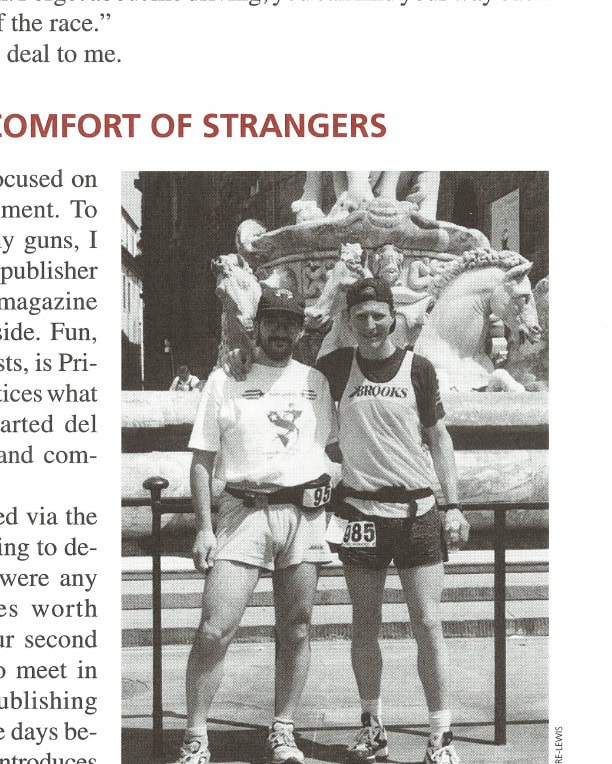
This time I really am focused on running for pure enjoyment. To ensure that I stick to my guns, I plan to have Indro Neri, publisher of the Italian running magazine Podismo, right by my side. Fun, not finishing, Indro insists, is Priority One. The man practices what he preaches: he has started del Passatore seven times and completed it twice.
Indro and I connected via the Internet while I was trying to determine whether there were any other springtime races worth checking out during our second Italy trip. We agreed to meet in Florence, where his publishing company is based. In the days before del Passatore, Indro introduces me to nuances of the local running scene and his American fiancée takes Lisa under her cultural wing.
“Did you know that Italian race directors attract entrants not with promises of award-winning T-shirts,” Indro asks me, “but with liters of wine and local delicacies like prosciutto and cheese?” I learned that prizes are more likely to be a leg of sopprasetta or a case of Chianti than a trophy or a few thousand lira in cash.
We visit a festival in the hills outside Florence the night before the race and meet for the traditional cappuccino and pastry breakfast on race day at Indro’s favorite bar. I am introduced to members of Indro’s running group and receive best wishes from the rambunctious, strictly recreational crowd.
“In Boca al Lupo,” they say, wishing me well, “in the mouth of the wolf.”
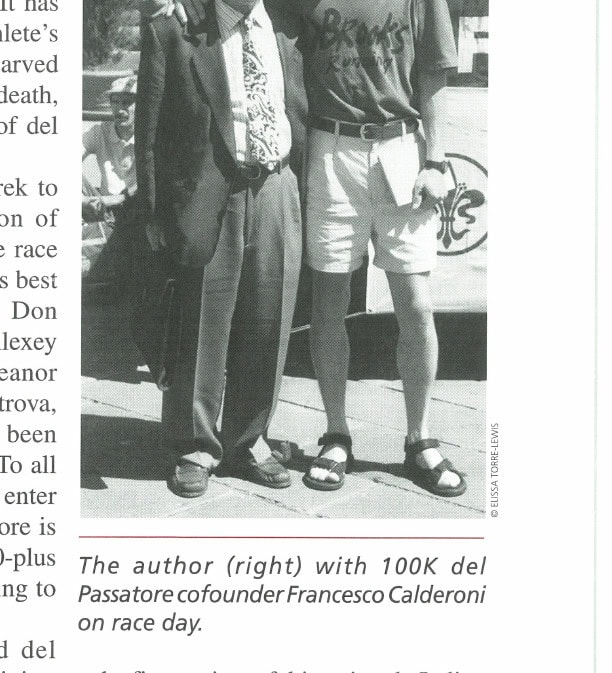
According to race organizers, aid stations are plentiful throughout del Passatore, and since the weather was quite cool the first time I ran, my recollection is that they are right. I meet Francesco Calderoni, one of the race founders, and he introduces me to the only man to have run all 23 previous editions of del Passatore.
I also meet the man they call “Il Pittore,” the painter, an eccentric artist who carries a canvas along the route and completes a scenic landscape by the time he reaches the finish line, as well as various others who return year after year to take part in the momentous event.
Indro and I start off together, but even before we reach the Duomo, we are separated by the crush of the crowd. When the course veers onto the wide road that leads to the first climb out of town, I pull up and wait. When Indro arrives, he is sweating profusely and complaining that he should have actually trained. He starts walking and tells me to go on.
“I have doubts about my arrival in Faenza this year,” he says, “but I will see when I reach Borgo San Lorenzo.”
The sun is hot and the humidity is unusually high. I wonder how many will be like Indro, reaching the 35K checkpoint, contemplating the long climb—and calling it quits.
VAI, VAI!
I push on and am soon laboring upward. As usual, the elite field is strung out far ahead. The back-of-the-pack walkers are three miles behind when I reach the first aid station at Fiesole, the 10K mark. The climb continues past the pricey houses of this hillside retreat from the heat. I note that on this particular day one could probably cook a pizza right on the road; it is no cooler than the city of red-tiled rooftops that is now laid out below.
The heat, in fact, is stifling, and by the time the course swings through Vetta le Croci at 22K and starts its downhill meander through the beautiful fields of the Mugello Valley, I realize something is wrong.
Shoes aren’t an issue this time. I have a perfectly broken-in pair of Brooks on my feet, with plenty of room. Instead, the problem is internal. With a history of stomach trouble in the longer ultras, I am acutely aware of the importance of hydration, and even though I am one of the few people carrying bottles, I realize that 32 ounces of water every 10K in this heat is just not enough.
The recollection that I had eaten fried dough balls at Indro’s infamous Festival di Cascia the night before doesn’t help, but my new friend had insisted they were a local delicacy that shouldn’t be missed. He had offered me a batch, and although the mere sight of a donut usually turns my stomach, I put on a smile and ate a half dozen of the sugared blobs of grease. When in Rome . . .
That’s the other thing, of course: we had arrived a full week before the race and experienced Tuscan cuisine to the fullest, right down to the daily gelato and bottle of wine. Being a nonmeat eater, I avoided the rabbit, wild boar, and exotic fat-filled cold cuts, but I didn’t exactly follow my prerace ritual of no caffeine, no liquor, and moderate quantities of clean, high-quality food.
By Borgo San Lorenzo, intermediate stopping point number one, I recognize that I will be paying for my overindulgence for the rest of the race. It is here that the real climbing begins. For the next 15K, the course winds ever upward on a road that is reminiscent of the famous mountain stages of the Tour de France bicycle race. Switchback after unrelenting switchback, uphill I go.
I try to admire the view of green valleys, tiny villages, and the human serpent of fellow runners that follows the road below, but I am feeling queasier with every step. Finally, I hear cheers ahead, and when I round the corner, I see a crowd on the slope just below the top of the ascent. Bravo, they yell, Vai! Go!
The aid station at Colla di Casaglia is a welcome sight, but when the water offered to me hits my stomach, it causes immediate convulsions. I throw up on the street. “Frickin’ frizzante,” I mumble to no one in particular. “I wanted sensa, not the fizzy water with gas.”
Just like the del Passatore course, my race goes all downhill from here. Frequent vomiting, dry heaves, and endless hours of coaxing myself through a final 30K Death March take away from the joyous spirit of the night about which Indro Neri had spoken so fondly. I do manage to spend some time contemplating Il Passatore himself as I stagger along a dark stretch of road with only lightning bugs illuminating the way.
“Passatore,” according to some sources, means ferryman, someone who takes people over a river or bay. Others say “passatore” is a person who takes from the rich and gives to the poor. Stefano Pelloni, a Robin Hood-like character who roamed the hills of Tuscany and Emilia-Romagna in the mid-1800s, certainly fits the bill on both accounts. He is said to have alternated fighting the oppressive masters of one province and fleeing over the mountains and valleys into the next. In his lifetime, Pelloni was known throughout northern Italy the same way he is remembered today, as Il Passatore. It’s quite likely that the bandit was a runner—albeit more by necessity than choice—so race director Calderoni felt it appropriate that one of Italy’s largest running celebrations carry his popular name.
Sadly, even visions of Pelloni give my besieged stomach little relief. The impromptu roadside stands that offered sustenance in the form of tomato and mozzarella, grilled eggplant, and prosciutto sandwiches, roast chicken and pork, homemade or vintage vino rosso, and every form of calorific Italian dessert gave me hunger pangs but just made me feel worse.
I’m sure the runners who pass me as I hunch over the side of the road are offering sympathy, but I can’t understand what they say unless the words are vai or andiamo. In those cases, I kindly tell supporters that I’ll meet them in hell. I’m stuck in purgatory for the moment but am fairly certain I will descend to the next level pretty darn soon.
I struggle across the finish in a dismal time, gather the medal and three bottles of Chianti Classico that are presented to every finisher, and crumble to the ground in a corner of Faenza’s Piazza del Popolo. It is dawn by the time I see a face I recognize from Indro’s group and arrange for a ride back to Florence, where my wife patiently waits.
FAMOUS LAST WORDS
I’m told that counselors say that committing goals to paper helps make the goals more real. Running magazines often advise first-time marathoners to tell friends and family about target races, so they pressure themselves into following through. So what’s an idiot writer to do when he finishes a widely distributed article with the suggestion that there could hardly be a better way to celebrate a 10th wedding anniversary than a return to the land of the honeymoon trip?
“You really loved Florence the last time, didn’t you, babe?” I began when talk turned to how best to celebrate a decade of wedded bliss. “Maybe we can spend a couple of days there to start a journey to some parts of Italy that we have yet to explore. While we’re there, there’s the case of this little run—”
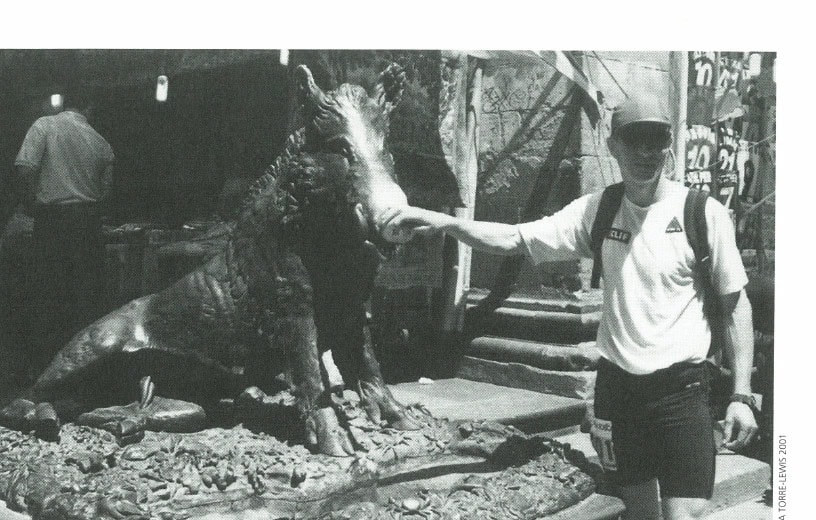
So, here I am, in May 2001, overlooking the Florentine market that surrounds Il Porcellino, getting ready to run another del Passatore. Rub the nose of the bronze pig, I’m told by the owner of the charming little hotel that goes by the same name, and you will surely have luck.
I don’t need any such thing, I say to myself, for this time I am really prepared. I have five more years of ultra experience under my belt. I’ve run a dozen 100-milers, twice as many 50s, and more 50Ks and marathons than I care to recall. My spring races have been good and so have my training runs. I’ve become accustomed to running with a hydration vest, so I’ll carry my own supplies and not rely on the erratic aid stations or unknown foodstuffs for aid.
It’s race day and Lisa and I have been in Italy for two days, enough time to get over jet lag but not so much that our systems have slipped out of physical sync. We finish our sightseeing and shopping and check out of the hotel. We have a few minutes, so we take pictures in Piazza della Signoria near where Indro and I embraced five years before. I reflect on the changes that have occurred since then: my Florentine friend has married and moved to Seattle; del Passatore race director Calderoni and race cofounder Alteo Dolcini have both passed away; and Lisa and I have moved twice, changed jobs, and added a third dog and second bird to our family of pets.
I return my focus to the upcoming event. It’s warm, but I feel as though I’m heat-trained this year. I plan to fill the bladder in my pack at every opportunity, alternating water with Succeed. I’ll take electrolyte capsules every 45 minutes, and make sure I consume enough Clif Bars and Clif Shots to avoid the possibility of a bonk. The chemistry of ultrarunning has come a long way in five years. I plan to run conservatively. This is an experience and a training run, not a race, I tell myself. Just get out and enjoy. Who needs luck when you’ve done everything right?
I might be mutton-headed, but I’m not stupid, so I pause and rub the porcellino’s nose before Lisa and I say our final farewells. She is doing the unthinkable and driving to Faenza alone again, but I’m certain that once there she’ll not venture back out onto the chaotic roads. “See you at the finish,” I say, “in nine hours or so.”
THIRD TIME LUCKY?
The race starts with the usual jockeying for position and series of unintelligible announcements, but it doesn’t take long before the Duomo is behind me and the road is widening out.
I’m pretty heavily outfitted compared with most of the runners around me, and I receive all kinds of curious looks as I settle into a comfortable pace. Except for the extreme back-of-the-packers, few of the runners carry water bottles, let alone fanny packs or hydration vests like mine. It doesn’t take long before I realize why: as the climb to Fiesole begins, nearly every one of the athletes around me is joined by someone on a scooter or bicycle who will act as their roving support, just as they used to do in the Boston Marathon a century ago.
For my part, along with my two liters of water, I am carrying a half dozen Clif Bars, two full gel flasks, a snack pack of peanut butter crackers, a Ziploc bag full of Succeed, a spare shirt, and a flashlight for when it gets dark. I laugh along at the looks and comments directed my way.
“I’m just a crazy American,” I say. “It’s all that Boy Scout training when I was a kid. You know, Be Prepared, that kind of thing.”
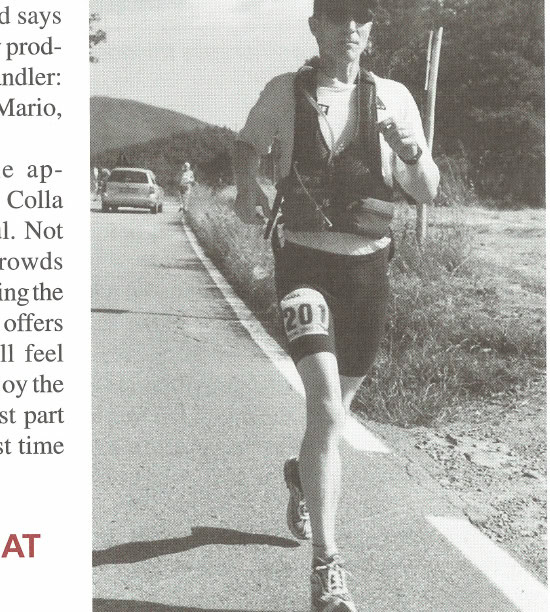
By the time I reach Borgo San Lorenzo at 35K, I’m delighted that things are going well and that I have stuck to my plan. It’s hot, but my energy level is good and I’m experiencing no stomach discomfort as the brutal climb to Colla di Casaglia begins. As we pass through the 40K aid station in the town of Ronta, a curious thing strikes me: the other runners have been speeding up whenever they approach a town and rush through assistance points, as though they’d be penalized for taking time to refuel. I, on the other hand, slow down on the steepest terrain, check my fluids whenever I have the chance, smile a lot, and always offer a “Grazie!” or two. Onlookers seem puzzled by my less-than-macho attitude, but they don’t realize that the increasing number of people on scooters, bicycles, motorcycles, and cars are not there for me.
Once past Ronta, the climbing gets tougher and the pace starts to slow. Rather than slow to an uncomfortable shuffle, I try to maintain a steady turnover and keep taking my regular walking breaks, which no one else seems willing to do. The result is a seesaw battle with the dozen or so runners who are moving at the same general pace. One speeds up every time I approach. Another smiles whenever I pass and waves when he overtakes me during my walks. A third says nothing and is constantly prodded on by his cyclist handler: “Vai, Mario, vai. Bravo, Mario, bravissimo!”
The feeling as one approaches the summit at Colla di Casaglia is wonderful. Not only do the raucous crowds buoy the spirits but knowing the hardest work is behind offers tremendous relief. I still feel strong and am able to enjoy the checkpoint at the highest part of the course for the first time in three attempts.
THE PAUSE THAT REFRESHES
I pause to mix some Succeed and the people watching make jokes referring to dope. Either they think I’m an idiot, or they’re wondering if my colorful potion contains some type of performance-enhancing drug. “No capito,” I say, shrugging my shoulders, laughing with them, and heading down the other side of the hill.
Casaglia, the scene of the foot fiasco a decade ago, comes and goes with relative ease. I cruise steadily down the switchbacks and pass many runners who had started off too ambitiously. I try to keep my effort relaxed and under control. In contrast to the brutally exposed nature of the climb, much of the descent is in a forest, and sheltered by trees I lose all sense of time. It is dusk when I reach a four-home village known as Madonna di Tre Fiume (Madonna of three rivers), and I recall the prayer I offered there five years earlier, begging for stomach relief. It didn’t work, but I cross myself anyway and wish for a good finish this time around.
This side of the mountain is more rural than the portion that faces Florence, and men, women, and children cheer from windows, roadsides, and fields even as it gets dark. Motorcycles and scooters continue to flood the course, their riders busily yelling into cell phones while navigating the narrow, impossibly winding, always treacherous road. Every so often an aid station appears, and at one of the livelier ones a broken conversation takes place.
“Italiano?” asks a volunteer.
“No. Americano,” comes my reply.
“Ah. Monica Lewinsky. Bill Clinton.” Bobbing gestures with hands and mouths are followed by laughs. “America OK.”
After the back and forth of the climb, I was pleased to have left several competitors behind on the descent. As I replenish my Succeed for the last time, however, the Velcro fastener on my water bladder breaks, and I waste several minutes making repairs. Then a pit stop draws me into a smoke-filled bar. When I emerge, I hear “Bravo, Mario, bravissimo” somewhere in the darkness ahead. I resolve to put my head down for the last 20 kilometers, make as few stops as possible, and pass Mario for good.
Most of the others running near me have said hello or offered me water at some point in the race. Their crew members have been constantly cheering me on. I have received no such offer of aid or encouragement from Mario or his squad, and I decide there is no way he is going to finish ahead of me.
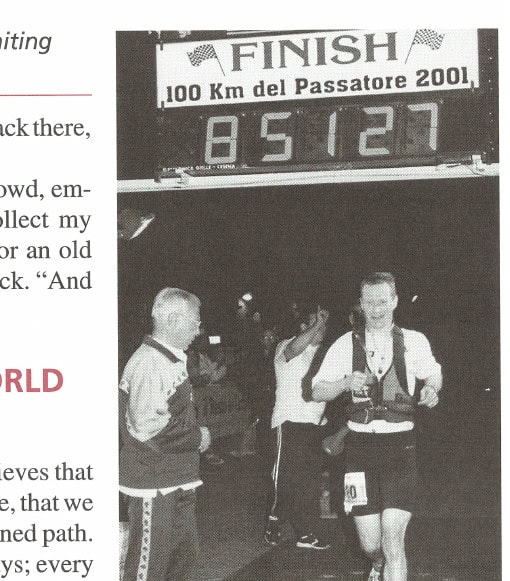
Brisighella marks the end of a long, dark stretch, and from there to Faenza, the course is almost suburban in feel. The roadway is lit and over the last five kilometers it becomes a bright, tree-lined boulevard. I have passed all of the runners who have been around me for most of the day as well as several that I haven’t seen since the start of the race. I approach another during the long straight stretch into town, but he kicks in the final half mile and crosses the line in 28th place. I am pleased to crack the top 30, but more importantly, I’m delighted to complete the race without major problems, with a strong finish, and with Mario somewhere back there, eating my dust.
Lisa emerges from the crowd, embraces me, and helps me collect my medal and wine. “Not bad for an old fart,” she says, patting my back. “And you’re on time.”
IT’S A SMALL WORLD AFTER ALL
A running friend of mine believes that there are no real choices in life, that we are all traveling a predetermined path. Nothing is coincidental he says; every decision we make merely sends us in the direction intended by the Great Programmer in the Sky. I don’t exactly subscribe to his philosophy, but I never cease to be amazed by the way small things have major impacts in life.
Take my current situation. Here I am, soaking in the tub, sipping vino rosso, and scribbling notes in the home of people I met because of the 100K del Passatore.
As luck (or predestiny) would have it, friends from Philadelphia had offered Lisa and me an opportunity to share in a Tuscan villa rental in the fall of 1998. We had been to Italy for our 5th anniversary in ’96 and knew we would return for our 10th in 2001, but how could we pass up a place on a hillside an hour from Florence? We had little trouble deciding we would go.
The experience was almost too good to be true. One couple were great friends, and even though we didn’t know the other two, they turned out to be ideal housemates for this kind of trip. We would converge in the evenings to dine and share tales of joy and travail, and after the week’s rental was up, we all did our own thing. Lisa and I settled on taking the train to Venice and Lake Como and then back to our endpoint in Milan.
I plead total ignorance as far as date selection goes; yet by some fluke of nature (predestiny?), the trip had been timed in such a way that the Venice Marathon was to be run two days after the villa rental was up. Since we were in the vicinity, it sounded like something I just had to do. Who could pass up
the opportunity to run a race that fords the Grand Canal on a temporary bridge of pontoons, crosses numerous smaller canals on steep marble walkways, and ends steps away from Saint Mark’s Square? Besides, Indro was still living in Florence and intended to go to the marathon expo to promote his magazine. He offered us a ride. So—
Getting accommodations in Venice at the last minute was a nightmare, but we ended up with a place on the Lido. One other couple at the hotel was there for the race. Mike and Kathy Connolly were avid marathoners who had recently traded life in corporate America for their dream of living full-time in Tuscany. “There are some neat races around,” said Mike, “and the village where we live, in the mountains of Lunigiana, is a great place to train.” When I mentioned that I was an ultra type, they asked whether I had heard of del Passatore.
“I read an article in Runner’s World last year,” Mike said, “and that race sounds like something you’d love to do. Man, I’d love to be able to do that myself.” Coincidentally (or not?), the piece Mike referred to was the one that I had written about my fifth anniversary experience on the del Passatore course. It was the very article that I concluded by plotting a return to the race in another five years.
“No kidding? You wrote that? Geeze, you’ll have to visit us when you come back for your 10th anniversary run.”
Which, of course, is just what we’ve done. I emerge from the tub, towel off, and finish my wine. Dinner awaits a short ride away, and tomorrow, when Mike and Kathy leave the village to tend to business affairs in London and Nice, Lisa and I will begin to explore.
Kathy’s notes help lay out our itinerary: on Tuesday morning, the cheese truck stops in the tiny village square; on Wednesday, it’s market day in Fivizzano; on Friday it’s fruit and vegetables in the morning and bread in the late afternoon.
In between meals and markets, we’ll meander through the nearby villages, drive the all-but-deserted countryside of what the Connollys call “the other, undiscovered Tuscany,” and hike into the mountains from which the marble caves have been carved. Each evening, we’ll sit on the terrace, wave to the neighbor as she brings her cows back from pasture, and enjoy coffee as the sun disappears behind the valleys below. We’ll cook with the olive oil made by another villager and sample our del Passatore wine.
If this is our destiny, I guess we’ll just have to take it. Maybe someday I’ll even learn to accept the relaxation part without having to first beat myself up. In the meantime, I’ll suffer on. More ultras await.
AT THE RACES
The 100K del Passatore is held on the last weekend in May. The 2002 race will be held May 25–26. Information can be obtained by writing to 100K del Passatore, Corso Garibaldi 2, C.P. 130, 48018 Faenza, Ravenna, Italy; by e-mailing 100km@mbox.dinamica.it; the Web site is www.dinamica.it/100km/eng/default.cfm.
For more details on rentals in Lunigiana, the untouristed Tuscany, visit www.labellatoscana.com. Kathy Connolly not only rents her lovely villa (Casa Michele) but also acts as an agent for several other properties in the region, which is known for its picturesque villages, Medici-era castles, accessibility to the Bay of Poets, and many wonderful hikes.
The Venice Marathon is held on the last weekend in October. Race promoters call the course flat and fast. The description holds true for the first sections through the scenic Brenta countryside east of Padova, but the 13 bridges at the end and the finish in the heart of Venice can make it tough to PR. One thing is guaranteed: the pasta at the expo will be the best you’ll ever get at a race. For details, go to www.venicemarathon.it/?lang=en.
These pages are advertisements only — no article text is present.
This article originally appeared in Marathon & Beyond, Vol. 6, No. 3 (2002).
← Browse the full M&B ArchiveMore like this
1,000+ stories from 19 years of Marathon & Beyond
The complete archive of the legendary long-distance journal — digitized and free to read.
