

Running For A Higher Purpose
The New York City Marathon Provides a Perfect Venue for Good Works. BY F AT H E R J A M E S J . M A H E R , C .M .
The mile was 24, the wind was slight and at my back, and tears streamed down my face. For all intents and purposes, I knew this to be my last New York City Marathon, at least for the foreseeable future. For the last 10 years, a small group of courageous and determined runners has banded together to run the New York City Marathon to assist the poor and hungry of New York City. As I write this piece, I await surgery on my right foot, which will force me to do something I have not done for the last 10 summers and fall: not train for the New York City Marathon.
As I was approaching the last two miles, I felt overcome with a wave of nostalgia. Perhaps my tears were tears of joy; no longer would I be compelled to wake up at 6:00 A.M. on a Saturday and run 18 to 20 miles. No longer would I feel the need to run six to nine miles after a demanding day with students in order to meet my weekly training mileage. It would no longer be necessary to ice my aching knees and to hope that the acupuncturist and massage therapist would get my body ready for another grueling week of training.
This could very well have been the case; however, I think there is much more that gave birth to those tears. As I finished the marathon, my recollections of 10 consecutive (11 total) New York City Marathons were vivid. I remembered the huddled masses gathered at the army fort on Staten Island, awaiting the start of the marathon. I conjured up wonderful memories of average New Yorkers who took to the streets to give needed energy and support to runners. The day of the New York City Marathon is a day in which class and ethnicity blend into vivid images of heartfelt generosity.
NEW YORK’S DIVERSITY WOULD BE MISSED In that moment, my tears told me I would miss the wonderful display of diversity that blossoms on marathon Sunday. In one neighborhood, salsa bands; in another,
rock bands; and as you approach the 12-mile mark, the Jewish community extends hospitality. It all represents the best of New York City. My tears told me I would miss the rush of the crowds who call out the name on your shirt, encouraging you to continue. I will miss the bolt of energy coming off the 59th Street Bridge into First Avenue in Manhattan, people lined up 10 deep. I will even miss the infamous Wall of the last six miles of the marathon: the time in which marathoners will their bodies to continue through the loss of toenails and glycogen. In the solitude of those last six miles, marathoners are given a glimpse of both our frailty and resilience. We struggle to run through the pain and uncertainty of those moments. Yet in those moments, we find our strength in the community of marathoners who struggle together and the people who choose to support us on the journey. In my heart, I know I would miss all those moments. At the same time, I am deeply grateful for the gift of the New York City Marathon and the all-powerful lessons learned on transcending limits.
Yet, all marathoners are faced with the perennial question: why do you do this to yourself? For me, I run not only for the challenge of sport but also for the service of my fellow men and women. My colleague and veteran New York City Marathoner, Neil Sheehan, came forward with this wonderful idea: why don’t we link the wonderful energy of the New York City Marathon with a human need, to alleviate hunger and poverty? So the Run Against Hunger was born. In the fall of 1994, a small band of runners chose to channel their desire to run into something ever more noble, to raise awareness about hunger and poverty and to raise funds to support the largest emergency food program in Brooklyn.
FROM HUMBLE BEGINNINGS St. John’s Bread and Life Soup Kitchen began to serve 70 guests in 1981. Today, the program serves approximately 1,000 people a day. This program is reminiscent of the little engine that could. It began as a Catholic parish social mission by a courageous nun, Sister Bernadette Szymczak, DC. Sister Bernadette lived with one abiding belief: you find Jesus Christ in the poor and desperate. This abiding belief was witnessed in many ways, referring to those we serve not simply as clients; they are our guests. Sister Bernadette, in her own rendition of the loaves and fishes, would find a way to feed all her guests even when others said it was not possible. She would find extra soup to send home to a guest who was too sick to make it to the soup kitchen. In her obituary in the New York Times, Sister Bernadette was referred to as a “friend of the poor.” The friendship and companionship she exhibited toward the poor and hungry are a challenge to all of us who surround ourselves in cocoons that insulate us from poverty and hunger.
I have been privileged to serve as chair of the board of this wonderful organization since 1994. I have been witness to some amazing people who use their talents to make life a little more bearable for people who find life unbearable.
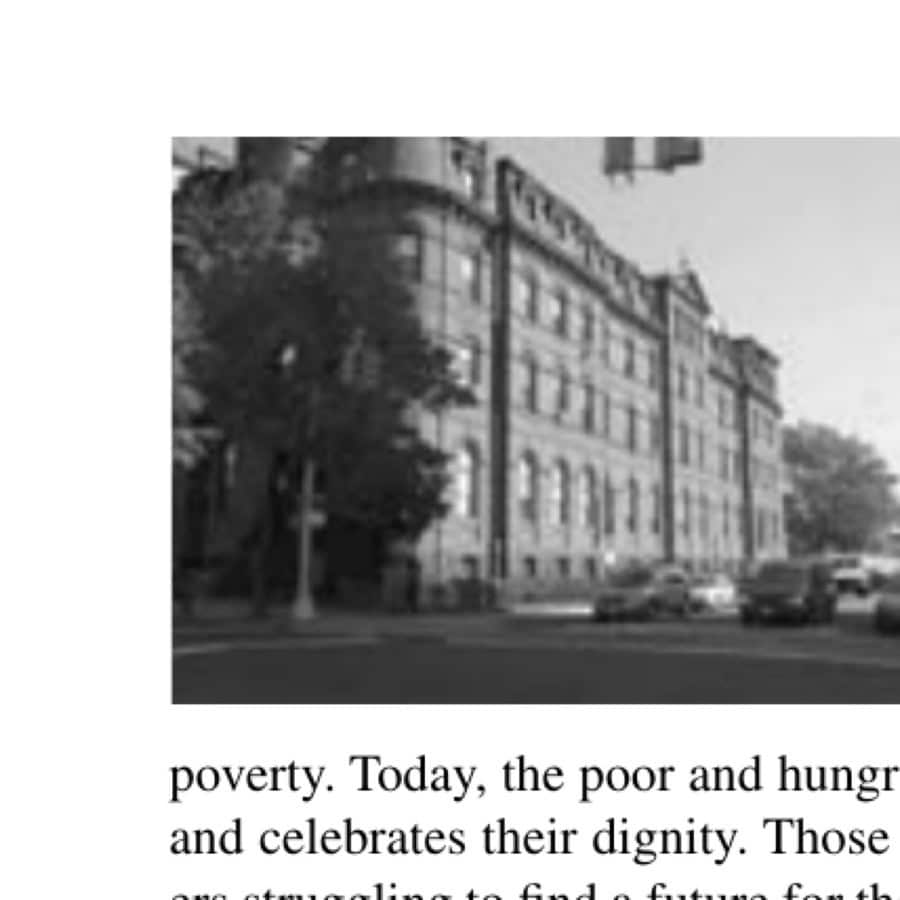
St. John’s Bread and Life in Brooklyn. The program occupies the basement floor. This section of Brooklyn is one of the poorest per capita in the United States.
We run the New York City Marathon not simply to improve our time or for the rush of finishing another marathon. We run for a higher calling: to put a spotlight on those who walk in the darkness of hunger and poverty. Today, the poor and hungry can come to a soup kitchen that recognizes and celebrates their dignity. Those gathered include the elderly, children, mothers struggling to find a future for their children, the working poor, and those who struggle with the demon of addiction. Guests come to St. John’s Bread and Life for a variety of reasons: for food, to see a doctor, to visit with a counselor, or just to seek refuge from the harsh reality of poverty.
The same entrepreneurial spirit of faith and service that gave birth to the Run Against Hunger has given birth to a multitude of services that restore shattered hopes and human dignity. Our board and staff have used the proceeds from the Run Against Hunger to purchase toys, turkeys, and clothing for 2,000 families at Christmas time. If you ever happen to be in Queens, New York, you might catch a glimpse of our mobile unit, the “hunger hunter,” a converted mobile home that serves Hispanic day laborers. Our running is not validated by our marathon splits or times but by the humble service we can render for the “least of these.”
A SIMPLE ANALOGY During these 10 marathons, it became clear to me that being poor and hungry is a lot like a marathon. The poor and hungry are in a marathon, hanging onto any form of stability that comes along, looking for a place to eat and drink, for gentle, kind, and familiar faces who do not push them along but who actually try to listen and believe in their inherent human dignity. There is one difference for the poor and hungry, however: their marathon has very few water
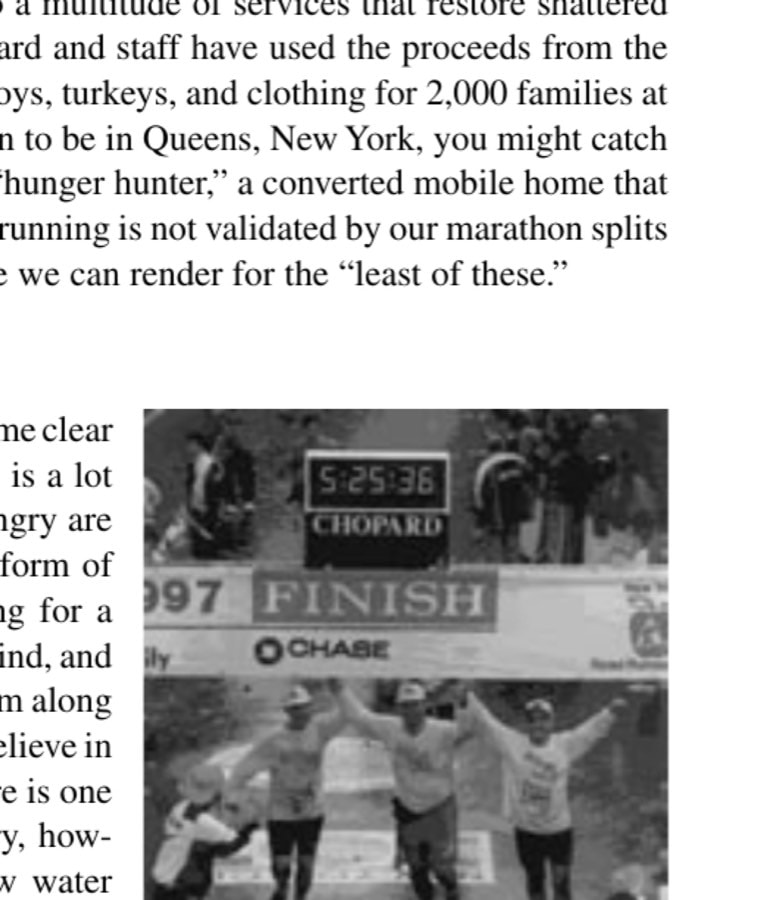
Father Jim (center) finishes the 1995 NYC Marathon with vice chair, Neil Sheehan, and then executive director, Hossein Sadaat.
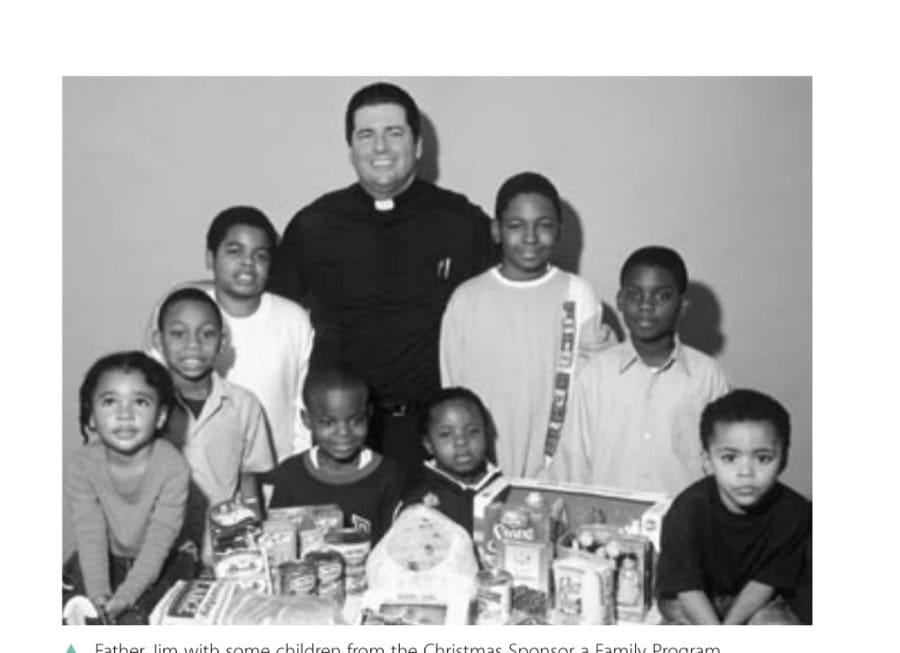
Father Jim with some children from the Christmas Sponsor a Family Program.
stops and no finish line. Our marathons push us to run through our limits that we impose on ourselves, knowing that a warm shower, good food, and hospitable family and dear friends await us. The poor and hungry have no such assurance.
So the next time you run a marathon, think about linking your struggles to those who find ordinary life a struggle, the poor and the sick. Use the gift of the marathon to shine light and hope unto someone else’s darkness. You will be surprised; not only will your time improve, but so will your faith and spirit. In my first marathon, during the last six miles I reminded myself of a beautiful saying of an early Christian martyr who lost his life in service of the poor: “The glory of God is revealed in human beings becoming fully alive.” When we use our gifts to serve others, we begin to claim the life God has set out for us. Happy marathoning!
Are You Moving? Please let us know when you move so there is no interruption in your subscription. Send address changes to Marathon & Beyond, 206 N. Randolph St., Suite 502, Champaign, IL 61820; or via e-mail to jan@marathonandbeyond.com. Put “Address Change” in the subject line.
This article originally appeared in Marathon & Beyond, Vol. 9, No. 5 (2005).
← Browse the full M&B ArchiveMore like this
1,000+ stories from 19 years of Marathon & Beyond
The complete archive of the legendary long-distance journal — digitized and free to read.
