

The Theme of Running in Literature Picks Up Steam as It Sprints Into the 19th Century. Part 3 of 5
Parts I and II of Roger Robinson’s series on Running in Literature appeared in our last two issues, respectively.
12. Top Runners in 19th-Century Literature: The Fastest, Weirdest, and Most Invisible
If Browning’s Pheidippides is the most heroic runner in 19th-century literature (see installment 2, Marathon & Beyond, March/April 2002), the fastest must be Longfellow’s Hiawatha:
Swift of foot was Hiawatha.
He could shoot an arrow from him,
And run forward with such fleetness,
That the arrow fell behind him.
(Henry Wadsworth Longfellow, The Song of Hiawatha, 1855)
Hiawatha had endurance, too, running the entire distance to the land of the Dacotahs to woo Minnehaha:
Striding over moor and meadow . . .
With his moccasins of magic,
At each stride a mile he measured;
And his heart outrun his footsteps;
And he journeyed without resting.
A mile-long stride sounds useful, but the runner with literature’s best-known running action is Whitman’s “The Runner” (though it sounds uncomfortable to me):
On a flat road runs the well-train’d runner,
He is lean and sinewy with muscular legs,
He is thinly clad, he leans forward as he runs,
With lightly closed fists and arms partially rais’d.
(Walt Whitman, “The Runner,” in “By the Roadside,” Leaves of Grass, 1891-92 edition)
The most enigmatic and dangerous runner of the time is the Huron chief Magua in The Last of the Mohicans (1826), who first appears in the role of running messenger:
His eye fell on the still, upright, and rigid form of the “Indian runner,” who had borne to the camp the unwelcome tidings of the previous evening.
Apart from a burst of speed when Magua escapes, running is implied rather than shown in Fenimore Cooper’s novel, though the film version opened with a wonderfully mobile sequence of Hawkeye and others running down a deer. But “Indian runners” as messengers play roles in several of Cooper’s stories, as befits their importance in Native American society.
The toughest running coach is surely Alice’s Red Queen, who hauls Alice along in Looking-Glass Land, crying:
“Faster! Faster!” but Alice felt she could not go faster, though she had no breath to say so . . . “Now! Now!” cried the Queen. “Faster! Faster!” And they went so fast that at last they seemed to skim through the air, hardly touching the ground with their feet . . .
When Alice complains that they haven’t moved anywhere, the Queen explains:
“Now, here, you see, it takes all the running you can do, to keep in the same place. If you want to get somewhere else, you must run at least twice as fast as that!”
(Lewis Carroll, Through the Looking-Glass, 1871, chapter 2)
Most runners know that feeling well.
The best woman runner in literature of the era is Atalanta, making a comeback from retirement as a lioness in ancient Greece (see installment 1, Marathon & Beyond, January/February 2002) to star in three 19th-century poems that celebrate her fleetness and beauty:
1.
They both started; he, by one stride, first,
For she half pitied him so beautiful,
Running to meet his death, yet was resolved
To conquer: soon she near’d him, and he felt
The rapid and repeated gush of breath
Behind his shoulder . . .
(Walter Savage Landor, from “Hippomenes and Atalanta,” 1863)
2.
Then from her course with eager steps she ran,
And in her odorous bosom laid the gold.
But when she turned again, the great-limbed man,
Now well ahead she failed not to behold,
And mindful of her glory waxing cold,
Sprang up and followed him in hot pursuit,
Though with one hand she touched the golden fruit.
(William Morris, from “Atalanta’s Race,” 1868)
3.
When the hounds of spring are on winter’s traces,
The mother of months in meadow or plain
Fills the shadow and windy places
With lisp of leaves and ripple of rain . . .
Come with bows bent and with emptying of quivers,
Maiden most perfect, lady of light,
With a noise of winds and many rivers,
With a clamour of water, and with might;
Bind on thy sandals, O thou most fleet,
Over the splendour and speed of thy feet . . .
(A. C. Swinburne, from Atalanta in Calydon, 1865)
The most horrific runner in literature of the 19th or any other century must be the Polynesian cannibal priest, dressed only in the hair of the dead, who in a little-known Robert Louis Stevenson ballad runs in a frenzied non-stop three-day ritual before naming the victims for the next feast:
Close in their covering roofs lay and trembled the clan,
But the aged, red-eyed priest ran forth like a lunatic man
And the village panted to see him in the jewels of death again,
In the silver beards of the old and the hair of women slain.
Frenzy shook in his limbs, frenzy shone in his eyes,
And still and again as he ran, the valley rang with his cries.
All day long in the land, by cliff and thicket and den,
He ran his lunatic rounds, and howled for the flesh of men . . .
Three were the days of his running, as the gods appointed of yore,
Two the nights of his sleeping alone in the place of gore . . .
Last, when valleys of verdure were heavy with manna and musk,
The wreck of the red-eyed priest came gasping home in the dusk.
(Robert Louis Stevenson, from “The Feast of Famine,” 1890, from R. L. Stevenson: His Best Pacific Writings, ed. Roger Robinson, 2002)
The weirdest runner, outdoing even the cannibal priest, in several terrific running scenes of chase and escape, is H. G. Wells’s Invisible Man. The footprints of his wet and bleeding bare feet magically appear on the London sidewalks as he runs invisibly through the amazed and pursuing crowds. Later, in the village where he takes refuge, there are two brilliant pursuit sequences where it is the increasingly dangerous invisible man who is the hunter. I particularly sympathize with Dr. Kemp, who as he runs away from this unseen danger “discovered that the hill road was indescribably vast and desolate, and that the beginnings of the town . . . were strangely remote” (like many a marathon finish line), and that “Never had there been a slower or more painful method of progression than running” (H. G. Wells, The Invisible Man, 1897, chapters 15, 21, 28).
The best-known 19th-century runner, in one of the most moving elegies in literature, is Housman’s “Athlete Dying Young”:
The time you won your town the race
We chaired you to the market place;
Man and boy stood cheering by,
And home we brought you shoulder high.Today, the road all runners come,
Shoulder-high we bring you home,
And set you at your threshold down,
Townsman of a stiller town.Smart lad, to slip betimes away
From fields where glory does not stay
And early though the laurel grows
It withers quicker than the rose . . .Now you will not swell the rout
Of lads that wore their honour out,
Runners whom renown outran
And the name died before the man . . .
(A. E. Housman, from “To an Athlete Dying Young,” in A Shropshire Lad, 1896. See installment 4, next issue, for some comment on this poem.)
Closing the field in this brief survey of notable 19th-century literary runners is the Indian overland mail carrier, another in the great line of running
messengers. From Pheidippides and the Old Testament’s “man of Benjamin” through the running footmen and Cooper’s Indian messengers, these couriers of heroic endurance have been celebrated in literature. Perhaps the last in the long line is the carrier of official mail at the northern extreme of Queen Victoria’s Imperial India, a runner whose jingling bells give him precedence over robbers and tigers, who defies flood, landslide, and the towering ascents of the Himalayan foothills to get the mail through. The sun even rises, says Kipling in this delightful, slightly tongue-in-cheek tribute, when the mail runner arrives. As it is a skilled and amusing poem that has never been mentioned before in the context of running literature, I will quote it in full:
The Overland Mail
(Foot-service to the Hills)
In the Name of the Empress of India, make way,
O lords of the Jungle, wherever you roam,
The woods are astir at the close of the day—
We exiles are waiting for letters from Home.
Let the robber retreat—let the tiger turn tail—
In the Name of the Empress, the Overland Mail!
With a jingle of bells as the dusk gathers in,
He turns to the footpath that heads up the hill—
The bags on his back and a cloth round his chin,
And, tucked in his waistbelt, the Post Office bill:—
“Despatched on this date, as received by the rail,
Per runner, two bags of the Overland Mail.”
Is the torrent in spate? He must ford it or swim.
Has the rain wrecked the road? He must climb by the cliff.
Does the tempest cry halt? What are tempests to him?
The service admits not a “but” or an “if.”
While the breath’s in his mouth, he must bear without fail,
In the Name of the Empress, the Overland Mail.
From aloe to rose-oak, from rose-oak to fir,
From level to upland, from upland to crest,
From rice-field to rock-ridge, from rock-ridge to spur,
Fly the soft-sandalled feet, strains the brawny, brown chest.
From rail to ravine—to the peak from the vale—
Up, up through the night goes the Overland Mail.
There’s a speck on the hillside, a dot on the road—
A jingle of bells on the footpath below—
There’s a scuffle above in the monkey’s abode—
The world is awake and the clouds are aglow.
For the great Sun himself must attend to the hail:—
“In the Name of the Empress, the Overland Mail!”
(Rudyard Kipling, 1886)
13. Hare and Hounds: Tom Brown’s Schooldays
The old world of running messengers and running priests was passing away. India, at its extremes where the rails had not reached, was the last place to have an extensive network of mail runners. Stevenson based his macabre “The Feast of Famine” (section 12, above) on a cannibal ritual he heard about in the Marquesas Islands of the South Pacific:
When the priest came forth it was to run for three days through the territory of the clan, naked and starving . . . to encounter the priest upon his rounds was death (R. L. Stevenson, In the South Seas, 1890).
But, he says, “I set it down with diffidence,” as an unconfirmed report, for the customs of cannibalism were of the past. So were Atalanta and Pheidippides, though literature in that nostalgic era cherished romantic versions of their beauty and heroism.
New forms of running were catching the attention of writers now, at first in the growing world of journalism. Magazines like Bell’s Sporting Life are a rich source. On the improving roads of Europe and America, “pedestrians” were running and walking challenge races and setting new ultradistance records. On the farmlands and commons of England, schoolboys and (after 1868) men were running after a “scent” of shredded paper to practice hunting the fox and hare, and racing “steeplechases” on foot over hedgerow and stream, laying the beginnings of organized cross-country. In the cities and the colleges, new “cinder paths” were laid out, where a changing mix of Greek games, rural sports, and imitation horse racing slowly evolved into the strange hybrid we call track and field, or athletics. Running was becoming a sport.
The book that best celebrates the birth of modern sport is Tom Brown’s Schooldays (1857) by Thomas Hughes, a hugely successful novel in the Victorian period. It remains one of the best, and best-known, of all school stories and virtually created that genre. It is also one of the first sports novels. Set in the 1830s and based closely on Hughes’s own days at Rugby School, it catches the nostalgia of looking back on school days and especially the appeal of
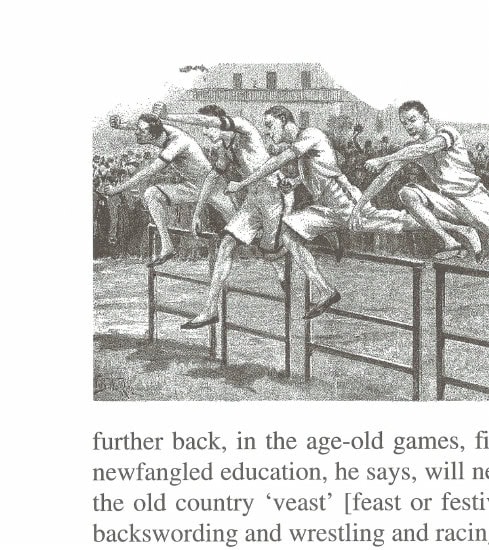
organized games. It’s a deeply Christian, moral, and patriotic book, and also offers some intelligent ideas on education and sport. In the opening chapters in Tom Brown’s home area in the English countryside, Hughes shows that the 19th-century growth of organized sports had its roots much further back, in the age-old games, fights, and races at rural festivals. Any newfangled education, he says, will need “some equivalent for the games of the old country ‘veast’ [feast or festival]; something to put in place of the backswording and wrestling and racing.” In nearly 150 years since he wrote, he has been proved right.
Running is not the only sport Tom Brown encounters at Rugby, but it is the first. Approaching by stagecoach, he sees two boys waiting for the coach, “their jackets buttoned tight,” at the third milestone before the town. The guard explains that they are runners, and Hughes provides an entertaining glimpse of one system of training in 1833 and a well-observed description of contrasting running styles:
“. . . out and out runners they be. They comes out about twice or three times a-week, and spirts a mile alongside of us.”
And as they came up, sure enough, away went the two boys along the footpath, keeping up with the horses; the first a light clean well-made fellow going on springs, the other stout and round-shouldered, labouring in his pace but going as dogged as a bull-terrier.
Old Blow-hard looked on admiringly. “See how beautiful that there un holds hisself together, and goes from his hips, sir,” said he; “he’s a ‘mazin’ fine runner. Now many coachmen as drives a first-rate team’d put it on, and try and pass ’em. But Bob, sir, bless you, he’s tender-hearted . . .”
At the second milestone the boys pulled up short, and waved their hats to the guard, who had his watch out and shouted “4.56,” thereby indicating that the mile had been done in four seconds under five minutes (Thomas Hughes, Tom Brown’s Schooldays, chapter 4).
Not bad running, on a dirt road in jackets and hats, and shoes that were certainly not zip-up racing flats.
The main running sequence comes when Tom and his friends join “Bigside Hare and hounds,” the paper-chase cross-country run for seniors. The chapter is lively, historically fascinating, and written with the true novelist’s ability to make a reader feel actively part of the run. It is essential reading for the origins of running, as well as its literature. The following is an edited version of the first part of the run:
Two well-known runners clustered around Thorne, who explained shortly, “They’re to have six minutes’ law . . . every one who comes in within a quarter-of-an-hour of the hares’ll be counted . . .” Then came a minute’s pause or so, and the pack break into a trot, scattering over the field to find the first traces of the scent which the hares throw out as they go along. In a minute a cry of “forward” comes, and the whole pack quickening their pace make for the spot, rush at the gap, and scramble through, jostling one another. “Forward” again, before they are half through; the pace quickens into a sharp run, the tail hounds all straining to get up with the lucky leaders. The scent lies thick right across another meadow and into a ploughed field, where the pace begins to tell; then over a good wattle with a ditch on the other side, and down a large pasture studded with old thorns, which slopes down to the first brook; the great Leicestershire sheep charge away across the field as the pack comes racing down the slope. The scent lies right ahead up the opposite slope; not a turn or a check to favour the tail hounds, who strain on, now trailing in a long line, many a youngster beginning to drag his legs heavily and feel his heart beat like a hammer.
Tom, East and the Tadpole had a good start, and are well up for such young hands, and after rising the slope and crossing the next field, find themselves up with the leading hounds who have over-run the scent and are trying back; they have come a mile and a half in about eleven minutes. About twenty-five of the original starters only show here, the rest having already given in; the leaders are busy making casts into the fields on the left and right. (Chapter 7)
And so on, as the pack works “steadily and doggedly,” the hares’ cunning in laying false trails adds extra miles, and the three younger boys start to struggle, “sobbing and plunging along,” until a brook “with stiff clay banks” entraps them, and they limp back by road, “plashing in the cold puddly ruts.” It’s one of the few accounts of running I know that gives a real sense of crossing different kinds of ground, the effects of hills, the disappointment when tiredness makes you lose contact, and yet for the best runners the pleasure in their own power, “loving the hard work.” Even the three friends soon forget their weariness and end up “thinking Hare-and-hounds the most delightful of games.”
14. More Hounds
David Copperfield felt the same when he tells how during his happy days at Dr. Strong’s school in Canterbury Mr. Dick used to come and watch him running “hare and hounds . . . mounted on a little knoll, cheering the whole field on to action” (Charles Dickens, David Copperfield, 1849-50, chapter 17).
So did the schoolboy son of George Warrington in Thackeray’s The Virginians (1857-59), who “took the most creditable prizes at football and hare-and-hounds” at Harrow School (Chapter 110).
Another novelist, Samuel Butler, was a prominent runner at Shrewsbury School from 1848 to 1854 and made use of his memories in fiction, in scientific writing, and in his translations of Homer (see Installment 1, Marathon & Beyond, January/February 2002). In The Way of All Flesh (1903), the downtrodden and inept teenager Ernest has one of his few heroic moments when he runs across country to make a gift to a housemaid who has been unjustly dismissed by his tyrannical father. At school, it is explained, he regularly ran in “the hounds.” His “want of muscular strength did not tell against him here . . . if it came to mere endurance he was as good as anyone else . . . His lungs thus exercised had become developed, and as a run of six or seven miles across country was not more than he was used to, he did not despair of . . . catching Ellen . . . before the train left.” He catches her “crimson with his exertion, covered with dust,” in time. (Chapter 39. For Butler’s running and Shrewsbury School’s place in the early history of running, see Roger Robinson, “On the Scent of History,” Running Times, December 1998.)
Butler’s own trained lungs and legs helped him become a noted mountain explorer during his four years as a young man in New Zealand and a prodigious hiker his whole life. He also used his running experience in one of the books he wrote to challenge Darwin’s mechanistic view of evolution:
“In running fast over average ground we find it very difficult to become conscious of each individual step, and should possibly find it more difficult still, if the inequalities and roughness of uncultured land had not perhaps caused the development of a power to create a second consciousness of our steps without hindrance to our running or walking . . . if while we are running we would consider the action of our muscles, we come to a dead stop, and should probably fall if we tried to observe too suddenly . . . Running is not controllable to a step or two without loss of equilibrium” (Samuel Butler, Life and Habit, 1877, Chapter 1).
Butler was no scientific match for Darwin, but by drawing his arguments so directly from personal experience, including running experience, he was a feisty controversialist.
15. Sex, Villainy, and How Running Harms Your Health
Sports for Thomas Hughes were not only “most delightful” but a means of training moral character. A famous passage near the end of Tom Brown’s Schooldays lauds team games that teach “discipline and reliance on one another,” as “much better than fives’ or hare-and-hounds, or any others where the object is to come in first or to win for oneself, and not that one’s side may win.” Hughes here seems to have forgotten how the hounds in his own story all collaborated in tracking the scent and how Brooke, the best runner, took “the wide casts round” to enable weaker members of the pack to run less distance.
Another mid-Victorian writer who believed that sports are morally beneficial was the liberal Christian Charles Kingsley, who did not put running into any of his novels (there are good rural sports in Yeast), but affirmed: “Through sport, boys acquire virtues which no books can give them; not merely daring and endurance, but, better still, temper, self-restraint, fairness, honour, unenvious approbation of another’s success, and all that ‘give and take’ of life which stands a man in good stead” (Richard Holt, Sport and the British, 1990, p. 93).
Not all writers were so positive about the upsurge of sports. The novelist and playwright Wilkie Collins felt strongly about the health risks of running, the excessive admiration given to sports stars, the associated evil of gambling, and the bad moral effects. Sports, he said, only teach you to “take every advantage of . . . superior strength and superior cunning.” So the central character of one of his major novels, Man and Wife (1870), is a brutally villainous runner. The book has two targets. It exposes the injustices caused by the antiquated marriage laws of Scotland and Ireland, and more radically by marriage itself; and it attacks the folly of “excessive development of the muscle, purchased at the expense of an excessive strain on the heart and lungs.”
Instead of being the disciplined and generous man envisaged by Hughes and Kingsley, Geoffrey Delamayn, the sports star, is “a callous scoundrel,” ruthlessly self-centered, who is also an unlikely combination of oarsman, boxer, and long-distance track runner. He trains for a big four-mile race in a North versus South track meet but has “gone stale,” collapses on the track, and spends the remainder of his life slumped “half-asleep, his heavy hands hanging listlessly over his knees, and his chin resting on the hooked handle of his stick.” Let that be a warning. He is also plotting to murder his wife. Best known for the brilliant The Woman in White, Wilkie Collins is better at the suspense and sensation than he is at the running, but he did his homework and there is plenty of fictional as well as historical interest.
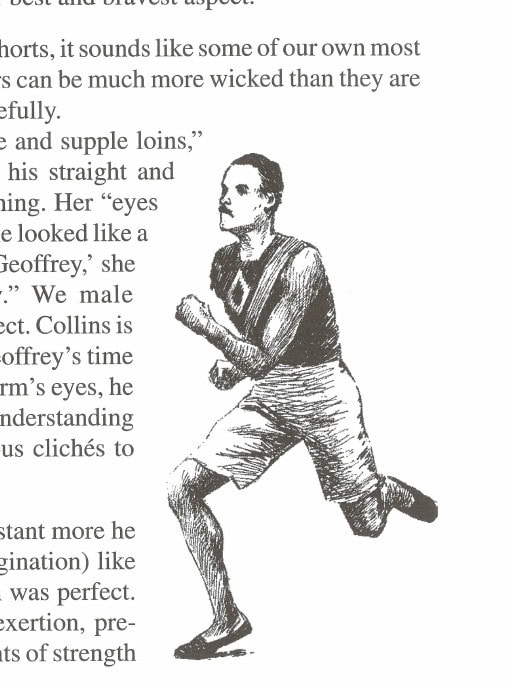
The best scene comes when Geoffrey is at the height of his training while also flirting with a rich widow. The jealous rivalry between the adoring Mrs. Glenarm and Geoffrey’s demanding and possessive trainer, Perry, is true to a good many runners’ relationships I have known and wonderfully brought to life. So is her enthralled admiration of Geoffrey in full stride when he permits her to watch him training. His outfit sets the tone:
Dressed in a close-fitting costume, light and elastic, adapting itself to every movement, and made to answer every purpose required by the exercise in which he was about to engage, Geoffrey’s physical advantages showed themselves in their best and bravest aspect.
Even in those days before Lycra shorts, it sounds like some of our own most prominent sprinters. Victorian writers can be much more wicked than they are supposed to be if you read them carefully.
Geoffrey’s “mighty chest,” “lithe and supple loins,” and “the easy and elastic stride of his straight and shapely legs” set Mrs. Glenarm sighing. Her “eyes devoured him in silent admiration. He looked like a young god of mythology . . . ‘Oh Geoffrey,’ she exclaimed softly, as he went by.” We male marathoners frequently have this effect. Collins is cunning, too, since by presenting Geoffrey’s time trial (300 yards) through Mrs. Glenarm’s eyes, he conceals the limitations of his own understanding and his resort to some pretty obvious clichés to describe it:
“Now then!” said Perry. In an instant more he flew by (to Mrs. Glenarm’s imagination) like an arrow from a bow. His action was perfect. His speed at its utmost rate of exertion, preserved its rare underlying elements of strength
and steadiness . . . lightly flying over the ground, still firmly keeping the straight line (Chapter 35).
Afterwards he sinks into a deep exhausted sleep, and Perry, muttering “Another of ’em gone stale,” sneaks off to hedge his bets for the big race.
That chapter (50) is excellent for its detail of how a London track meet was conducted at that date, with some emphasis on the seedier aspects, such as the illicit bookmaking, the pickpockets, the frenzied crowds, and the fatuousness (as Collins saw it) of the whole event. A bemused foreign visitor is used to show astonishment at this hearty and mindless British folly, and the race itself is presented partly from the viewpoint of Geoffrey’s physician, talking disapprovingly about how few “pedestrians” ever live to old age and how something has “gone wrong with Delamayn in his training.” He is prepared for the worst. “I know his health is broken; and I believe he is going to run this race at his proper peril.”
The race is convincing in detail, with the starting pistol, the trainers with their water cans in their hand running across the grass to meet their men, the cluster of officials, the increasing excitement of the crowd. It’s an interesting race, too, with a cautious first mile while they are “getting their wind,” then the lead switching and some tactical bursts, and a credible split at two miles of 10:33, even though Collins is unable to get the internal drama of it and has to use the crowd to raise the tension, just as some recent running novelists have used the announcer or radio or TV commentators. It’s pretty good, in other words, but remains external. And when Geoffrey suffers his catastrophic collapse with just over a lap to go, Collins uses the conventions of melodrama and “sensation” fiction rather than any understanding of what it is really like to be exhausted in a race:
Delamayn swerved on the path. His trainer dashed water over him. He rallied, and ran another step or two—swerved again—staggered—lifted his arm to his mouth with a hoarse cry of rage—fastened his own teeth in his flesh like a wild beast—and fell senseless on the course.
“He will never recover,” the surgeon pronounces. “It’s a breakdown in his health.” The cause, he says simply, is “Athletic Sports,” and he speaks of warning the public about the dangers as we might speak about brain damage in boxing: “Delamayn is far from the first man who was dropped at foot-racing, under the cruel stress laid on the vital organs.” Wilkie Collins has new allies in all those people who think Jim Fixx died because he did too much running. But the sport is strong enough to take some criticism, and Collins is a vivid and intelligent writer who has taken the trouble to describe competitive running colorfully and accurately—from the outside.
16. Thomas Hardy’s Running Women
For running from the inside, try Thomas Hardy—an unexpected source but a writer who places romance and tragedy in the precisely observed physical reality of rural living. You learn exactly what it is like to walk, or run, or work around Hardy’s Wessex. In his first published novel, Desperate Remedies (1871), Edward Springrove hears bad news from home and runs there across the fields, in a passage that perfectly gets the experience of trying to run at speed on clinging mud:
The path was across arable land, and was ploughed up with the rest of the field every autumn, after which it was trodden out afresh. The thaw had so loosened the soft earth, that lumps of stiff mud were lifted by his feet at every leap he took, and flung against him by his rapid motion, as it were doggedly impeding him, and increasing tenfold the customary effort of running.
But he ran on—uphill, and downhill, the same pace alike—like the shadow of a cloud (XIII, p. 5).
All real cross-country runners know that struggle against the weight of mud clinging to their shoes, “doggedly impeding” them, and then the loss of balance when one clump suddenly flies off and hits them in the back of the neck.
Another special contribution from Hardy is the remarkable number of running women in his novels. I said in installment 2 that the willingness to walk energetically was often in 19th-century literature a test of interesting and vital women, in an age that seemed to prefer them vapid and sedentary.
Hardy’s imagination was captivated by lively women like Elfride, the heroine of A Pair of Blue Eyes (1873), who “looked so intensely living and full of movement.” His women walk and ride, and one of them does spectacular rope exercises in her private gym (the significantly named Paula Power in A Laodicean, 1881). And a surprising number of them run.
Paula Power, confronting a scenic hill in Heidelberg, announces, “My aunt may drive up, and you may walk up; but I shall run up,” and does, though underestimating the distance.
In the first chapter of The Hand of Ethelberta (1876), the heroine sets off “in a rapid run” to watch a hawk chase a duck; and despite the touch of irony that runs through this novel, her running is described by a remarkably observant eye and ear: “her feet suddenly became as quick as fingers, and she raced along over the uneven ground with such force of tread that, being a woman slightly heavier than gossamer, her patent heels punched little D’s in the soil with unerring accuracy wherever it was bare, crippled the heather-twigs where it was not, and sucked the swampy places with a sound of quick kisses.”
Anne Garland in The Trumpet-Major (1880) shows a turn of speed to escape an over-insistent wooer, a common reason then for country women to run, and Suke Damson in The Woodlanders (1887) goes “racing away” from Dr. Fitzpiers, “cunningly dodging about among the trees,” “leaping over a stile,” “flitting down the mead,” for the equally common reason that she wants him to catch her. “Warming with the chase,” he does. Even Hardy’s most tragic female characters, Tess Durbeyfield and Sue Bridehead (in Jude the Obscure), are at their best when most energetic and mobile. It is the times when they are passive and static that destroy them.
Most mobile of all is Elfride in A Pair of Blue Eyes, based on Hardy’s own first wife during their courtship. She is first seen “running with a boy’s velocity, superadded to a girl’s lightness, after a tame rabbit.” Her father later calls her “You little flyaway! You look wild enough now.” She rides and walks in all weathers, runs for the train even in London, and runs most memorably in a brilliant scene when she has just saved her admirer’s life. Henry Knight has slipped partway down a steep cliff face, and Elfride at first proposes to run for help—”three-quarters of an hour.” When he says he cannot hang on that long, she rescues him, despite heavy rain, by lowering a rope of knotted linen to him. She made the rope, he realizes at the top, by tearing up almost her entire clothing: “Elfride had absolutely nothing between her and the weather but her diaphanous exterior robe.” Modestly, she says:
“I am used to being wet through . . . I have been drenched on Pansy dozens of times.” She then ran off from him through the pelting rain like a hare; or more like a pheasant when, scampering away with a lowered tail, it has a mind to fly, but does not. Elfride was soon out of sight (Chapter 22).
Not since Ovid lingered over the ribbons fluttering at Atalanta’s knees and ankles has there been a description of running in literature that sexy. And rarely has a simile more precisely evoked a running action. No tired “flew like an arrow from the bow” cliché satisfies Thomas Hardy.
17. Oral Literature
We too often think of literature only as what is in print.
For nearly 200 years, sports like running produced their own vigorous oral culture, in the form especially of ballads and songs. The paper-chasing “hounds”
at Shrewsbury School recited their own poems and sang their own songs in the 1820s, and at club reunions I have attended in New Zealand, the older members are still prone, after a few beers, to burst into the songs they sang on team buses in the 1940s and ’50s. We get embarrassed at such singing these days and easily forget how much communal vitality has been lost through our habit of traveling by car and how much creativity through the dominance we allow to commercial music. In dusty scrapbooks and aging memories lies original material that gave a special verbal life to sports and could now fill a hundred cultural studies theses. It is fading by the day.
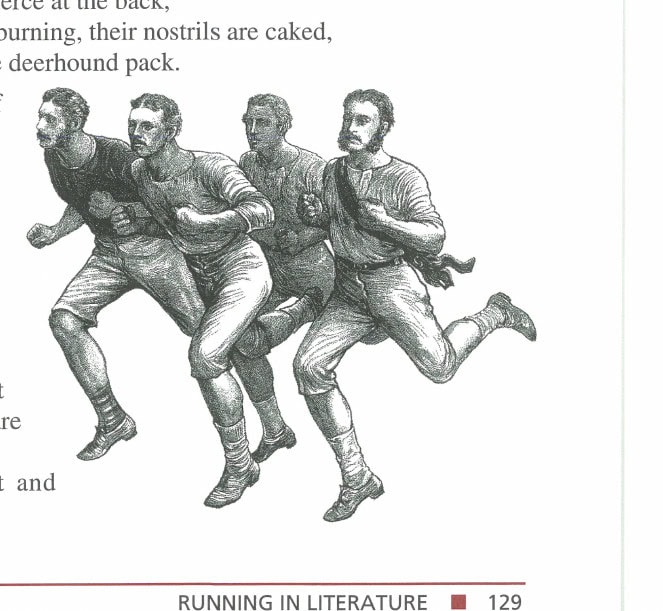
Here, in tribute to thousands of good poems and songs about running that are known only locally or have been lost, is one of the best I have come across in recent years. It’s a rollicking ballad that energetically catches the rhythms, risks, pressures, and excitement of hard racing on a rugged trail. It’s included in Barry Spitz’s marvelous book, Dipsea: The Greatest Race (1993). With it, this history of literature of running moves into the 20th century.
The Song of the Dipsea Trail
by W. O. “Bill” McGeehan, 1908
There’s a patter of feet on the Lone Pine Ridge,
And the whir of the frightened quail;
Now the white forms flash in the shimmering green,
And they’re off on the Dipsea Trail.
Now they press through the open and clear the madrones,
With the sun beating fierce at the back,
And their temples are burning, their nostrils are caked,
But they speed like the deerhound pack.
Oh, it’s far to the top of the Hog’s Back Rise,
And the breathing is labored and fast;
But it’s then for the cool of the ocean breeze
When the worst of the ridge is past.
Then it strikes the hot temples, the laggards are roused;
Now they’ve done it and quicken the pace,
Have a care for the boulders—a loose rolling stone
And you’re downed in the stretch of the race.
Now the spurt for the finish—the heart beats come fast,
And the weary heads, dust-caked and bowed;
There’s a gasp and a struggle, a rush to the tape—
And the winner falls limp in the crowd.
Oh, the eyes that are bloodshot, the lips that are white,
And the stiff limbs that falter and fail!
For it’s no place for weaklings—the grueling course
Of the men of the Dipsea Trail.
[All sources for this article are cited within the text.]
The fourth installment of Roger Robinson’s “Running in Literature” will cover some great writers of the 20th century, including James Joyce, W. H. Auden, Bernard Malamud, and Tom Stoppard, and will bring the story up to date with the first publication of some new poetry. It will appear in the July/August issue.
This article originally appeared in Marathon & Beyond, Vol. 6, No. 3 (2002).
← Browse the full M&B ArchiveMore like this
1,000+ stories from 19 years of Marathon & Beyond
The complete archive of the legendary long-distance journal — digitized and free to read.
