

The Dangers Of Sun Exposure For Runners
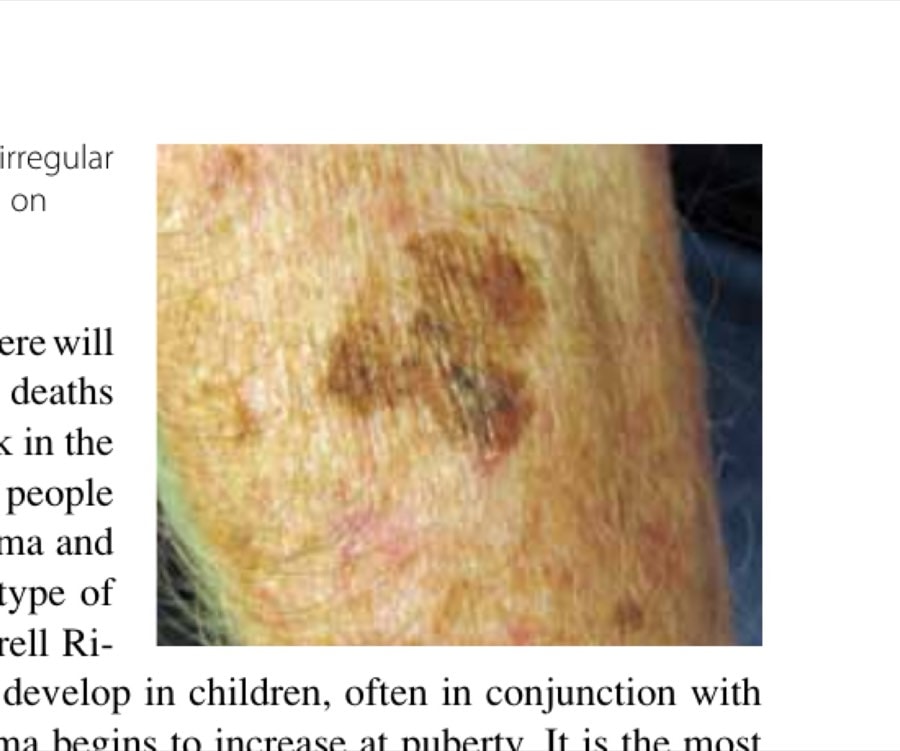
This melanoma has a large size, an irregular shape, and varied coloring and occurs on sun-damaged skin.
every hour from melanoma, and there will be an estimated 9,180 Americans deaths this year. The current lifetime risk in the United States is that one out of 52 people will develop an invasive melanoma and one out of 27 will develop any type of melanoma, according to Dr. Darrell Rigel (2012). Melanoma can even develop in children, often in conjunction with a birthmark. The risk of melanoma begins to increase at puberty. It is the most common form of cancer in young adults age 25 to 29, according to the American Academy of Dermatology (2012).
Marathon runners often show signs on their skin that are associated with an increased risk of melanoma. Notable runners who have suffered from melanoma include John J. Kelley, who died from metastatic melanoma, and Deena Kastor, who has reportedly had three early melanomas. A study published in the Archives of Dermatology (2006) found that marathon runners showed significantly more atypical nevi and solar lentigines (sun spots/age spots), as well as suspicious lesions requiring surgical removal, than age-matched controls. These changes are considered risk factors for the development of melanoma. The more hours spent training per week, the more striking the differences noted.
Besides sun exposure and genetic factors, it has also been suggested that intense training and competition may cause a decline in immune regulation. Any decrease in immune competence may result in an increased propensity for malignancy.
Risk factors for melanoma include More than 50 moles, large or atypical moles Light skin with red or blond hair, blue or green eyes Family history of melanoma Personal history of melanoma (higher risk for subsequent melanomas) History of sunburns Tanning-bed use Immunosuppressive therapy, such as medications used in transplant patients or for some patients with psoriasis or rheumatoid arthritis
Warning signs for melanoma include the so-called ABCDE rule: Asymmetry: one half of the lesion is not a mirror image of the other half. Border is scalloped, irregular, or notched—not round or oval. Color is not uniform across the lesion and may be dark brown or black. Shades of red, white, or gray may also be noted. Diameter is often greater than 6 millimeters, or the size of a pencil eraser. Melanoma can start smaller as well, however. Evolving or changing in size, shape, or color.
Other warnings may include the ugly duckling sign, which is a mole that looks very different from the other moles on the body—that is, it doesn’t fit the pattern of your other moles or is a new mole in an adult. Rarely, melanoma can be amelanotic—that is, lacking in melanin pigment so that it is predominantly pink or reddish in color. It is important to note that many times only one of these warning signs is present and perhaps to a lesser degree than photographs show.
There are other types of skin cancer besides melanoma. These include squamous cell carcinoma and basal cell carcinoma. These types of skin cancer are generally less dangerous and tend to occur in chroni
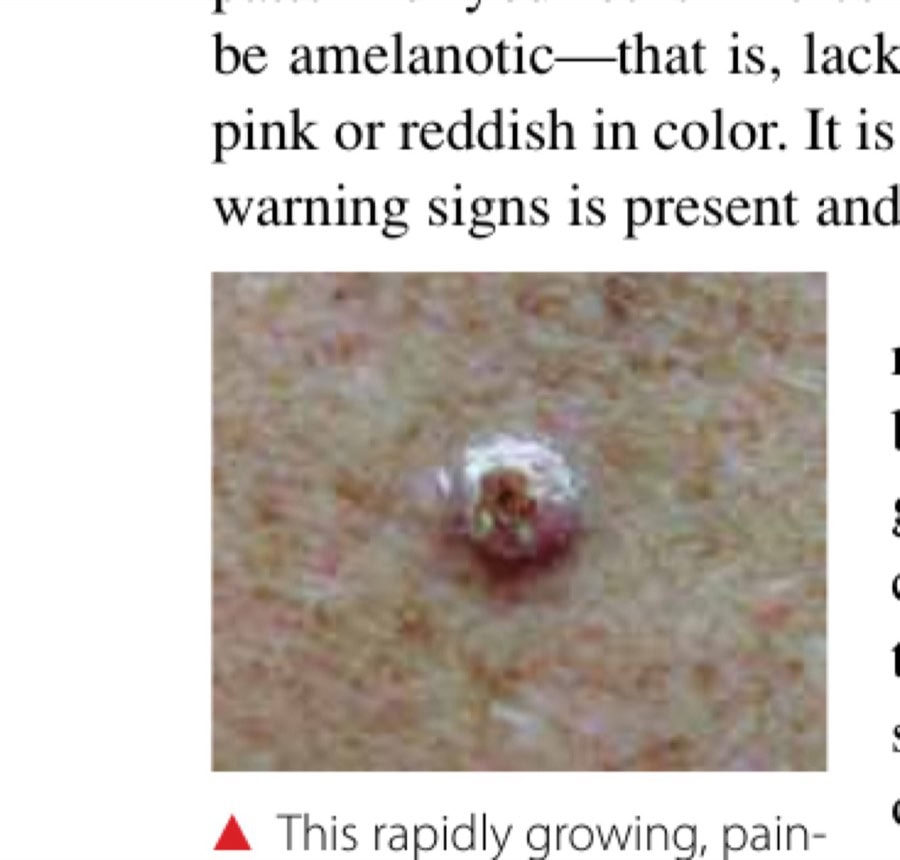
cally sun-exposed skin. Squamous cell carcinoma has the potential to spread and become life threatening in some cases, particularly tumors that are large or that ▲ This rapidly growing, pain- occur on mucosal surfaces such as the lips or in the ful keratotic nodule is a squa- setting of immune suppression. Basal cell carcinoma can be very locally aggressive and invade deeply in mous cell carcinoma.
the skin, destroying normal skin structures. This can lead to unattractive scarring from surgical removal. Squamous cell carcinoma often looks like a painful, crusted growth or a hornlike lesion. Basal cell carcinoma can show up as a pink, scaly, or scarlike patch or a pimplelike lesion that doesn’t resolve promptly. It can also be an area of skin that bleeds easily with minor trauma.
So what is a runner to do? Train at off peak hours whenever possible. The sun’s rays are most intense between 10:00 a.m. and 4:00 p.m.
▲ Regular use of sunscreen helps prevent skin cancer.
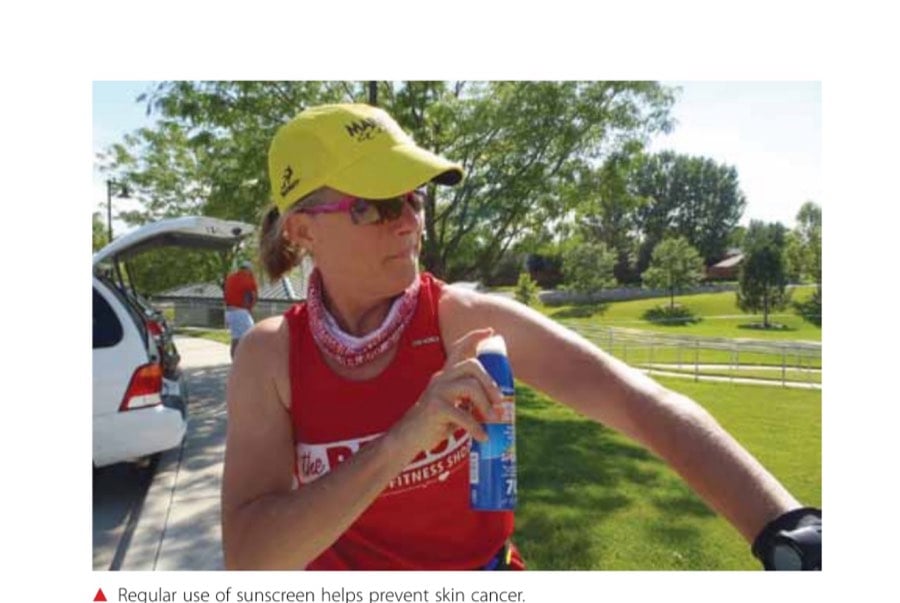
Wear a broad-spectrum sunscreen year-round, rain or shine. The new sunscreen labeling regulations from the FDA have been delayed until December 2012. Currently, SPF indicates the protection factor for UVB. The new labeling will clarify which sunscreens offer protection for both UVB and UVA. While UVB rays are responsible for sunburns, UVA rays penetrate more deeply into the skin and play a role in photo aging as well as skin-cancer induction. UVA can penetrate window glass, and there is a predilection for some skin cancers to occur on the left side of people who spend a lot of time driving. Sunscreen ingredients that are effective against UVA include Mexoryl, avobenzone, titanium dioxide, and zinc. Be sure to use a generous amount of sunscreen—about 1 ounce, or the size of a shot glass. Many people don’t use the recommended amount, and then the amount of sun protection is less than the SPF number indicates. Use of a high-number SPF sunscreen such as SPF 70 will provide protection even if used in smaller than recommended amounts, as recently reported in the Journal of the American Academy of Dermatology (2012). Reapply sunscreen whenever possible. Heavy perspiration can increase sun sensitivity.
Cover up with a hat, clothing such as a long-sleeve shirt, and sunglasses to protect the eyes. All fabrics offer some degree of photo protection. Whenever possible, use clothing with built-in photo protection. Fabrics labeled UPF 15-50+ are sun protective.
UPF measures the amount of UV that penetrates fabric and reaches the skin. The higher the UPF, the better the sun protection offered. An inexpensive alternative is to treat your own clothing with the laundry additive SunGuard. This product contains a sunscreen called Tinosorb. It increases the UPF of clothing to 30 and lasts through 20 wash cycles.
Put sunblock on underneath clothing if you might shed layers as you warm up. Use a lip block with SPF. Get your vitamin D safely from a healthy diet and supplements if needed. The skin can produce a limited amount of vitamin D from sun exposure, but the American Academy of Dermatology recommends avoidance of unprotected sun as a way to obtain vitamin D.
Be observant. Check your birthday suit on your birthday and, ideally, once a month. See a dermatologist promptly if you have any concerns, and consider obtaining a baseline skin-screening exam, especially if you have risk factors for melanoma. Realize that not all melanomas develop from sun exposure, and as such, do not ignore a suspicious lesion in a sun-protected site. Early detection may save your life.
The next time you head out for a run, remember to protect your skin!
References Ambros-Rudolph, C. M., R. Hofmann-Wellenhof, E. Richtig, M. Müller-Fürstner, H. P. Soyer, and H. Kerl. 2006. Malignant melanoma in marathon runners. Archives of Dermatology 142(11): 1471-1474. Green, A.C., G.M. Williams, V. Logan, and G.M. Strutton. 2011. Reduced melanoma
after regular sunscreen use: randomized trial follow-up. J Clin Oncol 29:257–263. “Melanoma.” American Academy of Dermatology, http://www.aad.org/skin-conditions/ dermatology-a-to-z/melanoma/who-gets-causes/melanoma-who-gets-causes. Ou-yang, Hao, J. Stanfield, C. Cole, Y. Appa, and D. Rigel. 2012. High-SPF sunscreens (
SPF70) may provide ultraviolet protection above minimal recommended levels by adequately compensating for lower sunscreen user application amounts. Journal of the American Academy of Dermatology. April 1. www.Eblue.org. Rigel, Darrell S. Updates from the 2012 winter clinical dermatology conference: advances in the diagnosis of melanoma.
M&B e-Newsletter Stay connected with Marathon & Beyond between our regular issues. Go to our website and sign up for our monthly e-newsletter, Marathon & Beyond e-XTRA! Read bonus material and excerpts, short subscriber features, “behind the scenes” interviews with authors and runners, and additional mini race profiles. Also, join the conversation on Facebook.
This article originally appeared in Marathon & Beyond, Vol. 16, No. 5 (2012).
← Browse the full M&B ArchiveMore like this
1,000+ stories from 19 years of Marathon & Beyond
The complete archive of the legendary long-distance journal — digitized and free to read.
