

The Fascinating Struggle
“For the great majority of adults . . . to take part in a Marathon race is to risk serious and permanent injury to health, with immediate death a danger not very remote. . . . The truth is that exercise should always be purely subordinate to the business and pleasure of life. To make it or the bodily changes it produces ends instead of incidents is a dangerous as well as an absurd mistake.” —THE NEW YORK TIMES, FEBRUARY 24, 1909
The story so far: The most famous photo in marathon history shows rubber-legged Dorando Pietri (Italy) staggering across the line in the 1908 London Olympics, supported by race and medical officials whose assistance caused his disqualification. He had in fact collapsed and apparently passed out five times in the last 400 yards of the race, the first time at the entrance to the stadium, receiving medical help and physical assistance on each occasion. For Johnny Hayes (USA), though he never passed Pietri, the gold medal was just reward for excellent pace judgment and a strong finish, when favorites like Tom Longboat (Canada) and Fred Appleby (England) had gone out too fast. Arthur Conan Doyle, creator of Sherlock Holmes, was in the stands as a special reporter and wrote the best contemporary description of the dramatic last lap. But the frequent claim that Doyle was one of those who assisted Pietri is one of many myths and half-truths that have accrued around the legendary race. Now read on:
The fund started by Arthur Conan Doyle for Dorando Pietri was intended to help the little cake maker set up his own business at home in Carpi, Italy (not Capri). In New York, Bloomingdale Brothers (as the big store was then known) resplendently decorated its whole building in honor of its most famous employee, Johnny Hayes, and rewarded him for all the publicity by promoting him to manager of the sporting goods department. Tom Longboat (“Cogwagee” was his Iroquois
Dr. Edward H. Kozloff Collection
Dr. Edward H. Kozloff Collection
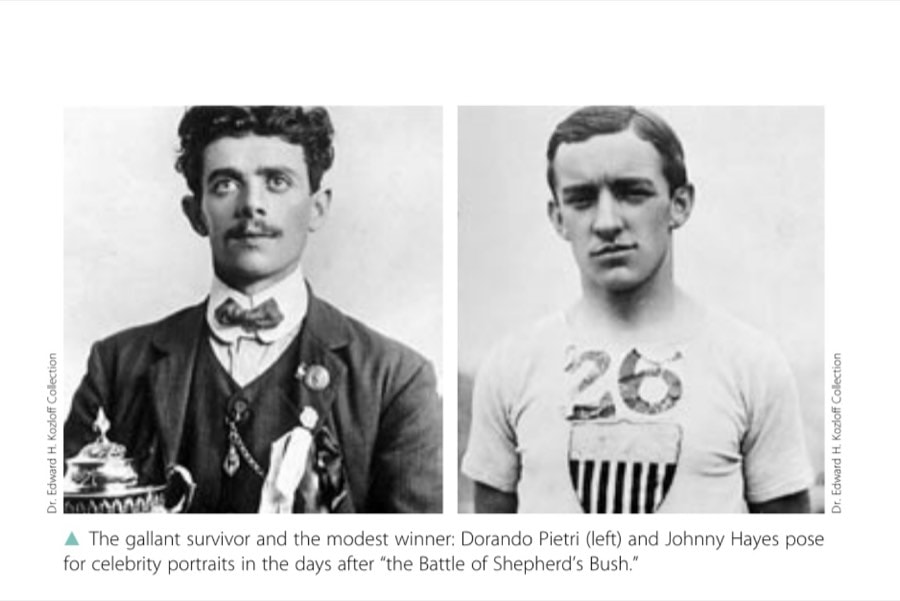
▲ The gallant survivor and the modest winner: Dorando Pietri (left) and Johnny Hayes pose for celebrity portraits in the days after “the Battle of Shepherd’s Bush.”
name) returned to the Toronto cigar shop that he nominally managed under the guidance of his racing manager, Irish-Canadian hotel owner and sports promoter Tom Flanagan. But the near-death drama in the Great White City had made “the marathon”
hot news. Pietri, Hayes, and Longboat were instant celebrities—the gallant survivor against exhaustion, the modest and efficient surprise winner, and the talented but mercurial “native” who wasted his big chance. Controversy raged about the motives of the officials who assisted Pietri. Many American commentators were
convinced that they virtually carried him across the line in their desperation to prevent another American Olympic victory. They asserted equally vehemently that the Canadian Longboat had been permitted to run, despite American protests
that he was professional, for the same reason. The ill will between British and American officials that marred those Games seethed on long afterward—it was known as “the Battle of Shepherd’s Bush” (the location of the Olympic stadium, later known as White City). Even the marathon’s official result was still hotly
disputed. There was wild variation between accounts of how much assistance Pietri received. Pietri himself, who had crossed the line first in front of nearly 100,000 people and earned huge admiration for his courage, now claimed that
the assistance had in fact prevented him from winning and that he could have reached the line alone, well ahead of Hayes, especially if his bicycle attendant had been permitted inside the stadium. (The photo of him totally blacked out after
his fourth collapse makes this unlikely, but memory is selective.) The story was too good to end with them all dutifully going back to cake making, department stores, and cigar shops. The world was agog for more races,
more heroics, more collapsing, more dicing with death, and it wanted all that over exactly 26 miles, 385 yards, the accidental curiosity of a distance that had become symbolic of the biggest sporting drama of the early 20th century. And the American world especially wanted to lay bets on the outcome.
NEW YORK LEADS THE WAY One of nature’s laws is that where there is a buck to be made, there will be someone in New York to make it. This time it was a New York entrepreneur named Pat Powers. He made Pietri and Hayes offers they could not refuse to give up their amateur status and rerun their Olympic contest for the city’s sports-gambling crowds. Being Italian and Irish-American made them doubly attractive in a city whose workforce was drawn largely from immigrants from those places. Hovering in the wings was Longboat, with the exotic appeal of being indigenous. He also was at last openly calling himself professional. Also looking for races in North America was the biggest star of all, the greatest runner of the decade, England’s multiple track world record holder, Alfred Shrubb. He had been defrocked as an amateur in 1905 by the same officials who had paid him the money, an act of mind-boggling hypocrisy equaled only by the similar disqualification later in the century of Wes Santee.
Fortunately for Shrubb (unlike Santee in the 1950s), professional “pedestrianism” was still thriving, and after two stellar years over distances from one mile to 15 miles on the East Coast of America and Canada, Shrubb was now coaching the students at Harvard and felt ready, at 29, to move up to the marathon. His old English rival Fred Appleby was another available for the show, anxious to make up for a bad day at London and join the chase for big prize money.
It’s hard now to realize the popular appeal of running at that time. Even before the London Olympics made the marathon into the glamor event, the big star races, usually man against man, often nominally amateur, were promoted with the kind of celebrity sensationalism that these days boosts the fame of singers and movie stars. When Tom Flanagan put up Tom Longboat for an officially amateur race in Montreal called Round the Mountain, he stirred up publicity and the betting with a story of how Alf Shrubb was going to run the course an hour after the amateurs and beat their time. Shrubb went along with the fiction (he never revealed whether he was paid) but had no intention of running. After the race, he met Flanagan by arrangement in a bar, where Flanagan first winked and then slapped his face in feigned anger about him being a pro. Later Flanagan had a cartoon on his office wall that read “Flanagan hits Shrubb in the interests of amateur sport.” It makes Jen and Brad and company look uninventive in their celebrity cavortings.
So Powers wanted the ultimate publicity dream of the Olympics revisited— Pietri against Hayes, one-on-one, man-to-man, pure and simple, like a boxing
Dr. Edward H. Kozloff Collection
championship, the race to settle all the arguments about who really deserved to win in London. For maximum spectator appeal and gate money, he booked Madison Square Garden, then a splendid classical building with columns like an Italian palace, at Fourth Avenue and 27th Street. It had vast spectator space, holding an estimated 16,000, many in standing room, with trackside boxes for the wealthy. But it provided only a tiny, dusty indoor track 176 yards round, 10 laps to the mile, requiring 262 laps for the magic 26 miles, 385 yards.
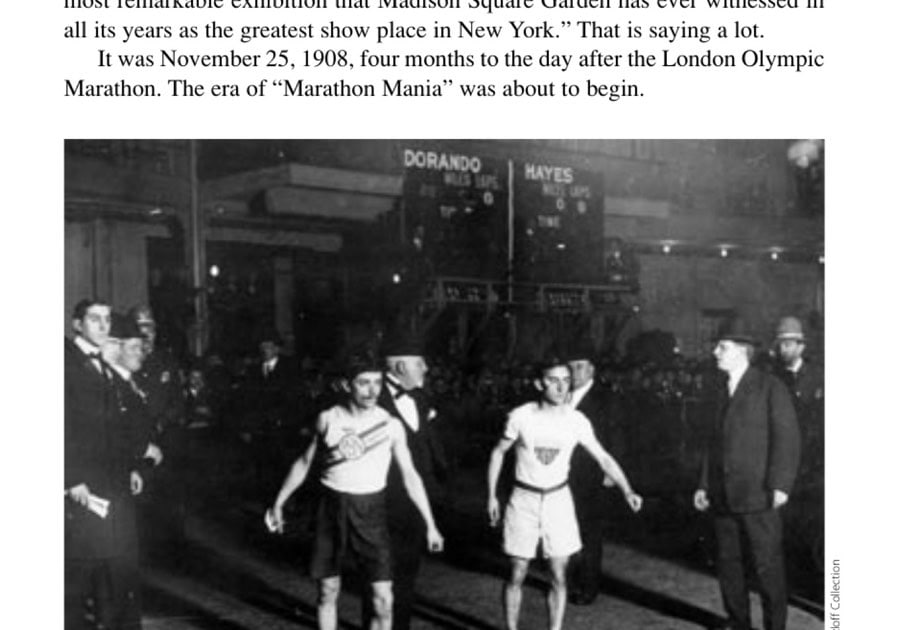
Turbulent crowds jammed the hall to the roof, waving Italian, Irish, and American flags—and making the air thick with tobacco smoke. Rival bands tried to make themselves heard—rollicking Italian tunes for Pietri and the stirring military brass band of the 69th Regiment for Johnny Hayes. The crowd was in a frenzy, especially (and unsurprisingly) the Italians, exuberantly chanting “Dorando! Dorando!” and “Viva Italia!” It was, the New York Times reported, “the most remarkable exhibition that Madison Square Garden has ever witnessed in all its years as the greatest show place in New York.” That is saying a lot.
It was November 25, 1908, four months to the day after the London Olympic Marathon. The era of “Marathon Mania” was about to begin.
▲ Two small, determined and very fit men: Pietri (left) and Hayes on the line at Madison Square Garden, November 25, 1908. Behind them the indicator board rises through the tobacco smoke, ready to show their “miles” and “laps.”
DORANDO BEATS HAYES AMIDST MARATHON RIOT Madison Square Garden, New York, November 26, 1908—It was, the New York Times reported, “the most spectacular foot race that New York ever has witnessed.” It progressed as a battle of attrition. For 24 miles, Pietri led by a stride, Hayes doggedly following, the tension sometimes broken by sudden occasional tactical bursts as each tried to make a break or at least grab the psychological initiative—always unsuccessfully. They resumed their positions, Pietri pattering on relentlessly, Hayes treading in his fresh footprints in the dust, round and round and round. Both seemed to look only inward. The atmosphere grew more and more suffocating as the dust and tobacco smoke swirled. The crowd watched and cheered through the gray haze. From 20 miles, Hayes was perceptibly tiring but threw in spurt after spurt, and two laps before 25 miles (12 laps to go) he led across the finish line for the first time. It was his last gasp. He faltered; Pietri sensed the weakness, picked up the pace, and a gap opened for the first time. After two and a half hours of suspense, the stadium erupted into 10 minutes of bedlam.
Once again, those extra 385 yards were nearly the undoing of Dorando Pietri. At 26 miles (260 laps), he was in front by 30 yards and running strongly, but his Italian fans, believing the race had ended at 26 (and why not?), poured triumphantly out of the stands and surged on to the track. Police and officials desperately tried to keep the tiny circuit clear, “blows were struck” (as the Times reticently put it), and the whole place was on the edge of a full riot as the little hero weaved and dodged his last two laps through a narrow lane cleared by fist-swinging police. He finished in 2:44:20.4, with Hayes, who had to fight through the crowd as it closed in behind Pietri, in 2:45:03.2. Those times, 11 minutes faster than they ran on the hot and dusty roads of London in July, are worth pausing to consider. On the tight curves of a 176-yard circuit, a surface of loose dirty sand and in a haze of smoke and dust, they are very impressive—6:16 miles. The skeptic in me wonders about the rigor of track measurement at that date and figures that one yard short per lap would amount to 276 yards. But even allowing for some possible error, these two small, determined, and very fit men were the real thing by any marathon standards. They put on a wonderful race, as great as you could hope to see in any time in history. If you were an Italian immigrant and had sold your Brooklyn barber shop to put all your money on Pietri, it was even greater.
IRVING BERLIN IMMORTALIZES LITTLE DORANDO Pietri Versus Longboat, Madison Square Garden, December 15, 1908—It was Dorando Pietri’s next race, however, less than three weeks after his vengeance over Hayes, that inspired the comic vaudeville song, “Dorando.” It is sung by a poor stage-Italian barber, who is so patriotically for Pietri that he “sell da barber shop, And make da bet Dorando he’s a win.” Among the frenzied Italian crowd, the song’s
character cheers wildly for his hero, who carries the ex-barber’s entire savings on his back. The fan’s hopes are high as “He run-a, run-a, run-a, Run like anything. One-a, two-a hundred times around da ring.” But he can only watch in despair, as “Just then, Dorando he’s a-drop! Good-bye, poor old barber’s shop.”
The song capitalized on the huge public interest in the continuing story of the marathon. The words and music were by a little-known 30-year-old composer, born in Russia, named Isadore Baline. Two years later he wrote “Alexander’s Ragtime Band,” under his better-known pen name, Irving Berlin. “Dorando” is not as memorable as Berlin’s “White Christmas” or “God Bless America,” but it deserves to be better known than it is. But guesswork has again smothered history. Everyone who refers to Berlin’s “Dorando” has assumed it to be a song of sympathy after Pietri’s heroic London struggle. In fact, it is a song of comic Italian misery at Dorando’s second great collapse, at Madison Square Garden, when he staggered and stumbled and “finally fell to the track exhausted” in the wake of Tom Longboat.
The New York Times made the most of his total exhaustion: “There was a glassy stare in Dorando’s eyes as his brother and a trainer rushed to the track to help him to his feet. . . . He fell back helpless . . . too far gone to speak. . . . As he was carried to his dressing room he fainted, and was unconscious for some time.”
In London, his public sufferings lasted long minutes, but this time collapse came suddenly, as Berlin’s song describes. Like the Hayes contest, the race had been too close to pick as Pietri led for 25 miles—250 laps. With the wisdom of hindsight, several reports describe how smooth and controlled Longboat looked and how confidently he seemed to choose his moment (with 11 laps or just over one mile to go) to move in front. Pietri clung for three more laps, but then it became futile, and Dorando he’s a-drop! Dismay spread among the Italian supporters, and the Indian war whoop of triumph from Longboat’s fans drowned out the fading cries of “Viva Italia!” Longboat, who after the London Olympics had been scorned as the “tottering Indian” and his failure taken as proof of the unreliability of his race, was now “the stout-hearted redman” and “the greatest distance runner of the age.”
There was just as much drama off the track. Swindlers took advantage of the throngs of Italians desperate to get into the Garden, many with limited English, and sold them thousands of phony tickets (mostly for a roller-skating event the previous month). Disappointed Italians do not go quietly. Fights broke out between Italians and Irish. Angry crowds clogged the gates, refusing to accept that the tickets they had paid for were worthless, and masses more, with fake or genuine tickets, fought to get past them to reach the entrance. People were wedged so tight that it was impossible to raise an arm, said the Times. Just as well perhaps. It took an hour, police reinforcements, and finally the mounted squad, to restore order.
CROWDS REACT TO RACE REPORTS POSTED ON BULLETIN BOARDS
Andy Yelenak Collection / www.RunningPast.com
Meanwhile, yet more crowds gathered in Times Square to follow the progress of the race on the bulletin boards of the New York Times. People pouring out of Broadway theaters got some free extra drama, joining the cheering throng in front
of the bulletin window just as the runners entered their sensational last mile. The streets and sidewalks were totally jammed, streetcars and all traffic halted, and only the final bulletin of Longboat’s winning time (2:45:05) enabled police to
clear a narrow lane to let passersby move along. All this public interest, as with Irving Berlin’s Italian barber, was not entirely purist, of course. There was heavy betting, with Pietri very much the favorite after
his victory over Hayes. No one knew then that two hard marathons in 20 days is asking too much of any elite runner. Longboat perhaps conspired to preserve his outsider status by losing a race against obscure opposition in Philadelphia a
few days beforehand. But if the odds were manipulated, the race itself sounds for real and was a beauty, even if Pietri was less than fully recovered. The world was gripped by marathon mania—and not just New York—see “Marathon Afloat:
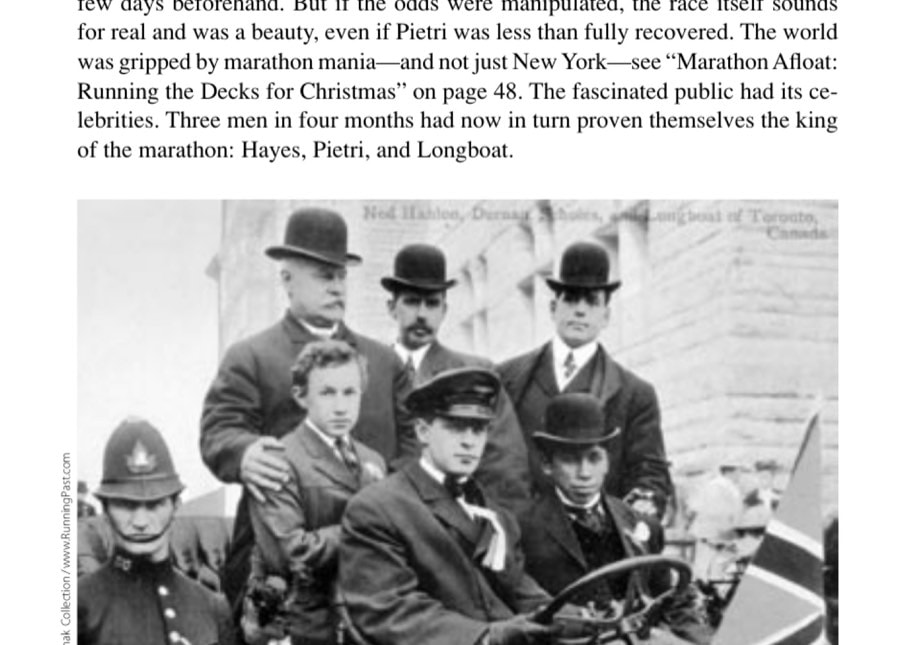
Running the Decks for Christmas” on page 48. The fascinated public had its celebrities. Three men in four months had now in turn proven themselves the king of the marathon: Hayes, Pietri, and Longboat.
▲ Thomas Longboat (sitting next to the driver) rides to City Hall with three other famed Toronto athletes, all rowers.
Marathon Afloat: Running the Decks for Christmas On board the Wyoming, Christmas morning, 1908—History’s first marathon afloat was run when 11 sailors started a Christmas Day marathon, the full 26.2 miles, around the deck of the warship Wyoming (waiting to be renamed the Cheyenne), at anchor in San Francisco harbor. The lap round the “huge deck” of the monitor was 130 yards, making a mind-numbing 355 circuits. Understandably, only two men finished, and the winner, who deserves to be recorded, was J. P. White—no time given, but he somehow went on to shine in “other contests during the afternoon.”
And now, looking for even more sensation in 1909 and yet another marathon king, Pat Powers signed up Alfred Shrubb.
HUGE CROWDS CHEER MARATHON THROUGH NEW YORK CITY STREETS Rye to Columbus Circle, December 26, 1908—The marathon returned to the roads, a point-to-point course, and amateurism, and the record for 26 miles, 385 yards was taken under 2:40 in an extraordinary run by Matthew Maloney of New York’s Trinity Athletic Club. Despite “roads deep and slippery in slush and mud” and “for the greater part covered by frozen snow,” Maloney won by nine minutes in 2:36:26.2. It was an amateur race from Rye that came down Seventh Avenue, crossed on 110th Street, and finished down Central Park West at Columbus Circle at the office of the New York Evening Journal, the race sponsor. So 1976 was not the first time a marathon was run through the streets of at least two New York boroughs. The “immense crowds” also matched today’s. They lined the entire route, many raced in pursuit of the runners in newfangled automobiles, and they arrived so early and in such numbers at the best viewing positions in the last five miles that the police had difficulty keeping streets open. Even the field, 109 starters on a cold day, was large by any standards pre1976—and over 400 would-be competitors were excluded on grounds of “physical fitness.” There is no record of how that was ascertained. The course was “carefully measured by a corps of civil engineers, accompanied by representatives of the AAU,” so the New York Times was confident that the distance was legitimate. Others were dubious, and I’m with them, as I am about all course measurements in this era.
Maloney’s marathon debut, in a fog-shrouded Yonkers race on November 26, 1908, had been disastrous, ending with him collapsed (yet another) on the
track. An Irishman who emigrated from County Clare three years earlier, he was a “mild-mannered youth of 21,” popular with his club, a nondrinking bartender who had given up his job to train for the marathon after a career as a strong but never a star runner. Apparently untroubled by the frozen slush and mud that was sometimes almost ankle deep (six weeks earlier he had run well in a junior cross-country championship), he took the lead at nine miles from his only serious competitor, Mike Crowley of the Irish-American A.C., dropped him at the Harlem River, and finished fresh as Crowley struggled to keep moving. The second placer could barely stay on his feet, staggering unsteadily through the crowd at the finish. Maloney meanwhile “capered about,” posed for photographs, and waited to encourage many of the finishers. So once again the marathon displayed the fine line that is its hallmark, between brilliant achievement and desperate collapse. Once again, vast crowds were enthralled to watch “the fascinating struggle between a set purpose and an utterly exhausted frame” (in Conan Doyle’s words about Pietri in the London Olympic race). And once again, new standards were being set in human capability over a long distance. However unreliable the new record times, in exactly one month, from November 26 to December 26, three great marathon races, all in New York, had made the new distance one of the world’s great sporting challenges.
Human-nature footnote (race directors please note): There were angry protests when the “cup trophies” that the race had advertised for the first 15 home were replaced, except for first and second, by medals, not even inscribed. The change aroused “bitter comment,” and the athletes (all pure amateurs) at first refused to accept the medals until reassured that the AAU would provide the missing cups.
Longboat Bliss Blocked by Bishop Toronto, December 26, 1908—The marathon, although it took a while to welcome women, has from the start been open to all comers, whatever their race or creed. Not always so the church. Native Canadian Tom Longboat’s
plans to marry Lauretta Maracle, a white schoolteacher of Indian children, in a Christian Anglican service, were banned by the archbishop on the grounds that the runner’s “change from heathendom to Christianity at Deseronto last
week was not sincere.” It sounds racist, or at least patronizing, but at this distance an informed view is difficult. Tom Flanagan (Longboat’s vigorous Irish-Canadian manager) protested loudly. Even Flanagan could not have set
up an archbishop, disappointed a bride, and arranged the media coverage, for the publicity—could he? (The marriage went ahead later, was successful, but ended sadly: see Longboat biographical note on page 61.)
And Maloney, loyal club man though he was, promptly turned pro and won a well-paid match-race marathon against the champion of Ireland, Patrick White. Amateurism (as Oscar Wilde said about truth) is rarely pure and never simple.
WAITING FOR SHRUBB Pietri’s latest collapse against Longboat in mid December 1908 did not deter the irrepressible Dorando. Four weeks later, on January 11, he was back on the boards to run a full marathon, and another only 11 days after that. His Italian devotees
wanted to see him win and were not too critical when he was matched with relatively weak opponents. He beat Percy Smallwood of Philadelphia in 2:44:32.4 and Albert Corey of Chicago in 2:56:00.4. Corey limped off the track, “distressed
and labored,” at 19 miles. Pietri was described as “seemingly fresh and strong.” There was another good amateur marathon, too, when Robert Fowler won the Yonkers Empire City Marathon on the roads on January 1 in 2:52:45.
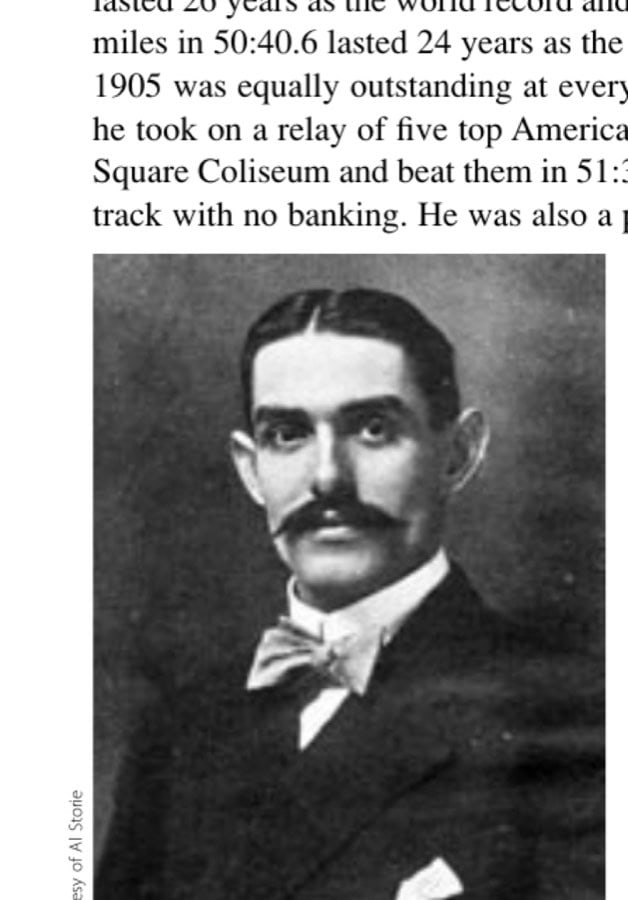
But the marathon was waiting for Alf Shrubb. As an amateur runner, Alf Shrubb twice won the International Cross-Country and on the track in 1902 to 1904 set at least 15 world records, from 1 1/2 miles to
one hour, some of which lasted for decades. His six miles in 29:59:04, for instance, lasted 26 years as the world record and 32 years as the British record; and his 10 miles in 50:40.6 lasted 24 years as the world mark. His professional career after
1905 was equally outstanding at every distance from one to 15 miles. In 1908, he took on a relay of five top American runners over 10 miles at Boston’s Park Square Coliseum and beat them in 51:33.4, an astonishing time on a tight indoor
track with no banking. He was also a pioneer of systematic twice-daily training and author of a coaching book that was influential for half a century. It’s no exaggeration to say that Alf Shrubb belongs
with Paavo Nurmi and Emil Zatopek as one of history’s truly great runners.
15 MILES DOES NOT A MARATHON MAKE
Courtesy of Al Storie
But not at the marathon. Well capable of running 14 miles in training at 5:30-mile pace (he did exactly that on February 2, ▲
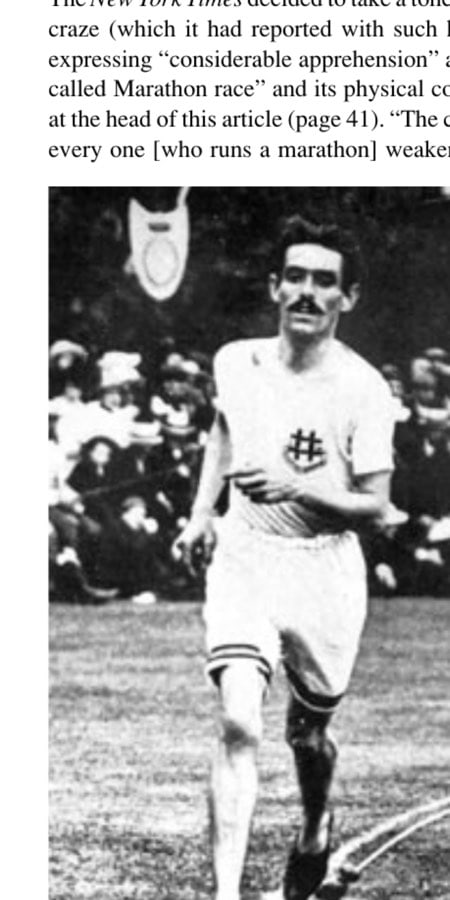
One of history’s truly great runners: Alf Shrubb, who began life as a rural builder’s laborer, shows the benefits of his success as a professional runner (about 1909).
Courtesy of Al Storie
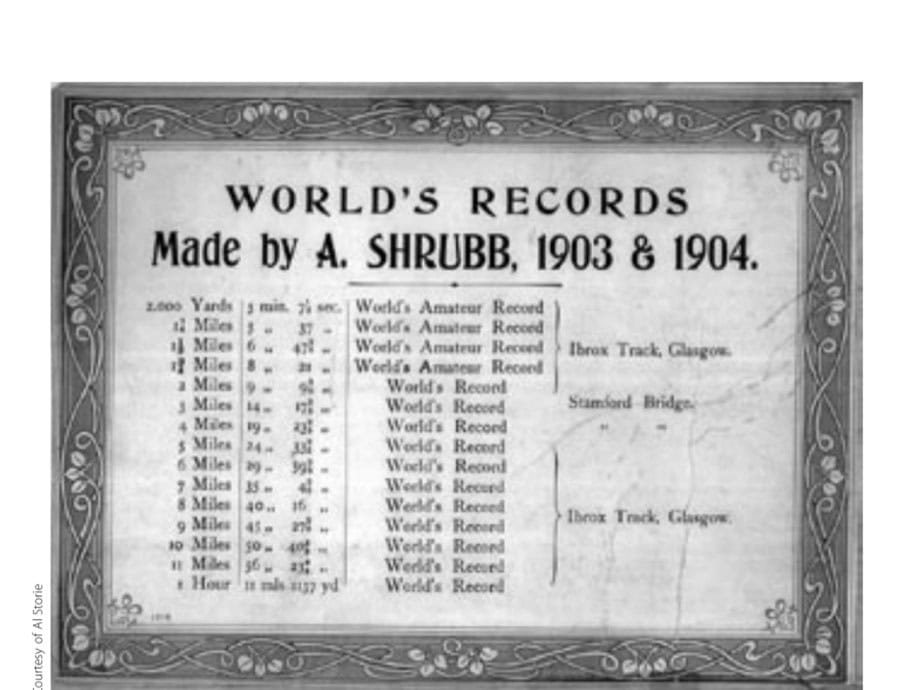
▲ Alf Shrubb’s 15 world records as an amateur track runner. All Shrubb pictures are courtesy of Al Storie, race director, Alfie Shrubb 8K, Bowmanville, Ontario.
1909), Shrubb’s insistence on going out fast in every race undid him every time he raced farther than about 15 miles—every time he went into what we now know is glycogen-deficiency territory. We find it utterly predictable that to run the first
half mile in 2:25 and mile in 4:52, as he did against Longboat, round tight bends and on a surface of crushed cinders, will (in days when the best ever was 2:36) merely add bricks to the waiting Wall. Even great runners have a finite store of
glycogen. But Shrubb had been so successful with fast starts at shorter distances that nothing would persuade him to try it otherwise. At Madison Square Garden on February 5, 1909, he ran faster than anyone had ever done in a marathon,
breaking the record for every intermediate time—up to 23 miles. But none stood, since he failed to finish. It was Longboat, often scorned for being an erratic Indian, who understood that the marathon distance is a far horizon and requires patience, not aggressiveness.
He logged training runs up to 50 miles, and when he won Boston in 1907, he didn’t take the lead until after 17 miles. And the marathon now was more than a mile longer than it used to be, thanks to Queen Alexandra and her grandchildren.
Longboat endured the wrath of the Madison Square Garden crowd for keeping to such an unexciting pace while Shrubb zoomed farther and farther ahead. When
Runner-on-Reservoir Disgrace: Police Swing into Action New York Times, February 8, 1909—S. Levy was arrested in New York “for using the Central Park Reservoir for cross-country running.” (Presumably that means the path around the reservoir, not the actual water.) The previous year Alf Shrubb had a similar encounter while training there but used his speed and cross-country skills to elude the mounted cop who pursued him. These days the reservoir path is one of the most heavily used running routes anywhere in the world.
Shrubb began to falter after 20 miles, Longboat got hissed and booed when he still refused to do more than what looked like plodding. Even when an Indian girl in full costume appeared alongside to urge him on, he declined to lift his pace. One paper (The World) reported that he quietly took inspiration from the trackside presence of Lauretta, “his little white wife.” But the crowd wanted action.
LONGBOAT KNEW THE MARATHON WAS LONG Nevertheless, even as Shrubb added to his huge lead, Longboat in fact was winning. At 17 miles, he had been eight laps behind—four-fifths of a mile. After 20, that whittled down relentlessly. At 21, Shrubb had trouble with his shoes and lost more than a lap; at 22, he had trouble keeping running; and at 23, he was alternating walking with “running very feebly.” The gap was down to under two minutes. Only a half mile later, after Shrubb had shuffled painfully forward for two laps at a slow walk, Longboat sailed past, and Madison Square Garden erupted. The crowd was “whooping and howling,” now wildly encouraging the Indian underdog, rejecting the prerace favorite, the seemingly arrogant Brit who had set out so ostentatiously to destroy him. (Shrubb in fact was a modest hard-working man who began life as a rural builder, but New York crowds are not that subtle.) The Times caught the mood: “The pent-up uncertainty of over two hours broke forth in an uproar, the equal of which has seldom been witnessed in the big Garden, famous as it is for scenes of stirring and heart-throbbing events.”
Alf Shrubb’s heart was throbbing pretty feebly. Only half a lap after he was passed, he slumped “limp and worn out” into the arms of his supporters. “I lay gasping on my back for four hours with two doctors in constant attendance. They told me afterwards I nearly pegged out.” Longboat strode on for the last two miles at the same pace, reaching the line in 2:53:40.4. Once more, a race between two excellent runners, “one of the great historic contests” (London Times), had revealed
the two contrasting faces of the marathon. It was, wrote the Evening Journal, “a race that had sensational features and grim, grueling grit.” Once again, spectators witnessed in vivid and elemental close-up triumph and despair. The fascinating struggle between them sustained marathon mania into the next decade.
THE TIMES IS SUDDENLY OUTRAGED!
Alf Shrubb in his prime as a world-record breaker, on a grass track in England, about 1903.
▲
Courtesy of Al Storie
The New York Times decided to take a tone of moral disapproval toward the whole craze (which it had reported with such hyperbolic gusto) and ran an editorial expressing “considerable apprehension” about the “sudden popularity of the so
called Marathon race” and its physical consequences. I quote some key phrases at the head of this article (page 41). “The chances are,” the editorial intones, “that every one [who runs a marathon] weakens his heart and shortens his life. . . .”
Just as well Johnny Kelley didn’t read that. He ran 61 Bostons and many other marathons and still lived to age 97. We know now that the Times’s arguments are mostly superstitious hooey. Unfortunately, six
weeks later, on April 4, the Times was able to report that a successful English marathon runner, Frederick Rumsby, collapsed and died during a 20-mile track race at Hull. His was, so far as I can establish, the only
death in these years of frenzied marathon mania despite the fact that no competitors could have much experience of the
Debilitation, Danger, and Death: The Risks of the Marathon New York Times Editor Exhorts, February 24, 1909—Part of the public’s fascination with the marathon was always the extreme and visible suffering endured
by runners on the edge of collapse. In a modern city, you don’t often get the buzz of watching someone stagger helplessly about in an advanced state of exhaustion, especially with the added interest that you have staked your life’s
savings on whether he falls over. Every race in these first two epic months of marathon mania had burned into the ardent spectators’ minds those two contrasting but simultaneous images: supreme athletic accomplishment and
humiliating and dangerous collapse. No one, including the runners themselves, could predict beforehand which runner would fill which role. Every race was a two-hour-plus suspense drama followed by a sudden sensational last act of triumph and tribulation.
weird distance and none were by modern standards sufficiently trained. But the public thrives on danger, and the editorial probably helped to keep marathon races popular as the horror shows of their time.
PIETRI AND HAYES GO AT IT AGAIN Pietri Versus Hayes, Madison Square Garden, March 15, 1909—Bands, patriotic tunes, flags waving from floor to ceiling, “joyous enthusiasm,” more throngs clamoring to get in, two popular runners idolized by their Irish and Italian fans—no wonder the marathon, as the Times remarked, “still holds a firm grip upon a large proportion of New York’s sports-loving public.” Dorando Pietri was adored by every Italian immigrant, a belief untroubled when a fully recovered Alf Shrubb thrashed him in a 15-mile race in Buffalo on February 26. Johnny Hayes, as well as his Irish following, was a hero with New York’s boys, who packed the cheap standing area. Fifteen-year-old John Donnelly broke his ankle trying to get in free by climbing over the Garden’s high iron fence. “I won’t mind the broken bone if only Hayes wins,” he said gallantly. Even that sacrifice was in vain. Hayes seemed to have lost his spark and could only follow Pietri’s pace. The Irish were briefly hopeful when Hayes managed to take the lead in the 13th mile, but it was only for one lap, and two miles later Pietri put the race away with a burst that took him two laps clear. With that lead safe (about 350 yards), he ran again with Hayes until 25, when he gave the night some excitement with “a whirlwind finish.” Italians rejoiced as only Italians
can. The London Olympic debate was finally settled, the score two races to one to Pietri. Meanwhile, Hayes quietly and slowly made it to the finish and did not collapse or die. The marathon was beginning to mature.
MARATHON OF THE ALL-STARS The Great Marathon Derby, Polo Grounds, April 3, 1909—It was the marathon of winners, “the six most famous runners in the world, each a champion in his own country,” the true world championship of the decade, the richest prize purse ever offered ($5,000 for the winner, big money in 1909). The race deserves to be much better remembered in marathon history than it is. In six sensational months so far of marathon mania, these were the big stars, five men who drew the crowds, who had rejoiced and conquered and collapsed in public view: Hayes, Longboat, Maloney, Pietri, and Shrubb, plus one unknown, a little French chauffeur (or waiter, according to your source) called Henri St. Yves, who qualified by winning a marathon in Edinburgh. It was promoter Pat Powers, of course, who put this dream international field together, and the whole East Coast was hot with gambling and gossip.
Longboat started favorite in the New York betting, at 6-to-5, with Pietri at 11-to-5 and Shrubb 3-to-1. Boston put its money on Shrubb, at 8-to-5. He was coaching Harvard, after all. Hayes, Maloney, and St. Yves were outsiders, though the Irish were with Hayes and Maloney. The unfancied Frenchman had trained for three weeks at Princeton with the student cross-country team, who stayed with him in relays. Loyally they backed him at long odds.
To accommodate bigger crowds, the Great Marathon Derby was at the New York’s famous baseball venue, the Polo Grounds, which squeezed in 25,000 with more overflowing to every nearby vantage point. They were clinging in their hundreds to Coogan’s Bluff and perched six deep along the Speedway and the heights above it. Boys beyond number, nearly all Johnny Hayes fans, prowled the adjoining Manhattan Field searching for illicit ways in.
The setting for this battle of the six heroes was an outdoor grass track, five laps to the mile. In the tradition of the Pietri-Hayes contests, Viola’s Italian Band and Bayne’s 69th Regiment Band were hired to “alternate in a concert,” which continued throughout the race. (And the meets today that add recorded music to track distance races think they are daringly inventive.) Everything was set for one of the most spectacular sporting entertainments since the Rome Coliseum was closed.
And then it rained. The field was so soggy that the size of the track was reduced to improve the footing, making it six laps a mile. Six men running 158 laps on wet grass means mud. It means difficult, slippery bends for tiring men. On April 3 in New York,
Dorando’s Chauffeur Arrested New York Times, April 4, 1909—William McCarthy of the New York Taxicab Company was arrested after the race for speeding. He protested that Dorando Pietri and a party of friends had asked him to make fast time from the Polo Grounds into downtown Manhattan. Pietri refused to put up $100 as bail. The vehicle was doing 22 miles per hour!
it means cold. It did not mean an unhappy crowd, who arrived hours early, sat on open banking getting totally soaked, and “cheered madly” as the competitors one by one made theatrical entrances. Pietri trotted over to the Italian block and bowed operatically, Longboat strode in with tribal dignity in a long dressing gown, Shrubb was stiff with English restraint, and Hayes entered last and got the loudest applause as he posed at length for the photographers. In these conditions, the crowd expected a good race but a slow time.
The start amused them. After Pietri and Shrubb had led briefly, the ridiculous little St. Yves took over on the fifth lap. The crowd, reported the New York Times, “laughed in derision as the French runner took up the lead . . . setting a heart-breaking pace.” A mere beginner among celebrities, a Frenchman and so by definition unreliable, with an unpronounceable name, despised in the betting, and running with a tiny pattering stride, St. Yves set off at a pace that was faster than even the notoriously fast-starting Alf Shrubb was willing to contest. St. Yves ran 5:14 for the first mile and well under six-minute miles from then on. The crowd knew he would kill himself at that pace, and Shrubb thought the same, running cautiously for once, keeping company with Pietri. Hayes, again using the negative-split tactics that won him the Olympics, was well back, and St. Yves lapped him as early as lap eight (in the second mile).
To everyone’s surprise and the crowd’s eventual reluctant admiration, tiny St. Yves stayed in front, lap after pattering lap. His action, said the Times, “seemed to glide rather than run over the grass track.” Still, they had seen Shrubb run in front like this for 20 miles and still end on the doctors’ slab while Longboat plodded home the winner. So they kept their eyes on Pietri and Longboat, three yards apart, who would both surely come through late in the race, and even on Hayes, who smilingly refused to be more assertive, even when the band played “The Star-Spangled Banner” to stir him.
And they cheered vociferously when Shrubb, who had never followed for so long in his life, grew impatient, reeled St. Yves in, and took over the lead at 10 miles. Longboat, 50 yards back, and Pietri, 50 behind him, awaited their moment. The overeager ones would burn out. This was how it was supposed to go.
WHAT’S THE FRENCHMAN DOING?
▲
The first marathon “world champion,” Henri St. Yves (France), who won the two great all-star marathons in 1909. In the Great Marathon Derby, Polo Grounds, April 3, 1909, he beat Pietri, Hayes, Shrubb, and Longboat.
Courtesy of Al Storie
But it didn’t. St. Yves sat on Shrubb for eight miles, with everyone in the ground expecting both to fade, until at 18 the unthinkable happened and St. Yves slipped by again into the lead. “His feet scarcely left the earth, and he ran with less apparent effort than any man seen here before.” Even the increasing sloppy mud didn’t seem to trouble him. The rain had stopped, but the track was getting churned. Now St. Yves moved away from Shrubb, still setting world marks for every intermediate distance. Pietri and Hayes looked more focused now but never came close. Longboat was in trouble at 18 miles. He stopped to change his shoes but was done, and walked off the track before 20. The other excitement came at about the same moment, when St. Yves lapped Shrubb. Now he was at least a lap—say 300 yards—clear of the entire field, and no one looked likely to threaten him. Shrubb was drifting, and by 22 he was paying for his reckless midrace pace. He walked, then staggered, then once again lost the fascinating struggle. Once more the great Alf Shrubb was forced to quit a marathon.
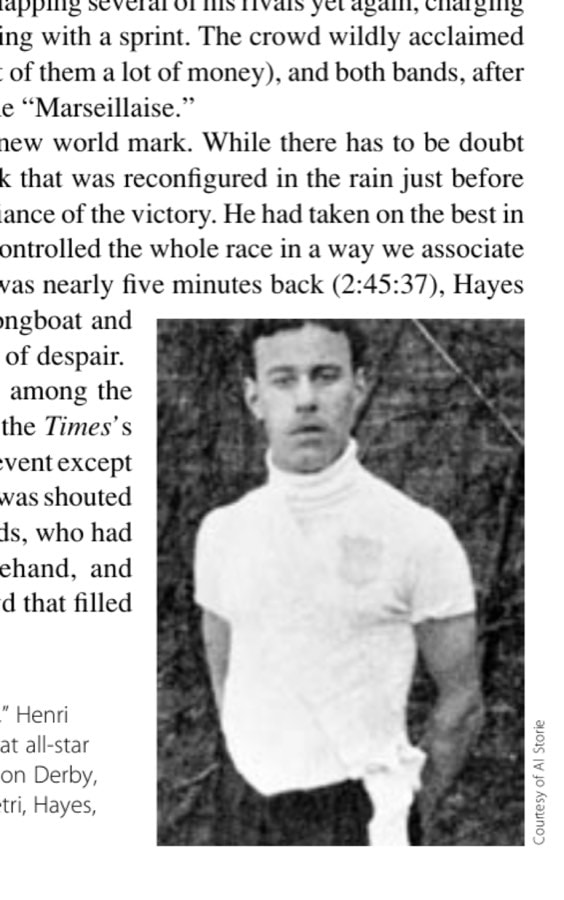
A pistol shot announced the last mile, and the irrepressible little Frenchman responded by picking up the pace, lapping several of his rivals yet again, charging briskly into his last lap, and finishing with a sprint. The crowd wildly acclaimed him (even though he had cost most of them a lot of money), and both bands, after some hasty research, broke into the “Marseillaise.”
St. Yves had run 2:40:50.6, a new world mark. While there has to be doubt about the exact accuracy of a track that was reconfigured in the rain just before the race, no one can doubt the brilliance of the victory. He had taken on the best in the world and thrashed them. He controlled the whole race in a way we associate with Zatopek or Radcliffe. Pietri was nearly five minutes back (2:45:37), Hayes and Maloney another five, and Longboat and Shrubb were in the dressing room of despair. In Times Square, rumors flew among the huge crowd that gathered around the Times’s bulletin board (the biggest for any event except a national election). Race progress was shouted by those closest to the notice boards, who had claimed their spots hours beforehand, and was passed back through the crowd that filled
Broadway and Seventh Avenue. Even the streetcars and taxis slowed down to hear progress reports. All was consternation and confusion. They expected to hear about Pietri, Hayes, Longboat, or even Shrubb, names that had become what we would call celebrities. The unknown leader was said to be Spanish, Mexican, or Hungarian before finally being identified as French. No one had heard of Henri St. Yves. No one, that is, except the Princeton cross-country team, who for three weeks had run in relays to help him in training and who won a great deal of money on him at very long odds. They were reported to be “jubilant.”
VIVE LA FRANCE DÉJÀ VU $10,000 International Marathon, May 8, 1909—Uneasy lies the head that wears a crown. St. Yves was the best in the world—but in the hotbed of marathon mania, he had to prove it again. There was too much public passion about the marathon, and too much money in it and on it, for any time-out. Only five weeks after the Great Marathon Derby, the swiftly organized $10,000 International Marathon put St. Yves on the line at the Polo Grounds again, this time against a largely new cast of challengers. Pietri and Maloney reappeared, to draw the Italian and Irish fans, but 10 fresh men now had their chance. The buzz was about the Canadian, John Marsh, who had broken St. Yves’s world mark in winning the Canadian championship in 2:39:47 on May 1, just a week before. Replacing Longboat was a new Native American, an Ojibwa with the nonethnic name of Fred Simpson; Fred Appleby took Shrubb’s British spot; John Svanberg of Sweden was there to point to the Scandinavian future; and two Frenchmen, Edouard Cibot and Louis Orphee, who had both beaten St. Yves at home, were there to do the same again.
A DIFFERENT STRATEGY THIS TIME, BUT THE SAME OUTCOME This time the race had a classic simplicity. Pietri rushed out fast and then Marsh, who led through mile one in 5:02 (2:11:58 marathon speed). Marsh kept it dangerously quick until just after four miles (21:51). There St. Yves skipped past him and was away. From then on, plus ça change, plus c’est la même chose (or the farther they went, the farther St. Yves got ahead). He slowed toward the end, but again his pattering stride showed uncanny aptitude for the narrow laps and grass surface. Being either a chauffeur or a waiter in Paris gets you used to tight corners. He won by a mile, in 2:44:05. Svanberg was second, finishing in trouble in 2:50:54. In five weeks, the little Frenchman had head butted the best 15 runners in the world in two world championship marathons. And Tom Morrissey (USA) collapsed. He fell twice, was bustled back on the track by his handlers, the crowd screamed for him to be removed, an attendant ran alongside, he fell limp in front of the grandstand so that the other runners had to veer around his
body, and it took 10 minutes before he regained consciousness and was carried off. Svanberg, too, was “dazed and staggering” and fell twice in his last lap. St. Yves trotted briskly off to collect his $5,000. The marathon’s fascinating struggle was as evident as ever.
THE STORY CONTINUES “Marathon mania” (as the official 1908 Olympic report had disparagingly called it) lasted another two years, quickly spreading around North America and the world. Top athletes faded and others replaced them, as they always do. The Swedes gained dominance, and brought the world’s best time under 2:30, excellent running in any era. Yet the “dangers” of the marathon were also still prominent in the public mind. Dire predictions were made about runners’ health, and one major athletic association, in Illinois, officially banned the event. The following headlines are selected to give a flavor of the sport’s continuing vitality and public interest, as well as its increasing diversity in these years. All are quoted direct from The New York Times 1909-1910. The date given in each case is of the actual event. Svanberg Wins Chicago Marathon St. Yves is Forced to Quit (May 29) Orphée Scores Easy Marathon Victory Frenchman Wins Brighton Beach Event (May 31) St. Yves Collapses French Runner May Never Race Again (October 3) St. Yves In Form Again Wins Guggenheim Marathon at Seattle (October 17) Marathon Victory for Harry Jensen First in Yonkers Event (November 27) Marathon Under Ban Illinois A.C. Will Eliminate All Long-Distance Runs (December 4) Ljungstrom Wins Marathon Derby New Mark of 2:34:08 2/5 Set by Swede in Capturing the Polo Grounds Race (April 2, 1910)
New Marathon Record Svanberg Runs 26 Miles and 385 Yards in 2:29:40 at Lawrence, Mass. (August 26)
AND AS AN EPILOGUE Bronx to City Hall Amateur Half-Marathon, May 6, 1911—It was only a “modified marathon” of 12 miles, but the story is too good to lie forgotten. When the borough president’s secretary gave permission for the finishers to “resume their street clothes” in a City Hall committee room, he thought there would be about 25 of them. He underestimated marathon mania. More than a thousand started, more than the officials could keep track of. Although many dropped out, at least 500 reached the finish. Tired and scantily dressed runners overcrowded the City Hall committee room and swarmed out over much of the building looking for space to rub down and change clothes. One horde occupied the lavishly furnished Board of Estimates Room and used the solid mahogany table as a rubbing-down table, smearing it with liniment and damaging the expensive carpet. Shouting and laughing, they ran from room to room, scattering orange and lemon peels, bottles, and towels. When one official of the Bureau of Weights and Measures refused them entry to his upper-story premises, they “made a rush upon his offices,” filled the room with runners, splashed water about, overturned chairs and desks, “and general pandemonium reigned.”
Several meetings were disturbed, and one conference of women schoolteachers, alarmed at the noise, left their meeting room only to find themselves trapped in the corridor in the midst of a cheering mob of men “in various stages of nudity.” The teachers dutifully screamed and beat a hasty retreat. Police aids were called and escorted the shocked women out of the building, “hiding their faces as they went.”
It took a force of cleaners two hours to put the building partly to rights. Thus, in a naked pandemonium of high postrace spirits, the great era of “Marathon Mania” came to a close.
After the Mania Dorando Pietri went home to Italy after the second Marathon Derby in May 1909 to marry Teresa Dondi. He returned to America in 1910 and took revenge on St. Yves and Longboat, then did a racing tour of South America. He retired in 1912 to run a motor garage in San Remo and died there in 1942, aged 56. There are proposals in Carpi to commemorate the centenary of the legendary 1908 Olympic race by holding a special Dorando Pietri Marathon and returning his remains to his old home town.
Johnny Hayes was a trainer to the American Olympic team in 1912 and later taught physical education and worked as a food broker. He also apparently spent some time digging the New York subways as a “sandhog.” He stayed in shape well enough to look very trim in a 1928 photograph of him jogging with world heavyweight boxing champion Gene Tunney. He is commemorated in a collection of memorabilia donated by his daughter to the New Jersey Shore Athletic Club and by a bronze statue in Nenagh, County Tipperary, Ireland.
Alf Shrubb was attracted to Canada, where he and Tom Longboat raced each other, often over distances shorter than the marathon, in the remaining years before World War I. Shrubb returned to England and managed a pub and
coached at Oxford University, before settling in Bowmanville, east of Toronto, where he enjoyed some recognition for his running achievements and died in 1964, at age 84. He is commemorated by an indoor sprint track in his birthplace
of Horsham, England, a biography by Rob Hadgraft, and an annual 8K race in June in his adopted Bowmanville, Ontario (www.alfieshrubb.ca). Tom Longboat volunteered for World War I and served three years, partly as
a running messenger in the trenches. Reported missing in action, he returned home to find his wife had remarried. His second wife, Martha, was from his own Six Nations Reserve. He was often unemployed after the war, tried farm
ing without success, became a garbage collector in Toronto, and retired to the Six Nations Reserve, where he died at 61. Alf Shrubb’s was among the most generous tributes. Longboat’s running medals had been pawned. He is
commemorated in two biographies, by Bruce Kidd and Jack Batten, and the annual Tom Longboat Awards, which recognize the outstanding First Nations sportspeople in each Canadian province. Information on Matthew Maloney or Henri St. Yves will be gratefully received at rogerrobinson61@hotmail.com.
FOOTNOTE Amateurs and professionals. Supposedly intended to free 19th-century sports from the evils of gambling and match fixing, the code of amateurism also sought to perpetuate class divisions by excluding those who worked as “mechanic, artisan or labourer” (in the terms of the original English Amateur Athletic Association). Most organized sports in their modern forms began in Britain with upper-class “gentlemen” wanting to continue the games they had played at their private high schools (in Britain called Public Schools). The separation was almost as rigid in the republican United States as in aristocratic Britain. In running, this class exclusion began to break down as clubs realized that good working-class runners could earn victories and kudos for the club. Under-the-table expense payments were
soon common, and competitors from lower socioeconomic groups were admitted to the sport, provided they retained the appearance of amateur purity. In 1908 in America, however, professional running still flourished alongside amateurism so that Pietri, Hayes, and Longboat were not giving up their whole athletic careers. They could also make an income far beyond any other available to them. But by the 1920s, the success of the Olympic movement had made amateurism emphatically the dominant code, and Jim Thorpe and Paavo Nurmi had nowhere to go once they were banned as amateurs. It was a system that kept power in the hands of the national federations and their officials, who often used it vindictively or to eliminate athletes who showed too much independence. Those of us who ran before the early 1980s remember having dutifully to sign a declaration on every race-entry form, however obscure the event, that we were true amateurs under the definition of the AAU or, in my case, the AAA or New Zealand AAA. Never mind insurance waivers, this was the thing that mattered. I used to do my writing about running for free, even for major national newspapers, rather than risk my vestal virginity as an amateur.
MAJOR SOURCES The files of The New York Times are the major source of part 2, accessed through the New York Public Library. Other newspapers were also used, including the New York Mirror and The American. For Alf Shrubb material, I am indebted to the excellent The Little Wonder by Rob Hadgraft—see recommended books below.
Recommended books include: • Batten, Jack. 2002. The Man Who Ran Faster Than Everyone: The Story of Tom Longboat. Toronto, Canada: Tundra Books. • Hadgraft, Rob. 2004. The Little Wonder: The Untold Story of Alfred Shrubb.
Westcliff-on-Sea, UK: Desert Island Books. • Kidd, Bruce. 1992. Tom Longboat. Don Mills, Ontario, Canada: Fitzhenry & Whiteside. • Martin, David, and Roger Gynn. 1979. The Marathon Footrace. Springfield,
Illinois: Charles Thomas. • Martin and Gynn. 2000. The Olympic Marathon. Champaign, Illinois: Human Kinetics. • Robinson, Roger, and Kathrine Switzer. 2006. 26.2 Marathon Stories. Emmaus, Pennsylvania: Rodale. •
Sears, Edward S. 2001. Running Through the Ages. Jefferson, North Carolina: McFarland & Co. • For Johnny Hayes, excellent material supplied by the Shore Athletic Club is at www.runningpast.com/johnny_hayes.htm.
This article originally appeared in Marathon & Beyond, Vol. 11, No. 3 (2007).
← Browse the full M&B ArchiveMore like this
1,000+ stories from 19 years of Marathon & Beyond
The complete archive of the legendary long-distance journal — digitized and free to read.
