

The Fascinating Struggle
“He has gone to the extreme of human endurance. . . . It is horrible, and yet fascinating, this struggle between a set purpose and an utterly exhausted frame.”— Arthur Conan Doyle on Dorando Pietri
It is the fantasy moment all marathon runners imagine during training runs on cold wet nights: you’re running through a dark tunnel and out into the bright sunlight of the stadium—and then, that sudden swelling roar of acclamation rises from 100,000 people. Your blood races at the very thought of it. No other moment in sport, however thrilling, is quite like this one. There are great touchdowns, and soccer goals, and home runs, and sprint finishes to one-mile races; but we watch and analyze the unfolding plays that precede each of those—we are witness to the whole drama. At the finish of a marathon, the stadium crowd sees only the final minute of a three-hour narrative. And for the runner, the moment of encounter is just as sudden—26 miles of lonely effort, then this sudden welcoming rapture.
It happens in a second. The crowd has waited, often with limited information. It mutters and shuffles and worries and waits—and then, he’s there, in front of you—he or she, since that iconic emergence into the sunlight by Joan Benoit in 1984. So much significance is condensed into that first glimpse of the marathon leader—an arrival that is the beginning, not the end, of the drama, a hero completing a journey, on the edge of triumph, yet still not quite there, visibly tired, terribly vulnerable, a tiny figure on a huge arena. Few moments are so expressive of human heroism and human frailty, the aspirations and fears we all share. Even as we roar in praise, we are looking anxiously or eagerly for the next runner. The runner’s sense of completion is also full of fear.
That moment has never been more dramatic than on July 24, 1908, at the Olympic Games marathon in London. Ten minutes earlier, a gun and a megaphone announcement, “The runners are in sight,” had told the crowd that they were near but gave no names. “Finally after what seemed to be an intolerable suspense a
Dr. Edward H. Kozloff Collection
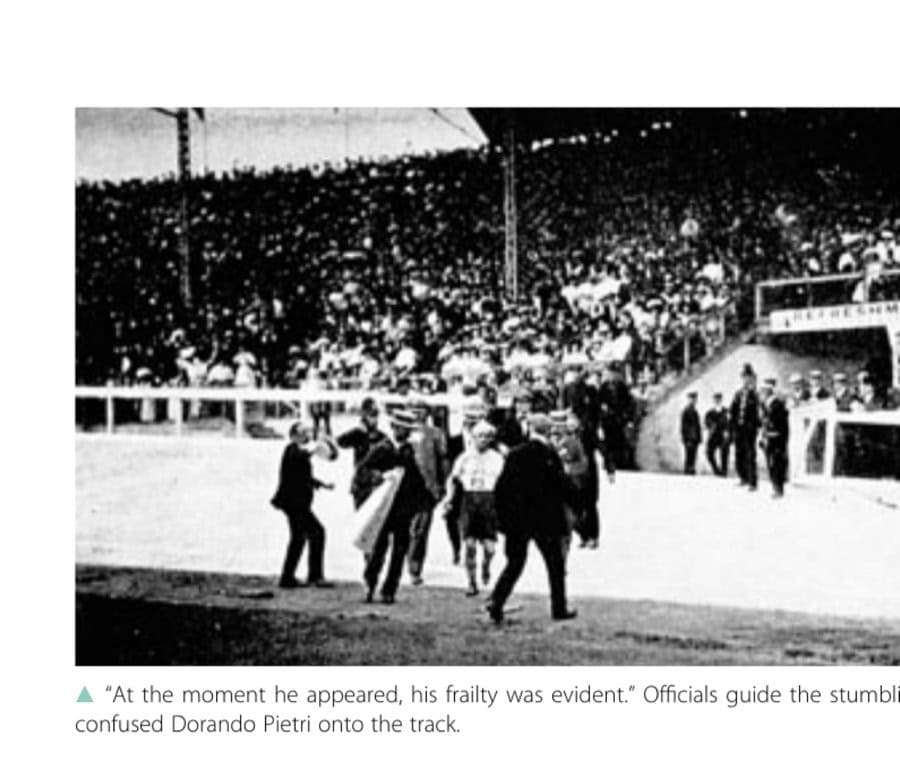
▲ “At the moment he appeared, his frailty was evident.” Officials guide the stumbling and confused Dorando Pietri onto the track.
runner staggered down the incline leading to the track,” wrote the New York Times. Down the sloping ramp and out on to the crunching cinders came a small, slight man in a sodden white T-shirt and baggy knee-length red shorts, a white handkerchief on his head. It was the Italian Dorando Pietri. And the crowd roared.
IT HAD BETTER BE A BRIT Earlier bulletins had brought the welcome news from the course that some of the 12 British runners went out fast into the lead and that two were still well ahead at 10 miles. Later the announcement was that South African Charles Hefferon was in front by nearly four minutes at 20 miles. For a British crowd, a South African winner born in England was nearly as good as a Briton in 1908, only six years after a bruising war had given Britain that last major colony. Better the South African than the young Canadian Indian Tom Longboat, who was the prerace favorite following his record-breaking win at Boston in 1907—but who was suspected of having taken money for running. Far better Hefferon, most of the crowd thought, than any of the 12 Americans, whose team had won many events and few friends in those conflict-ridden Games.
But when you’re waiting for the marathon leader to appear, nothing is certain. It was not the big white South African but the little dark Italian who by some miracle entered the roaring furnace of the Great White City (as the stadium was known). And the crowd cheered him a welcome from his dreams.
The dream was already a nightmare. At the very moment Pietri appeared and was acclaimed, his frailty was evident. He staggered and shuffled rather than ran. He “reeled as he entered and faced the roar of the applause,” wrote Arthur Conan Doyle (see “The Man With the Armband”). “It was evident at once to everyone that the man was practically delirious,” wrote the New York Times. He stuttered slowly out on to the cinder track, tried to turn the wrong way, encountered officials bewilderingly shouting and gesticulating at him, stopped in confusion, “afraid that they were trying to deceive him” (New York Times). He finally turned (or
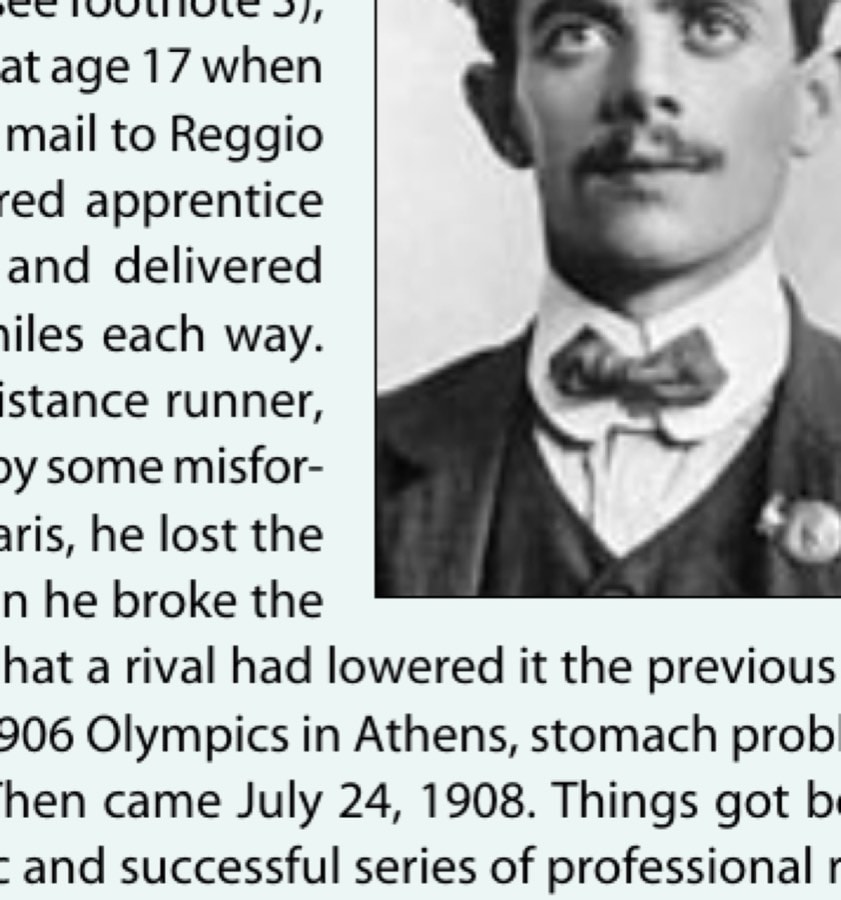
Dorando Pietri An ebullient personality sustained the disasterprone Pietri. He was born in Carpi (see footnote 3), and his running career began there at age 17 when his baker boss gave him a letter to mail to Reggio
Emilia. Four hours later the blistered apprentice returned, having misunderstood and delivered the letter in person, running 15 miles each way. He quickly became a good long-distance runner, but his successes seemed qualified by some misfor
tune. When he won a big 30K in Paris, he lost the title over an entry informality; when he broke the Italian one-hour record, he found that a rival had lowered it the previous day; and when he ran in the unofficial 1906 Olympics in Athens, stomach problems
forced him out of the marathon. Then came July 24, 1908. Things got better after that. He interrupted his hectic and successful series of professional races to return home and marry Teresa Dondi, and after he retired in 1912, they
set up a garage business in San Remo, on the sunny Mediterranean near the French border. At the time of the 1948 Olympic Games in London, six years after Pietri’s death, an Italian who owned a café in Birmingham convinced
newspapers that he was Dorando Pietri, but arrangements to have him run a lap of honor were dropped. Perhaps he was the brother or half brother who was living in England in1908 and acted as interpreter at the height of Pietri’s media fame.
Dr. Edward H. Kozloff Collection
October 16, 1885-February 7, 1942
A hundred years later, Pietri is a less-qualified hero, at least in Italy. Plans for the centenary celebrations in 2008 include a statue in Carpi and transferring Pietri’s remains there. The 2008 Carpi Marathon will also be a special commemoration. As warm-up, in the 2006 version, all runners wore bib number 19 and received a special T-shirt.
was turned) the right way, began to shuffle again. “He staggered along like a man in a dream, his gait being neither a walk nor a run, but simply a flounder, with arms shaking and legs tottering” (New York Times). Wavering from side to side, he covered about 20 yards—and then, to the horror of nearly 100,000 people, his legs crumpled and he fell. He was directly in front of a huge packed stand, and the people held their breath. Some thought he had died.
We might think that the noise or heat of the stadium overcame Pietri, but it is a little-known detail that he had already collapsed on the way into the arena. The marathon medical officer, Dr. Michael Bulger, reported, “I was first called to Dorando in the passage leading to the stadium. He was in a state of absolute collapse and quite pulseless. In a short time, he recovered sufficiently to enter the stadium.”
Now he was down and out in full view of the crowd. Officials ran to help the stricken runner. Later, Pietri lamented that the runners’ official bicycling attendants were not permitted inside the stadium. “If I had had my attendant to guide me and give me such aid as I was entitled to, I could have finished without falling again,” he said (through his half brother as interpreter).
THE ACCOUNTS VARY—WIDELY “There were wild gesticulations. Men stooped and rose again,” wrote Conan Doyle. All was confusion, and I’m trying to say only what I’m sure from contemporary sources did actually happen. Even eyewitness reports vary wildly. “He had to do one round of the arena [in fact it was half a lap] where unfortunately he was helped up, and so disqualified.” (Lady Metcalfe, letter to the Daily Telegraph, September 1965). “My recollection is that Dorando, on arriving at the track, was followed by a few enthusiasts . . . who patted him on the back. This no doubt caused his collapse.” (G. Chapman, letter to the Daily Telegraph, August 1965). Think how hard it is to get agreement on exactly what happened in the Budd/Decker incident in 1984—and that was televised and recorded on video. The official report probably gets nearest to a clear account. “As it was impossible to leave him there, for it looked as if he might die in the very presence of the Queen and that enormous crowd, the doctors and attendants rushed to his assistance. When he was slightly resuscitated, the excitement of his compatriots was so intense that the officials did not put him on an ambulance and send him out, as they no doubt would have done under less agitating circumstances.” (T. A. Cook, Official Report of the Olympic Games of 1908).
Pietri now struggled, or more probably was helped, to his feet, and tottered along the rest of the long straight, “the little red legs going incoherently,” as Doyle wrote. “Driven by a supreme will within,” he reached the curve, and “there is a groan as he falls once more” (Doyle). “The crowd shouted that he should not be left there, perhaps to expire in front of them all,” said Lord Desborough, the
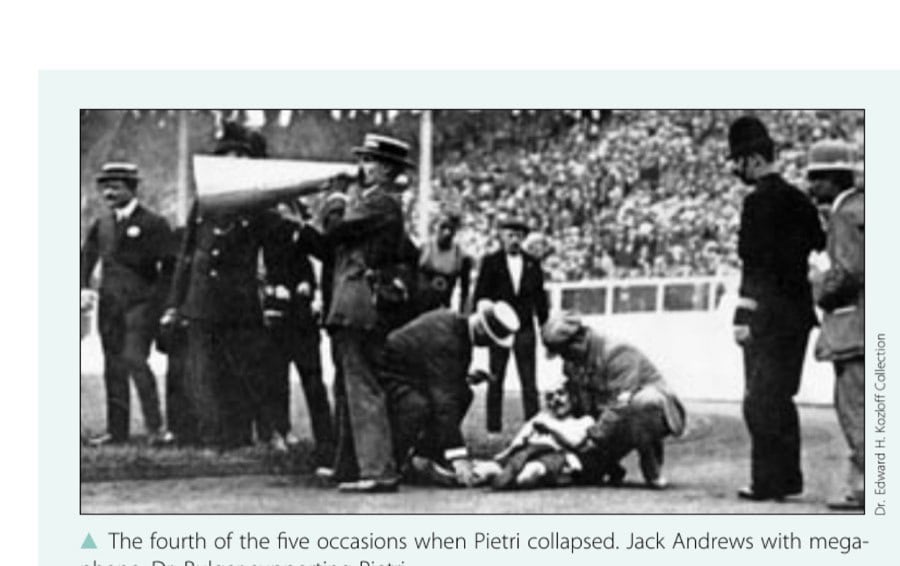
starter and referee, on a 1960s BBC radio program (“Scrapbook for 1908”). Up again—“a cheer as he staggers to his feet” (Doyle)—Pietri covered only a few yards before crumpling at the top of the bend. This time there is a photograph (see page 56), showing him lying on his back, supported in the arms of the medical officer, Dr. Bulger (see “The Case of the Man With the Armband” on pages 5357), with another man touching, perhaps massaging, his leg. Pietri looks totally out of it—eyes shut, limbs soggy, face shattered. He seems to have passed out. How he got to his feet again I can’t imagine, but he did, almost certainly with plenty of help. He got round the bend, “in the same furious and yet uncertain gait. Then again he collapsed, kind hands saving him from a heavy fall” (Doyle). And again the crowd gasped in horrified sympathy. Only about 60 yards remained to the white tape stretched across the track in the middle of the straight. But Pietri was down. “Surely he is done now. He cannot rise again,” writes Doyle, with the dramatic immediacy of a commentator on live radio or TV.
And now things became really exciting. The next runner appeared, the striped shield of the USA on his white shirt. It was Johnny Hayes, a New Yorker of Irish parentage. And he was charging—“going gallantly, well within his strength,” wrote Doyle. Hayes had run a perfectly judged race when everyone else was going bananas. The Brits ran the first mile in 5:01, and 1908 training and 1908 road surfaces simply did not give you a 2:11 marathon. Perhaps they were carried away by the presence of Mary, Princess of Wales. She received a telegraph from Queen Alexandra and thereupon commanded Lord Desborough to fire the gun. With that royal inspiration, two of the Brits reached 10 miles in a still suicidal 56:53. Hefferon and Pietri were on 57:12—also much too fast, on that training, on a hot day, on a course that was mostly dirt and stone and that crossed cow paddocks at 25 miles. But Hefferon and Pietri had enough in reserve to sweep up the Brits by 14 miles, where Hefferon moved powerfully away—too powerfully. On the 15th mile, he went ahead by two minutes. Then Tom Longboat came up fast—too fast. He was in second at 16 miles. At 17, he was walking. He soon gave up. (“A Special Car will follow to carry competitors who abandon the race,” promised the official instructions.) Longboat’s bicycle assistant was plying him with champagne to quench his thirst, which probably did not help.
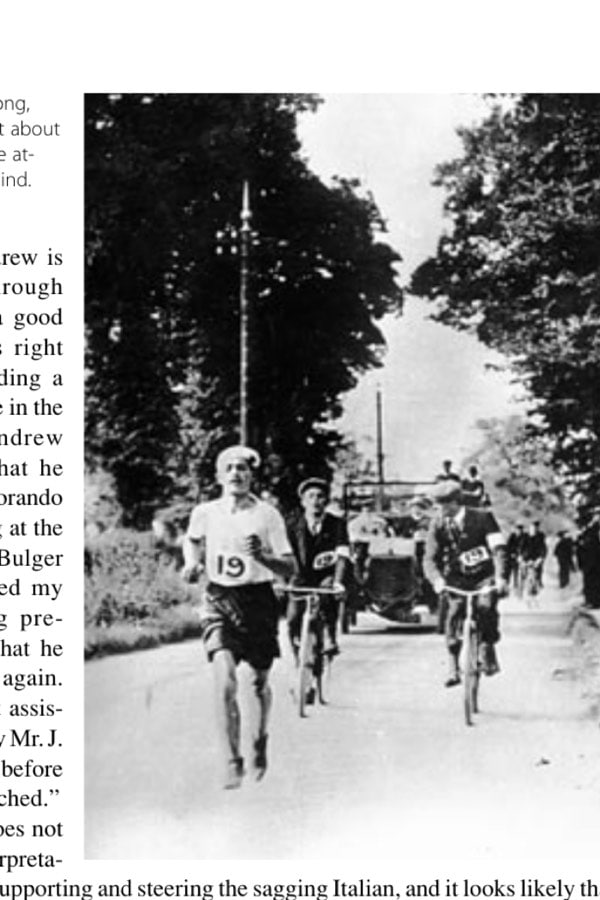
THE HAYES STRATEGY Hayes ran the first few miles well back in the field of 56. Some say dead last, but his teammate Joseph Forshaw of Missouri, who came through to third (fourth counting Pietri), told the New York Times that Hayes was always ahead of him. Anyway, he went out slow. At 17 miles, probably running with two teammates, he was still six minutes behind Hefferon, the leader—which means he was running perfectly. One photo taken at 23 miles shows him, now alone, looking composed and resolute, with a firm stride. Pietri in a photo at the same point looks
wobbly—his head on one side, down on his hips. At 25 miles, Pietri had caught Hefferon and they were battling for the lead, but it must have been a battle in slow motion. Hayes was coming on strong two minutes or so behind. Soon after Pietri dropped Hefferon, Hayes scooped up the big South African and was in second. While Pietri was a crumpled heap on the track, Hayes was powering over the cow tracks across the open space of Wormwood Scrubs toward the ramp into the stadium, running close to six-minute miles. He appeared. And the crowd roared again—not entirely in acclamation. How did Pietri ever reach the finish? He got there as Hayes was on the final bend, a mere 150 yards behind, roughly. The famous finish line photo shows Pietri with liquid legs and glazed expression. Clerk of the Course (race director in our
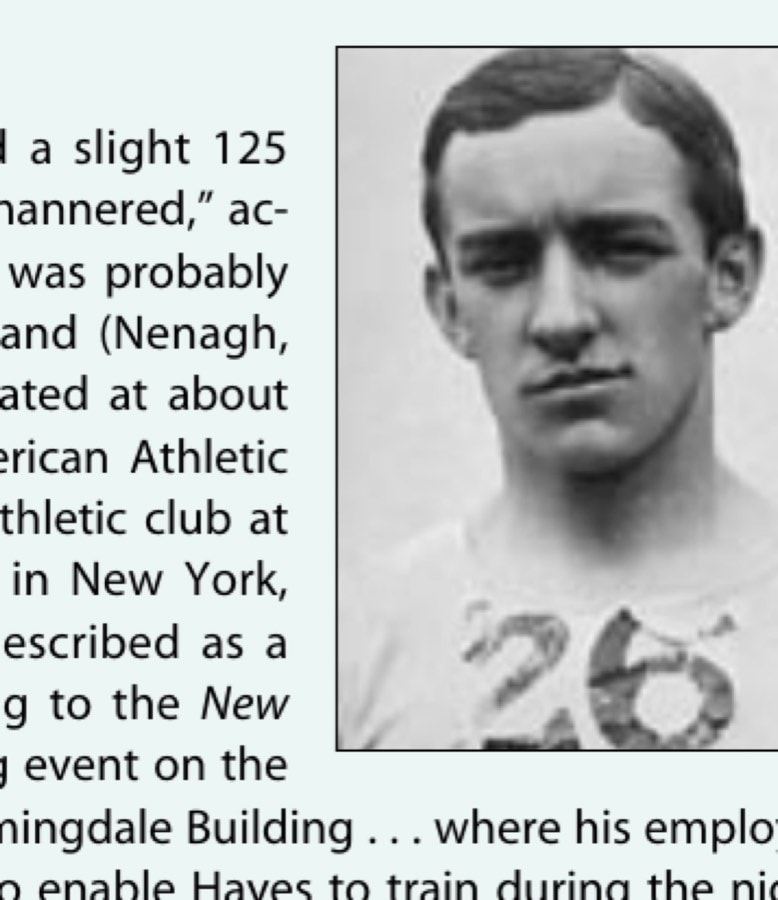
Johnny Hayes Hayes, under 5 feet, 4 inches and a slight 125 pounds, was “quiet and very mild-mannered,” according to the New York Times. He was probably born in New York, possibly in Ireland (Nenagh,
Tipperary), since his parents emigrated at about that time. He ran for the Irish-American Athletic Club and was also captain of the athletic club at Bloomingdale’s Department Store in New York, where he worked. He usually is described as a
shipping clerk there, and according to the New York Times, “He prepared for the big event on the cinder path on the roof of the Bloomingdale Building . . . where his employer installed a cinder-track path so as to enable Hayes to train during the night
without interfering with his work in the store.” Martin and Gynn, citing R. Schaap, question this true-blue amateur version, saying he did no active work for Bloomingdale’s but drew a salary that enabled him to train, most
of which he did outside the city. It is an open question whether that made him more professional than Pietri, who ran for the Italian army for some time after 1904, or Longboat, who reputedly was financed by patrons. Before the Olympics, in 1906 to 1908, Hayes placed fifth, third, and second at Boston
and won Yonkers in 1907, so, like Pietri, he started as young as 19 or 20 as a long-distance competitor. The New York Times said wrongly that he was 19 at the time of the London race. Mainly, Hayes deserves far more credit than he
has received for his astute pace judgment in the London race and his modest demeanor through all the hullabaloo after the race.
Dr. Edward H. Kozloff Collection
April 10, 1886-August 23, 1965
terms) Jack Andrew is helping him through the tape, with a good grip on Pietri’s right upper arm, holding a huge megaphone in the other hand. Andrew claimed later that he “only caught Dorando as he was falling at the tape,” and Dr. Bulger said, “I exercised my right in having precautions taken that he should not fall again. Hence the slight assistance rendered by Mr. J. M. Andrew just before the goal was reached.”
The photo does not bear out that interpretation. Andrew is supporting and steering the sagging Italian, and it looks likely that he has had that grip on the arm for some time. Doyle referred at an earlier point to “kindly hands saving him from a heavy fall,” and Andrew and Bulger are visible alongside Pietri as he first enters the stadium (see photo on page 42) and in every later picture (see pp. 48 and 56). Another retrospective eyewitness account recalled, “local officials couldn’t bear to see Dorando lose, so they picked him up and threw him over the tape” (Major N. Leith-Hay-Clark, letter to the Sunday Times, 1964). That makes it sound a little too like the great Australian pub sport of dwarf tossing, but it gets the spirit of the moment.
That is not to criticize Andrew. “Kind hands” is appropriate. The instinct to help a courageous and dangerously exhausted man is a decent one. Dr. Bulger had been right with Pietri since the very first collapse on the ramp into the stadium and seems properly to have taken responsibility on medical grounds. The huge crowd was noisily pleading for Pietri to be helped. Hayes was coming on fast. The place must have been bedlam.
Dr. Edward H. Kozloff Collection
▲
Pietri going strong, chasing Hefferon at about 20 miles, his bicycle attendants close behind.
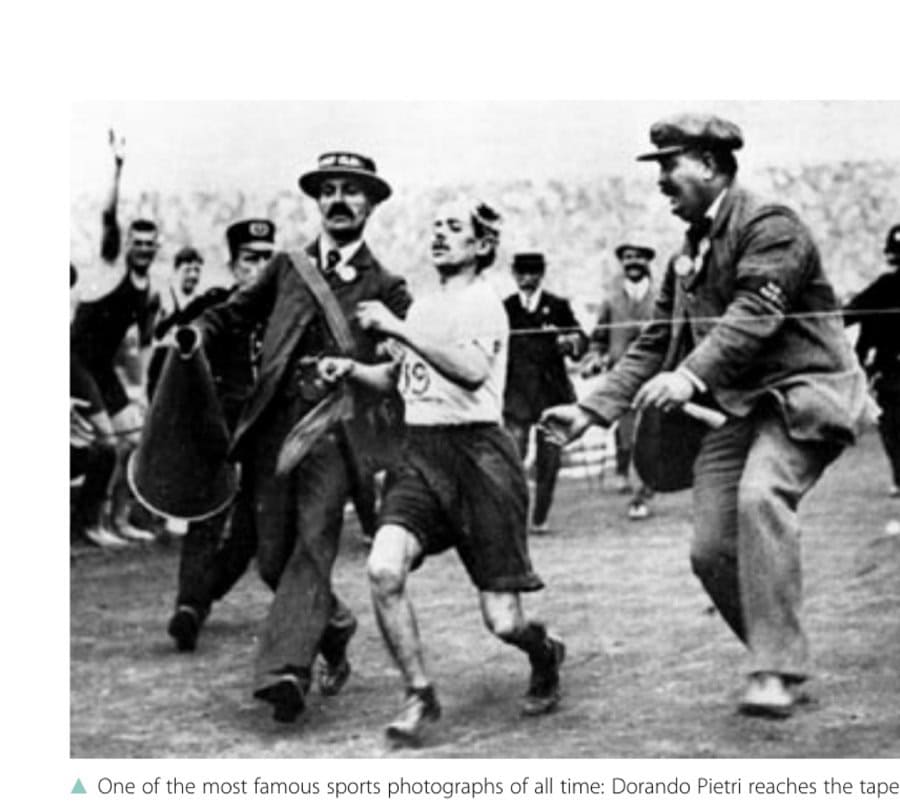
▲ One of the most famous sports photographs of all time: Dorando Pietri reaches the tape, with help.
PIETRI DECLARED THE WINNER! Andrew promptly declared Pietri the winner, presumably announcing it through that giant megaphone. As a longtime stadium announcer, I’m very grateful I wasn’t working that day. The American team immediately lodged a protest, which of course was upheld. The Americans had already lodged four in four days of the Games, which shows something of the tension between the hosts and their most successful guests. It started when the American flag was only at half-staff during the opening ceremony. (Well, it really started in 1776. British imperialism was at its height in 1908, and America represented its one great failure.) In the 400 meters, the race was declared void, one American was disqualified, all four withdrew, and a single Brit did the rerun final solo. The American bishop of Pennsylvania, invited to deliver the Sunday sermon at St. Paul’s Cathedral in London in the middle of the Games, tried to defuse the dispute by coining the phrase “the important thing in the Olympic Games is not so much winning as taking part.” Baron Pierre de Coubertin at the post-Games government banquet, only a few hours after the Hayes/Pietri drama, quoted that phrase, and it has
become enshrined in the Olympic creed. What Hayes and Pietri thought about it is not recorded. Anyway, Johnny Hayes was the winner. How well was Hayes running during those climactic final seconds? All eyes were (and still are) on Pietri at the tape, but an important question is whether Hayes was charging him down or struggling along in a similar state of near collapse. One American spectator said that Hayes “trotted into the stadium as fresh as a daisy,” and Doyle said he was “well within his strength,” but other accounts say things like he “struggled in second, apparently befuddled by strychnine” (Rob Hadgraft, The Little Wonder, p. 220). Jack Andrew also reported that he “assisted Hayes in the same way” as he did Pietri. Why did he need assistance? What shape was he in?
An Italian observer’s sketch reproduced by Martin and Gynn (1979) shows the points where Pietri collapsed and marks with an “X” Hayes’s position on the last bend as Pietri reached the tape. Assuming it is accurate (and it fits with Doyle’s and Cook’s accounts), this puts Hayes about 150 yards behind as Pietri reaches the tape (since the full distance on the track was 385 yards). Their finishing times were 2:54:46.4 and 2:55:18.4, a 32-second gap. One hundred fifty yards in 32 seconds is 93-second 440 speed, or about 6:15-mile pace. That’s hauling, at the end of a 2:55 marathon, average pace 6:41. So Hayes finished fast, by any standards. To imagine him at six-minute-mile speed charging in pursuit of the tottering, crumpling Pietri is to understand the full frantic drama of that scene. No wonder the crowd was in a frenzy. No wonder the officials around Pietri were in a state of near panic. Andrew’s motives in giving Hayes the same “assistance” may not have been as pure as I would like to think. You don’t need assisting if you can run 6:15s. If Hayes “collapsed” or fell down after the line, well, so do plenty of us, and it doesn’t mean we were not running strong.
For astute tactics executed with judgment and determination, few Olympic marathon winners have been more deserving than Johnny Hayes. Next day, after the awards ceremony, he was carried off the track on a table held by six American teammates, with “the Greek trophy” awarded for the marathon, a statue apparently representing the dying Pheidippides. Pietri had been carried off on a stretcher. But he did not die. He was taken to a hospital where he recovered quite quickly. The New York Times says he “was almost too weak to answer questions when seen tonight [after the race],” but the next day he looks quite perky in the picture where he is receiving his big gold cup from Queen Alexandra. The New York Times said he “walked briskly around the track and up the steps,” which is more than I could ever do the day after a marathon. The Italian hero received “a perfect ovation, the
people rising in their seats and cheering him for fifteen minutes.” The American part of the crowd “kept up the demonstration long after the others had quieted down” (New York Times).
▲
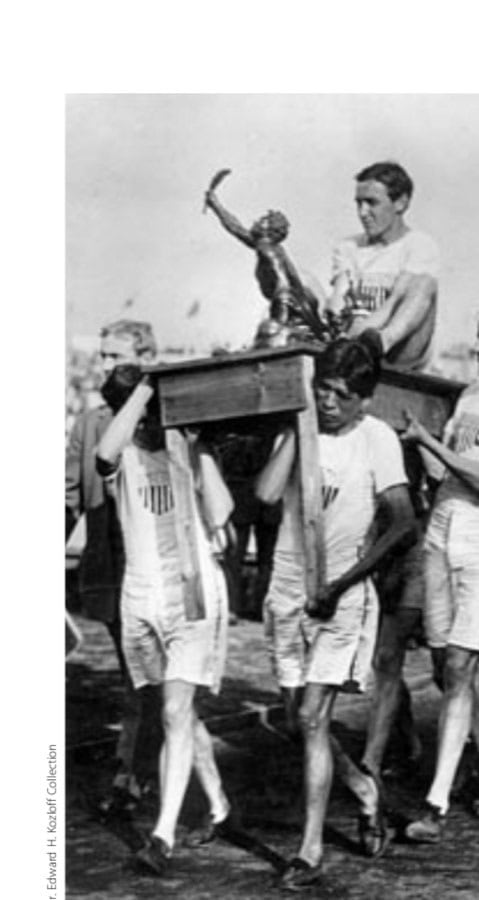
Tactics, judgment, determination, and modesty: American teammates carry Johnny Hayes in deserved triumph, with the “Greek trophy.”
Dr. Edward H. Kozloff Collection
THE NOBLEST ROMAN OF THEM ALL The Brits also took the little Italian to their hearts. He became a symbol of gallantry and of noble breeding. Conan Doyle pronounced portentously, “No Roman of the prime ever bore him
self better than Dorando. . . . The great breed is not yet extinct.” If it seems a bit of a stretch to dress up the sweaty little smalltown cake maker in a toga as one of the noblest Romans of them all, well, the Brits in 1908 believed in “great breeds,” especially
their own, and saw themselves as inheritors of Rome’s imperial destiny. It’s also possible that some of this spin campaign to apotheosize Pietri as the true winner of the marathon might have been meant to take the smile off the Americans’ faces.
No question that Pietri was amazingly gutsy. To get to your feet once after collapsing with heat exhaustion near the end of a marathon is tough. To do it five times is astonishing. Pietri earned his iconic place as a symbol of courage and
endurance. But for my money, as a runner, it takes just as much courage to let the entire field in a major race run away from you at the start, sit sedately back while Brit spectators jeer from up every tree, allow the leaders to go away by nearly 10
minutes, and wait until after 15 miles before you begin to make any ground on them. That’s really gutsy. The marathon is a sporting event that tests judgment as well as stamina and courage. By that full test, Johnny Hayes was emphatically
the winner. Pietri misjudged by probably only two or three minutes. That extra one mile, 385 yards indeed sank him. (Even the program said the distance was 26 miles. The official race rules said 40 kilometers.) But Hayes got it dead right, and all credit to him. The other thing that Pietri has continued to symbolize is the public’s mixture of horror and fascination with physical exhaustion. This was the appeal of fights to the death in the Roman Coliseum. A hundred years before the Pietri race, in the early 19th century, the big sport was bare-knuckle boxing, which went on until one contestant was smashed to a pulp. Some of the greatest fights lasted over 60 rounds. In the later 1800s, after boxing was regulated, there were still plenty of sporting events where crowds paid well to watch competitors run or walk to exhaustion, as in the six-day “Go as you please” races that have been described in Marathon & Beyond. Pietri went beyond exhaustion in front of the biggest crowd in history and for the highest stakes. Knowledge of the causes for exhausted collapse was primitive and included a good measure of sheer superstition. One doctor who examined Pietri at the hospital pronounced, “His heart was displaced by half an inch.” I have never worked out how he knew exactly where it had been to begin with. It was Pietri’s “supreme will within” that most impressed Conan Doyle. He caught perfectly, in a phrase that deserves to be better known, the appeal of this kind of extreme effort: “It is horrible,
and yet fascinating, this struggle between a set purpose and an utterly exhausted frame.” Some find it so horrible that they disapprove. The London Daily News struck a pose of shocked protest. “Nothing more painful or deplorable was ever seen at a public spectacle. . . . It may be questioned whether so great a trial of human endurance should be sanctioned.” Yet we all love to watch people risk death, even as we fear it, and even though we’re sometimes ashamed of liking it. My brother is a commentator at road circuit motorcycle racing and lives every week with a public that is half morbid in its fascination with his sport. I don’t watch NASCAR racing but suspect that sometimes there are crashes. It was this element of near-death danger in the Pietri drama that gave the new sport of the marathon its place in the shared human imagination. However purist we are about marathon running and however positive in our beliefs about it, we have to acknowledge that element in its popular appeal. Having just published a book about the marathon, I know that I could not decline to include the stories of Pheidippides, Pietri, and Jim Peters. They are intrinsic to marathon culture.
THE BIGGEST SPORTS EVENT IN HISTORY But Pietri’s sufferings were not the whole story. Look at any photo of the 1908 Olympic marathon and you’ll be struck by the hordes of spectators. One wonderful
picture shows dozens of them who have clambered up trees on Wormwood Scrubs Common, near the finish, to get a view of the start. People are lined two deep on Windsor’s Castle Hill in the pictures of the athletes walking up toward the start and then racing downhill on the first half mile. Several photos in the official report show a crowd at Willesden, about 23 miles, as good as those in modern Brooklyn. “The people who lined the course treated us finely, and they were of great assistance in cheering us up and giving a man heart,” Joseph Forshaw told the New York Times. One estimate I have seen put the crowds at 250,000. I’ve no idea how they calculate these figures, but the crowds were evidently bigger than at Athens in 1896, so it seems safe to say the 1908 Olympic marathon was, in terms of public response, the biggest sports event in history.
Why? It was just 56 undertrained, little-known guys doing something repetitive and not especially interesting that we now know can be done very much better. Yet there was huge public interest. Probably the main reasons are the same that bring out the crowds at modern Boston, London, or New York: (1) a race is a race, the purest and best of all sports contests; (2) the marathon has a sense of historical significance that no other event equals; (3) there is the “horrible fascination” of watching apparently ordinary people heroically push themselves to the extreme that marathon runners do; (4) it’s international so gives the buzz of patriotism; and (5) the marathon happens right outside your front door yet brings contestants from all over the world to do battle on your street.
With that 1908 race immediately becoming almost mythic, the marathon entered popular culture and the English language (and other languages, of course). After the inspiring Greek victory of Spiridon Louis in 1896, the phrase “marathon race” (soon just “marathon”) denoted the new sporting event, with added associations of long and heroic effort. After Pietri, it took on the extra meanings of a struggle against exhaustion or gallantly surviving long-term difficulty. The word was applied outside running for the first time only four months after Pietri’s race, when the London Daily Chronicle reported a potato-peeling contest named “The Murphy Marathon” (November 5, 1908). It entered literature the next year, when H. G. Wells was writing his novel The History of Mr. Polly (published 1910). A criminal called Uncle Jim warns Mr. Polly off his patch, appearing one evening while Polly is taking his walk. Wells spares the reader Jim’s more colorful adjectives.
Mr. Polly . . . quickened his pace. “Arf a mo’,” said Uncle Jim, taking his arm. “We ain’t doing a (sanguinary) Marathon. It ain’t a (decorated) cinder track. I want a word with you, mister. See?” If the lowlife Uncle Jim or the nonsporting H. G. Wells knew about the marathon, it had arrived. (Wells was a keen bicyclist but had no interest in organized sports.)
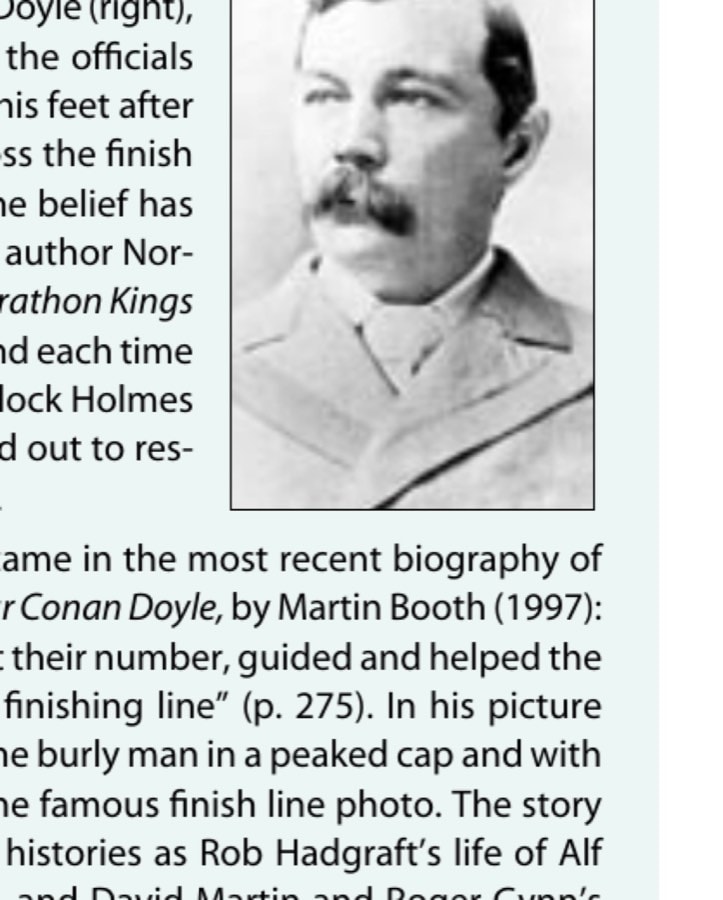
The Case of the Man With the Armband A recurring and popular story about the 1908 Olympic marathon drama is that Sir Arthur Conan Doyle (right), creator of Sherlock Holmes, was one of the officials who helped
Dorando Pietri get back on his feet after he collapsed and then assisted him across the finish line, thus causing his disqualification. The belief has been around for many years. The British author Norman Giller, for instance, includes it in Marathon Kings (1983): “Four times Dorando collapsed and each time helping hands—including those of Sherlock Holmes creator Sir Arthur Conan Doyle—reached out to rescue him from his sea of despair” (p. 19). Even more authoritative endorsement came in the most recent biography of Doyle, The Doctor, the Detective and Arthur Conan Doyle, by Martin Booth (1997): “Some spectators, Conan Doyle amongst their number, guided and helped the exhausted and confused runner to the finishing line” (p. 275). In his picture caption, Booth then identifies Doyle as the burly man in a peaked cap and with an armband who is alongside Pietri in the famous finish line photo. The story is confirmed by such excellent running histories as Rob Hadgraft’s life of Alf Shrubb, The Little Wonder (2004, p. 219), and David Martin and Roger Gynn’s great work, The Olympic Marathon (2000). They include a different photograph (see page 56), showing Pietri in a state of collapse with the burly man with the armband kneeling to support him (or “to assist him . . . to his feet,” as Martin and Gynn put it). Their caption identifies again this man as Conan Doyle, “noted writer and creator of detective Sherlock Holmes” (p. 74). And so “history” happens. Google “Pietri” with “Conan Doyle” and very many Web sites include this specific identification, while most retell the story that Doyle was one of those who lent a helping hand to the suffering Italian, thus causing his disqualification. In age (Doyle was 49 in 1908), in build (Doyle was big and a good boxer and footballer), and in facial appearance (Doyle wore a scrubbing-brush mustache, similar to that of the man with the armband), there is some resemblance to known images of Doyle. As a famous British author, patriot, and sportsman, and as a qualified physician, Doyle might well have been among the Olympic officials. But Sherlock Holmes would not be satisfied with such first impressions. So I decided to check further. I started with the official report on those 1908 Olympic Games. An appendix lists each day’s officials at every venue. Doyle is not among them, a disappointing
start to the enquiry. Nor is he listed anywhere as a “medical attendant.” Most of the officials for the marathon were provided by the Polytechnic Harriers Club, which was delegated to take full responsibility for the marathon race by
the Olympic Organizing Committee. The club’s Honorary General Secretary, J. M. (Jack) Andrew, headed the marathon team and was Chief Clerk of the Course on race day. Doyle was not a member of Poly (as the club is known),
nor of any running club. According to the formal Games report, then, he had no official status, either as a track official or medical assistant, which would have given him access to the stadium and an armband to wear.
Since Doyle was a writer, I next checked on what he might have written. Elementary. There he is, present and with his eyes very much open, at the Pietri incident, not as an official but covering the marathon for the Daily Mail
as a special celebrity correspondent. He makes a good sports journalist, too, as you might expect, since he wrote excellent sporting short stories about boxing, hunting, and cricket. Doyle’s report on the Pietri marathon is one of the most powerful of the
thousands of accounts of that memorable race. It employs the strong and vivid physical language that makes the Sherlock Holmes stories so compelling. He writes of Pietri’s “haggard, yellow face” and “glazed, expressionless eyes.”
He captures his stumbling movement in phrases like “furious yet uncertain gait,” or “the red legs broke into their strange automatic amble.” He writes in a dramatic present tense: “Surely he is done now. He cannot rise again.” And
Doyle summarizes the appeal of the episode in the phrase I have taken as the title for these articles: “It is horrible yet fascinating, this struggle between a set purpose and an utterly exhausted frame.”
So where, exactly, was Conan Doyle at the time? In his little-known autobiography, Memories and Adventures (1924), he says, “I do not often do journalistic work . . . but on the occasion of the Olympic Games of 1908 I was tempted, chiefly by the offer of an excellent seat, to do the Marathon Race for the Daily
Mail.” An “excellent seat” is not a pass to the middle of the arena or license to run around with an armband helping exhausted competitors. One sentence in his Mail report confirms his location during Pietri’s heart-rending last lap. “
He was within a few yards of my seat. Amid stooping figures and grasping hands I caught a glimpse of the haggard, yellow face, the glazed, expressionless eyes, the lank black hair streaked across the brow.” So Doyle was in the stand at the beginning of the final straight (where Pietri
fell for the last time), not jogging alongside Pietri on his final crumpling steps to the finish. The burly chap with the cap and the armband got a much closer view than a “glimpse” from “a few yards” away. He was actually holding and
lifting the collapsed runner. He was one of the “stooping figures” who almost
blocked Doyle’s view. Since Doyle was seeking immediacy and drama in his report, he would certainly have used such a privileged close-up. In search of further clues, I located some photos of Doyle. The nearest in date to 1908 that I could find is a wedding photo from 1907. Doyle is a well-built, upstanding man, but not as broad and bulky as the man with the armband, nor as heavily jowled, and is probably taller. His eyebrows are fine and high arched, not bushy. His mustache is trimmed differently, too, into sharp downward points, probably waxed—and later photos show he retained that style. The two are similar at a quick glance, but they are not the same man. I then turned my Holmesian magnifying glass on the big man’s armband (see photos on pages 48 and 56). The first letters on the lower line are “ATTE. . . .” Sherlock Holmes fans will instantly remember this as the beginning of the mysterious message sent by candle flame from the window of a rented room in Great Orme Street in “The Adventure of the Red Circle,” the Italian warning “Attenta.” But Pietri was not victim of a mafia revenge squad. On the upper line of the armband you can pick out “ME.” This time Holmes would more likely suggest that “ME . . . ATTE” are the beginning of the more humble English phrase “Medical Attendant.” My deduction is that the burly man is Dr. M. J. Bulger, the marathon’s medical officer, who acknowledged in writing (quoted in the official report) that he was there helping Pietri throughout his struggle in the stadium. In the photo, he holds a roll or tube of paper in his left hand, possibly (though this is my speculation) shaped into a long funnel through which a restorative could be administered. The official race instructions state “stimulants will be available in case of collapse,” although otherwise “No competitor may take or receive any drug.” As chief medical officer, Bulger is exactly the person you would expect to be kneeling to support Pietri when he has collapsed or be alongside ready to catch him as he staggers to the finish. Martin and Gynn, or their caption writer, say (wrongly, I fear) that Dr. Bulger is the other man, the thinner one, who appears in both pictures, wearing the straw boater (hat), who in the famous finish line picture is actually supporting Pietri through the tape by the right upper arm and who holds a giant megaphone in his other hand. A sash diagonally from across his right shoulder suggests he is a senior official and so would be qualified to make official announcements through the giant speaker tube that he carries. There is no reason why a medical officer should carry such an encumbrance. It is worth looking closely at the markings on the ribbon round this man’s boater. High resolution shows that this is not just a decoratively speckled band. Through the magnifying glass, the letters “IEF CLE” can be deciphered. This, Sherlock Holmes advises me, is the “Chief Clerk,” or officially “Chief Clerk of the Course,” Jack Andrew.
Dr. Edward H. Kozloff Collection
▲ The fourth of the five occasions when Pietri collapsed. Jack Andrews with megaphone, Dr. Bulger supporting Pietri.
It was Andrew who later defended his action in assisting Pietri on health and safety grounds. “The doctor’s instructions were emphatic, carrying them out caused disqualification; . . . I only caught Dorando as he was falling at the
tape. What I did then I would do again under similar circumstances.” Fair comment. Dr. Bulger was in charge at that point, and the medical necessity for intervention was clear, though the good grip Andrew has on Pietri’s right
arm, clearly taking some of the runner’s weight as he approaches the line, makes it dubious that he “only caught [him] as he was falling.” So our deductions about those present at the climax of the Pietri drama are: •
Thin man with megaphone, J. M. (Jack) Andrew, Chief Clerk of the Course. • Burly man with armband, Dr. M. J. Bulger, chief medical attendant. • Seated in the stand, not visible in the photo, notebook at the ready,
Sir Arthur Conan Doyle, doing what a writer does best—writing. Case solved. Conan Doyle did go on to play a more active role in the Pietri story. He used his Daily Mail column inches to initiate a subscription for the unfortunate near
winner. Doyle’s collection raised 300 pounds, mostly from Italians in London, supposedly enabling Pietri to open his own baker’s shop back home in Italy. (In fact, Pietri promptly turned professional and made a lot more than 300
pounds: see Part 2 in the next issue.) It is also suggested by Martin and Gynn, in their earlier masterpiece, The Marathon Footrace (1979), that it was Doyle who “prompted” the Queen to present Pietri with an inscribed “replica” of the winner’s gold cup. I do not
know their source for this, but Doyle was not an aristocrat, and the rigidity of the English class system makes it unlikely that he would have access to the Queen, especially so fast. The announcement that she wanted to
make a special award was made at the government banquet a few hours after the marathon. And the engraved gold cup she gave Pietri was not a “replica” of the winner’s award, which was “the Greek trophy,” a statue of
a Greek warrior dying heroically (see photo on page 50). One more detail in the famous finish line photo might interest running historians who own a magnifying glass (or “lens” as Dr. Watson calls Sherlock
Holmes’s). Look at his right hand. However exhausted Pietri was, even after collapsing and nearly passing out five times, apparently at death’s door, he has still kept hold of his handkerchief (which flutters from his right hand) and
his “grip” or “cork.” Clutched in his right hand, this was a short lightweight hollow tube of wood, usually bamboo cane, or piece of cork. Pietri’s looks like cane. He may have one in his left hand, too—you can’t see, but his fist is in a
clutching position. Runners 100 years ago carried such a grip in one or both hands in the belief that it helped style and concentration to have something to hold. Alf Shrubb, the great English multiple world record holder of the same
era, habitually ran with corks, and in various photos I have spotted them also in the fist of Tom Longboat and others. At the beginning of my own running career in the 1950s, some older runners still gripped a handkerchief wrapped
round one hand. If I had any commercial gene, I would reintroduce grips or corks in high-tech and colorful plastic and sell them at a booth at marathon expos. They would not be the most useless running aid on sale. Bet I’d sell more of them than I do books.
Dr. Edward H. Kozloff Collection
▲
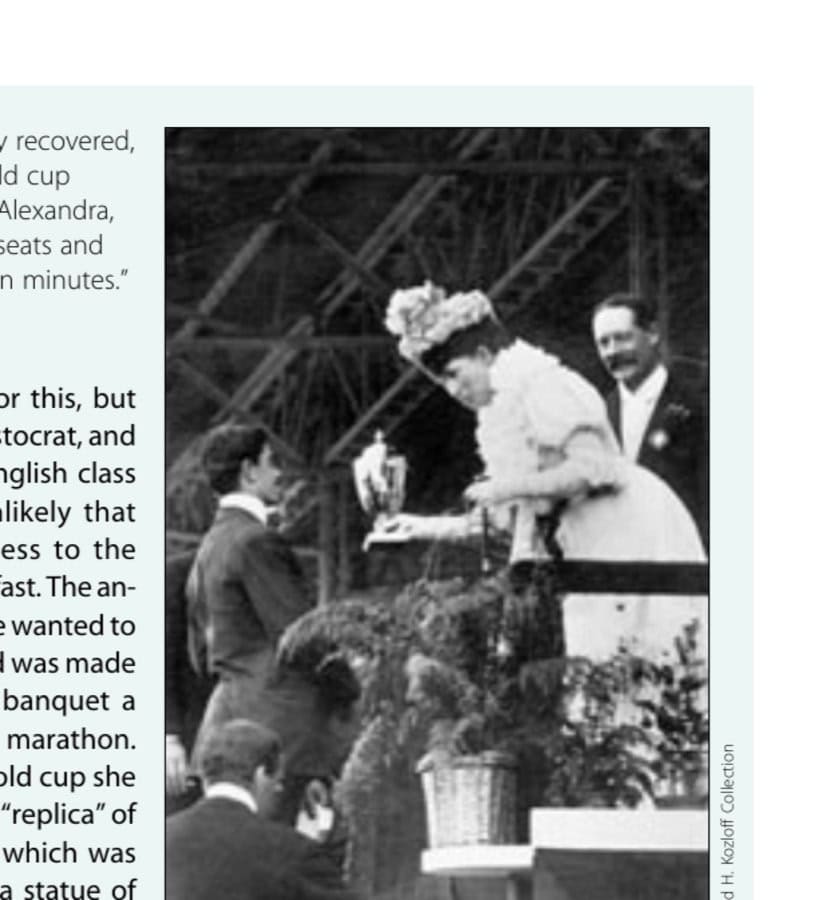
Dorando Pietri, fully recovered, receives his special gold cup next day from Queen Alexandra, “People rising in their seats and cheering him for fifteen minutes.”
THE AFTERMATH WAS SPECTACULAR Such public interest produced a great era of marathons. The rivalry between Pietri and Hayes was too colorful to let go. They were quickly signed by an enterprising New York promoter for a head-to-head race in November 1908. Pietri gave up his amateur status and endorsed Bovril (a beef tea drink) as the cause of his rapid recovery. (Another shaft for the race organizers, who had sponsorship from the rival Oxo, which was “appointed Official Caterers” to the competitors.) Tom Longboat, the Boston record breaker with the exotic appeal of being a Canadian Onondagan, also declared himself available for prize-money racing. So did England’s Fred Appleby, another star who had suffered a bad day at London. So did an exciting new name to the marathon, multiple world record holder Alf Shrubb of England, the world’s greatest track and cross-country runner. The official report on the 1908 Olympics grumpily dismissed all this as an “epidemic of ‘Marathon Races’ which attacked the civilized world from Madison Square Garden to the Valley of the Nile.” It was in fact the first great running boom and one of the most fascinating periods in the whole story of the marathon. By November 1908, they were all in New York. An all-star cast was ready for the greatest show in town.
Footnotes Three notes, to show how hard it is to keep telling the truth about history: 1. Many writers assume that by running 385 yards inside the stadium, the runners were covering almost a whole lap. But although the 1908 Olympic
events were all metric, the British had built the track at White City as 1,760 feet, or 536.45 meters, three laps to the mile, as British tracks often were at that time. The marathon runners entered alongside a large covered stand,
turned left, and had to do a little over half a lap, rounding just one bend, to reach the royal stand on the opposite straight. The direction was opposite to that of the Olympic track races, which might have confused Pietri, as he
had run in the three-mile team race 10 days before the marathon (he DNF’d, once Italy had no chance of qualifying for the final). The official instructions for Athletics issued to competitors end with the rules for the marathon, and immediately following those comes a “Note” that first states that the track is
measured “12 inches from the inside edge” and then “The direction of running will be left hand inside.” That’s all—it’s intended to apply to all track events, but it comes right after the instructions for the marathon and makes
no exception for that event. If Pietri had that instruction translated for him, no wonder he got confused when officials swarmed “expostulating” around him
as he tried to finish the marathon by running that way round. It’s of interest, too, that the distance in these prerace instructions is “40 kilometers,” but in the official Olympic report, that has been silently edited to “42 kilometers.” Pietri was indeed hard done by. 2. The official entry list gives the Italian’s name twice, both wrong. He is “Dorando, P.” (19) and “Durando, P.” (23). Another Italian, U[mberto] Blasi, is also given twice, with two numbers. Presumably there was difficulty with the handwritten team declaration, and British officials assumed that “Pietri” was his Christian name. Even when he was presented with his consolatory gold cup by Queen Alexandra, it was inscribed “To Pietri Dorando In Remembrance of the Marathon Race . . . etc.” For many years he remained “Dorando” in the public mind, especially his fans in New York, and there is still sometimes doubt which way round his names should go. Martin Booth’s biography of Conan Doyle gets it wrong, for instance. 3. There is also a common error about where Pietri came from. In 1908, he was a baker and/or cake maker and/or confectioner in his birthplace town of Carpi, which is north of Modena, about 30 miles northwest of Bologna. But the New York Times the day after the race called him “a confectioner who resides on the Isle of Capri,” and many expert accounts (Giller’s and Hadgraft’s, for example) perpetuate that error. Everyone knows the old “Isle of Capri” love song. But
Dorando Pietri baked his cakes in Carpi. Next issue: “The Fascinating Struggle, Part 2: Marathon Mania, 1908-1912.”
REFERENCES Booth, Martin. 1997. The doctor, the detective and Arthur Conan Doyle. London: Minotaur. Carli, E. 1973. Dorando Pietri. Stamperia Zendrini. Cook, T. A. The Fourth Olympiad, being the Official Report of the Olympic Games of 1908.
London: British Olympic Association. Daily Mail (London). July 25, 26, 1908. Daily Telegraph (London). August and September 1965. Doyle, Arthur Conan. 1924. Memories and adventures. New York: Little Brown. Giller, Norman. 1983. Marathon kings. London: Pelham. Hadgraft, Rob. 2004. The little wonder: The untold story of Alfred Shrubb, world champion
runner. Southend-on-Sea, Essex, UK: Desert Island. Lovesey, Peter. 1966. The most famous marathon runner of all. Athletics Weekly April 6, 1966 (includes research by Luigi Mengoni and Luciano Serra). Martin, David, and Roger Gynn. 1979. The marathon footrace. Springfield, Ill.:Charles C. Thomas. ———.2000. The olympic marathon. Champaign, Ill.: Human Kinetics. New York Times Robinson, Roger, and Kathrine Switzer. 2006. 26.2 marathon stories. Emmaus, Pa.:Rodale. Sunday Times (London) The resources of the New York Public Library are especially appreciated.
This article originally appeared in Marathon & Beyond, Vol. 11, No. 2 (2007).
← Browse the full M&B ArchiveMore like this
1,000+ stories from 19 years of Marathon & Beyond
The complete archive of the legendary long-distance journal — digitized and free to read.
