

Running Was My Best Friend
(age 40, 9 completed marathons, 2:12 PR)
WHEN I first began running in high school, I hated it. The possibility of running a marathon seemed about as likely as giving up television after school. But after memorizing every episode of “Gilligan’s Island,” I decided that I valued my own self-worth and was capable of achieving accomplishments even more worthwhile than knowing the Skipper’s hometown. So, after a long, boring winter during my freshman year at Miramonte High School in Orinda, California, I decided to pursue track as my high school sport. Since running long distances seemed especially painful at the time, I opted for the event that most mixes speed and endurance—the 800 meters.
In my first 800 that season, I placed third in the frosh-soph race but found myself writhing in pain on the infield afterward as I tried (in vain) to catch my breath. But the accomplishment of scoring a point for the team felt awesome—I was hooked. Ten minutes after I finished, a girl ran the distance nearly 12 seconds faster than I had, setting a new girl’s high school record. I understood that my work was cut out for me.
The summer following my freshman year, I hooked up with the number one runner on the cross-country team, who lived just down the street from me. He would become my training partner for the next two years. We would go 1-2 in nearly every race we ran. Toward the end of my junior year in cross-country, I began beating him. I also became zealous about my running, hitting the trails for lots of miles after cross-country practice. I reached a high one week of 108 miles. After that week, I decided to run the Livermore Marathon.
My first marathon was going pretty well, but I found the last five miles of Livermore excruciatingly painful. My legs locked up to the point where simply lifting my knees was a near-futile experience. I remember thinking it was cool that I could still break 2:45. At that point another young person blew past me, and I lost my spirit, struggling in with a 2:54. The young person who blew by me was a high school girl on her way toward setting the national record for her age group.
POSTMARATHON INJURY BLUES
If I was ever going to run another marathon, which at the time I seriously doubted, I knew I had a tough road ahead. After my experience at the Livermore, I developed sciatica and was unable to run track my junior year. Welcome to the world of overtraining and stupid race choices.
The following year, my senior year, I finished with good results in cross-country and track. I made sure not to run a marathon that year. In fact, I planned to avoid the marathon for quite a few years, until I finished my collegiate running career at Humboldt State.
I became a voracious trainer in college, at times reaching 140 miles a week. My senior year, I was running 120 mile weeks in the winter, with many of the miles in the 5:00- to 5:10-per-mile pace. Friends told me I should run a marathon. Shush, I would tell them. Talk to me after college.
My first year out of college was a running bust. Surgery on my Achilles tendon set me back roughly a year of running. After moving to San Luis Obispo, where I recuperated from surgery, I started to question if I really wanted to train again. I had often questioned my reason for running. Was it for fitness? The endorphins? The thrill of racing well? I was never quite sure. I just knew I was hooked, because it didn’t take long for me to decide that I wanted to come back from the surgery.
I did make a comeback, running personal best times at 5,000 and 10,000 meters. I ran a good half-marathon. I had a recharged urge to try a marathon once again, and I even began looking toward the 1988 U.S. Olympic Marathon Trials. To attempt to qualify for the Trials, I signed up for the 1987 California International Marathon. My coach, Jim Hunt, and I came up with a training plan focused on running several weekly miles at my anaerobic threshold pace or faster.
The California International went well until 21 miles, when my legs began to feel like 50-pound sledgehammers driving into the pavement. Running in severe winds and rain, I finished third, which qualified me for the Olympic Trials to come five months later. Despite my success, at this time I still couldn’t answer my age-old question: Why was I running in the first place?
TRIALS PREPARATIONS
After recovering from a pulled quadriceps muscle in the wake of the marathon, I began preparing for the trials. Again, Jim Hunt and I decided to go with relatively low mileage (about 85 miles per week) while maintaining high-level AT- and V̇O2max-boosting workouts.
What happened in the Trials is the stuff dreams are made of. It was so divine that I even thought I had found my answer to why I ran in the first place. On that day, in the U.S. Olympic Marathon Trials along the New Jersey waterfront, I felt fantastic from start to finish, and I won the race. I ran 2:12:26, defeating some of America’s best and earning a trip to the Seoul Olympics.
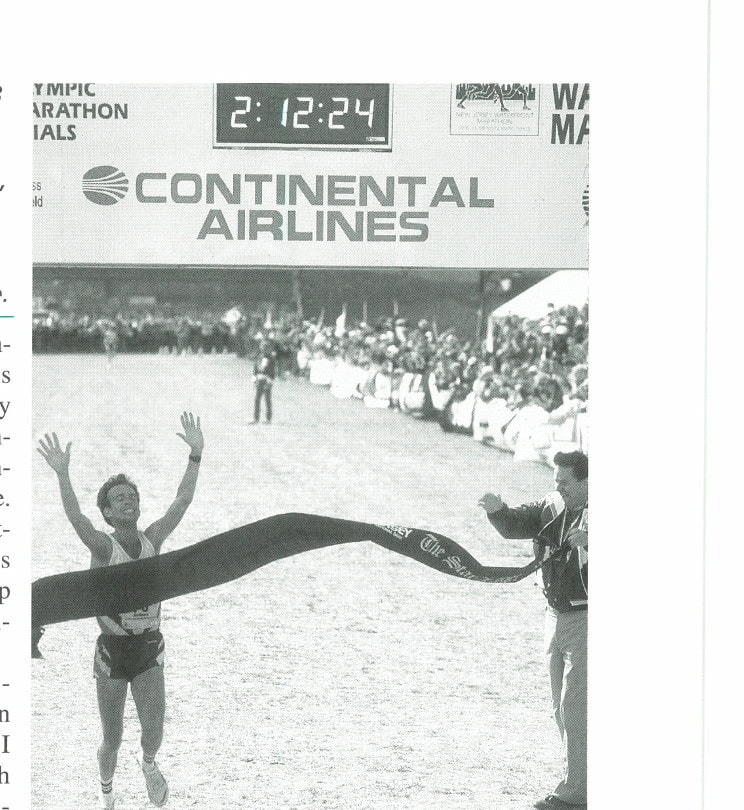
In Seoul, I blistered badly and again injured my Achilles. I was unable to finish the race. I had to undergo surgery on the Achilles, which meant another missed year of racing. Again, I asked myself if it was all worth it. And again, I quickly answered my own questions and vowed to make another comeback. But I was frustrated, as the question of why I ran in the first place remained unanswered.
In 1991, I ran well, running two good marathons, while notching personal best times at 10 miles and 15K. I thought I had a decent shot at making the 1992 Olympic team. But as I escalated my training toward the 1992 U.S. Olympic Marathon Trials, I developed weird flu-like symptoms. I would enjoy a few good days of training, only to break down again. I wound up taking 10th at the trials, perplexed by my ability to ricochet from one session of illness to the next.
In 1993, conditions became worse. I was finally diagnosed with Hodgkins disease, a cancer of the lymph nodes, and had to undergo six months of chemotherapy. It was during this dicey period that my question of why I had become a marathon runner was finally answered. During my chemo, running stood firmly in my corner as my best friend. On my worst days, I would head out the
ROB DE CASTELLA used to say I was a 2:17 marathoner—I just had not done it yet. Now that nearly a decade has passed since Deek was in Boulder training, I can look back and say with certainty that I never will run 2:17. Instead, when I jog up through the Pearly Gates and talk with St. Paavo, St. Phidippides, St. Abebe, St. Jim (Peters), and others, I will be forced to admit (because you cannot lie in heaven, especially about your PRs) that my personal best is 2:24:30. And there it will remain for all of eternity.
Not that I didn’t try to run faster. For five years after clocking 2:24:30 at Grandma’s Marathon, I ran nearly every day with de Castella and his training group, which included Rosa Mota, Steve Jones, Arturo Barrios, Ingrid Kristiansen, Steve Kogo, Derek Froude, and various and sundry other world-class marathoners. The training went well; the racing did not.
The perfect race for many of us living in Boulder in the 1980s was 2:19-anything. That was an Olympic qualifier. We were not Frank Shorters or Rob de Castellas, nor were we meant to be. We were Napolean’s rear guard, the royal bodyguards so to speak, filling out the field behind the world- and national-class runners at local road races.
Sub-2:20 was our Holy Grail. Qualifying for the Olympic Trials would have been as good in my mind as making the Olympic team. Back then, it was expected we would run that fast. It was attainable. It had to be, because so many people were doing it. On the University of Colorado cross-country team on which I ran, we had six runners 2:14 or faster: Kirk Pfeffer, Mark Spilsbury, Mike Buhmann, Mark Anderson, John Hunsaker, and Chuck Hattersley. I was embarrassed to tell newcomers to town that my bests were 2:24 and 30:23 (for 10,000).
BEST ATTEMPTS
I had two good attempts at sub-2:20, and I will never forget floating along at 5:20 per mile feeling strong and full of running. My first attempt was the
This article originally appeared in Marathon & Beyond, Vol. 4, No. 4 (2000).
← Browse the full M&B ArchiveMore like this
1,000+ stories from 19 years of Marathon & Beyond
The complete archive of the legendary long-distance journal — digitized and free to read.
