

It All Works—At Least on Paper
On paper, this structure had the simple majesty of a DNA double helix. In reality, it created rival fiefdoms, complete with (sometimes quite literal) turf battles. To my irritated bemusement, the marathon course was declared a venue, and was, therefore, assigned its own venue chief, who had authority equal to or superior to mine. As a result, I was directing the Olympic marathons without authority over the course security, communications, materials delivery, or medical coverage. In theory, the course marshals were to report to the marathon venue chief, not to me. All negotiations with the police were likewise a venue matter. I was responsible only for what actually occurred on the field of play itself: aid stations, course vehicles, and timing stations.
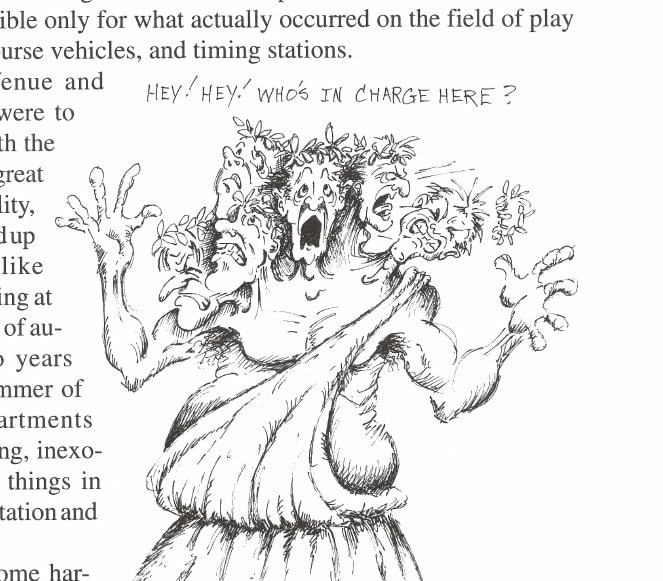
In theory, the Venue and Sports departments were to coordinate efforts with the smooth harmony of a great Baptist choir. In actuality, everyone tended to end up in muted quarrels like barnyard geese, pecking at each other’s plumage of authority. For the two years leading up to the summer of 1996, the two departments battled their way along, inexorably accomplishing things in spite of maximum irritation and ruffled feathers.
By early 1996, some harmony had crept into the marathon preparations. Venue authority had come to rest with an accomplished manager named Todd Allen, who was more interested in successful outcome than petty agenda. We shouldered our separate, ever-interdependent burdens as a team and were rarely at cross-purposes.
I was fortunate. My immediate boss, Phil Henson, Competition Manager of Athletics, was not so lucky. As meet director of Olympic Track and Field, Henson’s venue was the Olympic Stadium, a $200-million structure destined to be a baseball stadium after the Games. The stadium was also the venue in which the opening and closing ceremonies would take place. A Venue Manager was charged with overseeing the workings of the stadium. Ceremonies also had its own manager. In theory, the three managers wielded the same authority. As are most troikas, this threesome was harnessed in an uneasy alliance.
Henson’s brief was to stage an impeccable, stunningly-presented track and field meet at the highest international standards. The Ceremonies’ charge was to stage opening and closing ceremonies so wondrous that the millions upon millions of people watching worldwide would suck in their collective breaths in awe. Sports’ agenda was to present a perfectly maintained track and its field; Ceremonies sought to practice and practice on that self-same turf until the cast of thousands had reached Rockette perfection. Sports needed every inch of space behind the scenes for equipment and personnel; Ceremonies had to store warehousefuls of elaborate costumes and materials. Sports needed permanent command posts above the field; so did Ceremonies. Stadium Venue Manager Bob Stiles shuttled between the increasingly irritable camps—a diplomatic mission that rivaled Middle East negotiations.
Sports Versus Ceremonies
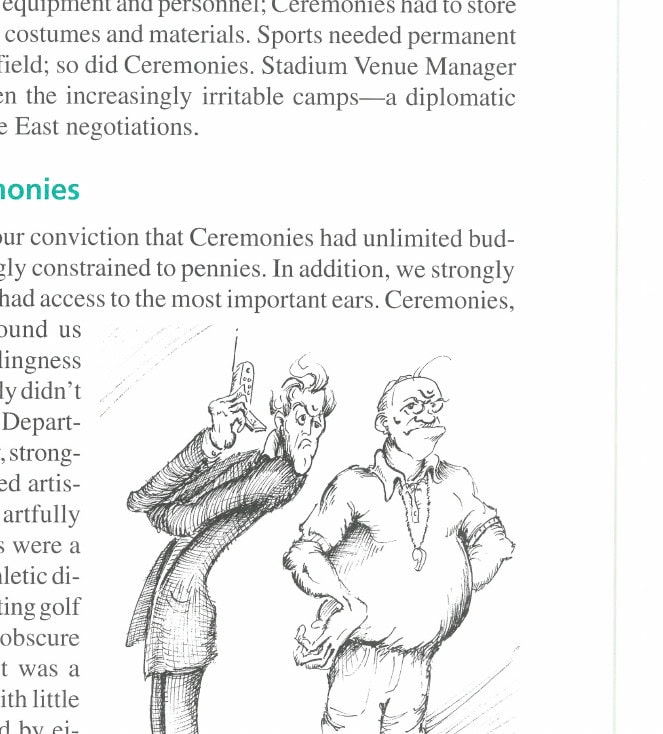
We in Sports were firm in our conviction that Ceremonies had unlimited budgets while we were seemingly constrained to pennies. In addition, we strongly suspected that Ceremonies had access to the most important ears. Ceremonies, on their part, doubtless found us monofocal, lacking any willingness to work things out. It probably didn’t help that the Ceremonies Department was staffed with trendy, strong-chinned Californians dressed artistically in black with hair artfully mussed, while we in Sports were a ragtag lot of coaches and athletic directors sporting faded, ill-fitting golf shirts bearing the logos of obscure track meets. The net result was a deeply embittered venue, with little charm or generosity exuded by either side.
The marathon obviously took place primarily outside the stadium so my contact with intra-venue strife was limited. The marathons began and ended on the track, however, so some coordination was necessary.
Scheduling the Marathon
The women’s Olympic marathon was scheduled to take place the second day of competition. Because of the crowded on-track schedule at Olympic Stadium, it was obvious from the beginning that any runners finishing outside three hours would have to conclude their race at Cheney Stadium, the warm-up venue 600 meters away. The men’s marathon was another matter. Originally, the event was slated to finish as a prelude to the closing ceremony, scheduled for the final evening of the Games. This was a tradition begun in 1984, which allowed the overweening and egotistical IAAF president to present the final medal of the Games. As closing ceremony could not be held up indefinitely awaiting the more sluggish finishers, anyone finishing over three hours would also be shunted to Cheney.
Those of us close to marathon planning had long felt that an early evening marathon would be disastrous in the inevitable heat and humidity of an Atlanta summer. There was also the likelihood that one of the powerful electrical thunderstorms that frequently plague Atlanta’s summer evenings would come along—two of the last five Fourth of July fireworks displays had been cancelled because of these dramatic downpours. We were mere squeaks of protest, however, with little clout. We thus planned for an early evening marathon, though never giving up hope that wisdom might somehow prevail.
Level—and Cool—Heads Prevail
To our astonishment, in March of 1996 it did. The IAAF medical commission recommended that the men’s marathon be held in early morning. The gold medal, however, would be presented during the closing ceremony by the IAAF president.
The men’s Olympic marathon was thus rescheduled to begin at 7:05 A.M. on Sunday, August 4, the 17th and final day of the Games. It would begin and end on the Olympic Stadium track.
Since the marathon was the only track and field event scheduled for that day, it seemed logical that all runners could finish on the track. There would be no need for the subtle humiliation of finishing outside the Olympic Stadium.
From lessons learned in Barcelona (where one runner finished in four hours), I asked that the finish be scheduled from approximately 9:15 to 11:00 A.M. on the Olympic Stadium track. There would be a crowd on hand to watch the start, follow the race on the stadium Jumbotron, and then view the finish. There seemed little reason not to keep the stadium open for the entire race.
I soon learned the lucid logic of my argument was not universally shared. Until March, Ceremonies had assumed it had the field the entire day for rehearsal. They were not amused to relinquish their morning. I continued to lobby within my middle management circle, mentioning the public relations downside of having Olympic athletes shunted off to Cheney so that majorettes could rehearse their struts.
Confident of eventual victory, we planned for closure until 11:00 A.M. Not until three days before the men’s marathon did I learn that the marathon could have the track only until 10:30 A.M. Thereafter, the gates would slam shut, and closing ceremonies rehearsal would begin. There was no argument. Ceremonies did indeed have access to important ears, and the marathon was suddenly a loser in the venue wars.
Thus it was. We were not overly disheartened, however, as the final finisher in the women’s Olympic marathon the prior week had finished in roughly three and a half hours. Surely, the men’s final finisher would take less time than that, and if we were a mere 10 minutes over the limit, we were confident Ceremonies would relent.
The Cast of Characters
Although I did not receive the final list of marathoners until the night before the race, the preliminary lists contained few runners who did not meet the minimum Olympic qualifying standard of 2:22:00. There were a few just over the mark, including a fellow from Andorra with a personal best of 2:51:03, and six runners with few statistics listed and no personal bests or qualifying marks. One of these was A. Baser Wasiqi of Afghanistan. I hoped these final few competitors had been mere victims of bureaucratic bungles, and that they were better qualified than the citizen athlete from Mongolia, who had taken four hours to finish the 1992 Olympic marathon in Barcelona.
The field for the 1996 men’s Olympic marathon numbered 123 and represented 77 countries. At 7:05 A.M. on August 4, they left on their 26.2-mile journey with three laps around the track and then proceeded through a tunnel near the 100-meter start line. After these 1,200 meters in the stadium, the runner in second-to-last place was Baser Wasiqi.
Snugly wedged into the lead vehicle in front of runners loping along at a sub-5:00 pace, I did not become aware of Wasiqi’s predicament until the 17th mile of the race. By then, the lead pack was polishing off the middle third of the race, which consisted of a flatish 10 miles out to the turn-around point and back. Wasiqi had just reached the 17K point, as the leaders were passing 27K.
Dressed in a loose-fitting Reebok uniform, his country’s name obscured by the napkin-sized race number, the short, stocky runner had one thigh bandaged, appeared to be limping, and was trailed by a sizable entourage of police and
emergency vehicles, along with a sag wagon ever at his disposal. I knew he would never make it.
The race continued, developing into a stunning three-way duel eventually won on the track by a mere footstep in a time of 2:12:36. Another 109 runners would finish, with Abdi Isak of Somalia bringing up the rear in 2:59:55.
ONE MAN’S JOURNEY
As we watched the “final” finishers slogging around the track, we were aware that a handful of runners were still out on the course. One by one they withdrew, except for one—Wasiqi—who was walking by 30K. He had reached 30K in 2:45:14, 35K in 3:24:17. He had just done a pedestrian 39-minute 5K. The odds seemed strong that Wasiqi would soon pack it in.
True to their word, Ceremonies had the stadium tunnel gate shut just after the Somali finished. Cones that had defined the final 500 meters on the track were gathered up, and a tarp was spread over the field. Nubile majorettes in short shorts and tall hairdos popped out and began their high-step routines.
Cheney was alerted that a finisher might be heading there. Timing and medical teams were sent over to greet the final runner, should he make it. As Wasiqi kept coming, like some sweat-drenched Energizer Bunny, I finally ambled over to Cheney along with a couple of TV cameramen intent on recording the final moments of the marathon. By the time I reached Cheney, we were close to four hours into the marathon. Wasiqi had yet to reach 40K. A pair of security volunteers yawned lazily under umbrellas, sipping from the endless supply of free Coca-Cola.
Out on the race course, however, the action was anything but tranquil. Several of the key personnel from Venue who had been coordinating various aspects of security had become involved in the final stages of Wasiqi’s journey. The course had long since been partially open to traffic. Wasiqi was protected by his own entourage of motor police, a medical vehicle, a sag wagon, an NBC-TV cameraman on a motorcycle, and a flying wedge of dedicated volunteers. He even had his own TV helicopter overhead picking up the TV feed from below.
Follow the Blue Line
Wasiqi followed the blue line that indicated the tangents runners could take when the six-lane boulevard was closed to traffic. Back and forth, runner and entourage followed the line as it led, meter by painful meter, towards the stadium. When the runner reached a cross-street 400 meters outside the stadium, volunteers would point him away from the blue line and toward Cheney.
As Wasiqi passed the 40K point in 4:04:49, I received a call from the key Venue personnel. “Julia!” they cried, “this man must finish in the Olympic Stadium. It’s only just.”
I agreed, then somewhat irritably listed the reasons I was standing there in the damp stillness of Cheney to greet the final runner rather than at the open gates to the stadium.
“Hey,” they replied, “Jennifer Jordon, the woman in charge of marathon central communications, knows the number two guy at Ceremonies. She’ll ask him to open the gates.”
I radioed back to go ahead and try, but pointed out that Wasiqi was approaching the fateful cross-street. In less than five minutes, we would be required to send him right to the stadium or left to Cheney.
Meanwhile, I was on another radio back to Henson at the stadium. I told him that Venue volunteers were working to get the gates open and asked that stadium timing and medical be reactivated, the tarp taken up, and something be done about the necessary coning of the track.
Bearing the scars of many a battle with Ceremonies, Henson was understandably skeptical about the success of the last-ditch pleas to open the gate, though both of us realized that Ceremonies was beginning to reflect on the public relations downside of barring the last runner of the Games from the stadium.
As Wasiqi was crossing an overpass towards the cross-street, word came through that the gates would open. “Turn him right towards the stadium!” I radioed the zone leader in charge of the final mile. I radioed Henson that Wasiqi was on his way, accepted a lift in a golf cart, and reached the track through another entrance just as Wasiqi came through the gates followed by the TV motorcycle.
Like the sea parting for Moses, the tarp was pulled away as the Afghani circled the track. The hundreds of Ceremonies volunteers applauded enthusiastically, and the band, which was practicing on the field, broke into vigorous tune.
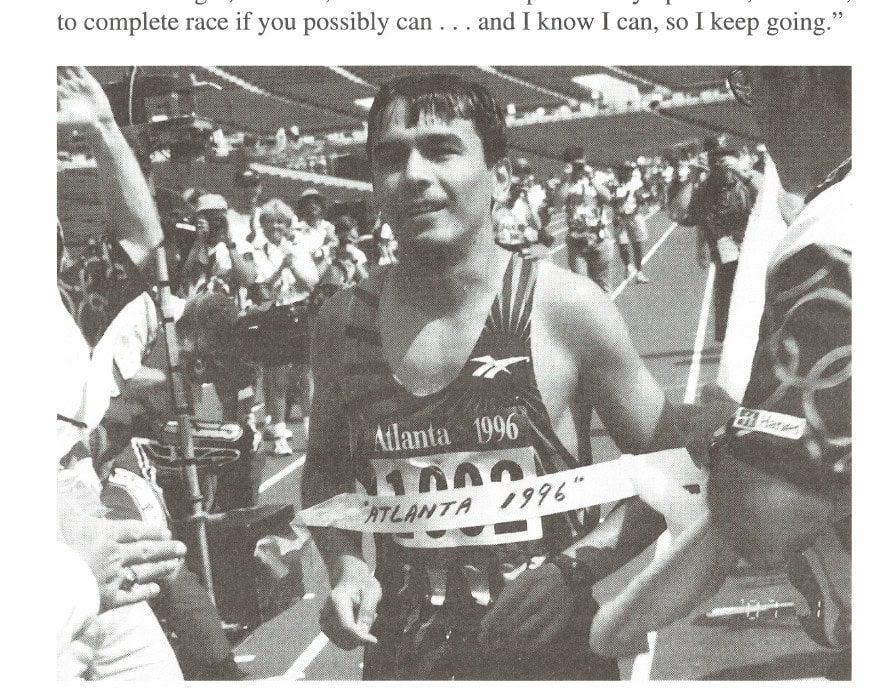
One of the volunteers found a length of broad white tape, quickly scratched “Atlanta 1996” in large black letters, and had it stretched across the line as Wasiqi finished.
His final time was 4:24:17. Overhead, Wasiqi’s faithful TV helicopter broadcast the news.
Ninety minutes later, Wasiqi was released from medical, and he held a brief news conference for the small gaggle of press that remained. We learned he was from Kabul, that his personal best was 2:33, and that he could only train on the streets of town since the countryside was too dangerous. He had lost his grandparents and many relatives to the continuous fighting, and he had also lost all semblance of a normal life. Someday, when the fighting stops, he told us, he hopes to continue his studies.
“I am taught,” he said, “that this is . . . important Olympic idea, to finish, to complete race if you possibly can . . . and I know I can, so I keep going.”
For those of us who came to know him that long morning of August 4, Baser Wasiqi became the overriding Olympic ideal. After years of empty hype, inflated egos, and unnecessary turf battles accomplishing nothing, our buoyant symbol of the Olympic spirit was not the flame nor athletic magnificence such as Michael Johnson’s 19.32 200 meters. It was the large-hearted effort by a semi-injured athlete from a war-ravaged country who would just not quit—combined with the get-it-done spirit of dedicated volunteers determined that his valiant efforts should merit a fittingly ceremonial finish.
I have many souvenirs of the 1996 Atlanta Olympic Games. But the one I would treasure most if I had it would be that scruffy piece of tape inscribed “Atlanta 1996.”
This article originally appeared in Marathon & Beyond, Vol. 1, No. 4 (1997).
← Browse the full M&B ArchiveMore like this
1,000+ stories from 19 years of Marathon & Beyond
The complete archive of the legendary long-distance journal — digitized and free to read.
