

On the Littleton Road
Here’s the first of an exclusive series of articles by Johnny J. (the Younger) Kelley, who will share his marathon memories with M&B readers. Look for the next “chapter” in a future issue.—Editor
John J. Kelley, Sr., of New London, Connecticut, died as December 29, 1947, slid silently into December 30. “Complications of viral pneumonia” was the cause listed on his death certificate. He was 57 years and six months old, a New London post office foreman with a wife, Genevieve, 50, and three children—John Jr., 17; Robert, 14; and Ellen, 13. Not quite four months earlier, Kelley had accompanied Johnny Jr. and the latter’s friend, George Terry, on a doglegged day trip by Greyhound bus and train from New London to Littleton, Massachusetts, to watch the boys compete in their first road race.
T HE LITTLETON 10-Mile Handicap Road Race of Labor Day 1947 had drawn a 45-man field—about average for the country fair spin-offs that were a New England recreational staple of the era.
Many of the racers had made at least part of their pilgrimage on a coal-burning “local” out of Boston. The stubby train’s doors had remained open throughout the hour’s start-stop westward journey, bestowing on the passengers a mixture of natural air-conditioning and carbon pollution. Outside, a hazy sun broiled through a stalemated mass of Gulf air.
Inside, a patrician, bowler-hatted man of 65 studied a clipboarded paper, now and then pausing to survey his youthful fellow travelers. Eighteen-year-old George Terry felt a tingle in his stomach. He nudged his pal. “Lad,” he said, “that’s old Al Hart, the AAU commissioner.”
“Oh yeah?” Johnny Jr. said.
“Yeah,” George confirmed. “Mal pointed him out to me last year at the New England Meet.” Malcolm Graham Greenaway was a popular teacher, activities adviser, and coach at Bulkeley School in New London. “He’s a wealthy guy”—George nodded toward Al Hart—”who goes around to all the AAU races to keep everybody straight.”
“Straight?”
“So’s runners don’t take illegal expense money, so’s they keep their amateur status,” George clarified.
“Oh,” said Johnny.
“Mal says Hart loves the running, but he never ran himself. Used to play polo when he was young, got kicked or slammed in the head . . . and ended up an AAU bigwig. Lives for the sport, lad.”
Johnny peered hard at Albert Thayer Hart. Even Pop Kelley sneaked a peek.
“He keeps us straight,” Johnny mused. “Yet there’s something crooked in his face when he looks at people.”
“Yeah. Mal thinks he might have a metal plate in his head,” George said. “Wow!”
Not 10 feet away the punctilious commissioner Hart tugged his bow tie into perfect alignment and sat ever more erect.
Above the locomotive’s clangor, the names of road racers and their latest clockings could be heard being nervously bandied about. The superheated air in the train’s coach hung heavier still with the smells of rubbing alcohol, Sloan’s Liniment, and Red Hot.
The local ground to its ninth halt. “LIT-tleton, LIT-tle-ton!” the craggy conductor barked.
Canvas tote bags, leather tote bags, string-tied brown paper bags in hand, a baker’s dozen metropolitan road racers, along with Pop Kelley’s duo, made their way toward a crayoned sign atop the jouncing pickup truck that would transport them the final miles to Littleton Green.
His paunch incongruous with the lean stomachs surrounding him, Pop Kelley clambered valiantly aboard the hatchdown pickup with the fittest and settled himself against the cab’s rear wall.
The elder Kelley had never been a runner as these boys were, though he had loved playing sandlot baseball as a kid; and, since coming out of a five-year “nervous breakdown” two years earlier, he had taken up walking—almost 10 miles a day, on a round-trip from his New London home to Ocean Beach, where he also swam for at least five minutes each day, March through November. Perversely, his girth had refused to yield an inch to his rededicated physical life.
Facing Pop, gray trousered legs drawn almost to his chin, clipboard resting on his humped knees, bowler held secure in his left hand, Commissioner Hart jounced democratically with his charges.
“Where you boys from?” a squatting runner asked George Terry.
“Oh . . . down New London way,” George replied.
The youth frowned. “Where the hell’s that?”
“Oh . . . down in Connecticut, you know,” said George.
“Kin-ettiket? Cripes, you boys’re from the sticks!”
“Kind of looks as if Littleton might be in the sticks, too,” George chanced.
The youth eyed him edgily. “You got a point there,” he replied. “You in a club?”
“Mmm . . . No, I don’t suppose we are,” George said. “You?”
” ‘Course. The BAA,” the other said proudly.
“BAA?”
“Never heard tell of the Boston Athletic Association?” the city boy asked.
“Uh-huh,” George said, trying to recover his fumble.
“Then you must have heard of the Boston Marathon. We put that race on.”
“Oh yeah, sure.”
“Heard of Jock Semple, too?”
George couldn’t right off say.
“Oh boy, if you don’t know if you have, I can guarantee you haven’t,” the BAA runner said. “Once you meet Semple, you’ll never again have to wonder. And, speaking of famous names, certainly you’ve heard of Johnny Kelley? He’s supposed to run up in Littleton today, too.”
George thumbed in the direction of his pal. “This is Johnny Kelley,” he said with deadpan earnest.
The BAA runner arched a brow for a full five count. “Yep. And I’m Paavo Nurmi,” he replied.
The prewar Ford cut a tight turn and halted in a cloud of dust. “OK, boys, all out, Littleton High, check in, change up, and be ready to run at three on the nose!” a stogie-crunching official with an alderman’s overhang yelled as he hustled them out of the pickup.
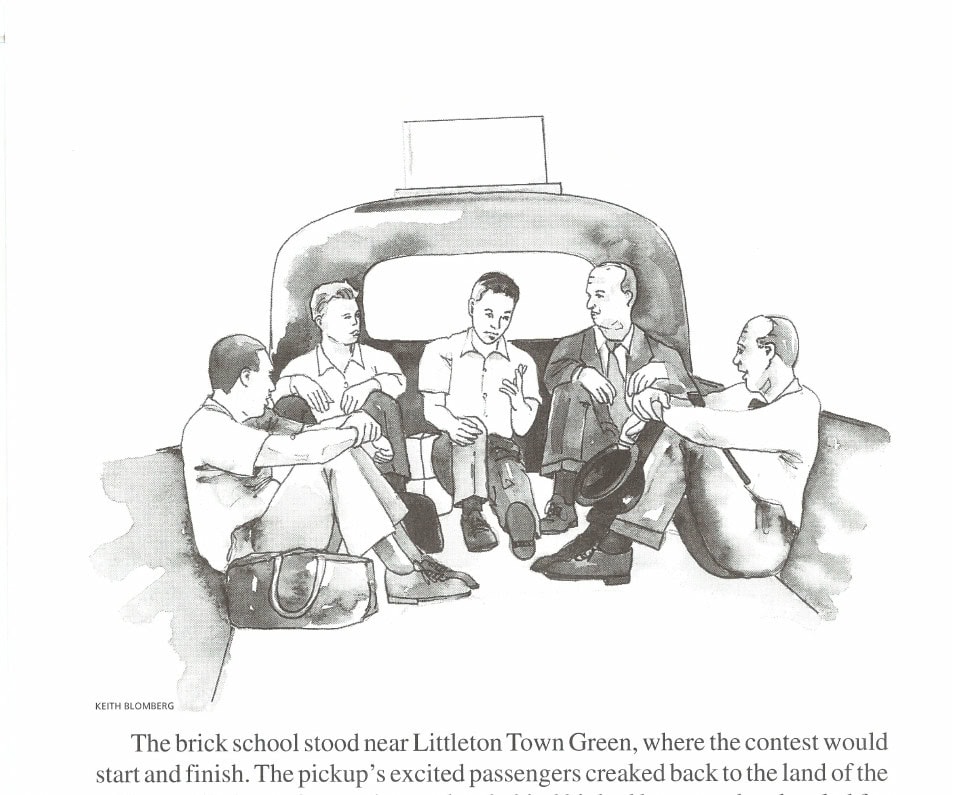
The brick school stood near Littleton Town Green, where the contest would start and finish. The pickup’s excited passengers creaked back to the land of the self-propelled, running anxious palms behind kinked knees as they headed for the waiting gymnasium.
Pop Kelley pulled a damp handkerchief from his pants pocket, swabbed his sweaty face clean of road grit, polished and replaced his bifocals, knocked dottle from his pipe, and told the boys, “Go do what you have to do inside. I think I’ll find a nice shady spot and enjoy the goings-on. Here’s a four-bit piece. I think I heard that the entry fee was a quarter.”
George and Johnny joined the line inside, were duly pried loose of their coin, handed two safety pins and a sizable paper number each, and told to report to an adjacent table for their time handicap assignments.
“Never ran a road race before? You swear on a Bible, never?” the histrionically skeptical handicapper charged.
“Nope, never,” George swore.
“Race before? Anywhere?”
“Um, sure, we’ve raced . . . in high school . . . in track and cross-country,” George replied.
“Well then, you’ve raced,” the skeptic concluded triumphantly. “Not exactly green wood, you know what I mean?”
He restudied his sheet and addressed his assistant, “So whadda ya say, Mike? Whadda we give ’em?”
“Can’t be the limit,” Mike said.
“No no, the limit’s for ol’ Amos and O. Gardner,” the skeptic said. Amos was Amos Kujala, a Finnish-born farmer from Harvard, a familiar road racing figure; O. Gardner Spooner of New Bedford was a perennial starter and “go man” in local handicap races.
“I dunno.” Mike puzzled the problem. “We don’t have nothing to go on.”
A persuasive suggestion broke the deadlock.
“The boys look promising. However, since this is their first road race, I might think you would want to give a cautious allowance, say seven and a half minutes up on ‘scratch,'” Al Hart said.
“Seven-thirty it is, for both. Thanks, Al,” the skeptic said.
“Certainly,” Al replied, touching his bowler hat.
Young Johnny Kelley straddled a bench, lacing his Keds halfcuts over prickly wool socks he hoped would protect his not-quite-healed bunion blisters.
A fraternal hand clamped on his hunched shoulder. He looked into the grinning face of his new friend from Boston. He had put on an eye-catching racing uniform—gold jersey embossed with a blue unicorn head.
“So what did they give you boys?” the BAA boy asked.
“Seven and a half minutes, I think,” said young John.
“Whatever that means,” added George.
The BAA boy sized up these two unknown quantities: Terry, a year or two the older, and his improbably-named shadow.
George Terry was already a Connecticut schoolboy entity. He had won a slew of races, including his high school’s conference and state cross-country and mile championships. He held records. Now he was pointing toward the fall’s state and New England cross-country showdowns.
George had prematurely thinning sandy hair, watery blue eyes, a quizzical half-smile, and your basic accountant’s tummy ripple: in all, a body deceptively designed to dispose of legions of more formful rivals.
Kelley had all but erased his name from his second-chance high school’s roster when he met Terry. The event marked a kind of road-to-Damascus turning point in his life.
Kelley did indeed see the hand of Fate directing his feet. During the previous few years, he had filled a shoebox with Sunday New York Herald-Tribune clippings about the era’s greatest runners’ exploits: those of tiny Greg Rice, the Indiana cannonball; Les MacMitchell of NYU, and his nemesis, Bill Hulse; and, as the war’s hiatus ended, of the relentless “Flying Parson,” Gil Dodds.
Young John Kelley was slight of build, standing barely 5’6″ and weighing probably less than the 120 pounds he reported on demand, his hair a tousled, mottled blond, eyes hazel, and a smile too ready to be the product of serenity. He was a worrier, a dreamer. On this hot September afternoon, he believed he had at last taken a fix on his star.
“You guys ever run in a handicap?” the BAA boy asked.
“Heh, we never ran in any kind of road race before,” George said.
“Oh Gawd, are you in for a treat! Well, see, there’s so-called ‘scratch’ races, where everybody starts together. And then there’s handicaps, where runners go off in small groups at intervals.
“The basis is a minute a mile. Ten miles, 10-minute time allowance, see? Ten minutes for the slowest, or ‘go men,’ that is.
“Now, the breakdown may be every 30 seconds, like today, so you end up with not 10, but 20 separate flights of runners.
“You guys got 7:30, which means that you go two and a half minutes after the go men, and 7:30 ahead of ‘scratch.’
“If you’re any good, what you got today should give you a fair shot. Only, watch out for the heat. Don’t take off too fast. You’ll fry like an egg on that blacktop.
“And remember, you’ll likely be catchin’ those ‘leathers’ ahead of you pretty quick. It’s the faster guys, like me, with five minutes, or Kelley or Tom Crane, if they show, at scratch, that you hafta be thinkin’ about, ’cause they’ll be closin’ on you with every step, bustin’ ass to win both place and time prizes, since handicaps offer both, and very few people have had the stuff to take both.
“Ah, these things can be great fun, but they’re crazy torture tests, too. Handicaps are the devil’s own invention, boys, as you’ll soon see.”
Then the BAA boy was out and lost in Littleton Green’s merry doings.
The Connecticut boys followed, stepping gingerly to avoid collisions, walking wide around urchins carrying cotton candy, relishing the fleeting stares of the curious and the steadier gazes of occasional devotees of the game.
Mid-afternoon’s cascading heat flushed sweat from every pore, instantly drenching the runners’ skimpy racing togs before their wearers’ exertions had even begun. Some runners busied themselves fashioning head covers of knotted kerchiefs. One was seen cramming a cabbage leaf between fabric and scalp.
The boys found Pop Kelley surveying the scene from the shade of a patriarch oak whose leathery leaves glistened in the molten sunshine. Pop knocked dottle from his ever-present pipe. “They’re about to line you up, by the looks of things,” he said. “Somebody just blew a whistle over there.”
George danced like Willie Pep. Johnny followed suit.
Suddenly, from the jumble of runners “warming up” on this Saharan day, there emerged a bantam-chested, sinewy-legged fellow shod in customized, kangaroo skin flats, a far cry from the Connecticut boys’ gutted sneakers.
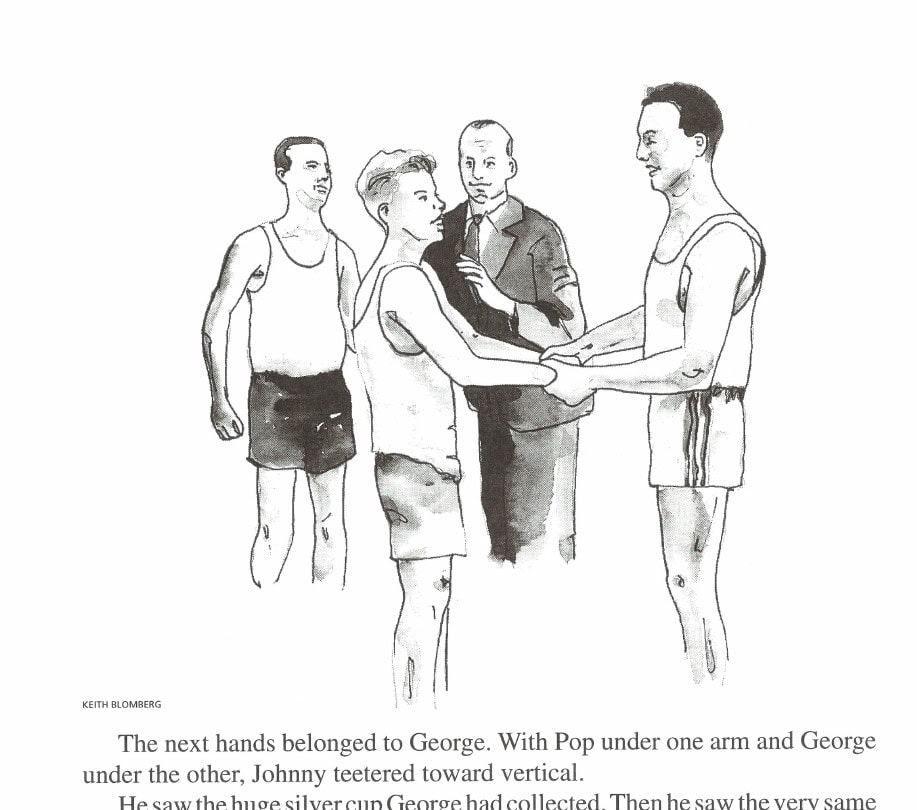
“That’s him. That’s Kelley himself,” Pop told the boys. “He did show up. It’s his 40th birthday, I’ve been hearing. And he lives only a hop and a skip away, in West Acton, so they were all hoping. And, by gosh, he really showed up!”
Whatever happened, Pop promised, before this day was out, they’d all get to shake the famous Kelley’s hand.
“TWEET!”
On line, the great man trotted ceremonially front and center, hands clasped above his head, grinning to a burst of applause. Then the stogie-chomping official read the rules of the road.
A pistol was fired heavenward. Two grizzled veterans of the game shuffled off their mark—a hastily-laid lime line—and the Littleton 10-Mile Handicap Race of 1947 was underway.
Ten minutes later, tactfully tailed by a Buick Roadmaster bearing an OFFICIAL CAR sign on its windshield, Johnny (the Elder) Kelley began his desperado’s pursuit.
Two hours later, young Johnny Kelley sprawled facedown on the cool, matted grass under Pop’s oak tree. It had been the spot most convenient for his ejection from the race’s “meat wagon.”
Johnny lay gratefully overlooked in the day’s winding down drama. “No,” he mumbled, “never again . . . .” Painfully, he raised himself to a half-sitting position. He touched a bloody bunion, soaked through sock and sneaker. Of course the shoes would have to come off. But not now, God, not just now! He collapsed once more.
Sounds of the gazebo’s awards ceremony beset his ears. George had won first place. Not unexpectedly, the great Johnny A. Kelley, his famous namesake, had won the time prize. He would have to feign happiness. The trip to Littleton had been long and disjointed. The return would be endless.
Kelley squinted one-eyed through a crooked elbow. Uncle Sam beaded him from a poster tacked to a nearby tree. “I want YOU to buy United States Savings Bonds.” Yes, the war was over. People were supposed to be buying Savings Bonds now. OK, Sam, Kelley thought, you’re right. I’m going to have to start taking care of business. This isn’t it, is it?
A hand touched him gently. He saw Pop Kelley’s inquiring face.
“Get up, Bud,” Pop exhorted.
He tried to obey, but his drenched running clothes and throbbing bunions drained the will.
“No, Bud,” Pop insisted. “There’s somebody here I want you to meet.”
When it’s time to taper for the marathon, there isn’t much more you can do to prepare physically, but mentally you can add some very important final touches before the gun goes off. In the March issue of Marathon & Beyond, I discussed the physical components of marathon training that must come together for you to conquer the marathon successfully. Training, however, goes beyond the physical. What can you do to be at your mental peak on raceday? Begin to boost your confidence by reviewing your training. Remember how you progressed from running 10 miles four months ago to running your last 20-miler recently? The 20-miler felt more comfortable than the 10-miler did. Be confident that you’ve worked to put money in the bank—now you’re ready to cash the check.
And count your blessings that you came through your training injury free and eager to run the big race. You can and should revel in the hard work you’ve put in—work that should give you confidence and a giddy feeling about your date with the marathon. Give yourself a pat on the back.
TRAINING SPECIFICS
No fewer than two weeks before your marathon, cut back on your training. If you’ve been training at a very high intensity, you should begin cutting back four weeks before the race. Two weeks before your marathon, cut back 20 to 40 percent of your previous week’s mileage; one week before, cut back 40 to 60 percent. Two weeks before your race, run one light workout of 3 to 4 miles at lactate threshold pace (10 to 15 seconds per mile slower than 10K race pace).
You may want to jump in a local road race two weeks before the marathon to get a feel for the racing atmosphere. The weekend before the marathon, go out for an easy 10-miler. Practice your form, feel your relaxed strides. Imagine yourself running the marathon effortlessly.
Marathon Week Training
The week before the race, do some 400-meter repeats after warming up with one mile. The 400s should be quick and relaxed. Run up to 6 × 400 meters five days before the race, then 3 × 400 meters four days before. If you’ve been training at a high intensity, run another 3 × 400 meters three days before.
Table 1 shows what your training should be during the week leading up to the marathon. The 400s work the leg muscles, which will allow them to replenish greater amounts of necessary fuel (glycogen) than easier-paced running would. Eat a lot of pasta and other high-carbohydrate foods after each workout. After your last long run, three weeks before the marathon, resist the urge to do another long run. You will have done sufficient work up to three weeks out. You can’t get any fitter. The best thing for your body is rest. You’ve earned it.
| Day | Workout |
|---|---|
| Monday | 1 mile warm up; 6 × 400m with 2-minute rest between each. Run briskly, but not all out for the 400s; 1 mile warm down |
| Tuesday | 1 mile warm up; 5 × 400m; 1 mile warm down |
| Wednesday | 1 mile warm up; 4 × 400m; 1 mile warm down |
| Thursday | 1 mile warm up; 3 × 400m; 1 mile warm down |
| Friday | 20-minute easy run |
| Saturday | 10-minute easy run |
| Sunday | Marathon |
OTHER DETAILS TO TEND TO
Running Shoes
Unless you’re a marathon “veteran,” don’t use lighter racing flats for your marathon. They may save you a couple of seconds in a 10K, but they won’t provide adequate protection for the average runner over 26.2 miles. Instead, wear shoes that you’ve been using in training. Make certain they have plenty of cushioning and stability. Test on a long run the shoes and socks you’re going
This article originally appeared in Marathon & Beyond, Vol. 1, No. 4 (1997).
← Browse the full M&B ArchiveMore like this
1,000+ stories from 19 years of Marathon & Beyond
The complete archive of the legendary long-distance journal — digitized and free to read.
