

The Lifetime Running Profile
How many miles did you run last year? How many days did you miss? How many long runs did you tack on over the course of the year? If you’re not quite sure, you should definitely read on. As most sports enthusiasts will tell you, keeping track of the related statistics is an integral part of the game. The wonder of professional baseball is that the batting averages, home runs, and RBIs of today’s players can be compared with the Triple Crown feats of yesteryear. Basketball pundits like to record “triple-double” performances of players who obtain 10 or more rebounds, points, and assists in a single game. And when it comes to football, computing a quarterback’s passing rating is a pure statistical delight. The tracking of such averages, numbers, and ratings adds flavor, nuance, and depth to sports, which provides an entirely different dimension and perspective. In a similar vein, there is plenty of pertinent statistical data to enliven the experience of runners as well. Indeed, some runners keep such careful track of their daily runs that their statistical compilations are more impressive than their race results.
Recording daily runs and charting weekly and yearly progress are not only worthwhile activities but also fun. More important, doing so can reduce and even prevent injuries. Take a look at the Lifetime Running Profile (see figure 1 on page 126) of a fellow runner we’ll call John Doe. As you can see, John has been diligently tracking his daily runs since 1985. His profile, a single page in length, speaks volumes. Doe has run 42 marathons, the first in 1979. His best marathons were in 1995, when he ran for over two hours on 72 occasions, and in 1997, when he ran for at least 10 minutes every day of the year, averaging 10 miles per day. Doe’s profile also shows that, except for 1989, he has surpassed 40 miles per week every year for the last 19 years.
AN AID TO INJURY-FREE RUNNING John Doe’s consistent training, enabled by his meticulous tracking of running mileage, has allowed him to remain—for the most part—injury free, one of the
Figure 1 John Doe: Lifetime Running Profile 1985 to 2003
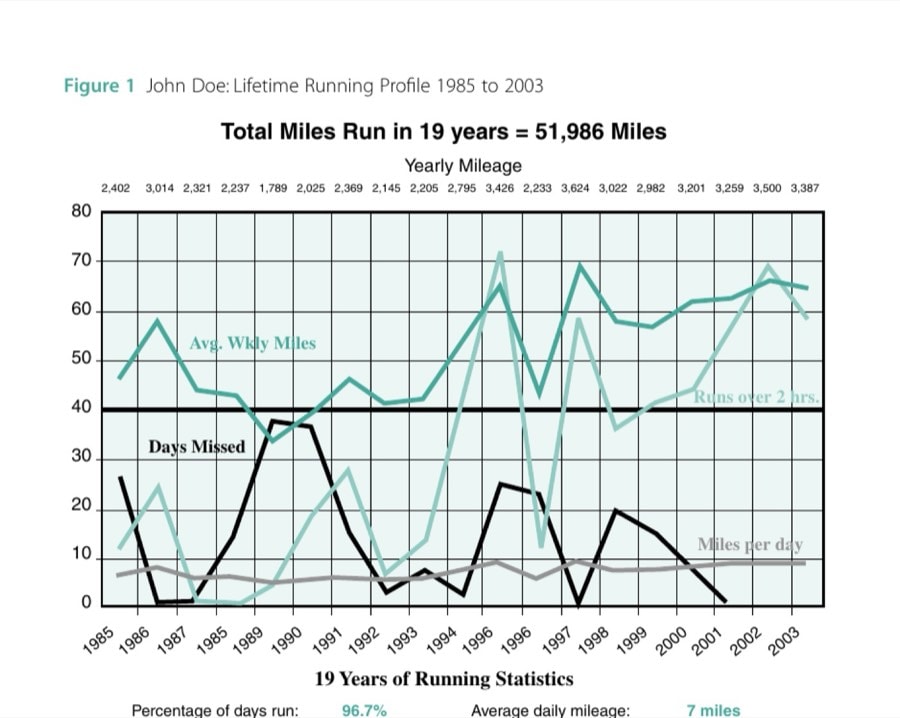
Total Miles Run in 19 years = 51,986 Miles Yearly Mileage 2,402
3,014 2,321 2,237 1,789 2,025 2,369 2,145 2,205 2,795 3,426 2,233 3,624 3,022 2,982
3,201 3,259 3,500 3,387
80 70 60 Avg. Wkly Miles
50
Runs over 2 hrs.
40 Days Missed
30 20
Miles per day
10 0
85 986 987 985 989 990 991 992 993 994 996 996 997 998 999 000 001 002 003 1 1 1 1 1 1 1 1 1 1 1 1 1 1 2 2 2 2
19
19 Years of Running Statistics Percentage of days run: Avg. days missed per year: Avg. minutes run per day:
96.7% 12 days 53 minutes
Average daily mileage: 7 miles Average weekly mileage: 52 miles Average yearly mileage: 2,733 miles
primary goals of all runners. For this reason alone, a running profile is worth its weight in gold. Most seasoned runners agree that methodical training, with only gradual increases in speed and distance, is the number one way to prevent and/or reduce injuries. Runners who know how many miles they average per week are much less likely to incur a serious injury than those who have no idea.
Runners who unknowingly double their mileage, say from 20 to 40 miles per week, are likely to get hurt. By recording each and every run and then comparing the results at the end of the week with the previous week’s daily training, runners become keenly aware of their level of fitness and are much less likely to inadvertently overtrain. Moreover, since no one likes to see a bunch of zeroes where miles should be recorded, average runners who track performance are more likely to train in conformance with their general plan.
A running profile can depict a life’s worth of running data, yet it’s easy to capture its information via two related documents: a Weekly Running Diary and a Yearly Running Mileage chart. If you were to start one yourself, the only equip126 l MARATHON & BEYOND l SEPT/OCT 2005
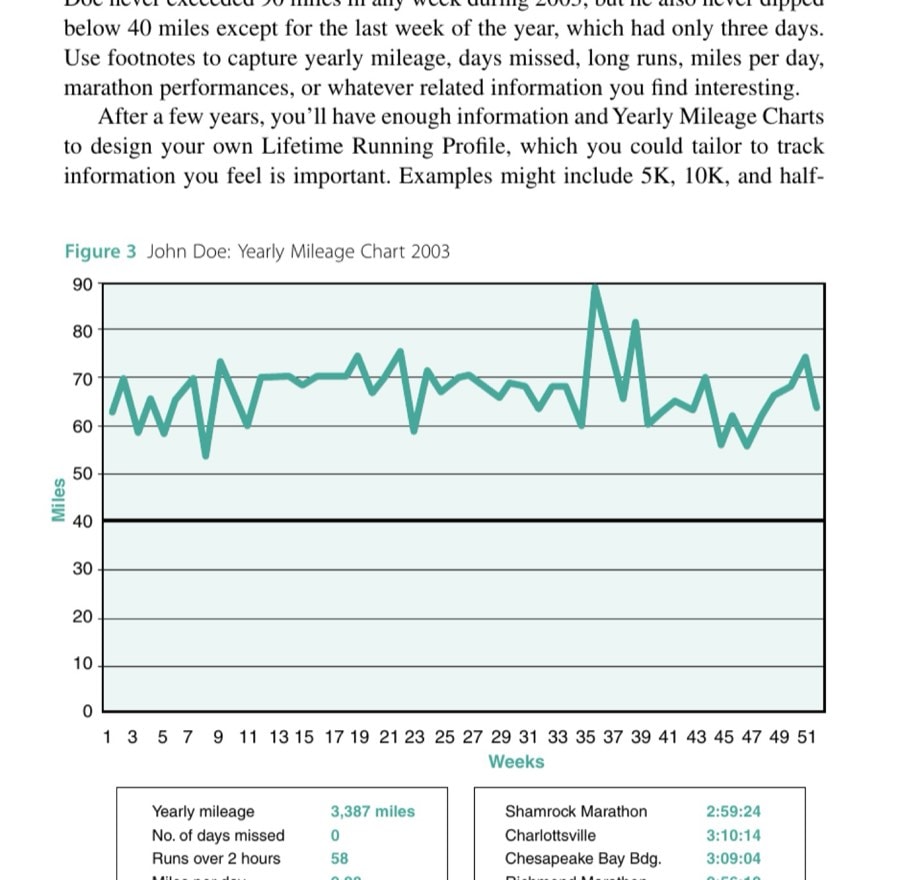
ment you would require are a runner’s watch (any watch with a stopwatch feature will do) and a runner’s diary (or a weekly calendar). You would use the watch to capture the amount of time spent running per day. Hint: it is much easier to use a measurement of time to estimate distance than it is to measure the exact distance, especially if your training venues vary. To convert time to distance, a good rule of thumb is to assume that your training pace is about two minutes slower per mile than your 10K racing pace. For example, if you race five miles in 30 minutes, this would equate to a six-minute-mile pace; therefore, your estimated training pace would be eight minutes per mile. At the end of the week, add up the total number of minutes run and divide by your training pace per mile. This will give you a quick way to estimate your weekly miles (see figure 2). Use the runner’s diary to also record your race results and distances, interesting running locations, long runs, interval workouts, and any other special circumstances. Make sure you put down a big fat zero for those days when you Figure 2 John Doe: Weekly Running Diary
2004
JUNE-JULY
WEEK OF JUN. 28 – JUL. 4
28 MONDAY
THURSDAY
60 mins Ran in Coatzacoalcos, Mexico
60 mins Ran in new running shoes
29 TUESDAY
FRIDAY
60 mins
30 WEDNESDAY
60 mins
1
2
60 mins Fords Colony 5K; 17:01 Fifth Overall Beat Rick & Steve; Lost to Mike & John
3 SATURDAY
30 mins
SUNDAY
4
120 mins
Interval Workout, 8 ea. 400 meters 75/76/74/76/75/75/76 seconds
56 Total Miles
60+60+60+60+60+30+120 = 450 minutes 450/8 minutes per mile = 56.25 miles
did not run. As a steady runner, you’ll be motivated to avoid having too many of those goose eggs in your running log.
FEED THE YEARLY MILEAGE CHART ON A REGULAR BASIS Every five weeks or so, transfer your weekly data onto the Yearly Mileage Chart, incorporating an Excel spreadsheet and an Excel graph—or use plain graph paper (
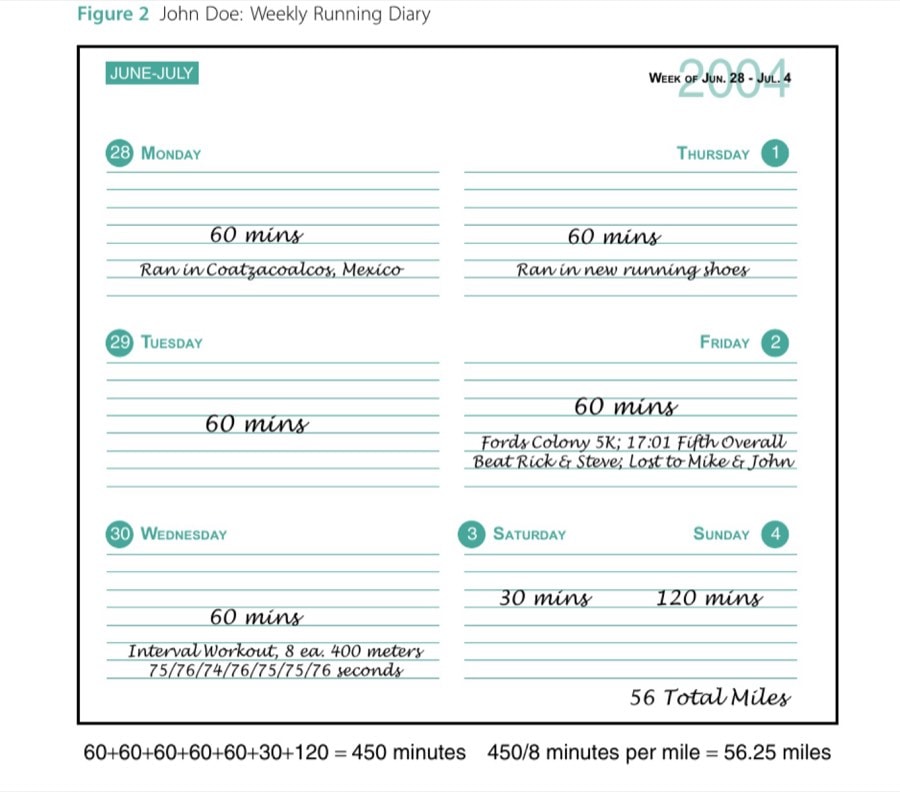
see figure 3). Set the Y-axis to range from zero miles to the highest weekly mileage you anticipate for the year. The X-axis would indicate the 52 weeks in a year. Then, simply plot your weekly mileage onto the Y-axis. As figure 3 shows, Mr.
Doe never exceeded 90 miles in any week during 2003, but he also never dipped below 40 miles except for the last week of the year, which had only three days. Use footnotes to capture yearly mileage, days missed, long runs, miles per day,
marathon performances, or whatever related information you find interesting. After a few years, you’ll have enough information and Yearly Mileage Charts to design your own Lifetime Running Profile, which you could tailor to track
information you feel is important. Examples might include 5K, 10K, and halfFigure 3 John Doe: Yearly Mileage Chart 2003 90 80 70
Miles
60 50 40 30 20 10 0
1 3
5 7
9 11 13 15 17 19 21 23 25 27 29 31 33 35 37 39 41 43 45 47 49 51 Weeks
Yearly mileage No. of days missed Runs over 2 hours Miles per day
3,387 miles 0 58 9.28
Shamrock Marathon Charlottsville Chesapeake Bay Bdg. Richmond Marathon
2:59:24 3:10:14 3:09:04 2:56:12
marathon race performances; personal records; different cities visited and trained in; number of interval workouts; and number of runs exceeding an hour. You’ll enjoy reviewing the results of your effort; Mr. Doe sure does. His profile is framed and hangs prominently in his home. He is just as pleased that he records his daily mileage as he is that he runs his daily mileage; as such, he readily tolerates the remarks of those uninitiated nonrunners who think that runners are crazy to begin with and that runners like him, who keep careful statistics of their runs, are even loonier. Over the years, Mr. Doe has come to particularly enjoy explaining every intricacy of his profile to those he has trapped while glancing at it. When they imply that John has a psychological need that mandates that he run every single, swinging day, John will study his chart and respond by saying that he doesn’t run every day. Although he has run every day so far this year and every day in 2004, 2003, 2002, and 2001, he did miss seven days four years ago, the last day occurring on November 17, 2000, the day before the Richmond Marathon.
THE LUNAR CONNECTION And if the nonrunner responds by posing the question, “What are you trying to do, run around the world or something?” then John will casually reply by saying that he already accomplished this on March 15, 1996, when he surpassed 24,902 miles (the circumference of the earth at the equator) or a month earlier from a longitudinal perspective when he surpassed 24,819 miles (the circumference of the earth around the polar regions). He will explain in a matter-of-fact manner, only half jokingly, that now he is trying to run the comparable distance to the moon. After all, he will say, he already has 51,986 miles logged in, and since the moon at its perigee distance (when it’s closest to the earth) is about 221,615 miles away, he needs only 169,629 miles more to reach it, in a figurative sense. Therefore, if he maintains his current average, yearly distance of 2,733 miles, he will reach the moon (from the perspective of distance) in 62 more years. Although Mr. Doe’s running data go back as far as 1985, he really wishes he had started recording his daily mileage in 1976, when he first started long-distance running. Still, it is better to be late than never to start. Why not start maintaining your own Weekly Running Diary,
Yearly Mileage Chart, and Lifetime Running Profile today? In conjunction with your running, it will help you stay both healthy and focused while serving as a conversation piece as it decorates your wall. Without a doubt, if you keep running, it will look great in five, then 10, and then 20 years. And if you happen to be one who is blessed with magic moon dust, it will look spectacular 62 years from now.
This article originally appeared in Marathon & Beyond, Vol. 9, No. 5 (2005).
← Browse the full M&B ArchiveMore like this
1,000+ stories from 19 years of Marathon & Beyond
The complete archive of the legendary long-distance journal — digitized and free to read.
