

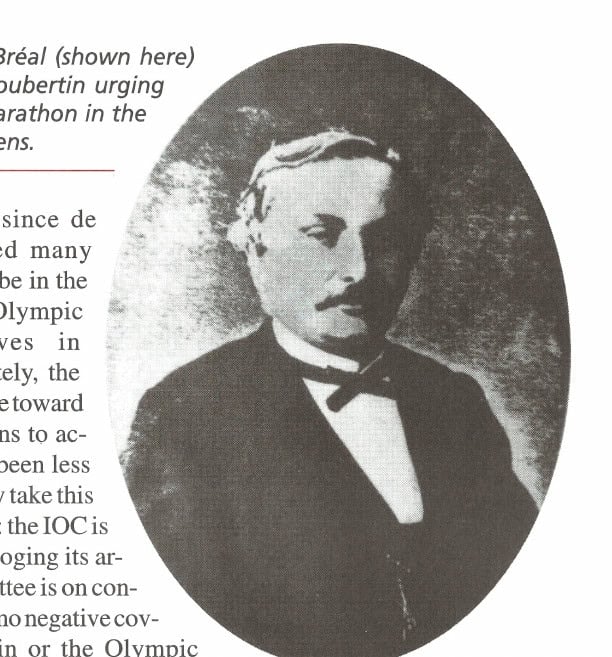
The Search for Bréal
I presumed that since de Coubertin had saved many things the letter must be in the IOC (International Olympic Committee) archives in Lausanne. Unfortunately, the IOC’s traditional stance toward the desires of historians to access the archives has been less than cooperative. They take this stance for two reasons: the IOC is notorious for not cataloging its archives, and the committee is on constant vigil that there be no negative coverage of de Coubertin or the Olympic movement in general.
By the mid-1980s, those fundamental policies had softened somewhat. New buildings had been erected for the IOC library, and IOC President Antonio Samaranch began to pursue a different public policy. In spite of the policy of increased cooperation, I was informed that the letter I sought did not exist in the archives.
A SEARCH OF THE ARCHIVES
In the summer of 1988 I faced the possibility of working in Lausanne doing other research activity. While there, I met the individual responsible for the IOC archives, Karel Wendl. It turned out that, like me, he was a passionate marathon runner and had run several. Thus, contact between brothers of the shinsplint was easily made.
As it turned out, Wendl was also interested in finding the letter. Against all odds, our problem was solved within minutes, since de Coubertin’s correspondence had recently been filed electronically. I soon held in my hands a copy of the letter in extraordinary condition. The letter had been written by Bréal on September 1894 from Nyon in Switzerland. de Coubertin was preparing to drive to Greece in preparation for the Games. The letter consists of four pages, but the crucial passage is as follows:
“Since you are going to Athens, check if it is possible to organize a race from Marathon to Pnyx. This would have ancient character. If we knew the time the Greek warrior needed for this stretch, we could make a record of it. It is my suggestion to donate a ‘Marathon Trophy.'”
It is general knowledge that the Greek water-carrier Spiridon Louis [also spelled Loues] won the first Olympic marathon in 1896. At the victory ceremony, which took place on April 12, he received a medal, the olive branch, a diploma, and an ancient vase that pictured a long-distance runner. He also received the trophy donated by Bréal. Louis died in 1940. His medal is today in the possession of the Greek state. For some time it was exhibited in a display case in the new Olympic stadium in Athens. But what became of the trophy?
At the end of May, 1989, the 13th Congress of the International Society for Sport History took place in Athens and Olympia. The day before the congress was to begin, Andreas Hofer (a sport historian of the German Sports University), Heiner Gillmeister (the famous tennis historian), and I drove to Maroussi, Spiridon Louis’s place of residence, with the intention to search for traces of the trophy, the Bréal cup.
On arrival in Maroussi (a very busy suburb of Athens), we initially stood around rather helplessly. The city hall was closed. We asked passersby where Louis’s birthplace was. But everyone seemed at a loss—our answer was a universal shaking of heads.
HARD ON LOUIS’S TRAIL
Eventually, an old woman who spoke a bit of English and some French sent us up a nearby side street. The street sign read Louis Road. She directed us to a tiny shack built of mud with a tiled roof. It stood sadly dilapidated between three-story houses. Was this the place of Spiridon Louis’s birth? Could it be?
Our savior accompanied us to another street nearby and shouted some Greek words into a house. From the house emerged a woman of roughly 70 years who could speak only Greek. Along with her came a young, pretty, dark-haired girl who spoke English very well. The girl apparently was the great-granddaughter, Katharina Louis. She served ably as translator between we three and Eutychia Louis. We learned that Eutychia is the daughter-in-law of Spiridon Louis.
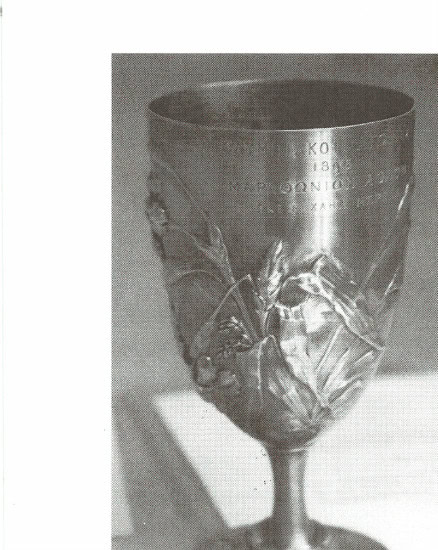
Initially, our interlocutors were rather taciturn, but when the ladies realized that our intentions were honest, we were ushered into the house. Once inside, Mrs. Louis went to the wardrobe and fetched a plastic bag . . . and, as we watched, from the bag she slowly and carefully withdrew the old silver trophy donated by Bréal.
My breath caught in my throat and my hands were shaking. Finally, I had literally The Source. The trophy stood about 25 centimeters high. It was slightly damaged at its base and had collected a patina over the years, but its inscription could clearly be read: Olympic Games 1896, marathon trophy, donated by Michel Bréal.
But there was more to come. Mrs. Louis now pulled out a large chest that contained nearly all the important documents concerning Louis: certificates, newspaper articles, medals of remembrance, and invitations, including the invitation to the 1936 Olympic Games, and even the invitations for the guests of honor. Mrs. Louis showed us two large framed pictures. One showed Louis entering the stadium in 1896. The other showed Louis at the 1936 Games presenting the olive branch from Olympia to Adolph Hitler. The manipulation of the great sportsman through a dictator!
The Louis family did not want to let us go quickly. Two great-grandsons were ushered in. We were invited for a look around the house, were offered a drink and other refreshment. Greek hospitality at its best!
PRE-1896 ARTIFACTS
From July 18 through August 2, 1994, the 35th session for young participants of the International Olympic Academy took place in Athens and Olympia. On the first day, a new congress center was opened on the academy grounds, inside which Giorgios Dolianitis held his exhibition “100 Years I.O.C. D. Vikelas. First I.O.C. President.” This exhibition was particularly valued by the experts, as it contained many original pieces concerning the national Olympic Games in Greece before 1896 and personal information about Dimitrios Vikelas, which up to then were little known, if known at all. The originals are in the possession of the sport association Panhellenios in Athens and of Dolianitis himself.
I was fascinated by one exhibit in particular: a letter dated January 9, 1896, from Michel Bréal to IOC President Vikelas. Bréal mentioned his idea of a marathon and the inscription of the donated trophy. It appears that Bréal corresponded not only with de Coubertin, the general secretary of the IOC, but with the president as well.
Bréal had written:
Dear Sir:
I do not know whether there is a meeting today. I am waiting for a friend who has not yet arrived. The moment in time is approaching when it will be necessary to take the marathon trophy into consideration. I would beg you to translate the following to me in modern Greek, in epigraphic style as best as possible: “Olympic Games, marathon trophy, donated by Michel Bréal.” I am capable of translating it into ancient Greek fairly enough, but I also want to be understood by the youth. Yours sincerely, Michel Bréal.
WHO WAS MICHEL BRÉAL?
Michel Jules Alfred Bréal was born in Landau (at that time part of Bavaria, nowadays Rheinland Pfalz) on March 26, 1832. His parents were Jews of French descent. German was the language used within the family. The family moved to Wissenbourg in the French Alsatian region after the father died in 1837. There Bréal attended a school (as he did later in Metz and Paris) at which French was spoken.
In Paris he was a pupil at the grammar school Louis-le-Grand and a student at the College Sainte Barbe. Afterward, he studied to be a teacher at the Ecole Normale. In 1857 he graduated as a teacher after two years of student teaching in Strasbourg.
Subsequently, he was a student of the famous teachers Franz Bopp and Albrecht Weber in Berlin. Bréal translated Bopp’s comparative grammar (“Vergleichende Grammatik”) into French (1866). Weber taught him Sanskrit and comparative philology (“Vergleichende Sprachwissenschaft”).
Bréal returned to Paris and took his doctoral degree reading mythological and linguistic topics and obtained his habilitation on comparative grammar (“Vergleichende Grammatik”) at the College de France, a place of study with university ranking for all scientific disciplines (1866).
In 1879, he was proclaimed the head representative for the Higher French educational system. His interest in ancient mythology, his responsible position in the French educational system, and his travels to Greece in the name of research explain his engagement for the Olympic Congress of 1894 and also his suggestion to stage a marathon to Athens at the first Olympic Games in 1896. Shortly afterward, Bréal became a member of the French Olympic Committee. Last but not least, due to his major work (“Essai de semantique” in 1897), he is considered the founder of the historic semantics and also Nestor of the French Philology.
Michel Bréal died in 1915.
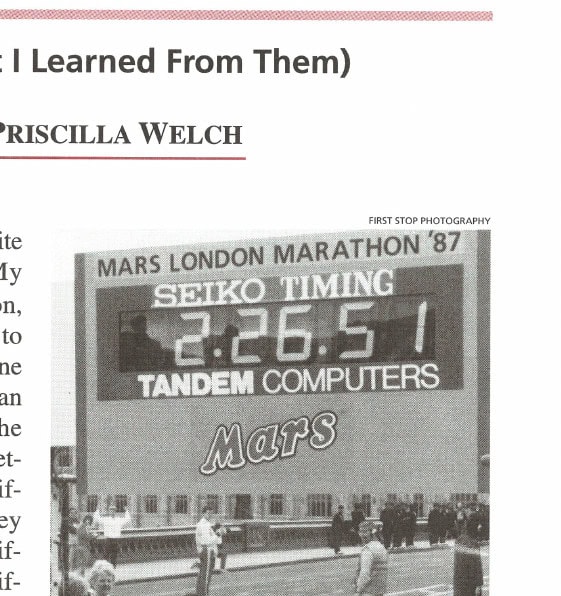
WHEN I was asked to write an installment of My Most Unforgettable Marathon, although I wanted very much to do it, I found that picking one race to highlight was worse than hitting the Wall. Many of the marathons I’ve run are unforgettable because they were so different from one another—they were on different courses, in different parts of the world, at different stages of my career, at different levels of competition, and had different impacts on me personally and professionally as a runner. The editors and I finally compromised that I could make two choices. (Between you and me, I thought 3,000 words on one race would get dull for you. The editors said, no, it wouldn’t be dull at all—but I figured you’d rather get two for the price of one anyway, right?) So, without further ado, here are my accounts of two very different marathons—the 1983 New York City Marathon and the 1987 London Marathon—each of them unforgettable.
This article originally appeared in Marathon & Beyond, Vol. 3, No. 5 (1999).
← Browse the full M&B ArchiveMore like this
1,000+ stories from 19 years of Marathon & Beyond
The complete archive of the legendary long-distance journal — digitized and free to read.
