

Theironman Marathon
By the time I got to the aid station at mile 15 of the marathon, I had to sit down. Then I had to lie down. I took off my sunglasses and just stared at the sky. I started pondering whether I should call it quits. I started doing the math in my head to see if I could walk the rest of the marathon and still make the 11:00 p.m. cutoff time, but I couldn’t do the math! How had this happened? I’m a marathoner! The run is my strength. I guess when it comes to an Iron-distance triathlon, my running resume doesn’t mean squat. What had gone wrong?
After two years of participating in triathlons, I felt I was ready to move up to the Ironman distance, which consists of a 2.4-mile swim, a 112-mile bike ride, and a 26.2-mile run. In those two years I participated in one sprint, four Olympic, and two half-Ironman triathlons with a whole bunch of running races mixed in, including a marathon. When considering the challenge of completing an Ironman triathlon, I thought the swim and the bike would be brutal but that I would make it all up on the run. After all, I’m a runner. Boy, was I in for a painful learning experience.
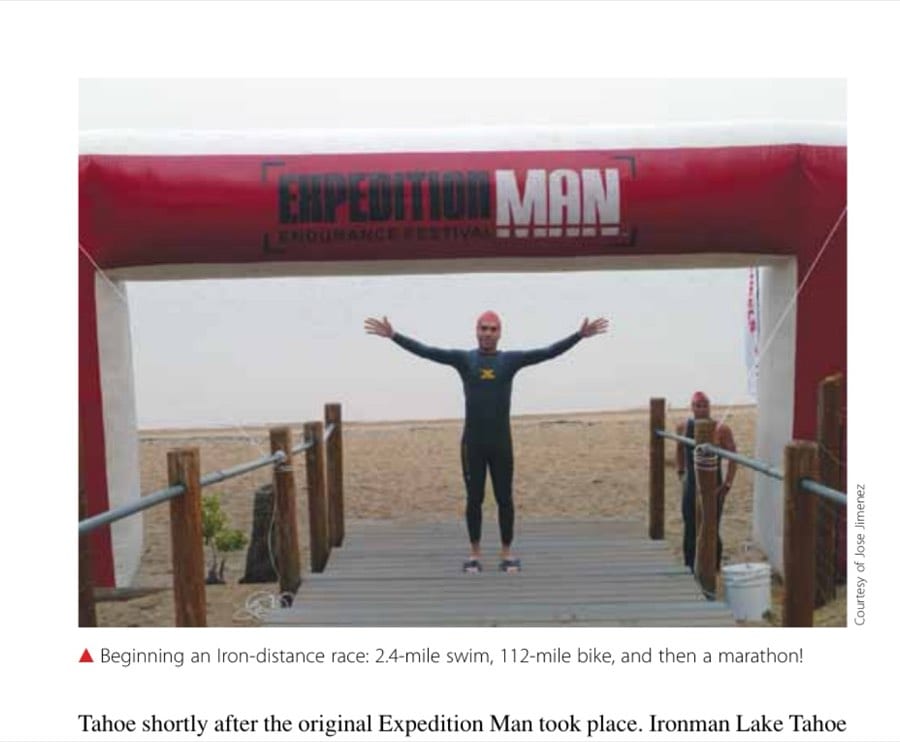
Expedition Man For my first Iron-distance race I chose the Second Annual Expedition Man in the Tahoe-Reno area held August 24, 2013. The first Expedition Man race was held in August 2012. While the event was small (fewer than 50 finishers in the Irondistance race), it was well received. The race was organized well and received great support from the community. The founder and race director of Expedition Man, Ryan Kolodge, said that he saw an opportunity for an Iron-distance race in the Reno-Tahoe area. He noticed that at the time there was no Iron-distance triathlon within 800 miles of the Reno-Tahoe area. Tahoe has a great history as a venue for endurance sports, and he thought an Iron-distance triathlon would be popular. He was right about the appeal of the venue, but others noticed also. World Triathlon Corporation, the owners of the Ironman-brand events, announced Ironman Lake
Courtesy of Jose Jimenez
▲ Beginning an Iron-distance race: 2.4-mile swim, 112-mile bike, and then a marathon!
Tahoe shortly after the original Expedition Man took place. Ironman Lake Tahoe is on the west side of the lake while Expedition Man is on the east. Some of the people who raced Expedition Man 2013 used it as a preparation for Ironman Lake Tahoe. Unfortunately, Expedition Man will not take place in 2014 because the Ironman-branded race met all the demand in the area. Expedition Man was a very well-run event and it is sad that smaller, independent Iron-distance events have such a hard time competing with the Ironman brand.
My triathlete progression My training approach for triathlon evolved as I increased the distances that I raced. I started with a sprint-triathlon distance in late summer 2011. A sprint triathlon usually consists of a 750-meter swim, a 12- to 14-mile bike ride, and a 5K run. I moved up to the Olympic-distance triathlon in 2012. An Olympic-distance triathlon consists of a 1,500-meter swim, a 25-mile bike ride, and a 10K run. From a fitness standpoint, my only challenge to compete in the sprint was the swim. I do not have a swimming background, and getting to the point where I could swim 750 meters was challenging, but I was able to put in the necessary training to accomplish it. The bike and the run for a sprint were easily within my fitness ability to perform well.
Moving up to the Olympic distance required more training adaptation. The swim is long enough that by the time you get on the bike, the body is already tired, which means that the bike and the run are more challenging. For me the bike ride was a limiter at this distance. The 25-mile bike leg really took a toll on my body. I was not used to the way that the body has to move over long distances to generate power for speed on a bike.
I stuck to my training plans and was able to complete a couple of Olympic triathlons at around the 2:40 mark, which I was happy with. With great trepidation I decided to up the stakes to move up to the half-Ironman distance. I registered for the 2012 Bear Lake Man half-Ironman to be held in September at Bear Lake on the Utah/Idaho border. This gave me two months to increase my training to be ready for the half-Ironman distance.
A half-Ironman is, as the name implies, half of the Ironman distance: a 1.2mile swim, a 56-mile bike ride, and a 13.1-mile run. My current training would take me through the swim since it really wasn’t much farther than an Olympicdistance swim. However, more than doubling the bike and run distances would require major changes in my schedule. I decided to add one hour of running and two hours of cycling to my schedule. This resulted in average weekly training of 10-11 hours. I fit this in by increasing my weekend training by two hours and doing two sessions of training during one of the weekdays.
My overall ability to run off the bike improved, but the bike was still a very painful process. I felt afraid to dedicate any more time to the bike because I thought that my ability to run would suffer. By now I had acquired an indoor trainer that I used for interval training on the bike. However, I still found it very difficult to get my heart rate anywhere close to where it would be when putting in a hard effort while running. According to elite triathlon coach Joe Friel, this is normal. Typically, the same level of effort on a bike will yield a higher heart rate on a run. In Friel’s book The Triathlete’s Training Bible, he divides heart rate into five training zones, each of which is emphasized during different phases of training. Zone two is supposed to be the most productive zone for endurance-training gains during the preparation and base phases of training. I calculated my training zones for the run and the bike and focused my efforts on zone-two training for the bike.
My experience at Bear Lake Man was great. My goal was six hours, and I completed it in 5:34. The course is pretty flat and the weather was perfect. I was exhausted to a degree that I had not experienced before, but I felt that if I could do this well in a half, then I could at least finish a full Ironman.
The Iron-distance training plan I signed up for Expedition Man in fall 2012 and developed my training plan. It became painfully obvious that I did not have the time available to prepare to “race”
this race. To finish under 12 hours would require 20 hours of training a week. This meant that my realistic goal was to shoot for an under-14-hours finish time. With a realistic goal in hand, I laid out my training plan in an Excel file as I do for every race. My philosophy was to bump up the training plan I had used for Bear Lake Man by five hours with the same distribution of swim/bike/run training. The training schedule covered 28 weeks but 12 of those were in preparation for the St. George 70.3 half-Ironman, which would be my first triathlon in 2013. The first 12 weeks were very half-Ironman specific, while the remaining 16 weeks were focused on the full Ironman.
I decided that the marathon at the end required special attention. I was keenly aware of how brutal a marathon could be, so I decided to build up my weekend long runs in the same fashion I did for a marathon. The plan built up to 20-mile long runs with three 20-milers before Expedition Man.
I also planned to do two 100-mile bike rides and two of what Joe Friel calls “big days.” A big day is a long bike ride (about 80 miles) followed by a 1- to 1.5-hour run. My first big day consisted of an 80-mile bike ride followed by a one-hour run. My first big day was a big freaking disaster. The bike ride went OK. I covered the 80 miles in a bit over 5.5 hours, but my legs were horribly tired and every step off the bike was labored. About two miles into the run, I was nauseated. My pace slowed to a crawl. I had to change my route and covered only five miles in one hour. It was a miracle I didn’t puke my guts out before I got home.
This turned out to be a scary experience since I ended up bedridden with nausea for the rest of the day. My nutrition plan was a complete failure. The problem was that I wasn’t sure what I had done wrong with my nutrition or whether other factors played into my meltdown. On my next big day, I did my best to increase my caloric intake per hour, which helped a lot. However, I could tell that I was undertrained when it came to the bike. Coming off the bike, I was still feeling beat up and tired but thought I had the nausea problem under control.
Well, that was it. The hay was in the barn. I had stuck to my plan pretty closely, but I still felt uncomfortable with the Iron distance. With the training I had done, I knew that I could perform individual time trials of 1:25 for the 2.4-mile swim, six hours for the 112-Mile bike, and 3:30 for the marathon. However, the big days showed me that how all those would play out together was still a complete mystery. The only thing building up my confidence was that I felt that I hadn’t significantly hurt my run fitness, and I was banking on that to get me through to a good finish. Boy, was I in for a rude awakening.
The race Race-day conditions were horrible. There was no rain, and the forecast called for a cold morning and a warm rest of the day with overcast skies. However, Yosemite
The swim The swim started at Zephyr Cove in South Lake Tahoe. I jumped into the water, and it felt much warmer than the cold morning air. The water in Lake Tahoe was clear but cold. The race directors said the temperature was 64 degrees, but the
water felt significantly colder than that. The water was calm and beautiful and there were only about 80 swimmers in the water, but for some reason I started having a mild panic attack only about 150 meters in. My strategy for dealing with a panic
attack is to go into a slow breast stroke until the panic subsides. I started to breast-stroke slowly and took deep breaths. I immediately felt better and the panic started to subside. After about 200 meters I
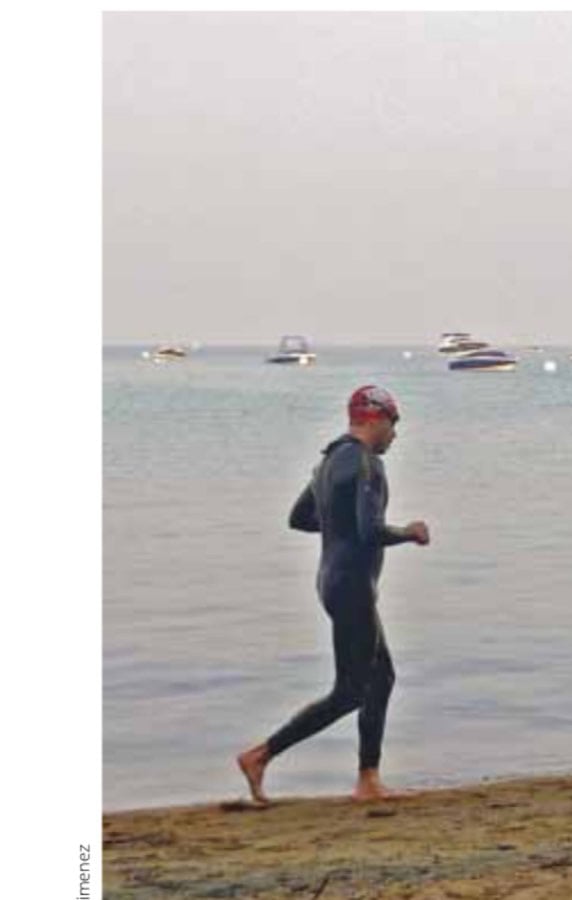
felt good enough to continue with a freestyle stroke. The swim course is two rectangular 1.2-mile loops with a 100-meter beach run in between the loops. The air was smoky and the lake was a bit foggy, and it
was difficult to see the buoys. I lost quite a bit of time trying to find buoys on the far side of the course. The first loop went great, although my right leg cramped as I got close to shore. I started kick
ing faster, which made the cramp go away. As I came out I saw my
Quick jog in the sand before entering Lake Tahoe for the second lap of the swim.
▲
Courtesy of Jose Jimenez
National Park was on fire and the smoke had enveloped the Tahoe/Reno area. The Expedition Man race organizers almost canceled the race, and they made participants sign waivers indicating that we understood that engaging in a 140.6mile race in such air-quality conditions could be hazardous to our health. Many participants opted out, but a few of us signed the waiver and went ahead. The wind was also very strong all along the bike course. Oh, well, if it wasn’t hard they wouldn’t call it an Ironman.
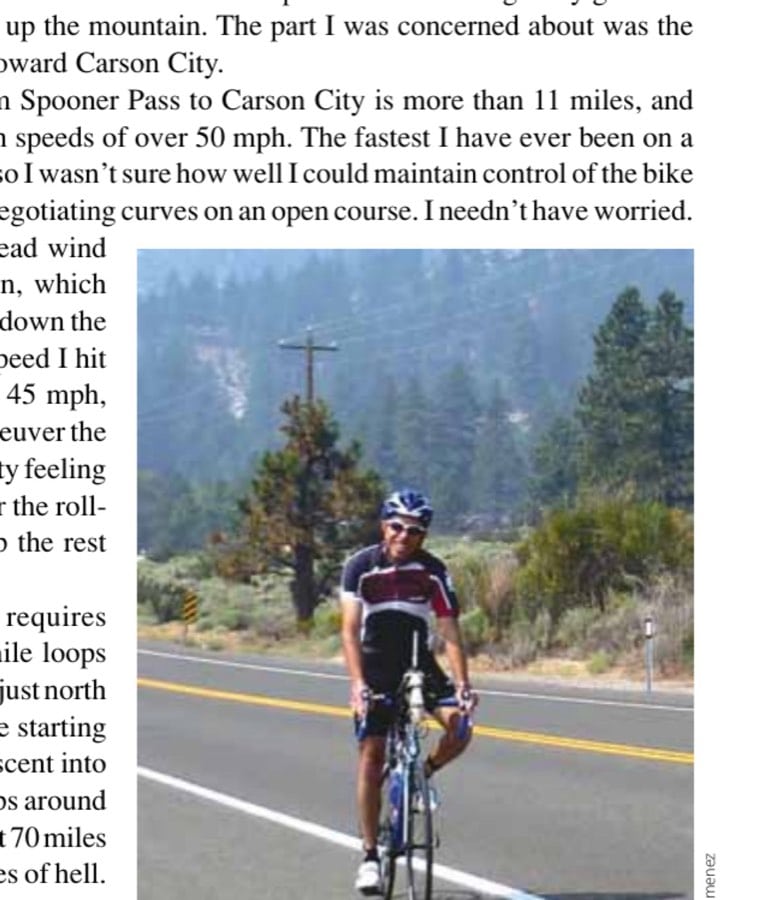
The bike The smoke in the air made me go into a sneezing fit as I was coming into the first transition (T1). I could not control my breathing. Once it normalized I was able to change into my bike gear. My breathing difficulties made me take 10 minutes in T1. The climb out of Zephyr Cove to Spooner Pass was 8.5 miles of fairly steep uphill, but it didn’t feel too bad. I put the bike in the granny gear and slowly made my way up the mountain. The part I was concerned about was the screaming downhill toward Carson City.
The downhill from Spooner Pass to Carson City is more than 11 miles, and riders can easily reach speeds of over 50 mph. The fastest I have ever been on a bike is about 43 mph, so I wasn’t sure how well I could maintain control of the bike going that fast while negotiating curves on an open course. I needn’t have worried. There was a strong head wind coming up the canyon, which automatically slowed down the descent. The fastest speed I hit on that downhill was 45 mph, and it was easy to maneuver the curves. I hit Carson City feeling good and settled in for the rolling hills that make up the rest of the course.
The bike course requires three and a half 20-mile loops around Washoe Lake (just north of Carson City) before starting the final 14.5-mile descent into Reno and T2. The loops around Washoe Lake represent 70 miles of what I call the circles of hell.
▲
Biking around Washoe Lake.
Courtesy of Jose Jimenez
wife sitting on a lawn chair very cozily wrapped in a blanket. She cheered me on and took pictures. I remember thinking, One more time. Let’s go! The second loop was uneventful except for the fact that I was going much faster. I was in a groove and I started to pass a few people. I actually had to remind myself to hold back so that I could save energy for the rest of the day. I finished the swim in 1:30, which is exactly what I was shooting for.
Don’t get me wrong, the area is incredibly pretty, but this section of the course is very challenging. The east side of the lake has rolling hills, while the west side is only slightly flatter. The road around the lake is diamond shaped. The winds that day were blowing from the west and slightly to the north. The wind was in my face for half of the western side and for the entire eastern side. While I can’t say how hard the wind was blowing, I can say that road signs indicated that this was a high-wind area, which I was able to confirm firsthand. The winds blew hard the entire time I was riding all three and a half circles of hell around the lake. This turned what should have been a reasonable course into an incredible challenge.
Halfway through the second loop, I had a flat tire, which took me about 10 minutes to change. By the end of the last half loop (mile 97), I was completely exhausted. The circles of hell had definitely done their demonic number on me. At this point, with about 10 miles to go, I had no idea how I was going to run a marathon after finishing the bike. I felt so beat up that I was actually wondering whether I could walk after getting off the bike. Getting to the bike finish seemed almost surreal. After imagining that moment for more than a year, I was happy to complete that portion and was surprised that I could even stand and walk. The bike took me 7:08 to complete, which was 38 minutes more than my goal but still well below the cutoff of nine hours.
The run I changed socks and replaced my jersey with a tri top and put running shoes on. I tried to run but I just could not do it, so I decided to start easy and walk for the first few minutes. It was only about 80 degrees Fahrenheit, but it felt extremely hot. I immediately started pouring water over my head to keep cool. After about five minutes, I was able to start jogging. I then came upon the only hill on the course. This hill would not have been a problem except for the fact that I would have to climb that hill four times in the two-loop course. I decided to walk up the hill to conserve energy and then run down the other side.
After a long stretch of straight and flat road, I came to the aid station at mile four and was happy to see that my wife was there waiting for me. In her everloving way she asked me, “What took you so long?” I simply smiled at her in a way that said, “You really think you’re hilarious.” I fueled up and kept going to the turnaround point at mile 6.5. I was feeling pretty good, but soon after I reached the turnaround, heavy fatigue set in. The heat started to feel oppressive although I knew that it wasn’t even in the mid-80s.
Most of the people I saw on the course were also hurting. I started freaking out a little bit. My feet were throbbing, my breathing hurried, my head was spinning, and every step took a great effort to complete. My heart rate, however, was low when compared to the level of effort I was putting in. On a 10-point rate of
ad
perceived exertion (RPE) scale, my effort was at nine. However, my heart rate was about 114, which is a zone-one effort. I knew that this was bad news. An RPE of nine with a zone-one heart rate means that your energy tank is pretty close to empty. You want to push the pace, which would increase your heart rate, but the body simply has no energy to draw upon. As I approached the run start/finish area and the half-marathon mark, I knew I was in real trouble. I now found myself in a situation where I had a half-marathon to go and no idea how to complete it.
This was frustrating! Here I was, a veteran of the Boston Marathon, a multiple recipient of age-group awards in running, and a survivor of the Pikes Peak ascent, and I couldn’t even run to the end of the block. What had gone so wrong?
Going up that freaking hill was pure murder. I tried to run down it but couldn’t. By the time I got to the aid station at mile 15, I had to sit down. Then I had to lie down. I took my sunglasses off and just stared at the sky. I could hear the aid-station volunteers close to me saying things like, “He doesn’t look so good.” I thought, No kidding. Their comments didn’t annoy me because I really was not doing well. I started pondering whether I should call it quits. My body was done, and I really didn’t think I could put anything else in it. About 2 hours, 45 minutes had passed since I started running. I started to do the math in my head to see whether I could walk the rest of the marathon and still make the 11:00 p.m. cutoff time, but I couldn’t do the math!
Courtesy of Jose Jimenez
▲
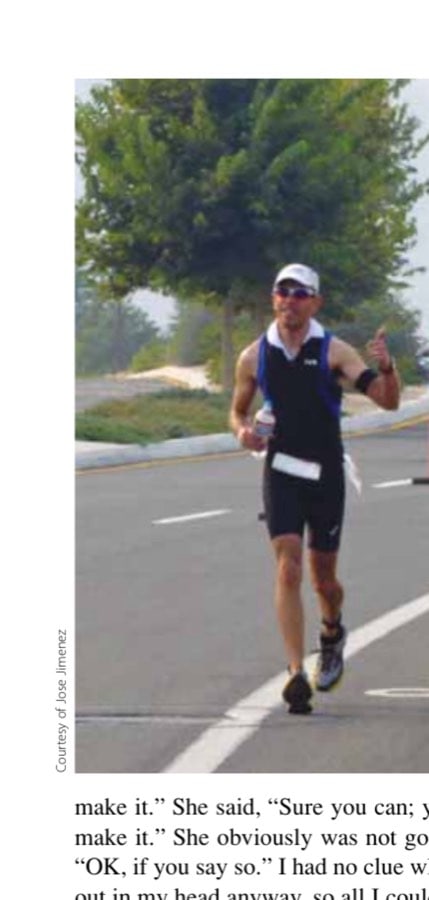
Feeling OK at the start of 26.2. That would soon change.
I decided it was time to man up. My marathon goal was history, but I should at least have the decency to consult with my wife before pulling out of the race. I knew she was waiting for me at the aid station at mile 17. That was only
two miles away. I could probably make it that far. So I got up and started walking. Luckily, after walking one mile I started feeling a bit better. I started jogging a bit and then would have to stop, but
at least I could now mix in my jogging with walking. I finally made it to the aid station and my wife gave me a cheer before I had even gotten there. I told her, “Well, I’m not sure I can make it.” She said, “Sure you can; you could walk the rest of the way and still
make it.” She obviously was not going to let me off the hook so easily. I said, “OK, if you say so.” I had no clue whether she was right, and I couldn’t figure it out in my head anyway, so all I could do was trust her. She took a picture of me
because she found it funny that I looked so completely beat up. It was then that I noticed her cup of Coke at the aid-station table. I asked her if I could have it, and she said that it was flat and warm. I told her that was
perfect and took the Coke and started sipping it down. I also noticed that the aid station had salt pills. I took two salt pills and washed them down with the Coke. The Coke immediately felt great going down, and my nausea started to subside.
I felt ready to keep moving and my wife decided to walk for a while with me. It started to get very dark so I put on my headlamp. I really don’t know whether it was the salt pills, the Coke, or the darkness, but I started feeling great
and decided that I could start jogging. After a while I was able to start running, and from that point on I walked only a few times. I cranked an average pace of 8:00 minutes per mile over the last 5K of the marathon. Poor nutrition choices
had obviously played a huge part in the problems I faced with the marathon.
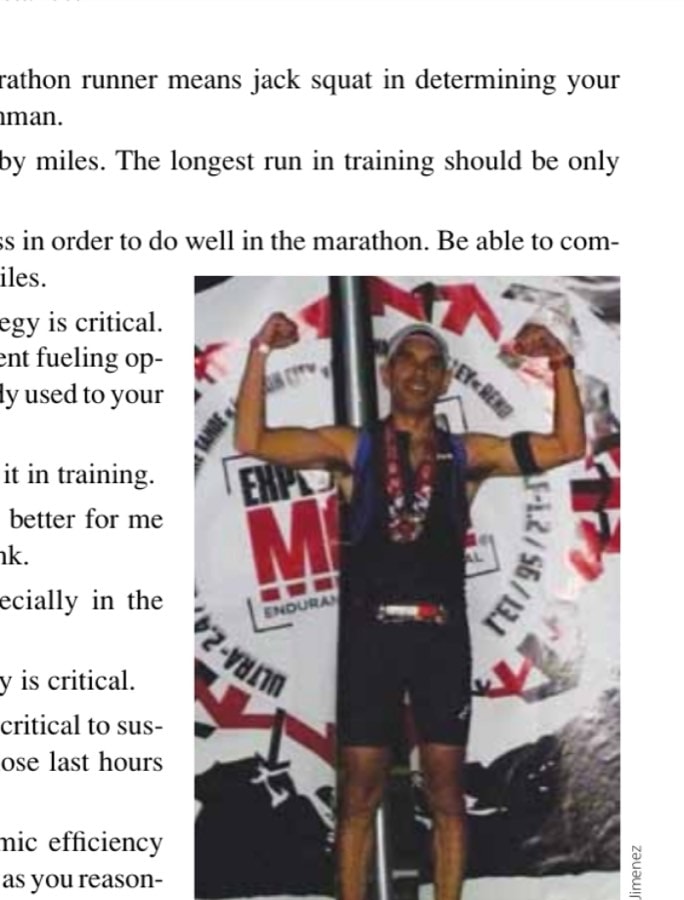
I finished the marathon in a dismal 5:40 and the Expedition Man Triathlon in 14:50. It was fully 50 minutes more than my goal time, but at least I finished. I was happy to see the finish line and to feel that hefty medal around my neck: I had done it. It didn’t go as expected, but with encouragement from my wife and foolish stubbornness I was able to conquer the Ironman challenge.
Lessons learned The overall lesson I took away from trying to tackle the Iron distance is that you can’t train for this type of triathlon the same way that you train for a marathon. Interestingly enough, bike training is more important than run training in preparing to have a good Ironman marathon. Finally, the right mix of nutrition is critical in helping you to cover the distance.
Here is what I learned: 1. Being a decent marathon runner means jack squat in determining your performance in Ironman. 2. Train by time, not by miles. The longest run in training should be only about 2.5 hours.
3. Focus on bike fitness in order to do well in the marathon. Be able to comfortably ride 100 miles. 4. Proper fueling strategy is critical. Practice with different fueling options and get the body used to your chosen fuel.
5. Coke is magic. Try it in training. 6. Salt tablets worked better for me than electrolyte drink. 7. Keep moving, especially in the bleakest moments. 8. Support from family is critical.
10. Invest in aerodynamic efficiency for the bike as much as you reasonably can. Now I get to try it all over again next year! Maybe this time I’ll get it right.
Courtesy of Jose Jimenez
9. Strength training is critical to sustain you through those last hours of the run.
This article originally appeared in Marathon & Beyond, Vol. 18, No. 5 (2014).
← Browse the full M&B ArchiveMore like this
1,000+ stories from 19 years of Marathon & Beyond
The complete archive of the legendary long-distance journal — digitized and free to read.
