


On paper, the idea is simple. Break a historically meaningful barrier in the mile, wear the right spikes, and walk away with a $40,000 NIL deal while you’re still in high school.
In reality, it’s one of the most striking signs yet of how much the landscape has shifted in the world of high school and college distance running.
This week, Diadora and Marathon Sports announced a first-of-its-kind NIL program aimed squarely at the fastest high school milers in the country.
The first boy to break four minutes for the mile, and the first girl to run under 4:35 during the 2025–26 indoor season, both while wearing Diadora’s new Mezzofondo spike, will earn a $40,000 name, image, and likeness contract.

Now the conditions.
The performances must come during sanctioned indoor competitions between December 8, 2025, and March 15, 2026. Fully automatic timing is required, approved 1600-meter conversions will be accepted, and athletes must be eligible for interscholastic competition under their respective state associations.
The shoe itself is central to the bet.
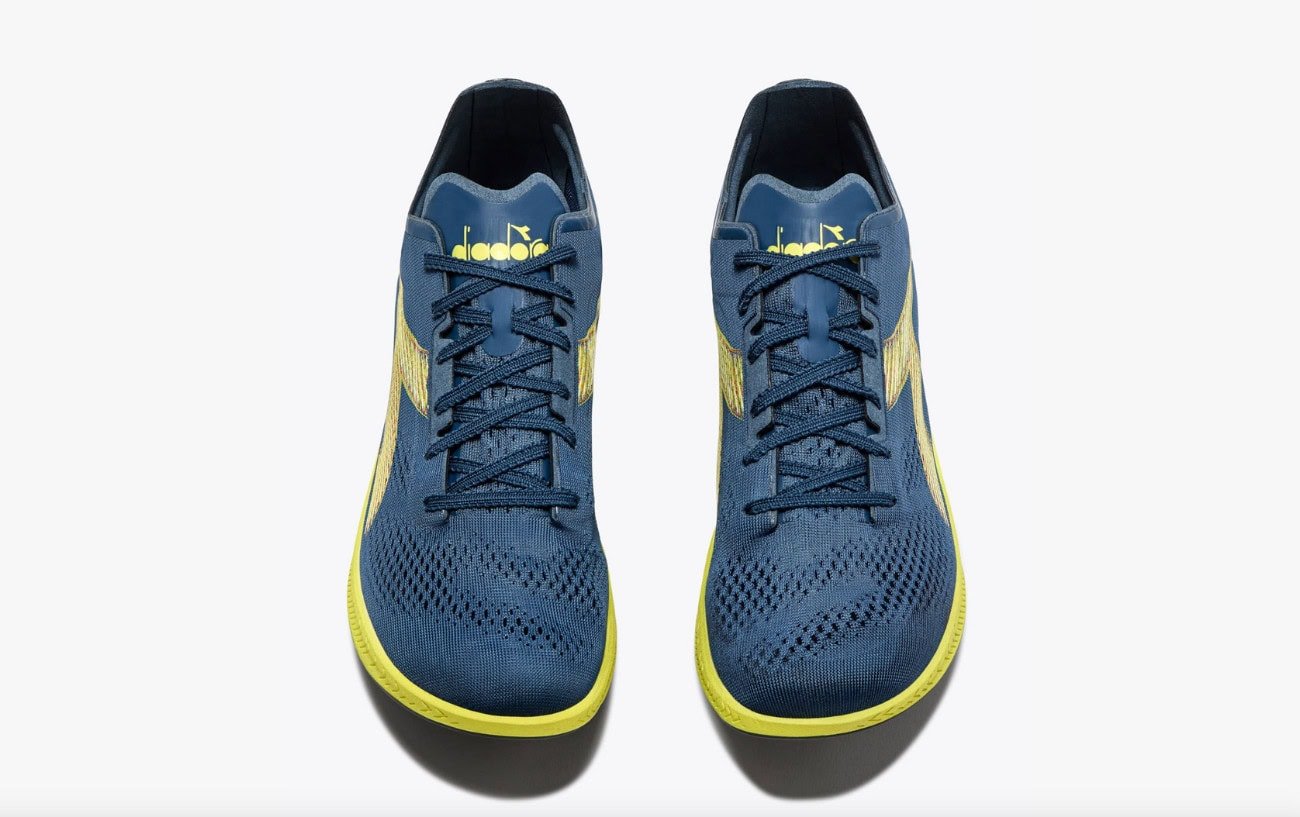
Diadora’s Mezzofondo, Italian for “middle distance,” is a $260 superspike built around a full-length, carbon-filled plate and the brand’s ANIMA PBX midsole compound. According to Diadora, lab testing shows roughly four percent greater energy return compared to other leading distance spikes.
The shoe was developed in Italy’s Run Valley in Caerano di San Marco and tested extensively with sponsored athletes, with additional engineering input from Ducati. Diadora USA president and CEO Bryan Poerner framed the program as a direct extension of confidence in the product.
We actually got a first-hand look at this spike at The Running Event in San Antonio, Texas, where brand reps claimed it was the fastest mid-distance spike in the world, with the lab data to back it up.

Marathon Sports president Ben Cooke said the initiative is part of a broader investment in scholastic running. The New England-based specialty retailer has increasingly leaned into high school and youth engagement through events, NIL support, and community partnerships, and this program represents their boldest escalation of that strategy to date.
The performance standards themselves were not chosen at random either.
Since 2020, the sub-four-minute mile has shifted from near-myth to recurring headline. Twenty high school boys have broken the barrier since, with seven of them last season alone. Prior to the pandemic era, only ten boys had ever done it, stretching back to Jim Ryun’s breakthrough in 1964.
On the girls’ side, 4:35 reflects a similarly elite but increasingly populated tier. Last indoor season, five athletes ran under those respective benchmarks, meaning that, had this program existed a year ago, multiple runners would have been eligible for a hefty payday.
Where this announcement becomes more interesting is what it represents beyond the stopwatch, especially for those who have watched the landscape evolve over the last years.
For decades, high school and college running operated under some quite rigid amateurism rules.
Accepting prize money, signing endorsement deals, or even appearing to benefit financially from performance could jeopardize college eligibility. Success was rewarded with records, recognition, and scholarships, not contracts.
The NIL era has now dismantled that framework almost overnight. What began as a correction at the college level has filtered downward to young teens far faster than many expected.
This Diadora–Marathon Sports program sits squarely in that new reality, fully compliant with current rules, yet fundamentally different from anything that came before it in scholastic distance running.
Now, of course, there’s an undeniable upside.
A high school athlete capable of breaking four minutes or running 4:34 indoors is already operating at an elite level. Many will certainly go on to Power Five programs. Some will eventually sign professional deals. A $40,000 NIL contract puts the value of those performances in the open market.
But at the same time, tying that money to the use of a specific piece of equipment raises questions the sport is still learning how to ask, let alone answer. Access is uneven. Not every athlete can easily experiment with $260 spikes. Not every program encourages or even allows deviation from existing brand relationships. And not every runner has the flexibility to chase a single peak performance indoors.
There’s also the human element. High school distance running already balances ambition with burnout. Adding a clear financial incentive to a single barrier changes the emotional stakes. The pressure to hit a time doesn’t disappear; it will only get stronger.

None of that makes the brands villains. From a marketing perspective, the logic is clean. The rules allow it. The performance standards are transparent. The reward is explicit. There’s even something refreshingly direct about it: run the time, get the deal.
What it does do is force an honest reckoning with where the sport is now. High school track is no longer insulated from money, branding, and equipment-driven performance incentives. Pretending otherwise doesn’t protect athletes, it just leaves them unprepared.
This single NIL program won’t redefine high school running on its own. But it does crystallize the moment the sport is in, one where tradition, opportunity, and commercialization are colliding in real time.
The high school mile still matters. It’s just no longer untouched by the economics surrounding it.




Start the conversation