


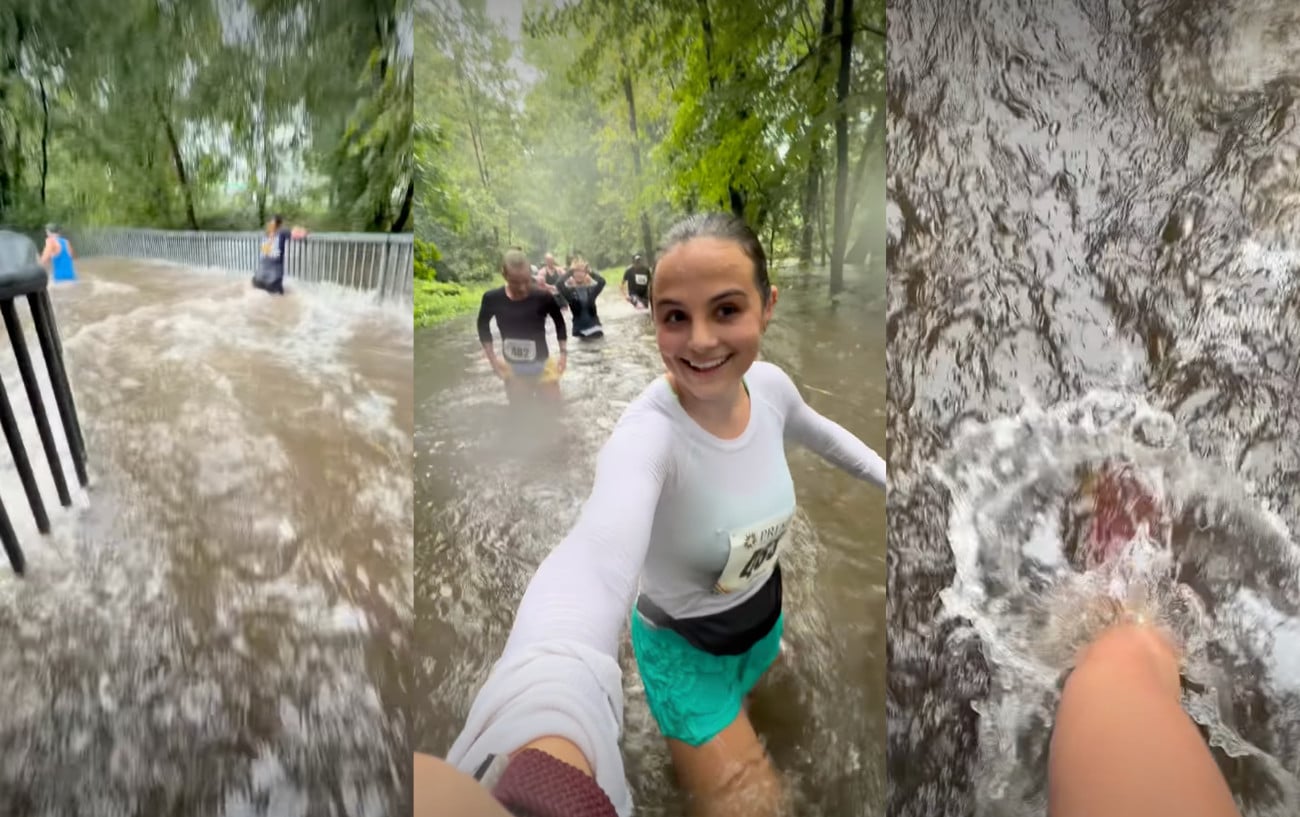
Nobody signs up for a flat, fast half-marathon in a county park expecting to swim part of it. On Sunday morning in northern New Jersey, runners at the Racefaster Half Marathon came through the bridges along the Saddle River holding the railings, in water several described as waist-deep, and plenty have spent the time since asking why it started at all.
At 8:53 a.m., an hour and seven minutes before the gun, the National Weather Service issued a flash flood warning naming Paramus and Fair Lawn. It put 2 to 3 inches of rain already on the ground, described the hazard as life threatening flash flooding, and ran until 11:30. Three more followed: one for the Saddle River itself, three minutes before the start, and two more while the field was still out on the course.
Runners knew the start had moved. Racefaster’s own website still advertises an 8 a.m. gun; the RunSignup listing now reads “10am START TIME.” Garrett Nathan, who had only signed up on Thursday, was chasing a half-marathon personal best and told NBC New York the move read as sensible. “I’m like, I guess it’s gonna rain… it sounds like a good, logical decision,” he said. Nothing came after that. “I keep checking my email from the race directors and get no notifications about a canceling.”
The Course Follows the River
Saddle River County Park is a 577-acre sliver of parkland that bends with the river through six Bergen County towns, its paved path running about 6 miles from Ridgewood to Rochelle Park, dipping under Route 4 and other road bridges. Nathan said the race set off from Ridgewood, near the top of the river. Those bridges sit at the low points of the path, which is exactly where the water was.
Rain alone is a manageable racing problem, and runners deal with it all the time. This was something else. Nathan counted five or six crossings out and back. “It’s waist deep, chest deep, holding onto the railing,” he said. Zac Clark, a former Bachelorette contestant, finished in 1:40:42 for third in his age group, and near Red Mill Road he stopped to film one of them. “Bro, this is nuts,” he says in the video. His caption read, in part, “Many rivers were crossed.” Daily Voice first reported the video and his result.
Underneath it, other runners were less amused. “Just finished this, and jokes and perseverance aside, the organizers 100% needed to call this race. So unsafe and I hope no one got hurt,” Claire Holt wrote on Instagram. Emily Smolenski only got through, she said, because she had company: “Thankfully I was in a group each time I went under those bridges otherwise I wouldn’t have gone through.” Bluntest was Jeff Le, who said he is a race director and works swiftwater rescue: “Wow, as a race director and SAR swiftwater tech this is extremely negligent and dangerous. Hard no even for a trail race.”
No Threshold for Floodwater
Le was measuring the race against a standard that, as it turns out, nobody has written down. The Road Runners Club of America’s Safe Event Guidelines are specific about most weather. There are heat thresholds, an 80 F dew point at the start that puts cancellation on the table, outright cancellation above an air quality index of 200, and an instruction to detour around ice, snow and mud. The words flood, flooding and floodwater appear nowhere in it. For a course that has simply turned dangerous, all it offers is: “Common sense should prevail. Consult with local authorities in making your decision.”
Plenty of organizers do make that call in public. Snowdonia’s trail marathon was pulled hours before its start in July over heat, and two weekends ago UTMB pushed its flagship race back two hours and rerouted around the Pyramides Calcaires over a thunderstorm forecast. Racefaster moved its start and left the course exactly as it was.
No one was reported hurt, which is how all three of those comments ended. The river carried on rising after the last finishers were through, peaking at 6.8 feet, more than a foot over flood stage and well past the 5.7 feet forecast that morning. Racefaster has still not said publicly why the race went ahead, and did not answer NBC New York‘s request for comment. Daily Voice said it had approached them too.
RunClub
Get more running stories — join RunClub
Daily running news, a community of 300,000+ runners, free training plans for every distance, and a daily running game. Free to join — no card.
Already a member? Log in →




Start the conversation