


Sage Canaday says he has filed a tip with the U.S. Anti-Doping Agency and has been in direct contact with the agency about Cameron “Cam” Hanes, the 58-year-old bowhunter, podcaster, and social media figure who ran 2:39:11 at the Eugene Marathon on April 26. Hanes won his age group and the masters division at Eugene, which is the Oregon USATF Marathon Championship. A week later he started the Cocodona 250 ultramarathon in Arizona, fell, cut his forehead open, and dropped out at roughly mile 60.
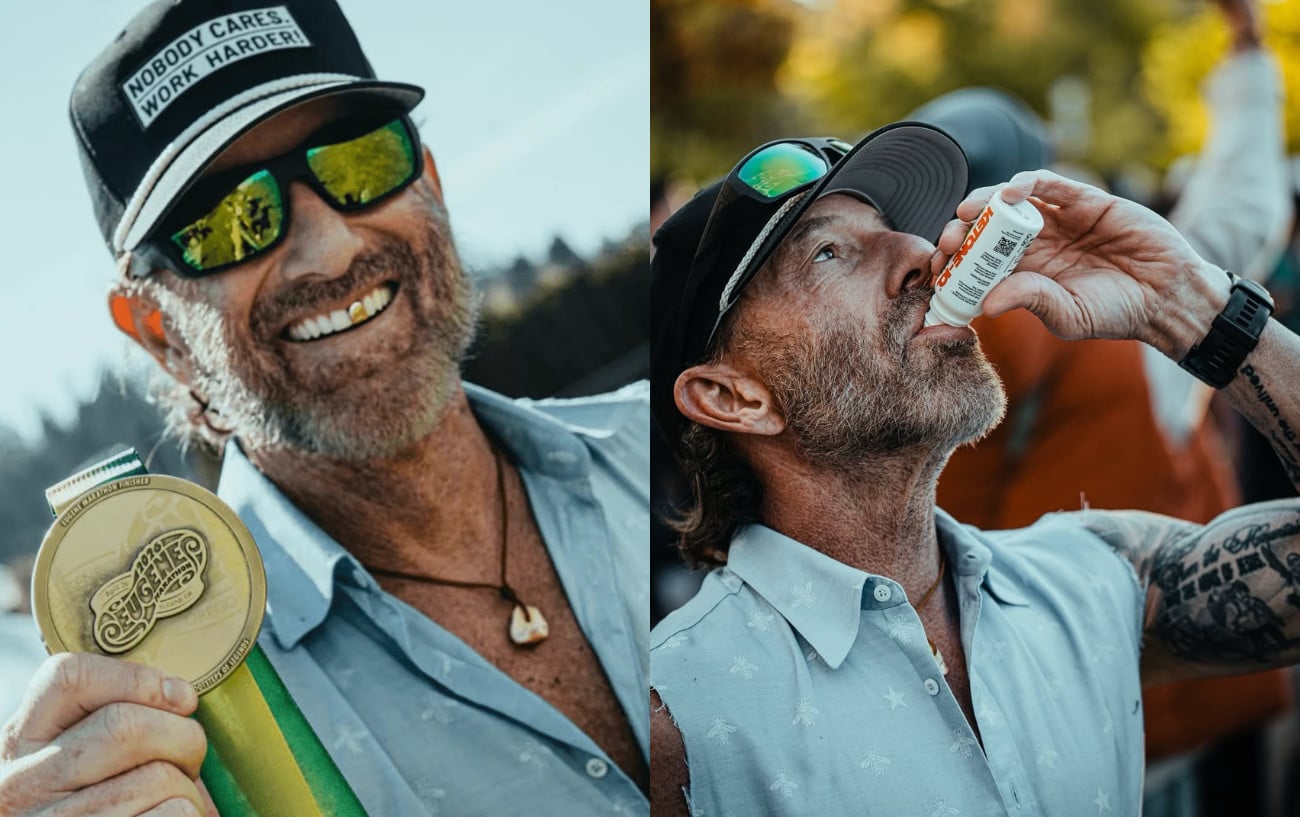
In an Instagram comment exchange with Canaday in late April, Hanes acknowledged that he uses BPC-157, a peptide banned at all times under the World Anti-Doping Agency code. He also said he has used testosterone in the past, and that a still-live 2011 post on his own website describing a daily stack of testosterone tablets and other supplements is real. He has not removed the post. On his “Keep Hammering Collective” podcast on May 15, he defended the peptide use as injury recovery and said he is not a professional athlete bound by Olympic rules.
The accusation is unusual mostly for who is making it. Canaday is one of the most credentialed mountain and ultra runners in North America. He ran for Cornell. He qualified for the U.S. Olympic Marathon Trials at age 21 in 2008, the youngest qualifier at the time. His marathon best is 2:16:52. His half marathon best is 1:04:32. He has six fastest known times on trails and founded the running media company Vo2maxProductions. He turned 40 in November last year, which now puts him in the same masters category Hanes is winning.
A 13-minute PR at 58, after 20 years stuck at 2:50
Hanes has been running marathons since at least 2006. His public race history sits almost entirely in the 2:50 to 2:55 range, with most efforts in his 30s and 40s slower than his Eugene time at 58. The 2:39 cuts more than 10 minutes off anything he has run before. Age-graded, it scores 91.5. His prior best age-graded effort was around 78. Canaday’s own 2:16:52 marathon PR scores 88.5.
Those numbers, by themselves, prove nothing. Plenty of older runners get faster with better training. What they do is set the context for everything else.
The 2011 blog post he never deleted
On April 29, Canaday quoted a passage from a post dated July 18, 2011, on cameronhanes.com. Hanes was 44 when he wrote it.
“On any given day, for growth, I take one tablet each of external testosterone in the A.M. and P.M. from Legal Limit Labs called Super Nova, along with another LLL product called Halo-Zol and anabolic optimizer from LLL and I take two tablets early and late of a product called Mega Shred. All of this stuff is for lean weight gain and it works.”
The post is still on Hanes’ website. He has said publicly that the products were over-the-counter at the time, available at GNC, and legal. He has not contested their content.
Hanes answered Canaday in his own Instagram comments
Canaday asked Hanes directly, in comments under one of his Eugene posts, whether he was clean. Hanes answered. The exchange was screenshotted and circulated on LetsRun.com. Hanes has not disputed its contents.
Canaday: “Are you on any performance enhancing drugs (Testosterone, hgh)?…or are you 100% natty and clean (ie would pass a WADA/USADA standard test?).”
Hanes: “I have no idea if I could pass a drug test? I don’t have any clue what they even test for?” “I’m a bowhunter. I run to get in shape for that. You’re the elite runner. It’s your job to know the rules. If they test for testosterone mine’s 500. That’s all I know. I’ve taken supplements for years, sometimes to put on muscle, but that was years ago (like the old post you’re parading around like a trophy), and now just for health, like stem cell, BPC-157, etc.”
In a follow-up: “my test level is fine as is but yes I’ve taken it before in my life as I’m old as hell and TRT is great for many men but personally I don’t like taking it because I feel it messes with my heart rate and blood pressure.”
Canaday wrote back: “you just admitted to taking a banned performance enhancing drug (BPC-157) that totally violates WADA/USADA code and rules. And You’re placing in your Age Group in fairly big marathons like Eugene (where it’s against the rules).”
Hanes did not walk it back. “I have used injury recovery and felt it helped. Approved or not approved is usually about making money and not safety.”
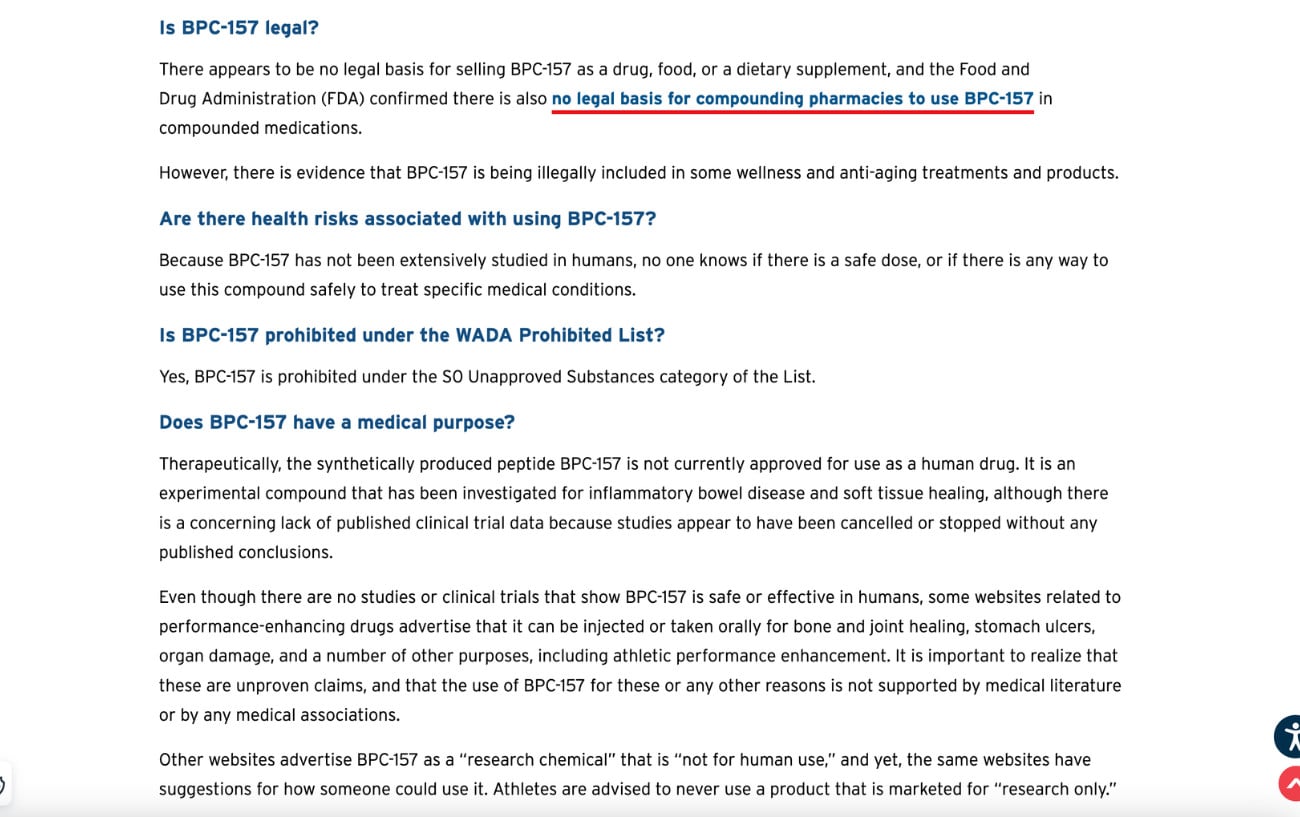
BPC-157 is a synthetic peptide marketed for tendon and tissue repair. USADA has flagged it as prohibited under the S0 non-approved substances category, and no therapeutic use exemption is available for it. A first violation typically carries a four-year ban.
A paid partnership with a TRT company in 2023
The TRT discussion isn’t new for Hanes. In November 2023, he appeared on Joe Rogan’s podcast, episode 2068, to promote his then-partnership with Blokes, a company built around testosterone replacement therapy. Blokes used the episode on its own marketing site. Hanes has said publicly, on Rogan and elsewhere, that he has been a Blokes customer.
In his recent comments to Canaday, Hanes said he is no longer on TRT and that his current testosterone reading is around 500 ng/dL. That is inside the typical range for adult men, but a total reading alone does not establish WADA compliance. The relevant testing looks at ratios and isotopic markers that distinguish endogenous from synthetic testosterone. Running’s own effect on testosterone is well-studied and depends on intensity and volume, but it doesn’t bear on doping status.
The podcast: “I don’t have USA on my jersey”
Hanes spent most of the May 15 episode of his Keep Hammering Collective podcast on the subject. He framed everything as injury recovery and self-determination.
“If I’m hurt, my foot’s broke, and I’m trying to avoid surgery by alternative medicine and taking a peptide, like last year I took a peptide to help me heal without surgery and it allows me to experience those moments with these incredible runners, I’m going to do it. I’m going to do it. I don’t give a f— what anybody thinks.”
He repeated several times that he is not a professional athlete. “I’m an old man. If this s— might work and save me from surgery, I’m going to try it. Why wouldn’t I? I don’t have USA on my jersey.”
He also said he believes hormone use is common in his peer group. “I know probably half the field is on it out there because it’s in aging. The women need estrogen. The men need testosterone. Whatever. If they’re healthy and they can experience a life-changing event, I’m down.”
The episode took a personal turn. Hanes called Canaday a “liberal, vegan, whatever” and brought up a pulmonary embolism Canaday has spoken about publicly, tying it to COVID-vaccine skepticism. Canaday, posting on LetsRun a few days later, confirmed he is in fact left-leaning and vegan, said he was surprised the response had gotten that personal, and said the attacks came from a runner he had no prior relationship with.
Hanes said he supports clean sport at the elite level and that the Olympics should be tested. He asked Canaday to revisit the conversation in twenty years, when Canaday is closer to 60.
The “I’m not making money” claim doesn’t hold up
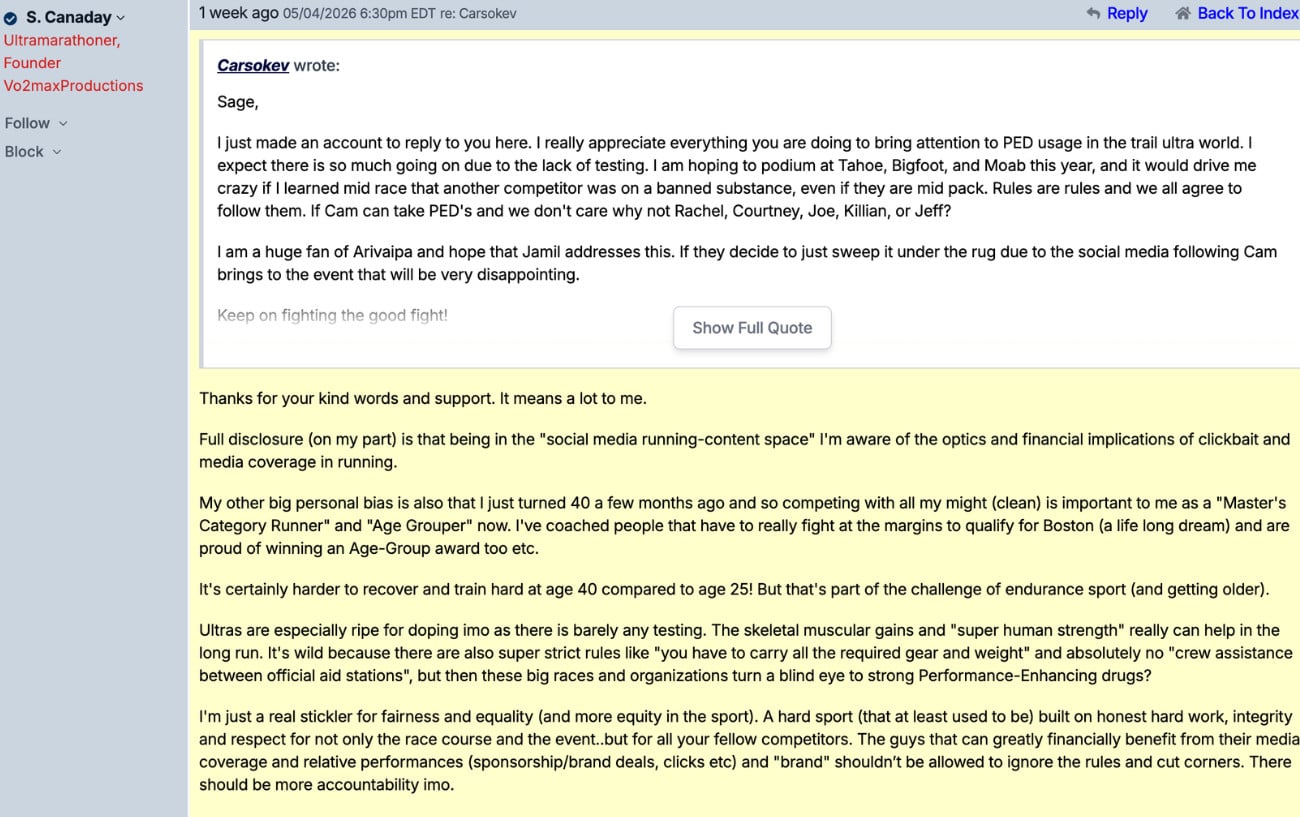
A line Hanes returned to throughout the podcast was that he has no financial stake in running results, so the rules shouldn’t apply the same way. He has a footwear deal with Speedland. He sells a clothing line under the Keep Hammering brand. His Instagram audience is about 1.8 million. Aravaipa Running, which puts on Cocodona 250, featured him at the front of its race-start coverage. Cocodona’s entry fee runs roughly $1,700 to $2,000, and the race has moved to a lottery because demand has outrun capacity. The event has also drawn unwelcome scrutiny this year after a runner died on the course.
A separate piece in the San Francisco Standard on May 17 reported that peptide sellers are paying influencers commissions for every buyer they refer. The piece didn’t name Hanes. It does explain why peptide use among visible endurance figures has become a flashpoint this year.
What USADA actually has jurisdiction over
The Eugene Marathon is a USATF championship. That brings it under USATF competition rules, which incorporate the WADA prohibited list. Aravaipa Running publishes an anti-doping policy that names USADA as its partner for sample collection at its events. Neither race tests every finisher, but the framework is in place.
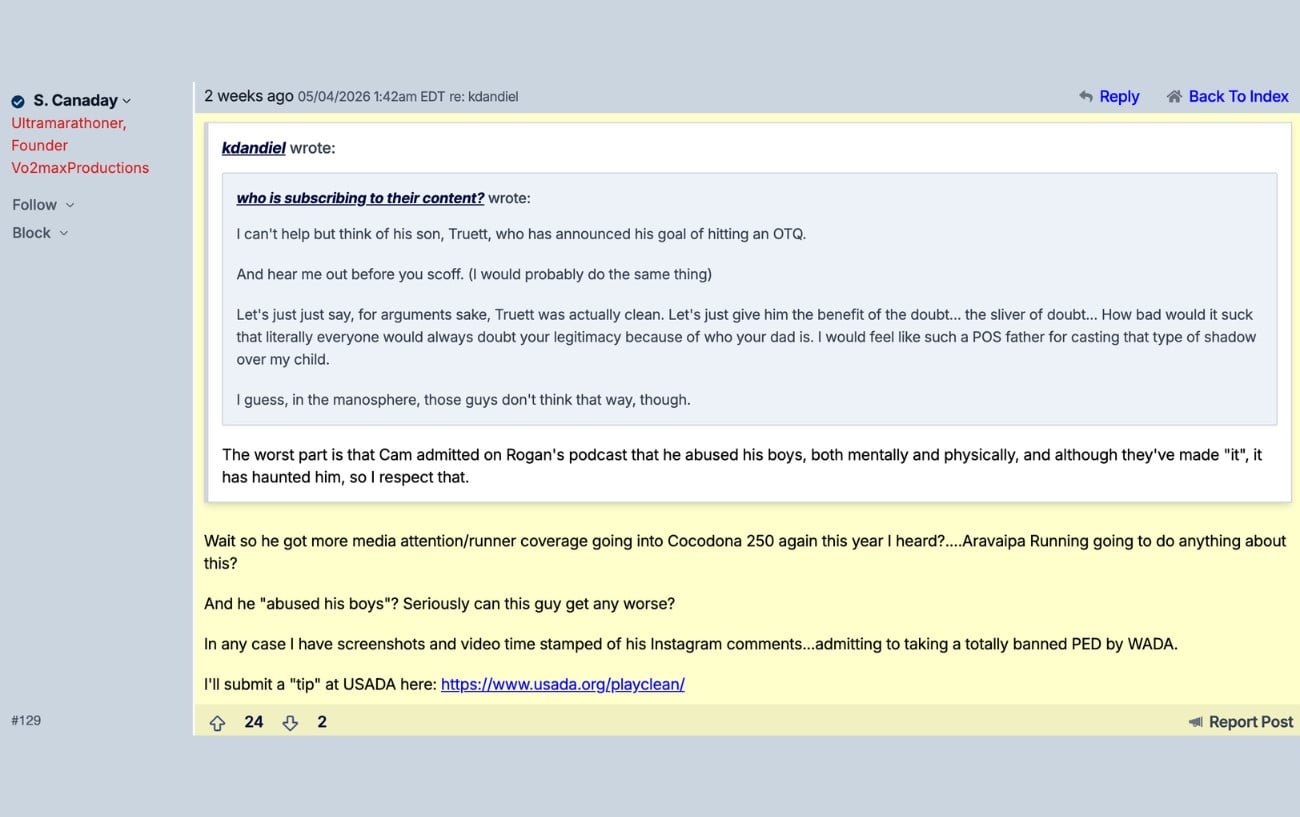
USADA can act on tips. It does not confirm or comment on individual investigations while they are open. Canaday says he has submitted screenshots and time-stamped video of the Instagram comments along with the link to the 2011 blog post, and that the agency is aware. That is as far as the public record goes.
If a sanction follows, what it would look like depends on what gets confirmed and when. BPC-157 by itself, as a non-approved substance, carries a default four-year ban for a first violation. An admission can shorten that. Aggravating factors, like trafficking or coaching others, can lengthen it. A ban would also affect Hanes’ eligibility for sanctioned races including Boston, Chicago, New York, and any USATF-affiliated event.
What’s actually been said, and what hasn’t
At the time of writing, Hanes has not been charged with a rules violation. His Eugene result stands. His age-group win stands. His 2011 blog post is still up. His Instagram comments to Canaday are still public. He has gone on his own podcast and confirmed, in his own words, that he used a banned peptide.
Canaday is not claiming Hanes used BPC-157 at Eugene specifically. He is saying the public admission of using a banned substance during the same competition window is enough to refer to USADA, and that placing in the age group at a USATF championship while doing so breaks the rules athletes sign up to follow.
That is where this sits for now. The Eugene result is on the books. Hanes is back home in Oregon. Canaday’s tip is with USADA. Whatever happens next will happen on the agency’s timeline, not the podcast’s.
RunClub
Get more running stories — join RunClub
Daily running news, a community of 300,000+ runners, free training plans for every distance, and a daily running game. Free to join — no card.
Already a member? Log in →









Join the conversation
Canaday has a boner for the Hanes family. Nobody cares about this except Sage.
Fair solution would be that over 50s can use PEDs but if they do they can't podium. There are health benefits to TRT, and to training for and running ultramarathons, so I don't think you can fairly stop people combining those. But they can only get a finisher's medal.
The question is, black and white, did Cam break any rules in this race? If yes then let the investigation begin, if no, quit complaining. The, "associated with" speak is ambiguous at best. Was the race a USADA, WADA, or other jurisdiction sanctioned race or were they just guidelines for participants?
There's a difference between doing the right thing and being a tattletale. If Canaday would have just submitted his objection anonymously, then we would not have had any of this drama. But now there's got to be somebody who's right and somebody who's wrong in the court of public opinion.
Of course with Sage admitting he's a liberal, this all makes sense. Typically liberals aren't happy unless they make someone else unhappy. Even then they are not happy. A sad bunch of whiners.
lol at you making this about politics. Also, they already said the race adheres to WADA policy in the article. But yeah gaslighting someone for “how” they report something like this just seems disingenuous. I bet you’d be salivating if Cam had done it in a public manner to Canaday.
He’s not a pro runner. You can apply for a waiver before running an event like this and maybe he would have if he knew his results would be analyzed this much.