


Grayson Murphy has won two World Mountain Running Championships, five US national titles, and a bronze medal at the 2023 World Mountain and Trail Running Championships. None of it was enough to keep her watch sponsor.
In a series of posts on Threads on March 31, the 30-year-old American mountain runner revealed that COROS dropped her from their athlete roster in 2024 after a five-year partnership, telling her she was “no longer valuable.”
“I’m tired of being told to keep my mouth shut about this stuff,” Murphy wrote. “I felt blindsided and didn’t see it coming at all.”
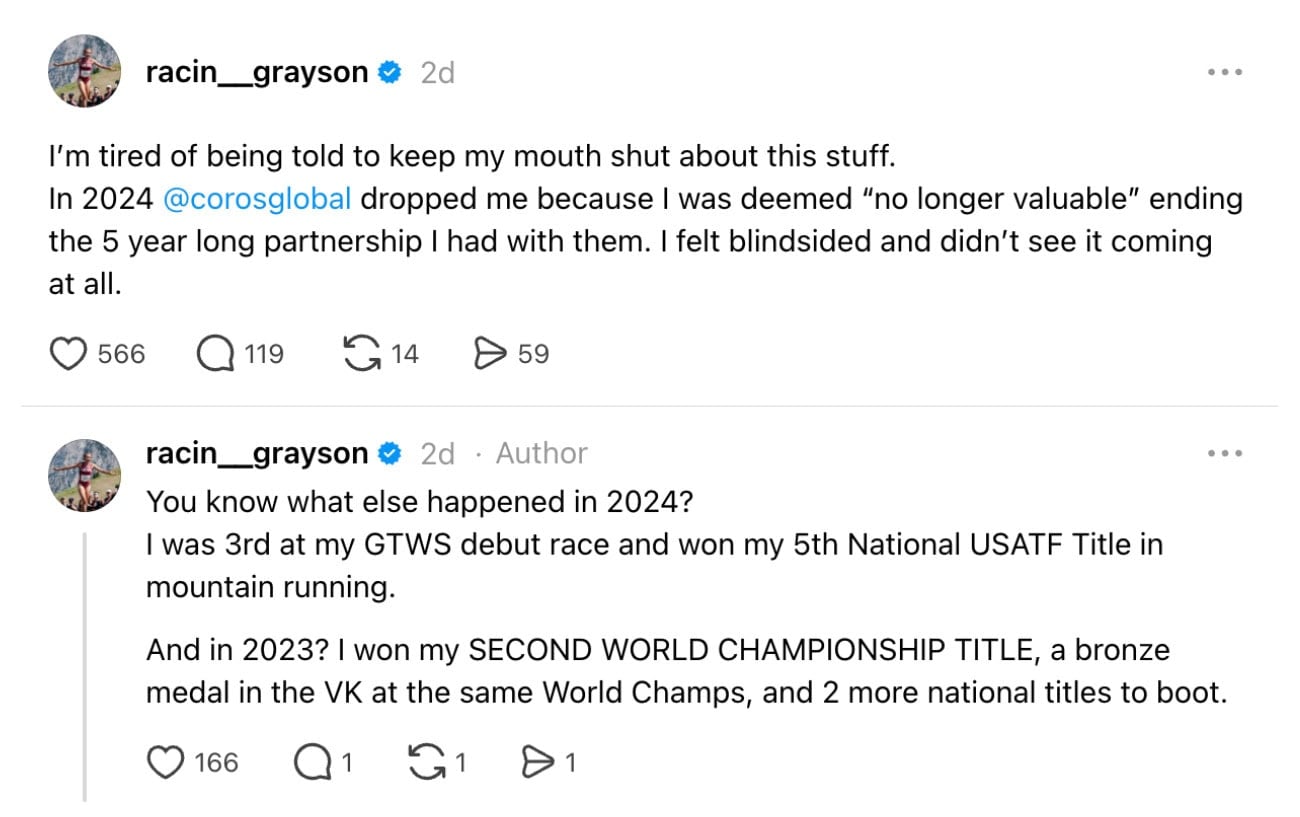
Murphy was among the first athletes signed to the brand after COROS released its first GPS watch in 2018. By the time she was cut, she had just won her second World Championship title and taken bronze in the Vertical Kilometer at the same event in Innsbruck — two podium finishes at a single World Championships. In 2024, the year COROS ended the deal, she placed third at her GTWS debut and won her fifth USATF national title in mountain running.
“You know what else happened in 2024?” she wrote. “I was 3rd at my GTWS debut race and won my 5th National USATF Title in mountain running.”
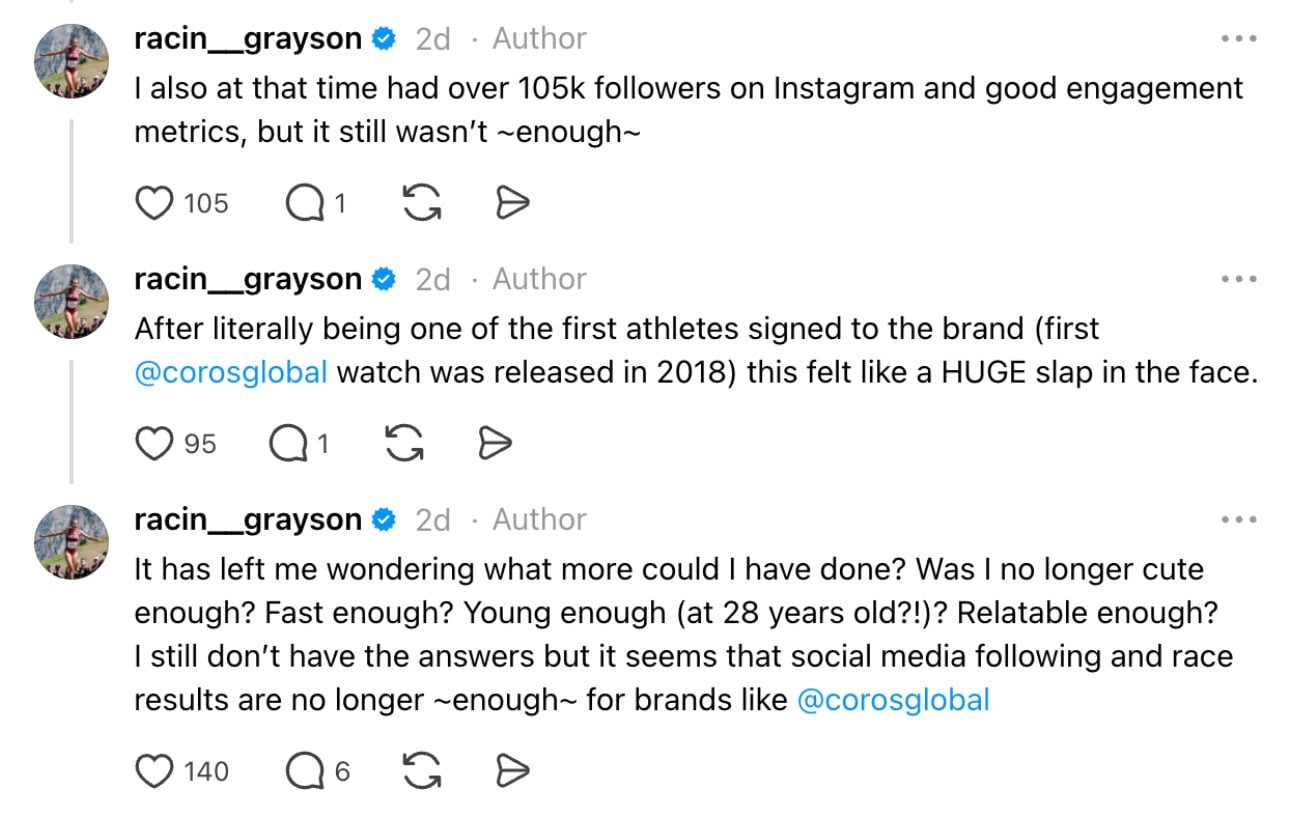
She also pointed to her social media reach at the time — over 105,000 Instagram followers. “It still wasn’t ~enough~,” she wrote.
The cut left her with questions she says she still can’t answer. “Was I no longer cute enough? Fast enough? Young enough (at 28 years old?!)? Relatable enough?”
COROS has not publicly responded.
What makes the timing particularly pointed is what Murphy was going through privately. Behind the scenes, she had been battling a serious health crisis — struggling with an undiagnosed autoimmune condition that would eventually be identified as Crohn’s disease in early 2025. She was also, it has since emerged, pregnant. COROS has not said publicly whether either factor, whether her health crisis or potential family plans, played any role in the decision. Murphy herself has not claimed it directly.
But for an athlete whose earning power depends almost entirely on a patchwork of brand deals, losing a five-year partnership while navigating a health collapse is not a minor inconvenience. For most professional mountain runners, sponsorships aren’t a bonus — they are the income. There is no broadcast deal, no gate revenue, no union minimum salary underpinning the arrangement. A watch contract, a shoe deal, an apparel partnership: that’s the job.
Since then, Murphy has signed with Salomon, who reportedly took her on with full awareness of her pregnancy and uncertain racing timeline. The contrast has not been lost on people following the story. One brand looked at the same athlete, at the same moment, and saw a liability. Another saw someone worth betting on.
That gap is exactly what’s driving the reaction to Murphy’s posts. Just weeks before she went public, elite marathoner Emma Bates claimed that nutrition brand UCan dropped her after she disclosed her pregnancy. UCan disputed the characterization, but the story sparked its own wave of debate about how brands assess athlete value — and whether the calculus changes for women in particular when their bodies become part of the equation.
Phil Gaimon, the professional cyclist and media personality, replied directly to Murphy’s post with a take that resonated with a lot of people in endurance sports. “Unfortunately turnover is part of the personal sponsorship life,” he wrote, “and I’ve learned it’s less about raw results than I would have thought.” He added: “‘No longer valuable’ is weird.”
That last phrase is where most of the reaction has landed.
Sponsors in endurance sports move on from athletes all the time, and most athletes understand that. Contracts end. Priorities shift. A new marketing person comes in with different ideas about who fits the brand. None of that is surprising.
What’s harder to process — and what Murphy’s posts make plain — is being handed a verdict on your worth as a person, not just as a marketing asset. It’s a dynamic that isn’t unique to running: the running gear industry has seen significant upheaval in recent years, with brands regularly reshuffling their rosters as market pressures mount.

“After literally being one of the first athletes signed to the brand,” she wrote, “this felt like a HUGE slap in the face.”
Whether COROS responds, and how, matters. Not because Murphy necessarily needs a public apology, but because the running industry is small, its athletes are paying close attention, and trust — once spent — is hard to buy back.
RunClub
Get more running stories — join RunClub
Daily running news, a community of 300,000+ runners, free training plans for every distance, and a daily running game. Free to join — no card.
Already a member? Log in →



Join the conversation
I was considering a COROS watch, but after this I think I will pass.
COROS’ PR/Ad dept. lost a great marketing opportunity. I would say that COROS