


The Boston Athletic Association changed two rules on Wednesday, and together they allow something the race has never really offered: a calculable answer to the question every qualifier asks, which is how likely a given time is to get you in. The new Boston Qualifier Selection gives roughly 1,000 places by random draw to applicants who beat their standard but miss the cutoff, and new time indexes adjust or disqualify times from steeply downhill courses. The arithmetic below uses the B.A.A.’s published numbers and the record of the cutoff era, and it ends with our estimate of where next September’s cutoff lands.

How the 2027 Field Gets Filled
The field is built in two passes. Applicants are ranked by how far they beat the qualifying standard for their age and gender, the fastest fill the qualifier allocation, and the slowest accepted margin becomes the cutoff. New for 2027, everyone who beat their standard but missed the cutoff then enters a draw for about 1,000 additional places, and the B.A.A. says the number accepted on time will stay consistent with recent years. Last September, that first pass accepted 24,362 of 33,249 qualified applicants against a field capped at 30,000, leaving 8,887 runners out, as we reported at the time.
Fifteen Years of the Cutoff
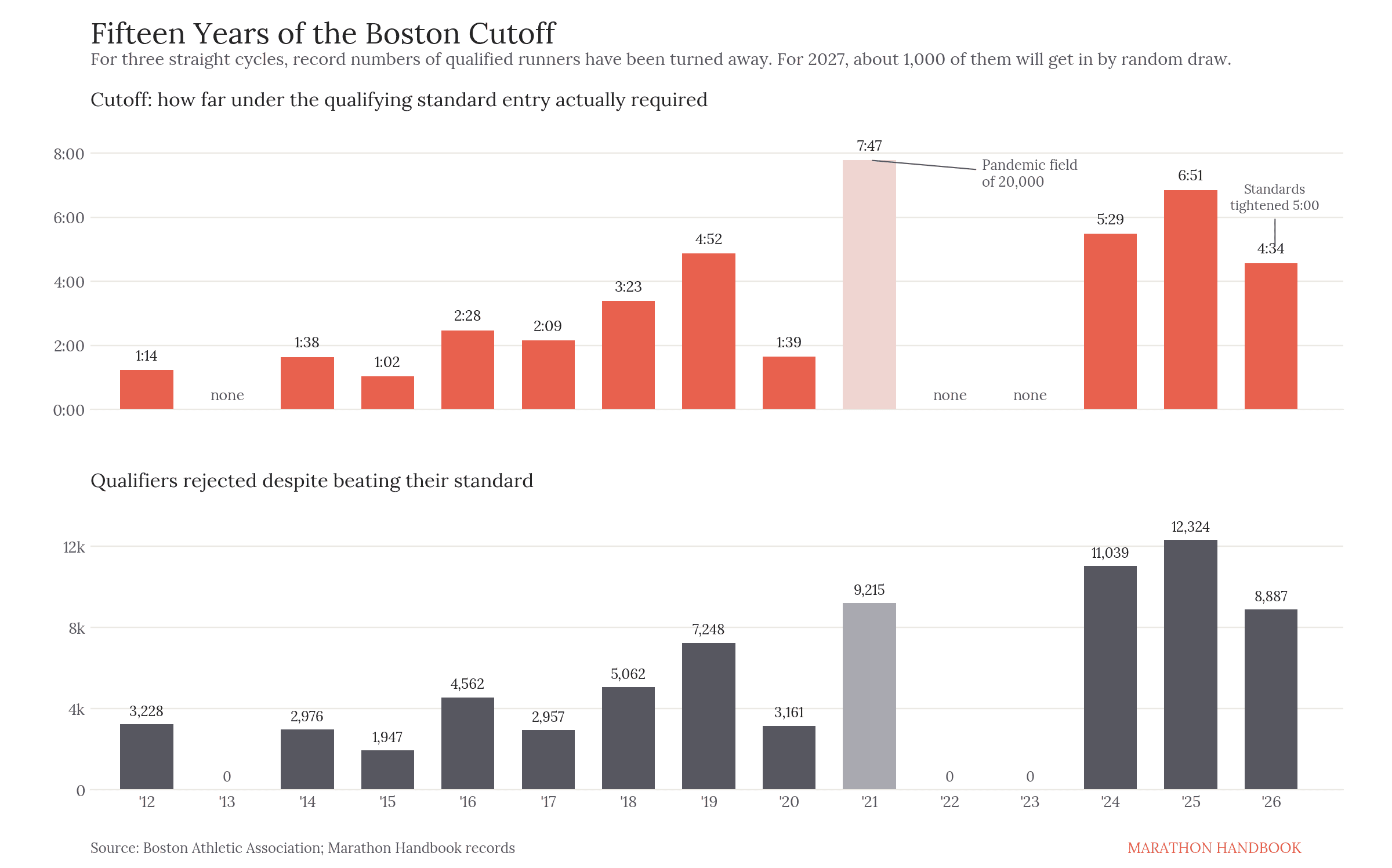
Two caveats and one trend live in this chart. The 7:47 of 2021 came against a pandemic field of 20,000, and the clean years of 2022 and 2023 reflect the post-pandemic dip in qualified applicants. The trend is everything else: the three heaviest rejection years in race history are the three most recent cycles, and the last of them came after the B.A.A. lowered the qualifying times by five minutes for most age groups. Demand, driven by a boom in young marathoners and times compressed by super shoes, absorbed the tougher standards within a single cycle. The cutoff for 2026 still reached 4:34, which for men aged 18 to 34 meant 2:50:26 against a published 2:55:00.
What the Cutoff Might Be This Year
The downhill change is the one variable that pushes the 2027 cutoff down rather than up, and it is possible to size it. Brian Rock, analyzing the qualifying data for Outside Run, found that 8 to 12 percent of the 2025 Boston field had qualified on a steep downhill course, and that the new indexes cut the number of downhill qualifiers by roughly 40 percent. Applied to last year’s accepted field, that is somewhere between 2,000 and 2,900 runners whose times now shift. The five-minute minimum penalty is larger than the entire 4:34 cutoff, so a downhill qualifier who was previously comfortably inside is now pushed below the old line or out of qualification altogether.
Run that through last year’s numbers, holding demand flat, and the top of the ranking loses those downhill-boosted times while the pool just under the standard gains the ones that survive the penalty. The vacated seats pull the cutoff down. On the middle assumption, that 10 percent of the field had qualified downhill, the model lands the 2027 cutoff near 3:30 to 3:45 under the standard, against 4:34 a year ago. If demand grows the way it has in three of the past four cycles, the softening shrinks, and a return to 2025-level applications would erase most of it and hold the cutoff close to four minutes.
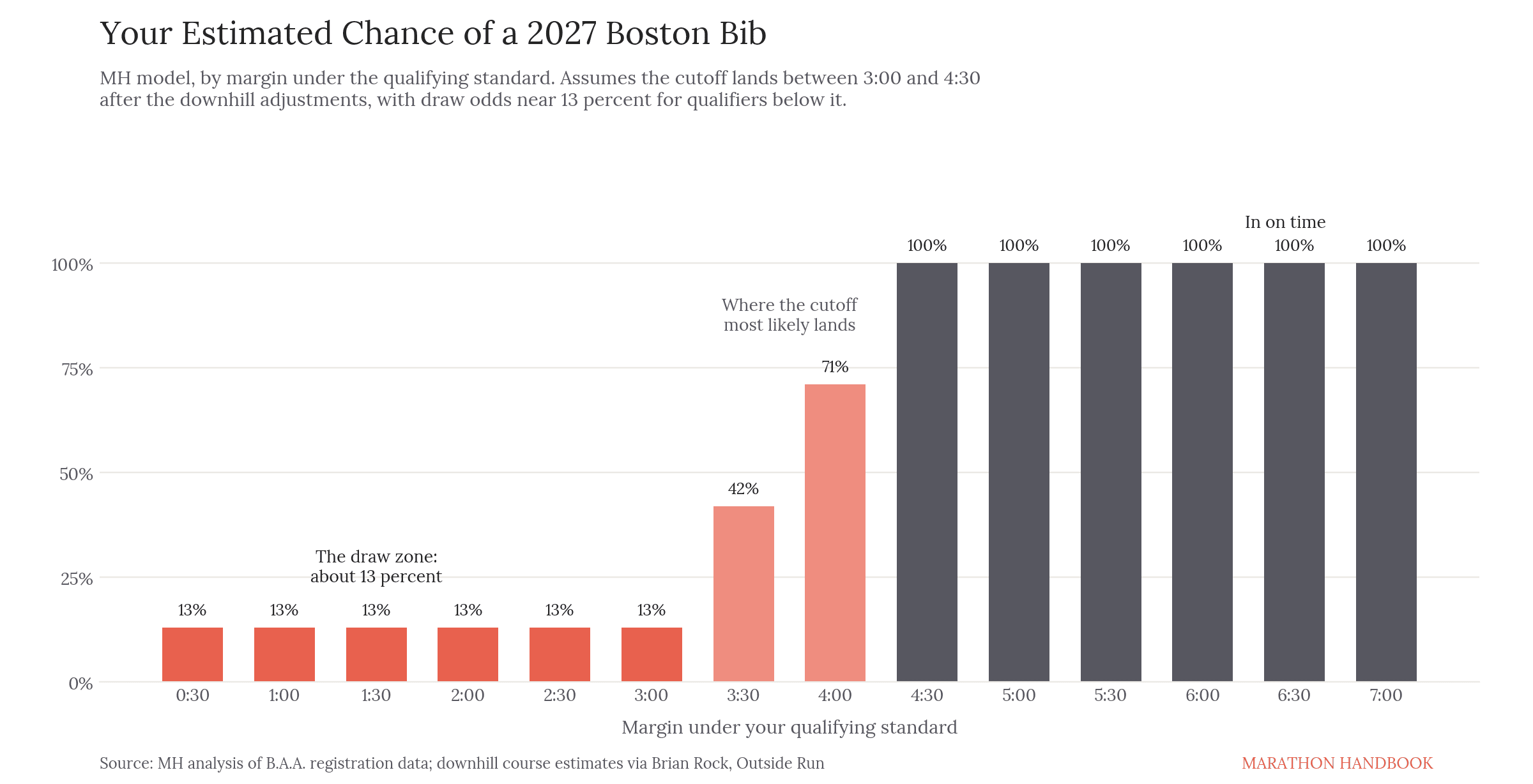
The chart reads in three bands. Beat your standard by more than about four and a half minutes and you are almost certainly in on time, as you have been in every full-size field. Land in the contested zone around 3:30 to 4:30 and entry is a coin flip that depends on exactly where the cutoff settles. Fall anywhere below the cutoff, from a second under the standard to three minutes under, and you are in the draw, with a chance the model puts near 13 percent this year. These are estimates built on last year’s pool and Rock’s downhill figures, not forecasts, and the single largest source of error is demand, which we cannot see until registration closes.
The Odds in the Draw
The draw itself is the simplest calculation in the piece. About 1,000 places divided among the qualifiers who beat their standard but miss the cutoff. If that pool resembles last year’s, and the downhill exits do not thin it too far, it holds somewhere around 7,000 to 9,000 runners, which puts each entry near 11 to 14 percent. A larger pool drags the figure down: a 2025-sized crowd of more than 12,000 would pull it toward 8. The draw converts what used to be a certain rejection into roughly a one-in-eight to one-in-nine chance, and nothing more.
What the Numbers Say to Aim For
The history gives a 2027 hopeful three reference points. Beating your standard by seven minutes has never failed in a full-size field. Five minutes cleared 2024 and 2026 but not 2025, and the downhill change makes it a safer bet this year than last. And for the first time, a time that merely beats the standard still counts for something, because it now carries a one-in-eight to one-in-nine chance instead of none. Registration for the 131st running opens Sept. 14 and closes Sept. 18, all applicants hear by early October, and this analysis will be updated with the real numbers when the B.A.A. releases them.
RunClub
Get more running stories — join RunClub
Daily running news, a community of 300,000+ runners, free training plans for every distance, and a daily running game. Free to join — no card.
Already a member? Log in →







Join the conversation
Michael, you are missing an important variable here. The odds are WORSE with the 1000 bib PR stunt. If the max field size is capped, then, in order to hand out 1000 bibs (via the random draw), then these 1000 bibs must come from somewhere; they must come from those that would have normally beat the cutoff time. Which means that many of those that would have normally beat the cutoff time (with a 100% chance), are now placed in a pool of other runners hoping for a <10% chance to get in.
And if the BAA decides to increase the maximum field by 1000, then why not apply this to reducing the cutoff time, and making it easier for those most deserving, (instead of using the pr stunt to favor those that are less deserving)?
Bottom-line, this 1000 bib gimmick gives the false appearance of helping, at the expense of hurting those most deserving.
I\'m not keen on the 1000 bibs either. If you missed the cut-off by a few seconds and then didn\'t get a place as one of the 1000 then you\'d feel pretty hard done by. It\'ll also mean that more will try to register i.e. those with a 1s to say 2min buffer who in previous years stood next to no chance so didn\'t bother registering, are now likely to try, so the 1000 bibs odds will be worse. I\'d prefer a direct - meet the standard and you are in - but the cut off adds a bit of extra prestige, the 1000 random bibs lessen that a bit.