


The Boston Marathon has always been the pinnacle of marathon running, drawing some of the world’s most dedicated athletes. But earning a Boston Qualifier (BQ) isn’t the golden ticket it once was.
In recent years, the race has become even more competitive, with the introduction of cutoff times—meaning that just meeting the qualifying standard isn’t always enough.
With the 2025 Boston Marathon seeing one of the steepest cutoffs in history, runners are now looking ahead to 2026 and wondering what to expect. Will the cutoff be even tougher? How many qualifiers will actually make it to the start line? Let’s dive into the data and trends shaping the next Boston Marathon.

Why Is There a Cutoff Time?
Simply put, there are more runners hitting BQ times than there are spots available in the race.
The Boston Athletic Association (B.A.A.) sets an entry limit—usually between 22,000 and 24,000 runners. When more people qualify than can be accommodated, a cutoff time is applied, meaning only those who have beaten their qualifying standard by a certain margin get in.
For example, in 2025, over 36,000 runners submitted their BQ times, but only 24,069 were accepted.
That meant runners needed to beat their BQ time by at least 6 minutes and 51 seconds to actually secure a spot. This was the second-highest cutoff time in Boston history, reflecting the rising competition among marathoners.
The concept of cutoff times was introduced in 2012 when the number of qualifiers began to exceed the marathon’s capacity. Over the years, these cutoffs have fluctuated:
- 2012: 1 minute, 14 seconds
- 2014: 1 minute, 38 seconds
- 2016: 2 minutes, 28 seconds
- 2018: 3 minutes, 23 seconds
- 2019: 4 minutes, 52 seconds
- 2021: 7 minutes, 47 seconds (notably high due to pandemic-related field size reductions)
- 2022 and 2023: No cutoff (all qualifiers accepted)
- 2024: 5 minutes, 29 seconds
- 2025: 6 minutes, 51 seconds
Trends That Shaped the 2025 Cutoff
Several key factors contributed to the dramatic cutoff time for 2025:
- More Fast Runners – The post-pandemic running boom has led to a surge in marathon participation. More people are training seriously, using advanced gear, and achieving faster times.
- Static Field Size – The B.A.A. hasn’t significantly increased the number of runners it allows into the race, despite the growing number of qualifiers.
- Changes in Qualifying Standards – In response to growing demand, the B.A.A. has periodically adjusted the standards to make qualifying harder. For 2026, those standards are tightening again.

2026 Boston Marathon Qualifying Changes
For the 2026 race, the B.A.A. is making qualifying even tougher by shaving five minutes off the standard times for runners aged 18-59. That means, for example, a male runner in the 18-34 age group now needs a time of 2:55:00 instead of 3:00:00, and women in the same age group need 3:25:00 instead of 3:30:00. Runners 60 and older will still follow the previous qualifying standards.
These changes are designed to keep the race competitive and ensure that qualifying remains a meaningful achievement. However, even with these tougher standards, it’s still likely that the 2026 cutoff time will be significant—meaning runners should aim to exceed their BQ time by a comfortable margin.
Predicting the 2026 Cutoff Time
While it’s impossible to predict with absolute certainty, analysts have developed models to estimate future cutoffs. Running data expert, Brian Rock has created a Boston Marathon Cutoff Time Tracker, which compiles marathon results to project trends. Based on early data, the 2026 cutoff could be somewhere between 4-6 minutes, though this number may shift as more results come in throughout the qualifying period.
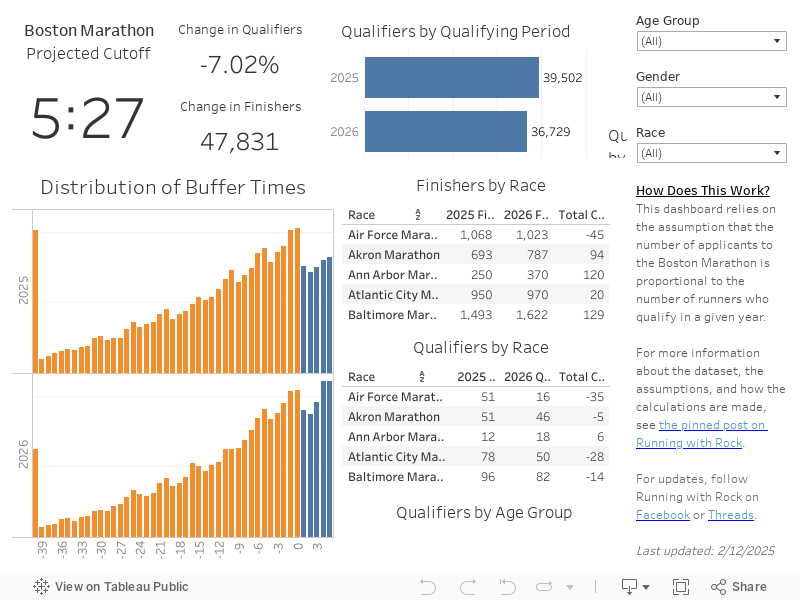
What This Means for Runners
For those dreaming of Boston, simply meeting the qualifying time isn’t enough—you’ll need a strong buffer. If history is any indication, aiming to beat your BQ time by at least 5-7 minutes will give you the best shot at securing a bib.
Additionally, runners should stay updated on qualifying trends, use resources like the Cutoff Time Tracker, and plan strategically. If you’re on the bubble, consider racing on a fast course known for producing strong times—like Berlin, CIM, or Chicago. Every second counts when it comes to making it to Hopkinton.
RunClub
Get more running stories — join RunClub
Daily running news, a community of 300,000+ runners, free training plans for every distance, and a daily running game. Free to join — no card.
Already a member? Log in →








Join the conversation
I started trying to qualify for Boston on my first marathon back in 2001. This past year in Chicago after 65 marathons trying, I finally achieved this, and even exceeded my standard by 6:13. Even with the new 2026 standard that was implemented just a few weeks before my time. I REALLY hope that is good enough if there is a cutoff. One thing that has bothered me over the years, is that because Boston has a capacity of about 30K each year, part of that number is made up of charity runners, exemptions, exceptions, people getting in through tour groups, etc. While I have no problem with this in theory, if the numbers from those groups are pushing out actual qualifiers, then the B.A.A. should really wait each year until after the qualifiers are all registered, then come up with an adjusted number of these other runners to accept. People like me have worked literally for decades trying to legitimately qualify, and when we finally do we shouldn’t be pushed out by someone running their very first marathon on some exemption or special privilege.
It’s not just Boston. I applied for NY for November. I was 9 mins inside the time for my age group (65-69) but didn’t get a place. I’d love to know what the time needed was, whether these deductions in time are the same for all age groups and how each age group & gender are affected.
I was same at NYC - was just over 6 mins under QT for male 65-69 and didn’t make it . So am trying to get a Boston QT later this year- know I’ll need to try and be 10-15 mins below to be certain!