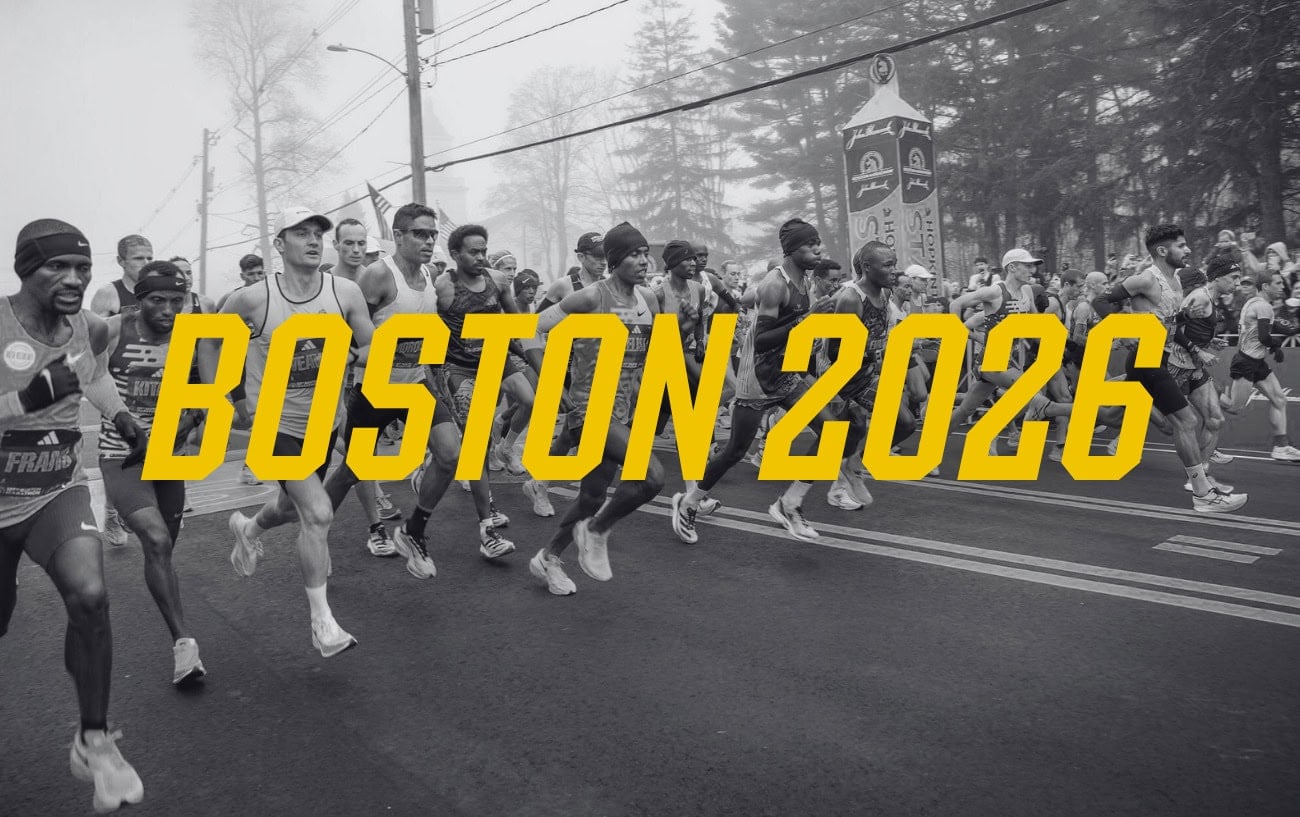
On Patriots’ Day, Monday, April 20, 2026, the Boston Marathon turns 130.
Not many races can say that. Not many races have earned the right to say it the way Boston has — with a course that punishes hubris, crowds that carry strangers to the finish, and a qualifying standard that means a big chunk of bibs in the field were hard-won.
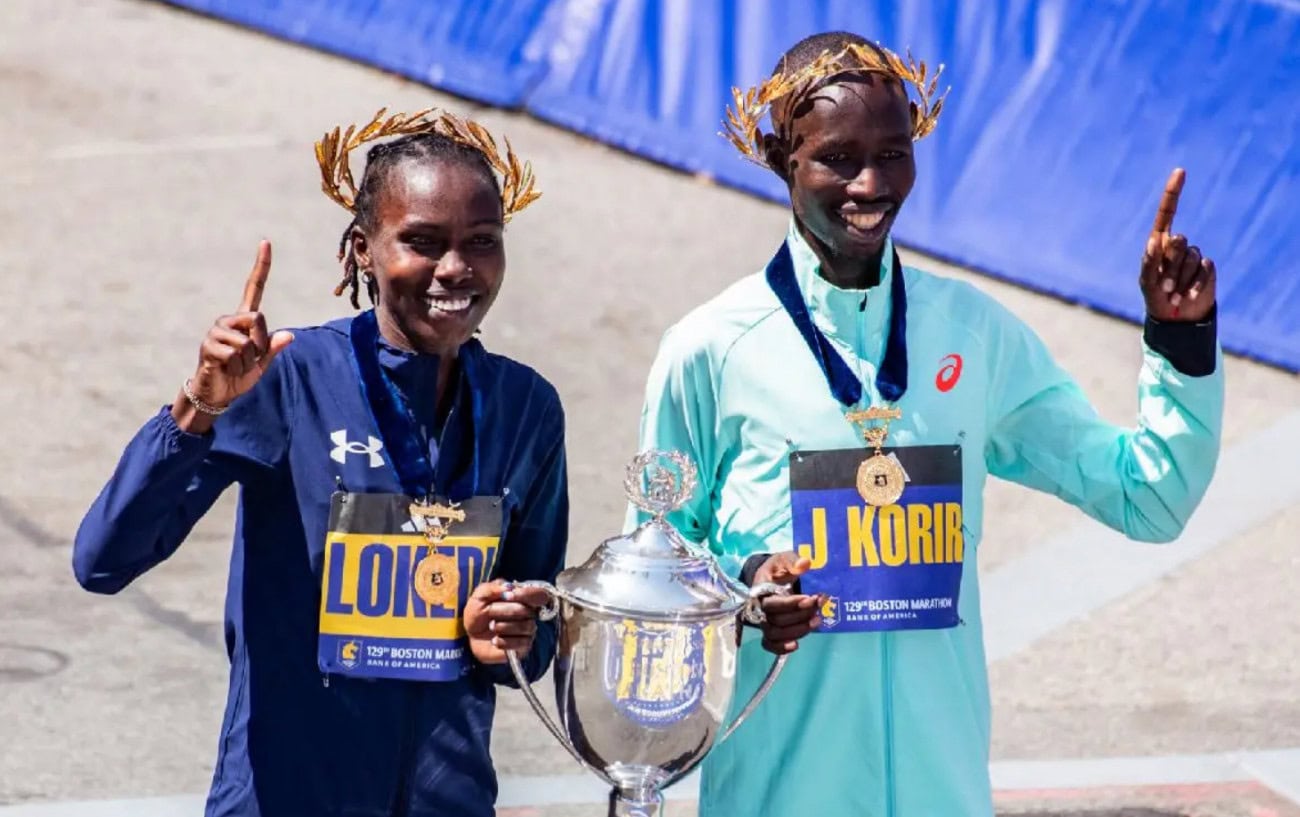
This is the 130th edition of the Boston Athletic Association (BAA) Boston Marathon, and it arrives with one of the most compelling elite matchups in recent memory: defending champion John Korir returns to Hopkinton to face Benson Kipruto, the four-time Major winner who wants the title back, while Sharon Lokedi lines up to defend a course record many thought would stand for years.
The field of over 32,000 runners, drawn from more than 130 countries and all 50 U.S. states, will take on 26.2 miles from the town green in Hopkinton to Copley Square in Boston. Some are chasing podiums. Some are chasing course records. Most are chasing something more personal.
All of them will meet Heartbreak Hill somewhere around mile 20.
The Race That Earns Its Field
Boston is not a race you simply sign up for. It is a race that many have to qualify for, and qualifying has never been easy.
For 2026, the BAA tightened qualifying standards by five minutes for runners under 60. On top of that, to be accepted, athletes needed to beat their qualifying time by at least 4 minutes and 34 seconds. Of the tens of thousands who applied, 24,362 were selected, making up the core of a 32,494-person field — 18,277 men, 14,101 women, and 116 non-binary athletes.
The entry process is now closed. But if you’re planning for Boston 2027, see our full guide to Boston Marathon qualifying times and cutoff standards so you know exactly what you’re targeting.
Key Race Day Information
- Date: Monday, April 20, 2026 (Patriots’ Day)
- Edition: 130th Boston Marathon
- Title Sponsor: Bank of America
- Start: Hopkinton, Massachusetts
- Finish: Copley Square, Boston
- Field Size: 32,494 registered athletes
- Time Limit: Finish line closes at 5:30 p.m. ET
- Prize Purse: Over $1.13 million; $150,000 each for the men’s and women’s open winners
Start Times
New for 2026: the BAA has expanded from four waves to six, ranging from 3,200 to 7,100 athletes each. The change is designed to ease the flow of runners through the start village, onto the buses, and into Hopkinton.
Your wave and corral assignment are determined by your qualifying time and are printed on your bib. They are also accessible through your online B.A.A. Athletes’ Village account.
- 9:37 a.m. — Professional Men
- 9:47 a.m. — Professional Women
- 10:00 a.m. — Wave 1
- 10:15 a.m. — Wave 2
- 10:28 a.m. — Wave 3
- 10:41 a.m. — Wave 4
- 11:01 a.m. — Wave 5
- 11:21 a.m. — Wave 6
Corrals 1–4 exit the Athletes’ Village via Maple Street and Church Street. Corrals 5–8 exit via Grove Street onto Main Street.
Getting to Hopkinton
Boston is a point-to-point race. You start in Hopkinton and finish in the city. That means you need a plan for getting to the start line.
Official BAA Buses depart from Boston Common (Charles Street, adjacent to the Public Garden) and are free for registered athletes. You must present your bib to board. Departure times by wave:
- Wave 1: 6:45 a.m.
- Waves 2–3: 7:30 a.m.
- Waves 4–5: 8:00 a.m.
- Wave 6: 9:00 a.m.
- Last bus: 9:30 a.m.
There is also limited parking at lots on South Street in Hopkinton for runners who choose to drive, but the bus is the recommended option. Do not cut it close — buses fill up, and Hopkinton is 26 miles outside the city.
Athletes’ Village
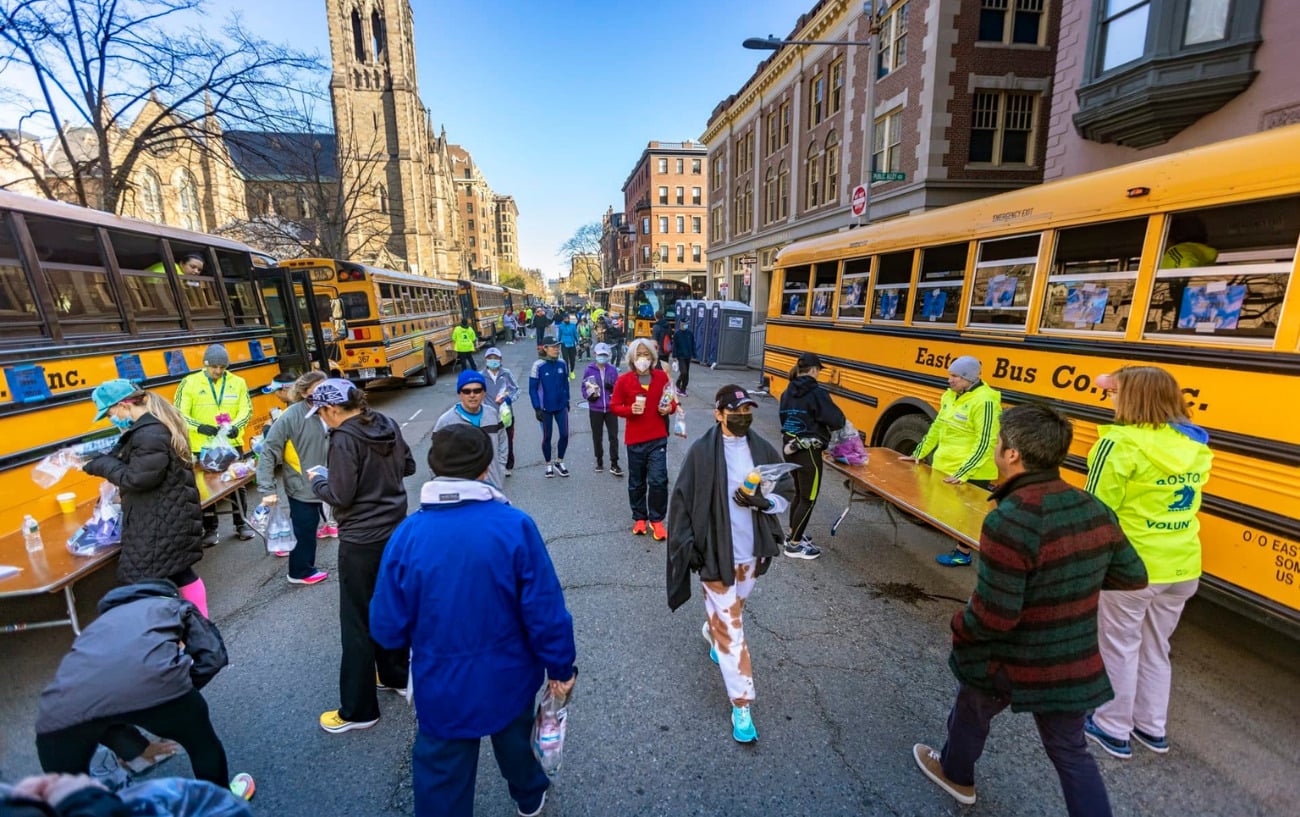
Once you reach Hopkinton, you’ll be directed into the Athletes’ Village — a holding area with food, water, portable toilets, and a lot of nervous energy. Expect to spend at least 60–90 minutes here before your wave is called.
Dress in layers you’re prepared to discard. The village provides donation bins. April in Hopkinton can feel cold at 9 a.m. and warm by noon, so don’t overdress for the finish line at the start line.
The Course
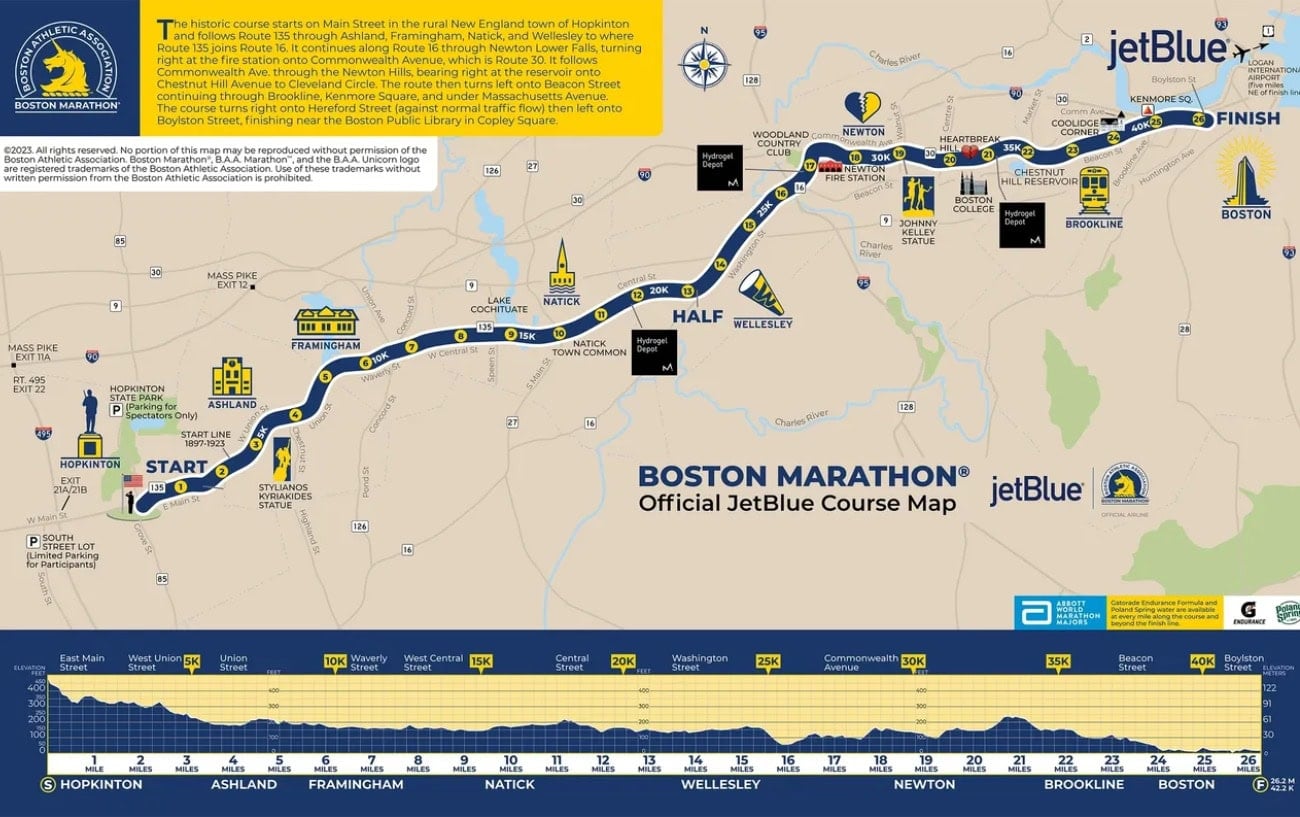
The Boston Marathon course is 26.2 miles of hills, towns, and transitions — none of it flat, almost none of it forgettable.
The route runs east through Ashland, Framingham, Natick, and Wellesley before climbing through Newton and descending into Boston. Starting elevation sits at 475 feet above sea level. The finish at Copley Square is just 16 feet. On paper, it’s a net downhill. In practice, it’s one of the most demanding courses at any major.
Total elevation gain is approximately 815 feet; total descent is about 1,275 feet. The last 10 miles include the infamous Newton Hills — four consecutive climbs between miles 17.5 and 21, culminating in Heartbreak Hill, which rises about 90 feet over a half-mile stretch. Heartbreak Hill is not the tallest hill on the course. It is simply the last one, and your legs will have already climbed everything that came before it.
If you’re running Boston for the first time, read our breakdown of the only secret to running the Boston Marathon course before race day — and our companion piece on how not to run the Boston Marathon course, which covers the most common mistakes runners make on this route.
After Heartbreak, the course drops into the city. You’ll pass the CITGO sign at Kenmore Square around mile 25. Then Hereford Street. Then the left turn onto Boylston, and the finish line comes into view.
Key Landmarks by Mile
- Miles 1–6: Hopkinton to Ashland to Framingham — rolling terrain, controlled effort
- Miles 7–13: Natick and into Wellesley — including the famous Wellesley Scream Tunnel near the halfway mark
- Miles 13–17: Newton Lower Falls — the course flattens briefly before the Newton Hills begin
- Miles 17.5–21: The Newton Hills, including Heartbreak Hill at mile 20
- Miles 21–26.2: The long descent into Boston — Kenmore, Hereford, Boylston
On-Course Fueling
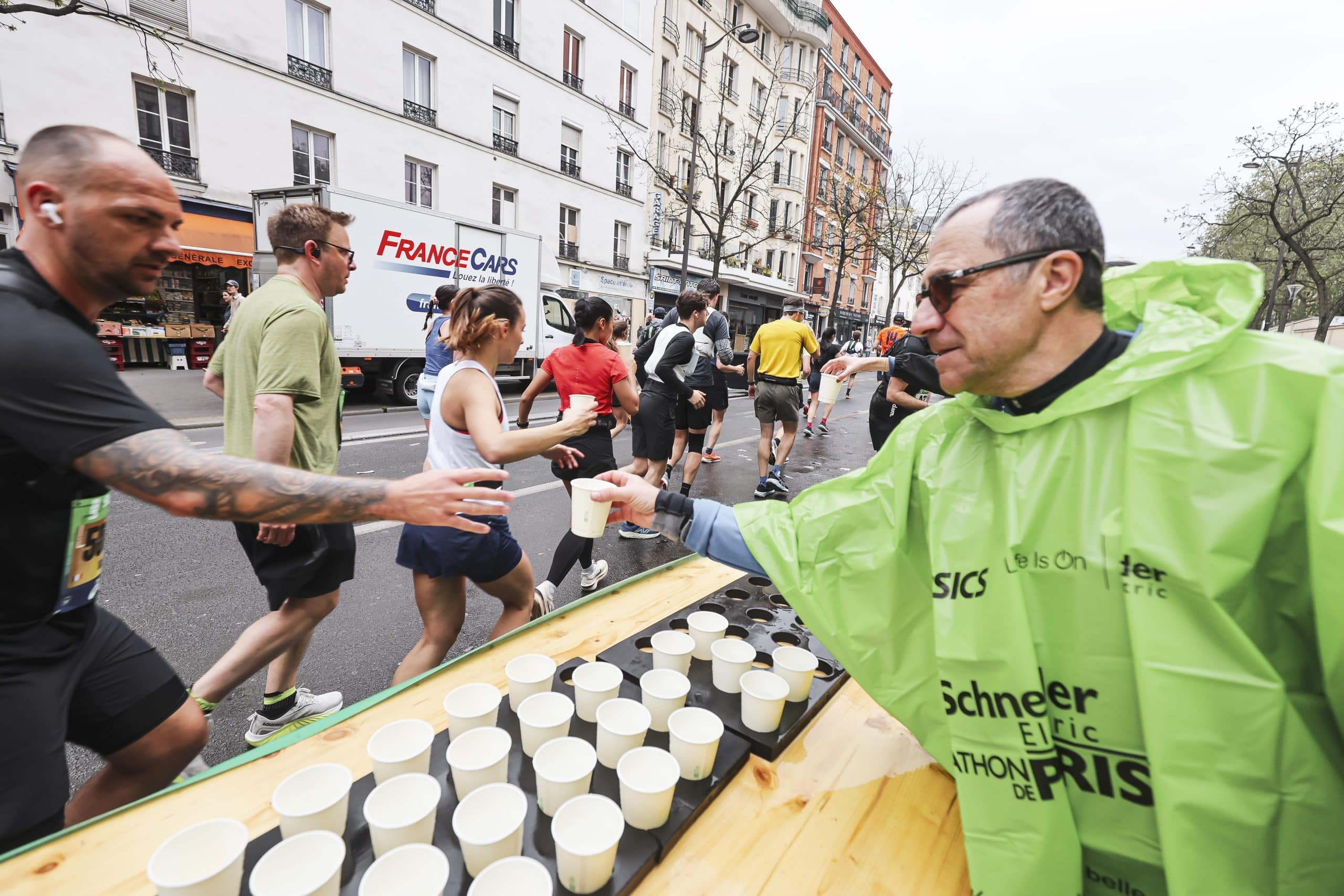
Aid stations start at mile 2 and appear at every mile through the finish. Each offers Poland Spring water and lemon-lime Gatorade Endurance in paper cups, served on both sides of the road.
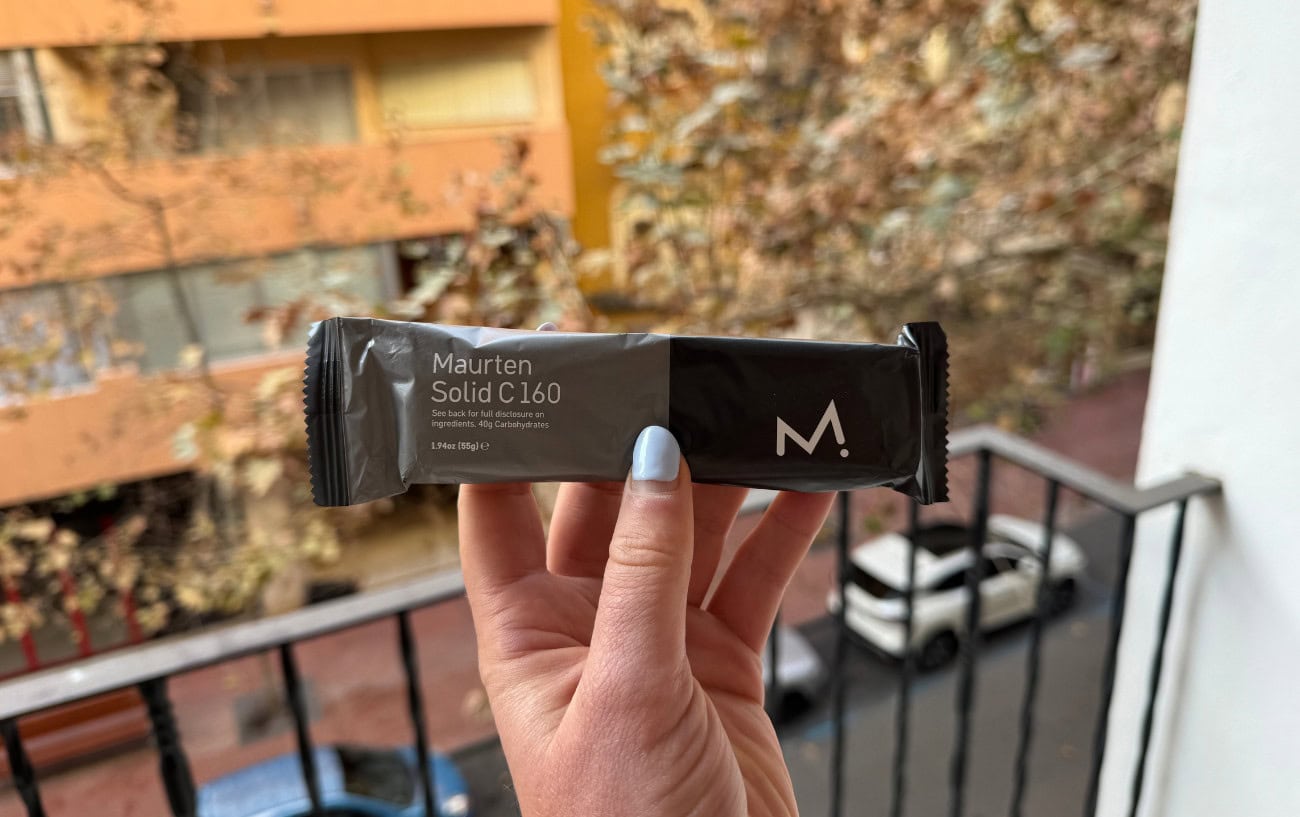
There are three Maurten Hydrogel depots: Mile 11.8 (Wellesley town line), Mile 17 (Newton), and Mile 21.5 (after Boston College). Maurten provides both Gel 100 (non-caffeinated) and Gel 100 CAF 100 (caffeinated) at these stations. Additional support includes sunscreen, vaseline, cold water sponges, and portable toilets at every aid station from mile 2 onward.
If you plan to carry your own nutrition, that’s fine — but familiarize yourself with what’s on course so you’re never reliant on a gel that isn’t there.
Weather
April weather in Boston is genuinely unpredictable. The 2018 race was run through freezing rain and 40 mph headwinds. Other years have seen 70°F and full sun.
For 2026, conditions are shaping up to be favorable. Forecast models point to mid-to-upper 40s at the start, rising to the mid-50s by late morning, with a light wind and only about a 16% chance of rain. That’s close to ideal marathon weather — cool enough for fast running, calm enough that you won’t be fighting the elements. Pack a throwaway layer for the village. Wear sunscreen regardless.
The Expo
Bib pickup is at the John B. Hynes Veterans Memorial Convention Center, 900 Boylston Street, Boston. There is no race-day pickup — collect your bib at the expo or you don’t start. Bring photo ID.
- Friday, April 17: 10:00 a.m. – 7:00 p.m.
- Saturday, April 18: 9:00 a.m. – 7:00 p.m.
- Sunday, April 19: 9:00 a.m. – 6:00 p.m.
Friday is typically the least crowded day if you’re coming from out of town. For everything happening around race weekend beyond the expo — pop-ups, shakeout runs, and community events — see our Boston Marathon weekend guide.
How to Watch
United States: WCVB Channel 5 (ABC Boston) carries live coverage from 4:00 a.m. ET, with regional simulcasts on WMUR (NH), WMTW (ME), and WPTZ (VT/NY). ESPN2 has national live coverage from 9:00 a.m. to 12:30 p.m. ET. Streaming options include ESPN+, the ABC app, and the free Very Local app (no login required).
International: Eurosport (UK and Europe), FloSports (Australia), ESPN Latin America, and additional regional broadcasters.
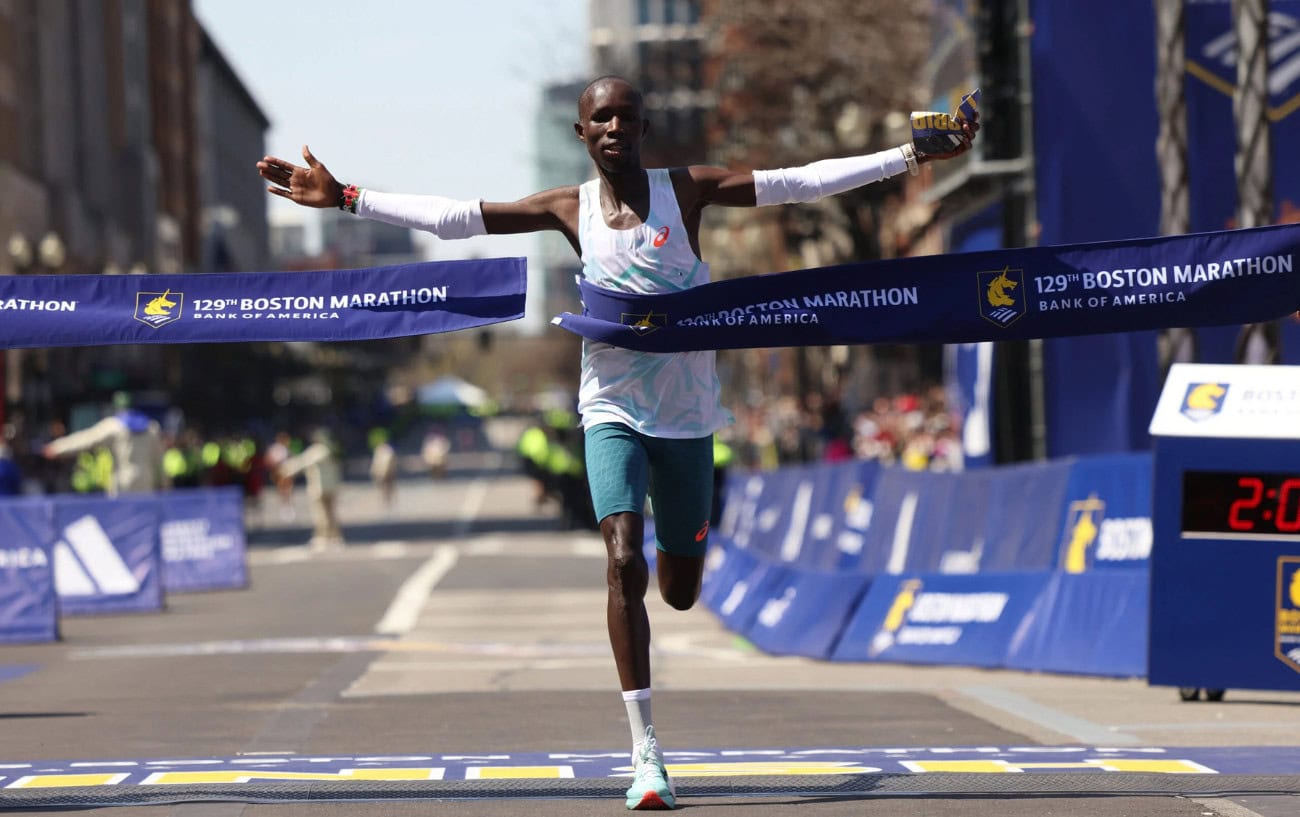
For tracking individual runners, download the B.A.A. Racing App (iOS and Android) — search by name or bib number for live split notifications. See our full guide to watching the Boston Marathon for every broadcast option in detail.
Spectating
Over one million people line the Boston Marathon course each year. If you’re planning to spectate, here’s where to position yourself.
Wellesley College (around mile 13): Known as the Wellesley Scream Tunnel, this is the loudest single stretch on the course. Students line the road for hundreds of meters, and the noise can be heard before you see them. Arrive at least an hour before the elites if you want a good spot.
Newton Hills / Heartbreak Hill (miles 17.5–21): The crowds here are among the most supportive on the entire course. Fans know these hills break people, and they show up accordingly. One of the best spots to watch the race unfold tactically.
Kenmore Square (mile 25): High energy, convenient Green Line access, and close enough to the finish that you’ll feel the momentum building.
Boylston Street: The finish line stretch. Arrive early — grandstand seating fills up and the sidewalks pack in fast. Plan for 60–90 minutes of waiting. It’s worth it.
Use the B.A.A. app to track your runners and plan your position accordingly. Road closures are extensive — leave the car behind and use the T (MBTA). The Family Meeting Area is at Stuart Street between Berkeley and Clarendon Streets, organized alphabetically by last name.
Post-Race
After crossing the finish on Boylston Street, runners receive their finisher medal, a mylar blanket, and food and drink from the recovery area. The finish line officially closes at 5:30 p.m.
Family meetup is at the Stuart Street Family Meeting Area, between Berkeley and Clarendon Streets. Pre-arrange which letter to meet at — cell service becomes extremely congested immediately after the race, so don’t count on calls or texts working reliably.
The Mile 27 Post-Race Party at City Hall Plaza begins at 12:00 p.m. on race day, open to runners, spectators, and supporters.
Men’s Elite Preview: Kipruto vs. Korir
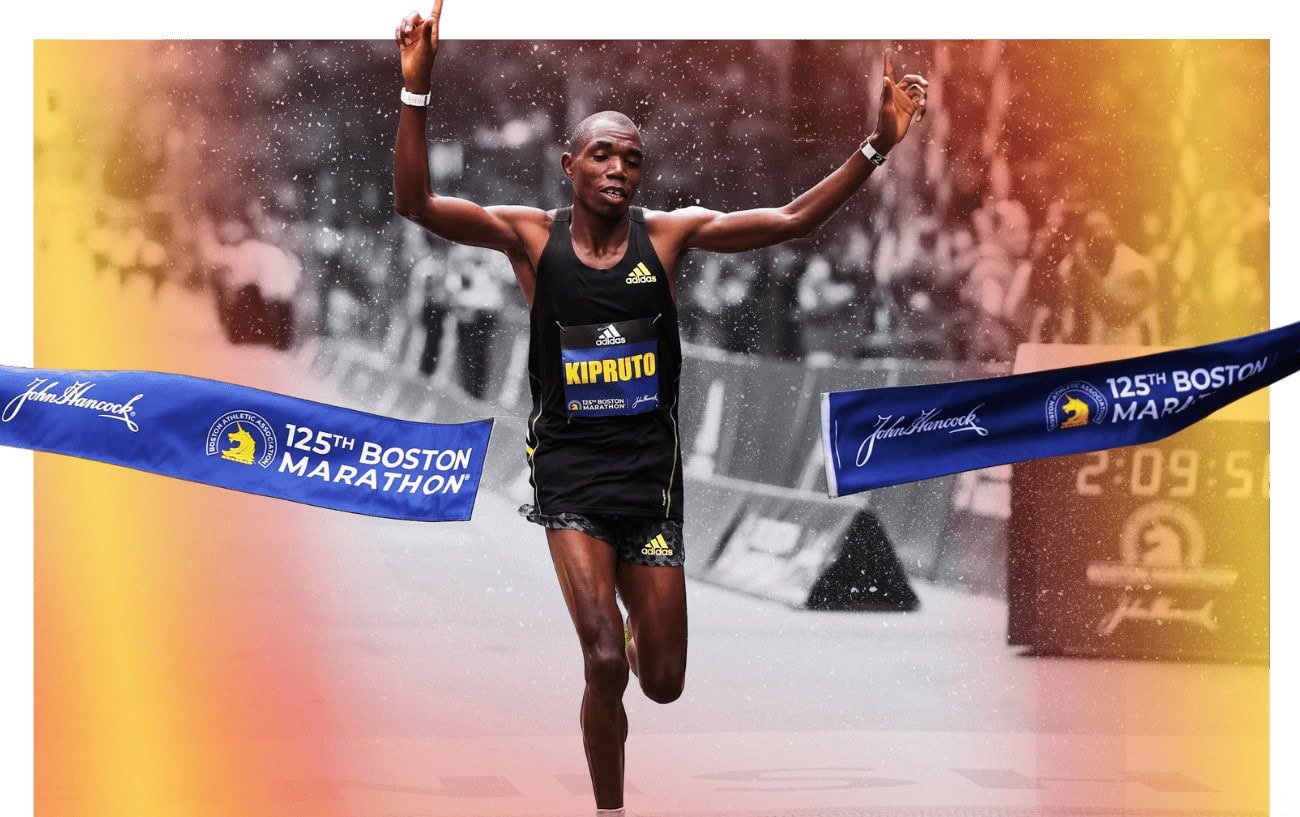
The central storyline in Hopkinton is a straightforward one: the man who wants his title back, and the man who took it from him.
Benson Kipruto (Kenya) won Boston in 2021. He returns now having added Chicago (2022), Tokyo (2024), and New York (2025) to his résumé — making him the only man to have won all three American World Marathon Majors. His personal best of 2:02:16, set in Tokyo, is the fastest time in the field. “Boston holds a special place in my heart,” Kipruto has said heading into race week, and his record suggests that isn’t sentiment — it’s strategy.
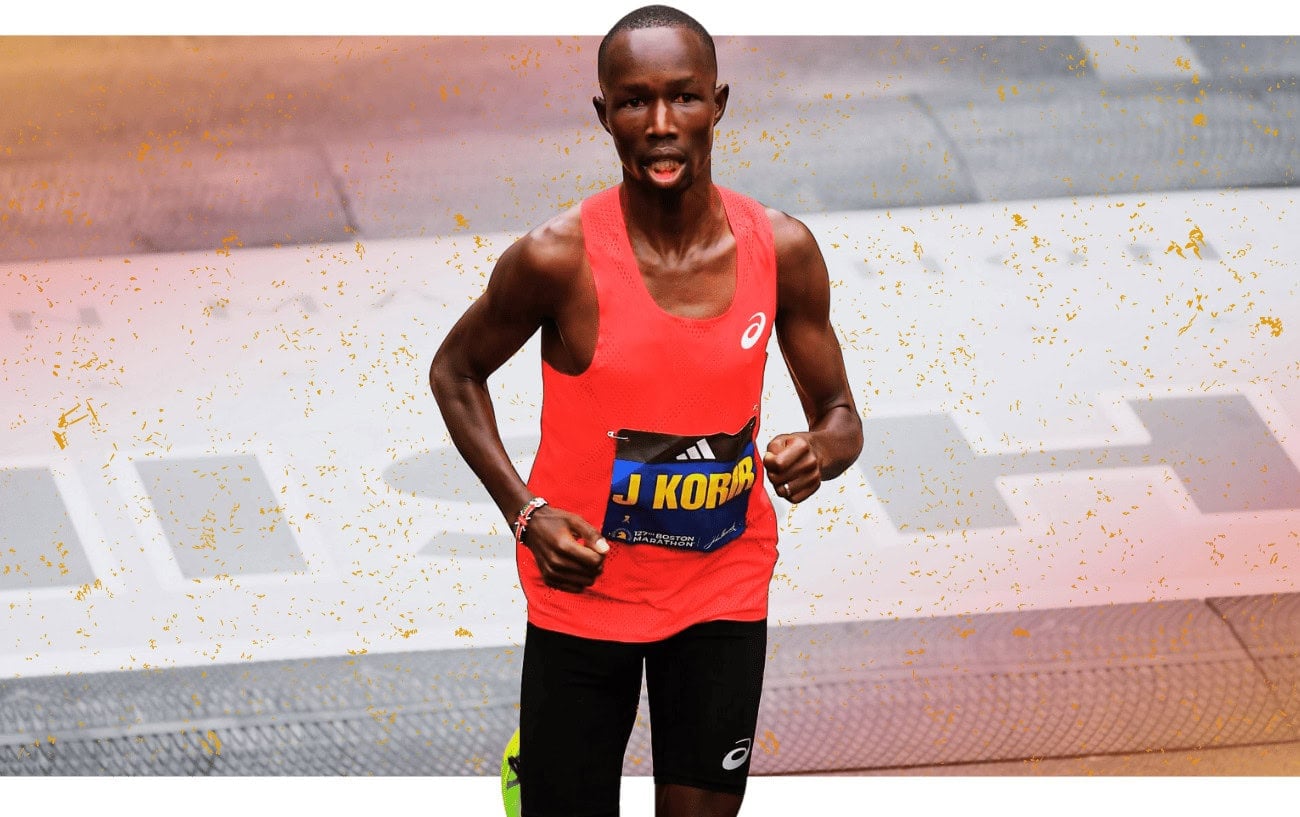
John Korir (Kenya) is the man standing in his way. Korir won Boston in 2025 in 2:04:45, the second-fastest winning time in the race’s history. Since then, he has lowered his personal best to 2:02:24 at Valencia in December. Eight seconds separates his PB from Kipruto’s. His brother Wesley won Boston in 2012, making them the first siblings to both hold the title. Korir is 26 years old, has only gotten faster since last April, and shows no sign of treating this race as a ceremonial defense.
The gap between these two men on paper — eight seconds of personal best — is razor thin. On a course as variable as Boston, form, tactics, and the Newton Hills matter far more than split times from December in Spain.
Alphonce Felix Simbu (Tanzania) pushed Korir hard in 2025, finishing second. He has since won World Athletics Championship gold, making him perhaps the most dangerous third wheel in the race. Cybrian Kotut (Kenya) was third last year. Abdi Nageeye (Netherlands), the 2024 NYC Marathon winner, and Milkesa Mengesha (Ethiopia), the 2024 Berlin champion, deepen a field that includes 10 sub-2:05 runners and 25 men who have broken 2:07.
On the American side, Clayton Young leads the domestic charge after Conner Mantz — the U.S. record holder — withdrew on April 1 due to a sacral stress fracture suffered after his Chicago American record run last fall. Mantz confirmed his fitness had not recovered in time to race at the level he expects of himself. For a full breakdown of the field, see our 2026 Boston Marathon men’s elite field guide.
The decisive moment will almost certainly come on the Newton Hills. Both Kipruto and Korir have enough speed to run even splits on a flat course. What Boston asks is something different.
Women’s Elite Preview: The Best American Field in a Generation
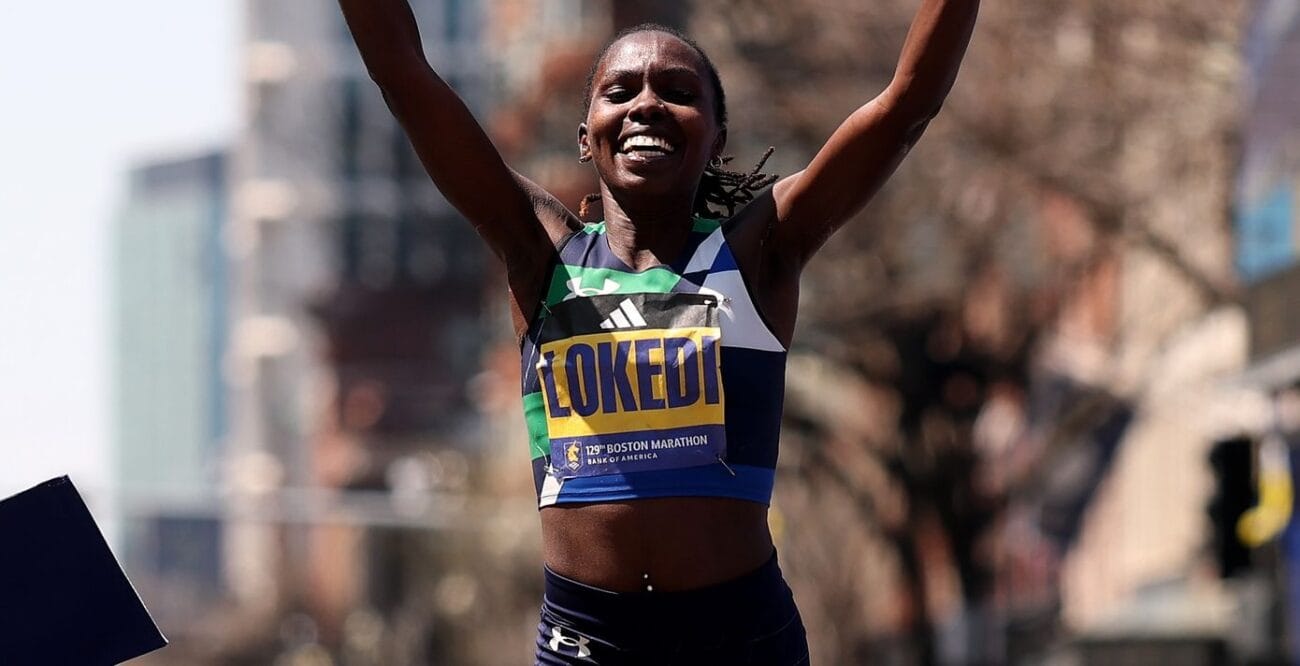
Sharon Lokedi (Kenya) returns to defend the course record she set in 2025 — a stunning 2:17:22 that broke the previous mark by a significant margin. Lokedi, who officially holds a PB of 2:20:07 from NYC (Boston times don’t count toward official World Athletics records due to net-downhill certification), ran a race in 2025 that turned heads across the sport. She is the favorite and knows it.
Challenging her is a women’s field that the B.A.A. itself has called potentially the strongest in the race’s history on the American side. Thirteen American women with personal bests faster than 2:26 will start in Hopkinton. The last American woman to win Boston was Des Linden, who crossed the finish in 2018 through some of the worst weather in race history. There are runners in this field who believe 2026 could end that drought.
Emily Sisson is the current American women’s marathon record holder. Irine Cheptai (Kenya) brings a PB of 2:17:51. Workenesh Edesa (Ethiopia) — fresh off winning the 2025 Hamburg Marathon — and Bedatu Hirpa (Ethiopia), the 2025 Dubai Marathon champion, add international firepower to a field that could see multiple runners push the course record hard if conditions hold.
Boston’s hills don’t favor pure speed. They favor strength, patience, and the ability to run the second half faster than the first — or at least survive it. The women’s race is wide open enough that the course itself could decide the winner.
What Makes Boston Different
Every marathon major has its identity. Berlin is fast. New York is loud. London is electric. Tokyo is precise.
Boston is earned.
The qualifying standard. The bus ride to Hopkinton. The Athletes’ Village. The nervousness of standing on the start line knowing you’ve done the work to be there. The crowds in Wellesley. The silence around mile 23 when it’s just you and the road. Then Boylston Street, and everything that comes with it.
In its 130th year, the Boston Marathon is not trying to be anything it isn’t. It is exactly what it has always been — the race where the road asks everything of you, and you give it.
Have more questions about the race? Our 20 questions about the Boston Marathon, answered covers everything from course logistics to what to wear on race day.