

260 to 3:09
I was the fat kid in my school. OK, maybe “fat” is a little harsh. I wasn’t what doctors would term “morbidly obese” in this day and age of supersize fries and 52-ounce sodas, but I was big. I was definitely bigger than anyone else in my class, which is a slightly easier accomplishment when there are all of 31 students in your class. So, while being the biggest out of 31 maybe isn’t as impressive as being the biggest out of 500, it’s still something. My point is that I was big, and that’s really all you need to know to get this story started.
I grew up in Chester, Montana, a small (as in 900 people and dwindling) farming and ranching town in north-central Montana. Chester’s claim to fame is that it’s the Heart of the Hi-Line, with “Hi-Line” referring to U.S. Highway 2, which runs east-west across northern Montana. I’m still not sure what the significance of that is, but it doesn’t really matter. The point is that I grew up in a small town where running for fun just didn’t really happen. My high school had the obligatory track team but no cross-country program. If you were a guy and wanted to play a fall sport, you could play football or you could play, well, football. And if you didn’t play football, you had better have a damn good excuse.
Being the biggest kid in my class automatically identified me to the general Chester public as a kid who must play football (no excuses for me). I didn’t mind this typecasting because I liked football. I would have played if I had been the scrawniest kid in class. And play football I did, all the way from seventh grade through high school. By the time I was a freshman in high school, I had pretty much stopped growing up, but not out. I stood around 6 feet, 3 inches and weighed in at just over 200 pounds when freshman football started. Four years later, I remained 6 feet 3 but tipped the scales at 240 for my senior year of football. Some of that was added muscle, some not. The local townsfolk’s premonitions that I must be a football player were apparently well founded because I actually ended up being pretty good at it, starting for three years and earning all-conference and all-state honors my senior year while also being invited to play in an all-star game.
Running as punishment
Football was fun, and I loved almost everything about it, except one small detail: the running. Our coach liked to keep us in shape, as most coaches do, which meant wind sprints at the end of every practice. We were also punished with running. Fumble the ball, run a lap. Miss your blocking assignment, run a lap. Jump offside, run a lap. Slack off while running your lap, run another, faster lap. Running was always the most dreaded part of practice for me. One of the things I loved most about the actual games was that they didn’t involve much running (not for me at least, being a lineman). Running was punishment, something to be avoided at all costs. This mentality would stick with me for a long time following my graduation from Chester High in 1996.
As much as I loved football, I never had any ambition to play it in college (and, honestly, had very few opportunities to do so). I did have ambitions of experiencing college the way it “should” be experienced. I headed off to the University of Montana in Missoula in the fall of ’96 and loved every minute of my four years there. Like most any college guy, I drank my fair share of beer and ate more than my fair share of cheap pizza. I did make a few token efforts to work out, mostly lifting weights and riding the exercise bike, while I was there, but none of these efforts ever lasted too long. By the time I graduated in May 2000, I was up to about 260 pounds. Running, even in a running-friendly town like Missoula, was the farthest thing from my mind.
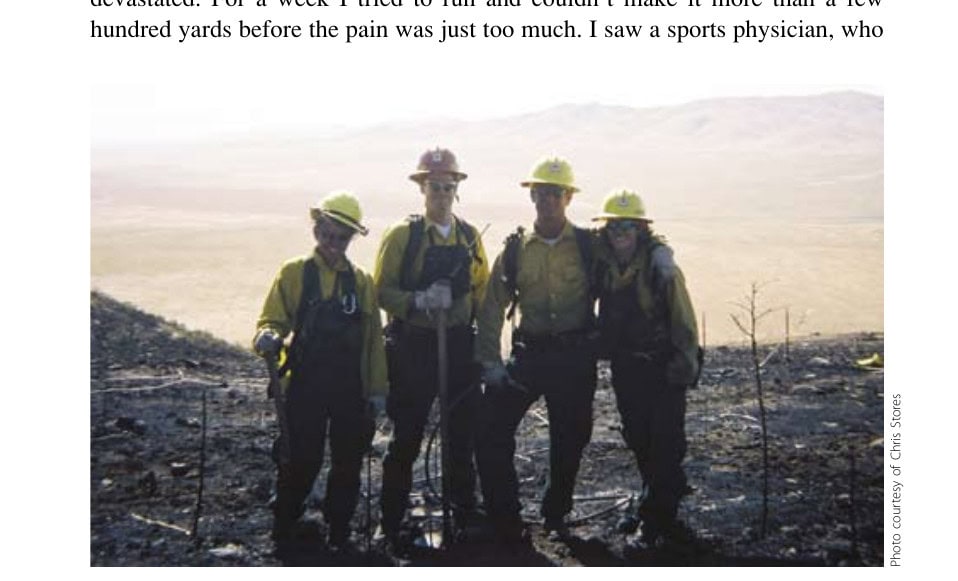
The irony of it is that by the time I graduated from UM, I had gotten my foot in the door of a physically demanding career. In the summer between my junior and senior years of college, I worked as a seasonal wild-land firefighter in eastern North Dakota. Hiking around on fires and swinging tools all day while carrying upward of 30 pounds of gear is demanding work, but I found that I enjoyed it. So after graduation, I decided to pursue this career path further. Over the next few years, wild-land fire would take me from North Dakota to Montana to Washington, back to North Dakota to Idaho and, finally, to California. At each of these stops along the way, I would at some point think that I should get into better shape. To do so, I would start running, maybe a mile at a time a few days a week. These efforts at physical fitness typically lasted two, maybe three weeks before they were abandoned for more attractive pastimes (fishing and drinking beer, mostly). It wasn’t until I landed my first permanent job in Idaho that my running life took a dramatic turn.
The thought of being a career firefighter who would be in charge of two other people on an engine crew convinced me that I absolutely had to get into better shape. On the day of my arrival in Idaho in October 2001, at an elevation of 6,700 feet, I attempted a one-mile run. I made it about a half mile and returned to my bunkhouse gasping for air like a fish out of water. I was still around 260 pounds at this time and, obviously, horribly out of shape. That would be the last time I tried running until the following spring, but it would also be the last time I gave up on running.
A commitment that stuck
Over that winter, as I sat isolated in a government bunkhouse just west of Yellowstone National Park, I made a resolution to lose the extra weight I had been carrying around for, oh, my entire life. I had made this resolution many times before, and like my previous attempts at running, it had never stuck. For some reason, it did this time, and over the next five months I lost 70 pounds. Not surprisingly, running became slightly easier with less weight to haul around, and in February 2002, despite temperatures that rarely climbed out of the 20s, I made a commitment to running. I haven’t stopped since.
At first, it was just a mile a day, four or five days a week. As the days grew warmer and the runs got easier, I started stretching my runs little by little. Eventually, I worked up to at least two miles a day with at least one run of three miles during the week. I was perfectly content with this volume and had no real desire to go any further. I ran my first road race, a 5K in Idaho Falls, in June 2002. My time was 25:24, and I was ecstatic with it. By that time, running had somehow,
without my really noticing, become something that I wanted to do instead of something I forced myself to do.
After one year in Idaho, I moved to a new position in northern California with my new wife. It was my wife who was the first to tell me that I would run a marathon someday. I told her that she was a few cards short of a deck if she honestly thought that was ever going to happen. For the first two years that we were in California, I was perfectly content to run three miles a day every day. I would sometimes run every day for up to two weeks straight, always running the same distance at just about the same pace every time. I ran my second 5K in 2004, just a week after our son was born. I have long since forgotten or misplaced my time for that race, but it was faster than my Idaho time. That 5K was held in Medford, Oregon, in conjunction with the annual Pear Blossom 10-mile race. Again, it was my wife who suggested I try something longer and run the 10-mile the next year. Again, I told her that only a sadomasochistic psychopath would run that far; I was perfectly content with my three-milers.
But once again, something struck me the next spring as the Pear Blossom race grew closer. I began wondering if maybe, just maybe, I could actually run that far. The idea of pushing my limits was strangely, and as it turns out, addictively appealing to me. So I signed up for the 10-miler and set about training for it, using an adapted half-marathon training plan I found online. I still remember the first time I ever ran six, seven, eight, nine, and then 10 miles without stopping. It was an exhilarating experience, and my life would never be the same because of it. I ran the 2005 Pear Blossom Run in 1:14:27. I was certainly tired afterward, but I was also hungry for more. I had suddenly destroyed my previously held belief that I could never run 10 miles. What else was out there that I didn’t think I could do?
Then there’s the marathon
If you’re following a progression of common road racing distances, the logical sequence might be: 5K, 10K, 10-mile, half-marathon, and marathon. I had already forgone the 10K in favor of a 10-miler. After 10 miles, the next logical step would be a half-marathon. But I was an all-out addict by this time and was desperately in search of the next big hit. I knew for a fact that I could run 10 miles, no problem. Adding on a measly three miles didn’t seem like enough of a challenge for me (remember that up until that spring, three miles had been the farthest I had ever run). I was actually doing that which I had claimed I never would: I was considering running a marathon. My decision was ultimately solidified when I went on a three-week-long work assignment to Tennessee just a week after Pear Blossom. While there, I worked with two other runners who had just completed their first marathon a month earlier in Knoxville. They were still giddy with the first-time-marathon-finisher euphoria, and talking to them convinced me. Shortly after returning to California, I registered for the 2005 Seattle Marathon.
Training for a marathon under any circumstances isn’t the easiest task. Training for a marathon while working as a wild-land firefighter complicates things a little. Since the Seattle Marathon is in late November, I knew that I would have to do some of my training in August and September, which is prime fire season in northern California. Although we followed a fairly rigid physical fitness program at work, very little of that program involved running. It was mostly centered on hiking up and down the extremely steep terrain of the Klamath Mountains. So I often ended up running in the morning before work, doing a strenuous PT hike at work, and then engaging in a physically demanding project throughout the workday. And of course, if you’re a wild-land firefighter, there is always the chance that you will end up fighting a fire.
I remember one workday very clearly. I had gotten up early in the morning to run a 13-miler, at the time the farthest I had ever run. A few hours later, we were called out to a fire and I spent several hours hiking up and down the fire perimeter, swinging tools, dragging hoses, and clearing brush. I was one whipped puppy at the end of that day. There were other days like that as my training picked up and the fire season wore on.
The days of double PT and physical labor eventually took their toll, and I came down with iliotibial band syndrome eight weeks before the marathon. I was devastated. For a week I tried to run and couldn’t make it more than a few hundred yards before the pain was just too much. I saw a sports physician, who
recommended rest and some stretching and strengthening techniques. I was eventually able to start running again, but unsure of how much of a setback I had incurred, I strongly considered switching to the half-marathon. It wasn’t until I was able to finish my first 20-miler three weeks before Seattle that I decided I had to give the full marathon a shot. As November 27 grew closer, I was fairly confident that I would finish, just not so sure of how long it was going to take.
Seattle’s challenges
Seattle probably isn’t the best course for a first-timer. Although the first 20 miles are mostly flat or downhill, there is a beast of a hill just after mile 20 and some pretty consistent uphill running over the last 6.2 miles—not exactly the best circumstances for someone who had never run farther than 20 miles before.
I woke up the morning of the race and wondered what in the hell I was doing there (a feeling I still get every morning before a marathon). I figured I had put in too much time and too much money to back out now, so off to the start line I went, totally unsure of just how this thing was going to turn out. My general goal was to run a sub-4, but really, finishing upright was the overriding goal of the day. For the first 20 miles, I felt pretty good. Then, as often happens, I went through some rough patches. Of course, that big hill didn’t help matters any, but I was able to run all the way up it and recover somewhat afterward to finish strongly (although my father-in-law was deeply disturbed by my bloody nipples). I ran 3:46:14 that day and was on top of the world. Boston was the entire width of the country away and nowhere in my thoughts. I knew before I finished Seattle that I would run another marathon. The training was addictive to me in a way that nothing else ever had been. By the time I finished the Seattle Marathon, my wife and I had two kids, and the appeal of being a wild-land firefighter, working a dangerous job for long hours in sometimes far-off locales, was wearing thin. It was all fine and good when I was a single guy with no commitments at home, but my priorities were changing, and fire was no longer at the top of the list.
So I applied for and was offered an office job with the U.S. Forest Service in Spearfish, South Dakota, and we moved there in 2006. I decided to take a more hard-core approach to training for my second marathon, so I bought Pete Pfitzinger’s Advanced Marathoning and launched into his 18-week, 55-miles-per-week plan for the Brookings Marathon in eastern South Dakota. My goal for Brookings was to run 3:30, an ambitious improvement of over 16 minutes from my Seattle time. But I was convinced that a more intense training plan and avoiding injuries would give me the boost I needed, and as it turned out, I was right. I ran Brookings in May 2006, finishing in 3:30:37. By this time, I was well aware that I needed to run 3:10:59 to qualify for Boston, but it seemed like an unattainable goal to me at the time. After all, I had just run a marathon at 8:00-mile pace and had to work very hard toward the end to maintain that. Running a full 26.2 miles at 7:17 pace simply did not seem realistic to me.
Over the next year and a half, I ran as many marathons as I could, trying both to get experience at the distance and to bring my PR down. I ran the Montana Governor’s Cup Marathon in September 2006, coming just 40 seconds short of another PR. I ran Mount Rushmore three weeks later and finished with a personal worst of 3:47:41 on a tough course on fatigued legs. The following spring, I made another push for a big PR and followed Pfitzinger’s 18/70 plan to a 3:18:53 at Fargo in May 2007. I followed that up with 3:32:24 at the inaugural Missoula Marathon, which was run in the midst of the hottest July in Missoula’s history. August 2007 saw me push my limits even further, running my first 50K (Lean Horse) in 4:46:22, good enough for second overall. In October 2007, I ran 3:28:09 at the Monumental Challenge Marathon, my second-fastest marathon time.
Adding on the miles
By the end of 2007, I knew that my next goal was to qualify for Boston. A higher-mileage training plan had brought me within eight minutes of that goal at Fargo. My first PR at Brookings the year before had also come after increasing my mileage. So to me, the logical thing to do was to increase my training mileage even more in preparation for my first Boston qualifying (BQ) attempt at the Colorado Marathon in Fort Collins in May 2008. I opted for the highest-mileage plan that Pfitzinger includes in his book, the 18 week/70-plus miles per week plan. According to Pfitzinger’s schedule, the highest weekly mileage should be 93, but temptation got the best of me on that week and I tacked on an additional seven miles to hit 100 for the first and so far only time. Other than that, I followed the plan almost exactly and found that I seemed to adjust to the high mileage fairly easily and very much enjoyed the challenge of running nearly every day for 18 weeks. A tune-up 10K in late April garnered me a PR of 39:17, which, according to every prediction calculator I checked, equated to a BQ time at the marathon distance. Since the Colorado Marathon, thanks to its downhill nature, is widely advertised as one of the more BQ-friendly courses around, I thought the BQ was in the bag. But, as they say, that’s why they play the game.
One thing I’ve learned over my six-plus years as a runner is that there are good days and there are bad days. Some days you feel like you are weightless and could run forever. Other days you feel like your legs are made of lead, and nothing you do can make your body cooperate. Obviously, you hope for one of the good days on race day. On May 4 in Fort Collins, I got one of the bad ones.
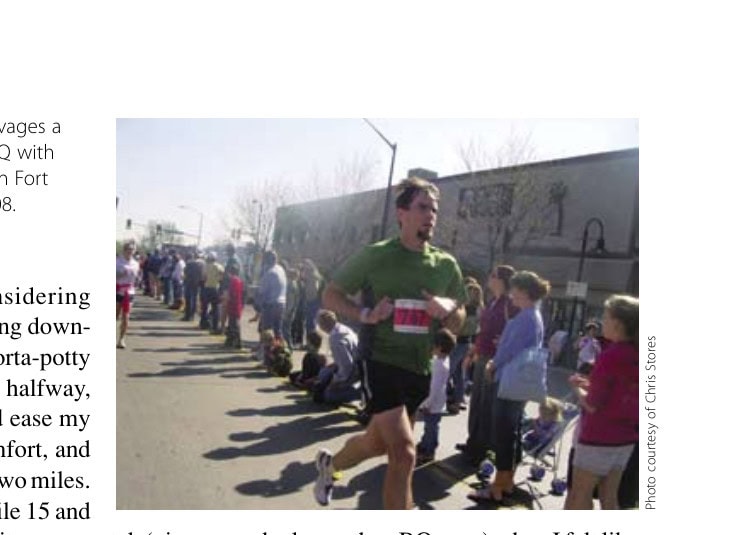
From the very start, I just didn’t feel right. My stomach felt weird, and although I was running at BQ pace for the first 15 miles, I was pushing too hard to do so,
especially considering that I was running downhill. I made a porta-potty stop just before halfway, hoping it would ease my stomach discomfort, and it did for about two miles. But then I hit mile 15 and saw the 7:26 split on my watch (nine seconds slower than BQ pace) when I felt like I was running more like 7:10, and I knew then and there that my day was done. I soldiered on and, technically, was still on pace for a BQ until mile 19 or 20, but I had absolutely no gas in the tank. I trudged along for a few miles, alternately walking and jogging and just generally feeling sorry for myself, before I realized that if I gutted it up I could run the final couple of miles strongly and still, maybe, get a PR out of the deal. I picked the pace back up and struggled to hit 7:45 miles, but it was good enough for 3:18:06 and a 47-second PR—not that I really cared about that once the race was over, though. The PR was almost meaningless to me in the wake of my failed BQ attempt. I was at a loss as to what went wrong that day, and Boston seemed farther away than ever before.
More attempts at a BQ
After wallowing in my own sorrow for a week or so, I refocused on how to go about qualifying for Boston. I knew that my next marathon would be five weeks later at the Deadwood-Mickelson Trail Marathon, the closest marathon to my house, in June. I also knew that Deadwood’s 13-mile uphill/13-mile downhill course wasn’t favorable to a BQ and that I wouldn’t be ready to try again so soon anyway. After Deadwood, I planned on running the Missoula Marathon again in July. Being from Montana and having fallen madly, deeply in love with Missoula during my college days there, I was very intrigued by the possibility of running a BQ there.
But two factors were holding me back from making an all-out commitment to that goal. The first was my own doubts about whether I would be able to recover well enough to take another shot just two months after Colorado. The second was whether Mother Nature would cooperate and keep the temperature reasonable this time. In the end, I decided that I would try as much as possible to recover and prepare for a BQ effort at Missoula, using Deadwood as a training run, but would also focus ultimately on qualifying at the Roughrider Marathon in Bismarck, North Dakota, in September. If the race-day weather in Missoula looked to be similar to last year (blazingly, insanely hot), I would simply run it as a training run and make the BQ attempt at a faster and likely cooler course in Bismarck. If, by some miracle, the weather looked favorable in Missoula, I would take a shot and see what happened (and still have Roughrider to look forward to if it didn’t work out).
As it turns out, I got my miracle. I recovered amazingly quickly from Colorado and ran a good, strong training run at Deadwood (3:36:55). Deadwood left me no more beat up than an average long run, which was exactly what I was hoping for. In the five weeks between Deadwood and Missoula, I started working speed work back into my training and bumped the mileage back up a little, topping out at 72 miles in a week. That was nowhere near my high mileage prior to Colorado, but I was feeling pretty strong and was worried more about staying healthy than posting big miles. I also kept my Missoula plans a complete and utter secret. I had made a big deal out of trying to qualify in Colorado and consequently felt an immense sense of failure when it didn’t work out. Not a single soul besides me knew that I had a secret BQ plan in my back pocket as I headed west to Missoula.
As race day drew closer, the weather forecast was looking pretty darn good. July highs are typically near 90 in Missoula, and this July was no different. But unlike some other areas, the mountain valleys of western Montana typically cool off significantly at night, and the overnight lows in Missoula in the days leading up to the race were consistently in the 40s, even dipping into the 30s two nights before the race. Since the race started at 6:00, I knew a BQ effort would have me done just after 9:00, and the temperature would likely be no higher than the low 60s while I was running. In contrast, the temperature was in the 60s when we started Missoula the year before. So as I stood at the start line in Frenchtown on the morning of July 13, shivering in the early-morning cold, I stood 26.2 miles from both Missoula and Boston. The cannon fired, and I was off.
At Colorado, I had one of the bad days. At Missoula, the running gods compensated me with one of the good ones, maybe the best one. I immediately hit 7:10 pace and was consistently at that pace or a little faster for the first 12 miles. The only significant hill on the course started near the halfway point but lasted for a good mile and a half. I was conservative on the hill but also maintained a strong pace and lost much less time than I thought I would.
The splits increase
I hit the halfway point in 1:34:00, giving me a 2:59 cushion on my BQ time. I maintained BQ pace (7:17) or faster up until mile 19, and then the almost inevitable fade began. I felt that I was running the same pace, but my mile splits started drifting into the 7:20s. Visions of a crash and burn similar to Colorado danced in my head. As I madly tried to calculate splits in my head, a dubious effort for me under normal circumstances, much less during the late stages of a marathon, I started to become sure that I was bleeding too much time per mile.
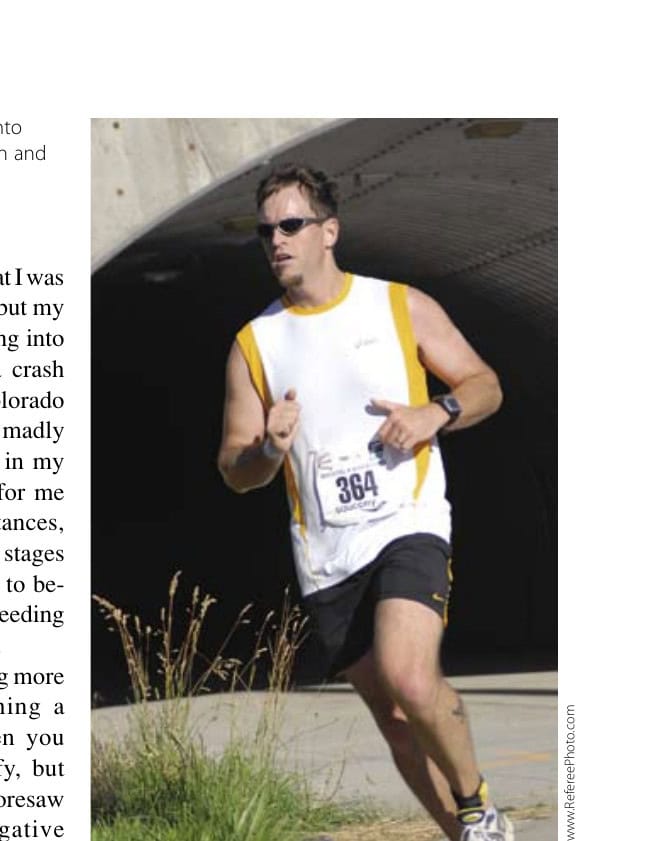
I can think of nothing more agonizing than finishing a marathon in 3:11 when you need 3:10:59 to qualify, but that is exactly what I foresaw happening. These negative thoughts dominated my head for a couple of miles until I hit mile 23 and realized that the situation wasn’t as bad as I had thought and that if I could just keep the pace under 7:30 for the final 3.2, I would make it. I ran the next two miles in 7:22 and 7:30. With a mere 1.2 miles between me and Boston, I dug down and told myself that if I could endure several more minutes of pain, the reward would be very much worthwhile. Mile 26 was a 7:14, and as I made the final turn from Fourth Street onto Higgins Avenue with 0.2 to go, I could see the balloon arch marking the finish line on the far side of the bridge. It seemed that I glanced at my watch 100 times as I crossed the bridge, but every time it told me the same thing: I was going to make it. I surged across the Higgins Avenue bridge, tossing the BQ monkey off my shoulders and into the Clark Fork River on my way, and crossed the line in 3:09:41—an 8.5-minute PR, good enough for first in the men’s 30-34 age group—and, of course, the much-coveted BQ was mine. What had seemed like an impossibility 2.5 years before at the finish line of the Seattle Marathon was now a reality. I can’t help but wonder what else is “impossible.”
Since my BQ run at Missoula, I have come to realize that my life has been divided into two very distinct time periods: before running and running. The people whom I grew up with and knew so well in Chester, the people from my prerunning life, are shocked to know that I, of all people, ended up being a marathon runner capable of qualifying for the Boston Marathon. On the other side of the spectrum, the people whom I know and work with now, during my running life, know me simply as a runner and do not see me at all as the lazy, overweight person I used to be. One thing they have in common is that both camps think I’m totally, utterly out of my ever-lovin’ mind, but that’s all right because I know I am. After all, as I told my wife years ago, you have to be crazy to want to run a marathon. And now, I get to run the granddaddy of ’em all with at least 26,000 lunatics just like me.
Postscript
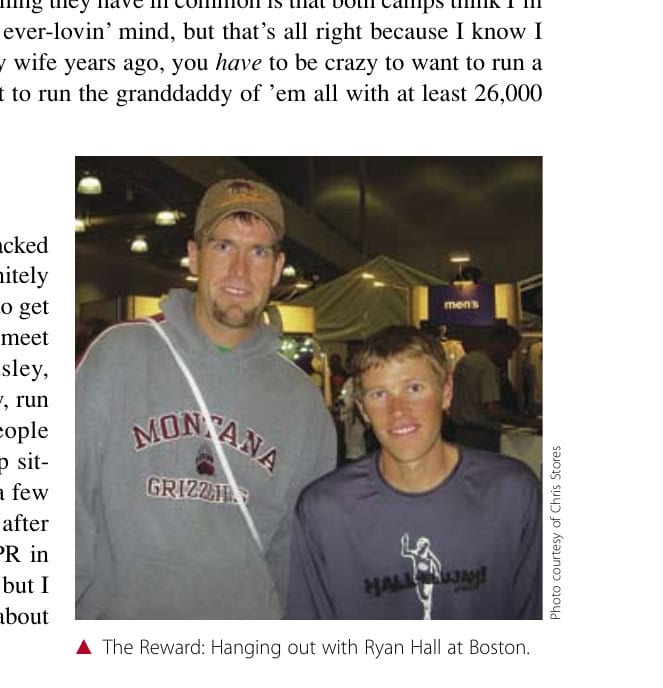
Boston is everything it’s cracked up to be and more—definitely worth the work required to get there. Where else can you meet Ryan Hall, Dick Beardsley, and Bill Rodgers one day, run in a mass of 26,000 people the next, and then end up sitting next to and sharing a few drinks with Bart Yasso after the race? I didn’t get a PR in Boston (I ran a 3:15:41), but I wouldn’t change a thing about my experience.
ASHLAND, WISCONSIN, October 14, 2006. It is finally here, marathon morning. There is excitement in the air, anticipation—all runners know that “It’s finally race day” feeling. Hundreds of runners are gathering in the tall timber near Iron River, Wisconsin, for the start of the WhistleStop Marathon, which is run on an old railroad bed all the way from Iron River to the quaint little town of Ashland, Wisconsin.
It is a cold, crisp morning, not a ray of sunshine—just gray clouds, damp with wind swirling through the trees. John, my running partner and brother-in-law, and I are thankful that it isn’t snowing like yesterday. The grass and leaves and the roofs of the houses are all white, covered with snow. When we ran this race last year, the trees were beautiful—gold and red. There are still some like that, but most are bare and stark, having already lost their leaves to the snow-covered ground.
I peel out of my long pants, and we put our computer chips on our ankles. John leaves his long pants on. I want to run barelegged, cold or no cold. My poor legs have enough to carry as it is.
Little do I know as I put on my chip in preparation for my ninth marathon how significant my chip time will be to me.
We have 10 minutes before start, so I check my bag, and we get in the long line of runners not too far back from the starting line.
As I talk with John, I am also going over my mental checklist. I have a few ibuprofen and Clif Bloks in my shorts pockets. In the side pockets of my jacket, I have some hard candy and sunglasses. I am optimistic about some sunshine later in the race.
A guy with a speaker horn is trying to give us final instructions, but I can hardly hear over all the chatter of the runners—something about two minutes until the start. I am excited; this is what I’ve trained for all year. I’ve run 105 times, 894 miles this year, all for this morning and a chance to make Boston. Finally, a big foghorn blows, and we’re off and running.
A turn onto the rail bed
After that southward first mile, we make the turn to the east onto the old railroad bed—25.2 miles to Ashland. The tail wind out of the west is helpful and appreciated. The old railroad bed surface is good, not too soft or muddy, as I feared it might be. It is another reason we like this marathon; the crushed limestone rock surface is easier on the legs.
The start of a marathon is always exciting, people talking and cutting up. I love the initial enthusiasm, but I also know how it wanes three hours later after mile 20. I, too, feel great. I tell John I am grateful just to be able to run and how awesome it is to run with him.
I started running primarily out of concern for my health. As a pastor, I don’t get exercise at work. However, I do get a boatload of burdens, and running helps me cope. For the longest time, I was a convenience runner. If it was a nice day, if my schedule allowed, I would run, which meant I was inconsistent.
As the years went by, I realized that I was getting stockier, which is a nice way of saying I had enjoyed too many church potluck dinners. I was a pretty good athlete in high school, but that was 40 birthday cakes and 30 pounds ago. Then my concern for my health actually grew into a phobia—a fear of open-heart surgery that gripped me when my dad had his heart surgery. After that, each time I made a hospital visit with someone going into heart surgery, I would drive straight home and change into my running gear and soon be running down the road with a prayer that I would never have to have my chest opened and my ticker fixed.
I became more consistent and started going farther. We live in the farm country just outside the city limits of Lincoln, Nebraska, and our area of the state is divided into square-mile sections. My usual run to the corner and back was a mile and a half. But I started going around the corner and each time a little farther to the next telephone pole or cedar tree or farmhouse until I worked up to two miles. Then it made more sense to go on around the square-mile section than to turn around and come home. The first time I ran the four miles around the section, I felt that it was an awesome feat.
I read in the newspaper about an upcoming 10K race. I didn’t know how many miles a 10K was, and I had never run a race in my 53 years of life. The whole
This article originally appeared in Marathon & Beyond, Vol. 14, No. 2 (2010).
← Browse the full M&B ArchiveMore like this
1,000+ stories from 19 years of Marathon & Beyond
The complete archive of the legendary long-distance journal — digitized and free to read.
