

In Pursuit of a BQ and a Sub-4:00
I have some hard candy and sunglasses. I am optimistic about some sunshine later in the race. A guy with a speaker horn is trying to give us final instructions, but I can hardly hear over all the chatter of the runners—something about two minutes until the start. I am excited; this is what I’ve trained for all year. I’ve run 105 times, 894 miles this year, all for this morning and a chance to make Boston. Finally, a big foghorn blows, and we’re off and running.
A turn onto the rail bed After that southward first mile, we make the turn to the east onto the old railroad bed—25.2 miles to Ashland. The tail wind out of the west is helpful and appreciated. The old railroad bed surface is good, not too soft or muddy, as I feared it might be. It is another reason we like this marathon; the crushed limestone rock surface is easier on the legs.
The start of a marathon is always exciting, people talking and cutting up. I love the initial enthusiasm, but I also know how it wanes three hours later after mile 20. I, too, feel great. I tell John I am grateful just to be able to run and how awesome it is to run with him.
I started running primarily out of concern for my health. As a pastor, I don’t get exercise at work. However, I do get a boatload of burdens, and running helps me cope. For the longest time, I was a convenience runner. If it was a nice day, if my schedule allowed, I would run, which meant I was inconsistent.
As the years went by, I realized that I was getting stockier, which is a nice way of saying I had enjoyed too many church potluck dinners. I was a pretty good athlete in high school, but that was 40 birthday cakes and 30 pounds ago. Then my concern for my health actually grew into a phobia—a fear of open-heart surgery that gripped me when my dad had his heart surgery. After that, each time I made a hospital visit with someone going into heart surgery, I would drive straight home and change into my running gear and soon be running down the road with a prayer that I would never have to have my chest opened and my ticker fixed.
I became more consistent and started going farther. We live in the farm country just outside the city limits of Lincoln, Nebraska, and our area of the state is divided into square-mile sections. My usual run to the corner and back was a mile and a half. But I started going around the corner and each time a little farther to the next telephone pole or cedar tree or farmhouse until I worked up to two miles. Then it made more sense to go on around the square-mile section than to turn around and come home. The first time I ran the four miles around the section, I felt that it was an awesome feat.
I read in the newspaper about an upcoming 10K race. I didn’t know how many miles a 10K was, and I had never run a race in my 53 years of life. The whole
family came to watch Dad run a race. My finish time was 54:28—certainly not fast, but I had finished my first race ever. I ran the same 10K the next year. The following year I read The Nonrunner’s Marathon Trainer by Whitsett, Dolgener, and Kole. Halfway through the book,
I closed it, laid it down and said, “Before I die, I’m going to do that. I’m going to run a marathon.” So at age 55, I ran my first marathon in hilly Kansas City. In those last hard miles, I made myself two promises: first, I would finish even if I had to crawl;
and second, I would never be so crazy as to do this again. My finish time was 4:44:58—not exactly a world record, but my family acted as though it was. Fortunately, the feeling of accomplishment that I had as I crossed that finish line
made me forget my second promise. Since then I’ve influenced my brother-in-law, John, and nephew, Chris, to run marathons with me. But they are younger and faster and thus not content just to finish. They insist on getting PRs, qualifying for Boston, and continually taking
it to the next level. Because of their influence, it became my goal to do a four-hour marathon in preparation for that time when a four-hour marathon would qualify me for Boston. I did Chicago in 4:15, North
Olympic in 4:11, Chicago again in 4:04, Grandma’s in 4:07, and Fort Collins, Colorado, in 4:05.
My very own pacer
Photo courtesy of Carl Godwin
Then in October 2005, John, who runs his marathons a half hour faster than I, agreed to do WhistleStop with me at my pace to help me get that elusive fourhour time. We were within two blocks of the finish when my right calf locked
▲
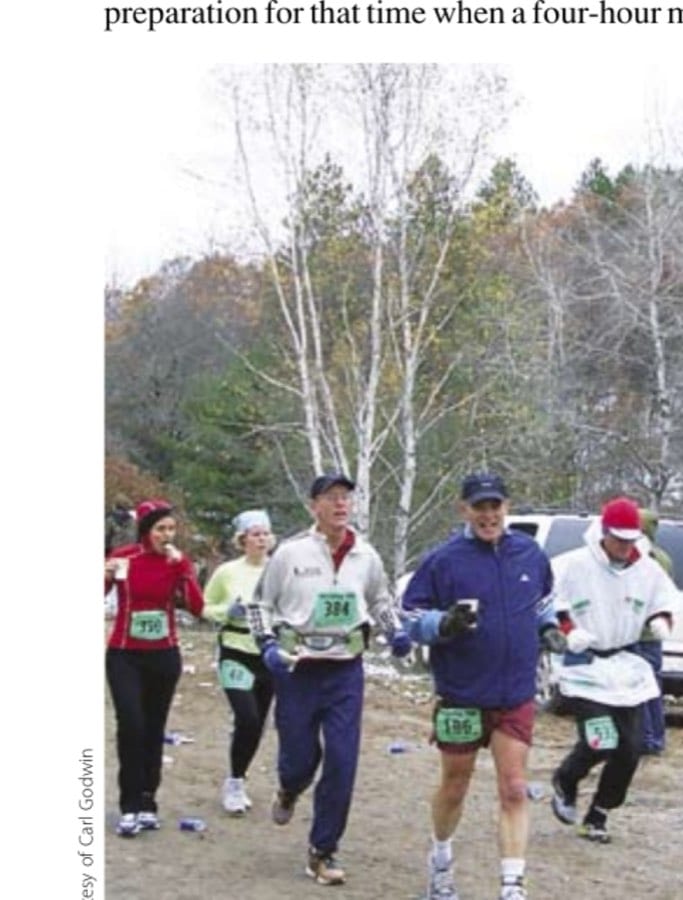
The author (in shorts) and his pacer, brother-in-law John (384), as they make their way through an aid station early in the race.
Photo courtesy of Carl Godwin
up in the worst cramp I’ve ever had. I staggered in at 4:01:44, excited to get a PR but disappointed that I missed that elusive sub-4. Now it is crunch time. None of those marathons would have qualified me for Boston even if I had done sub-4, because I wasn’t yet in that age bracket. Now I am 59, and we’ve passed that September date, and I’m eligible to qualify for the 60-64 age bracket.
So here is John coming all the way from Kansas City to northern Wisconsin, once again running at my pace with me, trying again to help this old plugger make Boston. My sister Marlene, John’s wife, is more excited for me than I am for myself.
John and I talk some, but we also just run along in silence, taking it all in. These northern Wisconsin woods are beautiful even if they aren’t as colorful as they were last year. Every so often the woods open up to let us see several wellkept dairy farms with their big barns. Runners are as far as I can see in front of me and behind me—maybe 1,000 or more this year. Ah, that’s a lot of crazy people! You’ve got to love it.
The WhistleStop Marathon has to be the most spectator-friendly race in the world. The old railroad bed runs parallel to Highway 2, which runs east/west across northern Wisconsin, and in our case, from Iron River to Ashland.
The first north/south country road that crosses our trail is at about mile four. There are my wife, Gayle, and sister Marlene cheering for us and taking pictures. We see them again at mile six.
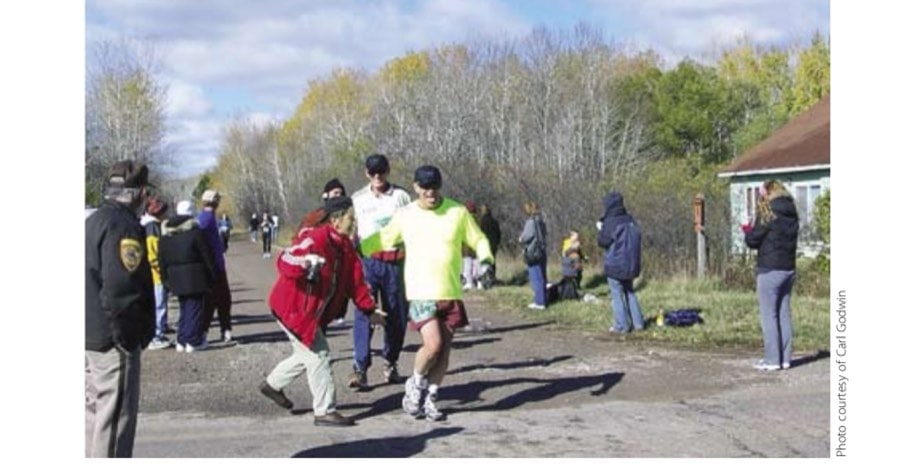
▲ Only your sis can get by with this kind of encouragement (a slap on the butt)!
The miles are clicking by—10, 11, 12, and finally halfway, 13.1. We are right on schedule: two hours. I am fearful of cramps and pain in my calves in the latter miles, so I am trying not to push it too hard at this midway point.
The reason I have such concern for my legs is that I ran a marathon just three weeks ago. The ultramarathon man, Dean Karnazes, was in our city to run the Lincoln Marathon as part of his 50 marathons in 50 days in 50 states tour. I just couldn’t pass up the opportunity to run with him. And what an experience it was to meet him, to visit with him as we ran, and to get an autographed copy of his book, Ultramarathon Man. I devoured the book and learned a lot from it.
That was not a “live” marathon. The Lincoln Marathon is in May, and that was September. Dean ran the route of the Lincoln Marathon with 12 of us who signed up to run it with him. Dean’s Web site indicated that he was doing his marathons in about 4 1/2 hours, so I felt that would be a good training run. It was for the first 20 miles, and then someone said, “Hey, I smell the barn. Let’s go!” and the group really picked up the pace. My pride got the best of me. I wasn’t going to let them leave me behind. I finished with them at 4:15, and I think it took a toll on my legs.
Some truly foul “ibies” In anticipation of pain, I take a couple of ibuprofen. Those “ibies” can really be gross as my shorts are sweaty, and the ibuprofen get soft in the pockets. I pop two into my mouth and just shake my head in disgust with the bitter taste. Then they lodge in my throat and don’t want to go down.
The miles are still clicking by—18, 19, finally mile 20, and our time is 3 hours and 1 minute. John seems pleased. I’m sure he is hoping that I’ve saved enough strength for those last 6.2 miles. The WhistleStop Marathon is a very flat and fast course; however, there is a slight but long incline somewhere after mile 20, and by this time it seems like a mountain to me. No one is making light conversation or cutting up. It is quiet; people are laboring, breathing hard, struggling, suckin’ air.
Every so often a pain shoots up my left calf. John is now running about eight to 10 yards ahead of me. The sun is breaking through the clouds. It is good to see blue sky. I reach around to my back pocket for ibies; only two left, and they are soft. Oh, no, I dropped one in the dirt. I pop the last one into my mouth then lick off what is left on my hand, behaving like some kind of addict.
John is 25 to 30 yards ahead of me. My left calf hurts. I am afraid it will lock up as my right one did last year. I am trying to push off more with my right leg and limp that left leg forward. Maybe if I can favor it some it will not cramp up. My quads feel good, and I am glad that I can depend on them to pull me up this forever incline.
My mile time for 21 is 9:20; for 22 it is 9:10. Finally, at 23, there are Gayle and Marlene. Their encouragement and an aid station keep me going. I get a cup of Powerade and walk through the station drinking it.
It is tough to get going again. My body says “No,” but my mind says “Go!” I can see John a couple of blocks ahead. I am determined to keep him in sight, not to lose him. Our plan is for him to keep the pace no matter what, not to wait for me.
Some people are walking and some are still running. I go by one guy, and he says, “You’re looking good. Go for it.” I thank him and think, If you only knew how bad I feel! Finally, mile 24. Now my right hamstring has started to cramp. I have to stop and bend over as though I’m touching my toes in order to stretch it. This happens more than once. How frustrating.
Finally, the end of the railroad trail, and we are in Ashland and through the 25-mile aid station. A security guy watching traffic for us at the intersection tells me, “One more mile to go.” I look at my watch—my total time so far is 3 hours and 52 minutes. Can I do this last mile in eight minutes? No way! I decide that I’m going to give it all I’ve got.
A lady directing traffic in another intersection says, “Only 10 more blocks to the finish!” I’m thinking, If you knew how I feel, you wouldn’t use the word “only.”
ad
Ten blocks seems like 10 miles, but I say to myself, OK, I’m going to count the blocks off. One block, then two, but, oh, the pain! At least my legs aren’t cramping. I tell myself, If I can keep from cramping up, I can run with the pain. I recall what Dean Karnazes said: “Run the first half with your legs and the last with your heart.”
I remind myself that I have run 900 miles, training all year for this, and everybody at home is praying: my family is praying, my church family is praying. Scripture verses come to mind, like Hebrews 12:1: “Run with endurance the race.” And First Corinthians 9:24: “Run that you may win.” And Philippians 4:13: “I can do all things through Christ.”
The marathon is a metaphor of life. Every runner can be a winner. We really don’t compete with others but with ourselves. The best thought I got out of Dean’s book was this: “The highest form of competition is self-competition (page 235).” The battle I’m fighting now is not with other runners at all, but it is a battle within me. The fight between fatigue and the determination to finish strongly is fierce!
Fatigue is using its favorite weapon against me—pain. Now every step is agony, and every few steps a pain shoots up my left calf like an electric shock. I’m not sure whether that is sweat running down my face or tears. Then determination counters with goals. Remember to focus on the goals, those goals you wrote down in your dream notebook and reviewed day after day during training. They have brought you through previous races and now through 26 miles, so focus and finish strongly through these last blocks. Run through the pain, remember what Dean said: “Yes, it hurts, but it is a good hurt.”
Block three, four, five—I quit counting because the crowd on both sides of the street is cheering. What a wonderful distraction. I feel an adrenalin rush, an emotional lift as I can now see the finish line just
▲
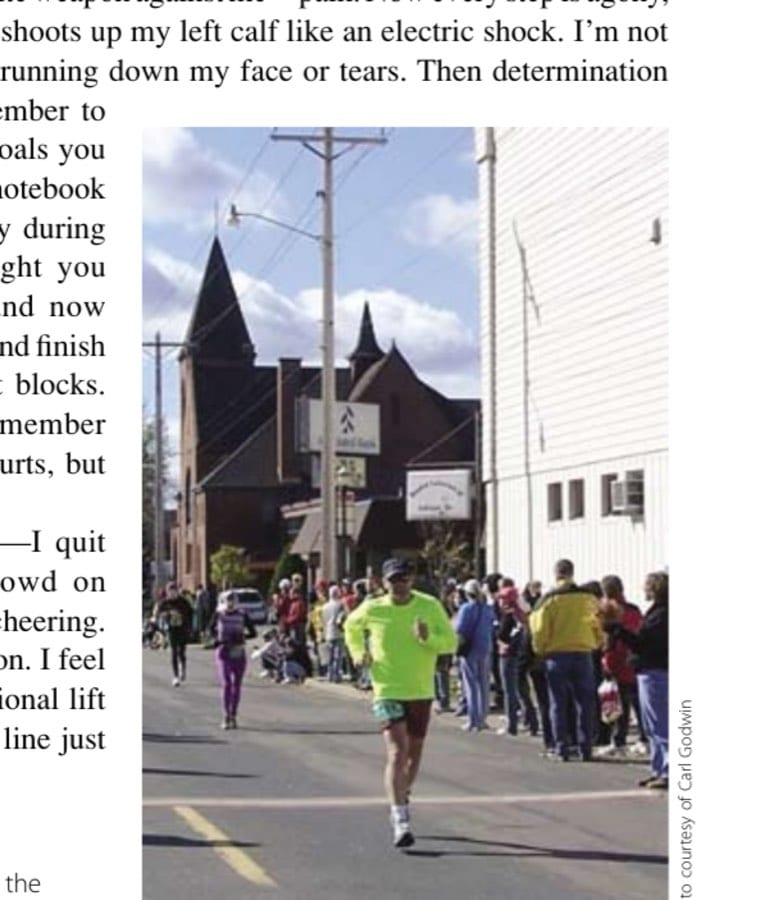
The author pushing through the pain—only a block from the finish.
Photo courtesy of Carl Godwin
The ever-expanding blocks
blocks ahead! John and Marlene will be there and my number one cheerleader, my Gayle, will be waiting for me. I pass another runner and have mixed emotions about going by her. It feels great to be able to pass someone, but I feel bad for her. I know how it feels when someone goes by you at this stage of the race.
Finally, only a block to go, and there is Marlene out in the street yelling, “Go, Carl, go!” Through my blurry eyes, I can see the digital clock above the finish line. I think it reads 4:01:20. If that is so, I have missed my dream of Boston, but I pour it on, swinging my arms and pumping my legs.
There is a man to greet me as I cross the finish line. He directs me to someone who takes my chip off my left ankle. He steadies me and keeps asking if I am all right. I can’t say anything. I just give a favorable nod. A girl puts my medal over my head. Someone else wraps me in a silver cape.
As soon as I come out of the finish chute, there is Gayle. The wind is chilly on my sweaty body. She helps me into my big raincoat. We go right by the food tent with its cookies, doughnut holes, and bananas and on to the next tent to find the official time.
The computer gives us a printed copy of my time: 4:01:26. I am sick—not only do I feel terrible physically, but now my emotions hit rock bottom. I missed Boston! I stagger to the porta-potty, so sick but thankful I didn’t have this problem during the race.
Minutes of gloom and doom We make our way into the community center to get out of the cold wind. Gayle leaves me sitting on the bleachers as she goes to look for John and Marlene. As I sit there watching other runners with their families, waves of discouragement and depression come over me. I gave it all I had. I can’t give anymore. Will I ever make Boston? Maybe it’s not in me. All those weeks and months of training, strict dieting, and I didn’t make it. I thought I could do it. I let everybody down.
Then Gayle and Marlene come bounding in and up to me. They are oozing excitement. Gayle says: “You made it!” Holding my computer printout, she tells me how John explained that while 4:01:26 was my clock time, my chip time, which represents the time from when I crossed the starting line to the finish line, was 4:00:58. I actually made it with a second to spare because the Boston Athletic Association considers anything under 4:01 as four. As long as the clock doesn’t click 4:01, you’re OK, so 4:00:59 is still good. Therefore, my 4:00:58 is good—good with a second to spare!
I am stunned. My jaw drops. What a change of emotions! I want to jump up and scream, “I made Boston!” but I don’t have the energy to do so. We walk out
and find John, and I give him a big hug. John finished exactly according to our game plan—in 3:58. Now I finally have a little appetite. I nibble on a peanut butter cookie and a doughnut hole. Marlene is telling everybody about her brother who just made Boston. She is brining some people over to meet me. I think maybe next she will offer them my autograph, for a price.
Gayle gets my medal engraved: Carl Godwin 4:00:58 Boston After shuffling to the car, we are busy on the phone telling the great news to the kids, other family members, and friends: I made it with a second to spare. I express my appreciation to all who have helped me so much and most of all to John, Marlene, and Gayle.
My legs ache, but it is a good hurt. “The desire accomplished is sweet to the soul.” Proverbs 13:19. I’ll never forget my ninth marathon. Still, in the back of my mind is the nagging thought: What would it take to get that elusive sub-4:00?
Photo courtesy of Carl Godwin
▲
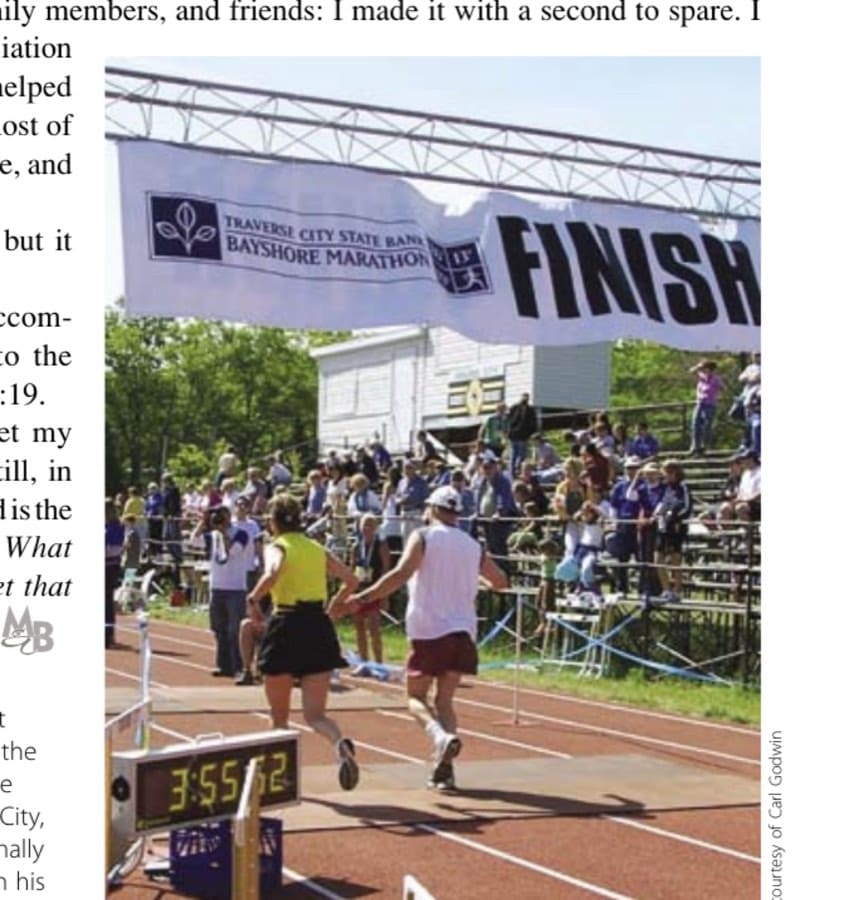
On May 26, 2007, it all came together for the author at the Bayshore Marathon in Traverse City, Michigan, when he finally got that sub-4:00 with his best marathon time of 3:54:54.
This article originally appeared in Marathon & Beyond, Vol. 14, No. 2 (2010).
← Browse the full M&B ArchiveMore like this
1,000+ stories from 19 years of Marathon & Beyond
The complete archive of the legendary long-distance journal — digitized and free to read.
