

A FAT woman in hospital pants isn’t much of an anomaly in a Midwestern airport. But it was a unique experience for me, a normally slight and athletic girl, being that fat woman in hospital pants. A mere four days earlier I had stood at the starting line of my first 24-hour track race, the 1998 Arizona Road Racers’ Across the Years 24/48/72-hour track run.
Four days later—and 25 pounds heavier—I flew back home to Colorado and joked with my husband that I had skipped the race to hang out at an all-you-can-eat buffet. The real story took me longer to explain and much longer to understand. But it seemed a story worth understanding, for my own sake as well as that of others. That’s why, 10 months later, I’m still sifting through stacks of medical abstracts and articles, researching and writing about rhabdomyolysis (rab-dō-my-ō-lī-sis), an affliction that sounds like a species of dinosaur. I’m hoping that my experience might serve a higher purpose if I can share it with others.
MY RACE: A RECIPE FOR RHABDOMYOLYSIS
The race began on Tuesday, December 29, at 9:00 A.M. on what promised to be a clear, sunny day. I was feeling strong; I had just taken a three-week hiatus from running after a spate of heavy racing and training through the summer and fall. Always game for an adventure, I’d entered this race on a whim. The enticement of a warm vacation and the opportunity to run with and learn from my friend Barb Marquer, second-place finisher of the 1998 24-hour national championships, sounded too good to pass up.
Barb and I started together at a comfortable pace and settled in for the long day. Then, quite suddenly at around mile 15, I began to feel intense nausea. The evening before, in my nervousness over dehydration and loss of electrolytes, I had consumed nearly six bottles of Cytomax and Metabolol, energy drinks containing carbohydrates and electrolytes. The mixture swirled in my belly. A few sips of Ensure was all it took to make me expel the whole mess.
Several passing runners offered condolences and a kind of congratulatory encouragement: “Get rid of it all, Steph. You’re going to feel so much better!” And indeed I did. I began a period of effortless, joy-filled running that took me through about mile 60.
My coach helped me through the hottest part of the day (about 80 degrees), filling my baseball cap with ice cubes and draping me in ice-water-drenched shirts. Some time after mile 60, I began to slow. I discarded my Walkman, feeling the need to focus, and I took an ibuprofen. I found it difficult eating anything but orange slices, watermelon, and other wet foods. Running became an effort, and my coach’s role became primary. “You just finished your 100K,” he said, “now focus on 100 miles.”
I began to run three laps, then walk the fourth, later shifting to running the straights and walking the curves. I reached 100 miles in 17:14. Every couple of hours I would take an ibuprofen. By the end of the race I had taken a total of 12.
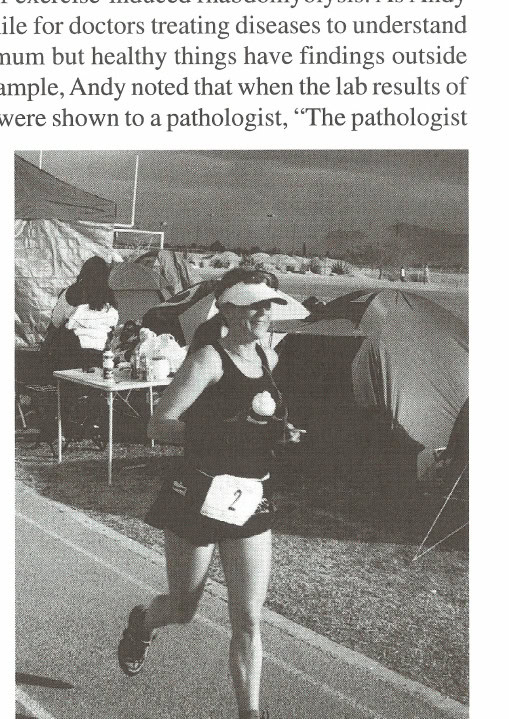
By mile 120 it was all I could do to keep running the straights. Every lap my coach would offer a word of encouragement or something to eat or drink. “Give me three good laps,” he’d say, “then take a rest lap.” At some point, a new person, who would become increasingly important to my well-being, entered the picture. “Hey, mind if I run a lap with you?” he said. “I’m Jordan.” Jordan Ross ran several laps with me, offering encouragement and bits of humor. I can’t remember much that he said, but I remember smiling—smiling at mile 122.
If the first 23 hours set the stage for the troubles to follow, the last hour was the coup de grace.
With the lure of 130 miles, I dipped deeply into my spiritual and physical wells and hammered out the final miles, running harder if not faster than any other time in the race. On December 30th, 9:00 A.M., the race was over. I had completed 128.99 miles in 24 hours, the fifth best in the world by a woman in 1998, and the seventh all-time best by a woman in the United States.
THE AFTERMATH
That should be the end of the story, but my true ordeal had really just begun. As I lay in the tent after the race, I felt overcome by nausea. I threw up something resembling thick, dark, water-logged mushrooms. I had not eaten any mushrooms. A hot flash quaked through my body. Something was wrong. And Jordan was back, like a guardian angel. More accurately, Jordan was an ultrarunning, Mickey Mouse-loving, family physician and chair of osteopathic medicine at Midwestern University. He suspected that I had thrown up the sloughed-off lining between my stomach and esophagus. I could overhear some discussion about taking me to the hospital. I thought that might be a good idea, since I was pretty sure I was dying.
My coach accompanied me to the hospital. For many hours, we waited in the emergency room; I felt hot and nauseated, and all my muscles had frozen up. When the nurse finally arrived, she shoved a tube up my nose to pump my stomach. (About four hours had elapsed since the end of the race.) More tubes were inserted to collect urine, to deliver an IV and medication, and to take blood. In my blood, the doctors detected very high CPK (creatine phosphokinase), an enzyme indicative of the breakdown of skeletal muscle. A normal count is under 100, while a reading of 25,000 to 50,000 indicates a high danger of kidney failure. Mine was 35,000 (see page 54 for more on CPK).
The CPK figures and myoglobin detected in my urine led my Phoenix doctors to diagnose my condition as rhabdomyolysis, “an acute, sometimes fatal disease characterized by destruction of skeletal muscle.” The photocopied explanation given to me by the nurse continued: “Rarely, this [disease] may occur following strenuous exercise . . . renal damage manifested by acute tubular necrosis may result if myoglobinuria is accompanied with acute dehydration or anoxia (lack of oxygen).”
My treatment included several gallons of fluid (saline solution and bicarbonate) being pumped into my tissues via the blood stream—fluid that my kidneys were unable to process. And the result left me with about 25 extra water pounds on my 5’1″, 100-pound frame.
Two days later I was released from the hospital and picked up by a cheerful entourage that included Jordan and another ultrarunning physician/psychiatrist, Dr. Andy Lovy. They took me to Jordan’s house to decompress and then to the airport, where I waddled onto my flight back to Colorado.
A LACK OF MUSCLE
After about a week back in Boulder, I began to feel and look like myself again. Well, almost. “Hey, look at those stick legs,” my husband joked. Minus the water weight, my legs had completely lost their muscle definition, a result of the breakdown of skeletal muscle that had caused my problems in the first place. The only other negative effect I experienced was fatigue. For almost two months I slept between 10 and 14 hours each day.
How to make sense of what happened to me? On one hand, the medical staff in Phoenix had strongly emphasized the serious nature of my condition. “You could have died!” the nurse admonished when I repeatedly asked her when I
Pathology of CPK
INTENSE ATHLETIC endeavors performed over long periods without acclimatization to the conditions can have devastating effects. In July 1987, Eleanor Adams, then the premier female ultradistance runner in the world, was induced to team with a fellow Englishman, Kenneth Crutchlow, to take on an American team (Tom Crawford and Jean Ennis) on the 150-mile race from Badwater (in Death Valley, the lowest point in the Western Hemisphere and the hottest place on Earth) to Mt. Whitney (at 14,494 feet, the highest peak in the lower 48 states). Each of the four runners was to run the entire distance, both team members’ times to be added together, with lowest total times winning. Following the race, a doctor took blood samples from Eleanor Adams, who was unaccustomed to running in 120+ degree temperatures, and Tom Crawford, who was accustomed to running in such conditions. The following is from the book The Death Valley 300 (Specific Publications, 1991) by Richard Benyo:
A day before the post-race party, to be held at Crutchlow’s house in Santa Rosa, I spoke with Dr. Dan Weinberg about the results of the blood tests done on Crawford and Eleanor Adams. . . . “In terms of the lab tests I got on these people, I looked at a lot of different things,” he said. “In Eleanor in particular, she had a tremendous amount of muscle breakdown. One way we measure muscle breakdown is an enzyme called CPK. CPK is normally less than two hundred. Her CPK went up to 13,500. The highest CPK I’ve ever seen was in results from the Western States 100 where there was a case of CPK of forty-four thousand. So these people experienced a tremendous amount of muscle breakdown. The interesting thing is when you look at Eleanor’s CPK and compare it to Tom’s, which was only 961. It really was a remarkable difference. I had them draw my own blood after the race.” He had accompanied Adams from Whitney Portal to the summit and back. “And it was a hundred and twenty-four. Her liver enzymes were well elevated. Also, her bilirubin, which is a measurement of red-cell breakdown, was very high. She was almost jaundiced; her bilirubin was 3.5. She was not heat-acclimatized. It’s a very small group to compare, but when you compare her to Tom, there’s a remarkable difference. Tom’s bilirubin was 1.1, which is essentially normal. Their sodium, potassiums, chlorides were all normal. So we did a very good job of meeting their sodium requirements. What we gave them was a dilute electrolyte solution, roughly between 10 and 25 millequivalents per liter. . . . But to put Eleanor’s condition in perspective, when I got the tests back and showed them to a pathologist, he asked me if the blood sample had been taken from a cadaver.”
might be released. On the other hand, I had been reassured by Jordan and Andy, both experienced ultrarunners and physicians, that given my 24-hour effort, my resulting condition was not especially uncommon or unexpected. In a letter to me, Andy wrote, “CPK levels, rhabdomyolysis, etc. can be markers of serious pathology, renal shutdown, irreversible muscle damage, etc., but, when present in ultrarunners doing maximum performances, they may be a natural product of the effort, with nearly complete recovery in weeks and total recovery in months.”
Still, I didn’t want it to happen to me again. So, beginning with a list of medical abstracts and references sent to me by Andy, I launched into an investigation of rhabdomyolysis. I also sought the assistance of a Boulder nephrologist, Dr. Richard Halterman, who, in exchange for a pound of Jelly Bellies (not his usual hourly fee), shared his information and expertise. In reviewing my case, he identified several factors that might have contributed to my developing “rhabdo.”
WHAT IS RHABDOMYOLYSIS?
Rhabdomyolysis, simply stated, is a breakdown of skeletal muscle that results in the release of myoglobin, a protein stored in the muscle fibers. Once released into the blood, the myoglobin is carried to the kidneys, where it has a toxic effect on the renal tubules. The result can be kidney shutdown.
My doctors in Phoenix conducted several lab tests to determine my level of kidney function. This included tests for BUN (blood urea nitrogen) and creatinine. When the kidneys’ filtration ability decreases, BUN rises. Creatinine, a waste product that is supposed to be largely filtered out by the kidneys when detected in high levels in the blood, is a measure of kidney failure. While my CPK levels were high, suggesting rhabdomyolysis, my BUN and the level of creatinine detected in my blood were within normal range. I did not suffer from acute renal failure (ARF).
Rhabdomyolosis is normally seen in patients with multiple systems failure, such as heart conditions resulting from poorly controlled diabetes or emphysema, or in association with drug or alcohol abuse. It can also be caused by traumatic crush injuries, seizures, heat stroke, and infectious or metabolic disorders.
Exercise-induced rhabdomyolysis occurs primarily in sports like running, skating, and weightlifting, where repeated impact causes muscle damage. It does not occur, or rarely occurs, in nonweight-bearing activities such as cycling or swimming.1 According to Andy, Jordan, Dr. Halterman, and the journals I consulted, elevated CPK is common among participants in prolonged weight-bearing exercise, afflicting both casual and professional athletes. “Depending on the duration and intensity of the effort,” says Jordan, “some athletes can have levels in the tens of thousands and higher.” But high CPK does not always indicate rhabdomyolysis. “Rhabdomyolysis,” Jordan explains, “also requires sufficient muscle breakdown to result in myoglobin in the urine.” When I asked Dr. Halterman if it’s possible to have levels as high as 35,000 without myoglobin leakage, he said that it’s very unlikely.
There’s some suggestion that the incidence of rhabdomyolysis, in addition to high CPK (see page 54), is also quite common among endurance athletes, particularly in those who are undertrained. In one study, the blood myoglobin was measured for 337 military men who had just undergone six days of basic training. The results showed that 40 percent of these recruits had developed some level of rhabdomyolysis.2
RHABDOMYOLYSIS AND ACUTE KIDNEY FAILURE
The real danger of rhabdomyolysis is the possibility of kidney failure and the need for dialysis. The latter was described by a physician’s assistant, whom I met at a dinner party: “Trust me,” he said, “you do not want to go through this. It means getting hooked up to a machine for several hours three times a week. It’s pretty horrible.”
Acute renal failure (ARF) develops in approximately one-third of patients diagnosed with some form of rhabdomyolysis.3 There is compelling evidence, though, that relatively few cases of exercise-induced rhabdomyolysis lead to kidney failure. A 1993 study looked at the effect of strenuous exercise, including weightlifting and leg squats, on 35 male prisoners. Two to three days after exertion, the prisoners exhibited an average CPK level of 40,500 and a “pure” form of rhabdo, meaning that they had no complicating or underlying factors such as trauma, stroke, dehydration, acidified blood, or NSAIDs (nonsteroidal anti-inflammatory drugs). All of the subjects had creatinine and BUN levels within the normal range, and none of them developed ARF.4
Dr. Rick Halterman agrees that the incidence of ARF from exertion seems to be much smaller than from other causes. He says he has seen many cases of rhabdomyolysis, some that have resulted in renal failure and even death, but he has “never seen severe renal failure from exercise-induced rhabdo.”
Still, ARF as a result of exertion can and does happen. When I shared my experience at Across the Years with other ultrarunners via the Internet, I received an e-mail from Don Davis, a competitive, longtime ultrarunner from Pennsylvania. Don has written an excellent article on his own experience with ultrarunning and kidney failure.5 In 1994, Don was hospitalized for 11 days with ARF after winning a 100K in Toledo, Ohio. The day after the race he felt the usual muscle aches and stomach upset. Over the next two days he began to feel progressively worse with frequent bouts of vomiting. The following day he went to the hospital and was diagnosed with kidney failure. Like me, he gained 30 pounds of fluid weight, but the treatment did the trick. Fortunately, Don didn’t need dialysis.
CAUSES OF RHABDOMYOLYSIS
As ultrarunners, just doing what we do, repeatedly slamming one foot in front of the other, sets us up for trouble. “Every endurance runner’s CPK levels are elevated,” says Dr. Halterman, “though most not dangerously so. It’s part and parcel with your hobby.” The serious problems seem to arise when additional factors are introduced: dehydration and heat, an imbalance of electrolytes, a high level of intensity, pushing beyond the limits of your training, and the use of NSAIDs. Each of these factors, together or separately, has been implicated in producing rhabdomyolysis and kidney failure.
Dehydration, like high CPK, is inherent in the ultrarunner’s chosen activity, especially if the runner is pushing hard, as in a race. “When your body is working at maximum effort,” explains Dr. Halterman, “its ability to absorb water is slowed to a degree—like putting fluid through a funnel. If you put in enough, you throw it up. There’s no possible way to come out of prolonged strenuous activity fully hydrated.”
Dehydration is obviously exacerbated by heat. Heat also increases cell permeability, which enhances the risk of myoglobin leakage and therefore kidney failure. Body temperature resulting from hot temperatures has also been found to affect myoglobin levels. Researchers studying the performances of 25 triathletes found a direct correlation between postexercise body temperature and peak myoglobin levels, suggesting “that myoglobinemia may be associated with body temperature, even without overt clinical symptoms of heat stroke.”6
Dehydration can also lead to acidosis (the buildup of lactic acid in the blood). When the urine is acidic, a pH below 5.0, myoglobin becomes much less soluble and may accumulate on the renal tubules, increasing the risk of renal failure.7
Maintaining a proper balance of electrolytes (sodium, potassium, and magnesium) is essential during an ultra. As we run, we sweat out these electrolytes that keep our cells functioning properly. If we don’t replace them through sports drinks or food, we can become depleted. In particular, Andy Lovy recommends potassium supplements. He says that, “During Surgeres [a multiday ultra event in France], we gave potassium gluconate to many of the runners, and those who got it had fewer problems with hydration and fatigue than those who didn’t.”
Glossary
- acidosis/acidemia—condition in which blood pH falls below 7.35; increases the toxic effect of myoglobin on the kidneys.
- acute—having rapid onset, severe symptoms, and a short course; not chronic.
- acute renal failure (ARF)—a decrease or cessation of glomerular function, the kidney’s filtration system. In ARF, the kidneys abruptly stop working entirely or almost entirely. The first sign is an inability to urinate.
- creatine phosphokinase (CPK)—an indication of muscle damage. CPK is an enzyme found in multiple areas of the body, including skeletal muscle, the heart, and the brain. While high CPK levels can be an indication of muscle damage and rhabdomyolysis, by themselves they are not necessarily dangerous.
- dialysis—when kidneys are so impaired that they can’t excrete nitrogenous wastes, regulate pH, or maintain a balance of ions in the blood, the blood is cleaned mechanically through dialysis. The process separates small from large molecules by the difference in their rate of diffusion through a permeable membrane.
- diuresis—increased excretion of urine.
- hyponatremia—deficiency of sodium ions in the blood; can be caused by an overingestion of water.
- kidney—one of the paired organs, located in the lumbar region, that regulates the composition, volume, and pressure of blood and produces urine.
- myoglobin—a protein contained in the red blood cells of the muscles and released into the blood during muscle breakdown. The toxin is difficult for the kidneys to filter and has been implicated in acute renal failure. The presence of myoglobin in the blood is indicated by markedly elevated CPK, which is simultaneously leaked into the bloodstream.
- myoglobinemia—the presence of high levels of myoglobin in the blood.
- myoglobinuria—the presence of the muscle protein myoglobin in the urine.
- NSAIDs (nonsteroidal anti-inflammatory drugs)—includes aspirin, ibuprofen, Aleve, and other widely used therapeutic agents. Used to reduce inflammation and pain by inhibiting a key enzyme in prostaglandin synthesis. Despite their widespread use, they have been implicated, under certain circumstances, in renal dysfunction.
- nephrologist—kidney specialist.
- nephrotoxic—toxic to kidneys.
- prostaglandins—released in small quantities, they act as local hormones to perform a range of biological activities. They play a role in inflammation, promoting fever, and intensifying pain as well as in protecting the kidneys.
- rhabdomyolysis—an acute disorder characterized by the breakdown of skeletal muscle; occurs as a result of drug or alcohol abuse, crush injuries, constriction of blood vessels, seizures, heat stroke, infectious or metabolic disorders, or as a result of extreme athletic exertion. Exercise-induced rhabdomyolysis can result in myoglobinuria and is occasionally associated with ARF.
TOO MUCH DOWN TIME?
In reporting his experience with kidney failure, Don Davis suggests that a three-week layoff from running before his 100K race might have contributed to his kidney failure. I had had a similar three-week layoff and asked Dr. Halterman if he thought it was a factor. He didn’t think so, feeling that three weeks simply isn’t long enough for a well-trained athlete to become detrained to the point of developing rhabdo or ARF. There are certainly examples, such as the 35 prisoners mentioned earlier, of untrained individuals who exert themselves beyond their limits and pay with rhabdo. But there are as many instances of well-trained, elite athletes who have developed rhabdomyolysis. The researchers who conducted the study on the 35 prisoners concluded that “reports of exercise-induced rhabdomyolysis in professional athletes support our experience that neither the amount of exercise nor the level of training appears to be a reliable predictor for the development of rhabdo.”8
Nonetheless, whether in the well-trained or poorly trained athlete, damage occurs when he or she pushes beyond a certain limit. “The athlete whose competitive performance exceeds the energy expenditure to which he or she has trained will release myoglobin and so be predisposed to the risks of muscle injury.”9
What does seem to have a measurable effect is intensity. I believe I did the greatest amount of muscle damage during the last hour of my race. I ran hardest when my reserves were at their lowest. A study of 25 athletes in the 1982 Savannah Triathlon would bear this out. The study showed elevated myoglobin and CPK levels in all of the participants. When the myoglobin levels were compared to finishing times, “an inverse relationship between average myoglobin and finish times” was found.10 In other words, the fastest racers had the highest myoglobin levels. The fact that the slower racers were out there longer and had lower levels seems to indicate that the intensity of the effort is more important than the duration, though both are undoubtedly significant.
The well-documented role of NSAIDs in kidney failure is twofold. Not only do NSAIDs allow the athlete to push harder and for longer periods, thus increasing the destruction of skeletal muscle, but they also inhibit the ability of prostaglandins, hormones that normalize blood flow, to do their job of protecting the kidneys. “A dangerous amount can be very little,” believes Dr. Halterman. He describes the case of a fireman undertaking a training exercise in which he carried heavy equipment up and down stairs. When the fireman finished, exhausted and sore, he took two ibuprofen, which was all it took to send him into renal failure. “In my opinion,” says Halterman, “runners should never take NSAIDs during high levels of exertion.”
After the race, I was concerned that I might have a predisposition to rhabdo or high CPK. While Dr. Halterman thought that possibility unlikely, Tim Noakes, in an article about the effects of exercise on enzymatic activity “found a 50-fold difference in postrace CPK in healthy and equally trained athletes running the same 90K ultra.” This variability would indicate that some individuals, for whatever reason, are more likely to have elevated CPK levels than others. Among those who might be predisposed to higher levels, Noakes believes, are men and the untrained.11
Dr. Dana Devine, chair of pathology at Midwestern University, suggests that several congenital disorders exist that may predispose individuals to developing exercise-induced rhabdo. Among them are glycogen storage diseases that “result from deficiencies in enzymes required to turn muscle glycogen into glucose needed during exercise.” These disorders are extremely rare.
SYMPTOMS AND WARNING SIGNS OF RHABDOMYOLYSIS AND ARF
Rhabdomyolysis and kidney failure are difficult to predict. There are warning signs, but they are not clear cut. The medical journals I consulted put forth an array of symptoms: muscle pain, cramps, weakness, stiffness, confusion, pallor, and so on. How many ultrarunners have finished a long race without experiencing some if not all of those symptoms?
Rhabdo can also be asymptomatic. The primary symptom I felt after the race was extreme nausea. During the race, I experienced no symptoms beyond what one might expect to feel during an ultra.
A widely recognized indication of potential kidney failure is dark urine. But even that can be difficult to detect and/or misleading. It’s particularly difficult for women to determine the color of their urine when urinating outdoors, especially at night. Additionally, factors like dehydration or repetitive trauma to the kidneys from running can cause dark urine. “Hemoglobin as well as myoglobin,” says Jordan, “will turn urine a dark color.” Dr. Halterman makes the distinction between red and “Coca Cola- or coffee-colored urine.” The former usually indicates blood and the latter myoglobin. Both are toxic to the kidneys.
The inability to urinate within 24 hours after a long race might also be a possible prelude to kidney failure. In Lore of Running, Tim Noakes warns: “The wise athlete will recognize the seriousness of this sign and will immediately report to the nearest hospital that has a specialized unit for the treatment of kidney failure . . . otherwise [he] is likely to start feeling rather ill 36 to 48 hours after the race.”12
The delayed onset of symptoms is also described in the article on the exercise-induced rhabdo in the 35 prisoners. The authors describe a situation in which the athlete rehydrates and begins to feel better only to have the symptoms return with a vengeance in the next 12 to 24 hours. This lapse in time before getting treatment could mean the difference between uncomplicated rhabdomyolysis and kidney failure. The same article cites a study of two groups of patients with similar degrees of various forms of rhabdo. One group is treated within six hours, the other group after six hours. Both groups were treated with bicarbonate diuresis, which increases the solubility of myoglobin. In the first group none developed ARF. In the second group, they all did!13
HOW YOU CAN AVOID RHABDO
There are no guarantees, but with a few precautions ultrarunners can minimize their chances of developing rhabdo and/or ARF. Every medical professional I talked to emphasized the importance of hydration during and after a race. While runners may never be fully hydrated, they must try to be. Hydration should continue after the race with sports drinks, not water, in order to avoid hyponatremia, a deficiency of sodium in the blood that can be caused by ingesting too much water. Rehydration can decrease the risk of ARF.14
Always adapt your race strategy to the conditions of the race on any particular day: temperature, terrain, and your own physical state. Don’t push as hard if you’re not acclimatized to the conditions. If you’re a competitive athlete, push hardest in the middle of the race, when you’re warmed up, and not at the end, when your reserves are low and the likelihood of muscle damage is increased. If you have any of the symptoms or warning signs for rhabdo or kidney failure, or if you simply feel worse than you normally would after an ultra, seek treatment immediately—far better to get fat from intravenous fluids than to develop ARF. And, finally, carefully consider the potential peril of using NSAIDs during long runs.
LITTLE IS KNOWN
In researching this article, I was surprised how little we really know about rhabdomyolysis and ARF regarding ultrarunning and other forms of extreme athletic exertion. Much of the available information is speculative and is based on the study of disease rather than of health and pushing the boundaries of our understanding of health and longevity. As Dr. Halterman says, “You folks [ultrarunners] are really pushing the frontier in terms of what we know.” And, because it is nearly impossible for medical researchers to recreate the conditions of an ultra in a scientific lab, our races must serve as laboratories and we the guinea pigs.
Because so little is known, doctors are virtually obligated to treat ultrarunners with rhabdomyolysis as aggressively as they might a patient with a serious disease exhibiting similar symptoms. It’s the runner’s responsibility to educate the physician about the nature of exercise-induced rhabdomyolysis. As Andy Lovy has said, “It will take a while for doctors treating diseases to understand that healthy bodies doing maximum but healthy things have findings outside of the ‘normal’ range.” As an example, Andy noted that when the lab results of sodium in his blood after a race were shown to a pathologist, “The pathologist looked in wonder, and then said, ‘What did the autopsy show?'”
My story has sparked a lively philosophical debate among friends and other ultrarunners. One pole maintains that running is an essentially senseless endeavor and running yourself to serious injury is not only stupid but even unethical as taxpayers incur a portion of those hospital bills. The other pole supports the theory of risk and reward and the belief that running is a life-enhancing endeavor. As in all
ventures, an individual must take some risk to obtain the personal growth and enlightenment that it brings. While I don’t take what happened to me lightly, I’m firmly rooted in the second camp. As my husband says, “It’s too bad bodies don’t come with tachometers so you know when you’re hitting that redline!” But they don’t. Sometimes we just have to take a leap of faith, or a few hundred thousand shuffling steps, and hope we don’t blow a gasket in the process.
For me, ultrarunning is a microcosm of life itself: It contains the drama, the struggle, the joy, and the redemption that makes life worth living. It brings about the best in the human spirit. At Across the Years, I learned that it sure as hell isn’t a good way to lose weight!
REFERENCES
- Noakes, T. (1987). Effect of Exercise on Serum Enzyme Activities in Humans. Sports Medicine Journal, July-August; (4):245-267.
- Sinert, R., Kohl, L., Rainone, T., & Scalea, T. (1994). Exercise-Induced Rhabdomyolysis. Annals of Emergency Medicine (23):1301-1306.
- Communication with Dana Devine, DO, Chair of Pathology at Midwestern University.
- Sinert, R., Kohl, L., Rainone, T., & Scalea, T. (1994). Exercise-Induced Rhabdomyolysis. Annals of Emergency Medicine (23):1301-1306.
- Davis, D., (1995). “Kidney Failure and Ultrarunning.” <www.lehigh.edu/~dmd1/kidney/html>
- Thomas, B. & Motley, C. (1984). Myoglobinemia and Endurance Exercise: A Study of Twenty-Five Participants in a Triathlon Competition. The American Journal of Sports Medicine Vol. 2, No. 2.
- Sinert, R., Kohl, L., Rainone, T., & Scalea, T. (1994). Exercise-Induced Rhabdomyolysis. Annals of Emergency Medicine (23):1305.
- Ibid:1306.
- Thomas, B. & Motley, C. (1984). Myoglobinemia and Endurance Exercise: A Study of Twenty-Five Participants in a Triathlon Competition. The American Journal of Sports Medicine Vol. 2, No. 2: 116.
- Ibid: 114.
- Noakes, T. (1987). Effect of Exercise on Serum Enzyme Activities in Humans. Sports Medicine Journal, July-August; (4):245-267.
- Noakes, T. (1991). Lore of Running: Discover the Science and Spirit of Running, Champaign, IL: Leisure Press, pp. 690.
- Sinert, R., Kohl, L., Rainone, T., & Scalea, T. (1994). Exercise-Induced Rhabdomyolysis. Annals of Emergency Medicine (23):1301-1306.
- Seedat, Y., Aboo, N., Naicker, S., & Parsoo, I. (1989-1990). Acute Renal Failure in the “Comrades Marathon” Runners. Renal Failure 11 (4):209-212.
This article originally appeared in Marathon & Beyond, Vol. 4, No. 3 (2000).
← Browse the full M&B ArchiveMore like this
1,000+ stories from 19 years of Marathon & Beyond
The complete archive of the legendary long-distance journal — digitized and free to read.
