

The Day of the Amby
This is the fourth in an exclusive series of marathon memoirs by Johnny J. “The Younger” Kelley of Mystic, Connecticut. The other three articles by the 1957 Boston Marathon winner appeared in volume 1, issue 4 (“On the Littleton Road”); volume 2, issue 1 (“Graduation to the Marathon … Sort of”); and volume 3, issue 2 (“Learning to Run on the Wind”). Look for the next “chapter” in a future issue.—Editor
CRUISING HOMEWARD on the last full-team bus trip of our 1962 Fitch Senior High School (Groton, Connecticut) cross-country season, I snap to wakefulness as my paperback falls from my lap and lands with a plop on the floor. October’s Halloween light has already vanished, leaving none but that afforded by the charter bus’s weak overheads. I wonder why I keep thinking I will sugar over the fretful nut of responsibility by reading while tending a covey of teenagers.
Yet, these aren’t your standard barnyard flock. I’ve been blessed this time around. With less than a half-hour left to roll, I can rest assured that no happenstance Groton School Board member will be given the finger or otherwise disconcerted in the act of driving past this vehicle. Such indelicacies have occurred in past seasons, and they will occur again. I’d be naive to expect otherwise. But these kids have been better than easy. They’ve been good, both behaviorally and athletically. Loaded with talent and promise.
As I retrieve my book from the bus floor (The Dwarf by Par Lagerkvist), our squad’s star, junior Bob Beardslee, taps my shoulder. Bob’s runner-up finish in today’s “Class L” state meet has understandably elated him, and he’s up for a bit of raillery.
“Looks like pretty heavy stuff,” Bob says of my book.
“For sure, Bob, and pretty depressing stuff too, as far as I can tell,” I say.
“You always do seem to go for the depressing ones,” he observes.
“Hmmm, you could be right,” I allow, then change tack with, “So, what am I doing hanging out with you guys? You’re the life of the party.”
Off his finish today, Bob’s made the cut for next week’s Connecticut Open and, if he shines there, he’ll go on to the New England championship at Orono, Maine, the following week.
“Oh, we’re here to keep you smiling—and away from those depressing books,” Bob says with a warm chuckle.
He resumes his seat. I gaze idly at our stolid driver’s head and shoulders bathed in the dull red glow of the emergency light. Then, turning my head, I look out the window at phantasmagoric roadside images punctuated by door lamps and picture-window jack-o’-lanterns. So much for my plan to read. I slip The Dwarf into my teacher’s valise and snap it up tight. For these final minutes of our final team trip till next fall, it seems more fitting to reflect on the luck of this season’s draw.
I think of our tall, lean-as-a-runner manager, Brent Nowak, sitting in the seat across the aisle from mine. Brent, though born stone deaf, reads lips so well than he can “listen” better than his hearing peers. In all areas of school life, Brent excels. I can depend on him to bring every essential item aboard the bus for our school departure and to run an equally thorough check before okaying our departure from the meet site.
And there’s our captain, senior Dave Grainger, sitting alone in the seat behind Brent. As talented and committed as Dave is, he hasn’t realized his hopes for his third and last high school cross-country season. I see him wrapped in characteristic introspection, possibly pondering the irony of having led this winning combination (closed out 8-4 in dual meets) while cast into the shadows of Bob Beardslee and our surprising “junior rookie,” Ambrose Burfoot.
Bob has done everything he was scripted to do for two years straight, having come well advertised out of West Side Junior High where, among other feats, he built his own telescope and broke five minutes for the mile.
WHO THE HECK IS AMBROSE BURFOOT?
Ambrose Burfoot, who surely must rate Bob Beardslee’s stone-in-my-shoe award, has appeared in our midst almost as mysteriously and beneficially as the Biblical manna. Without him, this fun-loving, earnest, endearing 15-lad-strong contingent would have gone down as a sweet clutch of also-rans, the dim tail of Beardslee’s Comet. Out of nowhere, aimed at the stars, Ambrose has set his racing sights dead on Bob. So far he has beaten Bob only once (on one of Bob’s rare off days), but Bob knows better than to waste energy looking over his shoulder.
I recall that I learned of Ambrose’s running talent not from the boy himself, but from my teaching crony, Fitch’s baseball coach, Ray Portelance, who nailed me one day on our way out of the faculty lunchroom.
“Geez, Kel,” he said, “Do me one big favor.”
“For you, ol’ pal, anything,” I answered.
“For criminey’s sake, keep Ambrose Burfoot from going out for spring track.”
“Ambrose Burfoot? Who the heck is he?”
“You mean he hasn’t signed up yet? Well, he will. He’s been telling his friends he’s going to be a cross-country star,” Ray said.
“Well, so?”
“So this,” Ray said. “I got a line on the kid out of Little League. He looks like anything but an athlete. He’s thin and gangly, growing like a weed, wears glasses that make him look blind as a bat. But, incredibly, he’s a deadeye, pitches, plays third base like a pro, and bats around .400. So please, Kelley, if you love me, keep Ambrose Burfoot the hell out of track!”
Sure, Ray, I thought. I hadn’t even met the kid yet. How could I keep him out of track, which I had nothing to do with, anyway? Besides, with the number of candidates I’d inevitably shake down to, I’d be lucky to finish four runners in the points behind Bob. Why would I want to steer a hot prospect away from running?
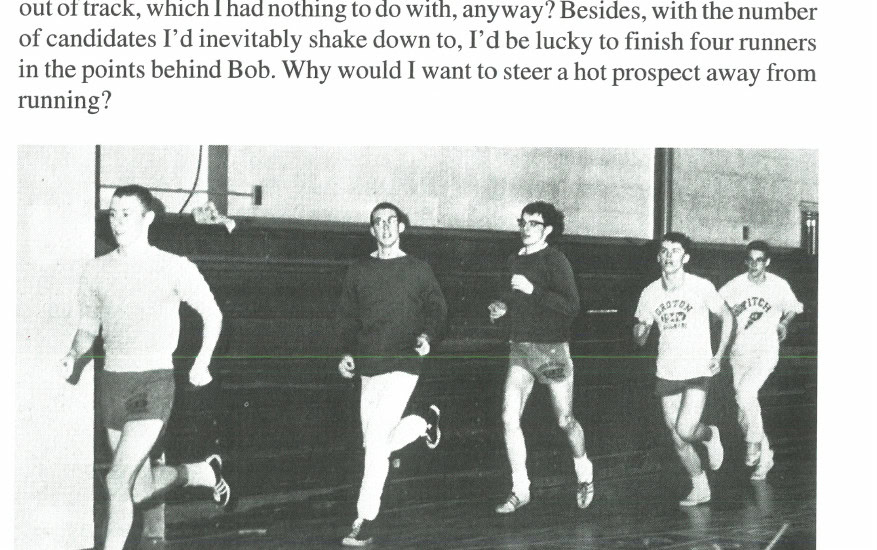
Or was Ray just ribbing me? Sure, that was it. A runner named Burfoot. Ambrose. I hadn’t met an Ambrose all century. I wouldn’t put it past these jock teachers to try to get under my skin. (“Hey, let’s bug Kelley about some made-up cross-country hopeful. You know he’ll take the bait!”) It was just too much. Here I was, teaching full-time while trying to keep my own selfish marathon thing going, and I’d let myself get snookered into coaching. I’d insisted on the term “advising,” to protect my so-called amateur status. “And only cross-country,” I said. I had been saying the same thing each fall since 1957.
Not that my extending association with the rising generation hadn’t already yielded a wealth of human interchanges, along with a few encounters unworthy of the old scrapbook. I had made a bunch of friends I was pretty confident I could count on through the years.
But, when you factored in all the unwanted nitty-gritty of public school teaching with inescapable husbanding and parenting responsibilities, you’d understand how a guy could feel crowded out of a private life.
MEETING AMBY
A couple of afternoons later, who should turn up in my doorway but the fictionalized character himself: Ambrose Burfoot. In the flesh. “Er . . . Mister Kelley?” the cornstalkish, bespectacled youth began, only to falter, as if he might pivot and run over the horizon.
I suddenly wanted desperately to block that possible move. And I felt strange in this impulse, because, at first glance, Ambrose looks to be anything but star stuff.
I dug out and handed him his sign-up forms, including the parent permission slip and our 1962 meet schedule. Then I tried breaking the ice by joking about Ray’s plea from two days before. The ice remained solid; Ambrose shrugged as if to loosen a tight collar.
“Nothing serious, heh-heh,” I hastened to add. “Just letting you know how I got wind of you.”
Ambrose’s stoic (or maybe just timid) countenance then changed into a sunny smile. “Mister Kelley, you can call me Amby, if you like.” He then pockets his papers and heads for the locker room and his first team cross-country workout. It didn’t take long for the old gang to dub their latest acquisition our “Junior Rookie.”
A few days later, I met Ambrose’s parents, Ambrose S. (“Big Amby”) Burfoot and his wife, Helga, who drove up to school just to tell me how happy they were that their eldest had gone out for cross-country. Big Amby is a squarish sports fan, exuding optimism; he was obviously pleased as punch to
see his son (whose physique so sharply contrasts his own) put himself to athletic use.
“So you will see, Mr. Kelley,” Helga said with a heavy German accent. “Little Amby is to become a really good, serious runner, one to make you proud.”
“Well, Captain Kelley, if you ever need any help with your home meets, call on me,” Big Amby said on the way out.
A welcome offer, but when the season’s busywork hit like a broken sack of potatoes, I failed to make the call. Undaunted, the elder Amby attended every meet. Meanwhile, young Amby digs into his pedestrianism with the efficiency and dispatch of a Mercury astronaut. Maybe it has to do with his height (nearly six feet) and weight (under 118 pounds). The kid runs without seeming to exert himself, deceptively fast for those mincing strides on stiltlike legs. He leaves the pretty boys gasping in his wake.
In fog or rain, he could use a pair of midget windshield wipers to clear his omnipresent specs. Yet he never misses grabbing the small place cards thrust at the runners by finish line volunteers.
When his race is over, he wastes no time getting into the shower and on home, usually in Big Amby’s Plymouth wagon, for supper followed by three hours hitting the books.
Yes, the crewcut kid is truly Mr. Dependable. Moreover, there’s only the most heartening feedback coming at me from his teachers. Lorraine Santangelo, who taught him last year, stops in the hallway to say how wonderful it is that
he runs as he does. While in her class he never failed to deliver assignments on time. “He’ll be a professional writer one day,” she prophesies.
So why, I wonder, as we roll through the final lap of this 1962 season, have I not come to know young Amby better? It’s now or never, time to make a sign. I ease myself out of my seat and walk gingerly rearward on the swaying bus until I reach the cubicle where an overhead light beams its inverted yellow cone onto a weighty book open on Ambrose Burfoot’s lap.
At my approach, the reader peers up, something like a surfacing snorkeler.
“Excuse me. What are you beguiling the tedious hour with, my friend?” I say.
“Oh, just this chem assignment. Say, Mr. Kelley, what do you know about valences?” Ambrose says.
“Next question, please!”
“Well, then, Coach, do you think we did okay today?”
“You all, and especially Bob and you, ran just great,” I say. “Imagine going there with one of the smallest teams in the state and coming out as you did. Just great.”
Now that the bridge seems to be in place, I want to say one more clinching thing. But all I manage is, “I’m sure looking forward to next fall.” Ambrose lowers his eyes as if to recover his place in the text. After a few seconds, though, he looks up, those studiously dispassionate eyes fixing on me.
“Oh yeah. I’ll eat ’em up next year,” he says.
POSTSCRIPT
The following fall saw Amby trading first-place finishes with Bob, as talented sophomore Dan Gaddis gamely pursued them. Fitch closed its 1963 dual meet season with eight wins, three losses, then sent its front-running duo to the New England meet at Burlington, Vermont, where Amby finished third and Bob sixth.
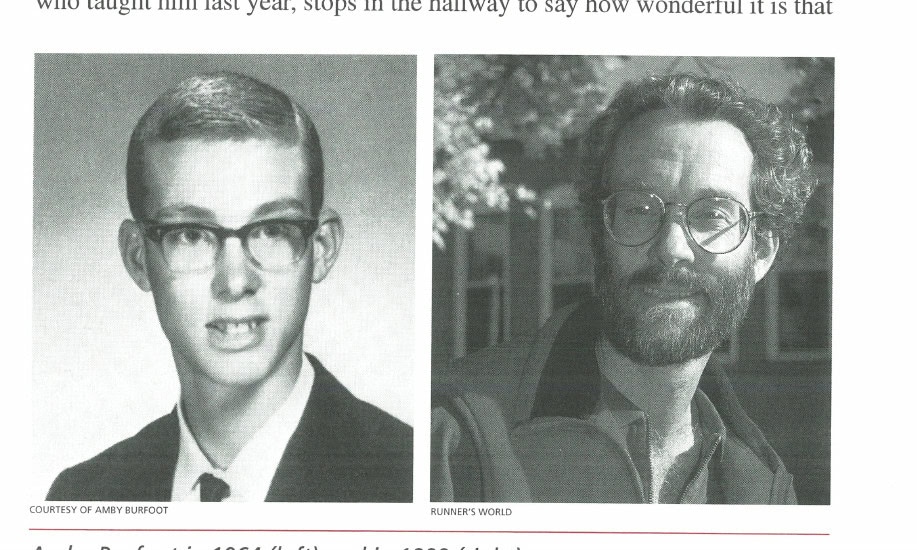
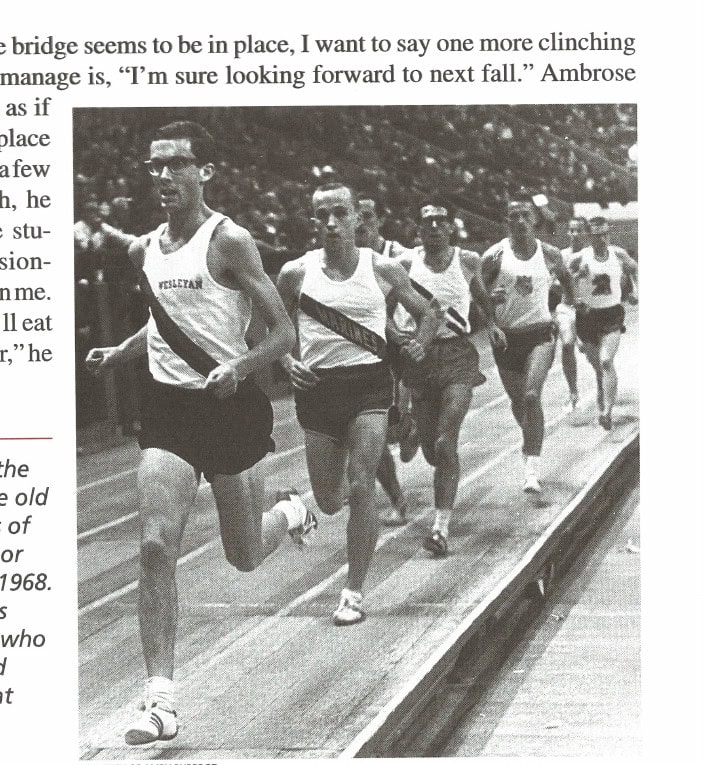
That year, Amby also won election to the National Honor Society. After graduating from Fitch, he entered Wesleyan University in Middletown, Connecticut (as did Bob Beardslee), continuing his cross-country and track careers under Coach Elmer Swanson. In November 1967, Amby won the IC4A college division cross-country individual title at Van Cortlandt Park, New York. In April 1968, two months before graduating from Wesleyan, he won the Boston Marathon in 2:22:17, the only American to win the classic race in the 1960s.
Amby returned to Groton, Connecticut, to teach at Mary Morrison Elementary School. He married, then left teaching to work as a Peace Corps volunteer in El Salvador. Following his Peace Corps service and a short stint as a book editor for a small New England publisher, Amby took a position as writer/editor of Runner’s World magazine. Today, Amby is RW‘s executive editor. He’s written three books about running.
This article originally appeared in Marathon & Beyond, Vol. 4, No. 3 (2000).
← Browse the full M&B Archive1,000+ stories from 19 years of Marathon & Beyond
The complete archive of the legendary long-distance journal — digitized and free to read.
