

“I
▲
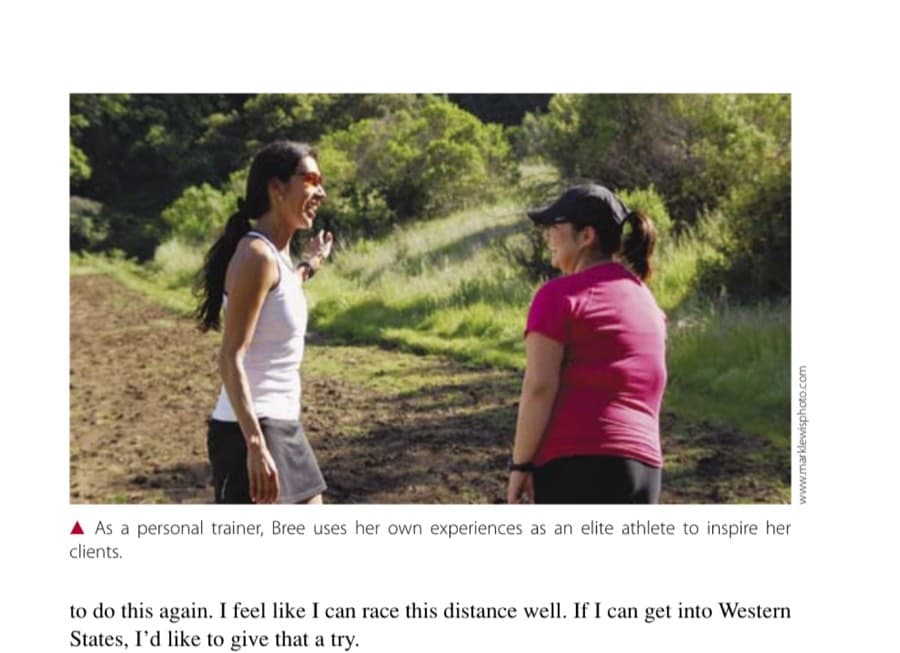
Athletics does not completely consume Bree, as she balances her competitive nature and the demands of endurance training with her personal training practice and her responsibilities as a mom.
www.marklewisphoto.com
found my talent for endurance events when my daughter was born,” said Bree Lambert. What was it about motherhood that started Bree toward her 2009 USA 100-Mile Trail Championships at the Tahoe Rim 100 race? Did becoming a mother give Bree insight into what is truly important in life? Was there new motivation to search for additional purpose in life? Did Bree want to be a role model for her daughter? “
Giving birth to Summer helped me discover that I had an unreal threshold of pain!” Bree said, laughing. How many USATF champions find their calling in the delivery room? Every month there is a new article about elite athletes scoring spectacular wins at major championships, offering up their stories and training secrets for readers. The problem is, who is listening? Other elites have their own coaches, and these stars already think they have the answers, or their coaching teams do. Most age groupers and recreational runners are properly skeptical that they can plug into a 150-mile-per-week training plan that won a marathon
major. So although it’s fun to read about how Ryan Hall or Deena Kastor or another superstar kicked butt, it’s just not clear what to do with the information. Bree Lambert’s story is different. Bree has elite credentials and a marquee title win after her USA Track and Field Championship in the 100-mile trail race. Yet unlike most championship athletes, Bree was not a star from the moment she laced up running shoes. Bree is a working mother and won her championship while balancing her elite training with her responsibilities as a mother and her job as a personal trainer. That’s a story that has a message no matter what your place in the running universe.
Flashdance, not flash on the track Bree ran cross-country in high school but says she was never a star. “What I wanted to do was dance,” she said. “Remember Jennifer Beal in Flashdance? That was who I wanted to be, not a runner!”
At San Jose State University, Bree ran casually for fitness while pursuing her BS in journalism and mass communications. A pro triathlete friend introduced Bree to cycling, “which I loved,” so Bree learned to swim and competed in a few triathlons. She ran her first marathon at Napa Valley in 1995 in a good-not-great time of 4:18. Distance running was fun, but Bree was not hooked yet.
After her daughter was born in 2000 and little Summer delivered the message about Bree’s pain threshold, Bree decided to compete in the Xterra off-road triathlon series. “I saw an Xterra event in Hawaii, and it looked like fun,” she said. “I wanted to come back and compete in Hawaii. To do that, I had to place in the top three in an Xterra championship race,” a competitive goal she had not given herself before.
Bree did qualify for the Worlds in Hawaii in her first Xterra season, having qualified in the 2001 national championship race in Lake Tahoe. In the 2001 Xterra World Championship, she also demonstrated her newly found ability to endure pain. After a nasty bike crash and a broken rib, she posted a DNF after the course medical crew pulled her off the course for her own safety; Bree herself was determined to finish. Not discouraged by her crash, Bree competed on the Xterra series for two more years, including finishing third in her age group for the Southwest Regional Series and fourth amateur female in the Lake Tahoe National Championship in 2002. Bree’s off-road triathlon career ended with a spectacular mountain-bike crash in 2003 while training on the Dogmeat Trail. Bree was airlifted off the mountain with a broken pelvis and collarbone. “I was told that was the end of racing off road,” Bree said, “and listening to my doctors, it was not clear I’d ever be an endurance athlete again.”
After Bree tried a few road triathlons (“looking for more,” she says), one of the owners of her local running store, Running Revolution, suggested that she
try a trail ultramarathon. She was introduced to Rob Evans, who eagerly agreed to pace her through her first ultra. “I had not run a marathon since Napa Valley,” Bree recalled. “This was my first ultra, so I read up on training for ultramarathons. I gave myself a goal of being in the top three in my age group and having fun.” She did more than have fun. With Rob pacing her in the December 2006 Woodside 50K, Bree won the women’s race and set a course record 4:41. Bree was hooked on ultramarathoning.
No junk miles Although she is self-coached, Bree has sought advice from many experienced ultrarunners she admires, including Rob Evans, Prudence L’Heureux, Rena Schumann, and Beverly Anderson-Abbs. She also has relied a lot on the book A Step Beyond: A Definitive Guide to Ultrarunning, edited by Don Allison. “But you can’t depend on any one source of information to work for you. Everyone you talk to thinks they have the one ultimate answer,” she laughs, reciting some of the running gospel that has been preached to her: • “
You have to run 100 miles every week—less than 80 is useless.” • “You have to run every day—or at least almost every day.” • “Back-to-back long runs—30 miles then 20 the next day—are the best.” Bree believes it is wrong to worship any one training system. A runner should not just pull down an online training program and follow that plan blindly or lock into a particular plan just because it is endorsed by one expert. Runners need to learn about their own bodies and understand what their bodies need, want, and can tolerate.
Even one of the most famous coaches to put together a running plan agrees. Jack Daniels, in Daniels’ Running Formula, says, “One of the greatest mistakes we can make . . . is to throw [runners] into a program currently used by a successful star athlete. If we do this, we are asking our runner to fit someone else’s mold. Different individuals need different training programs. It is silly to think that all [runners] should train the same because they are training for the same distance.”
Bree has some advice on how to continuously adapt a training program as the body provides feedback to the runner. She assumes that runners contemplating an ultramarathon should have some experience and some understanding already of what their bodies can take, and her advice can work with a runner’s self-knowledge. “
I don’t put together a long-term training plan. What I have is a season racing plan, with early-season races becoming my longer training runs.” Other than the
races she schedules, Bree does not plan a large number of particularly long workout runs. Her long training runs for the Tahoe Rim 100 are only a few miles more than the long runs called for in many marathon training plans.
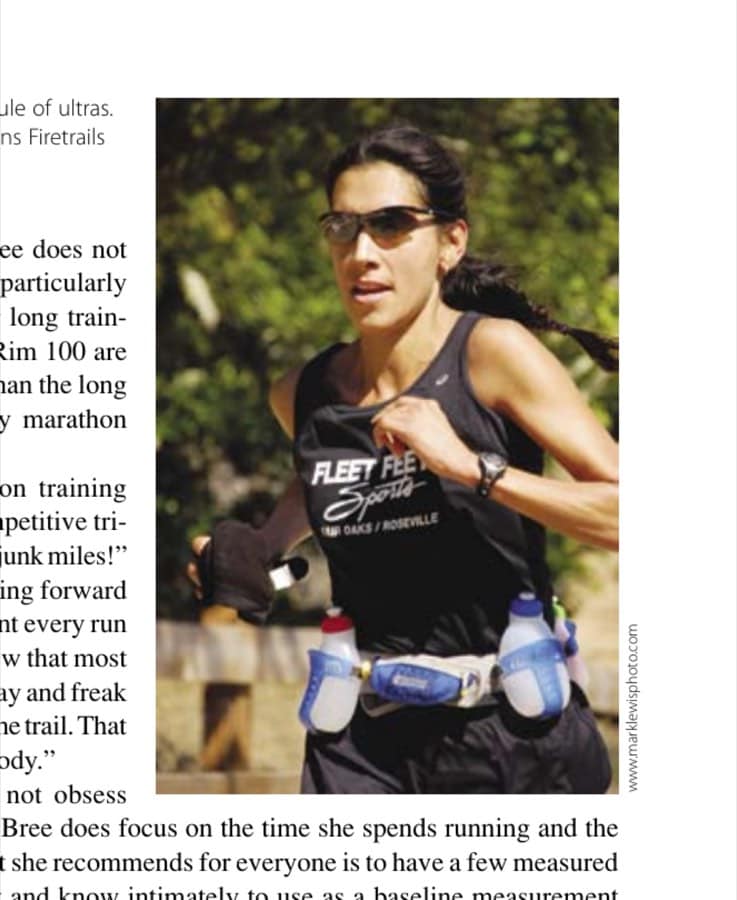
Bree’s philosophy on training mileage reflects her competitive triathlon background. “No junk miles!” she says forcefully, leaning forward to make her point. “I want every run to be a quality run. I know that most ultrarunners run every day and freak out if they miss a day on the trail. That does not work for my body.”
Although she does not obsess about training mileage, Bree does focus on the time she spends running and the quality of her runs. What she recommends for everyone is to have a few measured courses to run regularly and know intimately to use as a baseline measurement of current fitness. After running one of her own baseline runs, Bree will look at the time, check her heart rate, and make a subjective assessment of how hard the run was based on prior runs, how the run felt, how much salt was crusted on her face, and how much her body has recovered the next day.
What Bree does with this assessment of her run may be counterintuitive. “If I miss my usual time on a run I do often, I know my body is telling me something,” Bree says. “Why did I run poorly today? Why did I feel bad during today’s run? Was it nutrition, sleep, work—what was the cause? It’s after a bad workout where I can really geek out trying to figure out what happened. But my first guess is that I am overtraining and I need to back off on the mileage and effort right away.” She feels that this is a different attitude from many long-distance runners who feel that a missed target indicates a need to work harder. Bree feels that a poor workout or a slower run than usual is her body’s way of telling her to ease off.
A good workout is a sign to keep a heavy foot on the gas. “If I have a good workout, I look at my race calendar and see when I have my next race. If it’s soon, great. I am ready to race. If I have a while until a race, I keep pushing hard on my workouts.”
www.marklewisphoto.com
▲
Bree runs a heavy schedule of ultras. Here she is at the Dick Collins Firetrails 50.
Bree’s Season Plan for 2009 / USATF 100-Mile Championship Date
Race
Distance
Time (Pace)
Notes
March 14
Way Too Cool
50K
4:58 (9:36/mile)
20th place
April 19
Mount Diablo*
26.2M
50-mile race pace
Training run
May 9
Quicksilver
50M
8:04 (9:41/mile)
2nd
May 31
Ohlone
50K
6:10 (11:55/mile)
5th
June 7
Tahoe Rim**
27M
50-mile race pace
Training run
June 21
Tahoe Rim**
27M
50-mile race pace
Training run
July 18
Tahoe Rim
100M
23:42 (14:13/mile)
1st place
*Run on Mount Diablo 50-mile racecourse **Run on the first leg of the Tahoe Rim racecourse
At any distance, Bree has a valuable insight for self-coached runners using generic training plans. Many runners training alone will become locked into the tyranny of the season plan. A poor workout leads the runner to increase workload or drive to follow the plan, when the runner’s body may be asking for a break. Bree has learned to listen to what her body is telling her and has articulated a simple method that any runner can use to modify a training plan based upon workout results.
Elite marathoners, and even some recreational marathoners or age-groupers, will exceed the 60 to 80 training miles Bree runs each week. Bree gives herself plenty of rest, often running only four days per week. Her longest training run for an ultra, while longer than the 20- to 22-miler that most marathon programs advise, is not that much longer. Bree says that her longest training run will take her less than four hours. This might not seem like enough to prepare for a 100mile, 24-hour effort; however, this plan worked successfully for Bree.
Bree has not read Daniels’ Running Formula, but Bree and Dr. Daniels’s views on long runs are similar. Dr. Daniels works with Team In Training on its marathon program. In training TnT coaches, he is adamant about limiting premarathon training runs to two and a half hours, however far the runner can get in that amount of time. In contrast to many training plans, Dr. Daniels does not believe that a 20-mile long run is necessary before running a marathon. He feels that coaches and runners have locked into the 20-mile long run as a preliminary to a marathon for psychological, not physiological, reasons. While two and a half hours may be too short a time for a competitive ultramarathon runner’s long run, the point is the same: there is no reason to lock into a long run of a certain, fixed percentage of the race distance in training in order to prepare for the race itself.
To make his point, Dr. Daniels talks about a craze for 50-mile hikes in the 1960s. People—even elementary school classes—would just go and do these walks
A Couple of Average Weeks with Bree Monday Tuesday Typical Week
10 miles
Wednesday Thursday Friday Saturday Sunday Total
Bike ride 12 or weights
Hard 10 12 Week
Bike ride 13 25 Rest (two hours)
60 miles
Bike ride 15 8 25 10 (two hours)
80 miles
without training. In the same way, Dr. Daniels feels that a runner can go out and run a marathon without imposing a minimum long-run mileage. Both Bree and Dr. Daniels have a similar bottom line to their advice: don’t make the last long run the best day of the season. The best day, peak day, should be the day of the race.
Fueling the machine Bree’s approach to nutrition is straightforward. She had been vegan for 14 years, but as she started competing in the Xterra series, she wanted to add more strength. While her diet is still vegetable oriented, over the years Bree has added
ad
fish, poultry, and eggs. “It came down to a decision between my vegan goals Bree’s Fueling Plan and my athletic goals,” Bree says. “I for Tahoe Rim realized that I could be a really good athlete, and being an athlete was more Brought herself: important to me.” 21 electrolyte capsules (S Caps)
She does add supplements to her 17 gels (GU and e-Gel) diet. “I am intentional about dietary 2 bars (Mojo, Zone) supplements, vitamins, amino acids. 2 PB&J sandwiches The majority of the ultrarunners I talk to 60 ounces Hammer Perpetuem don’t use many supplements,” she says. She feels that because of the stress of Amino Vital Endurance throughout the race ultrarunning, supplements are important to the repair and strengthening process From aid stations: in her body. Other than supplements,
Half a turkey-and-cheese though, Bree believes healthy eating is sandwich enough: eating foods in simple, basic, 1 cup chicken noodle soup natural states as much as possible, drink1 cup creamy tomato soup ing very little alcohol, and staying away from processed foods that could impair her body’s performance.
Race-day nutrition is a different story for Bree. “I can obsess about planning my race-day nutrition,” she says, as she talks about how she calculates exactly how many calories she will need for a race and how and when to get these calories into her body. While Bree does detailed planning over her race-day fueling, she also believes that simple foods are best. She relies heavily on gels as her primary source of fuel, even for a 100-mile race, together with electrolyte drinks and electrolyte capsules. She will take a peanut butter and jelly sandwich and soup from the aid stations, but that’s about it. Bree prefers to be self-sufficient during the race.
She believes that much of the gastric distress that ultraracers encounter comes from the meatball sandwiches, pizza, beans, and other food offered at the aid-station buffets, even though many experienced runners have told her how important it is to eat solid food during a long race. “I think it’s hilarious what people can eat,” Bree says. “I was several hours into a race with a friend when we were coming into an aid station. He told me that he did not use a drop bag because it took too much time to find his bag. So while I was looking for my bag, in four minutes he just mowed through whatever food he found appealing on the aid tables. I think it’s risky for a runner’s stomach to work so hard digesting food and drawing blood away from the rest of the body during a race. Eating like this works for many people, but I think it is hilarious to watch these runners eat!”
www.marklewisphoto.com
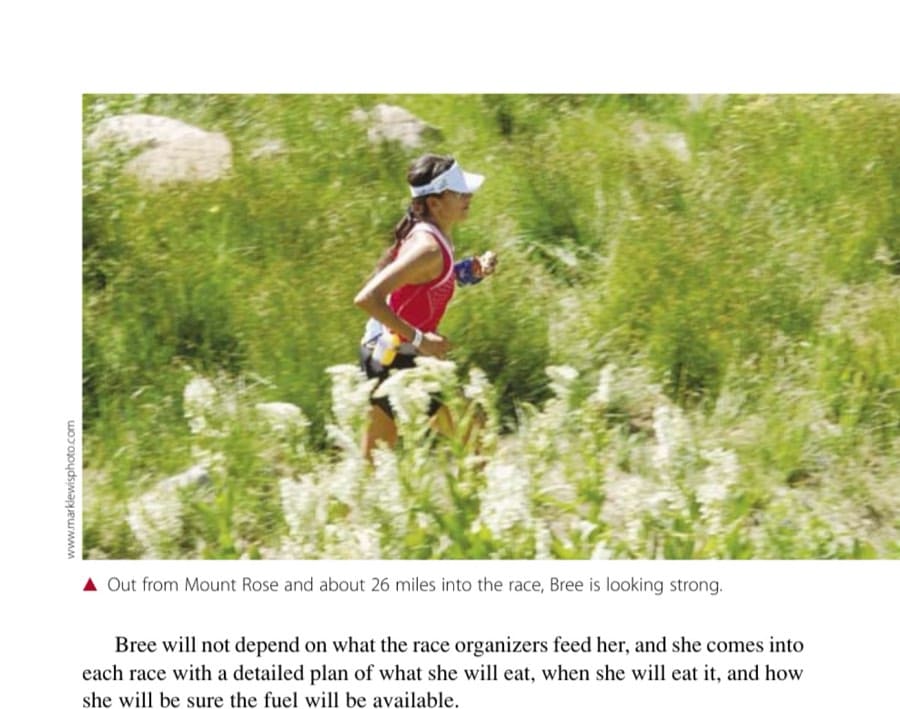
▲ Out from Mount Rose and about 26 miles into the race, Bree is looking strong.
Bree will not depend on what the race organizers feed her, and she comes into each race with a detailed plan of what she will eat, when she will eat it, and how she will be sure the fuel will be available.
Race day After a three-week taper, Bree was ready to go on Tahoe Rim race day. “This is going to be far,” was the thought in her head at the starting line. In contrast to her meticulous fueling plan, Bree’s pacing plan was simple: don’t
go out too fast. At Tahoe Rim, Bree’s first major target was to come through the 27-mile checkpoint in 5:15 to 5:30 to be on track to break 24 hours. She tried to run conservatively and came through 50 miles in about 10 hours, which she felt
was still too fast. Nevertheless, Bree finished in 23:42, good enough to win the USATF 100-Mile Trail Championships by more than a half hour. “You have to feel like you are doing all the things you should be doing,” Bree
said, recalling what she was thinking during her day out on the trail. “I’ve done this training, I know how to fuel my body, and I know what to do. Now I have to have the will to do it.” Bree says she was half surprised at how well she felt during the race. “I expected
to cramp, feel nauseous, maybe vomit. I was surprised that I did not experience any of that and that I was able to be alert and present the whole race. Not to say I did not suffer and moan and groan. But I did love the experience, and I want
www.marklewisphoto.com
▲ As a personal trainer, Bree uses her own experiences as an elite athlete to inspire her clients.
to do this again. I feel like I can race this distance well. If I can get into Western States, I’d like to give that a try. “Seeing my name on the USA Track and Field Web site as a champion was an unreal, out-of-body experience,” she concluded. Bree will need to get used to that experience. Elite, ultramarathon trail running is a small community. Runners know who is coming and can anticipate who their competition will be at each race. In her first try at the 100-mile distance, Bree probably surprised most of the competitors. Now, Bree is “that girl”—as in, “Oh, hell, did you see that girl is running here today?”
Epilogue Bree’s day job is as a personal trainer, and her clients are mostly ordinary people— nonathletes—who are simply trying to get in better shape. Watching Bree work with her clients is a treat. Bree’s training philosophy for her clients is like her philosophy for winning her USA championship—keep your strategy simple, be smart and thoughtful, work hard, and pay attention to detail. Imagine the USA 100-mile champion helping you get off the couch and get fit and for the champion to coach you with same techniques she uses to coach herself.
Listening to your body, preparing to endure pain, and keeping things simple are good lessons for all self-coached athletes to learn—or relearn! These lessons took Bree to a championship.

This article originally appeared in Marathon & Beyond, Vol. 14, No. 4 (2010).
← Browse the full M&B ArchiveMore like this
1,000+ stories from 19 years of Marathon & Beyond
The complete archive of the legendary long-distance journal — digitized and free to read.
