

Courage and Endurance
On October 4, 1931, officer John Salo of the Passaic, New Jersey, police department was killed in the line of duty, leaving a widow, two children, and a town in mourning.1 Just two years before, he had returned as the town’s hero after winning a 3,600-mile footrace from New York to Los Angeles, the second transcontinental “Bunion Derby” in history.2
He had battled Peter Gavuzzi of England across the muddy and dusty roads of 1929 America to win the race by 2 minutes, 47 seconds, in what one reporter called “the most exciting finish in the history of foot racing.”3 In later years, with Salo long dead, Gavuzzi claimed that he intentionally “kept things close” to ensure an exciting finish and forever hung a cloud over this historic race.4
GAVUZZI
Peter Gavuzzi was born in Liverpool, England, in 1906 to a French mother and an Italian father. This unique pedigree produced an exceptional man—one who “spoke with a Liverpool accent, moved with Italian gestures, and lived with French passions.”5 In his early years he worked as a steward on passenger ships before he entered the first transcontinental Bunion Derby from Los Angeles to New York in 1928, the reverse direction of the 1929 course.
Before the derby he was an unknown entity but quickly showed himself to have a “fearless appetite for competition.”6 After more than 2,600 miles of racing over the most difficult terrain imaginable, he led the eventual derby winner, Andy Payne of Oklahoma, by six hours before an infected tooth forced him to withdraw from the race.7
SALO
His rival, John Salo, was born in Finland in 1893 and immigrated to America when he was 15 years old.
In 1917 he married another Finn, Amalia Huovila, before serving on American merchant ships during the First World War. He made 10 perilous Atlantic crossings through submarine-infested waters and rose to the rank of ensign by war’s end. He eventually settled in Passaic, New Jersey, where he captained riverboats on the Hudson River.8
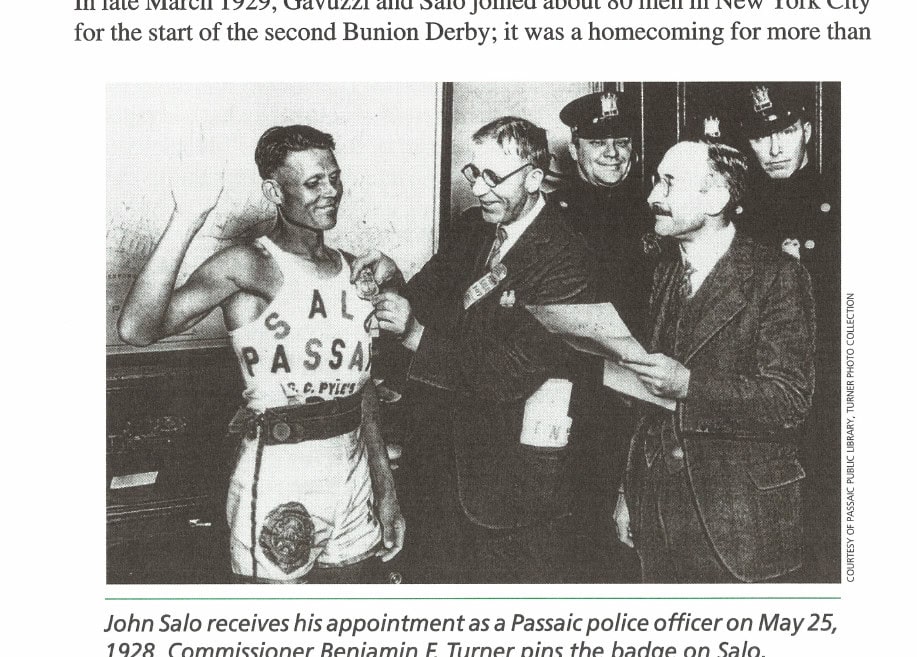
Salo began his running career late in life, at age 32, and practiced by running around the decks of his boats.9 In the 1928 derby he was another unheralded entry, who hit his stride in the last third of the race, winning 14 of the last 27 daily stage races.10 On May 25, 1928, Salo led the Derby into his hometown on his birthday, where he was greeted as a returning hero and appointed to the Passaic city police department. The newly christened “flying cop from Passaic” went on to finish the race in second place and earned $10,000 for his efforts.11
REUNION
In late March 1929, Gavuzzi and Salo joined about 80 men in New York City for the start of the second Bunion Derby; it was a homecoming for more than a third of the men, who had been baptized into transcontinental racing in 1928.12 They included such veterans as Phillip Granville, the giant cigar-smoking racewalker from Hamilton, Ontario; Guisto Umek, a champion walker from Italy; Arthur Newton, South Africa’s 100-mile running star; and Ed “Sheik” Gardner (see Marathon & Beyond, July/August 2001), an African American runner from Seattle who braved insults and death threats to finish in eighth place in his run across America.13
The New York press put its money on Salo to win the second edition of the derby after Andy Payne, the previous year’s winner, declined to enter the race.14
Tough race veterans such as Gardner and Gavuzzi and a bevy of untested newcomers waited to challenge that assumption on a 3,600-mile course that headed southwest across the United States in ladder steps: south to Baltimore, then west along what is now Interstate Highway 70 (in those days Highway 50) to St. Louis, then south again to Dallas, before heading west for a final 1,700-mile push across the broad expanse of the American West to Los Angeles.15
The “bunioneers” would race under a simple set of rules: start as a group in the morning, cover a preset distance on foot from one town to the next, and cross the finish line before midnight. At each night’s “control station” a race official would record each man’s time and add it to his cumulative total.16 The 15 men with the lowest totals in Los Angeles would get a share of the $60,000 in prize money, with the first-place finisher receiving $25,000—in 1929 dollars a figurative pot of “gold at the end of the transcontinental rainbow.”17
C. C. PYLE AND THE 1928 DERBY
The man leading this “parade” was Charles C. Pyle, a sports promoter long on vision but seriously short on management skills. In 1928, at the request of a group of businessmen trying to publicize the newly opened U.S. Highway Route 66, he agreed to organize a footrace across Route 66’s 2,600-mile length from Los Angeles to Chicago, then push east to finish in New York City.18
For an entry fee of $125, Pyle promised to feed and house any man who wanted to enter the derby. On March 4, 1928, 199 assorted individuals took Pyle up on his offer as his eccentric caravan left Los Angeles, complete with a carnival sideshow and a troupe of “artistic female dancers” for an 84-day trek across America.19 In late May the nearly bankrupt derby limped into New York City and finished in front of the smallest crowd in the history of Madison Square Garden. Pyle was rumored to have lost $100,000 on the race.20
For the 1929 edition, C.C. attempted to avoid losses in part by requiring the entrants to provide their own food and lodging along the route, an expense of upwards of $2,000, or about $20,000 in current value.
For all but the “well-heeled” this meant finding financial backers to support a race team, which typically consisted of a trainer or two and a supply-laden support vehicle. Salo used his 1928 winnings to fund his own team, taking a local track star from Passaic along as his trainer, and his wife, Amalia, as his cook and second trainer. Gavuzzi apparently received funds from a “backer in St. Louis,” but for the novices without reputation or wealth Pyle’s edict must have been a deathblow to their dreams of transcontinental glory. In 1928 men such as these started in the shadows but came to dominate the derby results and gave it its soul. For 1929 it was a different affair. The second edition of the derby belonged to the veterans, not to the unknowns.21
THE GREAT 1929 PARADE
A presumably wiser Pyle began the 1929 Bunion Derby on a pleasant Easter Sunday afternoon in New York City. With banners and flags flying, he planned an elaborate opening ceremony that quickly unraveled as thousands of curious spectators jammed the start area and brought traffic to a halt. Prodded by irate policemen, C.C. abandoned his plans and sent his men to battle their way through half a million cheering fans, onward to Elizabeth, New Jersey, 25 miles and a ferry ride away.22 Pyle followed in his customized “land yacht” with his traveling vaudeville company and caravan of supply cars in tow.23
Ed “Sheik” Gardner beat the New Yorker and 1928 veteran Sam Richman by 25 yards to take the first stage race of the derby.24 Salo and Gavuzzi finished far behind the leaders, but over the next few days they found their “running legs” and together with Gardner established themselves as front-runners as the derby reached Baltimore after six days of racing.25
The “bunioneers” then headed west into the rolling foothills of the Appalachian Mountains where temperatures reached into the 90s.26 Two days later Salo and Gardner “staged a bitter duel” over steep hills and in oppressive heat to Hancock, Maryland, before the Sheik pulled away to win. The effort left him exhausted, with “his black skin gleaming in the sunlight as perspiration soaked his body.”27
Then it began to rain, turning the dirt roads to mud and forcing Pyle’s men to slip and slosh their way through the mountains, especially on a winding 52-mile road to Wheeling, West Virginia, where only seven men crossed the finish line after 11 hours of running.28
By the time the derby cleared the mountains, an epidemic of shin splints, knee injuries, and pulled tendons had cut the field to 34 weary and leg-sore men. John Salo seemed poised to join their ranks when he became ill and struggled to stay with the front-runners.29 Of all the men, tiny 118-pound Peter Gavuzzi showed himself to have a giant’s heart, winning five stage races in a row and
moving into first place in the cumulative standings. He celebrated by “calling for his pipe” and smoking his favorite tobacco.30
SALO’S CHARGE
By the 16th day of the race Salo was more than six hours behind Gavuzzi before he rallied to take the next four stage races, which averaged about 47 miles each.31 In a 35-mile race to Indianapolis he paced his two rivals for 20 miles until he “stepped away” to win, and several days later he pushed Gardner out of second place in the cumulative standings.32 Gavuzzi proved to be a more stubborn opponent and “dogged the New Jersey cop’s heels” across the flat farmlands of Indiana and Illinois under a warming spring sun.33
With Salo surging, Gardner found himself fighting to stay with the front-runners as the derby crossed the Mississippi River and met cold headwinds and heavy rain.34 Over muddy Missouri roads Gardner pushed too hard, reinjured a tendon, and made a desperate weeklong attempt to stay in the race. Ignoring the pleas of his trainer he fought on to Muskogee, Oklahoma, before ending his brilliant monthlong duel with Gavuzzi and Salo.35
With the Sheik’s departure the derby headed south to Texas, where Mother Nature sporadically pelted Pyle’s men with torrential rains or baked them under a broiling sun.36
On the second day in Texas, Salo charged at Gavuzzi over red clay roads on a 79.9-mile course to Dallas. He won it in 11 hours and 22 minutes and sliced almost an hour off Gavuzzi’s lead.37
Salo continued his assault across the plains of west Texas, splashing through the mud and rain, to win four of the next five stage races and passing Gavuzzi at Big Springs, once a favorite resting place for the ’49ers as they headed west to the goldfields of California.38 On these muddy roads Pyle’s land yacht crashed outside of Abilene. Pyle broke his arm in two places and spent the remainder of the trip with most of his upper body encased in plaster.39
While Pyle concentrated on healing, Gavuzzi put together a campaign to recapture the lead near the Texas/New Mexico border where he won a 30-mile race to El Paso at sub-3:00 marathon pace.40 “The bewhiskered Italian” regained the cumulative lead just two days later after winning a 63-mile stage run to Deming, New Mexico, near the northern edge of the Chihuahua Desert.41 The pace of their duel was much faster than anything seen in 1928, when Andy Payne won the derby while rarely running faster than a 9:00-per-mile pace. In this derby the two front-runners pushed each other into the 7- to 8-minute range for days on end, taking transcontinental racing to a new level and leaving the rest of the field hours behind them.42
WEST TO L.A.
At Deming 20 men rested in “desert country” after more than 2,600 miles and 61 days of racing. They had become a brotherhood of iron men, forged on mountain slopes and in prairie mud and desert heat. Dreams of Pyle’s “pot of gold” had faded long ago for most, replaced by an addiction to a grand adventure that pushed them west on the “long trail” to Los Angeles.43
The last thousand miles of the race began with the oldest man in the derby, 55-year-old Australian Herbert Hedeman, winning a 64-mile stage to Lordsburg, New Mexico, in 8 hours and 27 minutes.44 From then on Salo and Gavuzzi fought a bitter battle over hot dusty roads and “long grinding hills,” with the lead swaying back and forth almost daily.45
On occasion they called a temporary truce and finished together in the pack, allowing Guisto Umek and Sam Richman to trade stage victories in their battle for the $6,000 third-place prize.46
As they entered the scorching Sonora Desert, Salo went on a final “rampage” to cement his hold on first place. Running under a “broiling desert sun” and setting “a terrific pace over hot roads,” he won three stage races at a pace of roughly 7:30 per mile and opened up an hour and a half lead—the biggest in the derby—over Gavuzzi.47 But Salo pushed too hard, suffered crippling stomach cramps, “dropped far to the rear,” and watched his hard-earned lead melt away in the desert heat.48 By the time Pyle’s sunbaked nomads staggered to the California border after 73 days and 3,258 miles of racing, Gavuzzi held a 55-minute lead over his ailing New Jersey challenger.49
DEATH ZONE
In California, Pyle had an unpleasant surprise for his exhausted men: he cut the remaining stage races from seven to five, thereby increasing the daily mileage to about 64 miles, 20 more than a typical stage run.50 This torturous new schedule allowed Pyle to hold the final stage race in Los Angeles on Sunday, June 16, the day after the Los Angeles Times held its inaugural marathon race with America’s premier amateur distance runner, Clarence DeMar, as its star entry.51
Hoping to offer Los Angeles a “weekend of racing excitement,” Pyle planned to stage his own marathon as a fitting end to the Gavuzzi/Salo duel.52 His unstated hope was that this event would attract enough paying fans to replenish his nearly empty coffers and to pay off his weary bunioneers.
On the first day of Pyle’s extended runs, the “flying cop from Passaic” showed once more the heart of a champion. He shook off his stomach cramps to win a grueling 58-mile stage run that took him on a 3,000-foot climb, from the desert floor into the mountains of Southern California. He slashed Gavuzzi’s lead to about 20 minutes.53 The next day the duo battled to a second-place tie, after a daunting 78-mile run to San Diego, with Guisto Umek finishing in first to “a tremendous cheer by the immense throng that jammed [city streets].”54 Salo halved his rival’s lead again after running the last 65- and 62-mile legs to Los Angeles.55 Of the two front-runners a reporter thought Salo was the fresher man at the end of the race; Gavuzzi, he said, “was plainly tuckered out.”56
AROUND A TRACK IN WRIGLEY PARK
The Los Angeles Times still put its money on the Anglo-Italian, believing him to be the faster and more graceful runner of the two.57 It proclaimed that “if Gavuzzi doesn’t win tonight’s wind-up over the marathon distance and thus become the 1929 distance champion, we’ll be very much surprised.”58 This prediction was put to the test when Pyle’s 19 men made “a four mile dash” from Saturday night’s control station to a track at Wrigley Park for a mind-numbing 131-lap marathon race.59
Gavuzzi’s final defense of his hold on the $25,000 prize got off to a rocky start. He later claimed that Pyle told him that the four-mile run was a warm-up for the marathon and that the official timing would start when the runners reached the track.60 Salo had a different understanding: he set off fast, leaving Gavuzzi far behind. Adding insult to injury, Gavuzzi ended up caught behind a passing train. None of the sportswriters who covered the Sunday race reported any irregularities or confusion with the four-mile run, so Gavuzzi’s later memories of the day’s events may have been exaggerated.61
When the Anglo-Italian arrived at Wrigley Park, he saw Salo tearing around the track and a race official waving him on to begin the marathon. By the time he entered the track Gavuzzi had already lost half of his lead, and he watched the remainder melt away under Salo’s “killing pace.”62 At the 20-mile mark in the marathon, he rallied and put on a “powerful sprint” but fell short by 2 minutes and 47 seconds in front of about 15,000 cheering fans.63 This finale brought an end to a 78-day odyssey, with the New Jersey policeman covering about 3,600 miles in slightly less than 526 hours of transcontinental racing.64
Over the next week Pyle tried to assure the press that the “boys will get their money,” but in the end he was forced to award promissory notes payable in six months.65 Facing $50,000 in lawsuits from creditors and unpaid staff, he never made good on his notes, leaving his embittered winners with worthless pieces of paper for their Herculean efforts.66
A LONG TIME TO REMEMBER
Gavuzzi, of all the men, felt the most betrayed. He wanted to protest the finish, but his friend Arthur Newton (who ran in the derby until he was hit by a car in Indiana) advised against it, fearing that he would “look like a sore loser.”67
After the derby Gavuzzi moved to Canada, where he scratched out a living in the Depression-era 1930s as a professional racer and as a marathon coach to such Boston Marathon stars as Walter Young and Gerard Cote of Quebec.68 He was in France during the German invasion in 1940 and spent the war years as an internee. He then returned to England and lived near Newton for many years.69
In the later years Gavuzzi cast a cloud over Salo’s victory by claiming that he had “kept things close” in the final days of the derby after Pyle warned him that his prize money depended on a “good gate at the finish.”70 Until his death in 1980 Gavuzzi kept Pyle’s promissory note with him, as a bitter memento from his days as a bunioneer, when he was twice denied “his fabulous purse.”71
John Salo returned to Passaic and occasionally ran in professional races such as the annual two-man, six-day races in Montreal. Two months before his death in 1931 he teamed with his old nemesis, Ed Gardner, to take 10th place in that event.72 In his obituary Salo was eulogized as a man who “brought more good will and good publicity to the City of Passaic than any other citizen the town had ever had.”73 In 1998 his name was inscribed in the National Law Enforcement Officers’ Memorial in Washington, D.C., through the efforts of the Passaic Police Department.74
IN THE END
Despite its controversial ending, Pyle’s 1929 Bunion Derby was an incredible endurance event, blessed with two talented and courageous men who pushed beyond the known limits of human endurance to the realm of the heroic. They battled many of the best endurance runners of their generation—Granville, Richman, Umek, Gardner, and Newton—and beat them over some of the most varied and challenging terrain on earth. Gavuzzi and Salo must rank as two of the greatest endurance runners of the 20th century for their performance in 1929; they possessed a God-given mix of natural speed, incredible endurance, and unfathomable grit to stay with each other on the “long trail to L.A.”
Their efforts caused a sea of change from the 1928 derby, when the press mocked Pyle’s ragtag troop as an aberration from legitimate sport when it limped into New York City.75 After the 1929 derby the press expressed its unabashed admiration for Gavuzzi and Salo’s duel and, by implication, transcontinental racing.76 This acceptance died in its infancy with Pyle’s bankruptcy and America’s downward spiral into the Great Depression.
Finally, Gavuzzi’s claim that he “held back” is impossible to prove and, far worse, is patently unfair to Salo, who matched the Anglo-Italian stride for stride across America.
Pyle died in 1939 and—to the best of my knowledge—shed no light on the subject.77 In the end Gavuzzi had 51 years to mull over the 1929 race and tell his version of the story. Salo had but two years and said nothing; his character and accomplishments speak for themselves across the ages.
ENDNOTES
- Peter Eichenbaum, “Passaic Hero to Get Long-Overdue Police Honors,” Herald and News (Passaic, New Jersey), 11 May 1998: B2, B4; Arthur G. McMahon, “Noted Runner-Policeman Felled While Pushing the Crowd from Ball Ground,” Daily News (Passaic, New Jersey), 5 October 1931: Front page, 2; Jouni Koskela, “Professional Runner John Salo was Born 100 Years Ago,” Raivaaja (Finland), 28 April 1993.
- McMahon, Daily News, 5 October 1931: Front page, 2; “Salo’s Final Spurt Wins Pyle’s Derby,” Chicago Tribune, 18 June 1929: sports section 29 (Chicago Tribune hereafter cited as CT; unless noted, all cited pages are from the sports section of the listed newspaper).
- “Salo’s Final Spurt,” CT, 18 June 1929: 29; “Pyle Harriers Smash Records,” Los Angeles Times, 2 June 1929: 2 (Los Angeles Times hereafter cited as LAT).
- Andrew Milroy to Charles Kastner, e-mail, 28 June 2001; Jim Shapiro, On The Road: The Marathon (New York: Crown Publishers, Inc., 1978): 131-2.
- Tom Derderian, Boston Marathon: The First Century of the World’s Premier Running Event (Champaign, Ill.: Human Kinetics, 1994): 156.
- Edward Burns, “Psychiatrist Needed; Pyle’s Hoofers Near,” CT, 2 May 1928: 23; Charles Kastner, “The Sheik of Seattle: Ed Gardner Had a Dream: To Win the 1928 Bunion Derby,” Marathon & Beyond, July/August 2001: 42, 45; David Blaikie, Boston: The Canadian Story (Internet edition: Ultramarathon World, 1999), Chapter: Dave Komonen.
- Kastner, Marathon & Beyond: 49.
- McMahon, Daily News, 5 October 1931: 2; Eichenbaum, Herald and News, 11 May 1998: B1.
- Koskela, Raivaaja, 28 April 1993.
- 1928 Time Sheet, Salo (cited time sheets developed from information in the Seattle Post Intelligencer, LAT, Seattle Times, Afro American, CT, Washington Post, and The New York Times); “Salo Lap Winner to Home Town; Passaic Welcomes Derby Star,” Seattle Post Intelligencer, 26 May 1928: 17 (Seattle Post Intelligencer hereafter cited as PI).
- Edward J. Neil, “Payne Wins First Prize, Salo Second,” PI, 27 May 1928: 17; Kastner, Marathon & Beyond: 50.
- Estimates of race starters vary from 101 to 76. “It was impossible to count the athletes, but Mr. Pyle said there were 101 . . .” Westbrook Pegler, “Laydess and Gentulmen! Mr. Pyle’s Big Derby Is On,” CT, 1 April 1929: 29; “The eighty-one assorted sizes of athletes,” “Gardner Wins Opening Dash,” LAT, 1 April 1929: 13; “a band of seventy-six sturdy athletes scampered away from Columbus Circle . . .” Arthur J. Daley, “76 Start Long Run; 500,000 Line Course,” The New York Times, 1 April 1929: 19 (The New York Times hereafter cited as NYT); “J. Cools of Belgium Leads in Coast Run,” NYT, 2 April 1929: 36; the estimate of 76 runners seems too low since two men who finished the derby were not listed as race starters in the NYT. This raises the number of known starters to 78. The LAT estimate of 81 seems realistic, though the paper did not list the starters; the estimate that more than a third of the entrants were 1928 derby veterans was derived from comparing all 1928 time sheets for men who ran part or all of the derby with the 78 known starters.
- Kastner, Marathon & Beyond: 42, 45, 48; Braven Dyer, “Runners Leave on Long Jaunt,” LAT, 4 March 1928: 2.
- “Run to the Coast Will Start Today,” NYT, 31 March 1929: 2; Pegler, CT, 1 April 1929: 29.
- Westbrook Pegler, “Pyle’s Troop Finishes Hike; And What For?” CT, 17 June 1929: 23.
- Pyle apparently applied his 1928 race rules to the 1929 derby; Kastner, Marathon & Beyond: 43.
- Daley, NYT, 1 April 1929: 19; “Runners at End of Rainbow to Seek Pyle’s Pot of Gold,” LAT, 28 May 1928: 11; “Pyle’s Harriers,” LAT, 2 June 1929: 2.
- Kastner, Marathon & Beyond: 43.
- Kastner, Marathon & Beyond: 49, 50.
- Daley, NYT, 1 April 1929: 19; “Pyle Pays; Is Poorer by $48,500,” LAT, 2 June 1928: 12.
- “Run to Coast,” NYT, 31 March 1929: 2; Bill Gibson, “Gardner, Granville Both Confident of $25,000 Plum,” Afro American, 13 April 1929: 21; Kastner, Marathon & Beyond:
42, 45; Braven Dyer, “Pyle to Pay Off Tuesday,” LAT, 23 June 1929: 5; McMahon, Daily News, 5 October 1931: Front page; Daley, NYT, 1 April 1929: 19; “Pyle Expects Great Finish,” LAT, 10 June 1929: 19; “What’s a Dollar Worth,” Federal Reserve Bank of Minneapolis, www.askjeeves.com.
22 LAT, 1 April 1929: 13.
23 Daley, NYT, 1 April 1929: 19; Westbrook Pegler, “Bunioneers in Toil of Law,” LAT, 2 April 1929: 1, 3.
24 Daley, NYT, 1 April 1929: 19.
25 1929 Time Sheet, Gardner; 1929 Time Sheet A, Gavuzzi; 1929 Time Sheet A, Salo.
26 “Salo Keeps the Lead in Cross Country Run,” NYT, 7 April 1929: 5.
27 “Cross Country Field Is Led by Gardner,” NYT, 8 April 1929: 30.
28 “Gavuzzi Wins Lap in Derby,” LAT, 12 April 1929: 11.
29 1929 Time Sheet A, Salo; “Salo First Runner to Reach Richmond from Springfield,” The Richmond Palladium (Richmond, Ind.), 16 April 1929: general news section, 1.
30 “Gavuzzi Cops Lap in Derby,” LAT, 14 April 1929: 2; “Gardner Ties with Gavuzzi,” LAT, 15 April 1929: 15; Kastner, Marathon & Beyond: 45.
31 1929 Time Sheet A, Salo; 1929 Time Sheet A, Gavuzzi.
32 “Salo Gains on Bunion Leader With Lap Win,” LAT, 19 April 1929: 4; “Salo Captures Lead to Hop into Second Spot,” LAT, 22 April 1929: 11, 12.
33 1929 Time Sheet A, Salo; 1929 Time Sheet A, Gavuzzi; “Salo Nabs Another Lap,” LAT, 20 April 1929: 11.
34 “Salo Cops Lap in Pyle Derby,” LAT, 26 April 1929: 4; 1929 Time Sheet, Gardner.
35 “Gardner Is Third; Leg Gives Trouble,” Afro American, 4 May 1929: 16; Bill Gibson, “The Passing Review,” Afro American, 11 May 1929: 14, 15; 1929 Time Sheet, Gardner; 1929 Time Sheet A, Gavuzzi.
36 “Simpson Wins Lap in Derby,” LAT, 10 May 1929: 2; “Granville Makes Gain by Finishing Second,” Globe and Mail (Toronto), 9 May 1929: 12; “Salo First to Reach Dallas,” LAT, 11 May 1929: 10.
37 “Salo First,” LAT, 11 May 1929: 10.
38 1929 Time Sheet A, Gavuzzi; “Richman First in Derby Lap,” LAT, 18 May 1929: 11; “Salo Annexes Lead in Derby,” LAT, 19 May 1929: 2; Leon C. Metz, Roadside History of Texas (Missoula, Mont.: Mountain Press Publishing Company, 1994): 426.
39 “Salo Increases Lead in Pyle’s Derby Parade,” LAT, 6 June 1929: 3; “Pyle’s Grind Ends Sunday,” LAT, 9 June 1929: 5.
40 1929 Time Sheet B, Gavuzzi.
41 Rob Rachowiecki, Lonely Planet: Southwest (Oakland, Calif.: Lonely Planet Publications, 1999): 901; “Gavuzzi Again Tops Runners,” LAT, 30 May 1929: 4.
42 1929 Time Sheet B, Gavuzzi; 1929 Time Sheet B, Salo; 1928 Time Sheet B, Payne.
43 1929 Time Sheet A, Gavuzzi; “Gavuzzi Again,” LAT, 30 May 1929: 4; “Pyle Harriers,” 2 June 1929: 2; “Simpson Wins Lap in Derby,” LAT, 1 June 1929: 11.
44 “Hedeman Sets Derby Record,” LAT, 31 May 1929: 3.
45 “Lead Changes Again in Pyle’s Bunion Derby,” Globe and Mail (Toronto), 5 June 1929: 9; 1929 Time Sheet A, Gavuzzi; 1929 Time Sheet A, Salo.
46 “Gavuzzi Gains Lead in Derby,” LAT, 4 June 1929: 22.
47 “Salo Increases,” LAT, 6 June 1929: 3; “Salo Adds to Lead in Bunion Derby,” LAT, 7 June 1929: 1; 1929 Time Sheet A, Gavuzzi; 1929 Time Sheets A & B, Salo.
48 “Pyle Expects,” LAT, 10 June 1929: 9.
49 1929 Time Sheet A, Gavuzzi; 1929 Time Sheet A.
50 “Salo Adds,” LAT, 7 June 1929: 1; “Run to the Coast,” NYT, 31 March 1929: 2.
51 “Pyle’s Grind,” LAT, 9 June 1929: 5.
52 “Pyle’s Grind,” LAT, 9 June 1929: 5.
53 “Salo Gains on Foe in Derby Lap,” LAT, 13 June 1929: 1, 4.
54 Braven Dyer, “Gavuzzi Holds Lead in Derby,” LAT, 14 June 1929: 1, 2.
55 Braven Dyer, “Derby Lap Won by Abramowitz,” LAT, 15 June 1929: 10; 1929 Time Sheet, Gavuzzi; 1929 Time Sheet, Salo.
56 Dyer, LAT, 15 June 1929: 10.
57 Braven Dyer, “Gavuzzi and Salo to Battle for First Prize,” LAT, 16 June 1929: 2.
58 Dyer, LAT, 16 June 1929: 2.
59 “John Salo Wins Pyle Footrace,” PI, 17 June 1929: 15.
60 Milroy to Kastner, 28 June 2001.
61 Milroy to Kastner, 28 June 2001; “Pyle to Try Marathon Again,” LAT, 18 June 1929: 1; “Salo’s Final,” CT, 18 June 1929: 29; “Second Bunion Derby Passes Into History,” Globe and Mail (Toronto), 18 June 1929: 10; “John Salo Wins,” PI, 17 June 1929: 15; “All Runners to Get Money, Pyle Tells Prosecutor,” PI, 18 June 1929: 15.
62 “John Salo Wins,” PI, 17 June 1929: 15.
63 “All Runners,” PI, 18 June 1929: 15.
64 The final mileage for the derby is listed as 3,635 miles in “Salo’s Final Spurt,” CT, 18 June 1929: 29, compared with 3,552.6 miles listed in the 1929 Time Sheet, derived from totaling daily mileage for the 78 stage races.
65 “Pyle to Try,” LAT, 18 June 1929: 1; Derderian, Boston Marathon: 156; Shapiro, On the Road: 132-3; Milroy to Kastner, 28 June 2001; McMahon, Daily News, 5 October 1931: Front page.
66 “C.C. Pyle, Promoter of Sports Events,” NYT, 4 February 1939: Obituaries, 1.
67 Milroy to Kastner, 28 June 2001; “Simpson Wins Lap in Run,” NYT, 21 April 1929: 7.
68 Derderian, Boston Marathon: 156-58; Milroy to Kastner, 28 June 2001; Blaikie, The Canadian Story, Chapter: Dave Komonen.
69 Milroy to Kastner, 28 June 2001.
70 Milroy to Kastner, 28 June 2001; Shapiro, On the Road: 131-2; Milroy to Kastner, e-mail, 24 June 2001.
71 Milroy to Kastner, 24 June 2001.
72 McMahon, Daily News, 5 October 1931: Front page.
73 McMahon, Daily News, 5 October 1931: Front page.
74 Eichenbaum, Herald and News, 11 May 1998: B4. See National Law Enforcement Officers’ Memorial Fund Web site at www.nleomf.com.
75 Westbrook Pegler, “Oklahoma High School Boy Cops $25,000 Plum,” LAT, 27 May 1928: 1.
76 “John Salo Wins,” PI, 17 June 1929: 15; “Pyle to Try Marathon Again,” LAT, 18 June 1929: 1.
77 “C.C. Pyle,” NYT, 4 February 1939: 1.
This article originally appeared in Marathon & Beyond, Vol. 6, No. 4 (2002).
← Browse the full M&B ArchiveMore like this
1,000+ stories from 19 years of Marathon & Beyond
The complete archive of the legendary long-distance journal — digitized and free to read.
