

The Team That Sticks Together . . .
THE SCENE was full of confusion and chaos. It seemed as if everything was quickly unraveling. We entered the checkpoint together, but then, like a July 4 rocket, we each split away to erupt with our own issues. We would need to pull ourselves together soon to be effective. It would be as difficult as reassembling an exploded rocket.
Dave trudged into the checkpoint last and went straight for the first-aid table in a desperate search for some sort of electrolyte replacement drink or supplement. “Do you have any salt, electrolytes—anything? I’m pretty depleted here.” Only blank stares. It appeared that the language barrier would prove more difficult than expected at the height of this crisis.
Safely away from the checkpoint commotion, Scott quietly sat down on a stone wall, an act he rarely performs in the heat of competition. His words expressed his condition. “My lower back is killing me and I’ve never seen so many concrete stairs in my life.”
Nate, keeping his thoughts to himself, slowly went about filling his water bottles. Up to this point he had kept the group rolling, passing in and out of the checkpoints in a timely manner, but now he was content to quietly pull up a piece of stone wall next to Scott.
Dave, after an incredible and hysterical display of nonverbal arm waving and funny gestures, found his much-needed salt tablets and began to munch on a digestive biscuit. This wonderful piece of shortbread, along with the salt tablets, seemed to help ease his queasiness. Scott and Nate sat and stared blankly down the trail along which we had to continue.
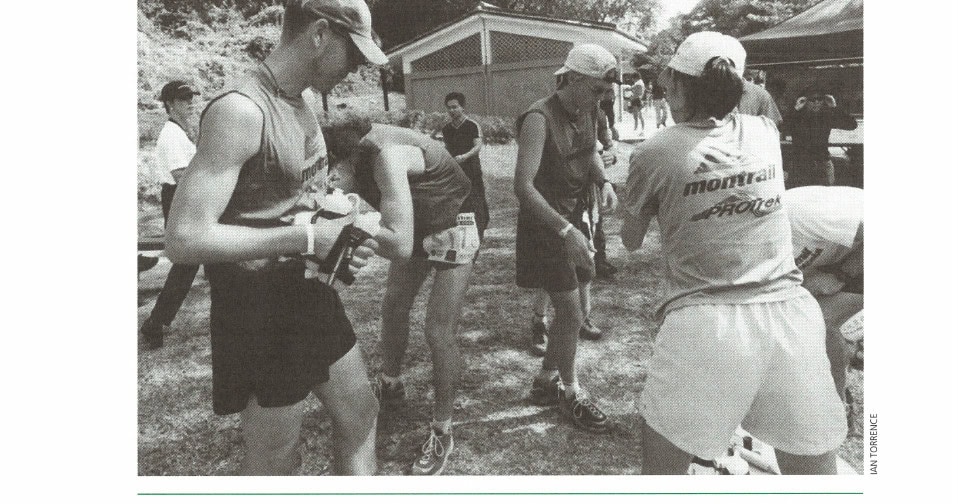
The fact that no one was in a hurry to continue was fine with me because I was attempting to overcome my own obstacles. I kneeled in the dirt in front of one of the checkpoint tables and dumped the contents of my fanny pack onto the ground. My electrolyte baggie had split open and sticky orange goop had oozed all over my supplies.
I was upset and my mind-set was rapidly degrading. While I shook out the goo from my pack, my thoughts focused on how far we still had to run. The thrill of the race, the object of our mission, and the beauty of the countryside were very quickly escaping me. I no longer wanted this to be a race but just a sightseeing tour, a simple fun run with friends. The pressure to perform was taking its toll on our four-man team.
Here was an instance where we were all feeling stressed and our negative thoughts were getting the best of us. We needed to stay focused. We had traveled many miles, had trained very hard, and had invested a lot of time and effort into this venture. The four of us were here not only as a team but also as friends.
The four of us had many years of experience with this kind of running and these sorts of apparently dire circumstances. We each knew that these negative feelings were only temporary and that we had set ourselves goals that needed to be fulfilled—not only for ourselves as individuals but also for the other team members, our crew, and our sponsors. We gathered ourselves up, rallied together, and—as a team—checked out of the Beacon Hill checkpoint. Quickly back on the trail, we were back into a familiar groove, one by one clicking off the remaining 24 miles to the finish.
TRAILWALKERS
Nate, Dave, Scott, and I were taking part in Trailwalker 2001. The 20-year-old footrace winds through some of the country parks located near the city of Hong Kong, China. The 100K race starts just a short drive from the city’s crowded and claustrophobic downtown streets and is one of the largest ultramarathon events in the world. In the 2001 event, 946 teams were entered, with each team consisting of four members.
The experience of the participants varied widely. Some of the runners had previously participated in this race, but most runners were using it as their first ultra. While a handful of teams would race for the win, most teams would choose to walk the entire distance and use most of the allotted 48 hours to complete the event.
Because of the large number of participants, the race began in three waves. Race directors dubbed the fastest 23 teams Super Trailwalker teams and started them in the first wave. Participants were required to stay in their four-person teams during the entire event and had to check in and out of each of the 10 checkpoints together. Wrist identification bracelets were scanned at every checkpoint to ensure the teams stayed together.
The course traverses the MacLehose Trail across a peninsula in the New Territories of China. The trail is one of several that make up a more expansive trail system that crisscrosses the Hong Kong area from shore to shore and mountain to mountain. Runners can easily leave behind the Hong Kong metropolis and find themselves at trailheads that lead to secluded white sandy beaches, bamboo and conifer forests, and rolling grasslands.
The race’s primary purpose is to raise money for Oxfam, an international relief organization that supplies many countries with long-term development assistance and emergency relief. To be officially entered in the event, each team had to be selected in a lottery. Then, if selected, teams were required to raise money for Oxfam.
THE PLAYERS
Last year’s winning team, the Cosmo Boys, was back to defend its title. The Cosmo Boys include some of the best mountain marathon runners in Hong Kong. Three of the members are from Hong Kong and the fourth is from England. They sport an incredible ultramarathon resume. Several of the members had been on previous winning Trailwalker Hong Kong teams, had participated in Trailwalker Australia and the Marathon des Sables in Morocco, and had run in the Reach the Sky race in Taiwan. The Cosmo Boys trained on the course, were the local favorites, and set lofty goals for themselves at this year’s event. They were there to win and to break the long-standing course record of 13 hours and 18 minutes set in 1993 by the Gurkhas, a team of soldiers from Nepal.
Our team echoed the goals of the Cosmo Boys. We were billed as the Montrail/PROTrek team. Montrail, a trail-running shoe company based in Seattle, and its distributor in Hong Kong (PROTrek) supplied us with transportation and lodging for the event. We were chosen in part for our success in past trail races but more for how well we worked together.
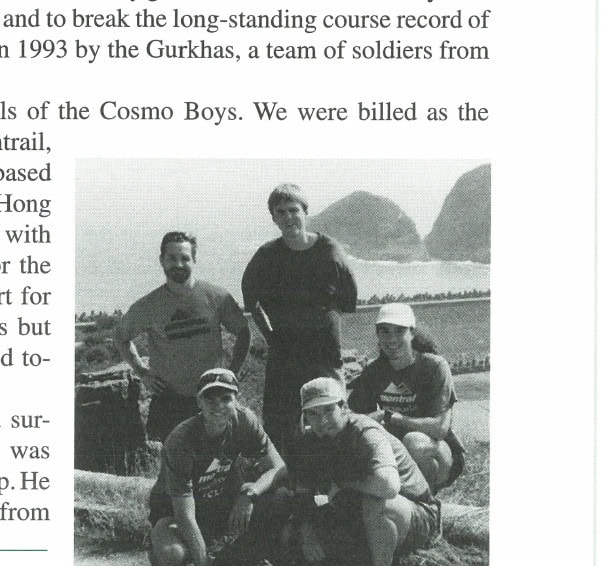
Dave Terry, a 37-year-old surgeon from Portland, Oregon, was the elder statesman of the group. He came with a lot of experience from numerous trail races in the Unites States. He is a perennial top-10 finisher at the Western States 100-Mile Endurance Run and returns yearly to the rugged mountains east of Salt Lake City to compete in the Wasatch Front 100-Mile Run. He spent time away from work before the Trailwalker race by preparing on the rugged trails in the Columbia River Gorge.
Nate McDowell, from Corvallis, Oregon, was the most vivacious of our group. The 29-year-old Ph.D. student had impeccable timing when it came to inspiration during the race. Nate holds the course record in several ultras in the Northwest and is a repeat winner of the Way Too Cool 50K race in northern California, the largest 50K race in the United States. The McDonald Forest, the lush countryside found literally out his back door, provided him with the necessary training grounds for the Trailwalker.
Scott Jurek, a 27-year-old physiotherapist from Seattle, was the youngest of our group. He is best known for his three straight victories at Western States, one of the most competitive 100-milers in the Unites States. When he wasn’t in his office, Scott could be found training on the steep wet trails of the North Cascades.
I prepared for Trailwalker on the slick rock and broken canyon bottoms of southeastern Utah. I was able to excuse myself from my position with the National Park Service for the time needed for the trip. At 29 years of age, I knew this would be a trip of a lifetime. I relied on my background with a dozen 100-mile trail races to carry me strongly over the course. And speaking of the course . . .
THE COURSE
None of our team members had run the Trailwalker before and we knew precious little about the course. The race literature was vague on many of the logistical aspects.
Several runners who previously competed on the course were very helpful in filling in a realistic picture of what we faced. They told us that every half kilometer would be marked with a small trail marker, but other than that we would have to rely on our instincts to guide us at trail intersections and indistinguishable turns. Unlike races in America, flagging or flour arrows marking the correct direction would be nonexistent.
Many significant climbs would consist of endless concrete and wooden steps. Past contestants suggested that we add three to four hours to our best trail 100-mile race time to determine how long it would take us to complete the course. They also warned us to be prepared for overwhelming heat and humidity. Various sources set the total elevation gain and loss anywhere between 29,000 feet and 10,000 feet.
Ian Torrence on the infamous steps.
Still, many questions remained unanswered.
Once in Hong Kong we utilized Whalen Leung, the owner of PROTrek and a former finisher of Trailwalker, as our primary source of information. On the two days before the race, Whalen took us to some of the key areas on the course, showed us each aid station, and discussed where the crew would meet us and what supplies would be needed. We ran an eight-mile section of the course to get a general sense of the terrain.
THE START
Getting to the starting line of Trailwalker would prove to be an adventure in itself. Nate, Dave, Scott, and I had flown from the opposite side of the world. From Seattle it took 30 hours before we finally arrived in Hong Kong. Now in a foreign country, we had only two days to adjust to a new time zone and a very different culture.
We discussed our preliminary race strategy and decided that we would go out conservatively, keeping an eye on the more experienced teams around us and playing it somewhat off them. We would rely on each other’s strengths to pull the rest of the team along at difficult times. It was understood that the essence of our race would focus on our ability to work as a team.
On the morning of the race, November 9, our starting time was 10:00 A.M. In most ultras in the United States, runners are rising well before dawn and covering the first several miles in the dark. The late start at Trailwalker allowed us to sleep in and organize our gear at the hotel before catching our ride to the starting area.
Once at Pak Tam Chung, our team checked in, met some of the other competitors, and posed for the obligatory prerace photos. We caught glimpses of teams that would be our primary competition. The sizing up began. Local newspapers had planted rumors about our team’s goals. Some teams told us that they had read that our goal was to finish the race in less than 10 hours, a goal that we had never formulated. In past years several other sponsored teams from the United States had come to Trailwalker predicting huge results, only to end up falling short. We didn’t want to repeat that history.
The starting line, at the base of a large cliff, was a mob scene of media personnel, runners, and course officials. As runners lined up under the start banner, photographers, spectators, and crew stood on the cliff above, waving and shouting last-minute farewells to the runners clumped below.
At exactly 10:00 A.M. the officials started the race, and we became part of a huge mass of runners. After the first two kilometers, even with what we considered a very slow pace, we shared the lead with only one other team. Through casual conversation we discovered that the team with us consisted of Hong Kong’s 24-hour and 100K record holder, the record holder for the solo Trailwalker, and two gentlemen who had just finished the River Shimanto 100K race in Japan several weeks earlier. We were in the midst of some awe-inspiring company.
AID STATIONS AND HILLS
After eight kilometers we were moving alone at the front. The other teams may have decided to moderate their pace in order to save energy for the tougher miles and hours that lay ahead. After having run along a concrete reservoir access road for the first 10 kilometers, we passed through the first water station. We quickly refilled our bottles and began the first climb of the day.
Although many teams chose to walk the first climb of stone steps, we ran. After cresting the first hill and looking across a valley and an inlet of the South China Sea, we saw our second climb. It was here that Scott made a short but keen observation. “I think I’ve forgotten just how far 100 kilometers truly is.” We realized that if we kept running these major ascents as we had the first, we would burn ourselves out in a very short time. For the remainder of the major climbs in the race, we settled into a more efficient and sane hiking pace.
Trailwalker’s race management requires that every team have at least one crew member to provide support along the course. There are no drop-bag services provided, and the supplies at the established checkpoints are not adequate for team members to subsist on while running a course this difficult.
Our team’s success can be attributed to our excellent crew. Any knowledgeable car mechanic will tell you, “If the motor ain’t lubed properly, then it ain’t gonna run too smoothly or too far.” Susan McDowell (Nate’s wife), Scott Tucker, Troy Trimmer, Whalen Leung, and three of his PROTrek employees (Ken, Maggie, and Wilson) acted as the mechanics who lubed the Montrail/PROTrek team’s engine. Their tasks included meeting our team at various checkpoints with food, liquid, and encouragement. They divided the tasks among themselves. Nate, Scott, Dave, and I were each assigned a crew member who would deal specifically with our own needs and wants. With this method we were able to pass smoothly through each transition area.
Unlike a typical ultra in the United States, Trailwalker allows teams to receive aid at any point along the course. Not only were we able to collect water and supplies at the 10 established checkpoints but we could receive aid at any point where our crew could meet us. This additional aid would prove to save our race in several instances.
Checkpoints were set up far enough apart so that even the faster teams would spend between two and three hours moving between them. On paper the distances weren’t that far apart—roughly 10K or so—but the steep terrain that lay between the checkpoints made going very slow. We had arranged before the race to meet our crew at several intermediate supply points, and it was a relief to have these additional points. In several instances we found ourselves running low on liquids more quickly than expected because of steep climbs, heat, and humidity. These supplemental stops prevented us from flirting with dehydration.
The use of cell phones enhanced crew communications. A crew member would run out from an aid station, meet us several miles out, ask us what we needed, and then phone in our requests to the rest of the waiting crew. Cell phones were used to coordinate our two vehicles when they became separated
in traffic. They also were used to receive instant progress reports on our team and on those giving chase.
The local individuals from PROTrek were an indispensable resource for us at Trailwalker. They were familiar with shortcuts to the aid stations, knew how to get around traffic jams that occurred between checkpoints, predicted where we would run low on water, and figured out how to get it to us quickly.
The Cosmo Boys, our major competition, had tremendous support along the way as well. They had enough crew and supporters that they were able to run much of the course without water bottles or fanny packs. Crew members met them almost every two kilometers, even on the most remote sections of the course. Although these crews were loyal to a particular team, they were still full of encouragement and cheers for us as we ran by.
THE MONKEYS
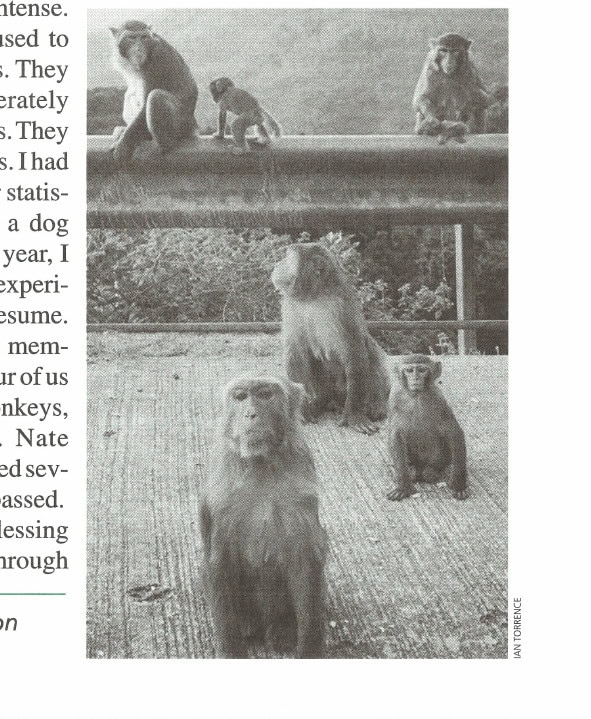
After checkpoint five we descended to the portion of the course that would frighten me the most, a section of road along the Kowloon Reservoir. The endless climbs, miles of steps, heat, and humidity didn’t concern me as much as what lay in wait. As we ran toward the reservoir, the loud screeches of the monkey colony grew more intense. The greedy animals were used to receiving food from humans. They were aggressive and desperately wanted what was in our hands. They had previously bitten runners. I had no desire to become another statistic. Having been bitten by a dog while running earlier in the year, I did not want to add a bad experience with a monkey to my resume.
Wilson, one of our crew members, quickly escorted the four of us through the hundreds of monkeys, using a stick as defense. Nate seemed to enjoy this and baited several of the monkeys as we passed.
In retrospect, it was a blessing to have been able to pass through this section in the daylight and not have to confront these vicious beasts in the dark, with their beady eyes looking back from the trees and surrounding brush. Now I know firsthand why the flying monkeys in The Wizard of Oz frightened a whole generation of kids.
THE LIGHTS
Darkness fell on us around 6:00 P.M. when we were several miles beyond checkpoint six with some 35K left to run.
It was here that we began some of the largest climbs on the course. While climbing over Needle Hill, a steep exposed crag along a ridgeline, we caught our first glimpse of the city of Hong Kong at night. We were skirting the ridges that form the basin in which the city sits. Hundreds of huge, slender towers rose out of the bottomland like a steel forest. The lights from the business and residential buildings created an incredible contrast against the vast darkness of the ocean beyond and the forests through which we had journeyed. The four of us ran alone across a dark, quiet ridge, while four miles away the city teemed with 6.5 million people; it was here that I realized just how immense this city is.
Reports from our crew suggested that the Cosmo Boys were anywhere from a half hour to an hour behind us, but we didn’t let this news comfort us. We wanted to make the gap even larger. It was important that the other teams not learn our location, how fast we were moving, and how we were feeling. One of the tactics we utilized during the night was turning off our flashlights and headlamps. This “stealth mode” allowed us to evade the eyes of our competitors. From past racing experiences we knew that once competitors realized just how close they were to their competition they would be easily inspired, run harder, and eventually catch and pass those ahead of them. We didn’t want to give the Cosmo Boys this opportunity.
While we climbed Needle Hill, the lights from the city below allowed us to switch off our lights. If we had kept our lights on here, anyone behind would have seen us easily on the exposed face of the mountain. As we approached the summit, the steps became very steep. Looking straight ahead afforded views only of my teammates’ calves. Communication near the summit was difficult because of deafening winds. We quickly pushed over the summit to avoid the chilling effects of the blustery weather.
After descending Needle Hill and passing through the Lead Mine Pass checkpoint, we began the longest ascent on the course. Tai Mo Shan (translation: Very Foggy Mountain) is the highest mountain on the course and stands nearly 1,000 meters high. It is also the last significant climb on the course. This may have been the hardest portion of the race for our team. We were beaten up and tired. Our knees and backs ached from the stairs we had ascended and descended throughout the day, we were weak from lack of sleep, and our food and fluid supplies were running low. It was a cruel joke to place the toughest climb at the end.
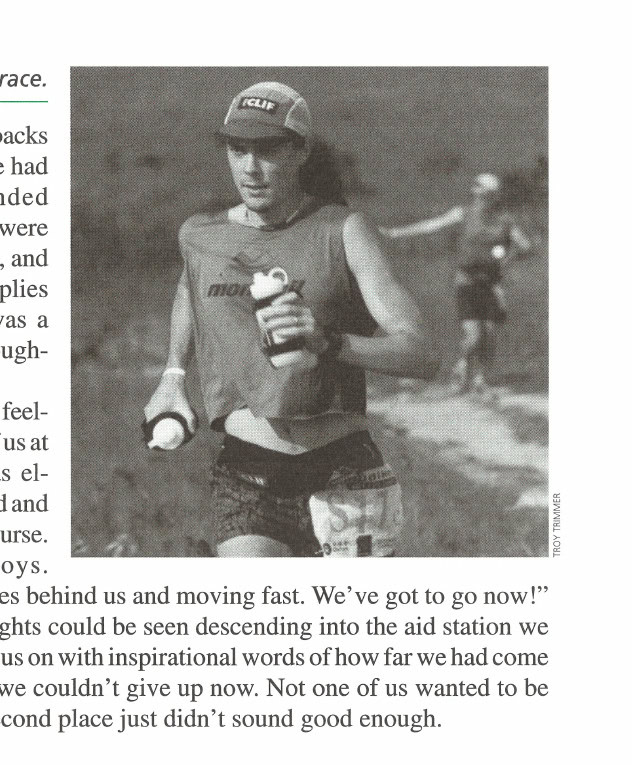
Scott was leading and feeling the best of the four of us at this point. Urgency was elevated when Scott turned and pointed back along the course. “There they are, boys. They’re about 20 minutes behind us and moving fast. We’ve got to go now!”
The Cosmo Boys’ lights could be seen descending into the aid station we had just left. Scott urged us on with inspirational words of how far we had come as the leaders and how we couldn’t give up now. Not one of us wanted to be passed and somehow second place just didn’t sound good enough.
GETTING IT DONE RIGHT
After a long quad- and knee-jarring descent off Tai Mo Shan, we entered checkpoint eight. Our crew and a crowd of cheering onlookers met us. The pressure was on. Lingering was not an option here. Batteries in our lights were changed, food was stuffed into our fanny packs, bottles were filled, and off we went into the night.
Joining us for the last 12 miles were two of our crew, Scott Tucker and Troy Trimmer, both Montrail employees. Their new enthusiasm revitalized our spirits as they paced us to the finish. We were now moving along at a decent seven- to eight-minute-per-mile pace, faster than we had gone all day.
The last six miles had the best footing of the course. The six of us ran along the shores of a lake through tall bamboo and a tunnel of brush. The trail was dirt—smooth and flat. The change in terrain suited us well; we had waited for this kind of running all day. We ran in single file and yelled encouragement back and forth. A wild boar passed in front of Dave, who was bringing up the rear. We were traveling so quickly and were so focused on the finish line that Dave’s wildlife encounter wasn’t conveyed until after we had finished. Nate led the
way. “Come on, guys, we’ve got to run this section fast,” he yelled back to us. The team was strung out in a long line, but we were all moving at an incredible pace, considering how far we had already come. The finish was near.
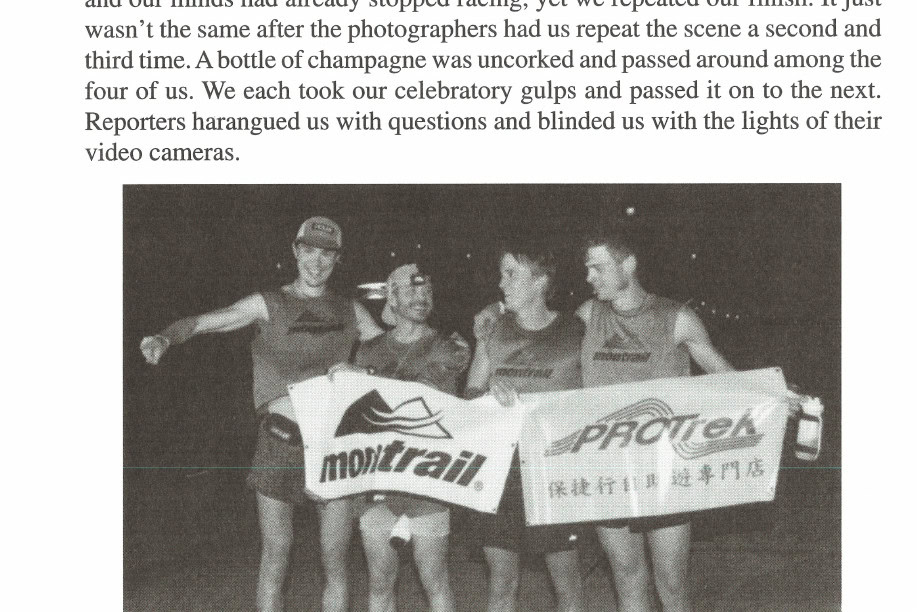
We descended the last set of stairs and crested a small hill. Our team gathered itself into a group and ran toward the finish line. A huge banner and chest-high tape marked the end of our journey. Dave, Scott, and Nate crossed the line with arms raised and accompanying triumphant yells. Exhausted, I was content to simply grin and revel in the excitement that we shared.
A blinding array of lights flashed as we crossed the line. Rarely have I seen this many people at the finish of an ultra. Race personnel, reporters, photographers, and our crew mobbed us. I was pleased to be finished but more moved to be sharing the experience with my teammates and friends.
Photographers requested that we cross the finish line again for additional photos. The adrenaline was gone, the concrete had begun to set into the muscles, and our minds had already stopped racing, yet we repeated our finish. It just wasn’t the same after the photographers had us repeat the scene a second and third time. A bottle of champagne was uncorked and passed around among the four of us. We each took our celebratory gulps and passed it on to the next. Reporters harangued us with questions and blinded us with the lights of their video cameras.
The Cosmo Boys finished 22 minutes later. As they came in, we approached the finish line and congratulated them. We shook hands and commented on each team’s talents. It was good to meet the team that had pushed us to the edge and forced us to focus and to perform at our highest level.
A VISITOR IN HONG KONG
This was my first time outside the United States, other than minor trips to Niagara Falls or Tijuana. I was apprehensive; this was an entirely new experience in a different country. Recent world events made traveling away from home much more difficult. September 11 left a huge mark on the United States and the world.
Our plans for Trailwalker had been set well before the events of 9-11 occurred. To get to Hong Kong we had to take several flights and pass through four airports and the customs checkpoints of two countries. Almost two months had passed since the terrorist acts took place, but our flights and arrangements had not changed. The plans had been laid; the entire team and crew were content to proceed with our schedule.
During our travels we were affected only once by the changes in airport procedures. Because of increased security requirements, we wound up spending 12 hours at an airport in Canada. While we were in Hong Kong, people frequently asked how things were in America and shared condolences about the tragic events.
I found it simple to adapt to my temporary life in Hong Kong. Street signs were printed in both Cantonese and English, many locals had a working knowledge of the English language, and if times got desperate there was at least one McDonald’s or 7-Eleven located on every other block. Several stores stocked typical American groceries. Our group was fortunate that our hosts, PROTrek, took good care of us, driving us around to view the race course, to go to meals, and to sightsee. They bore the brunt of the stresses that out-of-towners like us normally would have experienced.
I was able to experience a wide range of the city’s attractions. I tasted much of the endless cuisine the city had to offer: Dim Sum, Taiwanese, Thai, and Italian. We spent some time sightseeing as a group and were able to visit the Hong Kong arboretum and aviary, ride the ferries across the bay from Kowloon to Hong Kong, travel up the mountainsides on the inclined trolley, and visit the infamous night market in downtown Kowloon where deals aplenty are to be had.
I ran my pre- and postrace runs along the waterfront of the city of Kowloon and was joined by many others doing the same. One morning I even observed a course being coned for a 5K road race. I felt just as welcome and comfortable there as I would have in any major city in the States.
IN RETROSPECT
At the awards ceremony, which was held shortly after we finished the race, Montrail/PROTrek and Cosmo Boys took turns at the awards podium. It was here that emotion and deeper thoughts stirred within me. As each team’s captain gave a speech thanking the organizers of the race, I was reminded of why we were really there. Not only were we there to run, break a course record, and win a race, but also we were there to raise awareness, assist those less fortunate, and learn more about a different country and culture.
It was a storybook ending for our team. However, for many there will never be a storybook ending. As I sat in the gymnasium half a world away from home, I was reminded of the many people who would never have the opportunity that I was offered to travel to foreign lands, experience different cultures, and run through beautiful landscapes. I often find myself taking for granted those things that some people will never have such as food, shelter, and education.
Our team consisted of individuals who traveled far and came together as friends to work toward a common goal. It was an awesome experience to travel overseas and compete with these friends in an international event. Trailwalker showed me that camaraderie can be forged out of competition and that we should all take more opportunities to learn about different cultures, beliefs, and ways of life.
ADDITIONAL WEB SITES
Further information about the Trailwalker(s) and about Oxfam can be found at the following sites.
Oxfam
www.oxfam.org.hk
Trailwalker Hong Kong
www.trailwalker.org.hk
Trailwalker Australia/Sydney
www.caa.org.au/trailwalker/sydney/index/html
Trailwalker Australia/Adelaide
www.caa.org.au/trailwalker/adelaide/index.html
Trailwalker UK
www.oxfam.org.uk/trailwalker/index/html
These pages consist entirely of race advertisements and contain no editorial article content.
This article originally appeared in Marathon & Beyond, Vol. 6, No. 4 (2002).
← Browse the full M&B ArchiveMore like this
1,000+ stories from 19 years of Marathon & Beyond
The complete archive of the legendary long-distance journal — digitized and free to read.
