

DeMar@Home: What Was It Like With “Mr. Marathon” Living in the Same Neighborhood?
WITH ALL the complications that go with technological development, from satellites and space explorations to genetic coding and cloning, we long for what we nostalgically refer to as the common American man: one raised under harsh conditions, steeled by adversity, strong, silent and dependable. Humble beginnings, legendary by the time of death, mourned by many. In between, a life that inspired a nation and his neighbors. A man for all seasons, especially the spring season where Patriots’ Day means Boston Marathon. A man like Clarence DeMar, who came to be known as “Mr. Marathon.” A force on the world scene, a neighbor everybody knew. This is the story of Clarence DeMar’s domestic life, which began in Madeira, Ohio, in 1888 and ended in Reading, Massachusetts, where he died of stomach cancer in 1958.
From the beginning, Clarence’s life took a long and tortuous course. He had five brothers and sisters. His father died when he was only 8 and he had to help his mother keep hearth and home together by selling needles and thread in neighboring towns—covering 10 miles a day on foot to do so. To get home before dark, Clarence began running between towns, thereby starting an avocation that would change him and change the fledgling sport of long-distance running. When Clarence was 10, the situation in the DeMar household slipped beyond desperate. In a move to keep the little family together instead of splitting it between the poorhouse and orphanages, the family moved to Warwick, Massachusetts, to live rent free in a house owned by a relative. But in those harsh times, even a rent-free situation wasn’t enough to maintain the family, and it was broken up.
Clarence was sent to the Farm School on Thompson’s Island in Boston Harbor, but he was unhappy there and eventually left to work on a fruit farm in South Hero, Vermont. He eventually enrolled at the University of Vermont but left in his junior year to live with his mother. One brother and one sister were also living with her.
DOMESTIC LIFE BEGINS
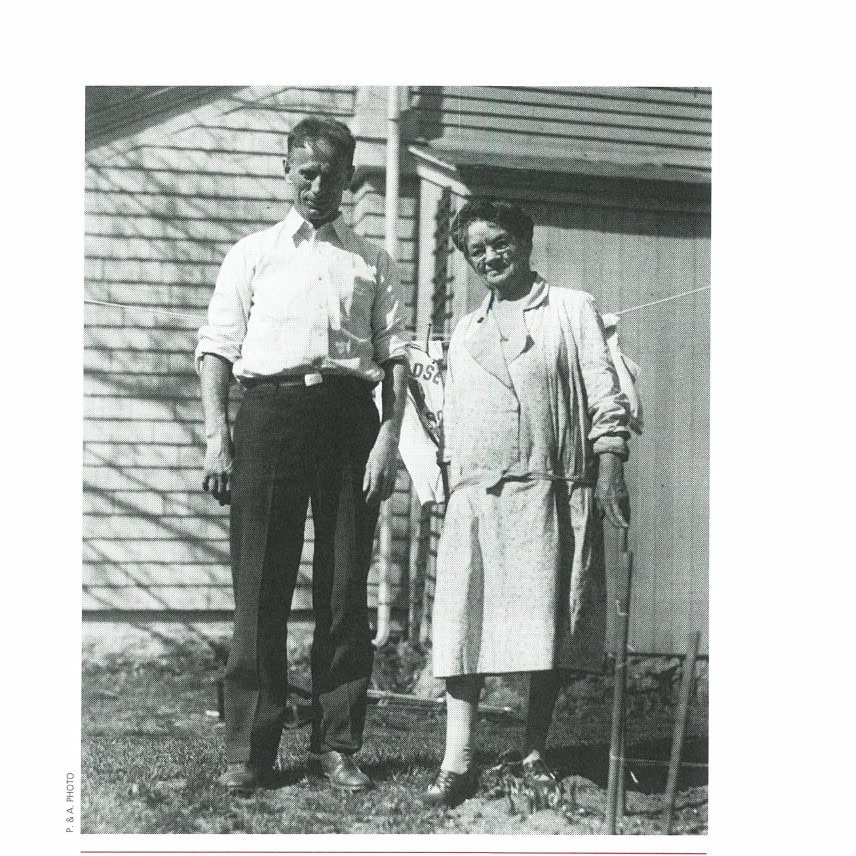
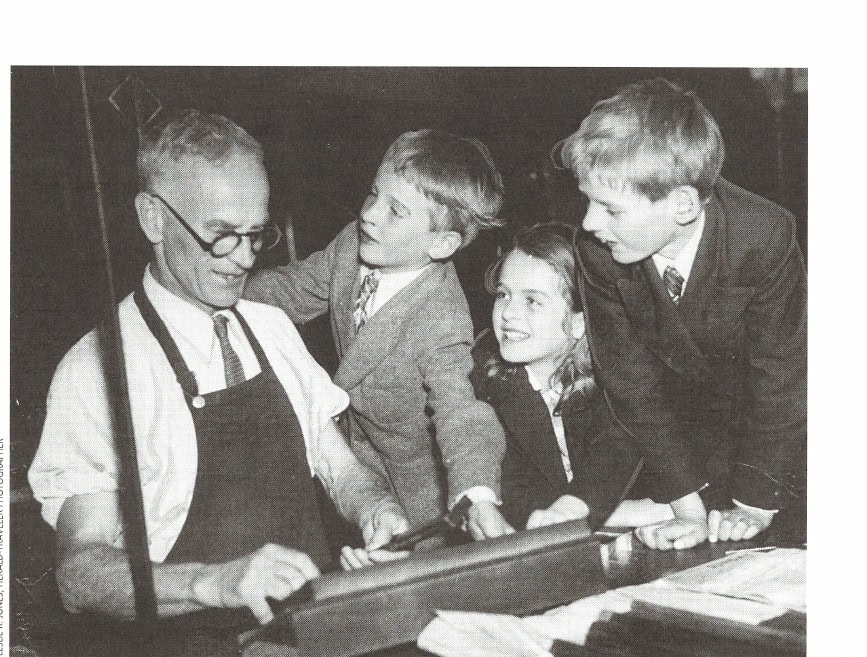
From 1909 through 1929 the DeMars lived in a modest house at 43 Union Street, near the Melrose High School athletic field. This is where our story of Clarence DeMar’s domestic life in New England begins. To help support his family, he had learned the printing trade, a business at which he would work for the rest of his life.
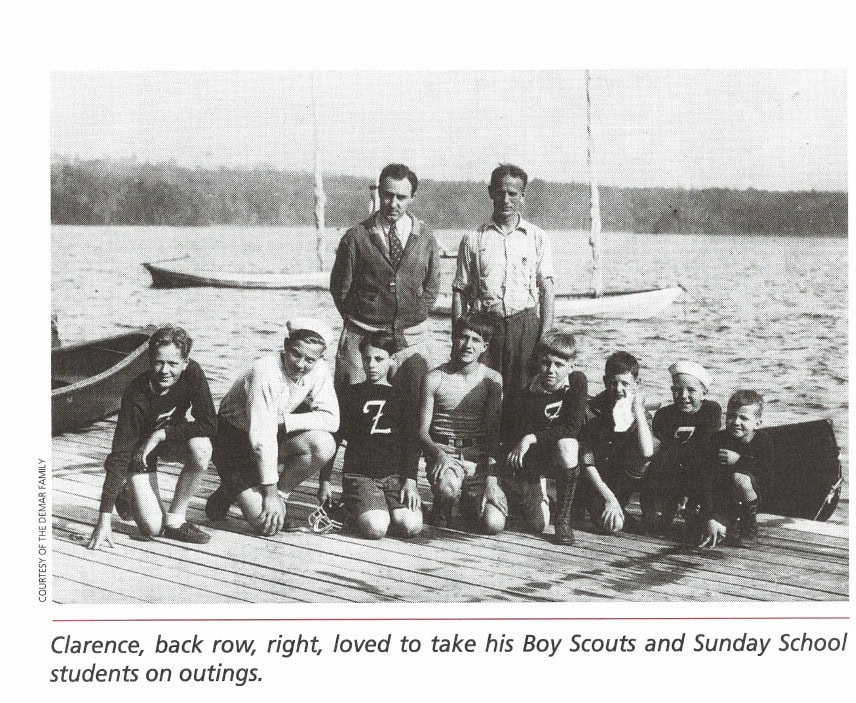
Meanwhile, he had not overlooked his religious life. He attended services at the First Baptist Church in Melrose, Massachusetts, and later taught Sunday school there. He enjoyed working with and teaching young men so much that, for three years, he became scoutmaster of Boy Scout Troop 5, which was housed in the same church. He would later be scoutmaster of Boy Scout Troop 9 in the Maplewood section of Malden, Massachusetts, from 1924 to 1929.
Since DeMar did not have an automobile, the young printer needed some way to commute to and from work, so he began running, carrying a clean shirt under his arm. His commuting at what was referred to as a dogtrot seemed to suit the introspective young DeMar. He loved to be alone with his thoughts where nobody could bother him.
DEMAR ACCORDING TO SQUIRES
All of Clarence DeMar’s contemporaries from the Melrose area are now dead. DeMar himself died when he was 70. However, another fine runner and coach, Melrose resident William “Billy” Squires, who coached Bill Rodgers, Alberto Salazar, and Dick Beardsley, gives us an insight into DeMar’s character and why he motivated runners, including himself, and became a mentor to them.
Squires was a national champion in the mile and later taught at Boston State College and the University of Massachusetts at Boston. He also coached high school track in the greater Boston area. Today Squires is semiretired and coaches elite runners at distances from 800 meters to the marathon. He is affiliated with John Hancock Financial Services, the principal sponsor of the Boston Marathon.
Squires didn’t know DeMar personally, so he can’t comment much on the running legend’s domestic life, but he thinks that DeMar’s strong work ethic and ambitious training schedule can serve as a model for today’s runners. Moreover, Squires believes that DeMar’s character, perseverance, and penchant for setting goals and achieving them carried over to his domestic life.
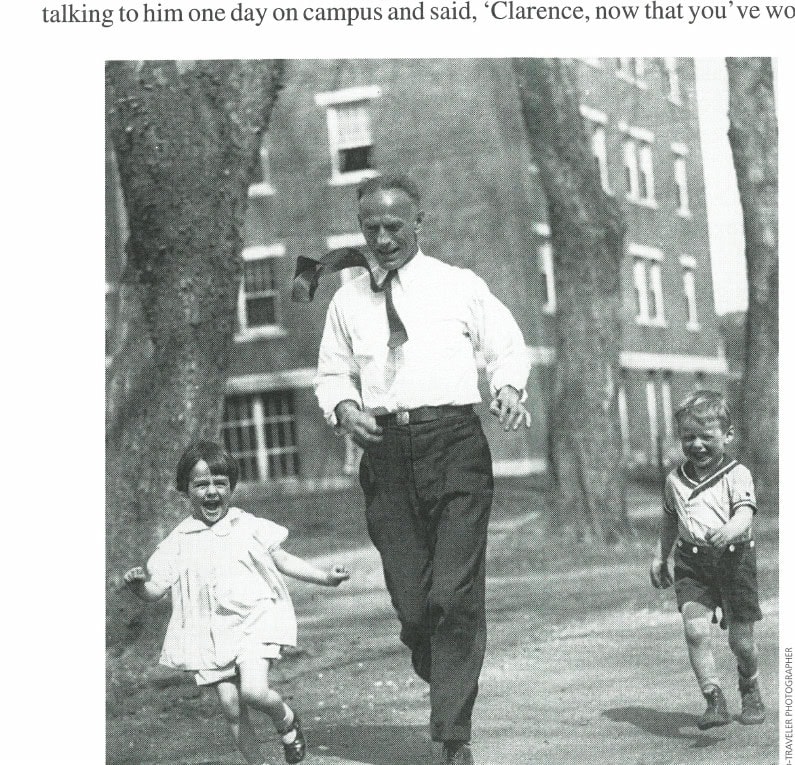
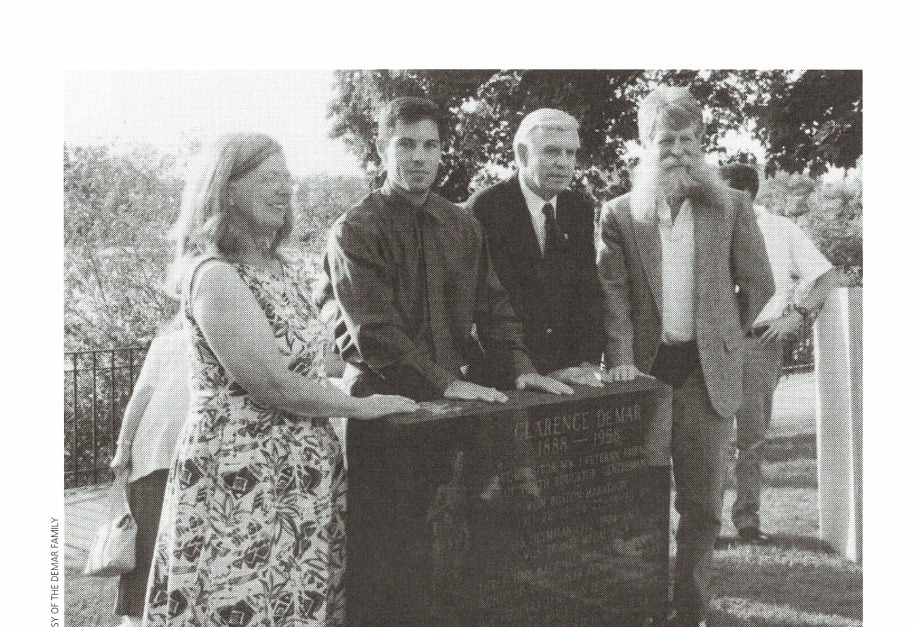
Squires has lived in Melrose for three years and greatly admires the persistence and motivation DeMar exhibited in running from Melrose to his night job at the Boston Herald-Traveler and back on a daily basis after being on his feet working as a compositor for 9 or 10 hours. Squires was one of the spark plugs behind getting a monument of DeMar dedicated in Melrose on DeMar’s birthday, June 7, in 2001.
“He ran over hills on the way to work and took a less strenuous route, with fewer hills, on the way home,” Squires relates. “He trained by running 18 to 20 miles daily, seven days a week. On Saturday he ran around Spot Pond [Stoneham, MA] three to five times. Each lap is approximately 5 miles, totaling another 15 to 25 miles. Clarence ran about 150 miles a week, and his endurance was above and beyond [that of his competitors]. The running shoes he wore for training were comparable to today’s bowling shoes, while his race shoes had crepe soles, which are soft, but wore out quickly.
“Clarence was a very, very serious man. In one Boston Marathon,” Squires continued, “someone got out in front of him and tripped him. After that Clarence carried a stick. He was the amateur of amateurs. A lot of that [resulted from] his stern, religious upbringing by his mother. He ate well: meat, potatoes, and vegetables, much of it from his own farm. He kept all of his training ideas to himself because his competitors were out to beat him.” This character trait defines Clarence DeMar, who was by nature taciturn, shy, and introspective.
After establishing himself in the printing business, DeMar felt it was important to further his education, so he enrolled in evening classes at Harvard in 1913. While studying for his associate of arts degree, he got to Harvard and back the old-fashioned way: by shoe leather. He ran 12 miles from Melrose to Arlington. Squires sets the scene. “Clarence hopped on the elevated train at Arlington and rode into Harvard Square, Cambridge, after running over rough, dirt country roads.” He graduated from Harvard in 1915.
CLARENCE AT KEENE
By the time he moved from Melrose to Keene, New Hampshire, in the fall of 1929, Clarence had matured as a professional printer, amateur marathon runner, and Christian. He met a fellow Melrose parishioner and placed first in the
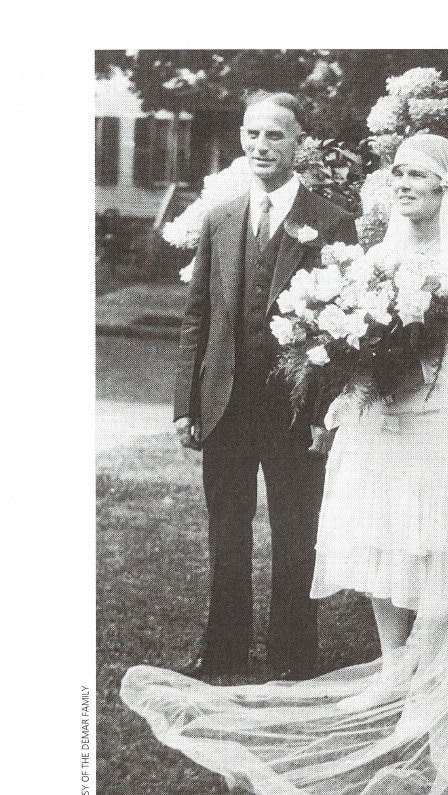
race to win her hand in marriage. Margaret Ilsley and Clarence were married at the First Baptist Church, Melrose, in 1929. Now that he had a wife to support, he needed a better-paying job, and he found one at the Keene Normal School as a printer and teacher of industrial arts. He began working at the school after taking a week off for his honeymoon. At that point DeMar, who had won Boston six times, taught Sunday school in Melrose and was a Boy Scout leader in both Melrose and Malden, Massachusetts.
DeMar’s flinty independence, dogged perseverance, and uncompromising work ethic found a perfect match in conservative New Hampshire. The Old Man of the Mountain, a striking profile in granite at Franconia, New Hampshire, stands as the state’s symbol of rugged independence, while its motor vehicle registration plate says it all: “Live free or die.”
Life in Keene held both promise and uncertainty for the newly married couple. Would the young bride adapt to the Granite State’s harsh winters and isolation?
A pleasant voice with a distinct New Hampshire twang fills us in on the domestic life of the new couple in their Keene years. Donald P. Carle puts it this way: “Clarence joined the faculty at Keene Normal School in the fall of 1929 where he taught young people printing and a large class of girls industrial history. The school was known as Keene Normal School from 1909 to 1938. Later, from 1939 to 1962, it was renamed Keene Teachers College. In 1963 it was renamed Keene State College.”
Donald Carle continues: “My father was a member of the faculty. He taught chemistry and was dean of men from 1928 until 1960. I was about five years old when I first remember seeing Clarence DeMar. He came to Keene in 1929 and left in 1939. He lived on Appian Way a few houses away from us. He taught printing and left Keene and moved to North Swanzey, New Hampshire, in 1932. [There he] ran to work [class], about four miles, and was never late to class.
“He taught Sunday school at the First Baptist Church when I was eight or nine years old. My father loved brook trout fishing. In 1930 Clarence won all the major marathons in the country [Boston, Philadelphia, Baltimore]. Dad was talking to him one day on campus and said, ‘Clarence, now that you’ve won all
the major marathons in the country, are you going to hang up your running shoes?’ Clarence replied, ‘Dwight, when you catch the biggest trout, are you going to hang up your fishing pole?’ He had a very dry sense of humor. When he ran he was very, very concentrated on what he was doing and became upset with people who interfered with him. Otherwise, with us I never saw that at all. We never had any unpleasant incidents with him.
“Every Sunday morning when he came up to church he brought us a dozen eggs from his farm. We would sometimes go to the farm to visit and get a chicken for dinner. He also had goats at the farm. The eight- or nine-acre farm is now the airport on the edge of a pond. He also had some ducks and we usually got 10 eggs and 2 duck eggs.
“He had to be extremely careful to retain his amateur status while at Keene Normal School. He couldn’t take any money for coaching the cross-country and track teams. In 1931 he was the favorite to win the Boston Marathon again, and Keene Normal School held a big parade on April 18 from the center of Keene to the railroad station. He took the train to Boston to run the marathon the next day. My brother and I went on the same train with Clarence, and when we got off at Waltham, somebody said, ‘That’s Clarence DeMar. What in heck are [those boys] doing with him?’ Clarence always told us, ‘If you’re ever in Boston come and see me.'”
The 75-year-old retiree says from his Peterborough, New Hampshire, home, “Another time I was in Boston and went over to the Boston Herald-Traveler. Clarence was working the night shift after he ran the Boston Marathon. Before I left, he said, ‘Oh, you have to have something to eat.’ He disappeared for a few minutes and came back with a banana and an orange.
“Mrs. DeMar was also very nice. She didn’t have a mean bone in her body, just a lovely, nice, humble person. Every spring we would have a flood in Keene. In 1936 it was a very serious flood. At Clarence’s house the water came up to the first floor. Clarence put on his rubber boots and waded through the water over to the Butterfield Building, the vocation education building at the time, to get everything off the floor so it would be dry.”
NOT A SHARP DRESSER
Carle continues with his recollection of DeMar: “His one handicap on campus was his dress. He wore a suit that didn’t get pressed very often. His appearance as a teacher was a little doubtful. I never saw him with an overcoat. He always said, ‘If you wear gloves, you’ll keep warm.’ Mrs. DeMar knit him a gray ski mask to cover his face. It went over his ears, down the back of his neck, and had an open space for his eyes and nose. It had a slit for his mouth, and I wouldn’t be surprised if it was the first one made.
“He and my father were very good friends and could talk about anything. He was a very courteous person, and a very strong believer and was very loyal to the church. He never drank or smoked. I know when he was in training he ran from Keene to Troy, New Hampshire, all uphill, a 20-mile round trip. He was a very, very thorough trainer.
“I feel he would be very pleased to see the number of people who are running today. The Clarence DeMar Marathon is run every fall.” It’s sponsored by Keene State College and has been run for going on three decades. Carle continues: “Mrs. DeMar was invited up as ‘official starter,’ as were several of his children. It can be used as a qualifier for the Boston Marathon. I would love to see the Boston Athletic Association give more recognition to Clarence.
“In 1939 I was a teenager when he left. We probably didn’t realize how famous this man was; he was a neighbor, a dad, and member of the faculty like many other people. We didn’t ooh and aah. He was just like everybody else except that he ran.”
Donald Carle graduated from Keene Teachers College in 1952, taught school, and was principal of two elementary schools as well as assistant superintendent of schools in Peterborough. He retired as alumni director at Keene State College in 1988.
The old neighbor and family friend concludes, “I can see him today running down Main Street, turning the corner onto Appian Way. He would say ‘Hi’ or ‘Hello.’ He was just a real nice person, as was his wife. Now that I’m grown up I see what he accomplished, what he did. He represented the country three times on Olympic teams. After he left Keene to work at the Boston Herald-Traveler, he told my father, ‘I know I’ll never win it [Boston] again. I run for time—to finish under three hours.’ He loved the sport. He just wasn’t going to quit running the BAA [race] until he had to stop. He set goals and challenged himself.”
In 1939 Clarence and Margaret DeMar and their children said good-bye to their friends in Keene and North Swanzey. Clarence took a printing job at Murdoch High School in Winchendon, Massachusetts, from 1939 to 1942. America was at war. Meanwhile, on the home front, Clarence was managing to eke out a living, but he and Margaret felt it was time to move nearer a large city, in this case Boston, where wages were higher and more printing jobs were available.
ON TO READING, MA
Clarence and Margaret had four children to raise and Reading, Massachusetts, 14 miles north of Boston, became their new home as Clarence started with the Herald-Traveler. He worked full-time on the night shift at the Herald and put
in as much overtime as his supervisor allowed. Commuters enjoyed their morning newspaper and cup of coffee on the train ride from Reading to Boston while the man who helped set the news in type was arriving home to chat with Margaret and catch up on family news.
The human dynamo that was Clarence DeMar didn’t rest long, however. He had numerous chores to take care of around the 16-acre farm that the DeMars had purchased in April 1942 for $6,000.
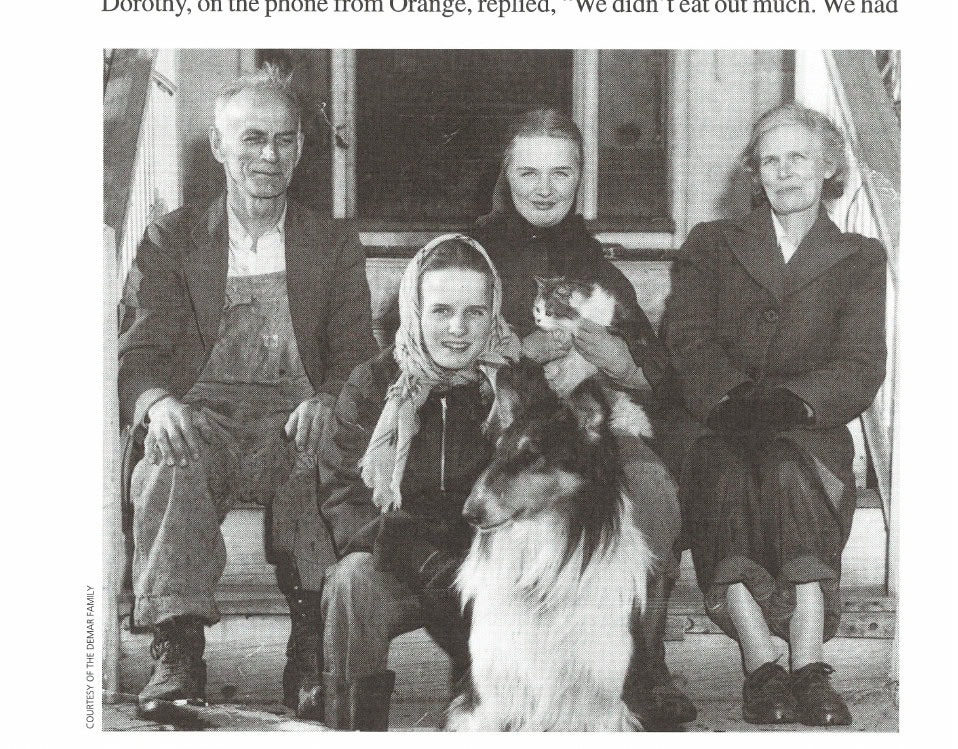
Dorothy (DeMar) Foster, 72, the oldest of the four DeMar children, has moved the farthest away from New England and their old colonial farmhouse in Reading. However, Dorothy still has vivid and pleasant memories of her childhood. Today she is a professional musician, mother, and grandmother and lives in Orange, California.
What was life like growing up on farms in North Swanzey and Reading? Dorothy, on the phone from Orange, replied, “We didn’t eat out much. We had an old woodstove in North Swanzey and an outhouse when we first moved there. My father bought eight acres, the house, and barn for $4,000. I think the house in Reading was modern by New Hampshire standards. Clarence paid $6,000 for it, and mother baked bread and cooked roasts, potatoes, cookies, pies—everything—on the old woodstove. We picked blackberries and my mother canned whole blackberries. We ate them for dessert with whipped cream on top from our own milk.
“I vacuumed every Saturday. I had my own chickens and sometimes helped with the cows by herding them up to the back pasture. Clarence wasn’t very good with fences, and the cows would crash through them and get into the neighbor’s yard. The cows gorged themselves on green apples and got tipsy. Maybe they ate the fermented apples on the ground. And I had cats. Oh, we loved our cats.
“I have two trophies in my living room with a white, blue, and red poster of Clarence from the 10th Clarence DeMar Marathon. In 1988 four of us went to the marathon.”
LASTING MEMORIES
Dorothy Foster recalls a lasting memory: “In Keene he put the twins in a basket on his bike, and Robert and I were on the back as he peddled from North Swanzey to Keene. He got stopped several times and was lectured for having too many people on his bike.”
Clarence was respected and loved by his Sunday school students and his Boy Scouts, but was he equally revered by his own children? “He was very supportive of my music,” Dorothy recalled. “We all got good educations. We all had animals to take care of and we were expected to be responsible. We were pretty independent; he wanted us to think for ourselves—not to be smothered. There wasn’t a lot of communication; he was always very busy and worked several part-time jobs. We ate better food than most people, no insecticides or preservatives. We produced our own food, and I developed a love of nature, animals, and the outdoors that has always been with me. I graduated from Reading High School, class of 1948; Boston University School of Music, with a bachelor of arts degree in music; and from California State University, Fullerton, with a master of arts degree.”
Is Dorothy interested in the Boston Marathon, which her father won seven times? “I’m definitely interested in the Boston Marathon. I follow the results. The media sometimes mentions Clarence DeMar. I was born when he was older than 40, so his best marathon days were behind him. He was like a folk hero [while I was] growing up. People used to ask me if I was related to Clarence DeMar.”
Betty (DeMar) Mueller remembers her father as a tenderhearted man who sometimes surprised his children with unexpected gifts. “As a kid, I was probably 10, 11 years old, he asked me if I wanted to go to a football game, not one a few towns away—we flew from Logan Airport [in Boston] to New Haven to see Harvard play Yale in the Yale Bowl. We came home on the train and had a meal in the dining car. At 5 I had rheumatic fever and was bedridden; Dad put a calf on my bed.
“Another time before we went on vacation, the cows needed to be milked every day, so we rode our horses to a Wilmington, Massachusetts, farm as Dad jogged along [leading] the cows. When vacation was over and it was time to get the cows, I wondered how Dad would ever get our cows away from the herd of perhaps 150 in the pasture. Clarence yelled, ‘Come Bossy. Come Bossy.’ And they both came running. We drove them down Lowell Street, and Dad took a shortcut, which saved about a half mile.”
ON FOREST STREET
What did the DeMar farm at 249 Forest Street look like when Betty was growing up? “I remember the house with its big, long front porch with pillars. The house had six bedrooms and two baths and an old-fashioned woodstove. I really liked that black woodstove. . . .
“The attic had back and front stairways and it was pretty hot in the summer up there. It was kind of a fun place. We used to go up there and play hide-and-seek. One could really hide forever up there. The barn had a hayloft and cupola with a horse weather vane. My dad was afraid of heights; one day our neighbor’s dog was chasing our cat and they both were run over. Dad went up the ladder into the barn and got the kittens. I guess he did it for me. Our collie nurtured the kittens. Bob had one of those cats and it lived for a long time.”
Living on the DeMar farm meant so much to Betty that when she eventually did return, she was shocked. “It was very depressing for me,” she remembers. “When I saw the pillars and the front porch were missing, it was very upsetting. It just wasn’t the same place.”
Today she prefers to remember the good things about that period in her life. “Dad was a real fan of Hopalong Cassidy,” she remembers. Betty also cherishes memories of going to the rodeo. She was a member of 4-H and participated in the rodeos. “I loved riding in the rodeo parade down through the streets of Boston ending up at the Boston Garden.”
Betty recalls an incident from many years ago where her father’s fame and her artistic talent came together to account for her first “sale.” It was 4:30 P.M. after a long day of classes at the Massachusetts College of Art. Tired and drained, Betty rushed to catch the Green Line subway car to North Station, Boston, where she jumped down and rushed into the dimly lit concourse. She climbed aboard, past the conductor, who began shouting in his raspy voice, “Track 19. All aboard Train 422 for Malden, Wyoming, Melrose Highlands, Wakefield, and Reading.” Exhausted, she collapsed into a seat, where she proceeded to break into a cold sweat. “Oh, my God,” she muttered to herself. “What am I going to do? I don’t have any money!” You can hear the anguish 47 years later as she relates the incident. “As the conductor came down the aisle toward me I quickly sketched a portrait of him in pen and ink. I was absolutely broke, and somewhere along the way he learned I was Clarence DeMar’s daughter. He loved his portrait. Maybe this was my first sale.”
MEMORIES BY BARBARA
Betty’s twin sister, Barbara (DeMar Roberts), loved to ride her horse with Betty and their neighbor and friend Virginia Merrill. In the ’40s and ’50s when they were growing up there, Reading was very much a country town. The girls had a 16-acre wonderland of farm, pastures, and forests. When she graduated from Reading High School in 1955, Barbara went to the University of Vermont, where Clarence had gone to school for three years. “He was very oriented to his family,” she recalls. “He was the oldest of six. The Merrills had two horses [which we boarded]. Our animals were all pets. Growing up on a working farm we sold milk and butchered beef. We ate the chickens we raised.
“Dad brought three or four cows when we moved from North Swanzey to Reading, and we sold the milk to people who came to the door or he delivered it on his bike.”
Mrs. Edward Ruff, who now lives in the DeMars’ old colonial farmhouse, recalls hearing about customers who came into the DeMar house, took their milk from the refrigerator, and left their money on the kitchen table. “At first,” Mrs. Roberts continues, “the milk was unpasteurized, but in the late ’40s and early ’50s [the state mandated] that all milk be pasteurized.
“The chickens were ordered by mail—purebreds, lightweight New Hampshire Reds and Asian varieties that flew. They were enclosed, but they didn’t stay enclosed long. The chickens would nest in the haymow and breed, and would turn up in many places like under a bush. We also had ducks and geese that were kind of independent.”
Today Barbara’s memories are pleasant but misted by the years, memories of her dad mending fences, doing a bit of haying, weeding the vegetable garden, and tending to the cows. “He was around a lot,” she recalls. “He never drove a car; he jogged to the Reading railroad station and took the train to Boston. He had a bicycle—a one-speed with balloon tires. Really kind of beat up. Clarence was born in 1888 and was pretty much a senior when I was growing up.
“Betty and I really teased to have a horse. He saw an ad for a horse in the paper and bought it in Saugus when I was 11. [On the way home] he dogtrotted along in front, and mother brought up the rear in our big old 1948 Buick Roadmaster through all that traffic. He, in his own fashion, was a good husband and father. Not a gregarious fellow, but a loyal churchgoer. My mother was really good at encouraging him to excel at running. Clarence really wasn’t into horses and horseback riding. I knew him as a family man. Clarence was known for his honesty and integrity. He was super honest and thoughtful. He looked in on his family and neighbors he thought highly of. When we moved to Reading, Clarence put more emphasis on family. But he encouraged us to join the Girl Scouts.”
MOTHER DEMAR
Margaret DeMar was an excellent cook and had a rich and plentiful larder from field and barn. Inside the cozy farmhouse she kept busy cooking, sewing, cleaning, and caring for her four children. Barbara recalls the wonderful aroma of homemade bread baking in that old kitchen woodstove in Reading. “My mother was very interested in keeping a neat house—more than my father did,” Barbara recalls during a phone conversation from her home in Woodbury, Connecticut. “He enjoyed his animals. Chickens came in the mail and he used to set up an incubator in the bedroom. It was not unusual for him to bring a sick calf into the house.”
George and Hazel “Dolly” Hodgkins live in Reading and were in the same Bible study group with Margaret DeMar. George relates an anecdote: “Margaret had one of her feet amputated at New England Deaconess Hospital, Boston. One evening during visiting hours several of Margaret’s church friends, including us, were in Margaret’s room as she told stories about her famous husband. Meanwhile, a doctor overheard part of the story from the hall. He poked his head into Margaret’s room and said, ‘Don’t say anything until I come back.’ [He wanted to be in on enjoying the stories.]”
George remembers when they all took part as a delegation from Old South Church in the 1973 Walk for Hunger. “There were several checkpoints along the way: 5, 10, and 15 miles. Margaret was quite a brisk walker and soon left the field behind. When Margaret and [associate pastor] Ward Coleman got to checkpoint number one and signed in, Margaret was ready to continue. Ward said, ‘Margaret, there are some people from Channels 4 and 5 who want to interview you.’ She replied, ‘Fine,’ and went along her way toward checkpoint two. She was in her 80s and displayed the same disdain for the press of her late husband.”
Clarence’s wife was also a prolific poet. George and Dolly Hodgkins have an autographed chapbook of poems Margaret wrote titled Adventuring With God. It’s dedicated to “Old South Church, Reading, MA. Where I find God and Love and many warm-hearted friends to be my inspiration.”
While George and Dolly never met Clarence in person, they remember seeing him running many times. “We met Margaret in the early ’70s in our Bible class,” Dolly says. “Margaret had white hair, was about five feet three, wiry, energetic, feisty, independent, and determined. If she had something on her mind she’d let you know in a sweet way. She had a cute little giggle. She was a sweetheart.”
Mrs. Edith Sias was a friend of Margaret’s for many years. She knew Clarence, too, and attended Keene Normal School from 1935 to 1938 while Clarence was there. “He was always tired; he would fall asleep in church.” It was obviously Clarence’s exhausting schedule, and not necessarily the sermon, that was responsible. After all, he worked one full-time job, two part-time jobs, and his 16-acre farm, and also had a rigorous training schedule and a large family.
CLARENCE’S REMAINING SON
What was it like for Robert DeMar in the DeMar household? The DeMar children all had chores and were expected to be responsible. Fifty-eight years ago Clarence gave his son, Robert, the job of keeping the coal furnace fire stoked and burning. “I tended to the coal furnace,” he recalls by telephone from Chicago. “One thing you never want to do is let an anthracite fire go out.” But that’s exactly what young Robert thought happened one cold winter day. He panicked and threw a cup of kerosene in the firebox and Whoosh! It exploded, singeing his eyebrows and hair. “I cleaned myself up and never told anyone what happened.”
Robert DeMar graduated from Reading High School in 1949 and Harvard in 1953. He spent the next 42 years as a professor at the University of Chicago. Now retired, he lives in the Hyde Park section of Chicago. Charles DeMar, Robert’s brother, died at age 7 from rheumatic fever.
Do Robert’s memories of life with father burn hot like an anthracite fire? “He was a difficult man, having grown up in an orphanage on Thompson’s Island, Boston, which he called a reform school,” Robert recalls. “He couldn’t bring himself to bring authority on his kids. He never discussed going to college with me. He had a great difficulty accepting authority. In the 1912 Olympics he blamed coaching on the failure [of the American team to do well]. I once asked him
about the Thompson Island orphanage and he went into a three-day rage. He was not a guy you had idle chat with.
“He and I got along all right. When I was a graduate student at the University of Chicago, he seemed quite proud of me at the time. I applied for and won the Laverne Noyes Scholarship. It is given to students who are sons or daughters of World War I veterans.” When Robert gave his dad the good news, Clarence, a World War I Army vet, quipped, “I thought I had used up all my veteran’s benefits.”
THEN THERE WAS PRINCE
Robert’s memories extend to the dog Prince. “Prince was a nice dog,” he said. “In selecting a dog you should go to a breeder. What he did was look for an ad in Country Gentleman. It was when Lassie was popular. It [Prince] arrived by Railway Express from Iowa and was covered with feces and his nose was bent a little and the price was marked down. The kids trained it.”
Virginia [Merrill] Adams was a close neighbor and friend who grew up with the DeMar children and still lives in Reading. “They were really our second home for my sister Jean and me. We lived across the street. As teenagers we boarded our horses over there; it was just friendship and neighborliness. Life was a lot simpler then. Their bantam chickens were running loose everywhere. They had a large orchard. They had two cows and sold milk. Margaret preserved a lot of the vegetables. I remember seeing Mr. DeMar working on his farm milking cows, cutting hay, and gardening. One time he invited us to share a gray squirrel he was cooking on an open fire. There was a meadow beyond the pasture, and in the winter the ice was always cracking. The best memory was skating by moonlight. Later we’d have hot cocoa with a bonfire, quite often.
“It was a stable neighborhood,” she reminisces. “They were just part of the fabric of the neighborhood. Mrs. DeMar enjoyed flower gardening and was an excellent cook. Clarence always led an interesting dinner conversation. Since he worked in the newspaper business, he was aware of current events. The DeMar girls had an annual birthday dinner. One time the roast beef came from one of their pet cows.”
Carl Bertelsen also was a neighbor. “My brother and I went to the DeMars’ on Halloween for pumpkin pie,” he recalls. “One year he came out of the kitchen carrying a pig’s head on a platter. We were grossed out, stunned. He thought it was funny. He had butchered the pig.”
To place Clarence DeMar in the larger marathoning context, let’s solicit memories of Clarence from some of New England’s most prominent marathon experts.
“YOUNG JOHN” AND OTHERS REMEMBER
John J. (“The Younger”) Kelley won the Boston Marathon in 1957; he lives in Mystic, Connecticut. “To me and people of my generation DeMar was a towering figure in American marathoning,” Johnny said. “The focal point in marathoning as it came to be—the race itself. I came into running at his late stages. I was 16 when I met him in 1948 when the New London Police Benevolent Association restaged a race, which was run at Thanksgiving. Clarence DeMar, John A. (“The Elder”) Kelley, and Les Pawson were invited. DeMar was known to have a flinty disposition, so the race organizers were hesitant to invite him. Instead they sent a letter, and he responded very warmly and came to New London for a 12-mile race, which was time handicapped. Clarence was 60 then and had an honorary starting position. He showed up wearing farmer’s clothes: overalls, plaid shirt, and running shoes. He was a character. Everybody loved him, and later I learned he had run this same race in 1930 or 1931.”
What stands out in your mind about Clarence that most people don’t know, I asked Johnny. “His scholarly approach of competitive runners. Clarence DeMar said that marathon runners should receive per diem payment, compensation for wages lost while competing, and he was one of the first to insist on the standardization of the length of the Boston Marathon after the 1924 Olympics. [He maintained] that every marathon should be so certified. Additionally, the problem facing marathon runners of his day was many were chronically unemployed [in the late ’20s and early ’30s].”
Kelley himself now walks and runs recreationally. “I can’t race,” he says. “I drive a cab and am a freelance writer for Marathon & Beyond. We’ll never see another Clarence DeMar. The Boston Marathon has lost the color—with runners winning against all odds. That time will never come again.”
Another John Kelley, this one the Elder, who competed in a number of marathons with Clarence DeMar, is retired and living in East Dennis, Massachusetts. He is the grand marshal of the Boston Marathon on an annual basis. “I was waiting on the rubbing table after the 1935 Boston Marathon,” John recalls. “He came up to me, shook my hand, and said, ‘We got your running out of the way.’
“I won Boston in 1935 and 1945 and placed second seven times. He was a very honest and fair person. Years ago I and several other runners went to his house and he wore a white sweater with a blue V-neck—the University of Vermont colors. He was very gracious—a good host.”
Another fine runner, Edward F. O’Connell, of Winchester, Massachusetts, who ran for Tufts University as a miler, has a different perspective of a visit to the DeMar house. “His wife was there, and we were served some apple cider. I would have expected something a little more substantial. The DeMar household was somewhat parsimonious. Clarence, while competing, wore long shorts that looked like today’s basketball players’ shorts. He always had a knotted handkerchief covering his head.”
William “Will” Cloney worked at the Boston Herald for 27 years and retired in 1956 as sports editor of the Boston Post. He currently lives in an assisted-living facility in Duxbury, Massachusetts, but his memories of Boston Marathons past are crystal clear. “I spent 37 years managing the Boston Marathon—the last 15 as director,” he recalls. Cloney remembers when newspapermen asked DeMar about the race he had run earlier that day. “‘I’m too busy, don’t bother me,’ he’d reply,” said Cloney. “It didn’t make any difference who you were: sports editor or reporter. He was a tough guy. He didn’t like newspapermen, even though he worked with them. He used to say, ‘[race sponsors] give you a watch [as a prize] that didn’t work.’
“Today he probably wouldn’t do that well,” Cloney continues. “He was always a shuffler—a good competitor in his day. A gruff guy who didn’t make friends easily. A pretty sardonic guy. Today marathon runners are all different—characters who are real athletes. I used to cover all the 10K races and marathons. I bumped into him in my early years and his late years. I was the first president of the Association of International Marathons in the 1970s.”
BILL RODGERS’S PERSPECTIVE
It’s fitting that we end our story of Clarence DeMar by talking with Bill Rodgers, a four-time Boston winner. This is Bill’s perspective of Clarence: “Primarily the [most frequent] winner of the Boston Marathon of all time. And he was one of the top American marathoners of all time—ahead of his time. Not that many runners were doing high mileage then. I read Marathon [DeMar’s autobiography]. It’s a very good book. His training makes him a classic prototype of his era, [with the characteristics of] a modern-day runner, almost a professional.
“I think DeMar, because he’s not alive,” Rodgers continues, “his history and persona will be known only by the real followers of the sport. They just don’t know about him; one in 100 does, maybe. Maybe there should be a trophy awarded by the BAA in his name to perpetuate running, to keep his character and history alive.
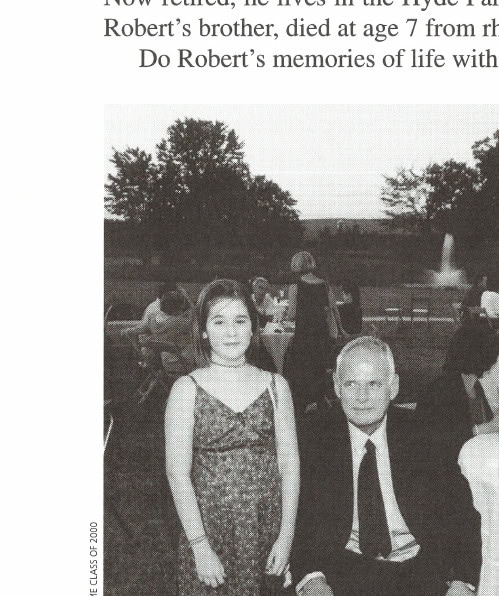
“Runners today are mostly professionals. In the past it was a part-time job. A blend of qualities came together that made him an all-American sports hero, almost a myth. I never met him, but it’s a real good story. I like his son, whom I met at the Class of 2000 award ceremony in Utica, New York [at the Long Distance Running Hall of Fame].
“Clarence dominated Boston and was one of the best in the world. The sport is more global today. For pure running ability, Paavo Nurmi, a Finn, was the top
runner in the world. Frank Shorter is the greatest American runner of all time. He didn’t do it at Boston, but he did it in the ’72 Summer Olympics. Clarence is a wonderful figure in Boston—that is one fine record. It probably won’t be broken. Nobody has won Boston four times in a row. It’s one heck of a major challenge.”
The words that are associated with Clarence DeMar (feisty, ornery, principled, caustic) can be capped with “legend.” An ordinary man living an ordinary life on a 16-acre farm in Reading, Massachusetts, who regularly went out into the world and established himself as a force to be reckoned with in road racing. Sort of like Clark Kent and his alter ego.
French Quarter ✤
Esplanade Ave. ✤
City Park ✤
Uptown New Orleans ✤
Garden District ✤
Audubon Park ✤
Prytania Street ✤
Bayou St. John ✤
Canal Street
Marathon · Half Marathon · 5K
504.454.8687
www.mardigrasmarathon.com
This article originally appeared in Marathon & Beyond, Vol. 6, No. 6 (2002).
← Browse the full M&B ArchiveMore like this
1,000+ stories from 19 years of Marathon & Beyond
The complete archive of the legendary long-distance journal — digitized and free to read.
