

The Way We Were
We recently had the opportunity to go sailing on San Francisco and San Pablo Bays with some friends. Their 17-year-old son came along. At one point, we oldsters were talking about how when we were kids there were only three channels on television.
That conversation led to a discussion of our favorite television shows, which led to memories of how we had to set aside certain evenings when we wanted to see those shows. The 17-year-old appeared to be perplexed. He wanted to know why we didn’t just DVR them. We were nearly as perplexed that he felt “DVR” was a verb.
Back then, there was no such thing as a DVR, his father explained to him. There wasn’t even a VCR. You set the evening aside if you wanted to see your favorite show. The kid appeared as astonished as he would have been had baby bats come fluttering out of our ears. “But—” he said, and then he had no point of reference to finish his sentence.
We more-mature adults (read that as “geezers”) went on discussing some of the shows we watched as kids, and the kid went on regarding us as potential exhibit pieces for the Smithsonian.
On the ride home at the end of the day, the same subject came up in a different context: that of running and how today’s runner hasn’t got an inkling of how it used to be . . . not that long ago.
Take, for instance, sports drinks.
Gatorade still dominates the field, as it has since it first invented the concept of sports drinks.
Today Gatorade comes in numerous iterations and a mélange of colors and flavors, including frost glacier freeze and fierce grape. And it tastes pretty dern good, which it didn’t when it was first marketed. The theory was that Gatorade was supposed to replace what an athlete lost when he played sports—sweat. (Back in those days, women did not sweat—they glowed, if they happened to participate in sports at all.) So to be quite frank, the original Gatorade tasted like . . . sweat. Like fierce sweat. Best served chilled.
Over on the ultra side of things, New Jersey ultrarunner Tom Osler experimented on himself during 24-hour track runs by brewing up enormous quantities of highly sugared tea. He was a math teacher, so he went about his running and his racing and his experimenting on himself with great logic and a very rational mind. He started out with some sugar in his tea and then added some more, and then more, until he had what he thought of as an ideal blend that would fuel his body but that would also keep his mind sharp, since the human brain runs primarily on simple sugar. He was quite successful, winning 25K and 30K national championships and pioneering methods of surviving 24-hour races.
Some of us felt that raw sugar would eventually upset our digestive system, so we used canned fruit nectars and Nutriment, a high-calorie supplement much like today’s Ensure. For the less sophisticated, there was always Kool-Aid, salted with additional sugar.
What to use to transport the sports elixir? There were no sports bottles in those days, so some of us put our secret drink mixes in those plastic squeezable bears that honey comes in.
In the late 1970s, while I was working for Runner’s World, we were marketing a competitor to Gatorade called Body Punch. The astute sportsmedicine guru, Dave Costill, developed the drink mix. Like the Gatorade of the time, Body Punch came in powder form in a handy packet. When I did the first Cow Mountain 50-Miler in the mountains east of Ukiah, California, in October 1978, I took along a case of Body Punch so that Gordy Ainsleigh, the race director (he had launched the Western States 100 several years before), had some sports drink to put out along the course. As had been the case with the Western States 100, the Cow Mountain 50 was being run nearly simultaneously with a horse race. (The runners started, in the dark, 45 minutes before the horses.) There were no sports-drink dispensers in those days, so Gordy simply went ahead up the mountain in his bargelike Cadillac and dumped the Body Punch in whatever horse troughs he could find. When we arrived at a horse trough, we had to dip our plastic-bear bottles into the trough, brush off the horse whiskers that floated on top of the Body Punched water, and head off. I imagine that many of the horses were pleased to find that they had some extra energy over the course because of sharing the Body Punch with the runners.
Many of today’s runners are astonished to learn that the Boston Marathon didn’t begin to put water out on its course until 1978, and then only reluctantly after 1977 winner Jerome Drayton, a Canadian, protested that it wasn’t fair to the runners to have to run an entire marathon without access to water other than what spectators offered along the course or that local runners had their friends hand them at various spots along the racecourse. Today’s aid stations, especially those at an ultra, are like a smorgasbord compared with what the early aid stations offered.
Then there were shoes and apparel.
When running cross-country in college in the mid-’60s, we practiced in red cotton shorts, a basic gray T-shirt, and a pair of then-incredibly-comfortable Converse training flats in basic black and white. The shorts chafed the inner thighs, the flats were often too narrow and therefore tight, and we had a tradition of washing our T-shirts only once a week; the object was to accumulate so much sweat in the T-shirt that when it dried, the shirt could be stood up in the corner of your dorm room. Of course for meets, we cross-countriers, being the catfish of the college sports food chain, wore discarded track uniforms.
For many of us getting back into long-distance running in the 1970s, our first stop was at a J.C. Penney to buy another pair of guaranteed-to-chafe cotton gym shorts. By then the slick, new running flats were hitting the market: Nike Waffle Trainers and Adidas leather Country models. Rather than discarding the shoes when they wore down, we sent them to a running shoe resoler who used a pair of pliers to rip off the worn soles and then replaced them with his custom rubber soles. (I still have my Adidas Countries with the replacement soles, the ones I wore in my first marathon. I have stopped taking calls from the Smithsonian.)
Of course, going back into the early part of the 20th century, marathoners wore dress shoes that they “modified” by slicing off parts of the thick soles and heels and by cutting vertical slits in the shoes to make them more flexible and breathable. Marathoners ran expecting to suffer severe blisters from their shoes.
Then there’s the matter of race organizing, which today is virtually rocket science.
For the last several years at the Kaiser Permanente Napa Valley Marathon, we have been using the D-tag timing system—the one that gets looped through the shoelace and is disposable so that volunteers don’t have to commit cruel and unusual acts upon exhausted finishers by making them stand still at the finish line, which turned them into a giant muscle spasm until the ChampionChip was cut loose. We’ve only used them for the past several years, being reluctant to embrace a new technology until the bugs had been worked out. During the transition period (when we scored the finishers using both the D-tag and traditional scoring methods in order to ensure accurate timing), we had several runners who insisted that without the chip involved, the scoring could not possibly be accurate and therefore they were going to enter a marathon that was going to score them fairly.
“Just how do you think races have been scored for the past century?” we asked. The question had never occurred to them. Sub-four-minute miles and a century of road races had all been scored successfully, thank you very much, by stopwatches where the hands of the clock spun around and could be stopped when appropriate. The doubters continued to insist that their times would not be accurate if they were not scored with a chip. We can only assume that they were so obstinate because they were going for the world record and wanted to have all the scoring bases covered.
We didn’t have the heart to explain the old Popsicle-stick method of scoring.1 They would have been appalled. We also didn’t get into the fact that American road runners were running much faster on the whole before the chip came along than they have been since, and it wasn’t a matter of previous timing and scoring methods being inaccurate enough to allow for fudging times. (Question: When is the last time that 20 or more American men ran under 2:15 at the Boston Marathon? Answer: 1983.)
We could go on and on and on about the Good Old Days. And they were. We were innocent, motivated, and such a low silhouette on the horizon that no-
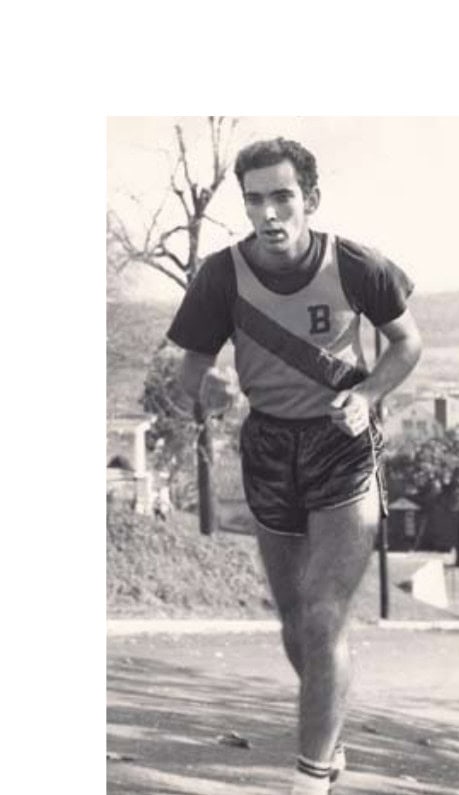
John J. Kelley, known to Boston Marathon fans as Johnny “The Younger” Kelley to differentiate him from John A. Kelley, “The Elder,” died early Sunday morning, August 21 from a melanoma that spread to his lungs. He was 80 years old.
One of the most personable and inspiring marathoners of his time, Johnny holds the distinction of being the only Boston Athletic Association member to ever win the famed marathon, which he did in 1957. He also holds a record that will likely never be matched: for eight years in a row (1956-1963) he won the national marathon championship held on the tough Yonkers course. To make the feat doubly astonishing, the Yonkers race traditionally came only a few weeks after Boston, which Johnny ran regularly.
Johnny was mentored by Johnny “Jock” Semple, the major-domo of the Boston Marathon. In turn, Johnny mentored Amby Burfoot, who was the only American to win the Boston Marathon in the decade of the 1960s (1968). Johnny was an English teacher at Robert Fitch High School in Groton, Connecticut, where he coached Amby.
Someone who personified the term “nice guy,” Johnny was a magnet to young runners, who inundated his house, eager to hear Johnny’s stories, to go on runs with him, and to fit into an environment that was always welcoming and warm.
Johnny was also a fine writer, and on many occasions he graced the pages of this magazine with vivid tales of his running exploits.
A major feature on our friend Johnny “The Younger” will be carried in the January/February issue.
This article originally appeared in Marathon & Beyond, Vol. 15, No. 6 (2011).
← Browse the full M&B ArchiveMore like this
1,000+ stories from 19 years of Marathon & Beyond
The complete archive of the legendary long-distance journal — digitized and free to read.
