

Hey!Back Off!
Iattended a high school that was known for its swimmers. They were the best in the country, and some of them competed in the Olympics. Before championship meets, you could overhear amusing discussions in the hallways about “shaving down” and “tapering” in an attempt to swim faster. As a member of the crosscountry and track teams, I was also interested in getting faster. So I couldn’t help but eavesdrop. “What were these odd-sounding things?” I wondered. “Could they work for me, too? Do swimmers have a secret?”
The idea of progressively reducing, or tapering, the training load has been a long tradition among swimmers, the most often-studied athletes in regard to tapering. While it’s not necessary as a runner to shave all of your body hair to run faster, you may benefit from tapering your training. Since most marathoners, either by training or by nature, are a driven bunch, it seems unnatural to cut your weekly mileage to a fraction of your current training. Competitive marathoners think they should always do more. But that’s one of the most interesting things about fitness—the adaptations to training occur during the recovery periods from the training, not during the training itself.
The positive physiological adaptation to training is the result of a correctly timed alternation between stress and recovery. Following a training stress, your body adapts and physiologically overcompensates so that the same stress, if reintroduced, does not cause the same degree of physiological disruption. In short, your fitness has improved. When you taper your training, you provide your body the opportunity to recover, adapt, and overcompensate to the training you have done so you are prepared to run your best race.
PERFORMANCE EFFECTS OF TAPERING Most research on runners, swimmers, and cyclists has shown that improved performance (from 0.5 to 6 percent) is more likely to occur after a period of tapering. Studies on runners have been limited to 800-meter performance,5,6 time to fatigue on a treadmill at 1,500-meter race pace,9 5K performance,3 and treadmill half-marathon performance.2 As with any type of training, these studies have
shown a large individual response to tapering. Two of these studies, one using 800 meters5 and the other using a treadmill half-marathon2 as the performance measure, found that while tapering had a positive effect on selected physiological parameters, it did not have an effect on performance. Regarding the latter study, it’s possible that racing two half-marathons only a week apart precluded the runners from improving in the second one. Possibly for the same reason, no studies have examined the effects of a taper on marathon performance.
PHYSIOLOGICAL EFFECTS OF TAPERING A number of physiological changes occur during the taper period. Among the most prominent are changes in the characteristics of the blood, including increases in red blood cell volume, total blood volume, and reticulocytes (immature red blood cells), and improvements in the health of red blood cells. These hematological changes reflect a positive balance between hemolysis (the degradation of red blood cells) and erythropoiesis (the production of red blood cells) leading to greater oxygen-carrying capability and, often, improved performance.
Tapering also increases muscle-glycogen content (giving you more fuel), aerobic-enzyme activity (allowing for greater aerobic metabolism), and muscular strength and power, and it increases or maintains maximum oxygen consumption . (VO2max). A decreased level of creatine kinase in the blood (an indirect indicator of muscle damage), which reflects an increased recovery, has also been consistently found following a taper.
Although no studies have examined the effects of tapering following different volumes of training, it’s likely that the more running you do prior to the taper, the more you will benefit from the taper. For example, if you run 80 miles a week prior to tapering, chances are that you will reap a greater benefit from your taper than if you run 30 miles a week prior to tapering.
TAPER DURATION The goal of tapering is to recover from prior training without compromising your previous training adaptations. In other words, you want to decrease fatigue without losing fitness. Unfortunately, research has not clearly established the time frame separating the benefits of a successful taper from the negative consequences of insufficient training, leaving most athletes and coaches to take a trial-and-error approach. Since studies on tapering in runners have used only one-week tapers and have not examined the taper’s effects on long-distance running performance, it’s difficult to speculate whether one week is ideal for the marathon. Typically, the longer the race, the longer the taper, so you should probably taper for two to three weeks before your marathon. The exact duration of your taper will vary depending on your prior training load, your level of fatigue, and your genetically
predetermined ability to retain your training effects while reducing the training stimulus (that is, how quickly you lose fitness). Obviously, if you tend to fall out of shape fast, you don’t want a long taper. Positive physiological adaptations and performance gains have been found using tapers lasting six to seven days in college-aged runners, four to 14 days in cyclists and triathletes, and 10 days in strength-trained athletes.7 Masters runners (over age 40) who take longer to recover from hard training may need to taper for longer than one week.
A study on female swimmers published in the Journal of Swimming Research in 1998 found that two weeks seems to be the longest time to receive the benefits of a taper before detraining begins,4 although tapers lasting up to 35 days have been shown to be effective in swimmers. Because technique plays a greater role in swimming than in running, swimmers may be able to get away with a longer taper since technique will likely not deteriorate at as fast a rate as physiological variables.
TAPER VOLUME AND INTENSITY Every high school track coach in the country knows that the fastest way to get athletes in shape is interval training. Research has shown that to improve or maintain fitness, the intensity of training is more important than either the volume (the weekly mileage) or the frequency (the number of days per week). This seems to also be the case when tapering.
You can reduce your weekly mileage dramatically during the taper as long as you keep the intensity high. Reductions in mileage of up to 60 to 90 percent have been found to be beneficial during the taper period. For example, a study published in Journal of Applied Physiology in 1992 found that college middledistance runners significantly improved treadmill time to fatigue at 1,500-meter race pace and increased their blood volume, aerobic-enzyme activity, and muscleglycogen concentration when using a one-week, low-volume/high-intensity taper (85 percent reduction in mileage and five x 500 meters at 800-meter race pace with six to seven minutes of recovery, decreasing by one rep each day for five days), but not when . using either a moderate-volume/low-intensity taper (six miles at 60 percent VO2max, decreasing by 1.25 miles each day for five days) or a taper with no running at all.9 Other studies have also found that a large reduction in volume accompanied by an increase or maintenance in intensity improves training-induced adaptations.
A study published in Dynamic Medicine in 2005 found that competitive cyclists who underwent a seven-day taper that included a 50 percent reduction in weekly training volume significantly decreased muscle oxygenation (meaning a greater use of oxygen) in the quadriceps during a 20K time trial and significantly improved their time-trial performance.8 Comparatively, cyclists who underwent
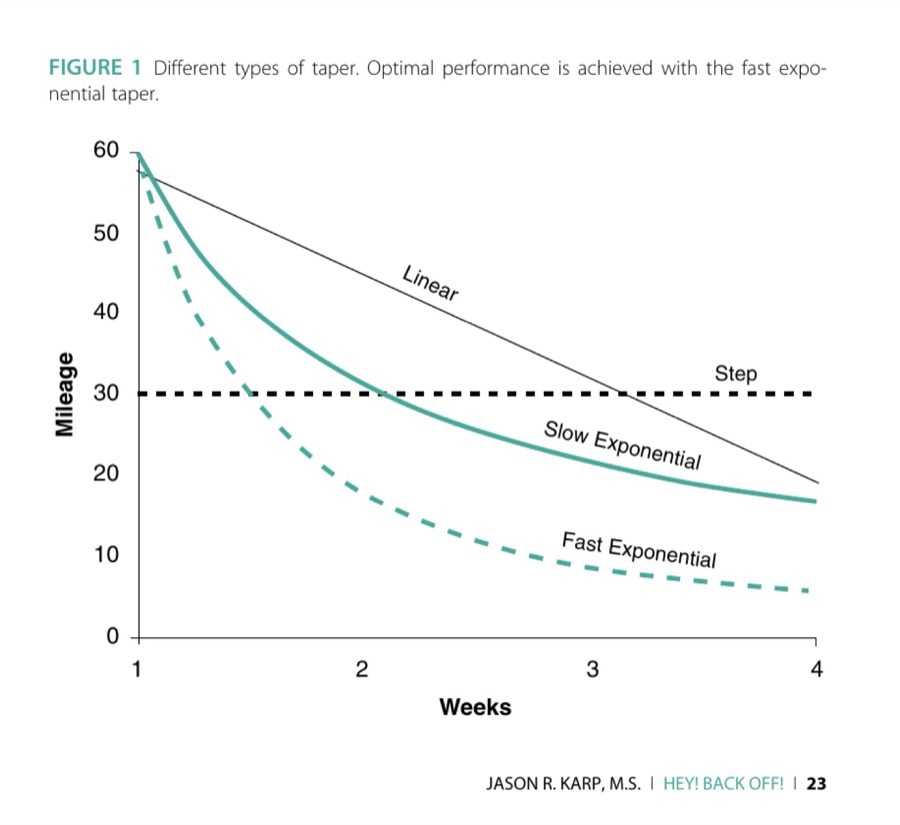
a taper that included a 30 or 80 percent reduction in weekly training volume did not significantly improve oxygen use or time-trial performance.8 Using a mathematical modeling approach, a study published in Medicine and Science in Sports and Exercise in 2005 found that training volume should be reduced in a progressive (linear or exponential) manner rather than by a single-step reduction.10 Furthermore, overload training (that is, a daily training load greater than the optimal level) prior to the taper would result in a better performance after the taper than if overload training did not precede the taper. The researchers concluded that the best performance would be achieved with a 39 percent reduction in training load for 28 days. If overload training does not precede the taper, the best performance would be achieved with a smaller reduction of training for a shorter period (31 percent reduction for 19 days). Another study using both mathematical and experimental approaches published in the European Journal of Applied Physiology in 1999 also found that an exponential taper was better than a step-reduction taper and that a fast, exponential taper was better than a slow, exponential taper.1 In other words, reducing your training quickly and exponentially is better than reducing it slowly and in a single step (Figure 1). FIGURE 1 Different types of taper. Optimal performance is achieved with the fast exponential taper.
60 50 Lin
ear
Mileage
40
Step
30 Slow
Expo
20
nentia
lFast Exp
onential
10 0 1
2
3
4
Weeks
4
5.5
Week 2
Week 3
• 2 warm-up • 4 x 1,200 meters @ 10 sec per mile faster than LT pace w/45 sec rest • 2 warm-down
6
9
Tues
7
8@ goal MP
• 2 warm-up • 6 x 1,000 meters @ 3K race pace w/2 min jog recovery • 2 warm-down
Wed
5
5
8
Thurs
3.5
7
9
Fri
Rest
Rest
Rest
Sat
Marathon
5+5@ goal MP
9 + 4 @ LT pace + 2 faster than LT pace
Sun
*Mileage depends on the pretaper training volume. This example is based on a pretaper peak weekly mileage of 80.
7
Week 1
Mon
Numbers represent miles. LT = lactate threshold. MP = marathon pace.
Example of Premarathon Taper
28 + marathon
40
56
Total Miles*
PRACTICAL APPLICATIONS You can probably expect to improve your marathon performance by reducing your weekly mileage exponentially for two to four weeks and including interval training (if you have already been doing so before the taper) to maintain training intensity. As you get closer to the marathon, also reduce the volume of intensity by reducing the number of intervals in each session. Although research has shown that reductions in training volume up to 60 to 90 percent can improve performance, the research is limited to much shorter races that are not as endurance dependent as the marathon. Because of the length of the marathon, and thus its large dependence on aerobic capacity, it’s probably better not to decrease mileage by as much as 90 percent.
I typically begin cutting my athletes’ mileage and the length of their long runs three weeks before the marathon (or up to a week later if they haven’t been running high mileage). I reduce peak mileage by 30 percent for the first week, 50 percent for the second week, and 65 percent for the week of the marathon (not counting the marathon itself). I keep the intensity high during the first week, including one interval workout at 3K to 5K race pace and one moderately long run (13 to 15 miles) with slightly less than half at lactate-threshold pace (about 15 to 20 seconds per mile faster than marathon race pace for highly trained
ad
runners). I begin to decrease the intensity slightly during the second week, including two short- to medium-distance runs (five to 10 miles) at marathon race pace. The week of the race, I include one interval workout early in the week at either lactate-threshold pace or slightly faster, cutting back on the pretaper number of reps. The final week also includes a daily reduction in mileage over the last few days that mirrors the pattern of the weekly reduction (see
Example of Premarathon Taper on page 24). Obviously, what you do during your taper will depend on what you did before the taper. If you want to give your performance a boost, try these tapering strategies before your next marathon. And if you taper smart enough, maybe you won’t have to shave your body hair.
REFERENCES Banister, E.W., J.B. Carter, and P.C. Zarkadas. 1999. Training theory and taper: Validation in triathlon athletes. European Journal of Applied Physiology 79(2):182191. 2 Child, R.B., D.M. Wilkinson, and J.L. Fallowfield. 2000. Effects of a training taper
on tissue damage indices, serum antioxidant capacity and half-marathon running performance. International Journal of Sports Medicine 21(5):325-331. 3 Houmard, J.A., B.K. Scott, C.L. Justice, and T.C. Chenier. 1994. The effects of taper
on performance in distance runners. Medicine and Science in Sports and Exercise 26(5):624-631. 4 Kenitzer, R.F. 1998. Optimal taper period in female swimmers. Journal of Swimming Research 13:31-36. 5 Mujika, I., A. Goya, S. Padilla, A. Grijalba, E. Gorostiaga, and J. Ibañez. 2000.
Physiological responses to a 6-d taper in middle-distance runners: Influence of training intensity and volume. Medicine and Science in Sports and Exercise 32(2):511-517. 6 Mujika, I., A. Goya, E. Ruiz, A. Grijalba, J. Santisteban, and S. Padilla. 2002.
Physiological and performance responses to a 6-d taper in middle-distance runners: Influence of training frequency. International Journal of Sports Medicine 23(5):367-373. 7 Mujika, I., and S. Padilla. 2003. Scientific bases for precompetition tapering strategies.
Medicine and Science in Sports and Exercise 35(7):1182-1187. 8 Neary, J.P., D.C. McKenzie, and Y.N. Bhambhani. 2005. Muscle oxygenation trends after tapering in trained cyclists. Dynamic Medicine 4:4. 9 Shepley, B., J.D. MacDougall, N. Cipriano, J.R. Sutton, M.A. Tarnopolsky, and G.
Coates. 1992. Physiological effects of tapering in highly trained athletes. Journal of Applied Physiology 72(2):706-711. 10 Thomas, L., and T. Busso. 2005. A theoretical study of taper characteristics to
optimize performance. Medicine and Science in Sports and Exercise 37(9):1615-1621. 1
This article originally appeared in Marathon & Beyond, Vol. 11, No. 3 (2007).
← Browse the full M&B ArchiveMore like this
1,000+ stories from 19 years of Marathon & Beyond
The complete archive of the legendary long-distance journal — digitized and free to read.
