

Jason Kehoe—In Memoriam
“Some people cast shadows on one’s life, while others are etched in one’s being and their outline remains clear and strong forever. There are many shadows, fewer silhouettes.”—Elisabeth Reavis
These lines my mother wrote to me in 1983 came to mind when I heard the sad news of the passing of my old friend, Jim “Jason” Kehoe, the longtime assistant manager of the Bill Rodgers Running Center in Boston, who died of natural causes at his home in Hull, Massachusetts, on June 3, 2012, at the fartoo-young age of 64.
Those of us lucky enough to have called him friend knew Jason as one of the indelibly etched characters in our lives and a major supporting player in the colorful cast that populated the Boston running community during, through, and beyond the running boom.
For me, Jason’s outline was recognized early on and never diminished, not when I moved thousands of miles away or even now when he has departed for dimensions unknown. In his 35 years as assistant manager of the Bill Rodgers Running Center, he liberated thousands of people from the shackles of a sedentary existence with his Socratic sales method—thus unbinding many minds, as well. But through it all, Jason became close to only a fortunate few, as he lived in the same uncompromising, utilitarian way that the clock reveals talent, training, and effort over distance. “
It is what it is,” might be his terse way of stating it. Growing up in the Hartford suburb of Newington, Connecticut, Jason was a childhood friend of running legend Bill Rodgers and his older brother, Charlie. While Bill was the standout two-miler on the Newington High track team, Jason was the long-legged miler who once held the school record at 4:44, run on a grass track.
After graduating from college in 1970, Jason and Bill moved to Boston, where they shared an apartment and caroused the ample local bar scene. Coincidentally,
Courtesy of Bill Rodgers Running Center
they first ran across the old finish line of the Boston Marathon on Ring Road while returning home after a late night out in Cambridge. Finally, Bill got back into running after the used Triumph 650 motorcycle he bought, with a loan from Jason, was stolen. Soon the latent talent first displayed at Newington High School blossomed into the world-renowned, Peter Pan-like marathon champion who helped expand the running boom worldwide. When Bill opened his first running store in November 1977 in Cleveland Circle after his second Boston and New York City Marathon titles, Jason came along and became a fixture.
Like so many of our generation who had been bequeathed the tools for success by parents molded by the Depression and steeled in war, Jason felt conflicted about striving for it as defined by his parents’ age. That resistance to conformity became the focal point for the rebellion he carried through college at Central Connecticut State, then into his running—and later rowing—years. From his carefree head of hair to his careless choice of clothing, it all bore an inflection of coming of age in the ’60s.
Despite his natural charm and a sharp, incisive intellect, Jason never sought to mainstream his talents. Instead, he chose the more placid waters of service to lifelong friends who had embraced the running movement the same as he. Though it gave him purpose, even there he never adopted the definitions of success as defined by convention where want holds dominion. He lived a simple
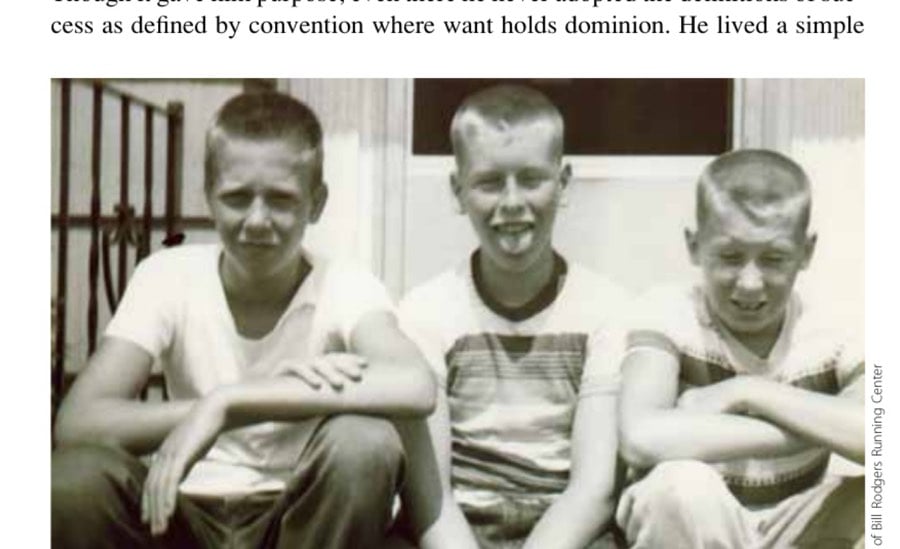
▲ Friends first and forever: Jason Kehoe, Charlie Rodgers, and Billy Rodgers, as kids in Connecticut.
Courtesy of Bill Rodgers Running Center
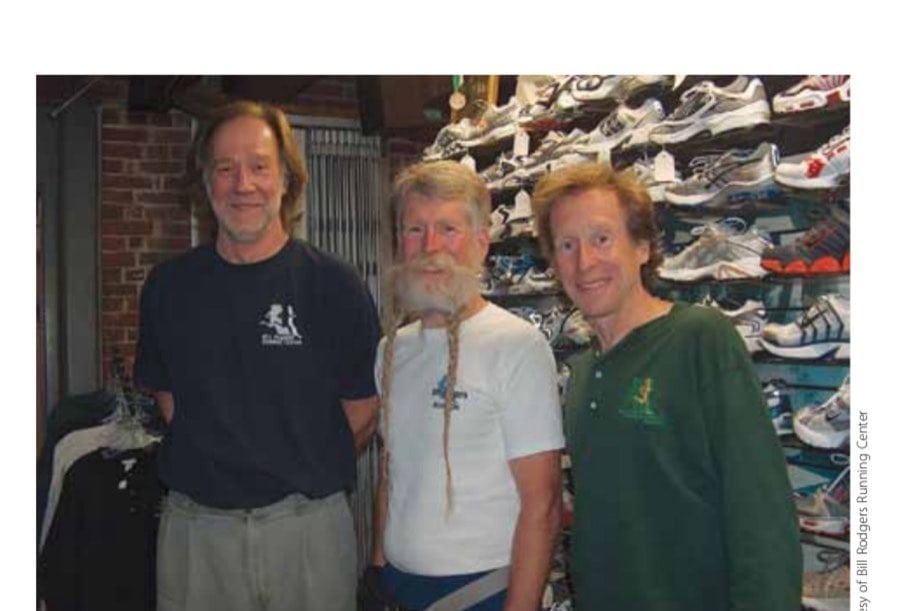
▲ Jason, Charlie, and Billy at the Bill Rodgers Running Center in Boston.
existence, and when everyone was headed in one direction, by nature, Jason was headed in the other. He chose restaurants not by their fare but by which was least crowded. “I’d rather be there than here,” was one way the caustic contrarian expressed his piquant worldview.
After Billy won his third Boston Marathon in 1979 against his Japanese rival Toshihiko Seko in an American record 2:09:27, we all met back in Cleveland Circle, which is where I lived at the time. When the crowds still lining the course saw Bill arrive at his store on Chestnut Hill Avenue at Beacon Street, they erupted in a lurching frenzy of appreciation and acclaim.
Wading through the masses while towering over the crowd at his 6-foot-5-inch height, Jason turned and remarked offhandedly, “Toni, these are the good old days.” As always, Jason had caught and then expressed the moment perfectly. And while the days ahead will be much less so without his keen presence, I can still see his profile against the red brick-face of Boston, where, in my mind, it will remain clear and strong forever.
And so, dear friend—fittest guy to never break three hours in the marathon because you were always more of a middle-distance man than marathoner—I won’t say “So long.” Rather, I say to you now what you always used to say when our roads parted, “Till then,” hoping, somehow, that it might still be true.
This article originally appeared in Marathon & Beyond, Vol. 16, No. 5 (2012).
← Browse the full M&B ArchiveMore like this
1,000+ stories from 19 years of Marathon & Beyond
The complete archive of the legendary long-distance journal — digitized and free to read.
