

Just Call Me Jock
Editor’s note: In ages past, giants walked the earth—and often strode out, racing the sun, howling at the moon, propagating the legends of long-distance runners that emanated from nearly every culture on Earth, from the Hawaiians to the American Indians, from the Tibetan monks to the Greek soldiers. Run. Run like the wind and deliver your message to the anxious throng. Outrun the stag and the horse and the wolf; leave them panting on the side of the road, spent and exhausted, overheated and near death. Run far, run hard—because you can and because you feel you must.
As the 19th century expired and the 20th erupted, the “marathon” was born and reached puberty as an extravagance of sociological extremes: college bluebloods and blue-collar laborers. The marathon had never been a sport of the elites. In Greece the hemorodromi were day laborers: working from sunrise to sunset over the hard ground delivering messages. The elite were the sprinters. The long distances always lured the eccentrics, the misfits, the aerobic astronauts. The sprints were run on nerves, the distances on pacing and patience and often patriotism. (Boston is run, after all, on Patriots’ Day.)
The marathon in America, its colors held aloft most conspicuously by the Boston Athletic Association and its annual Boston Marathon, drew men both colorful and unforgettable: the straight-laced Clarence DeMar, the uninhibited “Tarzan” Brown, the cigar-smoking and champagne-swilling Canadian Gerard Cote, the bohemian Frank Zuna.
And perhaps Boston’s most cantankerous, colorful, and cussed character of all, John “Jock” Semple, the Scottish immigrant who likely managed to save the Boston Marathon and the BAA itself from oblivion.
At one point in its existence, the once-fabled BAA was reduced to the contents of several cardboard boxes stacked in the corner of Jock Semple’s “Salon de Rubdown” in the Boston Gardens, where Jock massaged everyone, from tired marathoners and sore Boston Celtics to famed boxer Jack Dempsey.
Jock was a decent marathoner himself but more a promoter of the sport—an acidic, ascetic, avenging archangel who brooked no bending of the rules, no tattering of the image, no besmirching of the true faith of long-distance running in general and the Boston Marathon in particular.
He became most famous for jumping off the press bus during the 1967 Boston Marathon to attempt to tear the number (#261) off of Kathrine Switzer, a member of the Syracuse track team, who had signed up for the marathon as “K. Switzer” at a time when women were not yet welcome in the famed race. Kathrine’s boyfriend body-blocked Jock, and the delighted press on the bus Jock had just exited had a field day recording the confrontation. In one instant, Jock had bounced the women’s running movement a thousand strides forward. In typical Jock fashion, he and Kathrine later became close friends; to Jock, what he had attempted to do to Kathrine was only his duty, and he always took that more seriously than social convention or convenience.
One of the highest points in Jock’s career came in 1957 when his protégé, John J. Kelley, became the first member of the BAA to win the club’s own event.
John J. Kelley and his friend Tom Murphy teamed up in 1982 to work with Jock to write an autobiography/biography of the fiery Scot. This is that book, brought to you in serialized form, in the hopes of reacquainting those who knew Jock with one of running’s giants and to introduce those who have never heard of him to one of the sport’s most colorful characters.
Jock died March 8, 1988. He was 84.
But then, giants and legends don’t really die, do they? They merely move their address to a higher plane and look down with scorn or amusement at us mere mortals. Considering the current burgeoning status of the sport and lifestyle of marathoning, there’s little doubt that Jock gazes down with a mixture of alarm and amusement.
INTRODUCTION
By Amby Burfoot
East Coast Editor, Runner’s World
and 1968 Boston Marathon Winner
To tell the truth, I can’t actually remember the first time I met Jock Semple. In New England road racing circles, you see, the legend preceded the man. As a teenager first testing myself on the roads in the early 1960’s, I heard Semple stories everywhere. The best—most intimate and improbable—were recounted by members of his beloved Boston Athletic Association running club. (Did one of them really tell me that on a 600-mile drive into Canada Semple once stopped, worried about a worn front tire, to patch the balding rubber with athletic tape?) But you didn’t have to belong to the BAA to know Semple. He considered no man beyond his purview and was famous for his last minute, locker room sweeps: “Awright, all you bums and laggards, get outta here. The gun goes off in five minutes.”
From there he took to the roads himself. Usually he would drive the course in some behemoth vehicle, and a good thing too, as these were not only pre-gas crunch days but pre-running boom as well. Jock functioned as a pace car, police force, water stop and coach. An indelible image: I am running a Sunday road race, mid-1960’s, in one of the countless towns ringing Boston, perhaps Semple’s own Lynn. It is a ten-mile race, in July, and after six miles everyone is beginning to flag. I am struggling to stay up with Ken Mueller, a BAA member; we’re in the bottom half of the race’s top ten. The scenery—alternating used car lots, furniture warehouses, and bars—does not inspire. Occasionally we veer out from the curbside to avoid a broken beer bottle.
The sound of our heaving breath is broken by a car squealing around a corner. Tiredly, we turn our heads. Semple is zooming up behind us. He is driving with his right arm, while the rest of his body is leaning far out the front window, turned backward, to better inspect the long line of runners and count positions. Though he cannot see ahead, the pressure on the accelerator remains constant. In a moment he has passed us, stopped the car, and raced across the street with cups of water. “C’mon Muuer,” he screams at Ken, “Millrose is coming up behind you. We need your place. Don’t lose it.”
He storms back to the car, more red-faced than we are, and punches it hard up the road, hoping to find a BAA runner out ahead of the lead pack. Two miles farther down the road the same scene repeats itself.
Semple is, of course, a man meant to be heard. The typewriter can never do justice to the fusillade of fiery words, the inflections, the old world metaphors. Once before the Boston Marathon when I visited Jock in his Boston Garden training room, he picked up one of the daily dozens of pre-marathon phone calls. “Hello,” he growled into the receiver. Then, after a brief pause to listen: “I’m the stooge who does all the work. Whaddya want?”
But my favorite Semple outburst took place at a classy, New York press conference, proving that he does not temper himself to the social strata. This was a press conference hosted by Avon, the women’s cosmetics firm, and organized by Kathrine Switzer. Switzer, you’ll recall, is the woman who made Semple (in)famous, and vice versa when he attempted to bully her off the Boston Marathon course in 1967 because the AAU did not then permit women to run marathons. “I didn’t have anything against her,” Jock has always insisted, “but I was always taught to uphold rules and regulations.”
Anyway, he and Kathrine had long since made their peace and she shrewdly invited him to the press conference at which she announced the formation of the Avon Women’s Running Circuit. After introducing Semple and other invited guests, Switzer outlined the organization of the running circuit, and then opened the floor to questions from reporters. Someone immediately asked what she would do if a man tried to enter one of the women-only races. Semple, who had been seated up front, was on his feet and crimson before Switzer had a chance to answer. Turning and almost accusing the questioner, he raged, “No good runner would ever do that. And I’d call him a schmuck. I can’t spell it but that’s a Jewish word meaning a bum, a joker, a tramp, a no-good.”
Of course, Jock’s story is inevitably intertwined with the Boston Marathon, and well I remember the first years I ran Boston. With fields numbering under a thousand, we didn’t need elaborate seeding arrangements. There were no National Guard, no roped-off sections, no mile-time placards. Semple took care of everything. His only equipment was a burly shoulder. If you wore a high number, you didn’t dare edge forward. If you had a unicorn on your racing jersey, Semple found a place for you in the second or third row even if you weren’t one of the swiftest. It was, after all, the BAA Marathon.
Just before the gun, he would disappear into the press bus, and I wouldn’t see him until after the race. Until one April day in 1968, that is, when I led the pack over Heartbreak Hill and found the press bus mere yards ahead as we began descending toward the Prudential Center. Moments like that you don’t forget. Nor will I ever forget the sight of the portly Scotsman (he’s slimmed down since then) forcing two-thirds of his body out a rear window and yelling, “Give it hell down the hill, Aaamby, give it hell down the hill.” I did and it made all the difference.
Sometimes I find it difficult to separate Jock, the man and the athlete, from Jock, the source of countless uproarious stories. But then I remember the framed Boston Marathon certificate hanging in his office (the certificate notes his seventh place finish in 2:44:29 in the 1930 Boston Marathon), and I remind myself that these certificates were an innovation of the 1970’s and I understand that he is a proud runner, like the rest of us. I remember, too, that I have almost never had a conversation with Jock in which he failed to mention the two running clubs of his life—the Clydesdale Harriers (of Scotland) and the BAA. If he’s not talking about Bill Rodgers or Patti Catalano, both of whom cut their road racing teeth with the BAA, he’s waxing enthusiastic over a high schooler or perhaps the club’s crack masters squad.
In the end, though, what I value most about Jock is his purely emotional character. In this age of plastic men formed sometimes by Madison Avenue, sometimes by the contradictory forces of life, Jock remains cast in an original and unchanging mold. He will never be packaged. He does not recite lines from a Teleprompter. His reactions spring from instinct and are expressed with a sputter and an instant opinion. While others debated the Rosie Ruiz case, Jock instantly declared, “She’s a fraud and a phony.”
Jock Semple is incapable of—does not know—the ways of vacillation, disingenuousness, putting on airs. You never have to guess where he stands. Despite the Boston Marathon’s strict qualifying standards (that he staunchly defends), despite the stories of bullying and club favoritism (that I have here added to), Jock is far from being an elitist. He has remained true to his own working class roots and working class introduction to athletics. All he asks is that you devote yourself to sport and honor as he has.
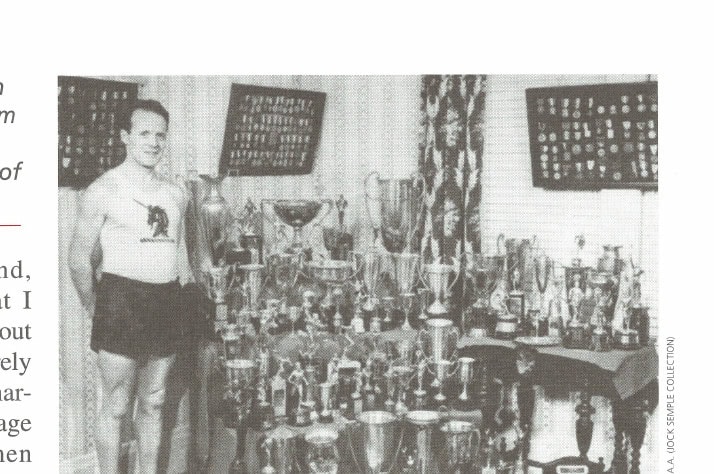
The afternoon before one Boston Marathon, as he shepherded over the tables where runners were picking up their numbers, Jock complained to me, “Oh Amby, my schedule is terrible. I’ve got to be here all afternoon, and then over to the Garden at five for the Bruins, and then back here tomorrow morning at five to lead everyone onto the buses. I don’t know how much longer I can keep this up.”
A tough schedule, true. Bone-wearying. But I didn’t find myself feeling sorry for Jock. I know a lament of love when I hear one.
FOREWORD
Welcome, reader, to Semple’s Salon de Rubdown. In the following pages you will come to know our feisty proprietor, who for 30 years has reigned as Boston’s dean of sports trainers. You will come to know him through both his own reminiscences and the memories of others, most notably John J. Kelley (Johnny the Younger), the man whom Jock the Scotsman inspired to revolutionize America’s perception of the marathon. The stories Jock tells here through author Tom Murphy are the stories he’s told time and time again in his rolling Scot’s burr. The narrative Murphy fashioned is intended to place you for a day in Jock’s Boston Garden cinderblock clinic where thousands of athletes and non-athletes have dropped in and out during three decades. Reminiscences, of course, are always subject to a twist here and an embellishment there; but perhaps this is fitting since such is the stuff of folk legend, and Jock is undeniably a legend among running folk. So welcome, and now join authors Murphy and Kelley for a portrait of one man’s tempestuous and loving life spent in sport.
Part One The Old Days
CHAPTER 1
Jock, the Baron of Glasgow
It’s 6:10 A.M. The sun casts its first vermilion splash over dusty Boston Garden as an old man shuffles up the worn terrazzo stairs to his tiny physiotherapy clinic.
Wearing a cotton jacket over his tee-shirt and white baggy pants, the old man once pushed a broom in a dingy factory in Scotland before becoming a great marathon runner, trainer, and ultimately co-director of the Boston Marathon. He turns the key in a chipped steel-plated door marked “J.D. Semple.”
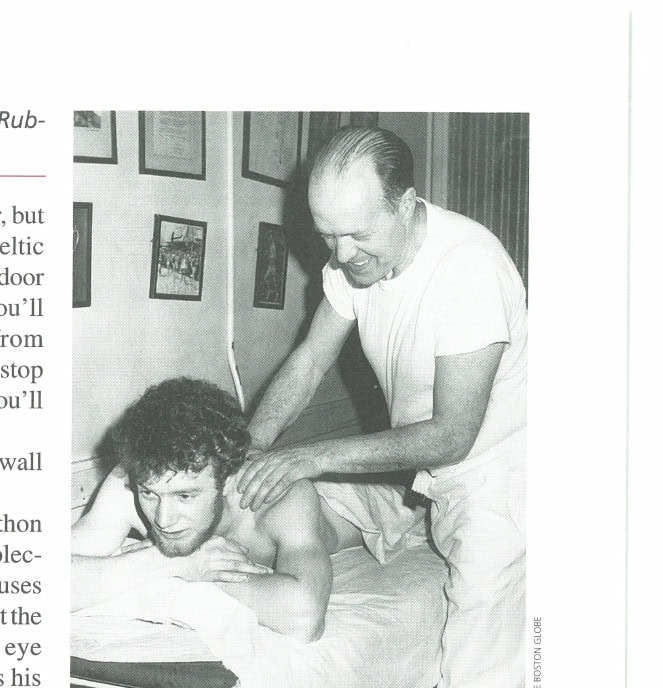
Inside he removes his coat and hangs it on a hook where the cinderblock walls of his cramped cubicle seep liniment fumes. Photos of great moments in the Boston Marathon curl inside their 69¢ Woolworth frames around him as he switches on the fan, diathermy machine, and hot box. He clears his desk with his forearm before glancing down at a mousetrap behind the door. The trap still sports the cheese, and he smiles to see that the Celtics’ cat is doing its job.
He puts new soap in the shower stall, then cuts the string on a tall stack of towels to finish prepping his clinic for his “patients,” as he calls customers who will begin arriving soon.
Nearly 80 years old, he continues to work six days a week attending to patients in his “Salon de Rubdown,” as Boston sportswriters Leo Monahan and Tim Horgan have dubbed his Boston Garden clinic. “I’ve gotten lazy,” he once told Monahan. “For 25 years I worked in my clinic seven days a week. Now I take Wednesdays off. That is, when I don’t come in.”
Above his desk laden with Boston Marathon mail, a plaque from Bobby Orr, one of his favorite patients, reads, “To Jock; A Guy Who Has So Many Friends Because He Rubs Everybody The Right Way.”
Semple has administered to athletes in a dozen sports over three decades. His skilled hands have kneaded many great names, including Orr, Cousy, Russell, Dempsy, Marciano, Newcombe, Laver, Conners, as well as the best of the top runners, Rodgers, Salazar, Catalano, the two Johnny Kelleys, Peters, Dodds, Hill, and on and on.
Always the running game has been his first love.
In 1934, long before the name Semple was synonymous with the Boston Marathon, the Boston Daily Record picked Johnny Semple to win the marathon.
“More than a half a million men, women and children will bank the 26 mile stretch between Hopkinton and Boston today to watch 239 runners bid for victory in the 38th Annual BAA Marathon,” the paper reported in a story which has changed little in intervening years.
“Over the hill and dell, distance runners from all parts of the United States and Canada will vie for the laurel wreath, emblem of victory, and the glory that goes with victory in the Boston Marathon.
“Chief among the veterans, the man for whom half a million voices will send up a thunderous ovation, is Clarence H. DeMar.
“(Nevertheless) Johnny Semple of the United Shoe Machinery Company, Beverly, Massachusetts, is the Daily Record‘s pick to win the long grind.”
Semple did not win. As he said, “I made a mistake and got on the bandwagon and ate a fat steak at Lucky Rock Manor an hour before the race.” Such was the convention in the old days. Runners, seeking to fortify themselves before attempting the 26-mile, 385-yard distance, tried to fit down two-inch steaks in the last moments before dashing to the Boston Marathon starting line.
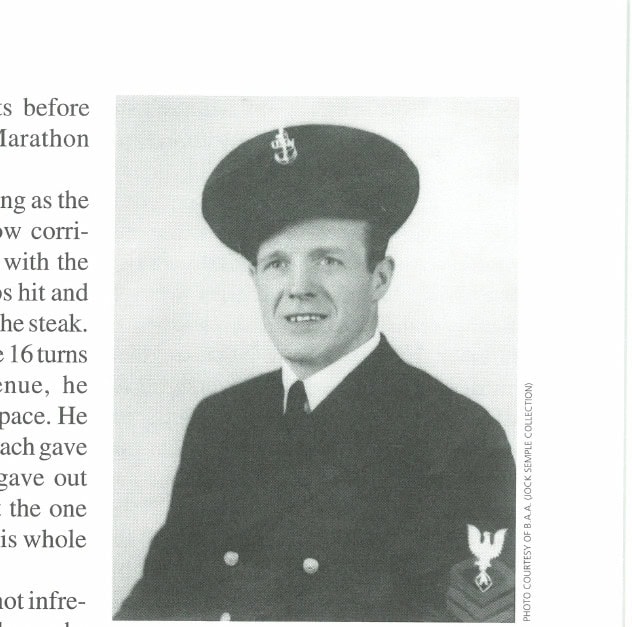
At Wellesley he ran strong as the coeds who formed a narrow corridor cheered for the runner with the red rosy cheeks. The cramps hit and he became nauseated from the steak. At Auburndale, where Route 16 turns into Commonwealth Avenue, he walked briefly and lost the pace. He ran again in fits, but his stomach gave in before his legs or will gave out and he lost his best shot at the one design that has consumed his whole life.
“I blew it,” he still says not infrequently from a perch beside a rubdown table in his clinic. “But I achieved my dream. When Johnny Kelley won the Boston Marathon in 1957, I won while standing behind the finish line.”
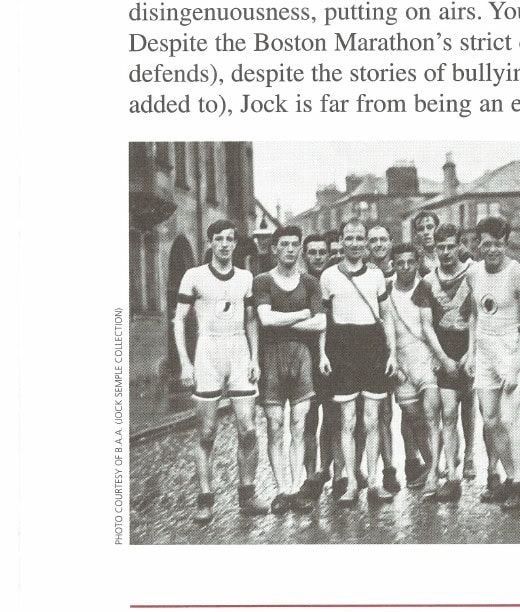
“Jock, the Baron of Glasgow,” his friends such as Pat Dengis, Clarence DeMar, and Jimmy Henigan nicknamed him in the 1930’s. Jerry Nason, the former Boston Globe sports editor, used the appellation in a column one day.
“Now nobody remembers my real name,” says the former Johnny, Baron of the Boston Marathon. “They all just call me Jock.”
Also called Mr. Boston Marathon, Jock Semple was born in 1903 in Glasgow, Scotland. He brought his carpentry skills to Philadelphia in the years before the stock market crash and discovered that the market for carpenters had already crashed. Still, he persevered. He became a vegetarian and bought broken nuts and old fruit from vendors by the docks, and he survived. In 1930 he moved to Boston where he took a boy’s job for $11 a week. His running helped him through the Depression. Nine times he finished in the top ten at Boston. He ran well enough, and was well enough liked, that Walter Brown, whose father co-founded the Boston Marathon in 1897, set him up with his first physiotherapy clinic in Boston Arena after World War II. Following a massive fire at the Arena in 1948, Walter Brown, then president of the Boston Garden/Arena Corporation, moved Jock and his clinic to fresher surroundings at Boston Garden.
Today the only thing fresh in Jock’s Salon are comments his patients make about Jock’s ulterior motives in chasing pretty Kathy Switzer down the road in
the 1967 Boston Marathon. Semple’s shove that day boosted women’s running more in two seconds than any thousand editorials written in support of women since.
Kathy Switzer, a Syracuse coed, decided to run Boston when women were still banned from competition, the assumption being in 1967 that distance running could hurt women. Kathy applied for admission by signing “K. Switzer.” Jock, who screened all entries (often between periods while he worked the Bruins and Celtics games), assumed that “K.” was male, and he sent her a number. Even so, Tony Nota, another Garden hand who typed the list of entries, nearly caught the oversight. A week before the marathon he rushed over to Jock’s clinic brandishing the incomplete application.
“Oh, blast it, Tony. Don’t bother me now. I’m trying to get these men into the whirlpool and the bloody phone hasn’t stopped ringing. If I get one more marathon question I’m going to pull the last bloody hairs out of my head . . .”
“Then you don’t want me to pull this K. joker?”
“Ah, what the heck, Tony. Leave him in now that I’ve already sent him a number. We’re never going to see the imbecile again anyway.”
A sportswriter riding the press bus was the first to spot “K.” the day of the marathon. Two miles into the race, while the press bus wound through the runners, he suddenly shouted, “Hey, Jock, come look quick. You’ve got a broad in your race!”
Jock ordered the driver to stop immediately once he discovered this “flagrant violation of the rules.” Like a shot he was off the bus and bounding down the road after Kathy. Though she sped up, Jock caught her quickly. But a wire service photographer riding a flatbed truck just in front of the action, caught Jock.
As Jock reached to retrieve his number from Kathy, her 220-pound boyfriend, running beside her, leaned in and planted a broad shoulder indelicately into Jock’s ribs. Jock landed in a ditch, but Kathy landed on the Johnny Carson show after the sequence of photos appeared on front pages of newspapers around the world.
Infamy guaranteed! Still, Jock insists he never did fall.
Since 1953 Jock has been the co-director of the Boston Marathon, a race which until recently most Americans considered a joke. During the 1950’s and 1960’s, he performed nearly all the clerical chores for the marathon. Most people who came through Boston for the marathon dealt with Jock, usually at his Garden clinic. Those who did not meet him in person spoke with him over the device which has linked Jock’s scathing Scottish brogue indelibly with the Boston Marathon: the telephone.
Will Cloney, the Boston Marathon director, best described Jock’s relationship with the Boston Athletic Association phone, which since the 1950’s has been located in the Salon: “Tap that phone and you’d have another book,” Cloney said. “If you could print it.”
Jock’s most celebrated telephone explosions came after running boomed. As he put it, “The infernal device now rings from morning till night. Every time I get my fingers into a patient’s sore muscles, another imbecile calls up with some new bloody stupid questions.”
As he often can be prompted to do while working on a patient, Jock elaborated:
“Running became popular, much to my doctor’s benefit because he was able to stick me for increased heart exams. In the 1970’s, the Boston Marathon grew like Topsy, and my headaches grew right along with it. The blasted phone in my clinic never stopped ringing. Some joker would want to know if we were going to have better facilities that year. I’d say, ‘Just put your gear in a bag, and into the truck at Hopkinton and you’ll get it at the end.’ Then he’d want to know about the fac-il-i-ties. I’d say, ‘What facilities? You mean hotels, and that?’ ‘No,’ he said. ‘Will you have toilets at the start?’ I hung up on him. I told him to look for the second tree on the left, or some tactful remark.”
John Kelley (the Younger) anchored Jock’s Boston Athletic Association marathon team in the 1950’s and led the team to a string of national championships. In short, Jock inspired Johnny much as Johnny later inspired Amby Burfoot and Bill Rodgers who followed him to the top at Boston.
Throughout this book, Johnny Kelley will offer testament to the mark Jock has made on his life. Here he describes an incident toward the end of his competitive days which added to his appreciation of the essence of Jock:
“Neither shall ye work,
neither shall yet eat.”
The Dairy Institute of New York had chosen to sponsor a 15-mile race to finish outside the 1964 World’s Fair entrance. My daughter Eileen celebrated her third week in this world. My friend and Boston Athletic Association teammate Al Confalone had lost his job. Still, the big news was that Jock Semple had decided to take a rest.
Nobody at my house in Mystic, Connecticut, could remember a previous lapse, but Jock had told us he preferred to sleep for the night rather than drive the whole way to New York. After 16 years of an association—hell, a loving relationship—with the Flying Scot, I was to see Jock in a light that enabled all of the pieces of the puzzle to fall into place. As the man whose hands had pounded other people’s flesh as incessantly as his feet had for decades pounded pavement quietly climbed the stairs to bed, Confalone and I stayed up to chat.
“Jock ragged me all the way down from Boston,” Al said as my wife Jessie joined us. “He never let up on me being out of work. ‘Neither shall ye work, neither shall ye eat.’ The whole way from Boston, and just me and Jock in the car.”
Confalone sought our eyes like a lost puppy. I sympathized with my clubmate, the 1959 Pan American Games Marathon’s fourth place finisher, who now slumped in my kitchen, a beaten fighter. Semple’s uncompromising sense of middle-class purpose sure could get to a man at close quarters.
“But Al, you’ve only been unemployed three weeks,” Jessie said.
“That’s three weeks more than Semple’s code allows,” he said. “Now he pictures me hanging out in bars, degenerating.”
“That’s ridiculous,” Jessie offered. “You don’t even like the stuff.”
“Well, I didn’t use to, much, but since Jock’s been ragging me up so, I have taken to a little Wakefield Italian bar, just to get my spirits up, mind you.”
“Let’s pack it in,” I said. “Everybody will be more optimistic tomorrow when we head for the race.”
My wife took the suggestion. Confalone and I stayed up for another half hour to chew the fat, and finish off the quart of Italian port he had begun while waiting for Semple’s Toronado to pick him up in Wakefield.
Early fog burned away quickly in the morning. It wasn’t August sun on my face that popped me awake though. Something rustled the foliage just outside the open bedroom window. Whatever it was hadn’t alerted the dog. I leapt out of bed, pulled on a pair of bermuda shorts, and headed out.
Warm, breezeless sunshine flooded the yard. For an instant, I imagined a World’s Fair gate shimmering in asphalt heat waves. Then I was around the house, bounding barefooted toward a figure in the garden.
Semple might have been a fugitive from Millet’s painting, “The Angelus.” He stood, shoulders bowed, amid a pile of discarded cherry tomato plants. Laden with succulent ripe fruit, the plants had prospered as accidentals among my intended crop of F-1 hybrids. I had reluctantly rooted them up two days previously. Their lavish crop hadn’t spoiled, but if anything, had ripened to fullest sweetness in discard.
Seeing me, Jock stood straight. “Johnny, did y’ know you had a full crop of tomatoes thrown away?”
I assured him I did, that they had crowded the favored plants. There wasn’t any other end for them.
“For cripes sakes, John, they’re goin’ to waste.”
“What can I do, Jock?”
“Do? Man, get me a bag. Make it one o’ them big supermarket bags.”
As I pulled a bag from the hallway closet, my wife woke up. “What are you doing, John?”
“Oh, I’m getting Jock a grocery bag to fill with cherry tomatoes.”
“We don’t have any cherry tomatoes.”
“Yes we do. Jock found them.”
“I thought they were weeds.”
“Jock thinks it’s food.”
“I hope they’re not poison.”
Back in the garden, Jock had made a considerable pile of juicy red tomatoes. He beamed at the bag.
“Ah, that’s the right size. These will last me all week. I’ll bring a half dozen in to the Garden each day to go wi’ my cheese sandwich.”
“Jock, Jess worries that you’ll take bad fruit,” I said.
“Arrgh! If you knew real hard times, you wouldn’t think that. Back in the Depression, I lived on cherry tomatoes, just like these, four weeks. I was in Philadelphia, livin’ wi’ relatives, and I didn’t want to burden them wi’ extra food bills.”
Jock’s Toronado made short work of Connecticut. Conversation between Mystic and Cos Cob consisted of Semple’s observation about the Scottish poet Burns’ hard life and his persistence in the face of adversity. “Burns was a farmer, too. He knew the value of what grew in the ground. He would have known not to throw away those cherry tomatoes. ‘Waste not, want not.'”
Confalone sat morosely in the front seat beside the supermarket bag filled with tomatoes. My wife tried to cheer him up while she sat between our two oldest daughters.
“Don’t worry, you’ll find work, soon, Al,” she said. “The night is always darkest just before the dawn.”
“It’s dark in that dive where he hangs out,” Jock corrected. “He should be home restin’ so he can wake up early to look for honest work.”
Confalone shifted under Semple’s scorch. Undeterred, the scathing Scot continued, “And the worst thing of all, he isn’t even running. The club needs him, and he has all the time in the world now, and he isn’t even running!“
Jock seemed about to explode. A toll booth forestalled Confalone’s demolishment.
“All I can say,” Jock concluded, as the car regained speed, “is, ‘Neither shall y’ work, neither shall y’ eat.'”
Confalone turned toward my wife. “That’s all Jock can say.”
The 15-mile race ran true to my expectation for ten miles. We baked under a sun borrowed from the Ancient Mariner’s Equatorial calms. I had to let a young New York Irishman named Norbert Sander amass a huge lead. To run with him would have spelled disaster. I hung on the edge of dizziness in second.
By 12 miles, with the help of Semple’s spongings, I began to cut Sander’s advantage. But by 13, I was still over a quarter mile behind. It would take a miracle for me to win.
The miracle transpired: as I approached the bridge that I knew lay only half a mile from the finish, I saw Sander standing still midway across the bridge. The discovery elated me as only a fanatical competitor who has managed to accept the inevitability of losing can be elated.
Poor Norbert Sander. Stricken en route to a sure win, the New Yorker “let it all go, fore and aft.” I sympathized, for sure, but with half a mile remaining I pummeled past Sander as he stood posed over the gridding in the bridge.
Several hours later, heading east in the Toronado, we rehashed poor Sander’s embarrassment.
“Diarrhea is a problem I had many times in a race,” Jock said. “But Sander should have run through it.”
“Waste not, want not, eh, Jock?” Confalone quipped. And that instant I realized the essence of Jock as he shot back: “If a race is important enough to a man, he’ll run through anything.”
The next week we got a postcard from Confalone. He had taken a job as a weatherman on the summit of Mount Washington. “It’s a lonely place,” he wrote. “But it’s a job. And now Jock will talk to me—but I don’t have to be there to hear it.”
CHAPTER 2
To gain access to Jock’s “Salon de Rubdown,” get off the Green Line trolley at North Station and proceed down the steps to Boston Garden. Go past the Iron Horse Lounge and make a left onto the stairs that face the “Den for Juvenile Delinquents,” as Jock calls the electronic pong game in the lobby. Walk down a long corridor strewn with candy wrappers and dotted with vendors selling fresh vegetables, cut flowers, and day-glow Larry Bird posters. Turn left and walk up the dark stairs to a door marked “Boston Celtics.”
Continue through the door, but don’t go left toward the Celtic offices, go right to the steel door with the crooked knob. You’ll hear whirlpool noises from 6:30 a.m. until the trolleys stop running for the night, and you’ll know you have arrived.
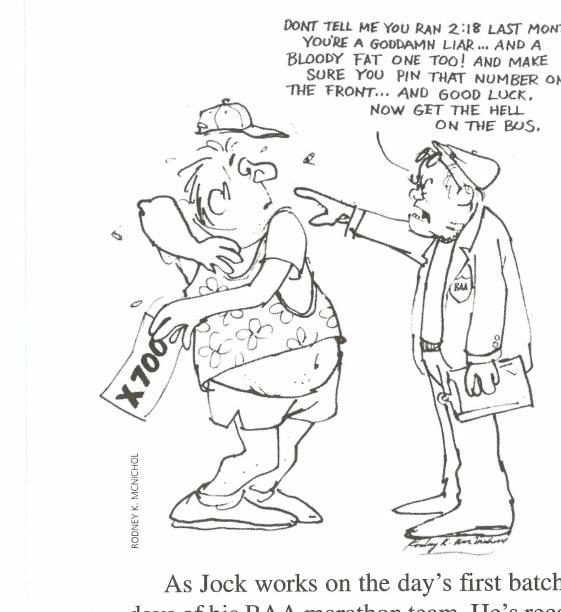
A cartoon hangs on the wall in Jock’s clinic:
It’s the day of the Marathon and the Jock figure, apoplectic, is trying to load the buses outside the Prudential and at the same time keep a sharp eye peeled for cheats. Jock has his mouth open in the cartoon and his finger is attached to a pot-bellied runner’s nose, a bogus marathoner indeed. The man, wearing baggy Bermuda shorts, tries to slip past Jock and get on the bus for a ride to the start at Hopkinton. Nevertheless, he encounters one problem: Jock nabs him. “Don’t tell me you ran 2:18 last month,” the cartoon reads. “You’re a goddamn liar . . . and a bloody fat one too! . . . and make sure you pin that number on the front . . . and good luck. Now get the hell on the bus.”
“Magic Fingers” is what hundreds of athletes call Semple’s digits. “I don’t know if Jock knows the names of all the muscles,” Johnny Kelley (the Younger) once testified. “But I know his treatments worked for me every time in the 1950’s and made the difference between winning and losing.”
Other top athletes concur. Bobby Orr took a massage from Jock before every game. Soon the rest of the Bruins were making appointments. Cousy took a rub at Jock’s clinic whenever he could. So did Russell, and Chamberlain when he was in town. Walter Brown, the Celtics owner, often joined his boys on the table.
Each year Jock sets up a table at courtside at Longwood in Brookline for the tennis tournaments. “Conners is my buddy,” he once said. “McEnroe I wouldn’t give two cents for.”
His method? “I dig in deep with my fingers,” he said. “A trainer’s got to be cruel to be kind.”
Johnny Bucyk, the former Bruins captain, insists that Jock added years to his career after “Chief” came up with a bad back. Gene Conley, who once played for the Red Sox while serving as back-up center to Bill Russell on the Celtics, claims that Jock could get him into shaper faster than any trainer alive. To prove that he is no longer a “chauvinist,” to demonstrate that he has “reformed,” Jock now accepts women clients, such as Patti Catalano. But he always oils the men first and gets them back out on the streets before bringing the ladies up. “My men know the r-r-rules!” he says.
As Jock works on the day’s first batch of clients, he tells about the glory days of his BAA marathon team. He’s recounting the national championships to which Johnny Kelley (the Younger) led the team. He’s telling about the time the cop stopped him one cold night near Pittsfield, Massachusetts, while he, Johnny and the others in his car were on their way to Detroit for a race. “The cop said I was weaving and he wanted to take me in for drunk driving,” Jock says. “But I told the cop that he should call Boston, that they’d laugh him off the force if he told anybody that Semple was drunk. Because everybody in Boston knows that Semple never touches the booze.”
That leads him, in a circuitous fashion, to a story about Scotto Gonzales, one of his BAA boys of the 1950’s who fell four stories off a building—but still ran a key race for Jock.
“Scotto was one of my good men on the BAA, but I never knew his real name,” Jock says. “I never knew if it was Gonzales Scotto, or Scotto Gonzales. Because Scotto signed it both ways. Even when he fell off a roof he offered to run. He knew we had the Canadian National Championships coming up. He never let any little accident throw him. Scotto was a window washer. He was up in the air holding down a job like the good man he was when the chain around his waist snapped, and . . .”
Then as so often happens in Semple’s Salon, the phone rings . . . and the story gets put on hold.
Hello? Who is this? What company? Beer company? Yeah, I know about salesmen, the job you have. It’s hard times. But I don’t want you advertising in the Boston Marathon. That’s not our tradition. This is an amateur race, and we don’t accept sponsors. Look, I said I don’t want you driving your car in the race. And I don’t want you bringing any signs that say, “Drink at Joe’s,” or any of your nonsense. But if I do catch you on the course, pal, I have one word of advice for you and your heirs: Keep clear o’ me or I’ll cut your throat!
Patient (on the rubbing table): Who was that, Jock, some guy who beat you in a marathon a hundred years ago?
Oh, this is the worst it’s ever been. The calls started about two minutes after I came in this morning, I had seven of them, and they haven’t stopped yet.
Hello? Yes, this is Jock Semple. But after today if this phone doesn’t stop ringing, I’m changing it to “Simple.” Because that’s what your imbecile questions are doing to me. No, I can tell you now, and I know Cloney will second me, we don’t need your vacuum cleaner company to help us put on the Boston Marathon. No, it’s not in our tradition, that’s all. We don’t take any money, and we don’t give any out. No runners get expense money. And they never will. Good-bye.
Oh, the loonies. People want to know if the Boston Marathon is going commercial. Over my dead body, I tell them. The runners come to Boston to make their fame. They can go other places to make their fortune. That’s our tradition.
Patient: Can you imagine the race ever accepting sponsors, Jock?
Sure. But they will have to pay me a nickel for every hour I’ve given free over the last 50 years. That scares them away. Hello?
Patient: Easy, Jock. It may be somebody’s mother.
You want to run in the Boston Marathon. Have you qualified? You have to have run two hours and fifty minutes in an officially sanctioned race if you’re a man. If you’re a woman you have to run 3:20. Which are you? OK, where the heck is your house? In Germany. Let me know what day you’ll be getting in on the plane. I’ll have Feeney meet you. He’s one of my BAA men. Don’t worry, he’ll recognize you. Just wear something German.
Patient: Jock, answer me one question. Why would somebody come all the way from Germany to run 26 miles and 385 yards?
That’s a stupid question.
Patient: Why?
Why do you like your wife?
I’ve got four patients in my Garden clinic, two lying on rubdown tables and one cooking in the steambath. He’s beside the radiator where I keep my grilled cheese warm until lunch. His head is sticking out the little hole at the top and he’s reading the Wall Street Journal. The fourth man is camped in the whirlpool. I’ll move him into the shower in a minute. That way I can advance the others over one place.
I have a varied clientele. I’ve got them from bankers to boxers. Two more patients will be coming by in an hour. Then Patti Catalano will be back from her ten-mile run. She and Joe leave from here about seven in the morning. That’s 20 minutes after I get in and before my men come. Patti hurt her hip a couple of years ago. The doctors said she’d never run again. I don’t want to go to Mass. State prison for slander, but as far as I’m concerned doctors are “itis-happy.” Bursitis, arthritis. Anyway, they said Patti would never run again. I had Joe bring her up and I started giving her treatments. Now she’s the first American woman to go under 2:30 in a marathon.
Patient: Jock, don’t you ever get tired? Six days a week, ten hours a day. Thirty years you’ve been rubbing them down. Aren’t you ever going to retire?
I tried that once. I went to New Hampshire for a week. But I tried to hit the fish with a pole.
I’m one guy still in the thick of things, one who has experienced all the transitions in the Boston Marathon, from dirt roads to cobblestones. From concrete to macadam. A lot of years since 1929.
Any favorites? Yes, two: In ’30 I broke into the big time in road racing. In 1957 young Johnny Kelley—I have to keep telling people that young John is no relation to old John—broke his bridesmaid role and beat the best in the world to win the Boston Marathon. He set a new American record that day, but more important, he made it respectable for college athletes to run on the roads, which some people—mostly college track coaches—formerly had thought were good enough only for us broken down working guys.
Just Call Me Jock will continue in our July/August issue. The world around him changes, but Semple remains stalwart.
This article originally appeared in Marathon & Beyond, Vol. 6, No. 3 (2002).
← Browse the full M&B ArchiveMore like this
1,000+ stories from 19 years of Marathon & Beyond
The complete archive of the legendary long-distance journal — digitized and free to read.
