

Chapters 1 and 2 of Just Call Me Jock appeared in our May/June 2002 issue.
CHAPTER 3
“Use the opportunity . . . “—Frank Semple to his son Johnny
Since the turn of the century Dixon’s steel mill has stood on Kidston Street in Glasgow, Scotland, churning out chunks of steel for shipment around the world. Not far from the mill, which we called “Dixon’s Blazes” because the light from the furnace shone night and day, a tightly-packed row of apartment buildings lined the side of the street that abutted the factory wall.
It was on the second floor of one of these apartments that I was born on October 26, 1903, the second son of Frank and Mary Semple.
If fathers did a halfway decent job they tried to prepare their sons for a trade. When I was four we moved to Clydebank, a shipbuilding city on the River Clyde. At my father’s prompting, I went out at six a.m. and took orders from the butcher’s customers down the street. My father said the job would build character. After school I delivered the parcels that the butcher had prepared. For this I was paid 50¢ a week. My father added two cents, which I saved.
My father wanted me to stay in school, but I preferred keeping my pockets lined, and when I was 14 I left school to take a job at the Singer Sewing Machine plant where I could work beside my father. Jobs were plentiful since most factories had adapted to production for the war effort, and I was hired immediately.
My social life was non-existent. Once in a while I met a girl whose hand I got to hold in the movies, and that sustained me for weeks. We had simple pleasures then.
Our street was a long row of three-story flats. A news-agent shop bordered us on one side, and a haberdashery bounded us on the other. Our apartment had two rooms, a main living room and a kitchen. We slept in beds in two alcoves: my parents slept in one alcove, my two brothers and I in the other. My brothers and I slept in one bed when we were small, but as we grew older I bought a camp bed with my earnings and I opened that each night and packed it up each morning. My mother attended to the chores around the house while the rest of us worked or went to school. Life was lean in a shipbuilding city.
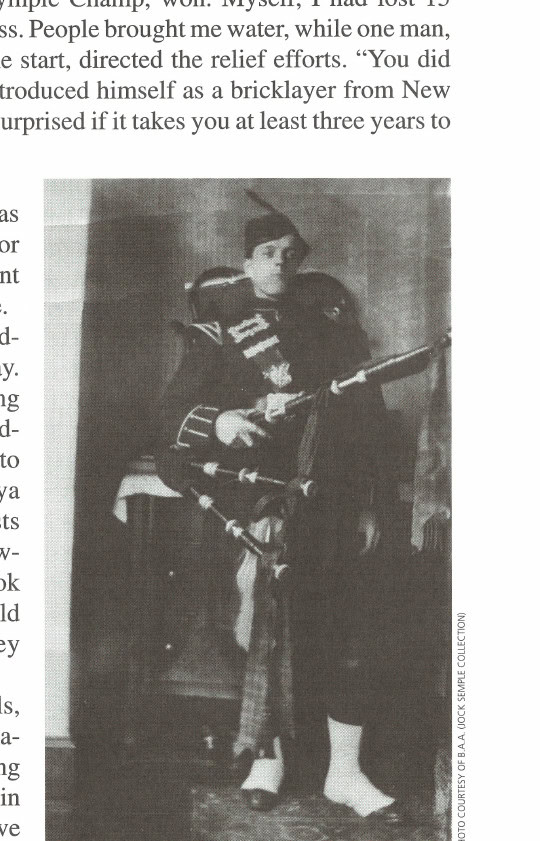
Shortly after I joined Singer I was introduced to running. The Singer factory held an annual company sports meet, and Bill Routledge, a professional soccer trainer who lived in the apartment below ours, offered to train me with his niece. She was my age and not a bad runner. Even then I favored women’s athletics, but today I still wear an “anti-woman” label because of the incident with Kathy Switzer. But that’s getting 50 years ahead of myself.
I won the 100-yard dash at the company meet and shortly thereafter I was recruited by the Clydesdale Harriers. Harrier meets were designed to function more like interclub social events than tooth and nail competition. We were taught that winning was important, but it was more important to love the idea of running and to enjoy the exercise fully.
On Saturday runs, the coach split us up into three packs: fast, medium, and slow. I ran with the fast pack which started ten minutes after the other two groups had left. From this the Americans developed cross country running. Note the parallels: a paceman ran at the head of each group, while a whip trailed at the end. If too much distance opened between them, the whip blew his whistle to slow down the faster runners. We were taught that our basic purpose was to excel as a group, and I owed all the enthusiasm I have brought to club racing in my life to the lessons I learned running with the pack in Clydebank.
Of course I was not above organizing a prank or two. Sometimes when I was appointed to take the sack with the shredded paper and mark that day’s trail, I’d look for a stream that I knew was deep. I’d lead the trail to the bank’s edge, then walk down to a part I knew was shallow and cross there. Once I had splashed across to the other side, I’d recommence dropping paper beside the deep part. Then I’d hide as the paceman led the entire pack face-first into the water. I must admit that I too found myself on the bobbing end not a few times.
I improved rapidly as a runner until the day before my 16th birthday when I broke my arm in a qualifying race for the Scottish National Championships. Though my arm was placed in a cast, I did not want to reduce my training. So I invented a workout at my job. I had many spectators each day as I slipped down to the main gate at the Singer plant to wait for the noon bell. Each day I tried to get a little extra running in by timing my exit more closely with the bell, but one day I missed and my foot touched the ground outside the gate one second before the bell. That afternoon I got a call up to the boss’s office. He was an old fuddy-duddy with a personality like a fish, and he fired me. He also had seen me running my weekly soccer score pool.
I decided to take my father’s advice. I knew that if I was to have any security in life I would need to learn a trade, but the economic situation in the country was dismal after the war, and it was months before I could find work again. I went back to school to learn to become a joiner, a carpenter who uses a fine grade of wood, and when I was 16 I found a job as an apprentice house joiner. This skill was to serve me later—to keep me from starving when I lived in Philadelphia—but in Scotland I couldn’t support myself on the paltry wages the job paid: three dollars per week, from which I had to buy my own tools. Soon I left that job, and found work at the John Brown Shipyard and continued my apprenticeship as a joiner.
I worked at John Brown for two years. John Brown was the main employer in Clydebank; both the Queen Mary and Queen Elizabeth were built there, but I was miserable. When a strike was called and I found myself out of work again, I became despondent.
“If I were to lend you money for the trip to America, would you go?” my father asked me one evening at supper.
This was like a bolt from the blue. “Sure, I’d go,” I said.
My father touched his napkin to his lips. “Use the opportunity,” he said. “See what you can do for yourself with a new start.”
A word about Clydebank: years later during World War II, Clydebank suffered the two heaviest nights of bombing in the war. On successive nights two hundred people died, a total of 400. Fortunately, my parents were down in the south of England. My brother and his wife lived in Wales and with news of the bombing in the south, my parents had rushed down there to be with them. While they were away, our house took a direct hit. Upon his return, my father sifted through the rubble, but all he found was a medal I had given him after I had won a race in Philadelphia. He wore that medal the rest of his life. After his death, my brother sent it to me. Of all my medals I’ve won, I prize that one the most.
America!
I landed in Philadelphia on a bright sunny day with a clouded future, but I didn’t pay it one whit.
On our crossing, we were served three meals a day. But I joked that with sea-sickness, I had six, three down and three up.
I stayed with relatives in West Philadelphia while I tried for months to find a job. Finally I talked myself into a good position as a joiner at the shipyards, and I loved that job.
With summer’s arrival, I went into the building trade. One day the boss assigned me to work with concrete, a project I attacked with great enthusiasm. I needed a brace to hold a wooden trough, but instead of grabbing a scrap to use in building it, I took a clean board. The boss walked over and watched as I cut the piece for the brace too big. When I stooped to cut it again, the boss said to me, “Get your tools.” “What?” I said. “Pick up your tools,” he said. “No job is as complicated as you’re making it.”
Bosses held all the cards. I was 19 years old and maturing by the minute.
My social life improved, even if my wallet got no fatter. Dances were held every Saturday night at the Scottish-American Club in Kensington, and I did not miss one except by choice. Sometimes I was forced to skip a dance if a girl got too amorous. Once I met a girl who began talking about her future husband. I was stunned to think that a girl would go to a dance without her beau, but when I asked where the boy was, she said he was at the dance. That shocked me even more, to think that she would sit on the side and sip a punch with me while her future husband was in the same room.
“Where?” I said, as I surveyed the crowd. But she only smiled and my eyes opened wide as I got the message.
“I’ve got to go to Wilmington in the morning for a carpentry job,” I said as I excused myself. Quickly I left the dance and did not return for two weeks. I loved dancing, but there was one thing we all knew instinctively: a man who lived on the fringes of unemployment did not flirt with matrimony.
I picked up some odd jobs and soon I was able to move into a $10-a-week room in West Philadelphia. I joined the Kensington Athletic Club and shortly thereafter became bitten by the marathon bug. When construction began on an exposition Philadelphia had planned for its Sesquicentennial, I found a job laying floors for the Japanese exhibit. The men I worked with talked about the Sesquicentennial marathon, a race that was expected to draw 150 runners. I grew increasingly interested.
One day I decided I would run the marathon and that night I ran ten miles through the streets of Philadelphia. Soon I was running 90 miles a week in preparation, until I dislocated my shoulder at work. Still I trained with my arm in a sling. That was nothing new, and even when I re-injured my arm from time to time, I never stopped running.
The morning of the race I hitched out to the start at Valley Forge. There were only a few marathons in the country and the same guys went to all of them. Culver City, California, put on a marathon, but outside of the East Coast the rest of the country remained a desert for road running. “Do well,” a fellow runner said to me at the start, and I was surprised that anybody even talked to me.
At the gun I trotted out, but soon I moved up with the lead pack which included Clarence DeMar. I fell back a bit as the course wound along the Skuylkill River, then moved inland. The finish was set at a huge stadium in South Philadelphia beside what is today the site of the Spectrum.
Soon I moved up again and one of the spectators who lined the streets shouted, “You’re number 10.” This heartened me because I knew that only the first ten finishers would get trophies, and I ran like hell in the hot sun.
The sun beat down fiercely, yet I held onto tenth place until we reached the University of Penn and the 22-mile mark. Suddenly I got a cramp in my leg and I was forced to hobble. I sensed somebody coming up on me, and I ran pulling my leg over the last four miles as I tried to hold off Frank O’Donnell, a Canadian runner, who edged ahead of me entering the stadium.
I kicked, dragging my leg, but I couldn’t catch O’Donnell and he beat me for tenth place and a trophy. I finished in three hours and collapsed at the line.
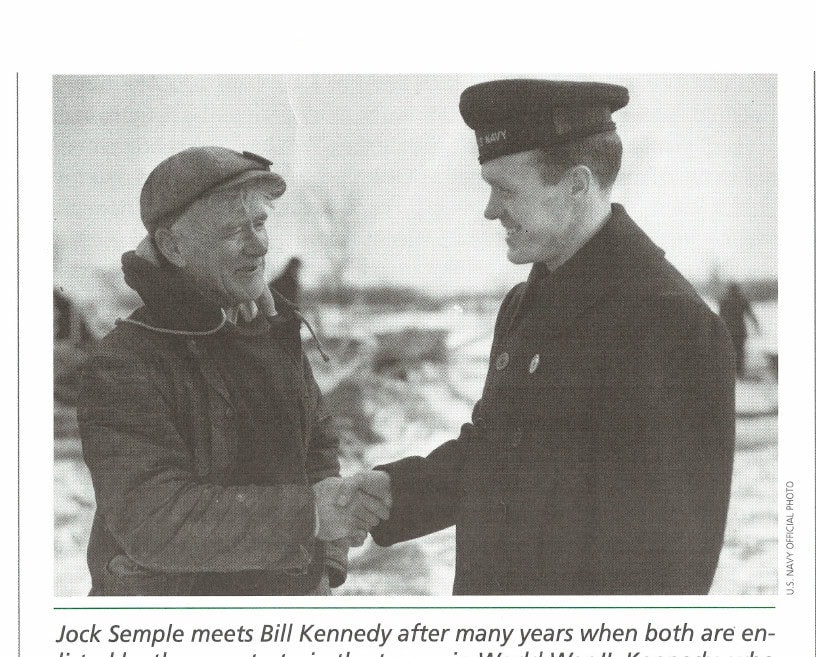
Albin Stenroos, the 1924 Olympic Champ, won. Myself, I had lost 15 pounds and lay gasping on the grass. People brought me water, while one man, the man who had said hello at the start, directed the relief efforts. “You did well,” said Bill Kennedy, who introduced himself as a bricklayer from New York. “Stay with it. But don’t be surprised if it takes you at least three years to run a decent marathon.”
He was dead right.
I remember his words, but I was so tired. I lay still for 30 minutes or more. After I recovered sufficient strength, I took the subway home.
Marathon runners were considered second-class citizens in my day. Freaks. I remember running along the roads in Philadelphia when suddenly a car would swerve to try to hit the group of us. “What’re ya runnin’ fer, President?” motorists shouted. Kids pelted us with snowballs, and some runners even took to wearing long pants so they could feign being a pedestrian if they crossed paths with anyone.
We were considered oddballs, yet we put up with it. For the camaraderie. I would try to do everything I could to beat the man next to me in a race, summon every competitive juice, but the minute it was over we shook hands and we were friends. But not on the roads. On the roads
we gave each other no quarter. That’s how life was in the Depression anyway. Most of us found ourselves in and out of jobs, and our running served as a ventilation for that frustration. We carried the lesson of the road over into our lives: if a man could be tough out there, he wouldn’t succumb under normal circumstances.
Most of us were laborers. Once in a while a college man tried the marathon, invariably without success. We were praised for our sportsmanship and camaraderie, but we weren’t considered serious athletes. Except in Boston, but then only for one day a year.
Boston has always been the Blue Ribbon. Bill Kennedy, who did the most to encourage me when I was a young runner, called the prize he won at Boston his “survivor’s medal.”
In many ways it was. Kennedy, who would take me aside at races, was typical of the manual worker who found himself unemployed and used running to kill the dead time while waiting for a job that rarely came. “Bricklayer Bill,” as they called him, was famous for wearing a red-white-and-blue kerchief on his head in the Boston Marathon. Bill enjoyed his one shining moment in 1917 when he hitchhiked up to Boston from New York and slept on a pool table in the South End. The next day he won the race, a moment of glory Bill spent the rest of his life trying to recapture.
In 1932, Bill wrote this letter to John Halloran at the Boston Globe. Bill expressed it for all of us—better than any of us: the gap we felt between being broke on the street and dreaming the dream of winning Boston.
Dear Johnnie:
“I am well, but broke. Business is —, but as long as I have my health that is the serious thing. I am looking forward to this year’s race. I have been out of work so much this winter that I’ve had much time to run.
“Speaking of Marathon runners, don’t you ever wonder what is the lure of it all? What does a Marathon runner think of?
“Well, Johnnie, I ran an average of 1000 miles a year for the past 25 years, some do more, some do less, but that average is about 130 hours, along with your mind wandering here and there—building air castles—tragedy and comedy. He thinks and pictures so many things.
“The lure of the Boston race, Johnnie, is far greater than any in the country and, to me, the world. I can only speak of my own thoughts; but I have been close enough to runners for 30 years that I also know their thoughts, hopes and chances—to win the Boston Marathon, that is the dream of every runner. Sometimes I hardly believe I realized that hope 15 years ago; I am still dreaming, still building castles, and actually believe I am going to win again.
“All Marathon runners are dreamers; we are not practical. The hours we spend every day every year! The strength we expend over long lonesome roads and the pot of gold we aspire to receive for it all! The end of the rainbow, Johnnie, is a survivor’s medal.
“Boston, to see the name in print, to hear it spoken, sends my blood racing as does the sounds of ‘The Star Spangled Banner.’ I reached the heights in Boston and also I gazed down into the depths. I used to beat my way in these unnoticed, cold, and half-starved. Then I met Larry Sweeney of the old Globe (Lord have mercy on him) and after that everyone seemed to be my friend.
“The 1917 race brings back memory of the ironworker who took me over to the public bath to clean up; the bricklayers who fed me and got me a job; Mr. and Mrs. John Brick, Jack Welsh, Jack Nason and Mrs. Nason and the children always to meet me at Coolidge Corner with a drink of hot tea; Rudy and Sam Allen, who put me to work; Jack Dailey, who rode a bicycle for me and drank my brandy himself; Al Upham, his father and mother, George Brown, his boy Walter, yourself, McCabe and the most colorful bunch of newspapermen in the game are strong in my mind as I each year visit Boston.
“And Edwin Geary of Hornblower and Weeks, whom I have not seen since winning, but his name and face are impressed in my heart. Chuck Mellor and I didn’t have a dollar between us. I had won the Boston race two days before and Chuck finished sixth, but we couldn’t eat those cups, nor cash them in and remain amateurs.
“So the cheapest way to eat was to pay 5 cents for a glass of beer and fill up on the free lunch, which some were doing. Then a gentleman recognizing me from the pictures in the paper stepped up to me and asked me was I Bill Kennedy and was it true about my having two children, and gave me two 10 dollar bills, one for each of them. Boy, I could have kissed him; a lucky thing, though, he didn’t give a third for myself, or I would have automatically become a professional.
“Well, John, meeting all these people gave me an incentive to show them I appreciated their interest, so I tried hard to win.
“Do you know that I always loved the old way best when they had the bicycle riders with us? It seemed more colorful and seemed to make you feel you had a protector at your side.
“The people up there appreciate the runners more than anywhere else; no slurs, no wisecracks. Just kind words and applause. Have you ever noticed how sympathetic the boys are? They are wild at times, but you can’t help loving them. Some three or four years ago, the time I finished third, some little kid on a bike, he couldn’t have been more than 12, pulled alongside me at Coolidge Corner. To listen to that boy crooning to me, the words of sympathy his little heart was pouring out, my God, Johnnie, you wouldn’t think I was 50 years old to his 12. Seemed like he was the old warrior and I was the child.
“Johnnie, I better cut this short. I ran a Marathon in 1924, the hottest day of the year, and I won by over a mile and a half. The officials told me the prize was a beautiful bronze statue of a Marathon runner, six feet in height, too big to carry, and it would be shipped to me by express.
“They gave me a receipt (one bronze statue, paid in full). Well, I still have the receipt. But the trophy never came, express or otherwise. Prizes don’t mean much to me anyhow. I won the race, which I think was satisfaction enough for me. I wouldn’t give a damn if I fell dead across the line at Boston if I could just win that one more time.
“The Olympic bait doesn’t mean a thing to me. They wouldn’t take me when I wanted to go. Hell, I can beat my way to Los Angeles anytime. But I want to beat the men they do send. There was never a time if I had six weeks to train and not work or worry over the wherewithal to run my home and family, I couldn’t beat any man on earth.
“Do you know I have seldom come to Boston in any other race in the last 15 years in shape. I dissipated last year before the race, and even the night before, but I ran the course, only to punish myself.
“Another attraction in Boston is the old-time runners you meet. Who can help but love Monteverde, the biggest dreamer of us all, and probably the wealthiest; little Jimmy Henigan, and DeMar, with his honest but peculiar ways and short answers. A lot of old boys are disappearing, but I try to keep in touch.
“Can’t you lean back, close your eyes and picture Tom Longboat with his funny teeth; Festus Madden, over whom I have had many a laugh; Fred Cameron, who became an amateur again in Chicago; great old Sid Hatch, lovable Chuck Mellor, Joe Forshaw, a millionaire. Mike Ryan and his red head leading the parade in ’12.
“Poor Harry Jensen, dying at home in New Jersey, wife and two kids penniless. Good old Johnny Hayes and a few of the old boys around New York visit Jensen and try to help. Jimmy Duffy, killed in France; youthful Johnny Miles, Linder, poor Sockalexis, and a host of others who have passed along the long, long trail. They all know ‘What price glory?’ The handshakes and then oblivion. All we have are the good friends we make.
“And that survivor’s medal, well, I would rather have a pair of overalls, I can use them if I get a job. But I will be there Tuesday, glad to see the bunch. My feet will be blistered, my legs weary, every muscle aching, but my heart will be happy at the cheers of the crowd. I will be giving them all that’s in me too and I look forward to that little thin string in front of the BAA clubhouse, a cot to lie on, and get those damn shoes off my feet! So long, old pal, I shall be in the prize winners.”
(Signed) Bricklayer Bill Kennedy
CHAPTER 4
“That was the biggest thrill of my life . . . I picked out my mother’s eyes as I kicked the last 200 yards to the line.”
Johnny Kelley reflects:
To his credit, Jock Semple was always accessible to us during the 1950’s. Whether we found him at work in his cubbyhole backroom physiotherapy clinic in the Boston Arena, or, after the Arena fire, at his new cubbyhole in the Boston Garden, Jock never refused a young runner advice.
Oh, there were others. Men who served as both fathers and confessors for us young pavement pounders. I shared a name with old John Kelley, who befriended me, but Jock symbolized the era.
A word about the breed. First, they never expected money for their chores. These men, runners themselves during the twenties and thirties, gravitated into advisory roles as our generation replaced theirs at the front of the pack. Fixtures at the various road races throughout New England, they had suffered the ridicule (and often dangerous hostility) of a generally uncomprehending public.
Theirs was an oral tradition, before the sacred oil could be tapped and bottled like snake oil, before “marathon” formed the essence of cocktail party chatter, before packaged advice to young runners could make The New York Times best seller list for 30 weeks, these men owned the roads.
Jock was a man before the running books.
Patient (in the steam bath): Jock, you’ve been called the Boston Marathon’s staunchest defender.
Wouldn’t you defend the thing that was like a religion to you?
What bugs me are the number of people who show up the day of the race totally unprepared to run a marathon. They end up jogging with their 62-inch beer bellies. They jog the first mile, then walk two, then jog again. Later it’s off to a bar room in Framingham, bend the elbow, catch a cab, and come sprinting down the final straightaway at the Pru like heroes. They make a mockery of all serious runners.
But even these comedians aren’t the worst. A few years ago, four or five of the leaders were running neck and neck outside Framingham. I was in the press bus when I saw a moron wearing a snorkel and fins pop out of the crowd making snorkel noises. Steam shot out my ears.
Patient: Did the District Attorney get you for Murder One?
No, but I chased him. This was a couple of years after the incident with Kathy, and the film crews banged off each other as they got into position on the flatbead truck. It didn’t take me long to catch the jerk, and I took a dive for his feet, but missed. A policeman followed me onto the bus intending to charge me with assault. The following day the chief of police took the matter into his own hands. “Look,” he told the snorkel guy. “If I was Semple, I would have done the same thing. Now get out of my sight before I feed you to Jock.”
A fella named Loues started all this chasing. In 1896 a group of countries got together to work for better relations in the world and they recreated the Olympic Games. A Greek mountaineer named Loues won the first Olympic Marathon in Athens in two hours, 55 minutes and became a national figure. The Boston Athletic Association paid expenses to take two-thirds of the American Olympic team to the Games. While they were over there, John Graham, the BAA Secretary, and George V. Brown decided to hold a marathon in Boston the next year as a novelty. It was supposed to be run just once. Yeah, well, my phone hasn’t stopped ringing once.
Patient: Jock, how did you come by getting the club phone?
Call the Boston Athletic Association at 227-3214, and you get me. This cinderblock palace, boys, that’s the BAA.
Years ago the Boston Athletic Association was one of America’s most prestigious clubs, on the order of the New York Athletic Club, which has survived and prospered. The BAA has survived, you’re looking at the club’s headquarters, but it’s only in the past few years that infusion of new blood has sparked a revival. Patti and Joe Catalano are enthusiastic members today. We’ve got about 300 enthusiastic members.
At one time the BAA roster included only proper Bostonians. Founded on March 15, 1887, the BAA once operated a lavish five-story brownstone clubhouse in Copley Square on what is today the site of the Boston Public Library. The clubhouse served for years as the finish line for the Boston—or more exactly, the Boston Athletic Association Marathon. Inside were posh rooms with stuff animals and a giant marlin on the walls.
Nobody lived in a house where the laundry hung on a line out the back window. Not like the boarding houses where I lived. These were “gentlemen,” and the clubhouse reflected their favorite leisure activities: bowling alleys, billiard rooms, five tennis courts, a gymnasium, swimming pool, fencing, boxing, and bicycle rooms, a barber shop, restaurant, parlors, library, and, not least, a wine and cigar department.
The BAA men were the wealthiest businessmen in New England, but following the 1929 stock market crash, most got wiped out. For me, 1929 was the year I finished 29th in my first Boston Marathon.
Patient: Think you could help me, Jock? I’m dying here in this steambath.
You’re still carrying some excess weight between your ears. Ten more minutes.
The Boston Marathon focused attention on the road race season, but only briefly. After the eight-column banner headline the day of the race, we ran in obscurity.
Boston did not cap the running season; instead it kicked it off each year. Throughout the summer we ran dozens of ten-mile handicap races. Social clubs around New England held picnics in the summer, and always they staged a road race as their festival’s featured event. These clubs pulled the best runners in America because they offered merchandise prizes. It’s hard to imagine Bill Rodgers, Frank Shorter, or Greg Meyer running at a picnic today, but in the 1920’s and 30’s, the people who put on these carnivals offered wrist watches and toasters, things we needed. It was the Depression, and often we sold or traded the merchandise to get money for food.
Patient: What happened in 1930?
I was 27 years old and that was the start of the Depression. I was out of work and living in Philadelphia. What else do you do when you’re out of a job in Philadelphia? I hitchhiked to Boston for the marathon. I left Philly on Roosevelt Boulevard at seven in the morning, and I got to Cambridge at nine the next morning.
Patient: Are you going to tell us about the night spots you hit?
Night spots! If you mean towns up Route 1 such as New Rochelle, Greenwich, Stamford, Branford, Saybrook, and so forth. They were night spots all right. I thought I was going to spend all night in them.
My last ride was in a truck. Remember the isinglass curtains? The truck had curtains instead of windows. Oooh, was I frozen. When I finally reached Boston, I took the subway to Scollay Square, then caught the street car to my brother’s house in Lynn.
I was frozen, but hungry to win. Boston was our dream. I ran hard that day, as DeMar won the Boston Marathon for the seventh time. At Natick, the ten-mile mark, I was running in fifteenth place. By the Newton Hills, I began to move up. I had been told that the first eight finishers would win gold medals and I wanted one badly. I moved into the top ten at Coolidge Corner, past Johnny Miles, who had won the race twice before, and Dave Fagerlund, one of the top Finns. I passed Bill Kennedy who had become my good friend, passed Silas McLellan of Nova Scotia and Gordon Norman of Malden, and I moved onto Jimmy Henigan’s shoulder. Willie Kyronen and Karl Koski, both great Finnish-American runners, battled to catch DeMar. I hung onto Henigan who would be an American Olympian two years later, and with two miles to go I passed him. I kicked hard to finish seventh, ten minutes behind DeMar’s 2:34:48. That was the greatest day in my life, but the Philadelphia papers bolluxed it up.
“West Philadelphia Irishman Hitchhikes To Boston and Finishes Seventh,” said the headline in the Philly paper the next morning.
Patient: What’s wrong with that?
I’m no Irishman. I’m bad enough on the telephone, aren’t I? Still, that was the biggest thrill of my life because my mother was visiting my brother and she attended the race. I picked out my mother’s eyes as I kicked the last 200 yards to the line. She was standing in front of the BAA clubhouse clapping and I swear I had tears in my eyes.
I got fired two days later and I hitched back to Philadelphia. I don’t go for excuses, but in this case I think the boss was laying for me because I was a runner. I had taken time off from my job to hitch to Boston and employers generally had nothing but scorn for marathon runners. They were more impressed with the elbow-benders, the guys who came to the job hung over but with stories to tell. “Oh, Joe, I saw you Friday night. You and that floozie at the saloon!” That kind of thing.
I had a good job, and I was sorry to lose it. The streetcars in Philadelphia were brought in regularly for inspection and my crew took the old seats out and replaced them with new ones. My feet still hurt after Boston, so at one point I changed my shoes. I put on a pair with rubber soles, but the boss called me over. “What do you got on your feet?” he said. “Those aren’t the shoes you wore to the job this morning. Get your tools, Semple. I don’t need anybody on my crew who takes a break before the bell.”
I went home, packed up my things, and moved to Boston. I have been a confirmed New Englander since. I’ve been offered opportunities to open clinics in different parts of the country, but I’ve always refused. One man wanted to give me a health spa in California with Greek statues without clothes, but I said no. I’m afraid if I accepted any of the offers I might be forced to be polite to everybody, even the phonies, and that’s a skill I never acquired.
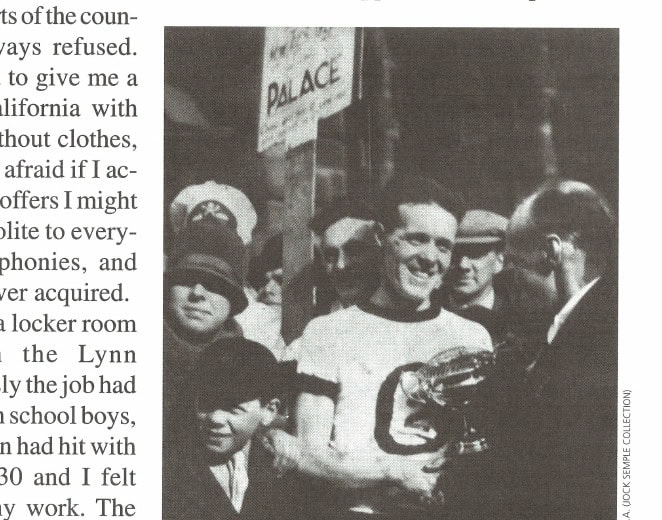
I got a job as a locker room attendant with the Lynn YMCA. Previously the job had been done by high school boys, but the Depression had hit with full force by 1930 and I felt lucky to have any work. The job paid $11 a week, barely enough to live on, but the worst part was my having to accept charity from my brother. The $11 paid for fruits and nuts which I bought from vendors at the open air markets, but I had scant money left over to give my brother James for rent. I slept on a daybed in the living room and bought him a ton of coal whenever I could. I gave him some of the merchandise prizes, including a gold watch, I won at road races in New England.
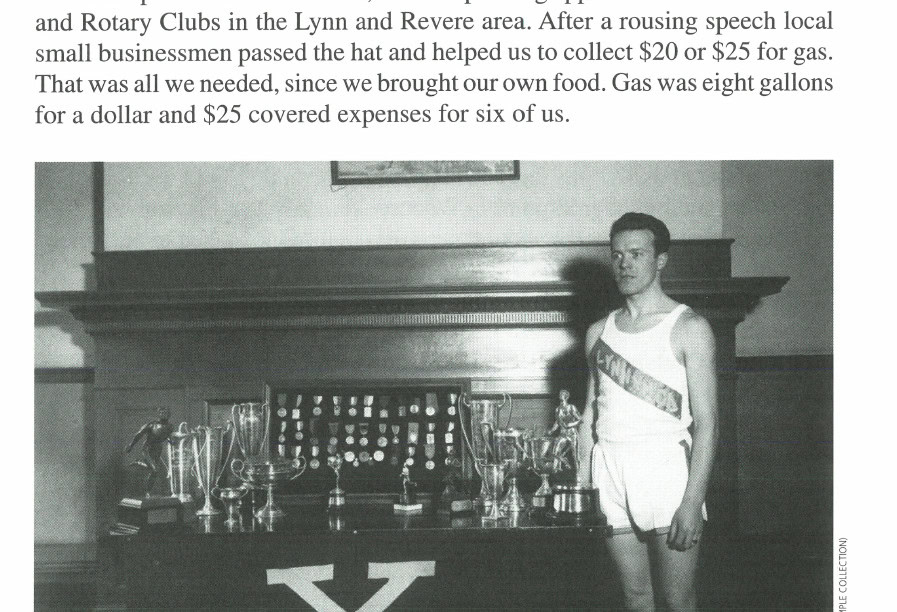
I took two long training runs a day, mostly because I had the time. I was punching the bag in the gym one day when Earl Mills, the YMCA coach, suggested half-jokingly that I start a team. A light bulb flashed above my head. I began recruiting some of the athletes as I stood in the cage at the Y. As they paid their three cents for a towel, I made my pitch. Soon I had a good crop of potential star runners. Mills became the coach and I captained the team. With runners such as Tom Bury, who was to become a regular top ten finisher at Boston, Frank and Larry Reed, Tony Paskell, and Andre Brunnelle, we won team championships up and down the East Coast, including the National Championship in Baltimore in 1931.
To keep the team on the road, I made speaking appearances at the Kiwanis and Rotary Clubs in the Lynn and Revere area. After a rousing speech local small businessmen passed the hat and helped us to collect $20 or $25 for gas. That was all we needed, since we brought our own food. Gas was eight gallons for a dollar and $25 covered expenses for six of us.
It was on one of these trips that I met Fred Brown. Today, you can find Fred’s picture in running magazines. Since the 1930’s Fred and I have been confirmed friendly antagonists. One weekend a local car dealer lent us a seven-passenger Buick to take down to York, Pennsylvania for a road race. Since we had an extra seat, I invited Fred, a milkman from Medford and the captain of the North Medford Club. Fred tells the story, which is a complete lie, that I brought a jar of goat’s milk with me for strength and the jar went sour, forcing abandonment of the car in New Jersey. Fred has done great work keeping the spirit of road racing alive in New England the past 40 years as handicapper and chairman of the Long Distance Committee. Oh, he was a pain, and dictatorial. Fred could get me madder than a bee in a jar, but he did a lot of good.
York, Pennsylvania. Know the product for which it is famous? We won the team championship, after which the Mayor of York invited us up to the speaker’s platform to accept our merchandise prizes: Bar-bells!
The mayor and other local dignitaries presented the first place finisher with 500 pounds, the second man received 250 pounds, and so on, until we all had to cough up a week’s pay just to pay for the gas to lug those moron items back to Boston.
I did well personally. I won the Novelty Park Marathon in Pawtucket, Rhode Island. It was a rainy day and the roads were muddy, but I went out with the leaders and by the mid-point in Woonsocket, only Les Pawson was with me. We battled together for about three miles before I managed to pull ahead and win in 2:44:32.
Pawson was the speed man of our era, the first one among us to appreciate the benefits to be derived from training on a track. When Pawson, who had been born in England, set the record at Boston with a 2:31:10 clocking in 1933, he ran the last six miles into a biting wind. After he finished, his arms were lobster-red on the front and white on the back. Jerry Nason estimates that the wind took six minutes away from him. Still, Pawson was a humble guy. He never said, “I could have done 2:25 today.” Instead, he remarked in a post race interview, “Someday somebody is going to run 2:25 on this course.” Give the credit to Pawson. He knew the value of speed.
Beginning in the 1930’s and extending into the 1940’s, four men dominated the Boston Marathon: Pawson (a winner three times, in 1933, 1938, and 1941), Old Johnny Kelley (the 1935 and 1945 winner), Pat Dengis (who finished on the heels of the winner a number of times), and Ellison “Tarzan” Brown (the winner in 1936 and 1939).
Clarence DeMar won for the seventh and last time in 1930. The new generation, led by Old Kel, Pawson, Dengis, and Tarzan, together with Gerard Cote, a Canadian, defined marathon running in North America before Young John Kelley opened the doors for the college men who continue to dominate today.
Tarzan was certainly the most colorful. We can only speculate how great he might have been had he been trained properly—trained at all, for that matter. But it’s my guess that Tarzan, a Narragansett Indian from near Westerly, Rhode Island, could have been the best 10,000-meter man in American history. Jerry Nason shares my opinion. As Jerry once wrote:
“The trim brown shanks of Ellison Myers Brown have caused many a professional coach to grind his teeth in exasperation. Throughout the 1930’s those streamlined legs sent the Indian pelting over the roads, when really they were meant to win Olympic track titles and races from the Finns.
“Tarzan Brown had the misfortune to be born poor, and in rustic surroundings. As a boy he guddled (a Scottish word meaning grasping fish by the hands) for trout with his bare hands. He roamed the woods. He was more at home in a tree than out of it; hence the name, Tarzan.
“His schooling was sketchy. Tarzan would much rather learn to keep a good line of traps than to explore the alphabet. He could run all day through the woods and brush without tiring.”
I have my own Tarzan story to support this last point: A trainer named Tippy Salimeno had been training another Indian runner in Rhode Island, a fine prospect named Chief Stanton, when Salimeno first met Tarzan. Stanton was out on the roads doing 15 miles, when an 11-year-old kid appeared from behind a bush and ran silently on Chief’s heels. For more than three-quarters of the workout the boy shadowed Chief without saying a word, just puffed along behind him. Finally, in the last two miles, Stanton pulled away, and as he arrived at the appointed spot where Tippy sat waiting for him in a car, Salimeno shouted, “Great time. Very fast, come on through.” Stanton was too tuckered out to speak; instead he pointed behind him. As he finished he said, “You think I ran fast. Tippy, there’s a boy about 10 years old right behind me.”
The two waited, but no boy showed. In order to prove to Tippy that he wasn’t crazy, Chief led Salimeno on a hunt for the boy, and finally they found Tarzan who had ducked back into the bushes.
Years later after Tarzan had won the Boston Marathon he said, “Trainer Salimeno deserves great credit. He kept encouraging me. He kept my pep up.”
It wasn’t for lack of trying that Salimeno couldn’t instill more self-discipline in Tarzan. It’s just the way Tarzan was. He died in 1975 when struck by a van in a parking lot outside a bar. Stories circulated that he had argued with the driver inside the bar, but Tarzan’s friends and family disputed this. At any rate, Tarzan was a free spirit.
“Tarzan’s natural ability was so great that even midway in his career as a road runner, when his sweeping stride was broken down to a macadam gait, they put him on a cinder track and raced him against the watch just to see what
would happen,” Jerry Nason wrote in the Globe in 1943. “He ran the mile in 4:28, fast enough to beat almost any college miler in New England.
“The Indian would give a dietician the heebie jeebies. He eats and drinks anything that appeals to him. Training is a haphazard affair for him at best. At various times he has been a stone mason, a farmer, a wood chopper, a laborer, a stevedore, and is presently working in a defense plant at Westerly.
“While he was doing a hitch as a stevedore, a steel door fell on him and inflicted a five-inch gash across his thigh. Tarzan quickly applied a tourniquet, but all he said was, ‘Hope this doesn’t stop my running.’
“When he was at Berlin in the 1936 Olympics just about all the Americans thought the Indian would make hash of the Japanese and the rest in the big Marathon race. Tarzan had a fondness for German beer, however, and on top of that he got into trouble. He picked on a couple of Nazi blackshirts and rapped together a couple of their heads.
“Also, he suffered from a hernia, which he never mentioned, even after he looked like an Olympic winner at 16 miles, then dropped out.”
Tarzan only made the Olympic race after the Americans sprung him from jail following his fight with the Nazis. Asked why he got into a fight with them, he told me one time, “I didn’t like them.” I remember the day he left with the Olympic team in 1936. He went down to the boat and began climbing up on the smokestack. I asked him why he did that. He said he wanted to see Germany. He didn’t believe the boat could go there unless he could see the other side of the ocean first.
Old Kel ran in the Berlin Olympics with Tarzan. Old John ran his first Boston Marathon in 1928. In 1981 he completed his 50th Boston. John A. Kelley and I have been close since my earliest days in Boston. We used to squeeze into cars and ride to races throughout New England. We’d stay over in dollar-a-night hotels in our younger days, just to run.
Old John was born in West Medford in 1907. The oldest of 10 children, he attended Arlington High. When he was 13 years old, his father took him to the Boston Marathon and he saw Frank Zuna win. That day he decided that he would be a marathon runner. No man in the history of the event has lost more Boston Marathons in the last three miles than old John Kelley. Twice he won, and seven times he finished second. Nineteen times he placed in the top ten. Had he not been so frail, Old John might have turned some of those second place finishes into victories. Still, like us all, Old John knew that running paid nothing, and nothing beat the satisfaction of landing a job. If the fame that came from winning a Boston Marathon helped, so much the better.
“These handshakes and the glory that goes with this marathon business are OK,” Old John said after he finished second to Walter Young in 1937. “But a job would be lots better. I’ve been unemployed for the past two months, and trying to look for a job and train for the big race was just too much of a burden, I guess. I know one thing: I could run a lot better if I had the peace of mind of a fellow with a job.”
Finally Boston Edison hired him, and that company had the wisdom to build a track club around Old John.
After I beat Les Pawson at the Novelty Park race in 1931, a group of well-wishers grabbed me and whisked me into a training room for a massage. They put stuff on me—it must have been horse liniment—and that was the worst torture! They put their fire all over me, even in the most delicate places, and I hopped off the table finally and ran into the showers. But even that didn’t cool off the delicate places. I was red hot, and all I could do to ease the pain that night was to go to a YMCA dance in Lynn.
There I was honored as the New England champion, but I kept on moving. It didn’t hurt so much if I flailed my arms and legs. The girls loved it. Nobody put more into dancing than I. Though I got home at midnight, I couldn’t sleep and I walked the streets of Lynn waiting for 5:01 a.m. and the first newspaper delivery truck to arrive. Suddenly one appeared and I bought a dozen papers right off his truck. It was five in the morning, the sky was black except for a blue strip behind the stores on the east side of the street. I fumbled through the top paper, while I held the others between my knees, and I saw it: my name in headlines for the first time in my life.
I only wish Tim Horgan could have been writing then, when I was genuinely famous—before “infamous” became a prefix for “Semple.”
Just Call Me Jock will continue in our September/October issue. Jock continues to run as he keeps the Boston Celtics healthy.
This article originally appeared in Marathon & Beyond, Vol. 6, No. 4 (2002).
← Browse the full M&B ArchiveMore like this
1,000+ stories from 19 years of Marathon & Beyond
The complete archive of the legendary long-distance journal — digitized and free to read.
