

Lake Tahoe Marathon
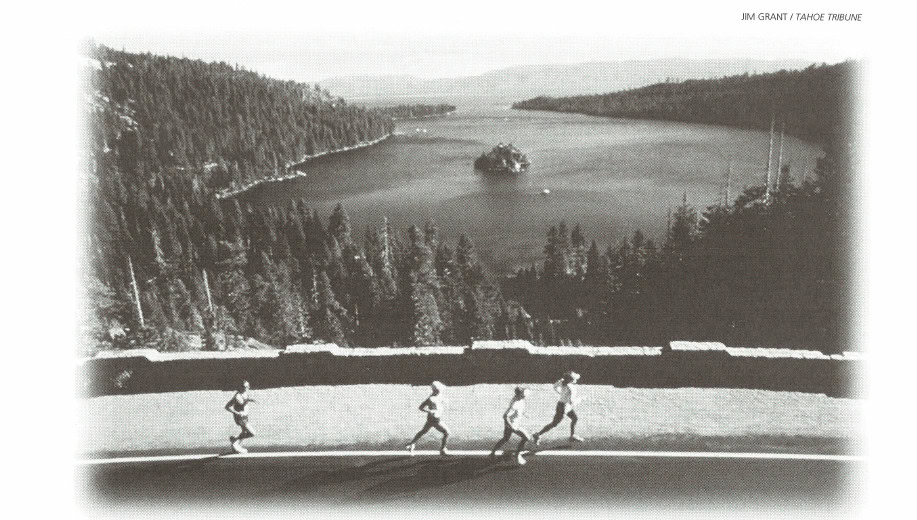
THE ONLY marathoners who are likely to get a PR (personal record) at the Lake Tahoe Marathon are first-timers. It is, however, an excellent course for notching a personal worst because of two factors: altitude and mountains.
On the upside—but everything in Tahoe is “up” in terms of altitude, so let’s call it the “positive side.” On the positive side, if you are wearing a bandanna and regularly wiping the sweat out of your eyes, you’re liable to think you died and went to scenic heaven. The Lake Tahoe Marathon is, hands down and thumbs up, one of the most beautiful courses in California. And that distinction comes in a state that boasts the Big Sur, Napa Valley, and Avenue of the Giants/Humboldt Redwoods marathons, all of which were among Runner’s World’s top 20 marathons in the United States for 2002.
The Basics
Lake Tahoe Marathon
2261 Cold Creek Trail
South Lake Tahoe, CA 96150
PHONE: 530/544-7095
FAX: 530/544-6061
E-MAIL: Leswright@laketahoemarathon.com
WEB SITE: www.laketahoemarathon.com
RACE DIRECTOR: Les Wright
YEAR RACE ESTABLISHED: 1996
SANCTION: USATF
FUTURE RACE DATES: 13OCT02, 11OCT03 (Saturday race in 2003)
START TIMES: Handicapped start, with women starting at 9:03 A.M., men starting at 9:30 A.M.
COURSE CLOSES: marathon course closes after nine hours
COURSE RECORDS:
| Open men: | Joseph Maina Ngunjuri, 2:30:55, Kenya, 2001 |
| Open women: | Katie Gengler, 3:02:46, San Luis Obispo, California, 2000 |
| Masters men: | Ric Stuart, 2:53:57, Sante Fe, New Mexico, 1998 |
| Masters women: | Kim Bricker, 3:30:07, Mustang, Oklahoma, 2000 |
| 3-day stage marathons/male: | Sean Meissner, 3:13:09, 3:18:52, 3:22:57 = 9:54:58 |
| 3-day stage marathons/female: | Linda Bialla, 3:59:16, 4:19:09, 4:31:32 = 12:49:57 |
MARATHON AWARDS: The first-place person receives $1,000, while the first person of the opposite sex to cross the line after the winner receives $500. Awards are presented to the first three places in each age-group division for both male and female: 19&under, 20-24, 25-29, 30-34, 35-39, 40-44, 45-49, 50-54, 55-59, 60-64, 65-69, 70&above. First-place finishers in each age group also receive a pair of Asics running shoes. Top 25 finishers receive a sweatshirt.
NUMBER OF VOLUNTEERS: 350
MARATHON FINISHERS IN 2001: 546 full marathon, 22 five-person relay teams, 10 two-person relay teams
MALE/FEMALE FINISHERS: 69 percent male; 31 percent female
COURSE MARKINGS: every mile
MEDICAL AID: start, 6 miles, 11 miles, 18 miles, finish
NUMBER OF AID STATIONS: 19 on course
ENTRY FEES FOR 2002: marathon: $75; five-person relay: $250; two-person relay: $110; three-day stage marathons: $175
ADDITIONAL RACES: marathon walk ($75; 7:15 A.M. start), half-marathon ($55; 11:10 A.M. start), 10K ($40; 9:00 A.M. start), 5K ($25; held on Saturday), kids fun runs (free; held at 10:15 A.M. on Saturday)
HOST HOTEL: Horizon Casino Resort, located 250 yards across the state line in Nevada at South Lake Tahoe, 800/648-3322 ($69 room rate for Sunday-Thursday, $89 rate for Friday and Saturday); also site of Sports and Fitness Expo: Friday, 3:00 P.M. to 8:00 P.M., Saturday, 10:00 A.M. to 7:00 P.M. Check the race’s Web site or race brochure for the names of other hotels in the area.
GETTING THERE: There is an airport in Reno, Nevada, 58 miles to the northeast; there is currently no commercial flights to the South Lake Tahoe Airport. South Lake Tahoe can be accessed from California by taking Highway 50 east, from Nevada by taking Highway 50 west. North Lake Tahoe can be accessed off Interstate 80 by taking 89 south to Tahoe City from Truckee.
To run the Lake Tahoe Marathon is to run for inspiration and for bragging rights. “I survived one of the toughest, most beautiful races in the world.” And race director Les Wright, who never seems content with the basic beauty of his race, annually adds interesting twists and innovations.
- When he added prize money in 1999 (when the race was in its fourth year), he didn’t just cough up the money. He made it interesting. He staggered the men’s start by 30 minutes (the difference between the men’s course record and the women’s course record at that point) so that whoever crossed the finish line first, man or woman, won $1,000. Each year he makes adjustments to the stagger time based on the current course records.
- For 2001 he added what he calls an “ultra 3-day stage marathon.” That is a mouthful for what amounts to three marathons in three days (Friday, Saturday, and Sunday) that together make more than a full circle of the lake (which is 72 miles around), in memory of the old Lake Tahoe 72-Mile Ultra, which is no more. The third and final leg is run within the Lake Tahoe Marathon itself. Like the Tour de France, the male and female leaders in the three-day race wear yellow jerseys in the next day’s leg.
Must See/Must Avoid
GO SEE IT
Heavenly Gondola. For a bird’s-eye view of the entire Lake Tahoe area, ride the Heavenly Gondola, which can be accessed from near the state line between California and Nevada. If you arrive enough days before the race, you can wear your running shoes and log a few high-altitude miles when you reach the top. It’s one of the most scenic views of an alpine lake you’re ever likely to get.
Around the Lake and Course Tour. The marathon sponsors a Saturday bus tour of the entire lake and gives an up-close-and-personal preview of the race. See the Web site or race brochure for info. Costs $15 and is well worth the trip. Sit on the left side of the bus for the best views.
The Beacon and Shoreline Café. Location, location, location. These are the best restaurants on the lake for a view of the water. The view from the Beacon on the beach at Camp Richardson is worth a million bucks. Walk up the beach from the finish line to the Beacon. The view from the Shoreline Café is equally inspiring, and on Friday and Saturday nights it goes heavy on the pasta. The Shoreline Café provides the finish-line gourmet brunch on race day.
Riva Grill. Also on the lake, but a bit more upscale and closer to the state line, the Riva serves terrific food, and the tables on the second floor give a wonderful lake view—especially after dark. Also hosts the Friends of the Marathon dinner the Thursday before the race.
Outdoor stuff. If you’re coming from the big city and want to return sporting the newest and best outdoor clothing and gear, South Lake Tahoe is the place to shop for the real authentic tried-and-true stuff. The sales personnel actually use what they sell and speak glowingly about the stuff from experience. Lots of good deals around marathon time, as there are lots of end-of-summer sales.
Carson City and Virginia City. They’re a little bit of a drive, but Carson City is worth seeing. It’s the capital of Nevada, and the downtown features some wonderful historical attractions. Make sure to visit the mine and check out the home of the inventor of the Ferris wheel. Also watch John Wayne’s The Shootist (his last film) before you arrive, and check out some of the locations where it was filmed. Virginia City is out beyond Carson City and is the old stomping grounds of Mark Twain, Dan DeQuille, and the gang from the Territorial Enterprise. You can see the desk at which Mark Twain worked, and you can drop by the Bucket O’Blood for a quick drink.
The Casinos
Good, inexpensive buffets. Big-name entertainment. Postrace massages. The casinos are a lot more upscale than they used to be. Check out some of the top-floor restaurants for magnificent views of the lake—and views across it, to the course you are about to run or have just finished.
Avoid It
Not much to worry about as far as big-city danger goes. The Lake Tahoe area is populated with plenty of wholesome, outdoorsy types, and most of the folks who live there full-time are gracious and helpful to strangers. Dress warm after dark, as the chill coming off the lake can sometimes catch you by surprise, especially if you’ve just arrived from the flatlands where it’s still early fall.
- There are also two-person and five-person relays, a marathon walk that begins 90 minutes before the regular marathon, wheelchair and handcrank chair races, a half-marathon, a 10K (run on Sunday morning; it’s all downhill), a 5K (run on Saturday morning), and an Optimist Kids Fun Run (after the 5K on Saturday, with races from 100 yards for the little ones up to 1.5 miles for the 13-year-olds). Whew!
And all of this at a 6,000-foot altitude. It’s enough to take your breath away and give you a nosebleed.
On the Course
So what’s the course like?
If you like the smell of pine trees and the look of aspen sporting fall foliage, it’s sensory overload. If you like spectacular views of Emerald Bay and lung-searing climbs up the sides of mountains (Not hills. Mountains. Mountains that make Heartbreak Hill in Boston look like an anthill.), this is your race. Or don’t race, just cruise along and soak it all in.
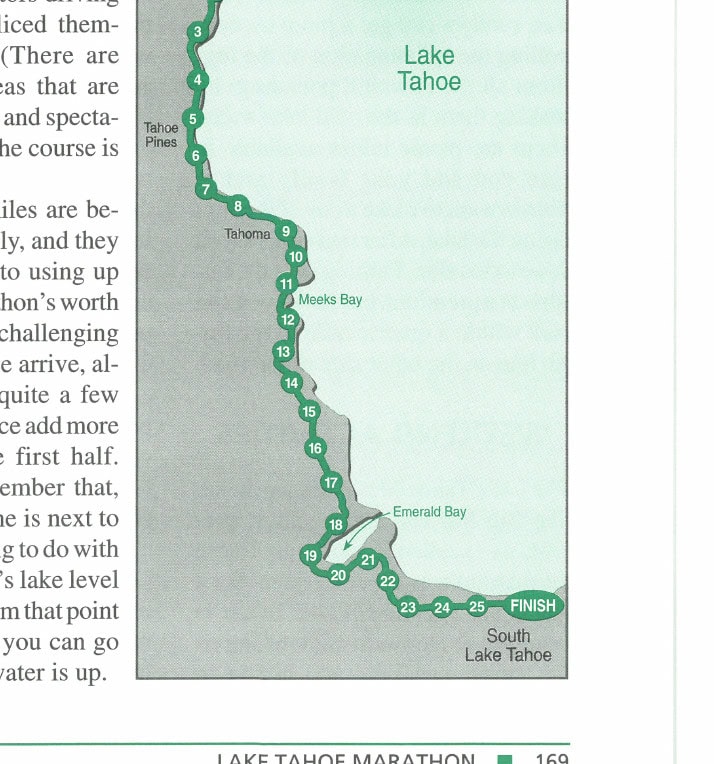
The marathon course starts at Tahoe City on the north shore of Lake Tahoe. The casinos and most of the hotel rooms are on the south shore, but shuttle buses leave South Lake Tahoe at 7:00 A.M. to take runners to the start. The start line is on Commons Beach, where permanent rest rooms are available and where the lake water laps gently at the beach.
The setting is open and friendly, and marathoners mingle and socialize, especially those who are lining up for their third marathon in as many days. Having put in the grueling miles around the lake the previous two days, they’ve made new friends and spend time comparing notes and trying to psych each other out before the peace of the moment is shattered by the report of Les Wright’s ancient shotgun. The shotgun report is a bit less startling than it was at 7:00 A.M. Friday for the start of the first of the three marathons, with the sun not yet ascended over the eastern mountains near Heavenly Ski Resort.
The fact that the female marathoners start first is a nice touch here, because amidst the gathered troops they are given a rousing send-off by all the male marathoners, who must now wait out the handicap.
The first 100 yards of the course are over beach sand, but the runners soon reach the bike path along the left side of the road; the bike path parallels the tree-shaded, two-lane highway and regularly cuts down along the water. In 2001 there was a distinct shortage of highway patrol cruisers in the wake of September 11, but spectators driving along the course policed themselves rather well. (There are plenty of pullout areas that are perfect for spectators, and spectator vehicle access to the course is superb.)
The first dozen miles are benign, scenic, and lovely, and they can lull the runner into using up more than a half-marathon’s worth of energy before the challenging segments of the course arrive, although we did field quite a few suggestions that the race add more water stations in the first half. Runners need to remember that, though the starting line is next to the shore, it has nothing to do with sea level. Lake Tahoe’s lake level is at 6,250 feet, and from that point on the only direction you can go without going underwater is up.
We love the course description on the Web site: “. . . mostly flat, except for a challenging hill at the 15 & 19 mile marks, rising 520′ up over 1.55 miles and then a 200′ dip and back up at Eagle Falls while going around beautiful Emerald Bay.” For a more graphic rendering of the course, hit the “course profile” button on the left side of the chock-full-of-information Web site. If you’ve ever seen a crocodile smile in profile, follow the teeth embedded in the lower jaw from nose to gullet and you’ll have an idea of the course profile for this marathon.
What’s your reward for all this climbing? Past the 19-mile mark you get to sluice downhill. At one point the little two-lane road is a razor’s edge, where Lake Tahoe is below you on your left and a smaller lake stretches out on your right, and you’re running on the razor’s edge itself. It’s breathtaking not only because you are out of oxygen but because you are straddling a ridgeline you’ll never forget.
The race ends on the lakeshore of Pope Beach just after the Camp Richardson Resort, a few miles to the northwest of South Lake Tahoe. On a favorable weather day, which 2001 was, runners can get a jump on controlling the inflammation of the legs (from all the downhill pounding) by soaking them in the cold lake water. There are picnic tables available in case you and your family and/or friends want to make a day of it relaxing on the lake. After that course, you deserve to relax. Parking near the finish is at a premium, but for $5 you can park within a quarter mile of the finish line on the other side of the road.
Weekend Activities
The Lake Tahoe Marathon weekend, like Big Sur and Napa Valley, presents an excellent opportunity to use the marathon as the centerpiece for a weeklong vacation. Lake Tahoe is beautiful, it glories in outdoor activities (from kayaking and hiking to mountain biking and sailing), and right across the state line in Nevada there is a slew of gambling casinos. If you don’t care for gambling, the casinos offer inexpensive buffets that they hope will draw gamblers but that are terrific places for the carboloading runner. The casinos also have begun offering nonsmoking sections, so they aren’t as unfriendly to runners as they once were.
The race expo for 2001 was relatively crowded. The room in which it was held featured low ceilings and exhibitors’ booths pressed against the walls, with the center dominated by a clothing sale operation. The number pickup at the back of the hall was chaotic on Friday afternoon because the professional scoring group that was engaged for the weekend got stuck in traffic coming up from the Bay Area (apparently for the second year in a row) and the line of runners trying to pick up their numbers ran the length of the expo hall and out into the hotel lobby. Les Wright says that problem is solved for 2002 by engaging a new scoring company that promises to be there well before the expo doors open.
Parking for the expo was also a problem in 2001 because of massive construction projects near the host hotel. Fortunately, that problem should be history for the 2002 race.
On the plus side is the Sunset Pasta Cruise to Emerald Bay on Saturday night. The pasta buffet (including live music and a two and one-half hour lake cruise that takes you all the way over to Emerald Bay and back) costs a mere $30 and leaves from the Ski Run Marina at 5:45 P.M. The only shortcoming is that there is space for only 300 people, so book this feature early! If you’ve reserved tickets, they can be picked up before 3:00 P.M. at the expo on Saturday; if they aren’t picked up, they’ll be sold to folks on the waiting list.
Runner’s Highs/Runner’s Lows
| HIGHS | LOWS |
|---|---|
| Altitude | Altitude |
| Outrageously beautiful natural scenery | Hills on the second half of the course that make Heartbreak feel flat |
| A cornucopia of racing distances | Did we mention the altitude? |
| Good race weekend organization | |
| Option of three marathons in three days | |
| Lake cruise for pasta load | |
| Swell medal to finishers | |
| Nice spot on the beach to relax after finishing | |
| Clever handicapped start for male racers |
3 x 26.2
One of Les Wright’s greatest contributions to the sport (besides his raw enthusiasm) is that his mind never stops working. His board of directors for the Lake Tahoe Marathon goes along with his innovations, no matter how outrageous.
His “three marathons in three days around the circumference of the lake” is innovative, clever, and very enticing for a radical segment of the running population. Les bills the affair the “Tahoe Ultra 3-Day Stage Marathon,” which is a mouthful and technically untrue, but it makes you want to sign up immediately.
First of all, the series of races isn’t an ultra, yet it is steeped in ultra tradition. Pepsi of Reno used to sponsor a 72-mile ultra that circled the lake. The record for the 72-mile loop is held by Rae Clark, who completed the circuit in 9 hours and 6 minutes. Les is considering changing the title of the race to reflect Rae Clark’s record—and Rae Clark may give the prerace Thursday-night talk for 2002.
Second of all, the race is “3-Day Stage Marathons,” but that sounds even more awkward.
Third, who cares? It’s a unique, extremely fun—and extremely challenging—event no matter how it’s billed or how it’s run. The 2001 event was an experiment to see how—and if—it could be done in conjunction with everything else that is going on over the weekend. It worked—splendidly. It worked because it was unique
and because the hardcore runners who took part entered knowing that they were up against
- running at altitude,
- running against tight traffic on the first day,
- running with limited support,
- running up and down very big hills, and
- running without whining.
The spread of talent in the inaugural event was mind-boggling, from runners who nearly broke 3:00 on the first leg to runners who stayed out on the course most of the day. Nobody complained. Everyone—from fastest to slowest—bonded and, in fact, spent time at the expo on Saturday (after leg two) comparing blisters and aches and pains.
There was such a show of high spirits that for 2002 Les has doubled the entry limit to 50 hardy runners.
Here’s what the runners in the 3-day event get for their entry fee:
- Finisher’s medal and T-shirt for regular marathon.
- Hooded sweatshirt.
- Commemorative wall plaque if you finish the three days.
- Special award to fastest total time for male and female.
- Special ultra-racing singlet, which sets you apart from the regular hoi polloi marathoners on Sunday.
The race is billed as “excellent speed work for your next 100-miler.” You sort of have to be in that headspace.
A description of the three courses:
- Day 1. Start near Inspiration Point overlooking Emerald Bay. Downhill (!) for 3 miles, flattish for 19 miles, “gentle” uphill over final 3 miles with downhill finish to Spooner Lake.
- Day 2. Start on the road near Spooner Lake State Park, gentle downhill for 13 miles to Incline Village. Final 13 miles rolling, with one bigger hill (!) at Crystal Bay. Downhill final 5 miles to Tahoe City; finish on Commons Beach.
- Day 3. See earlier description of standard Lake Tahoe Marathon course.
Jewel in the Crown
California has a handful of marathons that are exquisitely scenic. (So much so that there’s occasionally been talk of forming a Triple Crown involving Napa Valley, Big Sur, and Lake Tahoe.) Lake Tahoe ranks as one of those scenic marathons. But you have to earn the beautiful scenery by running (as Toshihiko Seko used to say) “at the edge of death.” The mountain passes in the second half dwarf Boston’s Newton Hills. But the race is laid back, the weather is almost always lovely, there are plenty of rooms available, there are plenty of things to do for the family, and you never know what unique innovation Les Wright will spring next. The handicapped male versus female marathon starts add drama and attempt to make the finish equal, even though it is plain that the two sexes aren’t equal in marathon-running potential; it is a solution that is about as fair as it can get.
The race provides a perfect extended weekend getaway.
And then there are the possibilities of the three-day stage marathons for those who just can’t get enough or, as Les bills them, for those who need some speed work toward their next 100-miler.
The Lake Tahoe Marathon (and attendant races) is a unique offering from a unique race director. The possibilities provided almost make up for the lack of oxygen at the start and the occasionally inconvenient mountains that are thrown in along the way. Or, as the Web site bills it: “A Sunday morning run you will never forget.”
The Bottom Line
We have weighed various aspects of a marathon within a 1,000-point scoring grid. Besides the author of the article, two dozen runners at the race were randomly chosen to score the race for us (LTM = Lake Tahoe Marathon). The results follow:
1. History/Tradition
Evaluate the race’s sense of history and tradition.
[Possible points: 30 LTM score: 17]
2. Entry Form
Is the race entry form clear, concise, attractive, complete, and easy to fill out?
[Possible points: 20 LTM score: 19]
3. Entry Cost
For most races, the entry fee covers between 30 and 50 percent of the cost of putting on the event. Rate the value of your dollar relative to this race.
[Possible points: 30 LTM score: 26]
4. Locale/Scenics
Is the race held in an area that is easy to get to and scenic and offers adequate food and housing services and nonrace activities for family and friends?
[Possible points: 50 LTM score: 49]
5. Registration
Is registration well organized and efficient? Does it bog down unnecessarily?
[Possible points: 20 LTM score: 17]
6. Prerace Activities
Evaluate activities, such as pasta feeds, parties, and so on, during the days before the race.
[Possible points: 50 LTM score: 45]
7. Expo
Does the expo offer a fair number and variety of booths relative to the race’s size? Are there quality exhibitors and good guest speakers?
[Possible points: 50 LTM score: 39]
8. Course
Take into consideration the following: degree of difficulty, certified, sanctioned, quality of road or trail surface, adequate mileage and directional markers, aid stations, medical coverage, race communications, accessibility to course for friends and family, typical weather, and so on.
[Possible points: 400 LTM score: 359]
9. Race Amenities
This category includes race T-shirt, finisher’s medal, finisher’s certificate, adequate and efficient finish area, ease of sweatbag retrieval, showers, postrace refreshments, awards ceremony, raffles, results postcard, results book, and so on.
[Possible points: 250 LTM score: 206]
10. Volunteers
Are the volunteers experienced and adequate in number?
[Possible points: 100 LTM score: 90]
Total Score for Lake Tahoe Marathon: 867 points
This article originally appeared in Marathon & Beyond, Vol. 6, No. 4 (2002).
← Browse the full M&B ArchiveMore like this
1,000+ stories from 19 years of Marathon & Beyond
The complete archive of the legendary long-distance journal — digitized and free to read.
