

The “Real” First Marathon
ONE OF the least-debated historical subjects is the origin of the marathon. But Herodotus, the Father of History, was Greek and told a very one-sided story. You’ve surely heard the saying that “the winners write the history books.” It’s unfortunate that over all these years, the Greek version has been made readily available, while the “real” story has been, shall we say, underlooked.
You’d think considering the relevance of the subject, especially in this day and age when everyone and his Aunt Bertha are running marathons, there would be deeper study of the world’s first marathon run. Even the very completely complete The Olympic Marathon by David Martin and Roger Gynn, published in 2000, gets it all wrong.
Noting the vacuum in reliable scholars on this subject, I felt sucked into the debate and appointed myself a committee of one to research the first marathon.
MY OWN FIRST MARATHON
When I ran my first marathon in 1987, I looked into the origin of this most grueling of sports. I felt that by learning of its origins, I could better understand its strange attraction to people in literally every backwater in the world. First, I checked my handydandy encyclopedia—always a good starting point. After reading a brief description and the one-sided historical “facts,” tears welled in my eyes, and the page began to blur. As a former American president often said, “Here we go again.” This was yet another put-down of Iranians (then known as Persians), this time by Herodotus, a guy you’d think would know better. But I guess everybody throughout history had a political agenda they were pushing.
Being of pure Persian ancestry, I felt compelled to run a marathon the hard way and not be overshadowed by the performance of the alleged first marathoner, that Greek guy Pheidippides. I refused to stop for water or rest during my training in the blistering Oklahoma summer of 1987, not even on my 20+ milers. I feared that if I took water or rested, I would tarnish the sanctity of my endeavor and not measure up to the Greek’s standards. I was afraid the race officials would disqualify me and pull me from the race if I was spotted taking a drink or a walk break. Not until I crossed the Verrazano Narrows Bridge and spied all the crumpled paper cups strewn all over the Brooklyn pavement was I convinced that it was okay to drink and walk during the course of the race. It was then I began to question the authenticity of the Origin of the First Marathon, as Herodotus has led us to believe it.
THE PERSIAN REBUTTAL
As I got to know other runners in my hometown and began to train with them, I asked them about their knowledge of the first marathon. I received two kinds of responses: either they knew no more about it than I did, or they flat knew nothing at all about it. At that point I realized that the brainwashing about the subject had completed its cycle—nothing remained to be done but put the brains in the dryer along with the Downy, and no one would ever question how the wash was done.
Well, then: you have all read about or heard the Greek version. It’s now time for the Persian rebuttal.
Imagine the scene if you can: the year is 490 BC, a clear mid-September day with low humidity and temperature in the low 70s on the Marathon Plains, 25 miles from Athens, Greece. Twenty-five thousand Persian fighting men land by sea on the Plains of Marathon in one of the greatest gatherings of its kind to that date. The Greek army of 10,000 arrived from Athens and spent the night trying to figure out how to push back the dreaded Persians without getting themselves annihilated. A little, skinny guy named Pheidippides, who was the Little Big Man of his time, climbed a huge olive tree and camouflaged himself within the thickness of the late-season branches. He was the only one left to tell the Greek version of the story.
The Greek army was no match for the warlike Persians. The Athenians had hoped the Spartans would be able to join them to help repel the Persians, but there was a full moon, which meant a pagan festival, and the Spartans elected to stay home and enjoy the annual Harvest Festival and State Fair.
At this point, I would appeal to the sensibility, intelligence, and common sense of my readers/marathoners. If the Athenians had won the War of Marathon, would it not make sense that the first thing they’d have done would be to get down and party, rummage through the dead Persians, relieving them of the spoils of victory, and only then, when the fun was over, send someone to Athens to let them know all was well? As any warrior will tell you, that is the normal course of war. The Greeks, however, would have you believe that the Little Big Man immediately took off at a gallop, running 25 miles to the gates of Athens, bleating out his message of victory as he expired from exhaustion. It has never made sense to me.
According to my more impeccable sources, here’s what really happened: Pheidippides, the little coward, witnessed the certain defeat of the Greeks, leapt from his concealing olive tree, and sprinted toward Athens like a scared rabbit to spread the bad news.
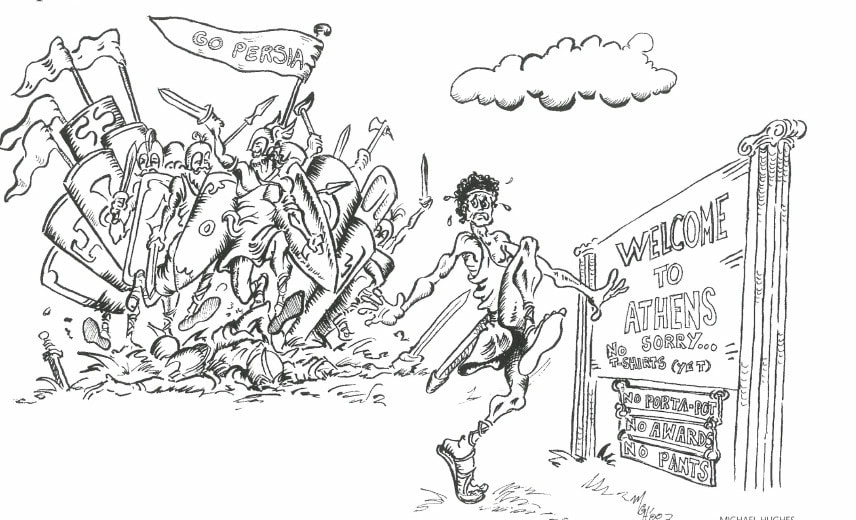
After the battle was won by the Persians, King Darius gathered his troops together and instructed them to hustle on to Athens to get the booty hoarded there, for everyone knew the Athenians were a wealthy people (after all, they were the Greek salad makers to the world).
THE FIRST MARATHON RACE
The fact that the first Persian to the gates would reap the greatest reward in booty made the race from Marathon the first professional marathon race in history. The race was also ecumenical. There were no age brackets, no handicapping, and no qualifying time needed to compete.
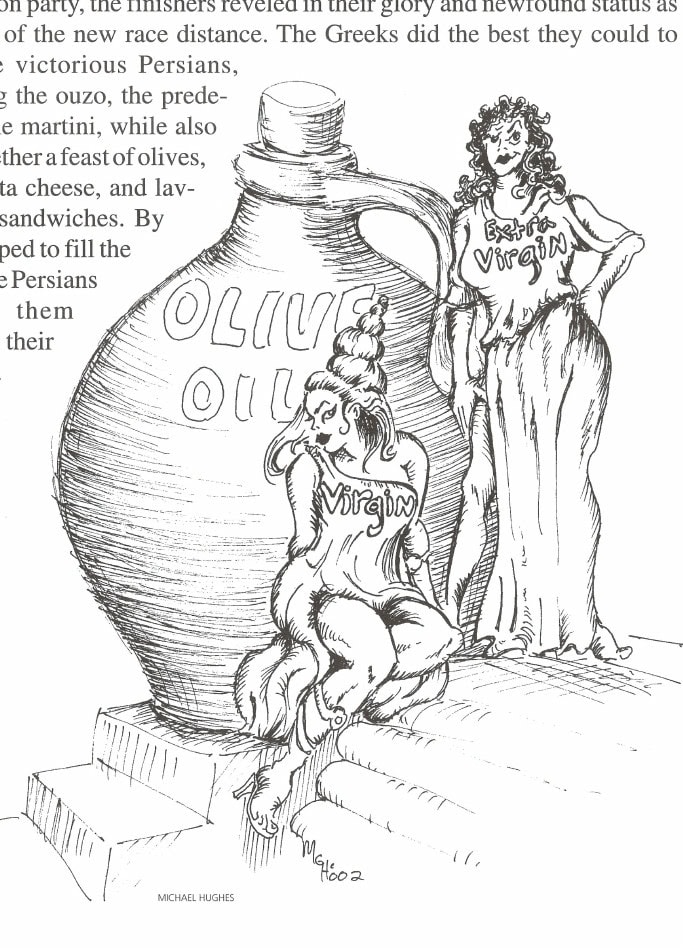
The first to the gates had their pick of all the available virgins they could deflower, all the virgin olives they could eat, and enough virgin olive oil to fill a swimming pool. These prizes were, after all, the original reason for the invasion—well, that and the fact the Athenians were getting under King Darius’s skin because every time he went to whup a Greek city-state’s butt for going against his wishes, the meddling Athenians would jump in and help out that city-state.
With more of an incentive to run like the wind than Pheidippides had (who was, after all, burdened with a big bag of bad news . . .), the lead Persians caught up to Pheidippides shortly before he reached the gates, thereby depriving the Athenians of advanced warning of the invasion.
The Persians invaded Athens, and the pace of the party and pillaging increased 10-fold from the slim pickings at Marathon. In the world’s first postmarathon party, the finishers reveled in their glory and newfound status as conquerors of the new race distance. The Greeks did the best they could to placate the victorious Persians, contributing the ouzo, the predecessor of the martini, while also putting together a feast of olives, bananas, feta cheese, and lavish pocket sandwiches. By this they hoped to fill the bellies of the Persians and make them sluggish in their celebrating.
UNVEILING THE TRUTH
I came upon the true story of the first marathon through plain old diligent research. Before returning to the old country to do firsthand research, I talked with a childhood friend, Faramarz, another purebred Persian like myself. He is also a runner and has been a participant in many large European marathons. I outlined to him my fact-finding trip to the motherland, and he admitted his admiration for my courage in taking a chance with my life for such a noble cause. (It just happens that, for reasons I’d rather not get into here, I’ve for years been persona non grata in my native Iran.) He assured me that if I could debunk the Greek myth of the marathon, I might well be forgiven in my native Iran for my misguided allegiance to the Great Satan and might even receive the Persian equivalent of the medal of citizenship and honor. That would at least temporarily save me from a public stoning as a stooge for the evil Uncle Sam.
Since the entire ancient history of Persia is carved on several granite cliffs in the ancient Persian language of Conifer, I had to prepare for my trip by going to night school. Conifer is to Persian much like Ebonics is to the King’s English. In order to find a place where Conifer is taught, I had to enroll at an Iranian inner-city night school in west Los Angeles, where a million displaced Iranians reside.
The cliffs are similar in shape and height to Stone Mountain in Georgia, and the history is written in very small type since it contains, in compact form, several centuries’ worth of history. It requires a scholar to bend back as far as possible and use binoculars to read the text. To condition myself to take on such a task, I spent four hours each day for a full month at Home Depot reading the fine print of the product description and prices of merchandise on the top shelves. By the end of the month, I had acquired the same flexibility as Linda Blair in The Exorcist—or even more so, as I could now count the moles on my back.
OFF TO IRAN FOR THE FACTS
Armed with a hard-to-find Conifer dictionary and assorted surveying equipment, I took my never-used geology degree and headed to Iran on a fact-finding mission.
When I arrived in Tehran, my old friend Faramarz picked me up at the airport. After discussing my plan and seeking his advice, I accompanied him to the sacred mountain, where we boarded a Bell helicopter (which, incidentally, was made in Iran during the Shah’s regime) and headed south to the 500 BC capital of the Persian Empire, known as Persapolis.
First, we studied the cliff writings and took photos of the carved history for later study. Translation of the material revealed what we had suspected: Herodotus was a fraud. He was no better than his modern biased media wonks. He had written the history as he wished it had happened, and not as it was. The indisputable facts are substantiated by tangible evidence discovered by those great historians, Faramarz and myself.
Wonderful additional facts emerged from the translations of the Conifer carvings. Persians had an insatiable thirst for Shiraz, a wonderfully diverse grape that would eventually evolve in several directions, becoming Chardonnay, Cabernet, Pinot, and a great vodkalike spirit called Araq. The kings of the Persian Empire attempted to strike a deal with the Greeks for free trade. The Greek citizens against WTO (World Trade Organization) rushed to downtown Athens and set the vendor carts on fire. Any product sporting an imported label was looted. The minority isolationist leader in the Greek Parliament, a fellow named Patrick, led the fight, and the House eventually turned down the deal. Darius the Great, the Persian monarch, gave the hand of his daughter to Mardonius, the ruler of Macedonia. This act of goodwill kept the flow of olive oil and Greek olives going until the Athenians interfered with the shipments. That action was one of several that precipitated the Battle of Marathon.
When Faramarz and I flew over the remains of Persapolis, we noticed a very peculiar pattern of qanats. Qanats, invented in ancient Persia, are a most ingenious way to transport water from one point to another. A well is dug to the water table in the fluvial plain, and once the water table is reached, a tunnel is dug toward the point where the water is to be used. Every half mile or kilometer, another well is dug to allow the flow into the new well. It was not unusual for water to be transported in this manner for hundreds of miles. This subterranean transportation also minimized the evaporation of a precious commodity in the high and arid Persian plateau. This technology, later adopted in Afghanistan, is now providing the hiding places for the Taliban.
Gazing down, Faramarz and I were struck by the unusual pattern of qanats leading to Persapolis. Exactly 25 qanat openings were visible from the helicopter, arranged in a kidney shape, starting from the center of Persapolis, going out and away from the city, but circling back to the center of town. Even more startling, when we measured the distance between each qanat, it measured one farsang, the approximate value of a mile. Undoubtedly, this was the site of the first marathon to be run on a designed and measured one-loop course.
GARBAGE MAKES THE MATTER MOOT
Further examination of the course yielded more amazing artifacts. An enormous number of broken clay water cups were strewn around the qanat openings and along the trail to the next qanat. This pattern continued all the way to the final qanat, which served as both the start and finish of the loop.
We also discovered fossilized banana peels and other typical discards: remnants of sandals complete with goat bladders as insoles (apparently the first air-cushioned footwear).
At farsang intervals, we found remains of jars containing residue of petroleum jelly. Clearly, volunteers offered lubricating substance to the participants, as is done in modern marathons. (This is not surprising since the first free-flowing petroleum was discovered at Persapolis more than 5,000 years ago.) In fact, the eternal fire at this location led to the rise of civilization and eventually spread to other continents.
Radiocarbon dating confirmed that many of the objects were from the 489 BC era. This was, to our way of thinking, direct evidence that the Persians celebrated their victory at Marathon on an annual basis. Examination of mounds of artifacts substantiated our findings that this annual event, a celebration running of the “marathon,” continued until the Arab invasion of Persia some 1,300 years ago. From that date onward, we found no evidence of marathon races, indicating to us that the Moslem invasion put a stop to all partying and introduced to the populace—or, more likely, forced upon the populace—a fundamentalist way of life not far different from the life the ayatollahs of today dictate. A sad state of affairs. This past 1,300 years of suppression of athletic activities in Iran would give credence to Herodotus’s version of events if you failed to seek evidence beyond that time period.
But let’s be logical about this. If the Persians had lost the Battle of Marathon, why would they then come home and inaugurate an annual repeat of the same agonizing experience? If you’re a marathoner, you know the answer to that. After a successful marathon, no matter how difficult, you can’t wait to do another one.
ADDITIONAL STUDIES
At this writing, I have been informed that my fact-finding mission has spawned several institutions of higher learning to embark on their own research. Both the Addis Ababa Poly Institute in Ethiopia and the Rift Valley Agricultural and Mechanical University in Kenya are world centers for the study of long-distance running, and they have since conducted extensive research on the question of who won the Battle of Marathon. Their studies have extended as far back as the Pleistocene Epoch of the Cenozoic Era. This research, covering somewhere between 1 and 3 million years, though a very noble endeavor, does not serve the modern age. In all likelihood, their research will be challenged as soon as it is published by that other bastion of running, the University of Kansas.
The creation science professors with God on their side will oppose the findings. The two major institutions’ research will be doomed and may possibly throw the sport into an international cultural war. One cultural war in Kansas is enough. The clash will likely be loud enough to obscure our focus on the origin of the marathon. Which once again will leave my own research as the only modern, credible crucible of fact on the subject.
The Greeks have no substantiated evidence except the story told by Herodotus—writing that amounts to feel-good fiction to be read out loud to put children to sleep.
Perhaps it is time to revive the Persapolis Marathon, to run it on its original course, to run from qanat to qanat, to celebrate the first-ever annual marathon (run from 489 BC to roughly AD 700) created by victorious Persians to celebrate their glorious accomplishments on the Plain of Marathon in 490 BC.
I have sent a letter to the ayatollah suggesting this very thing. I am not expecting a timely response. Still, if the marathon continues to grow in every corner of the world at its present rate, Iran is going to want to reclaim its rightful place as the ultimate creator of this divine event.
Sunday, Oct. 6, 2002
This is our 31st year! We are proud that with age our event has gained credibility and tremendous accolades. However, our goal remains to make everyone who participates feel like a winner.
Goodies and Awards
We do not spend our budget on purses for an elite few — we spend it on each entrant. Our Marathon runners and walkers receive high-quality, long-sleeved finisher’s shirt, medal, poster, food and drink, space blankets, and a great goody bag. Our related event participants also receive shirts and an assortment of goodies.
Last year over 1,250 awards were given out. We have five-year age divisions, masters, Clydesdale, state and country competition, as well as team, race walker, wheelchair, and other special handicapped categories.
An Event for Everyone
You do not have to be a marathoner to enjoy the Portland Marathon because there are seven other events that take place on marathon morning or during the weekend.
Our Five-Miler is an excellent event for beginning and competitive middle distance runners. The Mayor’s Walk is 6.2 miles of fun along the last 6.2 miles of the marathon course. The Kids’ Marafun is a noncompetitive approximately two-mile event for kids 12 and younger and anyone else who wants to join them. The 26.2 mile Marathon Walk allows the walkers to share the thrill, excitement and the same perks as their running counterparts.
Our other weekend events include a first-class race directors’ conference, a spectacular sports and fitness expo, the best pasta party in the west, and a great post-race/awards party. In short, we offer an event for everyone in the family.
Course and Weather
The marathon course is rolling with a few long gradual hills on the first part of the course. The route wanders through downtown Portland, China Town, Old Town and neighborhoods with tree-lined streets. There are plenty of dramatic views of the Cascade mountain range, our city skyline and river front.
The second half of the course can easily produce a “negative split” for our runners. An average of 33% have set PRs! The weather is normally in the low 50s. It is the best time of year to be in Portland.
Organization
Our event has gained its reputation for excellence through organization: 3,500 volunteers, 20 enthusiastic aid and medical stations, splits called at points on the course, over 65 entertainment groups, and a finish line where every marathoner’s name is announced to the thousands of spectators. All of our event participants share in a great array of food and beverages.
Marathon Hotline: (503) 226-1111
e-mail: info@portlandmarathon.org
Or enter online: www.portlandmarathon.org
This article originally appeared in Marathon & Beyond, Vol. 6, No. 2 (2002).
← Browse the full M&B ArchiveMore like this
1,000+ stories from 19 years of Marathon & Beyond
The complete archive of the legendary long-distance journal — digitized and free to read.
