

My Most Unforgettable Marathon: September/October 2006
SACRAMENTO, CALIFORNIA, December 5, 2004—I started feeling it between miles two and three. It was a problem with my anterior tibialis. At least that’s what my physical therapist, Chris, informed me when I first hobbled into her office just as I was turning the corner into a well-earned taper. The tibialis is a muscle that runs along the inside part of the calf, adjacent to the shinbone, and I had been cautiously nursing it for the past two weeks.
But here I was, minutes into the California International Marathon, and it was hurting again. Every time I planted and pushed off with my left foot, it felt as if some mean-spirited Lilliputian was jabbing the area just above my ankle with a penknife. Jab. Jab. Jab.
I had traveled up to Sacramento from Southern California to take part in the race. And here I hadn’t even really broken into a proper sweat yet. And here I knew, from having gingerly run on my calf in the days leading up to race day, that the injury wasn’t one of those things that simply disappears once the legs find their rhythm. The devilish little fellow continues to jab. And then jab some more.
OK, I told myself. You’re out here. You’re hurting. What do we do next?
A LASTING IMPRESSION Everyone has reasons for taking up this sport. For me, I suppose, the seed was planted during a matinee at the Creekside Cinemas. My three brothers and I were lazing away a warm Santa Rosa afternoon in the coolness of a darkened theater, and Ryan O’Neal was starring in a movie called The Games. Don’t remember it? Neither did I. I had to research the title on the Internet to refresh my recollection. What I do remember, though, was that O’Neal played a gifted runner who, beset by the pressures of his success, performs the ultimate meltdown while in the midst of the Olympic marathon.
His goal, from what I recall, was to run history’s first sub-two-hour marathon. I don’t want to spoil the ending for anyone interested in trying to unearth this relic—the type of sudsy, dispensable drama whose target audience was precisely a quartet of young brothers who had nothing better to do during a two-hour slice of summer—but he doesn’t quite make it. In fact, Hollywood’s golden boy du jour damn near runs himself to death right there before his agape coach and thousands of astonished spectators.
This, mind you, was long before crashing in an endurance race became fashionably known as either “hitting The Wall” or “bonking.” Whatever O’Neal was doing, though, it clearly left a lasting impression on me. I mean, he was bouncing from one curb to the other like a tiring top. Faces became blurry. The sky became the asphalt. And I’m sure there was blood. There’s always got to be some of that fake Hollywood blood in those things.
Anyway, as my brothers and I ribbed one another on our way back home and we staggered into one another’s arms just as we had seen O’Neal do in a determined bid for an Oscar nomination that would, in keeping with the thrust of the storyline, ultimately fall short, I secretly wondered to myself whether people truly did run 20-something miles at a time. And if they did, and if it really was as grueling as all that, then I thought I would like to give it a crack someday because deep down inside I figured I could go the distance.
TO RUN OR NOT TO RUN Eight days before CIM, I had hit rock bottom. I went out for an easy one-hour run, and I could feel the jabbing sensation start at the 30-minute mark. It slowly proceeded to get worse until it felt as if the penknife had been replaced by a steak knife, and then the steak knife had suddenly been swapped out for a bowie knife.
My wife, Margo, could tell from my demeanor as soon as she saw me limping down the driveway that I had mentally pulled the plug on the race. I thought of all the early-morning runs, and all the steep mountain trails I had struggled up during the course of my training, and all the trips I had made to the track, sometimes when it was still so dark outside that I couldn’t see whether others were on the oval until I was practically right up against them.
Mostly, though, I thought of the string of rotten luck I had endured for the past few years. Every time I was on the verge of finally tackling another 26.2miler, something would emerge from the depths of the earth and take a giant bite out of me.
First, there was the day my back went out. I was in the best running shape of my life, and I was slated to run Boston for a shot at a PR. One-third of the way through a training run, I went from feeling like Mercury with feathered heels in
full flight to feeling like a toppled statue that had cracked completely in half. Bye-bye, Hopkinton. Hello, chronic back ailment. Life after that became a continual struggle of trying to regain a semblance of my former fitness. Much like the frustrated Tantalus, I longed to sip from a marathon goblet that forever slid just out of reach whenever my fingertips drew close enough to grasp it.
Among other mishaps, there was the time I went running on a windy day, and—I kid you not—an honest-to-God pinecone fell from the sky like a grenade and cracked me in the forehead, leaving me dazed, bloodied, and in need of a box of sutures.
There was the morning I stumbled on the trails, fell awkwardly, and broke my clavicle. And then there was the time when I finally knew I was fit enough to run Chicago, a marathon I had lusted over since forever, but I came down with the flu the week before the race. I traveled out anyway, fooling myself that I had bounced back—and had to walk off the course at the half when it became excruciatingly clear that only fools fool themselves.
It had gotten to the point where Margo didn’t even utter the words “marathon” and “schedule” in the same sentence. As the buildup toward Sacramento was reaching a crescendo, she had moved well beyond the breath-holding phase. We were reduced to the barest of dialogues on the subject, hesitant to go into details out of fear that we would somehow jinx my progress. Whenever I would return from an especially challenging training run, she would simply ask, “Are you OK?” And I would nod.
On this particular Saturday morning, though, just over a week out from race day, she didn’t even need to ask. We embraced, she told me that she loved me and felt awful for me, and then she kissed me and sent me in to shower before my physical therapy appointment. If I felt as low as the concrete underfoot, I’m quite certain she felt as bottomed out as the dirt beneath the concrete.
“ALL ABOARD THE SACRAMENTO EXPRESS” CIM organizers describe their course as the “fastest in the west.” The first half of the race consists of rolling hills, and then the topography begins to level off somewhat until one last climb around mile 17. After that, it’s pretty much a flat shot leading up to the home stretch into the state capitol.
When your calf starts bothering you a few miles into the race, though, you’re not paying much attention to course elevation. You don’t notice the smiles of the volunteers at the aid stations. You don’t hear the cheers of the locals who stand bundled and shivering by the side of the road. And you certainly don’t engage in any of the customary early-miles banter with your fellow runners.
All your focus is on the hurting sensation in the lower part of your leg and the debate that begins to rattle in your brain. “Is it getting worse?” “Is there an outside chance the pain might go away?” “You pulled a little Ryan O’Neal action in Long Beach, your first bonk, and then you DNF’d your very next time out in Chicago—are you prepared to deal with yet another marathon disaster?”
I ran on one side of the road to see whether the pain would stop. It didn’t. I crossed over to the other side. No go. I tried to slow down, then to speed up. I felt as if I were engaged in a jaded game of tag and I was trying to somehow run away from my own calf, which had become “It.” Step after step, jab after jab, I was painfully aware of the damn injury I had prayed I had left behind in L.A.
Margo, my faithful handler, had, with my blessing, decided to sit this dance out by staying home. Perhaps her intuition had warned her about the very scenario that was rapidly unfolding. My older brother, John, though, had driven up from his home in Santa Rosa to cheer me on, and he was well aware of what I had been up against in the lead-up to the race. The plan was for him to be at miles five, 13.1, and 20. As a precautionary measure, I had tucked his cell phone number safely away in my running shorts. When I ran past John at mile five, I told him that I could feel my calf muscle. His response was that I looked great and to keep it up. What else is a lifelong buddy going to say?
My adjusted goals coming into race day had dramatically changed since the peak of my training. The first objective was to simply get to the start line in one piece. Mission accomplished. Then to get to the finish line. OK, very much in doubt. Then to qualify for Boston again. Pie in the sky? And then, and only then, to worry about shooting for a possible PR. Pie and cake shop on Mars?
As I continued on, the pain wasn’t getting worse. No, it wasn’t going away either, but it wasn’t getting worse. And that heartened me. Somewhere between miles five and six, I saw a large knot of runners up ahead. There had to have been some 30 to 40, and they were chewing up ground like Attila and his marauding Huns. Attila, some guy holding up a “3:10” pace-group sign who my prerace research had told me was local running legend Rae Clark, was surrounded by so many road warriors that it seemed as if they had all been hired to protect him and that the whole lot of them were all scurrying off to safety somewhere up ahead.
I latched onto the back of the pack like a caboose, and the pace felt doable. Yes, there was still the issue with my calf, but the rest of my body had warmed up nicely and I was right where I wanted to be in my very best-case scenario—in the ballpark of my PR.
FALLING IN LOVE
www.brightroom.com
I ran my first marathon exactly two days after I turned 40. I had taken up running a few years before. My background was swimming. When I closed that chapter of my life, I decided to explore some of the athletic endeavors I had had to sacrifice in my quest for Olympic stardom. First there was basketball, a sport I had reluctantly given up in junior high school. So, for a decade or so in my 20s and 30s, I embraced roundball with a childlike zeal, playing in any and all pickup games and adult leagues I could find.
Next up was running. I was a decent runner in all my physical education classes, and I had always had a yearning to see just how well I could have performed in the sport had I just been afforded the chance. At first, I couldn’t run 20 minutes straight without feeling knee pain. Gradually, though, I began to improve. All my efforts at the time were on the treadmill at the gym, and I distinctly remember the elation I felt the very first time I saw the red digits on the control panel spin past 35:00.
The goal setting and accompanying accomplishments began to flow with regularity after that: running for an hour straight, finishing my first halfmarathon, breaking 20 for a 5K. Those were the halcyon days, when ripe PRs hung on low branches just waiting to be plucked, polished, and savored.
I decided early on, though, that I would embark upon this new journey only within certain parameters. I would accomplish
▲
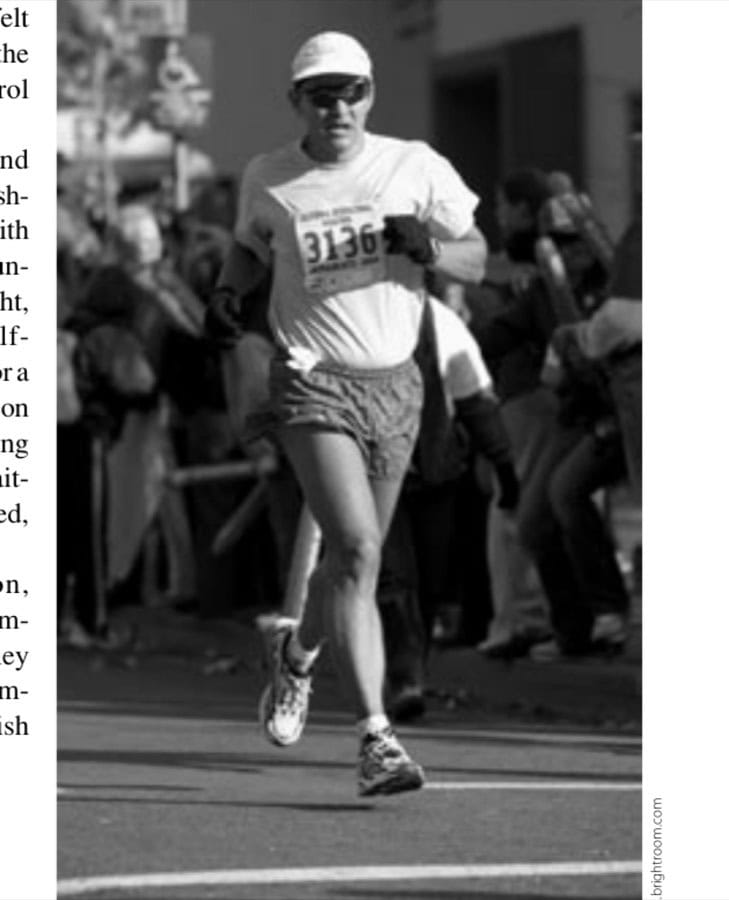
Sipping once more from the marathon goblet—finally.
whatever I could by limiting my running to three times a week, period. I wasn’t going to join a running club, commission a coach, or rush out to purchase a fancy pair of racing flats. God, though—even with such self-imposed restrictions—how I’ve come to adore this thing called running. I love watching others do it, whether it’s on television or passing by along a sidewalk. I enjoy reading the words of those who share the passion. And most of all, I relish my own miraculous ability to do it.
I may not be particularly fast. Others possess far more natural ability. And my legacy as a runner will certainly never lead to anything resembling a Hall of Fame. But, oh, how I’ve come to embrace this sport.
TURNING A CORNER When I had gone to my physical therapist eight days before race day to tell her I was abandoning the race, Chris, a fellow distance runner who has been at the game far longer than I have, refused to let me bow out so easily. Well aware of my trying history of getting to a start line, she dug, kneaded, electrically stimulated, ultrasounded, iced, and basically tried to exorcise the hell out of my calf—all the while insisting that I had to give it until at least Tuesday to make up my mind about whether to race. When she was finished, I could barely stand upright. I shambled out of her office, promising to wait the extra three days to decide, but all the while thinking to myself that perhaps one too many long runs had left this lovely woman with a shortage of brain cells.
Margo, meanwhile, was pretty ticked off at Chris. My wife and I had both already been through the mourning stage. Now she was convinced, especially with Chris’s optimism, that I was setting myself up for yet another plunge into despair by even entertaining the thought of still competing. She had been in Chicago, Margo. It was into her arms where I had collapsed into a wobbly, emotional heap at the halfway point. She squeezed away my torment, as we both cried, all the while talking common sense to me while my mind wavered about whether I should get back onto the course and continue along with the thousands of other runners who streamed past.
Lo and behold, though, 24 hours after my physical therapy appointment, I turned a corner. It may have been wishful thinking—just as had been the case with Chicago and the flu—but my calf actually started to feel better. I went to the track to do some marathon-pace running on Tuesday, and even though I was aware of my tibialis, it didn’t blow up on me like a ruptured pipe as I had feared. So I upgraded my chances of running to a whopping 30 percent. It’s difficult to gauge an injury when you’re in the last days of a taper. A 30- or 40-minute easy run on the Thursday before a Sunday race can perhaps tell you whether your right femur is busted—but that’s about all. My calf didn’t hurt. I knew that much. But of course, that wasn’t saying a heck of a lot.
Still, I decided to give it a go, really for one reason only: my legs were yearning to get out there and run. After years of start and stop and after months of consistent, high-quality training, I just wanted to get out there and let my legs go for all they were worth.
Maybe having survived the Chicago debacle had, in a sense, lifted a burden from my shoulders. I’ve heard many times over the years how others insist they would never not finish a race, even if it meant dragging a broken foot behind them. What I learned in the Windy City, though, is that not completing a race, in the grand scheme of things, is nothing to be ashamed of. Sometimes, in fact, it takes far more courage to recognize when you’ve truly reached your limit than to continue on under some twisted, misguided code of personal valor.
In any event, I traveled to Sacramento knowing that it certainly wouldn’t be the end of the world if I had to again step off. After all, marathons are not moving trains.
UNCOVERING BLISS I’ve been described as a lone-wolf runner. Some 80 to 90 percent of my training runs are solo not necessarily because I’m antisocial but because I enjoy the quiet freedom and creative thinking that solitary running brings. I can run when I want, how I want, and for as long as I want without having to concern myself with someone else’s needs.
So connecting myself to a huge pack of runners in the middle of a race was quite a novelty for me. Usually when I catch someone ahead of me, I immediately set about trying to pass. In this case, though, I had to keep my competitiveness in check. If a race was to be won here, it wouldn’t be in these miles. And besides, because of my calf, I still wasn’t certain that there was even a race to be run here.
And this was when it happened. Somewhere between miles seven and nine, the magic started. As we continued to roll through the picturesque, rural countryside between Folsom and Sacramento, I suddenly began to relax. I forced my mind off my calf and centered it on my breathing. I gently eased into a hypnotic state where I was cognizant only of staying with the group of runners around me, soaking up their energy and letting my legs do what they had desperately been wanting to do for years.
There was no calf, no wristwatch, no rises or drops in the road. It was just me out for a low-key run with a bunch of folks who looked to be as comfortable with the pace at which we were covering ground as I was. Rae Clark, I knew, was an expert on how to pace this course, and I was more than content to allow him to show me the way.
When I passed John at the halfway point, I didn’t mention how I was feeling. I was barely cognizant of the throbbing in my calf. I was there running, but I
www.brightroom.com
wasn’t there. I was surrounded by that 3:10 group, but in a sense, I was out there all by myself. I didn’t have to worry about how fast we were going. I had to concern myself only with my breathing. I was in that wonderful state of marathoning bliss where both mind and body were floating, and you feel as if you’re as spiritually connected to the universe as you’ll ever be. We could have been anywhere—on any marathon course, in any city in the world. Yes, somewhere deep in the recesses of my consciousness, I was cognizant of the fact that I still might not be able to finish the task. Even though I was
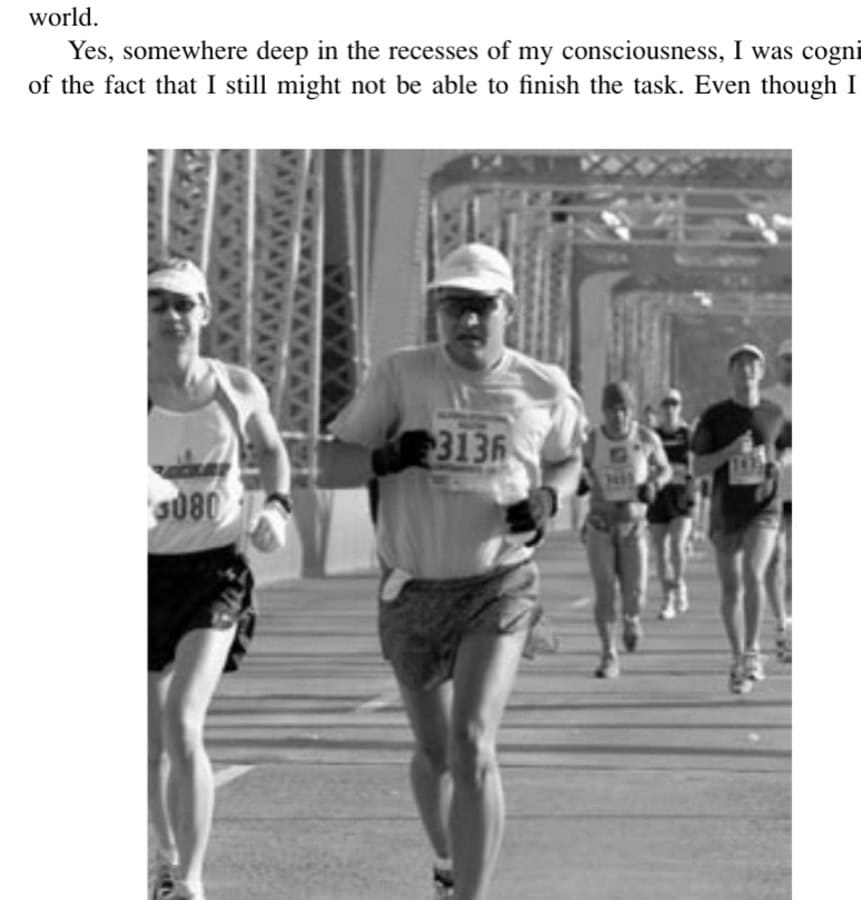
▲ Crossing the landmark H Street Bridge near Mile 22 and heading for finality.
completely immersed in that zone where you feel as if you can chase the horizon forever and never grow weary, there was still that distant nuisance that served as a vague reminder that I could very well plummet back to earth at any moment.
THE POINT OF NO RETURN As we approached mile 16, the large group began to splinter. We were venturing into what, for me anyway, have always been the truth miles—that stretch from 16 to 20. Marathoners can often fake their way through the first 15 or 16, but then the black and white facts begin to emerge. Have you done your homework with the requisite number of long runs during training? Did you reward yourself with a proper taper? Have you kept your patience and reserves in check during the long and drawn-out prelude?
As runners all around me fell off the pace, I too began to feel the ache in my quads from the relentless rolling hills. I stayed glued to the diminishing pack, though, knowing that if I could just make it past mile 17 that the course would finally pancake out. I f
inally let my legs out a bit more at the 19-mile mark. It was subtle—nothing more than a few sub-7:10 miles—but it was enough to get me ahead of the pace group. And now, suddenly, I really was on my own again. The last thing I wanted was to be caught, so I simply plowed forward and began to focus on the runners ahead of me while envisioning the crowd behind me trying to run me down.
As I spotted my brother by the side of the course just after 20, I could see his eyes searching the runners behind me. He had grown so accustomed to seeing me in part of the group that he was looking for a crowd. He broke into a grin as I called out his name. “
You’re looking great!” John shouted, handing me one last bottle of Gatorade. “I’ll see you at the finish.” So that was it—“the finish.” I knew that I had reached the point of no return. I was going to finish this race, even if it was on hands and knees. At this point, the angry Lilliputians still chipping away at my calf were the least of my worries. Everything—from my back to my biceps to my feet—had begun the familiar long-distance running ache.
I crossed a bridge at 22 and moved into a footrace with a young woman who was running as strongly as I was. She, too, had done her homework and was now reaping the rewards by passing one fading runner after another. When I finally managed to pull up adjacent to her, we silently began to work together. Every so often I would offer whispered words of encouragement. So would she.
Her name, I would learn later, was Melissa, and she was all of 24. My God—just 24 and already conquering marathons! How young and brave and fresh she was. I wonder now, as I reflect upon that race, whether Melissa was still so new to it
all that she had yet to taste the acridity of long-distance racing and training gone wrong. Eventually, it would happen to her. Eventually, it happens to even the best of us. But on this day she was soaring like the most inspirational of fledglings.
As Melissa and I approached Capitol Park and I knew that the finish was less than a mile away, I had to contain my emotions. I felt relief mixed with pride and triumph, because it seemed as if it had been decades since I had been in this position. I was minutes away from finally making good on all my training. No, there would be no personal record. But I honestly didn’t care. What mattered was that I was here, that I was running strong, and that I was, in fact, going to go the distance again. This race, for me, had turned into a battle for finality. I had overcome one setback after another—brushes with my own running mortality, so to speak. I had survived not just through months of demanding training but through years sprinkled with self-doubt as the PRs had suddenly begun to dangle just out of reach. In a sense, as I closed in on the finish line, I’d turned myself into a first-time marathoner all over again—and it was both refreshing and nice. The goal was to cover 26.2 miles. It didn’t matter how quickly or how aesthetically pleasing. What mattered most was the getting from the here to the there. And that’s why, I suppose, as soon as I stopped running, I was convinced that I had just completed my very best marathon ever.
And What I Learned From It So often we lose sight of the simple fact that the ability to participate is, in and of itself, a remarkable gift. It’s one thing to compete when conditions are ideal and you’re healthy and
primed to run fast. It’s another thing altogether, though, to toe the line when you’re uncertain as to whether you’ll even be able to run half, a third, or even an eighth of the race. You do it anyway, because you love the challenges associated with the sport.
Yes, there’s a certain forlorn resignation involved with your decision—that running, like life, may never ever again feel perfect—but you’re at peace with it. And that’s the real beauty of it all. Just as the sport always accepts and welcomes you back with no questions
asked, so too can you learn to accept the sport in the very same way. And that’s the way it always should be.
This article originally appeared in Marathon & Beyond, Vol. 10, No. 5 (2006).
← Browse the full M&B ArchiveMore like this
1,000+ stories from 19 years of Marathon & Beyond
The complete archive of the legendary long-distance journal — digitized and free to read.
