

My Most Unforgettable Marathon (Vol. 17, No. 6)
BThe author at the glorious 100th running of the Boston Marathon, not far from the location where runners were stopped in the 2013 race.
▲
©MarathonFoto
OSTON, MASSACHUSETTS, April 21, 1997—Of course, the 2013 Boston Marathon was unforgettable: sadly, tragically memorable. It was also inspiringly memorable due to the subsequent outpouring of solidarity for our sport. But I cannot call it
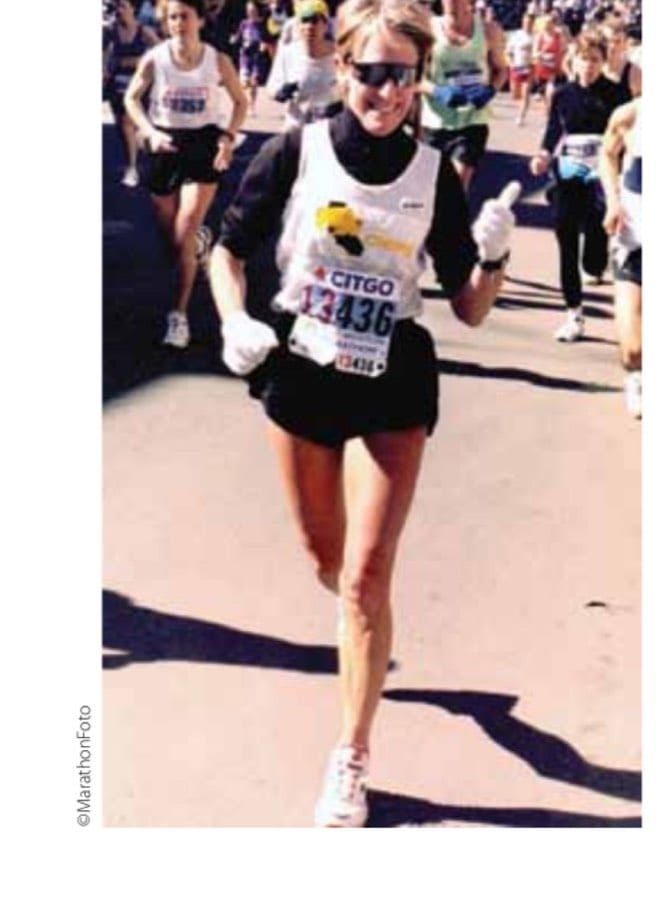
my most unforgettable marathon nor even the most memorable Boston of the 15 I have run. Some people are surprised when I say this. Could my most unforgettable be the 100th Boston in 1996? How can that one be topped? First there was
all the fanfare leading up to it. Then there was the event itself on a beautiful sun-filled day sandwiched between two days of nasty cold and rain. An astounding 40,000 runners were handled with precision and care. It
was the ultimate celebration for all of us fortunate enough to have achieved an entry, but my most unforgettable marathon? Not quite. My thoughts wandered back a decade. How about my first Boston—1986? The race date, the school bus trip to Hopkinton, and the course
▲
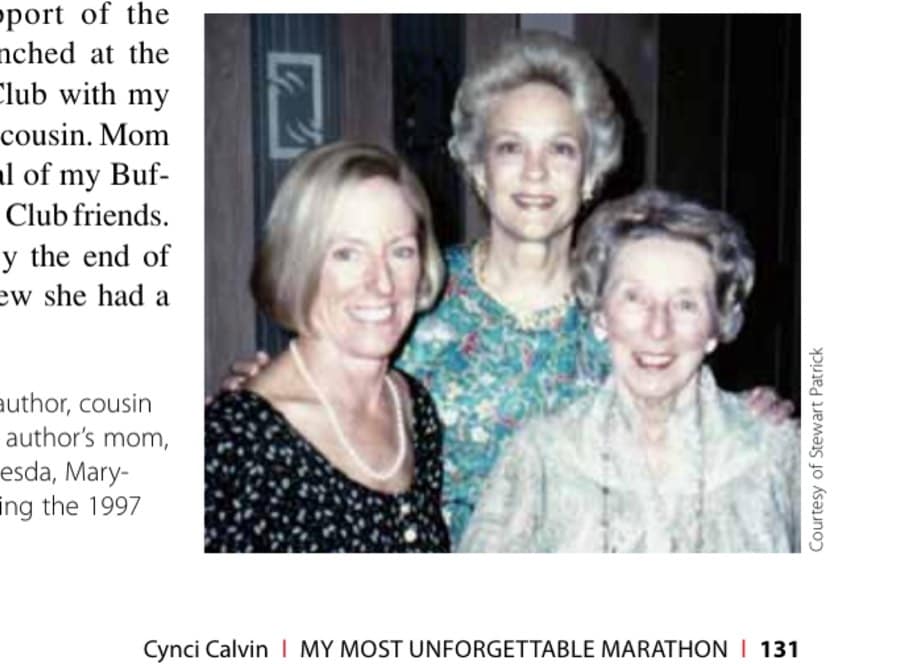
(Left to right) The author, cousin Janet Patrick, and the author’s mom, Frankie Weed, in Bethesda, Maryland, the week following the 1997 Boston Marathon.
Courtesy of Stewart Patrick
were the same as they are today, but that’s about it. I was one of around 7,000 entrants, and of those about 1,000 were women. At age 39, I needed a 3:20 to qualify, and I achieved this at the 1985 California International Marathon. A close friend qualified at the March 1986 Napa Valley Marathon, back when it was one of the last chances to qualify and still be able to enter! In Hopkinton prior to the noon start, women entrants were allowed to take over the classrooms of the grammar school (next to the athletic field, where the current Athletes’ Village is located). We had our own sweet lady volunteers, our own bathrooms, and our own company. Complete results were published in the Boston Globe the next day. Of course, my first Boston is very high on my list as unforgettable. But shouldn’t
my most unforgettable be my first marathon, the 1984 California International Marathon? It was a life-changing experience, as it is for so many. It opened a world of challenges, camaraderie, improved mental and physical fitness, and even a career change. My business as a graphic designer/editor grew out of my volunteer position as editor of the Buffalo Enquirer, the news magazine of my running club (the Buffalo Chips). I have run 60 marathons since then, and yet . . .
I’ve settled on my 1997 Boston as my most unforgettable marathon. It tops the previous four for reasons that make it unique among my 60 marathons and for the special lessons and insights it gave me. Early that year, I persuaded my 82-year-old mother, a grande dame of the San Francisco variety, to make the trip with me and to see firsthand what all this marathoning fuss was about. She was the one who would ask, “Are you going to do that ‘Boston thing’ again this year?” She was not a huge fan of my sport, worried over my lean body type (“Poor Tim [my husband] . . . must be like hugging a broomstick”), and rather hoped I would spend more time gardening and hosting teas.
Once in Boston, I happily shared my favorite Boston haunts with her, soaked in the city’s support of the marathon, and lunched at the Harvard Faculty Club with my Harvard-professor cousin. Mom got to know several of my Buffalo Chips Running Club friends. She fit right in! By the end of the weekend, I knew she had a
clear understanding of the spirit and inspiration of my sport. What better place to discover this than at the venerable Boston itself? A goal of mine over my years of running Boston had been to place in the top 10 in my age division (a top-three placing always seemed just a bit too much to aim for). I turned 50 in May 1996, so in April 1997 I would be in Boston’s 50-59 age division. My longtime goal should be more attainable than ever, and although my training for Boston was always focused, I now had a bigger incentive to train more seriously. Race-day weather was OK by Boston standards, I ran a consistent pace, and although those last few miles were exceptionally hard, I held on for a strong 3:23 finish. Then the icing on my Boston-experience cake occurred the following morning: the results in the Boston Globe showed I had placed fourth in the 50-59 age division. So along with the heartwarming time I enjoyed “educating” my mom, achieving this long-sought goal is another reason why the 1997 Boston is my most memorable marathon.
But there’s more!
▲
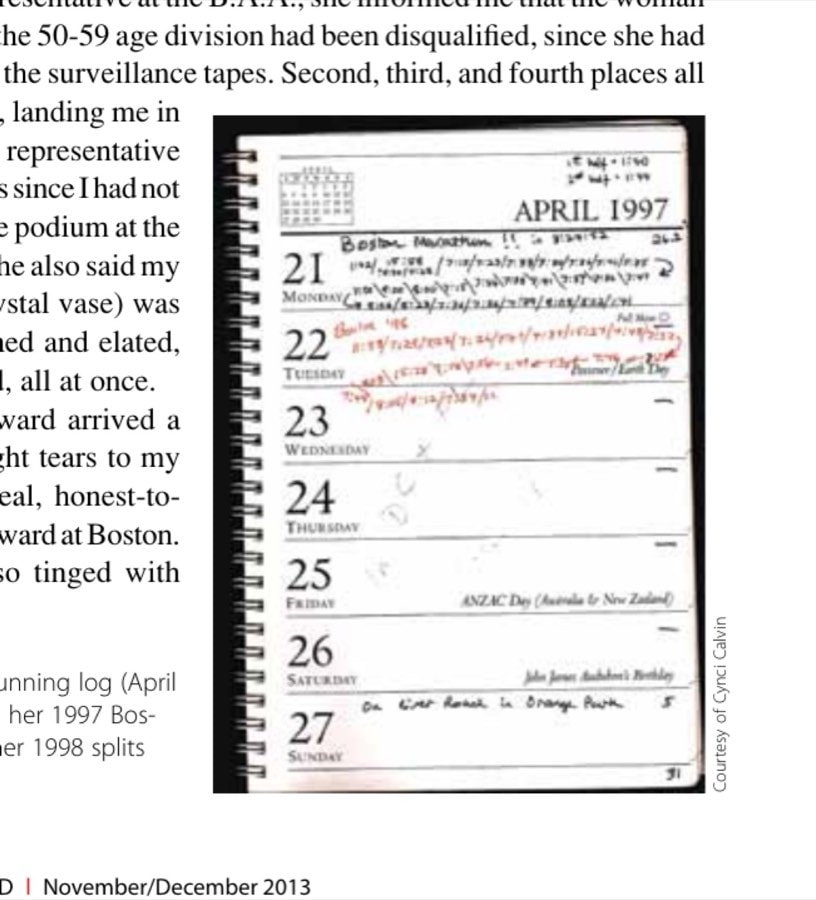
A scan of the author’s running log (April 21 to April 27 1997) shows her 1997 Boston Marathon splits, with her 1998 splits below.
Courtesy of Cynci Calvin
We extended our trip for 10 days to visit friends and relatives in Washington, DC, and then in Jacksonville, Florida. When I returned, Tim told me that the Boston Athletic Association wanted me to call as soon as possible. He had no idea why. When I spoke to the representative at the B.A.A., she informed me that the woman who had placed first in the 50-59 age division had been disqualified, since she had not been seen on any of the surveillance tapes. Second, third, and fourth places all were moved up a notch, landing me in the #3 spot. The B.A.A. representative offered sincere apologies since I had not been able to stand on the podium at the awards ceremony, but she also said my award (an engraved crystal vase) was on its way. I was stunned and elated, and yes, a bit frustrated, all at once.
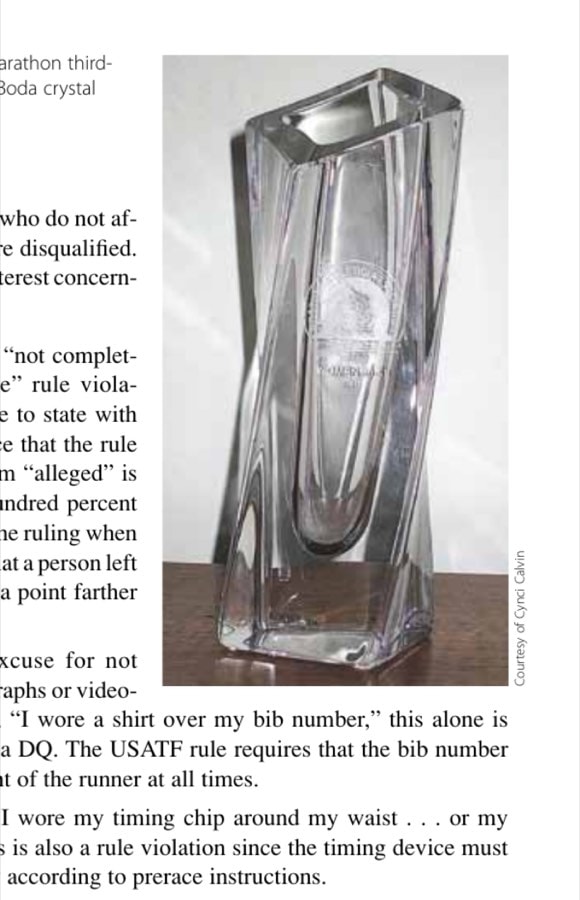
When the lovely award arrived a few days later, it brought tears to my eyes. I had earned a real, honest-togoodness age-division award at Boston. My emotions were also tinged with
annoyance about the person who had come so close to robbing three people of their proper awards and recognition. It sits in my living room as a visual tribute to my determination that got me through those cold, or rainy, or hot workouts; to my Buffalo Chips friends and coach without whom my training might not have achieved the quality I needed; and of course to Lady Luck.
Bogus finishers I know the 1980 Boston Rosy Ruiz story. Also, in the early 1980s a top woman finisher named Candy Dodge earned a place in infamy on the Northern California running scene after she was disqualified for allegedly not running the entire course at several high-profile events, including the San Francisco Marathon. Now I started to learn more about the Boston 1997 woman who can be added to this list.
It turned out that two age-division winners had been DQ’d at the 1997 Boston Marathon: a married couple from Cypress, California, named John and Suzanne Murphy. John (age 64) crossed the finish line in 2:43:09 for the second-fastest time ever in Boston’s M60-69 age division, and Suzanne (age 59) finished in 3:12:18, the fifth-fastest time in Boston’s W50-59 age division.
Bart Yasso at Runner’s World magazine later told me he was with some friends cheering on the finishers at the half-mile-to-go mark. They saw a chunky older guy wearing an official bib number amid the runners on pace for a sub-2:45 finish. Their unanimous comment was, “No way!” Bart sent me this email: “
I was near Hereford and Commonwealth Avenue at the 25.8-mile mark, watching all of the very fit-looking runners holding sub-6:15 per-mile pace. They all had that lean—almost gaunt—look about them. Next thing
I see is a man with what I would call a beer belly. He was holding his own, running very close to the 6:15-per-mile pace. I turned to my Runner’s World colleague and said, ‘That dude started at Fenway,’ which is about
three-quarters of a mile away from our intersection.” They were not alone in noticing the discrepancy. To learn more for this article, I contacted longtime Boston Marathon race official Steve Vaitones. He explained the procedure used by the Boston Marathon for maintaining the integrity of the event results and gave me a rundown of how the day unfolded. “
This was before lots of chip-timing backup—start/ half/finish mats were all that were on the course, not every 5K. All officials were (and still are) deputized to look for people or activities that seem out of place on the
course and at the finish line. Before I headed in to work on the results review, three officials handed me notes with the bib numbers of runners
who just didn’t look quite right at the time they finished. I filed them in my pocket for later review. “Going through results, we look at the placers for previous achievements to announce at the awards ceremony, and, at that time, to also see if there
were any questions. Mr. Murphy had run just 25 seconds off the M60 US marathon record (at age 64). That was 14 minutes faster than Boston 1996 and faster than his last marathon, which was in March. That race was faster
than his next previous, in January. And that was faster than the previous from the late fall. All were national-level times, with four approaching world-level age 60-plus times in just over six months? Maybe not. “
Then we reviewed the women’s times, and we see a placer—Murphy— same city. We track a similar history. This was all being done in just a few hours before the 6:00 p.m. awards ceremony. “So the decision was made to hold the results and not announce those
age-division awards. “Some of the next-lower placers had questions after the awards ceremony, but the Murphys didn’t show up for the awards ceremony. In one of the calls from the B.A.A. as this unfolded, they later said they didn’t
think they would have won anything and also weren’t aware of the quality of their times. Knowing how most masters, particularly as you get to 60-plus, are very knowledgeable on their age-group competition, this was
another red flag. “Those notes I received from the finish line officials: all three had Mr. Murphy’s number, his finish time of 2:43, and two words, ‘no way.’” The next step? Boston officials spent 11 days checking and rechecking surveillance videos from cameras placed in multiple (and secret) locations along the course. They found no sign of either of the Murphys, although their timing chips did register at the three mats (start, halfway, and finish). They then contacted the Murphys and asked them to provide evidence of their running the entire course by coming to Boston and finding themselves on the tapes. They declined to do this, but they insisted their finish times were properly attained, offering the explanation that their bib numbers may have been obscured. On May 1, the B.A.A. announced the Murphys’ disqualification.
Excerpt from the Los Angeles Times article “Cypress Duo Stripped of Race Titles” “May 02, 1997|CHRIS FOSTER | LA TIMES STAFF WRITER “Suzanne Murphy said Thursday she and her husband wore computer chips
on their shoes and that she wore a shirt through the early part of the race that might have obscured her number.
“The race uses a combination of computer-chip registration points at the beginning, midpoint, and end of the course and surveillance cameras mounted at secret points throughout the race. “‘We were wearing chips just like they do in LA, so I didn’t think seeing the number was all that important,’ said Murphy, who added that she has run the Boston Marathon seven times.” As I continued to learn more, a key question surfaced. Who were the other people who officially received their 50-59
age-division awards? I am sure that they, like me, were thrilled to simply receive their awards, but I want to acknowledge them in this article. The winners were available online, but I had no luck finding the second- and third-place men and the second-place woman. Steve Vaitones helped me out once again, and here are these awardees and their times:
1997 Men 60-69 (current course record: Clive Davies, Oregon, 2:43:20, 1981) • Anthony Cerminaro, 60, Jermyn, PA, 2:54:17 • Bill Riley, 60, Marstons Mills, MA, 3:04:47 • Malcolm Gillis, 64, Toney, AL, 3:10:15
ad
1997 Women 50-59 (current course record: Joan Benoit Samuelson, Maine, 2:50:29, 2013) • Susan Gustafson, 50, Norwell, MA 3:19:47 • Eileen Doran, 58, Toronto, CAN, 3:22:16 • Cynci Calvin, 50, Auburn, CA, 3:23:52 To learn more, this page on Boston.com has lists of age-division champions through the years: http://www.boston.com/sports/marathon/history/champions/
Keeping road racing fair In 1997, my home-based, freelance graphics/editing business had developed into a running-industry-based service. I had also become involved in my region’s USA Track & Field association (Pacific Association), where I continue to volunteer as the Communications Committee chair. The lessons learned at the 1997 Boston Marathon carried over into these two areas, especially as I watched the recent running boom develop.
John Mansoor was the CEO and co-founder of the Sacramento Running Association (parent of the California International Marathon) from 1982 until 2013, and he continues as the longtime executive director of the Pacific Association/ USATF. Through him and the Pacific Association, I learned that USATF rules are in place to keep the playing field level so that all athletes are tested fairly against each other. A downside of the ongoing growth in the popularity of running and the diversity of running events is that many new runners are not aware of, ignore, or fail to understand the importance of USATF’s role as the governing body. A few of the most basic competition rules such as bib-number transfers of any kind (selling or donating), not completing the entire course, having illegal pacers, and not having a bib number visible at all times are all too frequently abused. The integrity of the results ends up being compromised.
Of these rules, “failing to complete the entire course” is the one that applies to the most infamous of the alleged rule breakers. Every year at the California International Marathon, I assist with a team that reviews split times, results, photographs, videos, and information from course officials to find finishers who may have broken this rule. Once potential candidates for disqualification are found, they are notified and asked to provide evidence to negate our findings. If we do not receive a reply, they are placed on a list. If they reply, their evidence is reviewed, and if they are still suspect, they are added to the list. This list and evidence are then reviewed by the event’s assigned USATF official, who makes the final ruling. This tedious and time-consuming process is worth the effort, and my personal experience at the 1997 Boston is a good example of why it is needed. In recent years the CIM has disqualified two potential age-division awardees, and
▲
The author’s 1997 Boston Marathon thirdplace finisher’s award, a Costa Boda crystal vase.
• Since in most of the “not completing the entire course” rule violations, it is impossible to state with 100 percent assurance that the rule was violated, the term “alleged” is always used. One hundred percent
assurance would be the ruling when eyewitnesses attest that a person left and then returned at a point farther on the course. • Since a common excuse for not being seen in photographs or videosurveillance films is, “I wore a shirt over my bib number,” this alone is
sufficient reason for a DQ. The USATF rule requires that the bib number be visible on the front of the runner at all times. • Another excuse is, “I wore my timing chip around my waist . . . or my neck . . . or . . .” This is also a rule violation since the timing device must
be attached precisely according to prerace instructions. Rule ignorance surfaces in the replies to the notices or phone calls to runners with suspicious results. Here are some of our favorite answers: •
I ran the course from the finish to the halfway and then back. • I decided to run just a half-marathon that day. • What’s a timing chip? • I paced a friend of mine from the halfway point, but I entered so I would
be accepted on the course. The CIM prerace collateral materials (e-blasts, website, Facebook, expo handouts) clearly state: “If you do not run the entire course, DO NOT cross the finish line.” Although this often seems to fall upon deaf ears and blind eyes, the
Courtesy of Cynci Calvin
each year 20 to 30 runners who do not affect age-division awards are disqualified. Below are a few items of interest concerning these DQs:
CIM continues to persevere with sending out the message. The goal of finishing a marathon (or a footrace of any distance!) is a highly personal one. Those who do not complete the entire distance but who still cross a finish line and have their results officially recorded are diluting the accomplishments of those who do. I can only hope this message continues to be promoted at running events everywhere.
This article does not address the pathology of people who cheat to gain top finishes. Much has been written about these people, and as the popularity of running continues to rise, we can expect to read about more “alleged” cheaters along with explanations of why they do it. A recent example is the lengthy New Yorker magazine article, “Marathon Man,” (by Mark Singer, August 6, 2012), about Kip Litton, the scamming marathon finisher extraordinaire.
The days of a handful of people leaping from behind a chalk line at the sound of “Go!” to run from point A to point B are all but over. But the heritage of the end result—the first person to cross the chalk line at the finish wins, the second person is second, and the third person is third—stays with us. Those of us who care about that result will continue to do what we can to maintain its integrity.
And what I learned from it By spending time in Boston on Patriots’ Day weekend, even a nonrunner can learn why we love our sport so much. Set a goal, train consistently, and never give up trying to achieve that goal.
When surprise is an element of achieving that goal, it makes the accomplishment all the sweeter and more memorable. There are a few odd ducks who think they can take shortcuts to the awards podium, but behind the scenes, plenty of hard work goes on to
prevent this from happening. There are two important messages to promote among our ever-increasing number of new runners: 1. Do not cross the finish line if you have not run the entire course. Only those who complete the entire, official course should cross the
finish line, savor the moment, receive their finisher’s medal, and be listed in the official results. 2. Know the race rules and adhere to them. An organized, sanctioned running event is a competition, and the rules are in place to maintain fairness to all.
This article originally appeared in Marathon & Beyond, Vol. 17, No. 6 (2013).
← Browse the full M&B ArchiveMore like this
1,000+ stories from 19 years of Marathon & Beyond
The complete archive of the legendary long-distance journal — digitized and free to read.
