

My Most Unforgettable Ultramarathon (Vol. 19, No. 3)
LAKE CHABOT, CALIFORNIA, October 11, 2014—The first time you taste the incredible magic of breaking the 26.2-mile barrier, you feel like a child. A frontier, previously held and perceived as incredibly distant, becomes accessible—the impossible now made possible. Such newfound confidence makes you yearn for bigger challenges. It was these sentiments that influenced my decision to enter the Dick Collins 50-Miler, a race that I will never forget. Hot off my first 50K, I felt ready to take on the world. That race had undoubtedly been a push for me, and I wanted to reexperience that kind of joy once more.
A 50-mile race seemed like the next logical step, so I entered the race despite feeling terrified. During the months of training leading up to race day, I vacillated between states of extreme apprehension and excitement. I was plagued by nightmares of being unable to complete the race, becoming stranded on the course, and experiencing terrible injuries. At one point I thought the distance would kill me, so I consulted my doctor. I had never experienced such apprehension before a race. I remember feeling fear before my first marathon, but this intensity was several orders of magnitude greater. It was the thrill of glory juxtaposed against the uncertainty that comes with pushing your limits. Keeping my eyes on the prize, I kept a diligent training regimen. Living in downtown San Francisco, I found my long runs to be tricky and laborious. Often I would load up my CamelBak and spend hours running on pavement, which further heightened my concern for injury. In such conditions it was difficult for me to muster more than 23 miles on a long run. A few trail runs in Golden Gate Park were squeezed in at the last minute for good measure, but I was concerned about whether I had put in the correct number of miles. Ultimately, I trusted that on race day I would hold back, diligently run the race, and trust in my abilities.
No more excuses; it’s time October 11 arrived quicker than I expected. Suddenly, I found myself on the starting line, nearly overcome with nerves. Veterans of the ultramarathon community surrounded me, including Gordy Ainsleigh, the founder of the Western States 100, all wearing headlamps and eager grins. We stood in absolute darkness, blindly huddled together in anticipation. I looked through my running sack once more, making sure I had a healthy supply of electrolyte pills, energy bars, and water. Glancing around, I caught sight of the red digital race clock, and its ominous glow was a tacit reminder of the lengthy journey ahead. As the announcer started our race, I muttered a silent prayer and mentally braced myself for what lay ahead. The pack took off, and as it slowly began to dissipate, I sought a runner who could pace me. This was initially difficult, and for several miles I found myself alone on the course. As a result, it was decidedly difficult to restrain myself from running faster than I should have. These situations make running your own race especially hard. You crave company to mitigate the pangs of solitude and the occasional boredom that occurs in lengthy stretches of a race. This encourages you to try to catch up with a group, and ultimately your pace increases. Possessing the experience to know better, I steadfastly fought these urges but still managed to hang with a pack of beginners. I quickly learned that all of the runners in their first 50-miler were terrified. Many had made the intimidating jump from 50K with limited training and preparation.
On the other hand, one of the members of our intimate pack was a veteran who boasted an enormous number of 50-mile finishes. In her 70s, this woman was a paragon of perseverance and determination. She embodied the incredible fortitude that exemplified ultrarunning, and her stories of pushing through several 100-milers, including the Western States, were noteworthy. I took advantage of the interaction and absorbed her sagacious advice. Above all things, she reinforced how important it was to keep moving no matter what you were experiencing. This shockingly simple maxim proved to be my guiding approach for the remainder of the race.
The rest of us established common ground over training tribulations and past race struggles. Consequently, we were able to keep our spirits high and focus better on the task at hand. Moments like these reminded me how tightly knit the ultra community is. Whenever someone mentioned a race from the past, you could be sure that another person in the group had at least heard of it. Many had run together without knowing it. These conversations were conducted with a supportive undertone and an overall air of encouragement. The usual self-absorbed attitudes that I was accustomed to with metro road runners were virtually nonexistent. You didn’t get that intense sense of competitiveness that usually resulted in cold interactions and distance. Instead, there was a sacred, unspoken bond
that we were attempting something intimate and serious. Participation alone was sufficient for reciprocal admiration.
Conscious of cutoffs
© Facchino Photography
Gradually, the terrain grew steeper, a soothing silence overcame us, and other things crept into my consciousness that made it difficult to completely drift off. The mellow energy of the Collins 50 was at odds with the anxiety of missing cutoff times. This created a fear that occasionally punctuated the peace during the first half of the race.
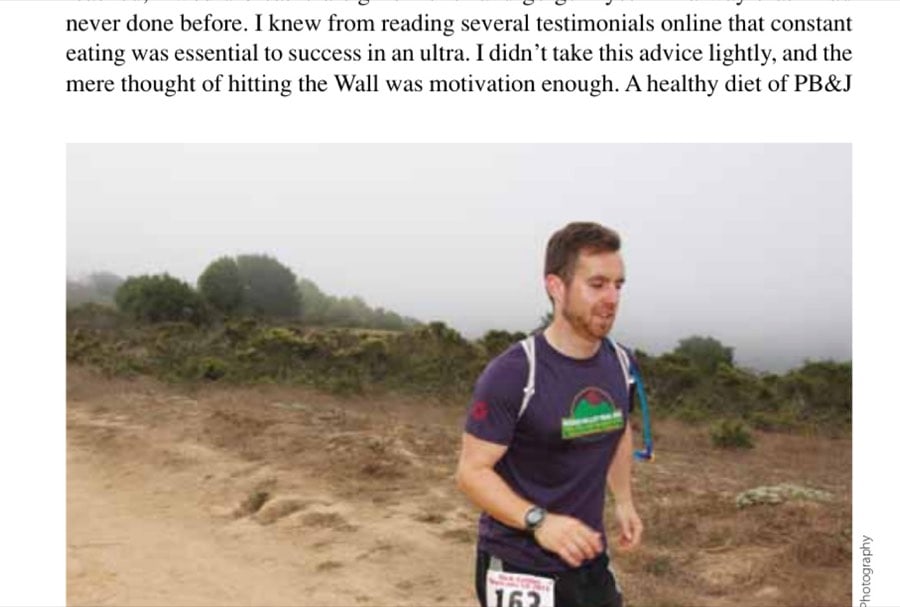
Moments of relaxation became more and more intermittent, and clock watching became an obsession during critical junctures of the race. Conversations among our group became curt once it became known that we were several minutes away from a cut. Aside from talking, counting off aid stations became the ideal way to cope with the distance. It helped that some of us carried an aid-station mile map. This is something I highly advise carrying with you. It alleviates the sense of endlessness and allows you to better pace yourself. As each aid area was reached, I would breathe a sigh of relief and gorge myself in a way that I had never done before. I knew from reading several testimonials online that constant eating was essential to success in an ultra. I didn’t take this advice lightly, and the mere thought of hitting the Wall was motivation enough. A healthy diet of PB&J
▲ Near the top of the ridge, with a view of the Bay Area.
sandwiches and electrolyte pills ended up keeping my body afloat as I took in the multifaceted topography of the course. The sheer beauty and grandeur of the trails were a reminder of why ultras, despite their difficulty, are worthy commitments. Situated on fire trails, the Dick Collins 50 was no exception. The pastoral views of cliffs and forests juxtaposed against the yawning cityscape of San Francisco and Alameda in the distance lured me to stop and take photographs. I speedily shot photographs of bucolic landscapes, knowing that lingering would be detrimental to maintaining pace. Afraid of stopping my inertia, I was careful to choose vantage points that would allow me to run while photographing. I knew these images could be fully digested later at the race’s completion.
A glorious half The halfway point came sooner than expected, and the excitement of reaching the turnaround ushered me forward. Twenty-five miles had been knocked out, and the strategic pacing was beginning to pay off. The aid station at the turnaround was one of the best I had ever experienced. Volunteers were eager to help, had smiles on their faces, and expressed enthusiasm about their participation in the race. Many wore 100K and 100-miler shirts, and once more, I realized I was in elite company. The selection of food was phenomenal, and the support staff supplied everything I could ask for. There were burgers, hot dogs, cheese sandwiches, Oreo cookies, and more. I was convinced once more that ultra aid stations were superior to those at road marathons. In particular, my mind was blown by the grilled cheese. I don’t think cheese sandwiches were ever more delicious. Eating little squares of bread and cheddar was a borderline religious experience. Every fiber of my being yearned for salts and carbohydrates, and this was the perfect combination. As if lured by a siren, I was tempted to remain for as long as possible. Just minutes went by and I was warned by volunteers to get moving. Apparently it was common to linger at this race’s halfway point. The urge was strong since the aid station was preceded by a four-mile descent and we had just run 25 miles. Who wouldn’t want to relax after a decline like that? I don’t think any of us were in a rush to get going. After regaining my faculties and replenishing nutrients, I felt a sense of relief in knowing that the majority of the elevation gain was in the first half of the race. Surely things would be easier from here on out. I was dead wrong.
The race really began to set in during the 30s. I found temporary satisfaction at mile 31, knowing that this was the farthest I had ever run. That elation ebbed and was quickly replaced with muscle pain and digestive problems. My diet of electrolyte pills and peanut butter sandwiches became difficult to stomach, and occasionally I would have to stop to manage the heartburn. This was the first time
that it had ever been a problem. Balancing proper consumption became a tricky effort. Perhaps the lactic acid buildup in my muscles was making its way toward my digestive tract. It then dawned on me why bottles of Tums sat on aid-station tables. I made a mental note that for future races I would bring a pack, as what I had experienced didn’t bear repeating—lesson learned.
Learning lessons and finding a running companion When the indigestion died down, I salvaged some energy bars from my CamelBak and decided to eat only when absolutely necessary. My legs began to tire for the first time, so I further dialed back my pace. Cutoff times were less critical, which slightly relieved the pressure to push forward. Fortunately, I found someone to converse with and once more we chatted about our race struggles, strategy, and training regimen. This time around, the conversations were much shorter. Exertion is most certainly a deterrent against chatting, and the heat wasn’t helping.
As the temperature increased and the sun came out, the race became harder still. The once-enjoyable pristine views became sweltering vistas wrought with mirages. Wanderlust spurred on by light heat exhaustion and endorphins began to set in, and the urge to stop and sit down was powerful. The lull of gravity never felt stronger, and the ground felt magnetic. I stared at the dirt beneath my feet, imagining the joy of curling into a ball and giving up. To alleviate such temptations, I shifted my focus to my surroundings.
While taking in the landscape, I paid close attention to how much I was sweating and kept a vigilant eye on the amount of water left in my CamelBak. For the first time in the race, I was draining my reservoir before arriving at an aid station. This proved to be a problem. Having experienced higher-intensity heat exhaustion in a previous 50K, I was not about to repeat the same mistake, so I took the extra time needed. Slowing down helped regulate my core temperature, in the process bringing back my sanity. Additionally, I consumed cups of cola, which may have helped balance my constantly diminishing electrolyte reserves. All the while, I anticipated intense mental discomfort. The terror of disorientation when you know you have to run an enormous distance but are unable to continue does not bode well for a good race experience. In my opinion, of all the things a runner has to deal with, heat could be the worst. It magnifies the severity of problems you might be having and inhibits reliable judgment.
Anxiousness intrudes Any chances of enjoying the run vanish when you’re consumed with these anxieties. Still, I continued through the 30s unsure of how I would make it through the following 10 miles and wondering what surprises were next in this race.
© Facchino Photography
Mile 40 arrived and the sun’s light danced on the horizon. Darkness began to set in, and the earth cooled. With that came the sense of relief that I would no longer have to battle the heat. Having started the race at dawn, I was astounded to note the light was gone once more. I glanced down at my watch and saw that it had been a full 10 hours. It was my first time running into double-digit hours and I was still going somehow. It was then that the experience took on an endless quality. I felt as though I had been running for years on end, and my perception of time was completely distorted. The psychological disassociations temporarily kept me entertained, and for a time I forgot about my physical discomfort.
By the time I reached the final aid station at mile 46, my mental state had become a mix of deliriousness and joy. I laughed at wild imaginings as I slugged it over each ridge. The dark landscape was enchanted with a surreal quality. Hallucinations became common and the body pain was growing still. Stopping to urinate became frequent, and each time, I saw something new in the shrubbery. It was an experience that you could equate to a drug trip. As I ran the last few miles, euphoria gradually swept over my being. The rewards of being diligent about my pace throughout were apparent now more than ever. A burst of energy filled me, and out of nowhere, I began sprinting. My second wind had arrived. The last leg of the race was around the edge of Lake Chabot. The surface of the water glistened with crimson hues of a dusky sky. A sense of tranquility pervaded the atmosphere, and
▲
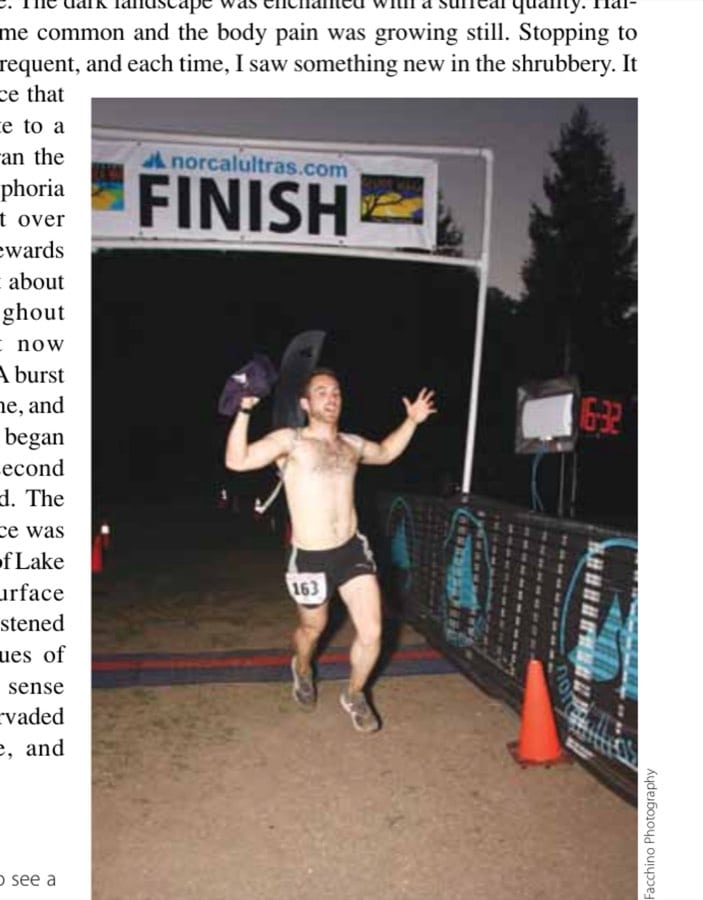
Never happier to see a finish line.
suddenly calm washed over me. Moments of peace blended with bliss were my rewards for the 50th and final mile of the course. Flying by fellow runners, I heard the sounds of vomiting and groans filling the air. Never had I witnessed racers collapse from exhaustion before. On the last half-mile stretch, I had my final conversation of the race with someone who touted the joys of finishing your first 50-miler. I was informed that the pleasure would be overwhelming. Hearing such claims only further quickened my pace. The sounds of a crowded finish line were audible in the distance the faster I went. The red light of the digital clock loomed on the horizon. Instead of the ominous glow it had during the race’s start, it looked to me like the second coming of the Messiah. Just moments later I sprinted over the finish line to the sounds of a cheering audience. A feeling of triumph and self-empowerment like none other swept over my spirit. This is what it felt like to run 50 miles. As I nourished myself once more at the finish line, I realized the grandeur and magnitude of my accomplishment. It was unlike anything I had ever imagined.
And what I learned from it Aside from being a fantastic confidence builder, this race taught me several things. 1. It is important, when running a longer distance for the first time, to hold back as much as possible no matter how anxious you feel. With
the exception of cutoff times, nothing should cause you to push your pace to an uncomfortable level. To be safe, take your comfortable pace and dial it back. Put up with being solitary if it means that staying
with the pack will cause you to run faster. 2. Eat constantly. Don’t stuff yourself, but eat enough to keep hunger at bay. 3. Be sure to carry a pack of Tums. Lactic acid buildup and accumulation of ions from electrolyte supplements contribute to indigestion.
4. Never stop completely for longer periods than needed. If you keep moving, you will regain energy and motivation, provided that your body is nourished. 5. Expect that things will eventually get painful and uncomfortable when
you’re pushing yourself beyond a former limit, so keep your mind strong! Your mind very much influences your body, and nowhere is this more apparent than in an ultrarace.
This article originally appeared in Marathon & Beyond, Vol. 19, No. 3 (2015).
← Browse the full M&B ArchiveMore like this
1,000+ stories from 19 years of Marathon & Beyond
The complete archive of the legendary long-distance journal — digitized and free to read.
