

My Most Unforgettable Ultramarathon
As example #2, I had thought I’d be doing this race with my Illinois coach and mentor, Chuck Bundy. Chuck—who, by the way, is a bona fide hero, as he was a frogman (now called a Navy Seal) and Korean War vet—and I had planned for a year that we would make this second assault on Hardrock together. (He too had DNF’d the first time.) But right before we were to leave, Chuck was hit with an emergency and could not make the trip.
In my moment of greatest need, Larry Ridgeway came to the rescue, fetching me at Denver’s airport and driving me to Silverton, where we camped in the RV park by the riverside. Larry, incidentally, is another hero, and not just for helping me. He’s a Vietnam vet who got his start rescuing people by piloting choppers for the Marine Corps. I told him he probably saved the life of one of my old high school buddies over there.
But even after I laid on the flattery, Larry still had the nerve to laugh at me and my crampons.
I tell you all this because, number one, you should ignore Hans and Larry and everyone else and go out and buy yourself some crampons. Number two, if you do show up for Hardrock, you should know the caliber of folks you’re likely to meet. These people really are heroes.
I learned something else from Ginny LaForme that I had all wrong in my first article. I had theorized that all the red I saw in the butt-slide chute on Virginius Pass was blood scraped from the exposed skin of runners in front of me. But Ginny (who well deserves her nickname “Mom”) set me straight.
“Nah,” she said. “It’s red algae. It grows in the snow here.”
ONCE ATTENDED, TWICE BEFRIENDED
You cannot enter, prepare for, travel to, endure, and return from an epic event like the Hardrock Hundred without making a whole valley full of new friends. This is one reason why it’s getting tougher and tougher for newcomers to get in. Hardrock’s “clan” is the first to fill out the paperwork and lick their stamps. It’s not so much a race or a war or a test of survival as it is a family reunion.
If so, Carolyn Erdman must be the matriarch. She did, in fact, receive the 1999 “Mother Lode” award, which the race booklet tells you is the highest award the Hardrock gives. The booklet also says, “Carolyn has welcomed many a runner to the San Juans. Her enthusiasm and caring spirit epitomize what ultrarunning is all about.”
Of course, you wouldn’t expect the booklet to mention that she and her husband Eric have a home there, that he is one of the standout local theater actors, and that Carolyn was the first person Larry and I looked up when we got to town. The booklet also neglects to disclose that Carolyn promised me a great big hug at the finish line (if we both finished the race).
Anyway, I’ve highlighted enough of my own ignorance about this great event. Now it’s time for something I’m sure you didn’t know about the race. That is, it’s not a race!
That’s right. My two newest friends among race management, Charlie Thorn and John Cappis, insist that Hardrock be called a “run” and not a race. The idea is to discourage the kind of participation a lot of other events experience, where the sport’s leading racers show up and—after some of them start and discover they won’t win—drop out. This takes away starting slots (only 110 available) from runners who aren’t in it to win and who thus miss out on the event.
In other words, Hardrock’s founding fathers, John (who established the original course), and trail-marking army general Charlie, want more people like Carolyn and Larry and me in their event. All you fast people out there can just stay away!
RUN DAY
If you’re reading this piece, then you probably want to learn something about the second half of the course, which I failed to tell you about last time (because I failed to get there). Let me now make amends.
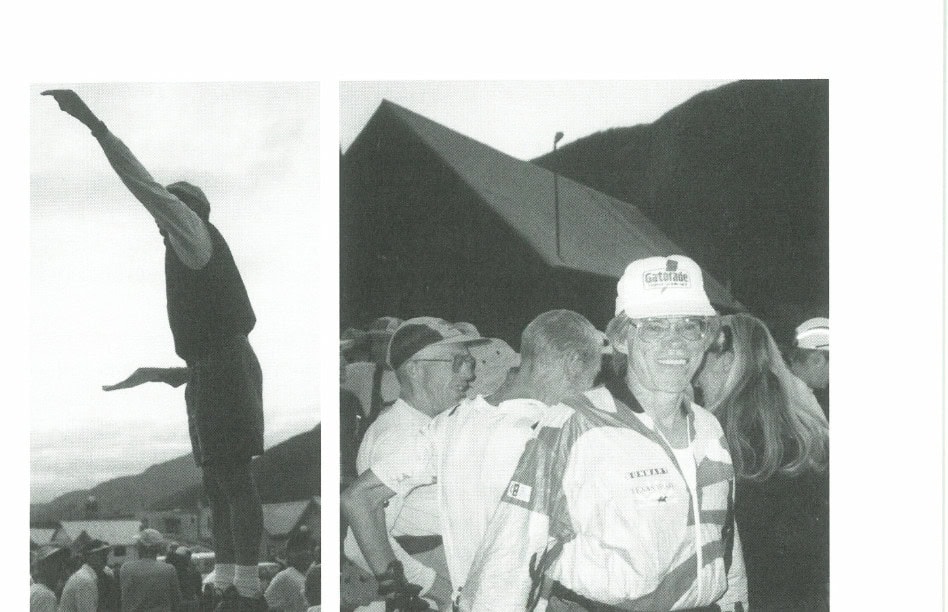
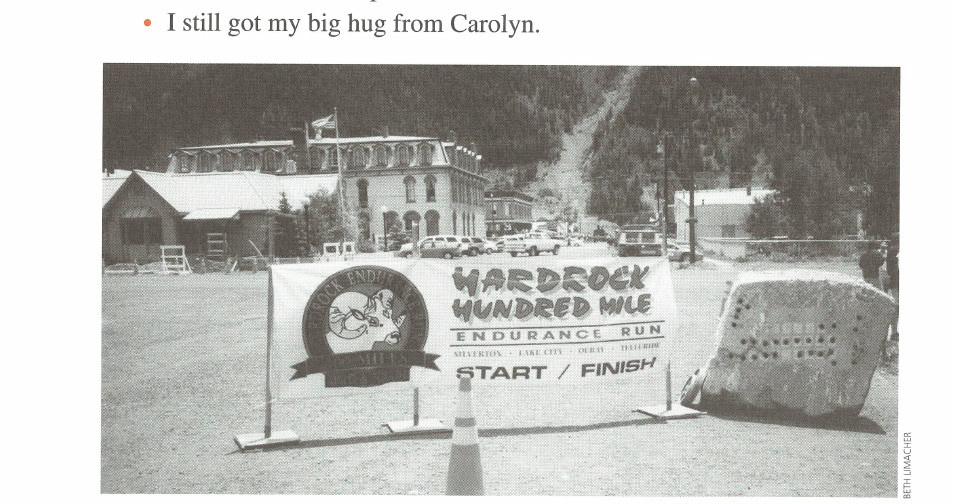
On an overcast, predawn morning outside the gym of Silverton High School (“Home of the Miners,” naturally) on 12th Street—or just before 6:00 A.M., MDT, July 7, 2000, to be exact—race director Dale Garland climbs on top of the hardrock, a big stone that public works hauls there for the occasion (I met the public worker who does this, Mike Luther, during trail marking), hollers out a few last-minute reminders (such as what to do if you drop, die, or survive), and then says, “Go!”
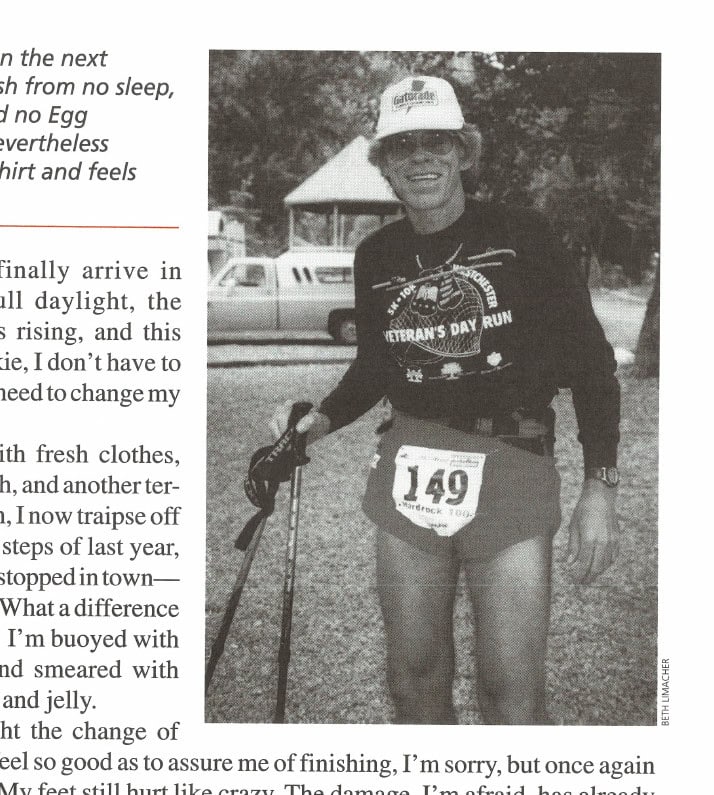
Immediately, but without much hurry, a scraggly-looking band of “crazies” begin running in their “underwear.” I am among them, along with Carolyn and Charlie and all my other newfound best friends. I know it’s the last time I’ll see Charlie for a while (because he’s such a strong finisher), so I wish him “good luck.” (Although I don’t yet know it) I am destined to see Carolyn and John later, and, still later again, and even more significantly, later than that.
As I mentioned, this year we’re going in the opposite direction, running first through the streets of town that I never got to trudge through a year ago. We follow perfectly the path that Carolyn had first showed to Larry and me two weeks ago, and none of us misses any turnoffs. We’re now southeast of town, on the jeep road, undertaking our first major climb of the day: Dives-Little Giant. The prerun booklet tells you this is the first of a dozen climbs above 12,000 feet. (Actually, Little Giant Peak is 13,000 feet, but who’s counting when you’re among friends?)
Two weeks ago, Carolyn had pointed out what’s left of the Dives Mine, on one side of the peak, and now I notice that the whole thing is ruins. She had also pointed out what’s ahead, which I might hesitate to call Dives-Little Giant Bridge (because if it really were a bridge, there’d be guardrails). This is the place where the booklet casually informs you: “About a hundred yards below the trail, the steep grass slope disappears over cliffs that are several hundred feet high. A slip here could be fatal.”
I ask you, how many 10Ks have a line like that in their course descriptions?
What I see as I look toward the “bridge” are a bunch of runners that I used to be in front of, but I’ve stopped here to pull out my camera and record this image for all preposterousity. I can shoot the narrow structure we’re supposed to traverse without seeing much on either side, but when I put the camera away and actually get there, there’s nothing on either side!
CIRCLE THE WAGONS AT CUNNINGHAM GULCH
What I failed to explain last time is the vast, circular shape of John Cappis’s incredibly concocted course. Think of it as a cosmic clock, ripped off the wall in frustration, thrown on the floor, and landing on its back. So when you look down, you see Silverton at 6 o’clock, Ouray at 12, Telluride at 9, and possibly Handies Peak at 3. Right now, coming down off Little Giant, I’m probably at 28 minutes past the hour, or exactly “2 minutes” into the race.
Except, of course, as I look at my watch, it’s actually three hours after we started, and the real fun hasn’t even begun. Remember, we’re going counterclockwise. This means I have 58 more “minutes” on the clock to cover yet.
Carolyn had earlier pointed out where Cunningham Gulch’s aid station is always located, which from high above looks like a little circle. That’s the empty roadway, and when we got down there two weeks ago, there was one lone camper to greet us. Today, I look down and see—a traffic jam! I mean, there are station wagons and people and (probably) Indians milling about, and a whole lotta hoopin’ an’ hollerin’ goin’ on. (Is this a concert?) Even the trail rocks.
Apparently, everybody hollers for every runner that arrives alive. Heidi Schutt (Larry’s wife) is cheering. She tells me her man and Carolyn are “only a few minutes ahead of you.” Even Dale Garland is here, wearing his big cowboy hat. He asks me what I think of this direction.
“Dale,” I manage to mumble with my mouth full of sandwich, “I am so glad I don’t have to go up that mountain after running 90 miles!”
Stuffed with sandwich, saddled with refilled bottles, and armed with hiking poles, I continue on my way. (Quick note about the poles: Yes, they help because they encourage your upper body to take some of the effort off your legs—very good for the climbs. But you should not wait until Silverton to buy them because then you’re buying where they know they’ve got you—bad for the budget.)
I’m suddenly running out of Cunningham on a flat gravel road. Unheard of! But it doesn’t last long, and next thing you know, I’m passing Jennifer Roach on a much steeper road up to Buffalo Boy Ridge, the next 13,000-footer on the agenda. Jennifer doesn’t know it yet, but she’s later going to send me an e-mail saying how strong I look going up this climb. Of course, what I don’t realize is that she’s destined to clean my clock!
Somewhere coming down into Maggie Gulch, the second aid station—just 6.9 miles (and 2 1/2 hours!) from the first—I happen to pass Susan Gardner on a switchback. I introduce myself as I trot by. Bad mistake.
“I know who you are,” she says, just as, I’m sure, in an earlier era, a similarly awesome young lady probably said those very same words on this very same trail to Jessie James. Of course, the mistake was not in introducing myself to her but in passing her. She proceeds to clean my clock, too.
After Maggie’s “cantina,” Susan blows by me on our way to Pole Creek. The thing about this creek is you never get there, and when you do, it’s called something else. But this also happens to be one of the longest and flattest sections of the course. Here too I make another tactical mistake: I fail to pick up my pace. This is costly. I keep thinking, Hey, I’m doin’ okay. If I can only maintain, I’ll finish easy. But as I’ve already noted, everything I know is wrong.
Now for my newest problem: my feet are starting to hurt. No doubt this is due to my new shoes I won in a raffle and hurt like hell since the first time I wore them. So my thinking becomes: I’ll wear ’em for the first half only and change into my better shoes at Ouray. My reason for thinking this is: My feet will feel such relief that I’ll finally be able to finish this thing. But this is very poor reasoning.
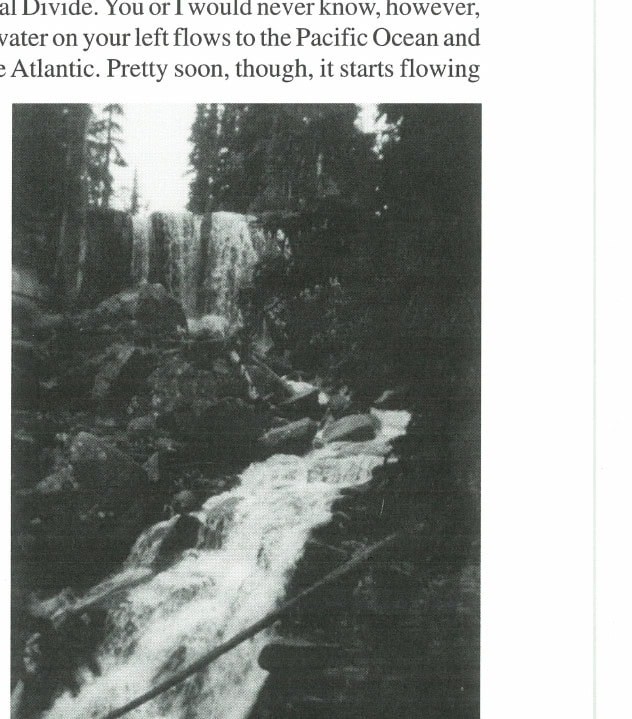
Something of interest that shows up after the Pole Creek aid station is nothing less than the Continental Divide. You or I would never know, however, that once you get to this point, water on your left flows to the Pacific Ocean and water on your right flows to the Atlantic. Pretty soon, though, it starts flowing from the sky.
There is also an incredible amount of nasty, prickly vegetation up here. Anyway, while I’m stumbling along the Great Divide (thinking if I fall now, will I roll toward the Pacific or Atlantic?), a whole bunch of people pass me, including Carolyn Erdman. I have no idea how I ever got in front of her, but here she is! And there she goes!
The trail down to the Sherman aid station is one of the most beautiful on the course. It is heavily wooded, and you crisscross your way through mountain streams and upwards and behind you is an awesome view of waterfalls. Of course, what you don’t realize is that while you’re carefully wading through each stream, Mother Nature already has you above a waterfall. One slip here and you’re over Niagara!
And when you finally get to Sherman—splash!—there’s a raging river you have to cross. Fortunately, a tree trunk was stretched across the water. However, over the years, this nice trunk has gotten slick. I’m wet, it’s raining, and my shoes are (you guessed it) wrong for the task.
Some volunteers are cheering on the other side.
“Hey!” I holler. “Should I take the log or the river?”
“I think the river’s safer,” a man answers. “It’s drier.”
HANDIES: THE PIQUE THAT MAKES US PUNCHY
Once inside the tent, I stuff my face and guzzle Gatorade, and the helpful volunteers drop off my drop bag. This allows me to change clothes (mostly) and layer on warmer threads for the oncoming winter up Handies Peak—not to mention the oncoming fall of night. And isn’t this something? Here I am almost 11 hours into a “race,” and I’ve covered a grand total of 31.6 miles. And it’s about to go from summer to winter today.
I’ve designed this drop bag with wisdom and foresight. It’s actually a backpack. So when I leave the station, I take it with me. And inside my luggage, of course, are crampons.
What’s the first thing that happens as I hike the rising jeep road out of Sherman? I turn around to see Jennifer Roach hot on my tail. When we take the turnoff onto the steep trail going up Boulder Gulch, she passes me. Way to go, Jennifer! I struggle for the next couple of miles just to keep her in sight. Now, suddenly, with all these fine folks having passed, I’m starting to feel that old sinking feeling: I’m last.
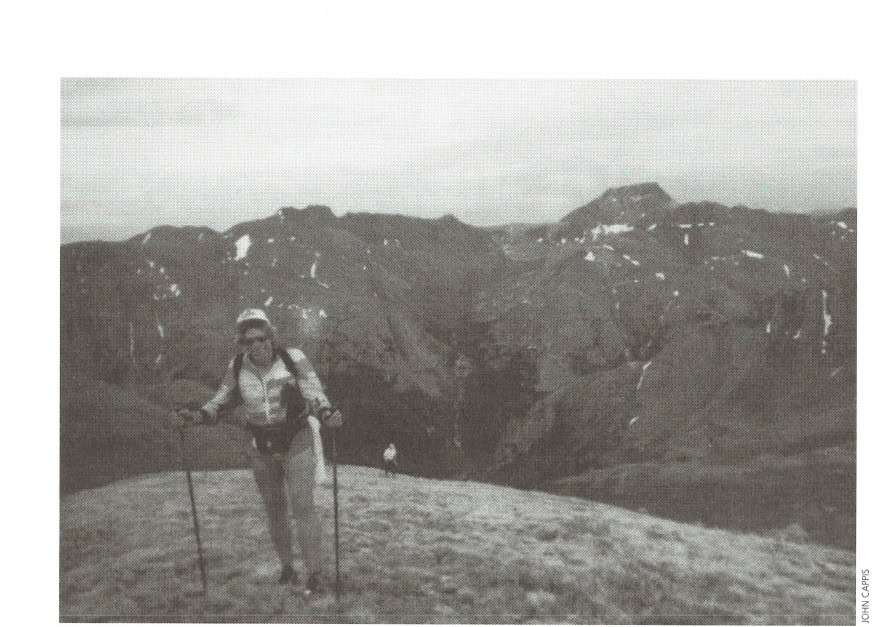
But on the endless wide-open climb above timberline on my way up to Handies, I see that I’m wrong about this, too. I’m not last. I look behind and see “the man” himself, John Cappis. (And he’s not last either!) John comes up and starts quizzing me on how much I remember from trail-marking. All I really remember is a blizzard. But he straightens me out, and we rise higher together. We even pause to take each other’s picture—something to prove that I really did scale one of Colorado’s 54 peaks above 14,000 feet.
The climb is endless. And when you get near the top (actually a “false top”), you’re still not there. Now you have to rock climb. There’s this 50—maybe 100—foot section where, if you’re going to get to the “real” top, you’re going to be climbing with fingers, knees, and shins. This section is straight up.
John, of course, scales it like some kid climbing an easy tree. It takes me a little longer. (I was never a kid, you see, and there are no trees in Illinois, not even ones that Lincoln planted. We have museums.) Eventually, though, I inch my way to the top, only to see another top. I don’t see John anymore, but—jeepers!—here come even more people behind me.
By the time I make the real summit (no blizzard this time, by the way), it’s sunset, and I find that I’ve scaled the heights along with Jim Ballard and Larry Ranney, who is the superintendent of Silverton Public Schools.
Now, to prove you’ve made it to this checkpoint, you must punch your bib. This means you need to locate the special paper punch, which General Charlie has set out beforehand, and use it to mark your race bib to prove you “did it.” There’ll be no Rosie Ruizes at Hardrock! And no subways, elevators, or escalators, either.
This is all cool except for one thing: Jim, Larry, and I search frantically all over that peak trying to find the paper punch, and it’s not there! What to do? We must punch our bibs or be accused of cheating.
Fortunately, I remember most of the fourteeners have what’s called a “register” at the summit, and here we find one atop Handies. The register is a small weatherproof tube fixed by a chain to the survey marker that indicates the elevation. You unscrew one of the end caps and find inside a sheet or two of paper along with a pen or pencil. If you’re a seasoned mountaineer, you know all about this and therefore cheerfully sign and date the paper for all posterity. “Kilroy was here.”
Unfortunately, when Larry and Jim look inside, they find a pencil with a broken tip and register sheets that have been ripped to shreds. Who would do such a thing?
I am suddenly reminded of what I wrote last time about Joel Zucker’s memorial plaque affixed to the top of Grant-Swamp Pass. My description? “It’s vandal proof.” Well, now I’m not so sure.
“What do we do now?” the three of us holler in unison.
Fortunately, I remember my camera.
“Good!” they exclaim. “Take our picture to prove we were here.”
Unfortunately, weeks later, I discover that sunset atop Handies Peak is too dark for a cheap disposable to prove much of anything.
The bright side? None of us finished anyway, so no one ever cared what we could—or could not—prove.
GROUSING AT GROUSE
Fortunately, there’s still enough light to get down off the mountain. I can’t keep up with Jim and Larry though and promptly get lost in American Basin. (Or is this Grouse Gulch Saddle?)
I am so glad that, despite all this, I am still not dead last. Even though it’s now pitch dark and freezing and I am most certainly lost (I was here planting trail flags; why can’t I remember?), I suddenly hear voices. Quickly, I yell and pick up my pace. I move in the general direction of the sounds and eventually join two runners who apparently know where they’re going. Thank goodness! This is when I stumble upon a body.
OH MY GOD!
The body, however, moves and starts talking, explaining how he just wanted to take a little nap on the trail. He apparently counts on people stumbling over him so he can wake up and get going again. Still, this little surprise has been unsettling. It’s pitch black, we’re in the wilderness, and there’s probably mountain lions. Marmots for sure; and, although they’re tiny, I sure wouldn’t want to mess with one of them. They eat flags.
Eventually, we all poke and feel our way down the switchbacks to the big valley known as Grouse Gulch. I’m hoping Beth, my wife, has managed to find a ride, because I think we’d like to see each other again before I die. Well, as it turns out, she did, we do, and I don’t.
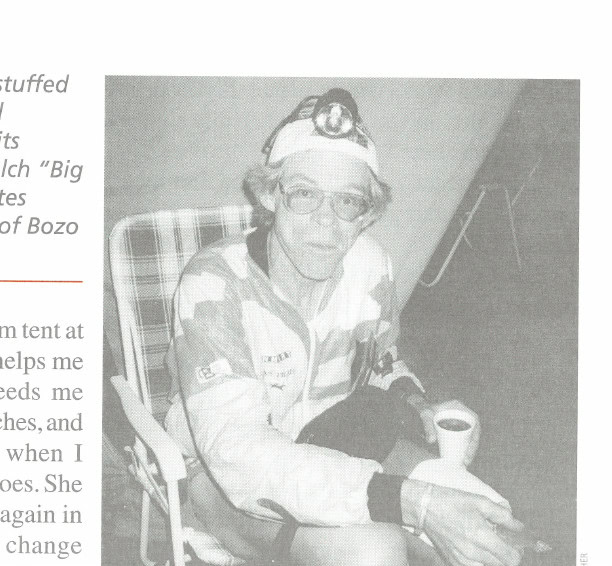
Inside the big warm tent at the aid station, Beth helps me find drier clothes, feeds me grilled cheese sandwiches, and gives me sympathy when I complain about the shoes. She promises to meet me again in Ouray, where I can change them. But that will be hours from now. Meanwhile she’s got time to go back to the hotel and grab a night’s sleep. It’s what? Almost midnight? Look at that cosmic clock on your imaginary floor. I’ve only made it past the 3.
COYOTES, MYOPIA, CLIFFS, AND SLIPPAGE
Thank goodness there’s this nice gradual gravel road climbing up out of Grouse. I hike it pleasantly. The night is young, the stars are bright, and—uh oh—there’s something yelping over by the roadside. I steel myself, resolving to be brave. This may be the Valley of the Shadow of Death, but I am the meanest son–huffa–Rich in the valley.
After a while, two more cheerful runners hike up behind me.
“Hey, did you hear the coyotes?” they ask.
“Oh, them!” I answer in my typical nonchalance. “Sure. I gave ’em all PowerBars and they left me alone.”
I watch these guys go by after I pause to wee. I assure myself that all I need to do is follow their flashlights and they’ll lead me right up to Engineer Pass. Unfortunately, it’s a long wee, and when I’m done, they’re gone.
So I climb the next umpteen thousand feet on my own, all the way up to a fork in the road. Uh-oh. Which way? Is there a sign? There should be a sign! This is a road! Tourists come here!
I see a sign so I squint and read. I see an arrow. It points to “Pass,” so I follow it. Cheerfully, I turn to the right and become enraptured again with the stars.
I snap out of it just in time to see . . . nothing. The road dumps off to oblivion, and I’m standing at the edge of nowhere. Hmmm. Don’t remember this from trail-marking. Better go back and check that sign.
This costs me at least a precious half hour’s time. I trudge all the way back to the fork, walk right up to the sign, shine my light on it, and read: “Engineer Pass.” The arrow points exactly toward the direction I went. “Oh Point,” another arrow points, is the other way.
“Oh fudge!” I think. “What did John tell us not to forget here?”
Fortunately, while I’ve been wasting all this time on my detour, a few more runners have come up the road and passed me. I can just make out their flashlights going off to the left—not toward Engineer Pass. I follow these lights.
The lights lead me once again to the edge of oblivion, but this time I recognize it. I’ve been here before, and now I have to go down. Where? Oh, point! Those are the aid station’s lights in front of me—straight down this very, very steep, grassy slope. It’s night and it’s freezing and the dew’s out. So guess what that does to the grass?
Right! As soon as I plant my first foot below the ridge, splunch! Down on my butt I go.
I get up, curse my first-prize raffle shoes, and splunch! Down again!
Now I’m starting to get mad. But, upsie! Down again. And, just once more, for good measure. Ouch!
At this “oh point” I’m furious! I pick myself up for the last time and fairly scream at the top of my lungs, cursing shoemakers, sign makers, optometrists, and the cosmos itself. No one hears me, so no one curses back.
HOORAY FOR OURAY
For 3 o’clock in the morning, the Engineer Pass aid station people are in surprisingly good humor, and I marvel how they got here. I ask to borrow their helicopter. They laugh. I eat. They throw me out.
The long way down to Ouray is fraught with danger. This is perhaps the most infamous “Bear Creek Trail” (there are three on the course) because for the most part it consists of a “shelf” winding down a cliff or canyon wall, which at some points is no wider than the mule train it was built for, and at most points overlooks a sheer drop-off on my left of, say, 2,000 feet. Absolutely spectacular!
In the daylight, that is. In the wee hours—because I know what’s down there—it’s a little bone chilling. A couple of times I slip here but not fatally.
Somewhere high above Ouray, the dawn breaks. When I say I can see by the dawn’s early light what so loudly has sailed o’er the ramparts left leaning, I turn off my headlamp.
When I finally arrive in town, it’s full daylight, the temperature’s rising, and this year, by crackie, I don’t have to quit. But I do need to change my shoes.
Armed with fresh clothes, Beth’s smooch, and another terrific sandwich, I now traipse off to retrace my steps of last year, when I’d also stopped in town—permanently. What a difference a year makes! I’m buoyed with confidence and smeared with peanut butter and jelly.
If I thought the change of shoes would feel so good as to assure me of finishing, I’m sorry, but once again I was wrong. My feet still hurt like crazy. The damage, I’m afraid, has already been done.
So be it. I’m on Camp Bird Road, going up ever upward in the direction of Camp Bird, which I (to this day) have never seen, and on ever onward toward Virginius Pass, which I have seen (twice). When I get here the third time—oh, yes, indeedy!—I put on my crampons.
I literally claw my way to the top. In each fist I have an “ice pick,” made by collapsing my hiking poles, and on each foot I have spikes. When I’m almost all the way up and they toss me that rope (the same one I slid down last year), I see the volunteers! They’re all cheering like crazy!
If you can believe this, at the very top of 13,100-foot Virginius Pass, a bunch of brave mountaineers operate an aid station. “Kroger’s Canteen” it’s called—not for the supermarket chain but for the first guy who volunteered to haul groceries up here. Having just arrived, I learn two more nonsurprises: #1 I’m the first runner they’ve seen wearing crampons, and #2 I’m the last runner there is. Now I know why they’ve been cheering. They’re closing the station and want to go home.
CAN YOU TELL I’VE A RIDE AT TELLURIDE?
Freshly supplied from Kroger’s deli, I turn my attention to the checkout—which I don’t know at the time, of course, is destined to lurk in the express lane at Telluride (34 1/3 hours or less). I do know this, though: It is a long, long way down to Telluride.
Last year, coming up this very same endless climb, I decided for the first time in my life to drop out of a race. This year, going down, I resolve never again to do this coming up. Going down here is just fine, thank you very much. Last year everything hurt except my feet. This year, my feet are killing me.
When I plop down into town—and run on the sidewalk and wait for the traffic light—and finally do check out the aid station, who should I see working the counter but Geri Kilgariff and Linda Van Tilborg, the gorgeous co-directors of the Zane Grey Highline Trail 50-mile race in Arizona. They give me what can only be described as “a big welcome.” Then they take my sandwich order and make me promise to sign up for their race next spring.
The aid station’s captain’s first question to me is, “Are you going to go on?” And, after my first question to him, he replies, “You’ve got an hour to make up your mind.” That’s all the lead I have left over the ultimate cutoff.
Unfortunately, this is only part of the picture. In fact, Hardrock’s closing miles aid station cutoffs are exceptionally generous. Even if you leave the Telluride, Chapman, KT, and Putnam aid stations before they officially close, you still have no guarantee you can finish before that final clock ticks 6 (i.e., 48 hours, or 6:00 A.M.).
While mulling over all of this and schmoozing all of them, I just can’t believe who shows up next. It’s Carolyn Erdman and John Cappis.
Whoa! How did they end up behind me?
Wrong! They weren’t behind me at all. They were well ahead. (They passed me a long time ago, no?) What they’ve just done is turn around on their way up to Oscar’s Pass. What they’re doing right now is dropping out.
What?
“Not enough time,” John says.
“There are other things I want to do with my life,” says Carolyn.
“But Carolyn!” I protest. “You promised me a big hug at the finish. I mean, after we both finish!”
With tears welling up in her eyes, she hugs me now.
If she and John are dropping out because they don’t feel there’s enough time, who am I to continue? (Especially since each foot now feels like it is full of shrapnel.)
So I ask John if it’s mathematically possible to finish under 48 hours at this point, which is mile 73.7 and some 33 hours into the run. We’re talking roughly 15 hours to complete a marathon, and John Cappis is saying that’s not enough time!
He looks at me in all seriousness and asks, “Well, Rich, can you run as fast at night as you can during the day?”
In all seriousness, I assure him I can’t.
“That’s what it would take,” he says.
And that’s all it takes to convince everyone hanging around the aid station to call it a day. We all drop (there’s five of us), and the volunteers start right away to pack up and go home. All it takes to drop out is to extend your wrist with your weight and vital signs banded in plastic, and ask the aid station captain to cut it off. (The band, not your wrist.)
This we all do and suddenly, 180 pounds lighter, I’m a free man.
And these (as we all learned later) are the precise reasons why we all made the right decision:
- The weather that night went to hell—freezing rain, sleet, ice underfoot, horribly high winds, and fog.
- The last-place official finisher, who finished with just 10 minutes and 28 seconds to spare, had departed Telluride three hours ahead of us.
- The sweetest couple on Earth was there, Milton and Mary Zimmerman, and offered a ride back to Silverton to the two of us needing it most, Dr. Stanley Zychowski and yours truly.
- None of us five dropouts is dead now.
- I still got my big hug from Carolyn.
And What I Learned From It (The Second Edition)
TOP 20 LESSONS (The Latest Now Added to the First 10)
- You are never so successful that you cannot ever fail.
- Being coached is a lot different from being there.
- The best people can be found in the worst situations.
- Before you shoot yourself in despair, consult those people.
- The Hardrock Hundred is not a running race.
- You don’t have to kill yourself climbing on this course if you can make up time by skiing on your shoes.
- Skiing on your shoes might be the only way some of us will ever beat the cutoff.
- Wait till winter, lace up the trail shoes, go to the playground, climb up the ladder, and practice skiing down the slide.
- Buy poles and crampons.
- Don’t kill yourself before next July.
- Failing once is no guarantee you’ll succeed the next time.
- At Hardrock not being is not much different from not being successful (but sometimes this wisdom is hard to come by at a cutoff point).
- The most heroic people can be found in the worst situations.
- Before you decide to keep going, consult those people.
- The Hardrock Hundred is not a race. It is a run.
- In the counterclockwise direction (going up the snow and down the rocks), you have almost no chance to ski on your shoes.
- I will most likely only be able to finish this incredible run (someday) by not skiing, by signing up during a counterclockwise year, and by waiting next until 2002.
- Instead of practicing on frozen playgrounds, this winter of 2001, I’m running in Florida.
- Don’t wait until you arrive in Silverton before buying your poles and crampons.
- Unless, of course, some other runner from the “Land of Lincoln” beats me to the post office—or just beats me—I can still be Illinois’s first finisher!
CHAPTER 3: TRAINING FOR ALL DISTANCES
Training for ultramarathons does not differ from training for the marathon or shorter road races. Runners who have completed the marathon several times have attained the physical condition necessary to cover fifty or more miles. However, while they possess the sheer power required most would fail if they tried. First, they would lack knowledge of how to mix walking and running. Second, they would not know how to take fluids so as to remain hydrated. And third, their psychological orientation likely will be too intense and they will squander valuable energy in the early miles. In this chapter we will review briefly the most popular forms of marathon training, as well as consider warming up, stretching, training in heat and cold, diet, and injury and illness. We will take a closer look at those areas of training of special interest to the ultramarathoner in the next chapter. These include walking, the selection of fluids to be used while running, psychological preparation, as well as a glance at the training techniques of the great pedestrians of the past.
Mileage and Speed
The first question today’s runner asks when he considers training is, “How many miles should I run each week?” As mentioned earlier, ultramarathoners generally run no farther in a week than well-trained marathoners or 10,000 meter specialists. The ultramarathoner of today is in the enviable position of being able to compete at a great variety of distances. Most are no strangers to five and ten mile road races, as well as the marathon, fifty miles, 100 kilos, 100 miles, and beyond. Those who consider themselves ultramarathon specialists will use the very shortest races as tune-ups for speed.
Just how many miles should you run each week? This varies with the individual runner’s basic strength and opportunity to train. Few will run less than sixty miles per week, and few will go more than 120; most will average seventy to eighty miles over seven days. A typical schedule will look something like this:
| Day | Mileage for 60 mile week | Mileage for 80 mile week | Mileage for 120 mile week |
|---|---|---|---|
| Monday | 5 miles | 7 miles | 10 miles |
| Tuesday | 10 miles | 13 miles | 20 miles |
| Wednesday | 5 miles | 7 miles | 10 miles |
| Thursday | 10 miles (including 3 mile time trial) | 13 miles (including 3 mile time trial) | 20 miles (including 3 mile time trial) |
| Friday | 5 miles | 5 miles | 10 miles |
| Saturday | 10 miles | 15 miles | 20 miles |
| Sunday | 15 miles | 20 miles | 30 miles |
The essential feature of these schedules is the following:
- There is an observable easy, hard, easy, hard pattern. Monday’s run is short, followed by Tuesday’s, which is long, and so on. Rest is as important as stress when training, and the shorter days provide insurance against overtraining.
- There is a long run every week, or every two weeks. These serve to reacquaint the athlete with the difficulties involved in prolonged footwork.
- There is a short time trial or race each week to help the runner develop the important ability to relax at a fast pace.
The speed attained in these workouts varies with the individual’s strength, level of fitness, and goals. In general, the pace should be easy and relaxed, with no difficulty maintaining a conversation. The runner should be moderately tired at the conclusion of the workout and should have sufficient reserves to repeat the workout immediately if necessary. Overtraining to the point of exhaustion will eventually cause illness or injury.
What pace is typical in these workouts? A 2:18 marathoner can probably relax at six minutes to the mile, a 2:30 marathoner at seven minutes per mile, a 2:45 marathoner at seven and a half minute speed, and a 3:00 marathoner at about eight minute speed. These times are only guides, and a particular athlete might find that his or her pace varies considerably from those mentioned. I can run a marathon in 2:50 at any time, yet I frequently run at nine minutes to the mile, especially in the early morning hours.
This article originally appeared in Marathon & Beyond, Vol. 5, No. 5 (2001).
← Browse the full M&B ArchiveMore like this
1,000+ stories from 19 years of Marathon & Beyond
The complete archive of the legendary long-distance journal — digitized and free to read.
