

On THE Road WITH Ellen McCurtin
SEE JULIA RUN
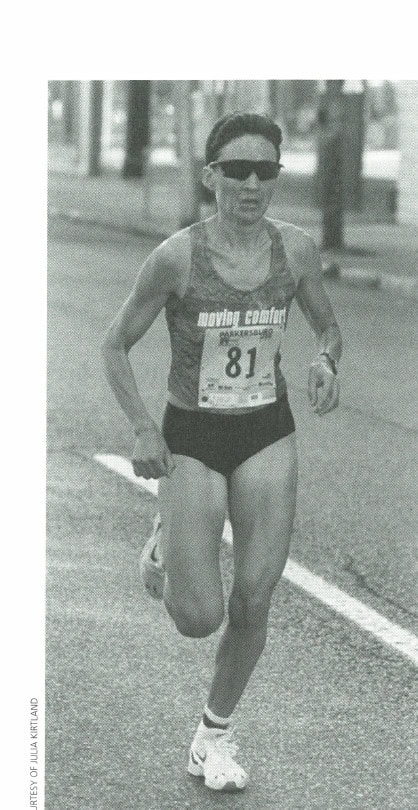
Julia Kirtland won the women’s national marathon championship in February 1997 when she was 31 years old. It was a breakthrough performance and one of those days where everything fell into place. She felt good throughout and set a PR of 2:37:46. She also earned $12,500 for first place, her biggest racing payday, and the win earned her a spot on the World Championship team that would compete in Athens later that year.
I remember seeing Julia before the race and knew that she was one of the favorites to win that day. I wanted to say “Hello,” and I think I did, but I was reluctant to really get into a conversation because I didn’t want to be a distraction to her as race time neared.
It inspired me to see how much Julia had accomplished with her running. To put this into context, Julia and I had attended the same boarding school in Massachusetts, Northfield Mt. Hermon School, back in the early ’80s, and had met on the cross-country team during her senior and my sophomore year. Like other underclassmen on the team, I looked up to Julia. She was the best runner and also one of the nicest to be around. She was, and is, the type of runner whom you want to see do well and you don’t begrudge her success. It is hard to explain why this is, but I’m sure you can think of at least one runner you know who falls into this category—and probably one who doesn’t.
She works hard—very hard. I would, as an outside observer, characterize her approach to the sport as quiet, methodical, and serious but by no means dour. She genuinely enjoys running, and, to be more specific, she truly enjoys the training as much as the racing. She is also a good sport and represents running well.
Going back to our days on the cross-country and track teams, Julia was unlike some of the better athletes I knew in that she never flaunted her successes or treated the slower runners any differently than the faster ones. It seemed to me that her attitude was that we were all on the team together and that was good enough for her. She placed more emphasis on the team’s performance than she did on her own individual race, and I remembered that, more than once, she and another Northfielder would end a race in a tie.
And as the captain, she mercifully never led us on runs past the boys’ soccer practice and exhorted us to moon them, a shy person’s nightmare. It was another captain who led those forays . . .
NO MEMORY FOR STATS
Although no doubt there was some amount of expectation that she would always win or come close, she says she doesn’t recall feeling pressured, and, in fact, when I asked her about her PRs for cross-country and for her track events (which were mainly the 1,500 and 3,000 with an occasional 800), she could take only a ballpark guess. In fact, later on, some time after graduation, she was inducted into Northfield Mt. Hermon’s athletic hall of fame, where she was introduced to the girl who had broken her cross-country course record. She laughed when she told me she had forgotten that she had the record at all.
Not that she’s blasé about her time or her personal expectations. I’m sure she enjoyed the successes she earned in high school, but to talk to her about it now, the analogy that comes to mind is blowing the dust off a trophy you stored in the attic and had forgotten was there but to look at it again brings you back, momentarily, to a really nice time in your life.
I asked whether she had been recruited by any schools for her running and she said no, which surprised me, especially since Northfield Mt. Hermon’s girls’ cross-country and track was, in the late ’70s and early ’80s, notable for dominating its rivals at the New England competitions.
Her college choices came down to Carleton and Macalester. Having spent her high school years in a rural area, she wanted to go to college in a city and ended up choosing Macalester in St. Paul. She told me she loved it there and was very enthusiastic about it as a runner-friendly place, with lots of good places to run and proximity to trails as well.
Still, she didn’t center her life around running and did not envision making a career of it. “To be honest, I really didn’t think much about my future at Northfield. I think I knew that I would always run, but I don’t think I quite envisioned a competitive running career. Not even in college. But at that point I was thinking of trying to one day qualify for an Olympic trial, most likely in the 10,000 meters. But careerwise, I was more focused on a career in the field of plant ecology.”
Nevertheless, her career at Macalester was an excellent one.
The team was decent but still in its early stages, and Julia often trained by herself to get in the miles. This was the early ’80s and high mileage was given a lot of emphasis. Since she hadn’t been pushed to run that many miles in high school, double workouts and triple-digit weeks were new horizons for her, but the transition did not prove problematic.
She enjoyed rapport with her coaches, most of whom were women. In fact, she noted that she thought it was both good and somewhat unusual that she had mostly had women as coaches since her start in competitive running in high school.
She ran year-round at Macalester, sandwiching indoor track between cross-country and spring track. Indoors she ran the 1,500 and 3,000 and outdoors she gravitated toward the 5,000 and 10,000. Sophomore and junior years saw her set collegiate PRs outdoors with a 16:28 and 34:53, respectively.
NAGGED BY MINOR INJURIES
With all the mileage and the little downtime she had from racing, added to academic demands, something had to give. I was surprised to find out that it was not fatigue or mono or anemia that got to Julia but some assorted injuries. None was of any specific note and none followed her to the present day, but they bothered her enough that by her junior year she got orthotics in an attempt to correct the problems—and they worked.
By the time she graduated, she had built up an impressive resume, with eight NCAA Division III collegiate titles to her name, including wins in cross-country, indoor 3,000, and the 5,000 and 10,000 outdoors. She won both the 5,000 and 10,000 in her junior and senior years.
Julia graduated in 1987 with a BA in biology and moved to Maine to study plant biology in graduate school at the state university at Orono. She received her MS and took a yearlong internship at the National Resources Council of Maine in Brunswick. But she discovered in the course of the year that she was not happy in a 9-to-5 office, so she left and took a number of part-time jobs, including digging clams, selling sea urchins, and working in a bakery, to support herself while she figured out what she wanted to do with her life.
It was around this time that she met some fellow runners who urged her to consider getting back into serious training and racing, something she hadn’t done since her undergraduate days.
Particularly instrumental were Marge Tennyson, who made the introduction to her current sponsor, Moving Comfort, and Steve Podgajny, who lives in Brunswick. Steve is one of the founders of the exemplary Maine Distance Festival that is held every July at the Bowdoin College track and has quickly developed into a world-class event. (I am particularly enamored of the inspiration for the meet. A sub-four-minute mile had never been run on Maine soil, and the meet was created to rectify that. That happened in 1998 when Jason Pyrah won the men’s mile in 3:56.82 and seven men broke 4:00 in the same race.
Steve recalls: “My wife, Marjorie, and I used to just gently check in with Julia every once in a while. We knew that she had a great collegiate career, and I would see her running on Sunday mornings when I met the regular crew. We didn’t want to bug her, but we also knew that eventually she’d come back—and she did.”
In addition, Julia vividly remembers watching the television coverage of the women’s marathon in the 1992 Barcelona Olympics in which a fellow New Englander, Cathy O’Brien, competed. (We also discovered that we could both remember exactly what we were doing and where we were when we watched the TV coverage of Joan Benoit winning the first women’s Olympic marathon in Los Angeles in the summer of ’84.) The ’92 race inspired her further, and she began to think about what she wanted to accomplish in running.
LOVE AT THE BAKERY
I’ve read enough accounts of talented young runners working odd jobs to support their running that I tend to romanticize it a bit. Working in a bakery, for example, sounds like such a classic young runner’s job that I assumed it was relatively conducive to her training. Although I knew it meant a lot of time on her feet, I forgot about the predawn hours that bakeries require—not so ideal for training. But it was significant for another reason, for it was at the Wild Oats Bakery that Julia met the man she would marry: a soft-spoken lobsterman named Paul Hickey, who lived in Harpswell, Maine. She had actually seen him before, on the waterfront in Portland where they were both selling sea urchins.
Paul encouraged her to quit her job at the bakery to train full-time, which she did. They were married in Maine in June 1994. (It is a custom for lobstermen and fishermen to name their boats after their wives, so I wondered whether Paul’s boat was the Julia K, but she told me that when he bought his boat it was already named the Tessa Eve and that it was considered bad luck to change the name of a boat.)
Later that year, Julia ran her first marathon, Twin Cities, finishing 12th in 2:44:26, and she was hooked.
She said she had always suspected that her best distance would turn out to be the marathon, and this first experience confirmed it. She told herself going in that if she hated it she would never have to run another one, but instead the opposite happened. She loved it. She knew this was where she belonged and it was what she wanted to do.
She returned to Twin Cities in 1995 and improved to 2:40:17, an A standard time for the women’s Olympic trials, earning her an expense-paid trip to Grandma’s Marathon the following year. Seeded 36th for the trials, she ended up in 14th place and set a then-PR of 2:37:53. She considers this race her best. “It was my first sub-2:40 marathon. I ran very smart, started slow and just worked my way through the pack. Near the end I was passing people I had never been able to run with before. It was a race that really boosted my confidence.”
In 1997 she traveled to Columbia, South Carolina, to run the women’s national marathon championship.
national marathon championship. She had been there for several weeks preparing specifically for this race and was one of the pre-race favorites. The day was rainy and the championship field was small, but Julia was unfazed and ran 2:37:46, a time that remains her PR and earned her a berth on the World Championship team that was headed for Athens, Greece, later that year.
For a couple living on the unpredictable income of a road racer and a lobsterman, the paycheck must have been an especially nice reward for all that hard work.
The World Championship race, by contrast, was not such an ideal experience. Athens is severely polluted, and the added heat and humidity of late summer really bring down the air quality. Julia, however, while willing to acknowledge very unfavorable conditions as a factor in a race, puts the onus on herself. In retrospect, she says, she was tired and overtrained going into the race. She struggled and ended up hanging on to finish in 2:49:43, 36th overall. Of the 76 women who started the race that day, 21 dropped out.
When asked about her strategy for hanging on when the going gets really tough, she responded: “I play a lot of mental games. Mostly using positive reinforcement. During the hard parts of a marathon I remind myself that it is just a tough patch, and it will pass. So, having the faith to know that the pain is temporary helps. Also, I would rather finish despite the pain (that is temporary) than give up.”
ON TO 2000
Despite her experience in Athens, Julia forged ahead without any major downtime. She went on to run Houston in January 1998 (it was the first qualifying race for the women’s Olympic marathon trials of 2000), finishing in 2:40:09. She admitted that her legs felt beat up, but it was not so bad that she backed off.
She ran Chicago that fall in 2:40:16, followed the next spring by Boston in 13th place (second American behind Lynn Jennings) in 2:39:45.
Julia was scheduled to go back to Twin Cities that fall, but she was feeling worn out and was having a lot of muscle tightness. She had a blood test that suggested she might have had mono or some other virus, but it was not really conclusive. In retrospect, she believes it was primarily a case of overtraining. She opted out of Twin Cities and concentrated on recovering so that she could train for the Olympic marathon trials in South Carolina the following February. She hoped that rest, yoga, and more attention to diet would restore her equilibrium.
Unfortunately, despite all her good intentions and planning, it was not enough. Julia’s second time on the Columbia course was the antithesis of her first experience there. There were indications that she was not going to have a good race, but she was not about to back out of the trials.
It can be tricky to gauge whether you are truly recovered and ready for another hard effort. You can start to feel stronger again and believe you are on the mend. Often you don’t really know until the race itself that you weren’t as rested as you had thought.
The end result for Julia: 2:45:28 for 23rd place.
So much has been made of that race that I doubt I need to refresh anyone’s memory. And Julia’s personal experience seems to correspond with the majority of the finishers. “It was just an awful race and not only because of the weather,” she recalls. “I just didn’t have the fitness and mental focus to run as fast as I would have liked. But it taught me the importance of just finishing a race. This was the Olympic trials—and there was no way I was going to drop out just because I wasn’t feeling well and not running as fast as I wanted. It put things in perspective because I was actually lucky enough to be there competing in the Olympic trials.”
Picking up the pieces after a disappointing and physically grueling race is a very individual process. “I was very frustrated but also probably relieved,” she said. “I needed a break from marathon training and was looking forward to some time off from the rigors of training. My thoughts were turned more to shorter races. I wasn’t quite sure what to think about my career at that point. I guess that I figured that I would rest and then start back from where I finished off. But, what happened is that I finally dealt with my personal life, which meant that running was not of the same importance in my life. These past few years, post-2000 Olympic trials, have been ones where my running career was not my focus.”
I had read an interview with Julia before she ran the 2001 New York City Marathon in which she alluded to a difficult time recently in her personal life.
A MARRIAGE DISSOLVED
Julia and her husband separated after seven years of marriage and were divorced in 2001, although they remain on good terms and are in touch about once a week by phone or e-mail. Although not reluctant to discuss it, she was characteristically thoughtful and understated in her response, not going into the details of the breakup with me, except to say that the dissolution of the marriage was complicated by the fact that they were not only husband and wife but also each other’s best friend.
She is also quick to point out that Paul was absolutely supportive of her running during their marriage and that it was not a point of contention in their relationship. She said her running wasn’t good during that time, but it didn’t seem important considering what was happening in her personal life.
I was curious because some people find solace in running during emotionally difficult and stressful times in their lives, while to others it feels trivial and they lack the energy or the desire for it. Although she feels on more solid ground now, she says the experience did alter her relationship with running. “It can’t be the only thing or the most important thing anymore, and I don’t want it to be,” she said.
When asked whether she had any regrets or how she might do things if she had a second chance, she had this to say: “I think that the only thing I would have done different was to bring more balance into my life. I tend to get very focused on my running, and I think I neglected my personal life somewhat. I also think that maybe I should have given my body and mind more rest at times—taken more breaks from competitive running. But really, in general, I have enjoyed my career.”
She is now living on her own in Brunswick, in an apartment where pets aren’t allowed (she would like to have a cat) and is very busy in her new job as assistant cross-country and track coach at Bowdoin College. Bowdoin, Joan Benoit’s alma mater, is an excellent, small liberal arts college with a lovely, quintessential New England campus, located in Brunswick, Maine. She is working under coach Peter Slovenski.
While she expected to like the job, she was surprised to find that she really loves it and says it doesn’t feel like work. Her job involves working with the athletes, an assignment on which she thrives, but as the assistant coach, she notes, she is also not encumbered with the stress or the paperwork of being in charge.
I was impressed with her daily routine, perhaps because it was so disciplined and uncomplicated, and because it is so far removed from mine.
A SET-IN-STONE ROUTINE
I would sum up her routine as no caffeine, no junk food, no junk miles, and a sensible sleeping schedule. She doesn’t drink coffee because its acidity is hard on her stomach and she says it would just make her jumpy. She also doesn’t drink soda (mainly she just doesn’t like it) and pretty much avoids junk food, although she is not fanatical about it.
Water intake is not monitored exactly and there is not a daily quota to which she adheres. She says she probably should drink more water, but she usually has her bottle with her and just hydrates throughout the day. She also was a vegetarian for several years. It was in part a philosophical decision, but she just wasn’t fond of eating red meat anyway.
Not long ago, when she was traveling for a race, she went out to eat with a group of friends and they ended up at a burger place. Out of the blue, Julia ordered a hamburger, and she says it tasted so good and was so satisfying that she ended her no-red-meat routine that day. She is quick to point out that this does not mean that she stops at just any fast-food place. She is selective about her food choices and says her place to buy meat is Wolfe’s Neck Farm in Freeport, an organic saltwater farm that sells all-natural meat (no growth hormones or artificial preservatives).
She goes to bed between 9:00 and 10:00 P.M. and gets up with the sun, more or less. Ideally, she likes to get about nine hours of sleep and will sometimes compensate for getting less by taking a nap. (So she frequently has some trouble getting to sleep at night.)
Within a half hour of waking in the morning, she’s out the door for her first, and sometimes only, run of the day. Unlike in her college days, her mileage does not creep into the triple digits. Typically, in the marathon buildup phase, she might do cycles of two to three weeks of 70–90 miles and then take a recovery week, lowering her mileage to a low end of about 60 miles. “I occasionally use a heart rate monitor to make sure I’m not going too hard in certain workouts,” she admits. “But I have found that I am able to read my body quite well. Usually my HR is where it should be at and coincides with the pace that I would run naturally by just listening to my body.”
The miles now must have a purpose; junk miles are out (she is simply not interested in doing that kind of training), and each mile is recorded. “I started keeping a running log the summer before college,” she says. “I am pretty methodical about it and always write down what I do. I include the date, what I do, time, mileage, where I went, weather, who I ran with if anybody, and how I felt.”
Julia is self-coached and finds that it is working out well. In the late ’90s she was coached long-distance by Benji Durden.
She doesn’t have a particular favorite run near her home, but she loves to run long. As far as training partners, she enjoys company but says that training alone has never presented an obstacle for her and that she doesn’t mind it.
Winters in Maine can curtail training, so I asked Julia what she does to make sure she gets in the training she needs. She prefers to go outside whenever possible, but she resorts to her
An Indoor Alternative
treadmill if road conditions are such that she feels she would be a danger to drivers or would put herself at risk of injury.
Another alternative is the indoor track at Bowdoin if she wants to do a quality workout. She also cross-trains with cross-country skiing, and sometimes she just resigns herself to occasionally cutting back. Fortunately, this winter has been mild to average. The same could not be said of last winter when the snow that fell in Maine was measured in feet if not yards. By winter’s end, the snow at my mother’s house, about an hour south of Julia’s, touched the windows.
In spite of these seasonal monkey wrenches, Julia seems to have found a home in Maine and plans to stay. As a native Mainer myself (who just happens to be living in Connecticut at the moment), I can attest to the fact that that affection is returned and members of the running community are proud to call her one of their own.
“Julia is absolutely one of the best, highly and affectionately regarded here, totally sweet, self-effacing, and down-to-earth,” said John Rolfe, who writes the running column for the Portland Press Herald. “I also remember her [Julia] celebrating when Mya Mangawang won the Maine Marathon in 2000. Julia had trained with her, and it was clear to see how much pleasure she took in someone else’s success. I think she has a very generous spirit and I don’t think that is common among competitive runners.”
Her most recent marathon was the 2001 New York City Marathon, with its unprecedented elite American field. Watching from the sidelines in Central Park at the top of “Cat Hill,” less than two miles from the finish, I saw Julia pass by. Clearly she was not having a great race, but she looked like she was managing and would at least break 3:00. (Her finish of 2:57:53 was good for 55th place and accounted for her slowest marathon ever.)
Catching up with her later in the finish area, I asked what had happened. She said she knew going in that she was not fit enough, but she wanted to do this race and she had made a commitment to it. It was as simple as that, and she felt no need to make excuses or rationalize it.
Right now she is planning to test herself in local races such as the winter staple on Maine runners’ calendars, the Mid-Winter Classic 10-Miler, organized by the Maine Track Club (whose team singlet bears a black-capped chickadee perched on a branch of white pine—the state bird and the state flower—and the motto “Run with a friend.”). Her long-term plans include qualifying for the 2004 Olympic marathon trials. I have no doubt she’ll be in the thick of it.
This article originally appeared in Marathon & Beyond, Vol. 6, No. 3 (2002).
← Browse the full M&B ArchiveMore like this
1,000+ stories from 19 years of Marathon & Beyond
The complete archive of the legendary long-distance journal — digitized and free to read.
