

The Deed Is Done
Home. Just one plane ride and one train ride away, followed by a five-mile zoom in my pal George Terry’s powerful Pontiac. Then, on Monday morning, spit-spot, I’ll be stationed behind my Fitch Junior High School teacher’s desk. And my round-faced, thumbs-up principal, John Bates, will look in to inquire about the success of our photography mission. John and his Groton Rotary Club buddies packed me off with a new camera and a dozen rolls of film, plus a greeting scroll that I duly delivered to the Melbourne Rotary chapter. I’m sure to have my lunch periods, and probably sixth periods too, commandeered for civic purposes for months to come.
I began my first year of teaching (“Reading”) blessed by an elated Groton superintendent. Yale graduate Dr. Lewis Allbee well understood the public relations value of signing on an Olympian.
I sag onto a bench, my luggage clunking on the tile floor. I wonder if I should just pull up the stakes so recently set in the town across the river from my hometown. Tell Jessie to pack and get set to fly?
I feel exhausted, not only from the Melbourne adventure, but drained of get-up-and-go through every pore. Tired of the road-racing demon that has possessed me for 10 years. Tired of the barely begun teaching grind.
My New York–bound plane is loading. En route to the ticketer, I sidetrack to a pay phone.
A thousand miles away, in Genevieve’s house, Jessie picks up.
“I’ll be in New London at 2:00. That’s A.M. Oh yeah . . . tired,” I tell her. “Come on home,” Jessie says.
FIRST TRAINING DAY, 1957
Call the predawn morning of January 2, 1957 custom-made for the most unhinged of running fools. Snow came to Groton yesterday. On Shennecossett Road, where I jog out of warm-bed sleep toward the golf course rendezvous George Terry and I have set, it persists, plow-scored and compressed. An eight-degree-above-zero wind frisks every fiber of my old army khaki pants and hooded cotton sweatshirt. Two minutes more and I spot my friend jogging in place inside a streetlight’s amber cone. Seeing me, he grins his trademark wry grin and asks, “Kind of hoping I wouldn’t make it, lad?”
“What? On this perfect morning?”
And we’re off over the golf course’s low boulder wall, k-shish! into a snowdrift, then running south along the wind-scoured fairway’s edge. It’s our first workout of the first training day of our running year 1957. And if we peer hard enough into the dark and cold, we both believe we will see a bright April day when what we’re doing now will have been raised from the realm of madness. In a way, it seems to me, George and I are the Boston Marathon’s answer to the Corsican Brothers. Running, we sense each other’s joy and distress. We’re both on the rebound with something to prove. Last Patriots’ Day, George crumbled after setting checkpoint records through Natick. All his athletic eggs cracked in that basket. He’s been toiling up a rocky comeback trail ever since.
And me, I “retired” after my Melbourne crash last month, only to unretire on the condition that George stand honestly behind his consoling words: “Melbourne was a fluke. You have to prove that.”
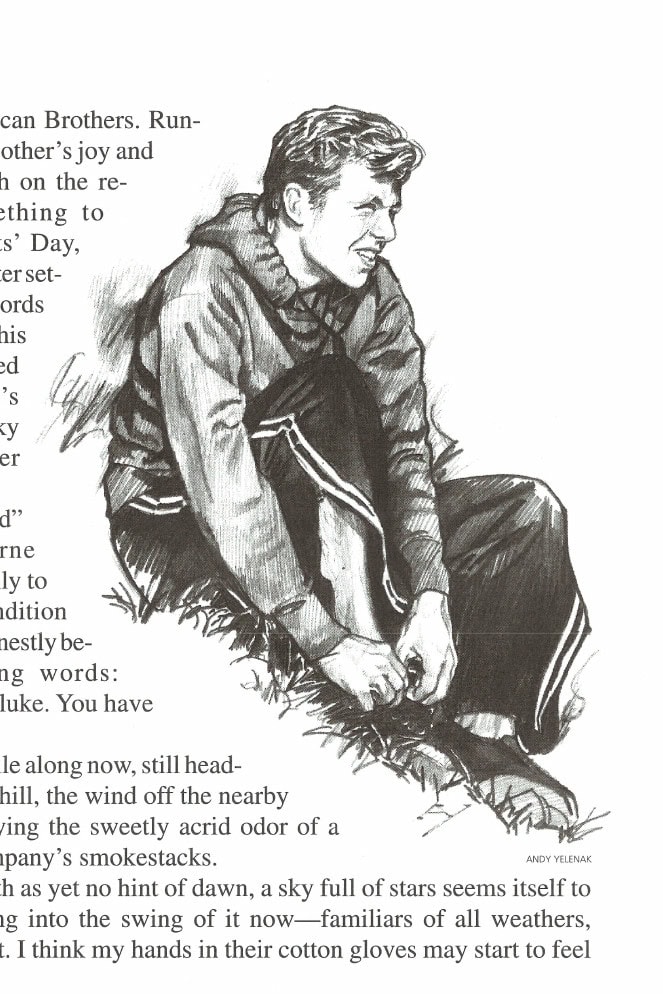
We’re about a mile along now, still heading south and downhill, the wind off the nearby Thames River carrying the sweetly acrid odor of a pharmaceutical company’s smokestacks.
At 5:45 A.M., with as yet no hint of dawn, a sky full of stars seems itself to shiver. We’re getting into the swing of it now—familiars of all weathers, brothers of the night. I think my hands in their cotton gloves may start to feel toasty soon.
“Are your shoelaces frozen?” George asks.
“Think so.”
“I forgot to wear socks,” he says.
“Jee-eez!”
“Ahh, you kind of get used to it.”
Yes, we’re doing okay, seeing better than usual because of the snow glow, taking the drifts exuberantly.
“Two laps is all, today,” George pronounces. “We’re lucky to do 25 minutes a lap in this stuff.”
“Hey, George,” I tack. “Exactly what the hell are we doing?”
“Training, lad. To win Boston,” he says, as if there were no other possible answer.
“All right,” I say. “But let’s, for argument’s sake, say we crap out.”
“Then, we crap out” says George. “People’ll feel sorry for us for a couple of days because we were so nutty and then move on and forget it.”
A hundred yards later he adds, “We both have that good one waiting. You have to believe it. One of us can win this year.”
“Okay. What about the other one?”
“He can win the next year,” George says, with the Don’t-you-see? tone of one spelling the obvious out for a kid.
At the golf course’s southern boundary we execute a 90-degree turn eastward. The cruel wind at once transforms itself into a giant’s assisting palm at our backs. I fix on a point just above the horizon to see Venus, morning star of ancient mariners, casting her serene and reassuring light.
GOOD FRIDAY, 1957
Supper at Laura Harlow’s home on the Watertown-Belmont, Massachusetts, town line is a private affair. The supper hour spells relief from the day’s busyness for Laura, who is a Kendall Company department manager; and for her fiancé, 49-year-old Johnny A. Kelley, a Boston Edison Company maintenance worker. The Boston Edison Company never before employed such a maintenance man. It’s a safe bet they never will again. Johnny won the 1935 and 1945 Boston Marathons. After his work day is done, he quite literally lives to run.
Road racing, that athletic hybrid that flourishes in New England’s cranky climate, has brought Johnny a share of fame in his city, if no commensurate amount of money. He is so adulated that were he to signal his wish to be mayor, the office would be his. But why bother? Racing on Boston’s streets, he can have his cake and eat it, too. Still, a life on the run must have its refuge.
Last marathon eve, the once-widowed, once-divorced “king” of the road took in a movie. As his eyes adjusted to the dark, he found them straying to the attractive woman a couple of seats away.
It was one of those storied romantic coincidences. Laura Harlow had been Johnny A. Kelley’s Arlington High School classmate some 30 years before.
So at supper tonight, Good Friday, April 19, 1957, in Laura Harlow’s mother’s home, conversation naturally turns to Johnny and Laura’s forthcoming marriage.
“Circle the date, kid,” Johnny instructs me.
Laura brings in the main course. Her frail, smiling mother gets first serving. The chiseled-featured king sets our dinner conversation pace. Johnny’s a master psychologist when it comes to diverting an edgy marathoner’s thoughts from the impending agony.
“Let me tell ya about Tarzan [Ellison Brown]. Everybody loved the guy. They said few bad words about him. The worst was that he never trained or ate right, and of course that he was a hellion. He was that, for sure, but the first two were at least part baloney. Tarz was a smart cookie. And he was loaded with talent. He might have been the greatest of us all, but he had some bad luck. Those hernias finished his racing.”
Seeing me getting antsy, he drops the running-related stories.
“Enough of this stuff, kid. How’s teaching?”
“Thank God, I’ve had this whole week off.”
Johnny knows too well the dubious honor of being the marathon’s favored son. In fact, last April 19, the day of my fast run, he dropped out for only the third time in his career. Johnny, too, is looking to prove he was the victim of a fluke.
“John,” I say, “did you ever read Walden?”
He scratches his head doubtfully. “The fellow who lived out there in the Concord woods?”
“Yes! The pond he lived beside is Walden Pond. Anyway, I’ve been reading the book this week.”
Laura has returned with dessert. Johnny’s eyes follow her dotingly, then dart back to me. “Is the book good, kid?”
“Well, you know, it’s a revelation,” I say. “It’s like a tonic for pressured lives. I’m toting it around like a good-luck charm these days.”
“Good, kid, good!” Johnny assents emphatically.
As we dig into our dessert, the hallway phone jangles. “What the heck!” Johnny exclaims. He has given his reporter brother the word: keep “those guys” from disturbing us tonight.
“No, no, he isn’t,” he rebuffs the caller, adding, “But even if he was, I wouldn’t tell you. Don’t call again, pal.”
Back, he says, “Kid, someday you’ll realize that the worst combination in this world is ignorance and arrogance.”
Laura tells Jessie, “When you’re ready for bed, it’s right in there. Why don’t you take a look and tell me if there’s anything you need.”
The clock strikes nine.
“Kid,” Johnny suggests, “if you think you’d like to take a little stretch on the golf course, just out our back door, I’ll tap on your door about six, okay?”
“Oh sure, John, that’ll be great.”
For a tingly 10 seconds, Finnish marathon champ Veikko Karvonen’s grim countenance flickers in my brain. It mercifully vanishes as I see Jessie moving toward the room which, for the next eight hours, at least, holds about the same promise of escape as that famous hut in the woods held for the author of Walden.
“12 noon: BAA Marathon: won by 2 minutes, 45 seconds over Karvonen. Ran easily behind group of 8 to 10 until Natick, then accelerated pace with Lin (Korea) and Karvonen until the Route 128 overpass (16 miles), pushed pace to build up 1 minute, 40 second lead by BC. Felt good, straining at finish. Weather fair and warm (71 degrees, fresh SW wind).”—Kelley running diary entry.
Easter Saturday 1957 breaks clear and early over Boston. Birds chirp in the burgeoning box hedge outside the room where my wife still sleeps. Popping awake with the nervous athlete’s surprised realization of having slept, I focus new eyes on my surroundings.
On the bedside table, I see my Modern Library edition of Walden open at the page where sleep overtook me. I pick it up once more and resume reading: “What youthful philosophers and experimentalists we are! There is not one of my readers who has yet lived a whole human life. These may be but the spring months in the life of the race.”
I drift off to sleep again, only to be awakened for good by the promised knock, followed by the ever-eager voice asking, “Up and ready, kid?”
Minutes later, shaved, brushed, and with PJs traded for a warm-up suit, I’m trotting beside my namesake around Belmont golf course’s manicured perimeter. Like myself, and, I suspect, most of our breed, Johnny draws much from his running days’ ingrained rituals. “His” Belmont golf course, like the Shennecossett course in Groton for George and me, has assumed a centrality in his patterned marathoner’s life.
“It’s not that we need to run at all this morning,” he says, as we commence the panoramic downsweep from the clubhouse heights. “It’s just something I like to do to start my day—kinda sets me up, ya know?”
“Of course, Johnny.”
Johnny flashes that canny pol’s smile and wink.
The sun is well up as we close on Laura’s backyard. Robins dart everywhere, vying for the early worm. Early bird golfers, too. Recognizing Belmont’s most famous interloper, they shout, “Go gettum today, Johnny!”
The famous interloper answers, “Hey, don’t forget my ‘son,’ here!”
“Sure! You go gettum, too, Johnny J!” they shout.
At 9:25 A.M., Laura pulls Johnny’s car to a halt at the Hopkinton State Forest signpost.
Johnny gingerly probes the contents of his gym bag and comes up with a honeybear jar and two spoons. The honey ritual observed, we have ignition again, and now there’s no turning back.
With two and a half hours to tick until high noon, the tummy butterflies are already off their marks.
Laura drives across the race’s new starting line, 1,180 yards west of the old one. Johnny nudges me. “What d’ya think the longer course will do?” he asks, softly and kind of scared.
“Don’t know. Not much, I hope,” I answer, softly and kind of scared.
The quaint suburb is rapidly filling with its horde of fly-by-day visitors. According to this morning’s Globe’s Marathon Edition, the race field has closed at 140.
“That’s not a big field, is it, kid?” Johnny asks, though he knows the answer to his question. “I can remember times in the ’30s when there were over 300.”
“I’d settle for 150 more Americans for the subtraction of 15 foreigners,” I say.
Colonial dames and militiamen mix with tonic and hotdog vendors and the runners’ retinues on Hopkinton Green. In the near distance, a cannon explodes.
When starter Walter Brown finally delivers his own blast using a sawed-off shotgun, I depart Hopkinton with the strange, buoyant feeling that I’m leaving the right place at the right time and racing toward the same. A good night’s sleep on the heels of seven good nights’ sleep in the course of a perfectly timed April school vacation; a wife attuned to my purpose; a good adviser and physiologist, Johnny “Jock” Semple, to smooth out the kinks yesterday and shout encouragement from the press bus today; friends like Johnny and Laura; a happily discovered book . . . such are my sustainments as I stride into the 61st Boston Marathon.
And certainly I can’t forget my “Corsican Brother,” George, running not quite effortlessly beside me, himself sustained by the grit of Yankee ancestors and determined to beat the devil out of his ’56 undoing.
The weather as we set out seems ideal, temperatures inching upward into the 60s, wind freshening out of the west, cumulus clouds slowly building. Our dozen-member lead-pack featherfoots through Ashland. Three miles in, Jock pokes his head from the pausing press bus’s window and bellows, “Ow’re ye feelin’?”
“So far GREAT, Jock! Wow!”
“I’ll keep up on ye!” he promises.
I turn my attention to the grimly concentrated faces around me. Except for George and our New York Pioneer buddy, Rudy Mendez, the fellows are the cream of today’s 15-strong foreign crop. The good news is there’s no need to waste breath on pleasantries. So, on I run, wrapped in my cocoon of unswayable purpose.
At Natick, I accept the first of three orange quarters.
We’re five minutes past the 10-mile checkpoint when George grabs his right thigh, grimaces, and wishes me luck.
Two miles more, and the muscular Mendez tips off his demise by asking me how much longer I can keep “this pace.”
“Fifteen miles, if I have to,” I tell him truthfully.
Then he, too, is gone, leaving me racing in tandem with the smooth-striding Korean, Lin. The BAA’s 1954 champion, Veikko Karvonen, covers us like Marley’s ghost, 10 yards in arrears. In the way of the Finns, Karvonen underscores his presence by frequent throat clearings and snortings.
Mindful of the quadriceps-numbing drop into Newton Lower Falls, followed by the sapping climb out toward the Route 128 overpass, I trail Lin on the descent—down, down, to the course’s lowest elevation before the Back Bay finish line.
The stratagem apparently works. Lin fades as we begin our ascent.
But there’s no rest for the wicked. Lin is immediately replaced by the implacable Finn. How could I forget that it was at this very spot that Karvonen broke Britain’s Jim Peters three years ago?
My nemesis turns up the heat as he puts Route 128’s buzzing traffic canyon behind us. For an instant I read his move as the handwriting of doom. However, studying his sunburned neck, I begin to think he’s sweating too heavily, given our so-far moderate pace. I wonder if, on a gamble, I might even play Veikko Karvonen to his Jim Peters of 1954.
I also remember how I lost out to Karvonen’s countryman, Antti Viskari, last year, after a race of attrition. I decide on the gamble.
We have reached Newton-Wellesley Hospital. I jack the pace up by 10 seconds a mile.
Surprisingly, Karvonen doesn’t respond. If he’s hatching some strategy of his own, I can’t second guess it. I’ve made my critical move.
The crowd roars its approval. I’m alone in my race at last. Turning sharp right onto Commonwealth Avenue, Newton, driven now by the thought that I must win, I make a silent prayer to Saint Mary. I run regardless of the dreaded Newton Hills, crest Heartbreak Hill three miles later in mind’s-eye sight of victory.
After Boston College, pandemonium reigns. Huge crowds have turned out on this double holiday. Flags of many nations flutter along the line.
“Ye’re two minutes up on ‘im! There’s nobody near ye!” Jock blares his final apoplectic posting as I emerge from Brookline’s “mysterious mile” and head down past Chestnut Hill toward Beacon Street.
Kenmore Square. Twenty-five miles. The jubilant crowd, informed by radio and television of an impending American win, pulls out all the stops. For this unrepeatable instant, I long to slow the pace, to savor the moment.
But I know I have to push on, through the jubilation, past the last remnant of self-doubt.
Massachusetts Avenue crossing. Twenty-five-and-a-half miles. The legs that have performed like flawless pistons to this point suddenly stiffen. Fear floods over me. Will the prize so close at hand be snatched away?
I must continue. Five minutes more. Three minutes. Two.
On Exeter Street, magnetized by the great crowd’s welcoming roar, I raise my right hand cupping the gold watch, which reads 2:20.
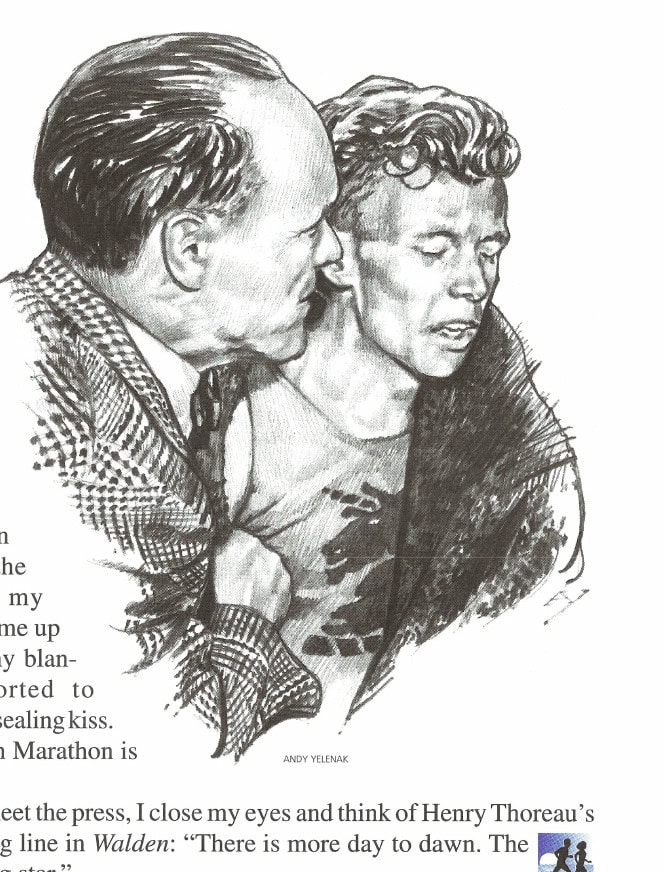
The BAA’s blue and gold finish line ribbon snaps. Mayor John B. Hynes places the laurel wreath on my head. Jock sweeps me up in his scratchy army blanket. Jessie, escorted to curbside, plants the sealing kiss.
The 61st Boston Marathon is history.
On my way to meet the press, I close my eyes and think of Henry Thoreau’s triumphant finishing line in Walden: “There is more day to dawn. The sun is but a morning star.”
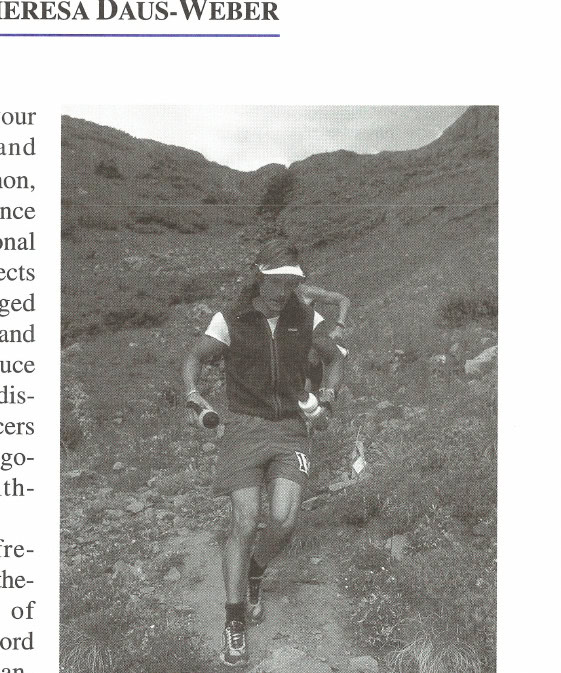
To get the most out of your marathon training and money, consider a trail marathon, an entirely different experience and culture than the traditional road marathon. Although aspects of trail courses such as rugged surfaces, elevation variation, and water crossings typically produce slower times than the same distance on a flat road course, racers are both challenged and invigorated by these running-with-nature elements.
Trail marathoners are frequently rewarded with top-of-the-world views and a sense of achievement that gives the word “demanding” a whole new meaning. On top of this, there’s the draw of the far-from-the-maddening-crowds aspect: smaller fields, out-of-the-way venues, camaraderie, and a psychological and physical high.
And drawn they are. The largest trail marathon in the United
This article originally appeared in Marathon & Beyond, Vol. 5, No. 2 (2001).
← Browse the full M&B ArchiveMore like this
1,000+ stories from 19 years of Marathon & Beyond
The complete archive of the legendary long-distance journal — digitized and free to read.
