

Pikes Peak and Bust
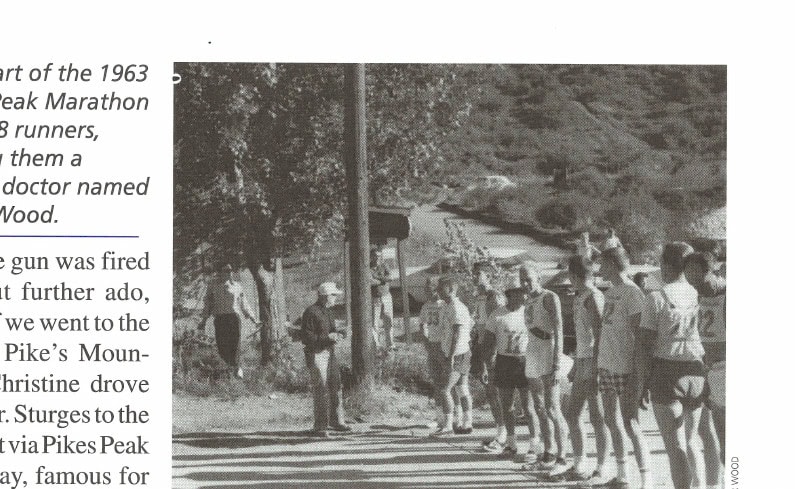
The gun was fired without further ado, and off we went to the top of Pike’s Mountain. Christine drove with Dr. Sturges to the summit via Pikes Peak Highway, famous for its annual car race.
My recollection is that the trail was good and not quite as steep as I had expected for the first hour or so of running, up to Barr Camp. I fell into conversation with a runner whose pace was similar to mine and learned that he was one of the Englishmen, John Grundy from Wakefield in Yorkshire. He had finished second a year or so before in a 1,000-mile race in Britain, from John o’Groats to Land’s End. I recalled that this event received much media attention in Britain, not least because of the participation of a woman—remarkable enough in itself—who claimed to have run the race subsisting only on water and . . . grass!
I was most impressed by John’s credentials and flattered to keep up with him. He also said that he, Geoffrey Garnett (a fellow Yorkshireman), and Bob Mohler (defending Pikes Peak Marathon champion) had all been training on the mountain at altitude for some months, working with a Cog Railway maintenance gang. He warned me of the substantial effects of altitude above 12,000 feet, now some 2,000 feet above us. My concern about the impending altitude was beginning to be compounded by worries about dehydration. I greatly wished I had some water with me. I had not stopped at any of the few creeks I’d noticed early in the race, and now that I would gladly have clambered down from the trail for water, the creeks had disappeared. The sun blazed down, and with less and less tree shade, sweat evaporated rapidly into the thin air, and I was hot and thirsty.
I recall few landmarks on the trail from my first ascent of Pikes Peak, but the “A-frame” and the notorious 16 “Golden Stairs” leading to the summit stick in my memory. John Grundy and I arrived at the A-frame at 11,800 feet (the 10.2-mile mark) in fair shape, with just over three miles to go. The trail became steeper and rockier. I dogged John’s footsteps and gritted my teeth as we started up switchbacks of the Golden Stairs. We could see the summit above at times, looking only a stone’s throw away.
I was now well above my “altitude record” of about 11,000 feet (in Switzerland) and so was not surprised at increasing fatigue, nausea, and dizziness. In spite of his extended training at altitude, John did not seem to be doing much better. We traded rest periods of a minute or so every few hundred yards when we could find a rock on which to sit, pant hard, close our eyes to alleviate the dizziness that was becoming dangerous over the rough terrain, and to consider throwing up.
HIGH AND DRY
To the extent that I could think about anything other than making it to the top as soon as possible, I recall that I attributed all my nasty symptoms entirely to altitude. They were worse than I could have imagined. How did mountaineers ever climb Everest?
With excruciating discomfort, we slowly counted off the yards to the summit. I finally tottered up the last few rocky steps to find Christine with Dr. Sturges and a few race supporters. As it turned out, my ascent time was a disappointing 3:23 for the “half-marathon.” I guess John must have sat on rocks a few less times than I did, as he’d arrived in 3:21.
I could do nothing at the top but lie on the ground, oblivious to everything. After perhaps 15 minutes I managed to get up and was urged by the bystanders to “Get on down” and not lose further time. I was never more certain of anything in my life that this would be physiologically impossible and extremely dangerous.
And so I dropped out of a marathon race for the first (and, to date, last) time in my running career. (Did I ever tell you the story of how I completed the Boston Marathon in over six hours with a raging flu, throwing up at regular intervals? Perhaps another day.) John was made of sterner stuff and turned around promptly to finish the race, as befits a 1,000-mile competitor. I never saw him again.
My wife and Dr. Sturges were justifiably concerned about my condition. At the top of Pikes Peak is a large, flat area with a parking lot, the upper Cog Railway Terminal, and a gift store with a cafeteria. I found a water fountain in the cafe, sat down beside it with a paper cup and drank . . . and drank and drank. Now I could dimly discern that most of my condition was due to dehydration. Dehydration and altitude are a very bad combination. After about an hour I felt a little better, and we drove down the highway to our motel, and to a kinder, gentler altitude.
Later I learned that John Rose won the marathon in a new record time of 4:01:23 (ascent: 2:31); Geoffrey Garnett, the third Englishman, was second in 4:09:05; my ascent companion, John Grundy, was ninth in 5:13; and Rudy Fahl, at 65, was 17th in 7:19.
Three women completed the ascent, but I don’t recall seeing them at the starting line. One was Mrs. Katherine Fahl, in 6:13.
I wasn’t much good for anything for two days, when we had to catch the plane back to San Francisco. I suffered from headaches for the next month after the ascent, but otherwise I had no aftereffects. I was lucky. I had renewed respect for the dangers of altitude and dehydration.
FORWARD TO THE PAST
How should I rate one failed attempt at the Pikes Peak Marathon in comparison with 14 successful Bostons or eight successful New Yorks? And what do I say if asked which of my 100+ marathons I remember most vividly at age 70? I suppose I would recall especially my first marathon, in Melbourne; my fastest marathon, in the Pacific Association Championships, in Marin; my 35th place in Boston; and, perhaps, the only “marathon” I ever won (actually, a 33-miler from San Francisco to Stanford, with only two runners).
But in any listing I would have to include my first Pikes Peak ascent because the circumstances of my running it were so unusual, the terrain so remarkable, and the run, well, so pathological!
I never considered the possibility of challenging this mountain again after 1963, although I did do some regular mountain climbing in the United States and Mexico.
But then, in 1999, an opportunity arose. I have a very long connection with the Fifty-Plus Fitness Association (formerly the Fifty-Plus Runners Association, founded by the late Ibrohim Clark), and I was the first president of this national organization, based in Palo Alto, California. A small group of endurance runners from the association have been in the habit of traveling to selected long-distance running events and training together prior to the race. In 1997 I had run the London Marathon (my “hometown” marathon) with Walter Bortz, Sr., MD, and Karin Bivens. Now the plan was to tackle the Pikes Peak Ascent Race, to be held on August 21, 1999—four days before my 70th birthday. The running group included Ruth Anne Bortz (distinguished ultrarunner and board member of Fifty-Plus), Joyce Hanna (immediate past president), Karin Bivens (committee member), James Fries, MD (consultant to Fifty-Plus), and me. We were joined for the race by David Bauer and Robert Warner (Colorado residents and Fifty-Plus Ambassadors). Walter Bortz acted as our honorary team manager.
In spite of busy schedules, we managed some training before the race, running mostly on the steepest trails we could find within 10 miles of Palo Alto. It was impossible to run above 4,000 feet, so short of going out well ahead of time to Colorado to train on the Pikes Peak trail (which none of us could do), we had to accept not being altitude acclimated or trained.
Several of us had transitory minor injuries in training. And there were a number of falls, though none were serious. I was a major contributor to the tally of falls, registering three in training. These may have had something to do with my incipient senility, but I do have another explanation, which amounts to not looking where I was planting my feet. In any event, in exchange for putting my teeth through my lower lip twice, I finally learned that I must “watch my step” on the big mountain.
OFF TO MANITOU SPRINGS
After some discussion of the best way to get some altitude acclimation in a short time, most of us traveled to our motel at Manitou Springs (6,300 feet) about two days before ascent day. This small mountain town is very pleasant and exuded great enthusiasm for the coming races: banners, posters, television coverage, and runners on the streets everywhere. Quite a contrast to my accidental discovery of this obscure event in 1963.
We stayed at Wheeler House, a nice motel run by two charming people, Penny and Edd Bever. We were very close to the beginning of the Pikes Peak Highway, the lower terminus of the Cog Railway, and to Memorial Park, the center of activities and the start of the Pikes Peak Ascent (Saturday) and the Marathon (Sunday). Over 1,700 runners were entered in the ascent (one third were women), and 800 in the marathon.
There were numerous prerace events. I attended an outdoor party given by the Peak Busters, an exuberant group of experienced women runners who specialize in mountain running, including Annabel Marsh, noted trans-America runner. The Fifty-Plus Fitness group enjoyed a great barbecue at the home of Bud and Emily Warner, Fifty-Plus Ambassadors. I also went to the official prerace Pikes Peak spaghetti dinner, which was very well-attended.
One morning I took the Cog Railway to the mountain’s summit. The rail cars were crowded with runners and other visitors. I was seated among a group of Midwest farmers for the one-hour ride up the mountain and also for the return trip. I learned more about the trials and tribulations of farming in Iowa than I needed to know. The farmers asked me where I came from and what I was doing in Manitou Springs. When I replied, “I come from Stanford, California, and I plan to run up this mountain tomorrow,” the conversation quickly and permanently returned to hogs, corn, and bureaucracy.
Peter returns to the summit of Pikes Peak the day before the race via the Cog Railway.
The summit’s air was clear and cool. I felt no effects from the altitude. I jogged and scrambled a few hundred yards down the trail and was immediately reminded by the steepness of the very rocky path of the miserable last few miles of my 1963 ascent.
I was also reminded one evening of a possible hazard of Pikes Peak running: sudden hailstorms. About 6:00 P.M. the sky darkened, clouds rolled in, dramatic thunder echoed between the mountains, and hail fell furiously for an hour. The race booklet, sent to all entrants, warns of the unpredictability of weather on Pikes Peak and advises carrying at least a hat and windbreaker as protection should a sudden hailstorm hit during the race. The probability of hail is low on an August morning but increases as the day wears on.
These sudden storms are quite ferocious, and one can only imagine being caught unprotected on the exposed, treeless upper flanks of Pikes Peak. Perhaps Zebulon Pike had this experience. I stuffed a windbreaker into my fanny pack, together with a water bottle and some energy bars.
READY TO RUN
The Saturday morning of the ascent race, August 21, was clear and cool. The runners had been assigned to one of two waves, starting at 7:00 and 7:30 A.M. I was in the second wave. We were all aware of published cutoff times at two points along the trail, which we understood would be enforced. One reason for this was to keep very slow runners off the exposed, upper part of the mountain in the afternoon, when the probability of hailstorms and snow was increased.
For my 7:30 start, I would need to reach Barr Camp by 10:45, and the A-frame, an alpine structure off the trail at the timberline, by noon. Otherwise, I would suffer the indignity of being turned away and never seeing the summit. So with that daunting thought, my warm summit clothing and a cellular phone (to notify the world of my success) went into my sweatbag to be driven to the top.
The race started under the banner on Manitou Avenue, at 6,295 feet. The first half mile was on roads, up to the Cog Railway terminus (from which the 1963 race started), and these roads are quite steep. I and quite a few others were reduced to walking briefly already! In fact, I think I felt more pessimistic about the whole undertaking at this early stage than at any other point in the race, and I was seriously concerned about those cutoff times. But the trail flattened out somewhat for the next few miles and running felt much better.
The early going, past the first water station and up to the junction with the Barr Trail (1.7 miles; 6,800 feet), which was to take us to the summit, was remarkable to me for the sheer number of runners jamming the trail and, particularly, for the number of women of all ages. From this point on in 1963, I hardly saw another runner, apart from my running partner, John Grundy, and I never saw any women at any time.
The trail wound through lush forest, past the second water station, up The Incline on Mount Manitou to French Creek and the third water station (4.3 miles; 8,800 feet). With all this water, dehydration was the least of my worries this time. I was entirely concentrating on getting to Barr Camp by the 10:45 cutoff.
There were some downhill sections on this part of the trail, which I really enjoyed, but I knew there would be no more downhill sections from this point to the top.
I ran along quite well, passing many slower runners (most of whom passed me later), and was
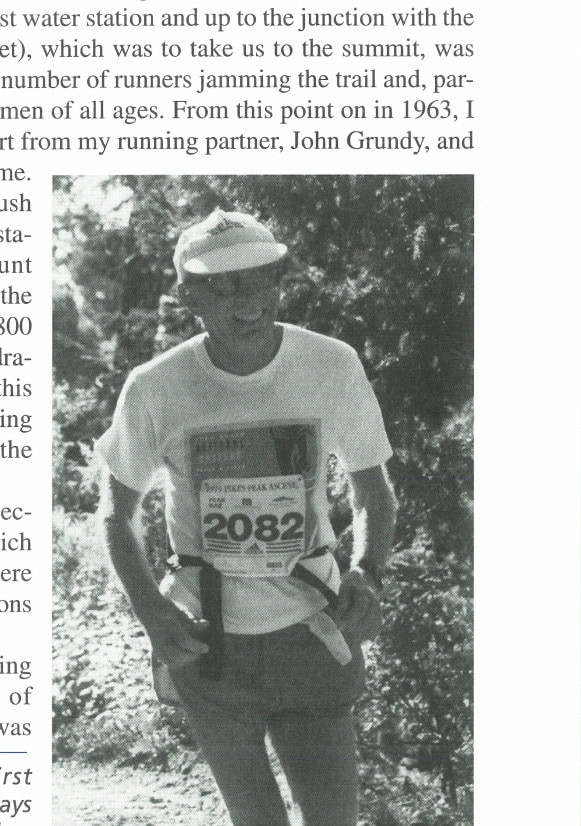
pleased to get to Barr Camp (7.6 miles; 10,200 feet) with 30 minutes to spare before the deadline. We were past halfway, but the tough part was about to begin. The next objective was the A-frame near the fifth water station (10.4 miles; 11,800 feet). This stretch was taxing for me, with the cut-off time at the back of my mind all the way. I doubt that I could have covered the distance any faster, although I was now walking on some steep parts, as were many of my fellow runners. It was with considerable relief that I arrived at the A-frame with only 10 minutes to spare. Now I was bound for the summit, come what may!
LAST CALL FOR WATER
The next section took us up to the Cirque (“a steep-walled mountain basin”) and the sixth and last water station before the summit. We toiled across a barren, rocky wasteland along a steep trail. I jogged a few sections, but most of the time a fast walk, with much scrambling over boulders, was all I could manage. Looking off to the side, if you dared to take your eyes off your feet, you could see down some 1,500 feet to the depths of the Cirque.
The first of the three signs appeared announcing three, two, and finally one mile to the summit. We arrived at the first of the 16 Golden Stairs, with their seemingly endless switchbacks. Now and then we could look up and catch a glimpse of the summit, periodically enshrouded in cloud, and we could faintly hear snatches of amplified music (could that be the theme from Rocky?) drifting down to us, giving us hope that there really was life up there.
At this point the oxygen shortage began to register. For me, the limiting factor was severe fatigue of my leg muscles as well as the familiar shortness of breath. On this ascent, unlike 1963, I did not experience dizziness, disorientation, or nausea, for which I was most grateful. This contrast, particularly since I was 36 years older, emphasized to me the enormous importance of adequate water for this type of racing.
I’m sure the problem of providing water at multiple points on the trail, even with only 28 runners, seemed insurmountable in 1963, but I’m also sure its absence presented a substantial hazard to the competitors. These days, so I understand, water is conveyed to the less accessible water stations (for some 2,600 runners over the two days) by ingenious means, including running water from the summit (supplied by road) through long, flexible tubes, down to the stations. Clearly, a difficult operation, but truly lifesaving.
I suppose the elite runners in these races run every step of the way up and (for the marathon) back down. Of course, I have never witnessed this feat. At my end of the now very strung-out field, over the last miles, everyone was walking, some almost in lockstep, as automatons, or resting! Although I was nothing like as far gone as I was 36 years ago, I was still obliged to rest on a rock, however uncomfortable, every so often. While resting, I could see walking “runners” stretched out below me and also above me walking-resting-walking.
Over the last half mile my walks were down to a hundred paces (counted out) and my rests up to a minute. I was distressed at the way time was ticking away, and I hoped that I would make the summit in time to be officially recorded and timed. As I pushed slowly upward, the summit seemed very close and sounds quite audible. I began to wonder how my Fifty-Plus Fitness group had fared. I had glimpsed only one member since the start. Most of all I was filled with the pleasurable certainty that I would finish.
When I did finally reach the Promised Land in 6:07:41, there was no crowd, no teammates, no music, apparently no officials (although some kind person did record my arrival and time). Curiously, I recall a more rousing welcome at the top in 1963, but then I was one of only 28 runners. It was decidedly chilly once I stopped climbing, and the summit was in cloud.
But I felt pretty good—so much better than last time. But where were the 1,000+ runners who must have finished during the hours before me? There were a few in the store/cafe, but understandably the vast majority had left in the fleet of vans provided to take us back to the warmer clime and thicker air below.
NO CONTACT WITH THE OUTSIDE WORLD
I retrieved my gear from the sweat check, donned my sweats, bought a cup of coffee and a T-shirt, and then sat down at the highest point I could find with my cell phone to inform the world of my arrival. But horrors! The battery was dead. So the world would have to wait.
And so we went into the van and back to Wheeler House. A dinner had been arranged for the Fifty-Plus Fitness group at the U.S. Air Force Academy in Colorado Springs, which didn’t leave me much time to rest before getting ready for this most pleasant and relaxing event. I was anxious not to miss it, as I had served in the Royal Air Force myself many years before. This was also a good opportunity to catch up with the fortunes of my teammates.
Joyce Hanna, my frequent training partner, had excelled herself with an outstanding first place in the F60-64 year group, with Ruth Anne Bortz third in F65-69. Dave Bauer was fourth in the M60-64 group. I consoled myself that I would have been fourth in the M70-74 group had I been four days older! And everyone made it to the top in time to be recorded: David Bauer, 4:01:06; Joyce Hanna, 4:37:05; Ruth Anne Bortz, 5:17:31; Karin Bivens, 5:28:47; Robert Warner, 5:42:21; Peter Wood, 6:07:41; James Fries, 6:16:07.
On the plane home the next day I craned my neck to catch a last glimpse of Pikes Peak, on which the full marathon was now being run. I ruminated for a while on the events of the past two days: how well our entire group of seven had
I T’S 6:15 on a hot summer night at the outdoor track at Harvard University, and I’m getting my butt kicked by a 60-year-old.
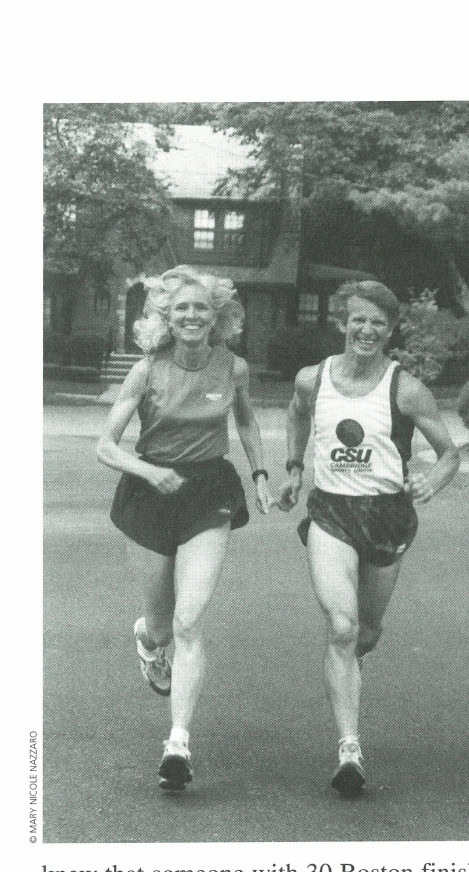
Even though I’m a turtle by birthright, it’s only a small consolation knowing that this particular 60-year-old once kicked a way-more-famous butt than mine: that of none other than Johnny A. Kelley, Boston Marathon legend, in the 1970 race. This guy Martin Duffy, my track coach and local Boston running guru, doesn’t like being beaten by anybody, even if Kelley was 61 to Martin’s sprightly 30 back in 1970. My turtle legs don’t stand a chance against Duffy. Fortunately, they don’t have to.
While I labor through another set of 200-meter repeats, Martin, a businessman by trade and a 31-time (yes, you read that right: 31-time) Boston Marathon finisher, scoots past me with the effortless form of a truly gifted runner. In my less kind moments—like when I’m huffing through another track repeat—I want to kill him. But since he’s my coach, and since I’m training for the 2000 Chicago Marathon under his tutelage, and I’d actually like to finish without wanting to amputate my legs this year, pure envy will have to do.
THE JOURNEY BEGINS
About a year and a half ago, Ted Hammett, one of the regular attendees at my weight-training class at the Original Mike’s Gym in Cambridge, Massachusetts, told me he was trying to interest the Boston Globe in doing a profile of a friend of his who was running his 30th consecutive Boston Marathon. He had my attention right there. The friend turned out to be Martin Duffy. Ted had a typed bio and a list of finishing times (fastest: 2:40:54 back in 1975) to show me, but unfortunately the Globe writer never got back to him. Evidently, Ted
hadn’t made the Globe’s deadlines for suggestions of Boston Marathon articles for that year, and the story went unreported on Martin’s 30th anniversary. (The Globe did get its act together in 2000 and featured Martin as one of their “Faces in the Crowd” in their annual marathon feature on race weekend.)
I asked Ted more about Martin and learned that he and his wife, Rusty Stieff, were both members of the gym and that Ted had run several Bostons with Martin back in the early days, when they were burning up the track together. I’m not sure if it was Ted or Martin who told me about the Wednesday evening workouts at the Harvard track. I just knew that someone with 30 Boston finishes to his name—consecutively, no dropouts ever—had to know a little something about how to train for my favorite distance.
A few weeks later, there I was on the track at Harvard with Martin and Rusty, who just happened to be a 1984 U.S. Olympic Marathon Trials qualifier with a lifetime marathon best of 2:51:12. My marathon PR at the time? A cool 4:20:24. Tortoise, meet hares. This was going to be one long summer.
RUNNING LONG AND RUNNING SMART
“It takes three years of consistent training—including speedwork—for you to begin to see what your potential as a runner can be,” Martin said to me early that summer at the track. I hadn’t done a whole lot of speedwork before hooking up with Martin and his crew. I’d dabbled a little with speed and even showed up for a track club workout or two a few years back, when I was considering joining a training group.
But as the slowest, or one thereof, in just about every group I joined, I felt pressured to either perform way above my head or accept not being taken seriously by the group’s coach. I knew I was a marathoner: I’d been a Boston Bandit in 1993 in my senior year in college, and I’d eked out two more races in the ensuing years—a long, painful Philadelphia Marathon in 1997, when a long-term relationship was ending, and a much happier Marine Corps Marathon in 1998, the year I discovered weight training and knocked 21 minutes off my PR in one fell swoop.
But I still couldn’t find a coach who treated me as though I was a “real runner.” It’s not that I couldn’t do a set of 800-meter repeats—I just couldn’t keep up with the women who did them in three minutes flat. And in the Boston running club scene at that time—at least the part of it I’d tried out so far—there didn’t seem to be much of a middle ground. You were either a speed demon or a turtle for life.
That first night with Martin and Rusty, I knew this training experience was going to be different. I was a runner, and so were they. That was good enough for them. Suddenly I didn’t feel like I had to recite my race times sheepishly; I just got to run and was able to set goals—and meet them—from that first night onward.
Martin’s group workouts are a blast, partly because Martin understands what it’s like to be “the slow one” in the group. I have no idea how he ever came to that understanding, given his DNA, but that’s the mark of a great coach. He knows I will try too hard to keep up with the clan—so he sets it up so that I don’t have to.
“Each person will take a repeat,” he explained that first time out. “Whoever starts the repeat finishes first. So if you think you’re faster than the leader of that repeat, you can’t start when the leader starts. You have to wait until you know enough time has elapsed so that you can run your own workout without interfering with the leader.”
We started with a mile easy, four laps around, talking easily, laughing about the week’s follies in the areas of family or career. No problem there. Then, two 200-meter repeats with 200 meters of rest in between.
The first 200 of the day is the slowest, Martin reminds us. “It all goes down from here!” he laughed in his trademark good-hearted, Zen-master-esque way. We ran the first 200 and stopped our watches. Each of us reported our times to Martin, and he said, “Okay. Now on this next repeat, run 1/10th of a second faster!”
That was enough improvement for Martin.
Just from that bit of coaching, I realized he wasn’t looking for Olympic-level times. He was going to teach incremental improvement and smart training, things I’d never experienced before. He was going to take me seriously, and
This article originally appeared in Marathon & Beyond, Vol. 5, No. 2 (2001).
← Browse the full M&B ArchiveMore like this
1,000+ stories from 19 years of Marathon & Beyond
The complete archive of the legendary long-distance journal — digitized and free to read.
