

The Pheidippides Legend: The Marathon
THE WORD “marathon” did not appear in English language dictionaries prior to the mid-1890s. Today it refers to a footrace run on a predetermined course—typically 42,195 meters (42.195 kilometers), or 26 miles, 385 yards in length—or to some other event or activity of great duration. Thus, there are “marathon sessions of Parliament or Congress” that extend for many hours. And there is the “Comrades Marathon,” a South African footrace of roughly 90 kilometers (56 miles) between Durban and Pietermaritzburg. A little thought brings to mind many other examples of ways the word is used. The word comes from the name of a village in Greece, roughly 40 kilometers northeast of Athens, known for an important ancient battle.
THE LEGEND OF PHEIDIPPIDES (PHILIPPIDES)
Herodotus tells us that King Darius of Persia landed a force of 20,000 men onshore near Marathon, planning to conquer the Greeks and punish them for helping the Ionians (who lived in western Asia Minor) revolt against Darius’s rule. The Greeks were under the direction of a very competent general, Miltiades, but being outnumbered nearly two to one, they needed reinforcements. Cornelius Nepos, a Roman historian and biographer in the first century BC, reported that “the Athenians, distressed by this war so near and so great, in their own land, sought aid nowhere other than from the Lacedaemonians (Spartans) and sent Phidippidus, a runner of that class known as hemerodromoi, to report how urgent was the need of aid.” The hemerodromoi were trained distance runners.
A later source (Solinus) gave the distance from Athens to Sparta as 1,240 stades. A stade was the length of a stadium, which in cities such as Athens and Olympia was 185 meters (607 feet), which translates today to a distance of 229 kilometers. On today’s highways, the distance from Athens to Sparta is a similar 245 kilometers. Ancient evidence leans toward the name Philippides for this runner, but there is some manuscript evidence for Pheidippides as well. It is not clear from Herodotus whether it was an entirely different runner who traveled from Marathon to Athens to announce that soldiers from Sparta were needed or whether this same runner, after arriving and conferring with authorities, continued on from Athens to Sparta.
Herodotus does mention that the runner reached Sparta “on the very next day.” If taken strictly, this trip from Athens to Sparta implies “within 24 hours,” but if taken loosely it suggests “within two calendar days.” Either feat is humanly possible, but both are stupendous efforts, particularly considering that (1) the terrain is hilly and (2) he returned soon afterward (again, it is not clear whether he returned just to Athens, with an additional runner dispatched to Marathon, or whether the same runner covered the entire distance). Interestingly, ever since 1983, an ultradistance competition has been staged between Athens and Sparta to commemorate this legendary run. This so-called Spartathlon is held in September, with worldwide participation, and the current course record for the one-way trip from Athens to Sparta is 20 hours and 25 minutes by a Greek, Yannis Kouros [see the May/June 2001 issue of M&B].
Due to a preoccupation with a religious festival, the Spartan support forces did not reach Marathon in time to assist General Miltiades in his struggle (Martyn 1997). Fortunately for the Greeks, they were not needed, as Miltiades faced the Persians squarely and soundly defeated them. In the battle, the Greeks lost 192 men, while the Persians lost 6,400. A large tomb, allegedly holding the remains of these 192 Greeks, can still be seen at the site of the old battlefield.
According to legend (but not mentioned by Herodotus), after the battle an Athenian soldier gifted at running, again known as Philippides or Pheidippides (potentially the same individual who had run to Sparta), was sent to announce the news of the victory to the king in Athens. Reportedly, after his arrival and gasp of the single Greek word “Nenikhkamen” (“We have won!”), the soldier collapsed and died. Others who relate the legend say the phrase he uttered best translates to “Rejoice, we have conquered.” Because it was in Greek, the translation will never be quite precise. It’s curious that this final run from Marathon to Athens was omitted by Herodotus in his reporting of events (Kyle 1998), as it would have been the perfect end to a great story.
The legendary run from Marathon to Athens could have taken one of two routes (Ioannides 1976). The longer choice, about 40 kilometers (25 miles) in length, is flat initially, extends south along the sun-baked seacoast past Mati and Raphena, then turns west and eventually crosses the mountains surrounding Athens. Cresting in Stavros at an elevation of 240 meters (788 feet) above sea level, the final several kilometers then descend into the city. The shorter route, about 34 kilometers (21 miles), proceeds immediately westward into the mountains outside Marathon, climbing to an elevation of 350 meters (1,150 feet) in the first 9 kilometers. Passing the Dionysos stream provides a source of fresh water. A long gentle descent toward the southwest through cooler pine-filled forests then allows entry into Athens via the suburbs of Kifisia and Amaroussion. Thus, the total ascent using this latter route is greater, but it occurs during the early portion, when runners are fresh and the route is 15 percent shorter in total distance.
THE MODERN OLYMPIC GAMES
When the ancient Games of Olympia were about to be reborn in Athens during 1896 in the form of a global sports competition, it became appropriate for this legendary run from Marathon to Athens to assume a modern reality as part of the sport competition program. The plan was to have a competitive long-distance footrace over roughly 40 kilometers (~25 miles), called “the marathon race,” starting at the Marathon battlefield and ending in the Panathenaikon stadium, which was rebuilt for these games. Two days later, there would also be a “marathon cycle race” of 87 kilometers (54 miles), starting in Athens, going to Marathon, returning, and finishing in the New Phaleron Cycle Track.
A very brief historical perspective on a few relevant issues may help readers appreciate the setting in which these modern Olympian Games found themselves. First, during the ancient Greek national sports festivals—at Olympia, Nemea, Delphi, and Isthmia—long-distance running events were not included, so a competitive long-distance race in an Olympic Games context was an entirely new concept. The primary running competition in these early Games was the stade—a sprint along the length of the stadium. There also was a diaulos, or down-and-back. The longest event had been the dolichos, or 24 stades, which would not have exceeded 4,800 meters (about three miles).
Second, although the ancient Greeks limited their stadium games to shorter-distance dashes, long-distance running and walking were increasing in popularity during the second half of the 19th century, particularly in the British Isles and in America, creating a sport known as pedestrianism (Quercetani 1990). Contests to see how far a person could walk, or run-walk, in an hour, a day, or a week became fashionable (Dodd 1997; Cooper 1998). Professional contests were held in which sizable sums of money were exchanged in betting.
Amateur distance racing was also important at the public school and university level, again particularly in England and the United States. In England, especially, track and field competitions with specific established rules provided a basis for competitive sport to develop. In the United States, using such rules, the National Association of Amateur Athletes of America (NAAAA) initiated an annual men’s championship over five miles in 1880. This series has continued to the present day, changing names to match variations in the name of the national governing body under whose direction the event was conducted.
Third, nearly a dozen local-level national sports festivals with the name “Olympic” attached to them occurred in Europe during the 1800s (Ruhl 1997), notably in Greece and England. It was the Frenchman Pierre Fredy, the Baron de Coubertin, who successfully brought into reality the idea of having nations come together for friendly sport competition. However, at least two other gentlemen deserve considerable credit for developing an environment that permitted de Coubertin’s enthusiasm to flourish (Young 1996).
William Penny Brookes, an English physician, writer, and sports enthusiast, organized in 1850 a local sporting competition in his home village of Much Wenlock. His Much Wenlock Games grew into an annual festival, and an expanded version called the Olympian Games started in London in 1866. Meanwhile, in 1859, Evangelis Zappas, a wealthy Greek of Romanian descent, organized the first Zappian Olympic Games in Athens (Chrysaphes 1930). There were four such games open to Panhellenic participants—that is, Greeks or people of Greek descent from Asia Minor and Italy. On November 15, 1859, at these first Zappian Games, a dolichos event (24 stades) took place. At the second Zappian Games, on October 18, 1870, the longest race was the diaulos (two stades). On June 22, 1875, a diaulos was again contested at the third Zappian Games. Only the stade was contested at the final Zappian Games on April 13, 1889.
Brookes and Zappas were aware of each other’s activities, and they shared their experiences and ideas with a view toward improving the quality of their respective festivals. According to Young (1996), in 1880 Brookes may have been the first to suggest the idea of an international Olympic Games held in Greece every four years. His problem was finding someone in Greece to help him implement the concept. In failing to do so, he was unintentionally upstaged by Baron de Coubertin, who later also envisioned a similar festival but who was better connected in Athens.
Born in 1863, de Coubertin developed during the 1880s an academic interest in how school systems could best develop optimal social values among children. He was particularly intrigued by the English and American public school systems and how their philosophy of integrating physical exercise with academics differed fundamentally from that in France. In England, sport was seen as essential for teaching fair play, ethical conduct, and personal interaction and, as such, should intertwine with academics. The French view was that physical activity stifled intellectual thought.
At this same time, de Coubertin perceived a degradation in the role of sport itself as a positive social force. Two issues in particular worried him. One was a developing dislike by athletes in one sport for those playing other sports—caused, as he saw it, by too much intensity in focus. Another was the commercial invasion into sport, particularly the specter of the outcome of competitions
being influenced by paying athletes to lose. De Coubertin sought to “purify” and “unify” sport rather than allow it to become a purely commercial enterprise.
To stimulate more discussion of these problems and differences, de Coubertin organized an international conference on physical education for November 25, 1892, in Paris, during which he proposed a “restoration” of the Olympic Games (Mallon and Widlund 1998). His idea received a lukewarm reception. Undaunted, he organized another meeting starting on June 16, 1894, and lasting nine days at the Sorbonne. This meeting became the inaugural Olympic Congress, wherein de Coubertin hoped to solidify a conceptual framework for his proposed reorganization of the Olympic Games. As de Coubertin declared (1896), the mission of this Olympic movement was “[to] create competitions at regular periodical intervals at which representatives of all countries and all sports would be invited under the aegis of the same authority, which would impart to them a halo of grandeur and glory, that is the patronage of classical antiquity. To do this was to revive the Olympic Games: the name imposed itself: It was not even possible to find another.” While William Penny Brookes had proposed such an idea years before, de Coubertin had a friend in Athens, Demetrius Vikelas, who helped make it happen. Vikelas became the first president of the International Olympic Committee, serving from 1894 through 1896. He was appointed by, and then succeeded by, de Coubertin himself.
Athens was the logical venue choice for the initial modern Olympic Games, with Paris the appropriate follow-up. The ancient Greeks probably never envisioned a worldwide sports competition—and it was a novel concept to contemporary Greeks as well. They warmly welcomed the idea as a logical outgrowth of their several national “Olympian Games” organized earlier in the 19th century.
CREATING THE FIRST OLYMPIC MARATHON FOOTRACE
The idea for the marathon race did not originate in Greece but was conceived by Michel Bréal, an associate of Baron de Coubertin. Bréal was born in 1832 in what then was Bavaria; his parents were Jews of French descent, but they spoke German at home (Lennartz 1998). After the death of his father, when he was five, Bréal and his family moved to the French Alsace, where Bréal quickly learned French. In fact, he learned several languages as he progressed through his years of academic study, majoring in philology and mythology. His interest in mythology brought him to a consideration of Greek culture, and he became fascinated with the ancient Greek Olympic Games. He eventually became head of France’s educational system, and this, combined with his interest in ancient mythology, inevitably led to his attending the Sorbonne Olympic Congress.
Being well versed in both sport and politics, Bréal believed that the Greek enthusiasm for hosting these Olympic Games would be enhanced even further by the inclusion of a sporting event relevant to Greek history. Bréal outlined his ideas in a handwritten, four-page letter to de Coubertin, written in French. A rough translation of the key paragraph is “Since you are going to Athens, see if you can’t organize a marathon race from Marathon to the Pnyx. If we knew the time that the Greek warrior took, we would be able to establish the record. For my part I would beg the honor of presenting a Marathon Cup” (see the engraved silver cup shown in the photo).
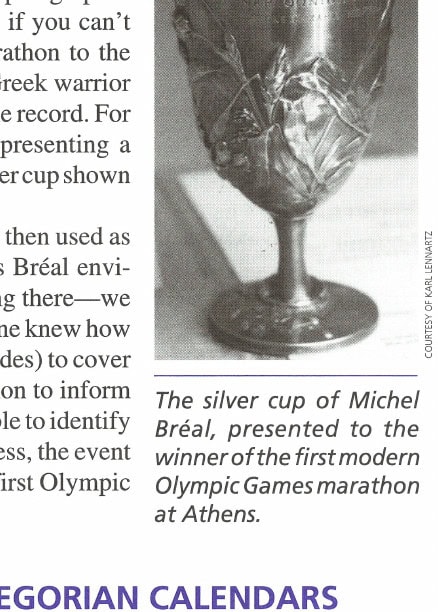
The Pnyx is a steep hill in Athens then used as a social congregating place. Perhaps Bréal envisioned the race as starting or finishing there—we don’t know. And also, of course, no one knew how long it took Pheidippides (or Philippides) to cover whatever route he used from Marathon to inform the king of victory, so it wasn’t possible to identify a record time to be broken. Nonetheless, the event was placed on the program, and the first Olympic marathon was set to be run.
JULIAN VERSUS GREGORIAN CALENDARS BRINGS OLYMPIC CONFUSION
The date of the first Athens Olympic marathon is given in the 1896 official Games report as Friday, March 29. This date is also reported in local Greek newspapers of that period. Other authoritative sources (Wallechinsky 1996) use April 10. Both are correct, which points to one of the many confusions surrounding documentation of Olympic details. At the time, Greece was using the Julian calendar, whereas much of the rest of the Western world (including most of the world today) was (and still is) using the Gregorian calendar. Some explanation is useful.
The first modern calendar was put into use in 45 BC by Julius Caesar, who decreed there should be three years of 365 days each and then one year of 366 days, in perpetual cycle. Known as the Julian calendar, this started the practice of adding one day to the end of February every fourth (leap) year. Although an improvement over previous systems, this scheme is inadequate because one solar year (one revolution of the Earth around the sun) requires 365 days, 5 hours, 48 minutes, 46 seconds—about 11 minutes shorter than 365+ days.
In 1582, Pope Gregory XIII proposed a correction to the Julian calendar. The new, improved version became known as the Gregorian calendar. First, to correct for all the days that had accumulated since the start of the Julian calendar, it was decreed that 10 days would be removed from 1582. The day after October 4 thus became October 15. The pope then also instituted a so-called Leap Year Rule: one day is dropped from each centesimal year (ending in 00) whose number cannot be divided by 400. Thus, a day was dropped in 1700, 1800, and 1900, and they were not leap years. A day was not dropped in 2000, so February of 2000 had 29 days.
After the decree in 1582, primarily Roman Catholic countries initially adopted the new calendar. Protestant countries joined later. The American colonies switched in 1752, when the entire British Empire changed. By that time, however, an 11-day adjustment was required. Many countries were slow to adopt the Gregorian calendar. Japan adopted it in 1873, China in 1912, and Greece not until 1924. By the time of the 1896 Olympic Games, the adjustment was 12 days, which explains why Athenian newspapers were 12 days behind newspapers from many other parts of the world. Thus, the date of March 29 on the Julian calendar used in Greece during the first Olympic Games corresponds to April 10 on the Gregorian calendar.
Some other dates for these first Olympic Games are also relevant. The Opening Ceremonies were on Sunday, March 24 Julian (April 5 Gregorian). For a specific reason, de Coubertin wanted the competitions to start on the following day. In 1896, the Christian and Eastern Orthodox Easters coincided, and thus his “resurrection” of the Olympic Games on Easter Monday for both religions was especially symbolic (MacAloon 1981). This day was also the Independence Day of Greece. The marathon occurred on the fifth day of competition and was the last contested event in athletics (track and field). The final day of competition was April 3 Julian (April 15 Gregorian), with the Closing Ceremonies one day later.
REFERENCES
- Chrysaphes, I. 1930. The modern Olympic Games. Athens: Gergiadon Publishing Co.
- Cooper, P. 1998. The American marathon. Syracuse: Syracuse University Press.
- Dodd, E. 1997. The great six-day races. Marathon & Beyond 1(1): 73-89.
- de Coubertin, P. 1896. The Olympic Games of 1896. In The Olympic Games, 776 BC–1896 AD. ed. C. Beck. Translated 1966. London: H. Grevel & Co.
- Herodotus. The Histories. Book VI. Translated by G. Rawlinson. Everyman’s Library. New York: Random House.
- Ioannides, I. 1976. The true course run by the marathon messenger. Olympic Review 109-110: 599-602.
- Kyle, D. 1998. Dictionary of world biography: The ancient world. Edited by F.N. Magill. Hackensack, NJ: Salem Press.
- Lennartz, K. 1998. Following the footsteps of Bréal. Journal of Olympic History 6(2): 8-10.
- MacAloon, J.J. 1981. This great symbol: Pierre de Coubertin and the origin of the modern Olympic Games. Chicago: University of Chicago Press.
- Mallon, B. and T. Widlund. 1998. The 1896 Olympic Games. Jefferson, NC: McFarland & Co., Inc., Publishers.
- Martyn, S.G. 1997. Book review. Olympika 6: 129-136.
- Nepos, C. Miltiades, 4.
- Quercetani, R.L. 1990. Athletics: A history of modern track & field athletics (1860–1990). Milano: Vallardi & Associati.
- Rühl, J. 1997. The Olympian Games at Athens in the year 1877. Journal of Olympic History 5(3): 26-34.
- Solinus. Collectanea rerum memorabilium. Book I.
- Wallechinsky, D. 1996. The complete book of the Summer Olympics, 1996 edition. New York: Little, Brown & Company.
- Young, D.C. 1996. The modern Olympics: A struggle for revival. Baltimore: Johns Hopkins University Press.
Note. This essay is from The Olympic Marathon by David Martin and Roger Gynn. Copyright 2000 by David Martin and Roger Gynn. Excerpted by permission of Human Kinetics, Champaign, IL. Available in bookstores or by contacting 1-800-747-4457 or www.humankinetics.com.
This article originally appeared in Marathon & Beyond, Vol. 6, No. 2 (2002).
← Browse the full M&B ArchiveMore like this
1,000+ stories from 19 years of Marathon & Beyond
The complete archive of the legendary long-distance journal — digitized and free to read.
