

Running With the Dragons
IT’S A Sunday morning in Beijing, and the 2000 Chicago Marathon is 10 weeks away. I’m two hours and 29 minutes into a two-hour and 30-minute training run. I’m guessing that at my pedestrian speed it’s been 16 miles, but since you don’t get mile markers in China, I just check in with my gut and keep going. I glance at my running watch with satisfaction: 2:29:30. Thirty seconds from now, I can go get a cold bottle of water and hail a taxi back to my dorm room at Beijing Normal University, where I’m enrolled in a Mandarin language course sponsored by Princeton University’s Chinese department.
Suddenly my toe hits a section of concrete jutting up from the pavement. I trip, my Walkman goes flying, and in a second and a half I’m sprawled on the dirty concrete with a gashed-up knee. What feels like 10,000 Chinese eyes are suddenly pointing my way, and everything around me gets very quiet. The locals look at me as though I’m an interplanetary visitor who’s just crash-landed in their town.
And in some way, maybe I am. Here I am, an Italian-American female runner in Beijing, dressed in Western-style running shorts, a Jogbra, fancy running shoes, and sporting a fresh new bloody knee in one of the city’s biggest parks.
Leave it to me to figure out the best way to get noticed halfway around the world.
WHERE IT ALL STARTED
This story is about running in a new place. It’s also about rediscovering old places when you bring running to new places. Like the dirt track that you find behind a run-down building on a Beijing University campus. All of a sudden you’re 13 years old again, running the very first mile of your life on a gravel track behind the local junior high school. You remember how awkward you were and how you joined the track team because it was the Thing To Do when you were in the 8th grade. Then the teacher put you in the mile race because, well, that’s what they did with the slow kids.
Yes, I confess. I was a Slow Kid. I’m still a Slow Kid, age notwithstanding, but I’m also a Kid Who Just Loves to Run. My five marathon finishes attest to that. But it’s not just the finisher’s medals hanging in my bedroom that prove my love for the sport. It’s the fact that, wherever I go in the world, I’ve just gotta take my running shoes. China was no exception. Especially when I had a marathon coming up.
BRINGING RUNNING TO CHINA
If you’ve never packed your running shoes when going overseas, then you’ve never traveled with the likes of me. I’ve been studying strange and exotic languages (or at least languages that seem strange and exotic to your average North American) since my college days.
It started with five years of Russian, including a stint studying (and running) in the former Soviet Union in the early 1990s. Then it morphed into Mandarin Chinese four years ago. Just to let you know: I’m completely lacking in any sympathy for communist governments. It just sort of happened this way, that in the fall of 1989—right before the Berlin Wall was brought down, beginning Eastern Europe’s irreversible slide into democracy and market economics—I enrolled in first-year Russian in college.
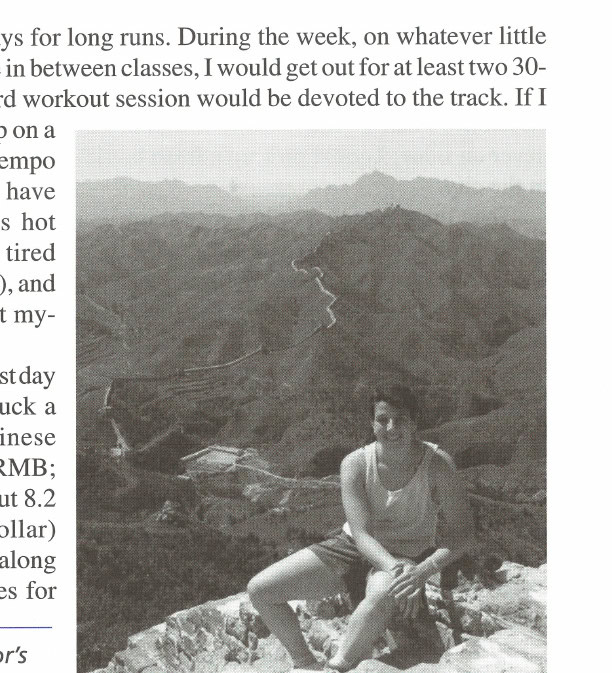
Eventually I took it on as my major, and I traveled to Russia three times in the next five years. In the fall of 1997, having been thoroughly fascinated by both the martial and healing arts of East Asia, I decided it was time for a new adventure. At that point I wasn’t quite sure what I was going to do with Chinese once I had it, but the Far East had been beckoning for quite a while, so I decided it was time to check it out and see what awaited me over there.
This is what I called the Door Number One school of going through life, and I think it might have a little bit to do with why I’m a marathoner. It’s a simple philosophy, really.
When you get to a door in life, why not just walk through and see what’s on the other side?
When I first started running, I suspect it would have been hugely demoralizing if I had ever really gotten the gist of the thing—which of course was that if you finish last in a race, you are supremely uncool.
But for some reason, that little gem of wisdom never hit my tender running ears. I just ran. When high school came around and I could suddenly run 3.1 miles in a single race in cross-country, I thought that sounded like fun, so I went out for the team. Then one day I finished last in a race and got made fun of by one of the boy runners. (I’ve always wanted to send him photos of my marathon finishers’ medals, by the way—not that I’m bitter or anything.) Another time a coach brought up a new, juicy goal: a 10K road race. Not a high school cross-country race but a real all-comers road race. Did that too. And on I went until one fine day in April 1990 as a college freshman, I lined up with all the other bandits at the back of the pack at the Boston Marathon and ran until my legs gave out at mile 14. The bug had bitten, and this sickness was contagious.
So what does all this have to do with China?
Well, I started running because it was there and because I couldn’t think of a good reason not to do it. And I came to China for the same reasons. By the summer of 2000 I’d run four marathons, taken a nice chunk off my PR, and started to dream about coming back to Boston officially (besides the 1990 Boston start, there was also a little matter of the 1993 race, which I actually finished, again as a bandit).
This particular running adventure started the day I decided to apply to graduate school in Chinese. The link between sport and China for me was clear: from my beginnings as a runner, I had gradually become more and more interested in health and fitness issues.
I took certification as a personal trainer and group exercise instructor, and then I thought, wouldn’t it be cool to be able to study Chinese medicine, with the goal of writing about alternative medical practices for a mainstream audience?
That meant one thing: I had to actually go. To China. To study Chinese. The same year I was training for my first Chicago Marathon.
Gulp.
This was going to take some work.
SETTING STRATEGIES
The blast of heat outside Beijing International Airport told the tale: when you bring your running to a new country, you need to learn the rules of engagement. As I wheeled my baggage to the curb, I sucked in the hot air and realized it wasn’t going anywhere anytime soon. It was June 17, 2000. Those rules were going to get learned quickly.
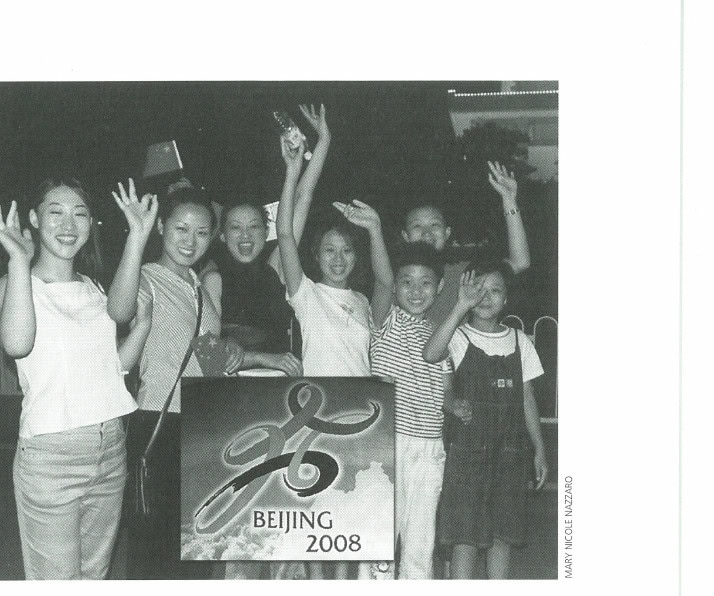
(By the way, I also noticed a few posters around the airport reading “New Beijing, Great Olympics” and sporting a great emblem: a flower-burst in the Olympic colors that I’ve since learned is a depiction of a person doing tai chi. Little did I know at that time that Beijing was in the running to be designated as a Candidate City for the 2008 Summer Games. But we’ll get to that a bit later.)
So without further ado, here are the rules as I learned them in those first weeks running in China:
- Do your homework.
- Deal with the traffic and pollution problems.
- Find appropriate running venues.
- Take care of your health.
- Make sure you’ve got the right running gear with you.
And now for the specifics.
THE RULES
Rule number one for running in a new country is simple: do your homework.
Culture, weather, availability of clean water, and sports facilities—everything affects your ability to train properly. I went running for the first time in Beijing two days after I arrived (good) but waited until 6:30 A.M. to get started and chose a road clogged with traffic at that hour (not good). The first couple of days were just about getting my bearings and knocking off the jet lag, but I knew things were going to have to improve—and quickly.
The good news is that when I reach a new destination, I never doubt in my heart that running there will be possible. It may not always be easy; it might even be a severe pain in the neck to get yourself going sometimes, but it will always, always be possible. Of such determination is a successful marathon-training schedule in Beijing born.
The first obstacle I had to overcome while training in the middle of a Beijing summer was simple: all that heat. By 8:00 in the morning you’re looking at temperatures of 75 degrees or worse. Part of the reason it gets so hot so early is that China doesn’t use daylight saving time, so the skies begin to lighten up by 4:30 A.M. So I had to get up earlier than usual. Okay. I could do that.
Rule number two deals with a double-edged challenge not unique to Beijing: traffic and pollution. Just about every large city in the world has problems in this area, though Beijing takes the cake—it’s a very tough place to try to breathe clean air. Remember never to put yourself at risk, whether it be running in traffic jams or in obviously polluted environments. It’s no secret that Beijing has some of the worst traffic problems around. When you add in soot from the factories and dust from the little land mass next door called the Gobi Desert, you’re talking about some severe air pollution. It makes running on the roads extremely unpleasant, even early in the morning.
This leads to rule number three: find appropriate running venues.
If there’s traffic on the road at 6:00 in the morning, get off the roads by then. Or look for running routes that circumvent the traffic entirely. I did two things
to combat this problem. First, I found the track at Beijing Normal University. Who knew that in a city of massive congestion you could also find a suitable 400-meter track at just about every university and school campus? You might have to have university affiliation to get in—or get a Chinese-speaking friend to help you—but they’re there.
The second thing I did was find a park where I could do my long runs. Beijing may suffer from overpopulation and stuffy air, but it’s also the home of the emperors, and the emperors liked their parks. I like the piece of advice I read a few years back about running while traveling: get a good city map and look for the green. In my case, the closest green to home base was Beihai Park, just six kilometers from my dorm room.
The final two rules have to do with personal care. First, mind your insides: drink lots of water and eat healthfully. And finally, make sure you’ve got the proper gear to run in and that you allow yourself to recover well. This was where Beijing really surprised me. Long runs in Beijing (once you’re inside the park, of course) are easier by far than runs in the West in two important respects: water and bathrooms. Public toilets are everywhere (bring your own toilet paper; I tucked a package of tissues into my running shorts before heading out) and so are kiosks selling water, other beverages, and Popsicles. I carried a wristband that held keys and money, so hydration was never an issue; I could pick up a fresh bottle of water no matter where I was in the city.
Then there was that little knee-scrape incident in Beihai Park.
Not a second after I fell, no fewer than five Chinese women approached me. One held a medicated Band-Aid, another a package of wet-nap tissues. A third dispensed running advice: “You fell because you were too tired. You need to stop for the day and go home.” In the end I was cleaned up by my hosts and sent on my way but not before learning yet another important safety lesson: carry bandages when you can because you never know when you’re going to need them.
If you’re heading to mainland China, running gear is best brought from home, from shorts and Jogbras to running shoes and energy gels. There are a few fancy (read: expensive) shops in the larger shopping districts that sell imported running shoes from major Western companies, but there’s no guarantee you’re going to find the model you need. Name-brand clothing and shoes sold in small kiosks and street shops are knockoffs. Tuck an extra pair of running shoes into your carry-on bag before you board the airplane, and everything should be okay.
As far as nutrition in Beijing goes, there are going to be challenges, not the least of which is the fact that menus are rarely translated into English unless you want to eat at Pizza Hut and Outback Steakhouse every day. But if you think Chinese food in the West is good, wait until you taste the real stuff. It’s amazingly yummy, and if you make the right choices it can be super healthy as well.
One warning, though: watch out for street stalls serving Things That Are Fried. The proprietors of such establishments sometimes change the cooking oil during the day, and sometimes they don’t. My one case of Montezuma’s revenge–level diarrhea was brought on directly by a little piece of fried bread that looked oh-so-good in the window but turned out to have been fried in three-day-old oil. No fun there. A bottle of Pepto-Bismol and a night spent on the toilet later, I was back out in the world. Don’t say I didn’t warn you.
BUILDING A WORKOUT SCHEDULE
So now that you’ve got the tools, you actually have to go out and run. Here’s how I put a marathon-training schedule together using all those Chinese building blocks.
Sundays were my days for long runs. During the week, on whatever little free time I could squeeze in between classes, I would get out for at least two 30- to 40-minute runs. A third workout session would be devoted to the track. If I had the energy, I’d get up on a Saturday morning for a tempo run. But I didn’t always have the energy (jet lag plus hot weather equals a very tired marathoner after a while), and I did my best not to beat myself up over it.
Long runs were the best day of the week. First, I’d tuck a few renminbi (the Chinese currency, abbreviated RMB; the exchange rate is about 8.2 RMB per American dollar) into my running shorts, along with a package of tissues for the obligatory mid-run visit to the public bathroom, trot outside my dorm room at Beijing Normal University, and hit the streets.
My target was Beihai Park, the aforementioned oasis of a city park near campus. I knew the distance because I would treat myself to a taxi ride back to campus after my run and the ubiquitous red Chinese cabs in town charge a flat 10 RMB for the first five kilometers, then another 1.2 to 1.6 RMB per kilometer after that. My bill was around 12 RMB, depending on the route the driver took.
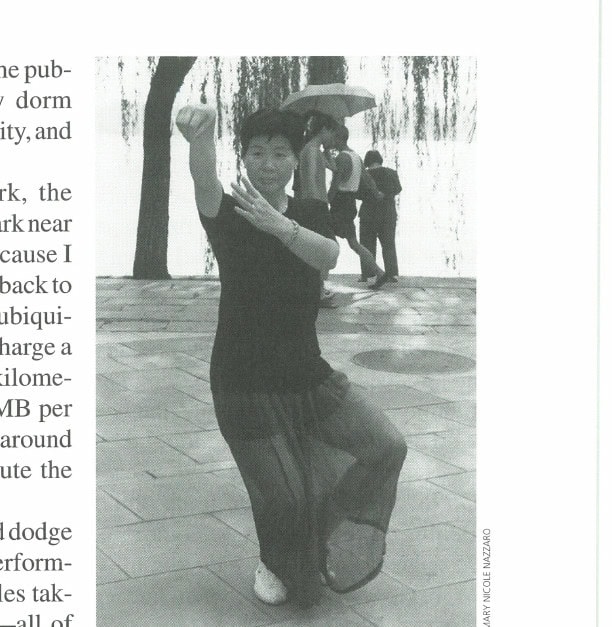
Once inside the park, I would dodge tai chi classes, elderly women performing dances with fans, and couples taking ballroom dancing lessons—all of which were happening at 6:00 in the morning.
There were always a few other runners there—mostly men, all in thin-soled Chinese sneakers, circling the lake inside the park. I doubted that anyone else was training for a marathon, but then the Beijing Marathon pours 30,000 runners out onto the streets every October, so what do I know?
There was no time to ask these guys what they were up to, though. When you’ve just figured out how to beat the pollution and crowded streets of the capital of the most populous nation in the world, life gets pretty simple.
CULTURE SHOCK
When I first went to China, I wondered if I would find any sort of running culture there. I wondered if I would be stared at as I tooled around the streets of Beijing in my Western running gear, if I would be arrested for indecent exposure, or simply laughed at by the locals. As it turned out, none of that happened. I had no idea that I would be welcomed, that people would give me a thumbs-up sign as I passed them while running through the parks, and that running would become a way to connect with this culture as surely as it had been in America.
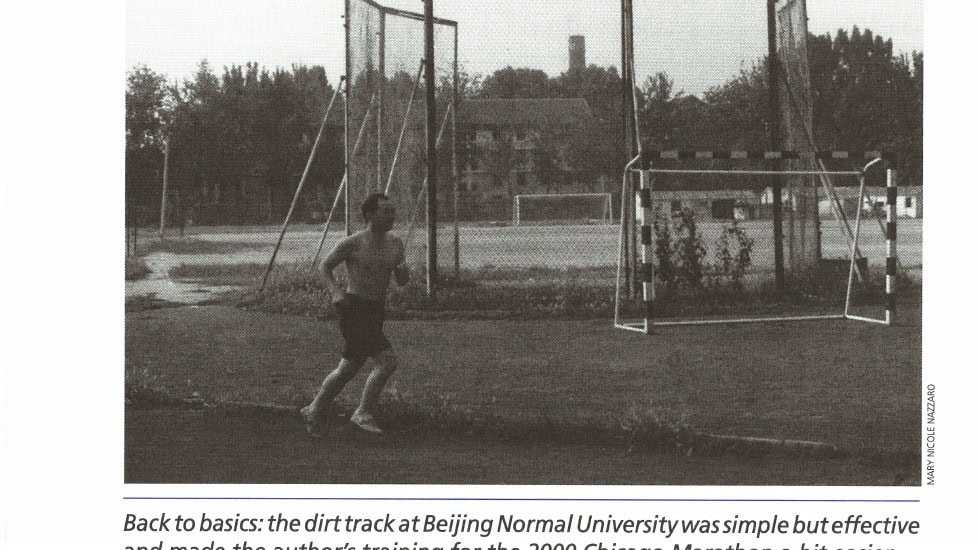
Then there were the surprises: the things that seem ordinary to the outside world but feel enthralling to you because they’re new. That’s what happened the day I found the track at Beijing Normal University. There was nothing fancy about this track—it was a dirt track, plain and simple, with soccer nets set up on the infield for China’s true favorite sport.
I set out running on my first morning at the university with no real plan; I knew that the university had an enclosed campus of sorts, so I thought this would be a good way to explore a bit. Whenever I hit an intersection, I just turned one way or the other—no thought, really, into where I was going or where I would end up. Then I made a turn around a large classroom building and noticed a clearing. A second later, I realized I was looking at a track. A running track. And suddenly, the world got just a little bit bigger.
There are runners here too, I thought, and I just found their home.
Happily I circled the track a few times—and then came a clap of thunder. On this first morning of track running in China, the first rain of my stay in Beijing came as well. A welcome rain, for even at 6:00 A.M. the temperature was 75 degrees and rising, with humidity to match.
I skipped through the mud like a piglet on a happy day, then realized that I was making a bit of a show of myself. Gathering underneath the awning of the big classroom building were the people—all of them Chinese—who had been
walking, running, or doing tai chi before the storm hit. I sheepishly walked back to where they were standing and took a place alongside them until the rain subsided. My socks were muddy for weeks, but boy was I a happy girl.
When you first thought about running a marathon, did you doubt that you could do it? That anyone could do it? If you did have those doubts, then what led you to cross the abyss and say, Hey, I believe it can be done?
Ask 10 different people and you’ll get 10 different answers: faith, belief in oneself, trust in one’s ability to achieve great things in sport. But I think it all boils down to one thing. We all believe in magic. We all believe in the ability to do something we haven’t done before. When I made that last turn on winding roads around the university campus and suddenly the track appeared before my eyes, I knew I believed. After six days in this new country, I realized that there were others out there just like me. And suddenly China wasn’t a foreign place, and these fellow runners were my brothers and sisters, and there was a track workout to be done, and, by God, I was going to do it.
NEW BEIJING, GREAT OLYMPICS
While we’re on the topic of magic and miracles, let me allude to one extraordinary incident in my time in China that solidified my belief in the power of sport to communicate universally.
After the summer of 2000, I came back home to Boston and prepared my graduate school applications. (I also ran an 18-minute PR in Chicago, proof positive that my workout plan in Beijing did the job.)
I started to plan my return to China in the summer of 2001, to bone up on my Mandarin before facing the rigors of graduate school research. This is where those Olympic posters at the airport become relevant. When I first came to Beijing, I had no idea that the city was even in the running for the 2008 Olympic Games. And I certainly had no idea that just a year later I would return to China to witness the birth of a new era in sport: Beijing winning the vote by a landslide, marking the first time China will host the Olympic Games.
It was July 13, 2001. The entire International Olympic Committee meeting was broadcast over Chinese national television live from Moscow—all 12 hours’ worth of it, from the five candidate cities’ final presentations to the actual vote.
The Chinese delegation offered up a stunning presentation in English, French, and Mandarin. Their plans for the city include many improvements that will surely raise the standard of living for the average Beijing citizen: a new highway circling the city to alleviate traffic congestion, more buses converted to use natural gas, reduction of pollution, and a state-of-the-art railway system connecting the airport to the city center.
In the United States this past spring, I took the pulse of my friends in the Olympic sportswriting business: did Beijing really have a shot at getting the 2008 Games? Most said yes, a few said no, but you better believe that when IOC president Juan Antonio Samaranch went to the podium in Moscow with that envelope in his hand, my fingers were crossed for Beijing.
Then came the vote.
Beijing landed a clean majority in the second round of voting after Osaka was eliminated in the first round. If you have never seen television commentators burst out crying while reporting a story, you weren’t watching TV in China that night. There was a huge outburst of cheers from everywhere—from the crowds at a televised celebration in the western part of Beijing to the TV studios to the small cafe on campus near my dorm room.
The sports station broadcast the phrase shen ao cheng gong on the air: “The Olympic bid was successful!”
I jogged over to the Internet cafe to file a story for Runner’s World Online and then learned that an all-night impromptu party was being held at Tiananmen Square. It was 12:30 A.M. when I heard the news. My decision was split-second. I had to go.
TIANANMEN SQUARE REDUX: WE ARE ONE COUNTRY
The Chinese flags are out in full force, and the cheering resonates from every street corner. It’s 1:00 on the morning of July 14. It’s been three hours since Beijing was awarded the 2008 Games. The firecrackers, cheers, and screams of delight from Beijing citizens when the vote was announced have melded into a single symphony of joy, one that I can hear cycling the whole distance from my university dorm to Tiananmen Square.
I’m riding my bicycle—a little purple one-speeder, just enough for commuting purposes in this town—and I’m headed to a place that the modern Western world remembers for just one thing but that resonates with millions of Chinese citizens for its history as the home of the emperors. “We have one house,” someone sings, and the crowd joins in. “Its name is China!” they sing back. “Long live the Olympics! Long live China! Long live Beijing!” they cheer.
It has been 12 years, one month, and 11 days since the pro-democracy movement in Beijing was crushed by the Chinese government. Seven years from now, the sporting world will come to Beijing for the Olympic Games. The streets are packed full of people. The police have shut down the streets to cars so that people can walk safely to the square. And once I hit Tiananmen, I’m overcome by the music, the songs, the dragon dances, and the pure happiness of the moment.
By the time I’ve made it back to the university at 5:00 A.M., I’m fully aware that this country has been reborn on this night. The IOC has given Beijing—and all of China—an affirmation, and a decisive one at that. Not one, I believe, of validating the current human rights situation in China or a cynical nod to the 1.3 billion Chinese citizens who represent the world’s largest consumer market. But an affirmation of hope: we believe that you can do this. The crowds continue to sing and cheer all through the night. And for a moment, I feel as much a part of this party as anyone here.
Can sport sometimes accomplish what political struggle cannot? The 2000 Olympic Games in Australia lent an international spotlight to the plight of the Aborigines, a struggle perfectly symbolized by Cathy Freeman and her spectacular gold-medal 400-meter run.
This year the Western press skewered China’s human-rights record in the weeks leading up to the IOC vote; Canada’s Globe and Mail even took a potshot at the state-sponsored televised celebration, noting that it was an invitation-only affair to which the Western press was not welcome. (That wasn’t true, by the way; that night I talked with an American journalist at Tiananmen who had just come from the official celebration.)
I can’t say that China’s human-rights record will improve to a level that the United States government will be happy with by 2008; I can’t even say that China won’t follow the lead of the former Soviet Union and turn the Games into a triumphant celebration of the superiority of socialism. I can tell you, though, that there was nothing state-sponsored about the Tiananmen Square celebration. There was only joy.
A middle-age couple approached me and excitedly shared their thoughts: “Do you realize that now people from the West will have the opportunity to visit China and to really understand our culture?” they asked. “Bring your mother! Bring your family! We will see you in 2008!”
Say what you will about the Communist Party, but even they can’t choreograph a moment like that.
There was one other thing I knew as the sky began to turn blue in the Saturday-morning glow of the Beijing Olympic win. It was that on this night, my athletic and writing life had come full circle. From 13-year-old turtle of a runner, I was an Olympic sports writer now, a five-time marathon finisher, and a graduate student in Chinese. And Beijing was an Olympic city, and the citizens were basking in the joy of the moment.
You think I’ll be back in 2008? Bank on it.
IF YOU GO
Traveling to Beijing requires advance planning, particularly if you expect to run while there. Along with your gear, be sure to pack energy bars and gel and anything else you think you might need while running; such products are hard to come by in China. Gatorade is sold at some stores in Beijing at reasonable prices (about 6 RMB—75 cents U.S.—for a small bottle).
Getting Around the City
Getting around Beijing will be a whole lot easier if you understand at least some Mandarin Chinese. If you don’t, you can still figure the place out, but if you have a Chinese-speaking friend willing to run with you, life will be easier.
As the 2008 Olympic Games approach, more and more Beijingers will be learning basic English phrases. If you’re alone in the city for any reason, make sure that you take a card with your hotel information, written in Chinese, if you go out. You can always show the card to a taxi driver and they’ll get you where you need to go. Also, if you’re staying in a hotel for foreigners, the desk staff
will be able to speak basic English as well. Note that tipping is not customary in China for taxi drivers or in restaurants, though fancy Western-style restaurants in hotels may add a service charge to your bill.
Guidebooks and Maps
Any of the major guidebooks on Beijing will be of use to you. I’ve used the Lonely Planet Guides and the Rough Guides myself, but I’ve also seen plenty of other great books. A city guide of Beijing is extremely useful, even if you also want to purchase a guidebook covering all of China. A tourist map, showing names of streets in both Chinese characters and pinyin (phonetic spellings), is available in any large bookstore for 8 RMB (U.S. $1.00).
Gyms and Workout Facilities
Most Western-style hotels have in-house workout facilities, and some of the best also have swimming pools, massage therapists, and other amenities. Expect to pay Western prices for access to workout facilities unless you’re a guest in the hotel. Some universities also have workout rooms, though access to these facilities may be restricted to students enrolled at the university. One of the niftier aspects of Beijing is that when you go to a hair salon for a shampoo (xitou), they give you a great upper-body massage (anmo) as well, and for an unbelievable price (about 10 to 20 RMB—U.S. $1.25 to $2.50—depending on the location).
Running Tracks and Parks
There are lots of running tracks in Beijing. Every university campus should have one, as should most high schools. Ask your Chinese friends or the staff at your hotel, and they should be able to direct you to the nearest one. City parks are also great places to run—try to get there as early as possible to beat the tourist crowds.
Besides Beihai Park, to the northwest of Tiananmen Square, you can also get in a great run at Tiantan Park, south of Tiananmen by a few blocks. If you’re up for a little more traveling, go out to Yiheyuan (the Summer Palace) in western Beijing. Park admission prices generally range from 5 to 35 RMB (U.S. $0.60 to $4.25).
Food
Beijing is a city of great culinary adventures. Westerners might find the oil content of most foods a bit more than what they’re used to, but many dishes can be prepared steamed.
Some of the healthiest options for runners include jingcongpaoji (chicken with scallions in brown sauce), qingzhengyu (fish steamed with soy sauce, ginger, and rice wine), and of course, the ubiquitous bowl of mifan (steamed rice). If you want jiangyou (soy sauce), you’ll have to make a special request; unlike in the West, you won’t find it on the table in an authentic Chinese restaurant.
Safety
On the whole, Beijing is a safe city, though as with any major metropolitan area, you’re best off traveling in groups at night and having at least one person in your group who speaks Chinese.
Keep your passport and any other important travel documents in a safe place at all times, and always watch your wallet or purse when you’re on the street.
When buying souvenirs from street stalls, bargaining is expected, and asking prices are astronomical if you’re a foreigner. Offer one-third of what the proprietor tells you and go from there.
Major Events
The Beijing International Marathon is held every October. Tour groups, which offer travel packages including hotel accommodations and meals, are probably the best way to travel to China for an event. For more information, visit the Marathon Tours Web site at www.marathontour.com/beijing.
The Great Wall Marathon will be held on May 25, 2002, in Tianjin Province, China. Race information can be obtained at www.great-wall-marathon.com.
And, of course, there’s the 2008 Olympic Games. It’s a little early to be planning your trip (unless you want to get started learning Mandarin now), but you’ll want to keep up with www.nbcolympics.com as the time gets closer.
This article originally appeared in Marathon & Beyond, Vol. 6, No. 2 (2002).
← Browse the full M&B ArchiveMore like this
1,000+ stories from 19 years of Marathon & Beyond
The complete archive of the legendary long-distance journal — digitized and free to read.
