


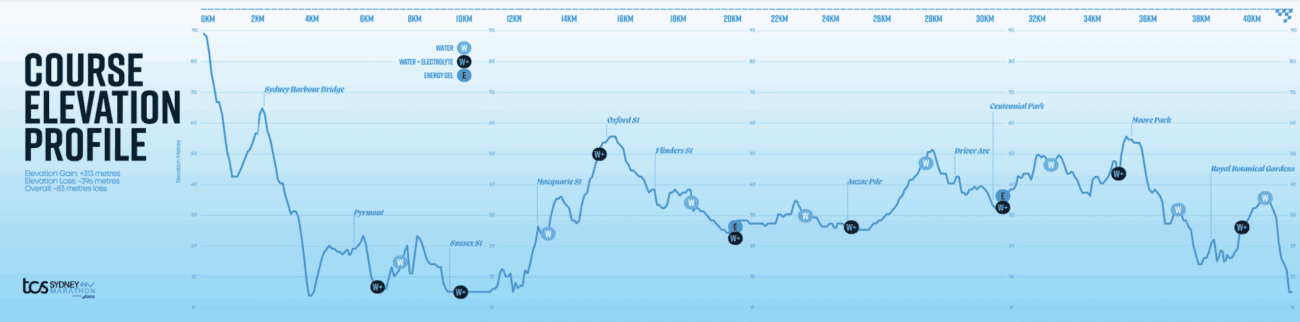
The Sydney Marathon starts at the highest point on its own course. Runners leave Miller Street in North Sydney about 80 meters (262 ft) above sea level on Sunday morning, cross the Sydney Harbour Bridge in the opening kilometers, and finish 42.195K later on the Sydney Opera House forecourt at 5.2 m.
Organizers publish 313 m (1,027 ft) of climbing against a net drop of 83 m, and almost none of that climbing takes a runner above where the morning started. The gain is considered the hilliest of the seven World Marathon Majors. The drop is what makes it too steeply downhill for a world record: Rule 31.21 of World Athletics’ competition rules, whose road-race criteria are also published by AIMS, allows a net loss of one meter per kilometer, or 42.195 m over a marathon. Sydney’s published figure is 1.97 times that limit, and the endpoints of the race’s own GPX file are 74 m apart, 1.75 times it.
The organizers publish no mile markers and no per-kilometer elevation table, and the file they link as the 2026 course carries the internal track name “TCS Sydney Marathon 2025 – 42.195 km” with no distance waypoints in it at all. What they do publish is exact: the official spectator map fixes seven locations to the tenth of a kilometer, three of them passed twice, which gives 10 distance readings. Those readings anchor the breakdown that follows, section by section from North Sydney to the finish.

Miles 1 to 4, North Sydney and the Harbour Bridge
The start sits on Miller Street beside North Sydney Oval, in St Leonards Park. North Sydney Council records it as the marathon start used at the 2000 Olympic Games, and the NSW government describes the race as the sole remaining participant legacy of those Games. The Olympic course ran the opposite way, out to the stadium at Homebush, where Gezahegne Abera won on Oct. 1, 2000. The modern route turns toward the water instead.
The GPX file’s highest reading, 80.4 m, comes in these opening kilometers, and its last, at the finish, is 5.2 m. The descent through North Sydney is the only stretch that gives without having taken first. Runners drop through the closed grid of Miller, Walker, Berry and Blue Streets and onto the Sydney Harbour Bridge, which Transport for NSW closes in both directions from 3 a.m. to 11 a.m., along with the Cahill Expressway and the Western Distributor.
Miles 4 to 7.4, the Western Distributor and Pyrmont
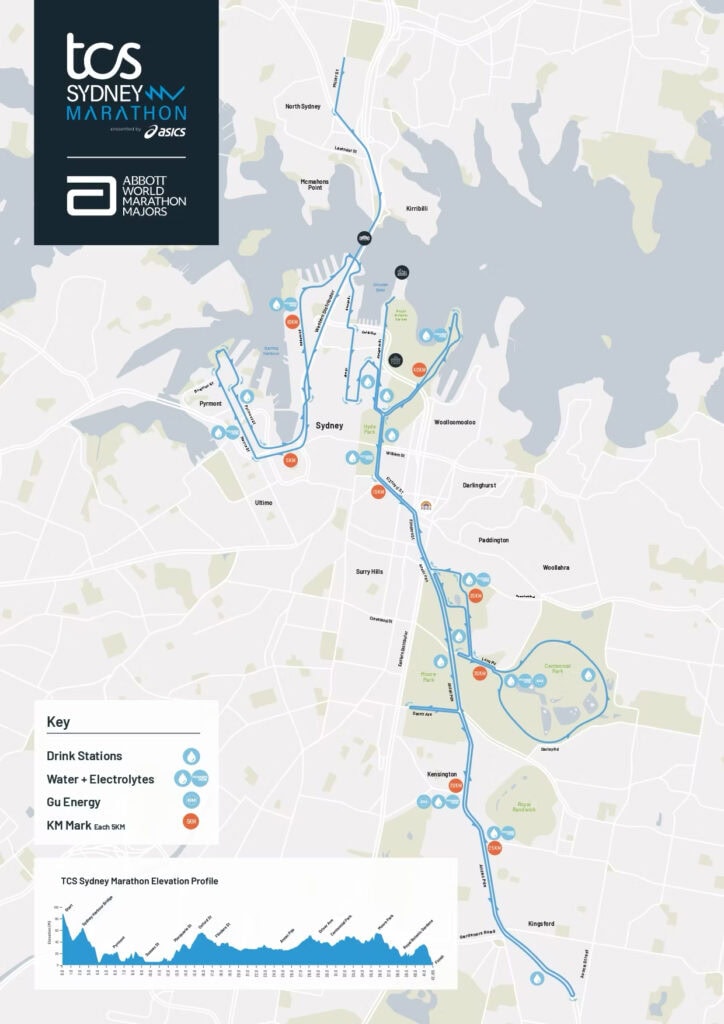
Off the bridge the course does not turn for Circular Quay. It runs west and south instead, along the Western Distributor and into Pyrmont and Ultimo, where the closure schedule covers Harris Street, Pyrmont Bridge Road, Wattle Street, Fig Street, Pirrama Road, Jones Bay Road, Union Street and Point Street. This is the flattest section of the race, and it ends at the first official marker: 6.21 miles (10K), on Hickson Road at Barangaroo, with the harbor back on the right.
A little over a mile north along the waterfront comes the second, 7.39 miles (11.90K), at George and Alfred Streets in The Rocks, where the course reaches Circular Quay for the first time.
Miles 7.4 to 9.6, the CBD and the First Climb Up Macquarie Street
The next anchor is 8.70 miles (14K), at the top of Macquarie Street by Hyde Park, and it sits 2.1K past The Rocks. Macquarie Street from the quay to Hyde Park is about a kilometer, so the gap accounts for a circuit of the city blocks first. Transport for NSW closes sections of Bridge, Grosvenor, Pitt, Phillip, Bent, Hunter, Elizabeth and Castlereagh Streets from 4 a.m. to noon, and King Street between York and Elizabeth Streets from 4 a.m. to 11:30 a.m., which is the footprint that loop needs.
The pull from Circular Quay up Macquarie Street is the first sustained climb of the morning. It runs past Parliament House and the State Library to Hyde Park, and the course then turns down College Street and into Oxford Street, arriving at Taylor Square, in Darlinghurst, at 9.57 miles (15.4K).
Miles 9.6 to 18, Oxford Street and the Anzac Parade Out-and-Back
This is the longest stretch the organizers leave unmarked, 13.6K between Taylor Square and the next anchor at Moore Park, covering roughly miles 9.6 through 18. Three things happen in it. Oxford Street climbs through Darlinghurst, closed from College Street to Darlinghurst Road until 4 p.m. Flinders Street then carries the course south to Moore Park Road. And Anzac Parade takes it out and back, closed from Moore Park to Kingsford between 5 a.m. and 2 p.m., including Cleveland Street eastbound and High Street at Randwick. Kingsford, in Sydney’s south east, is the course’s furthest point from the finish.
Halfway, 13.11 miles or 21.0975K, falls on Anzac Parade, in Kensington or Kingsford depending where the turn is set. It is the one part of the course where a runner can go the better part of an hour without a landmark to measure progress against, and it arrives immediately after the Oxford Street climb.
Miles 18 to 22.5, Moore Park, Centennial Park and the Second Pass at Taylor Square
The markers resume at 18.02 miles (29K), on Driver Avenue outside the Sydney Cricket Ground, and then come quickly. Greater Sydney Parklands closes every road inside Centennial Park for the whole day for the loop that follows, and 20.69 miles (33.3K), at The Homestead on Grand Drive, is the point organizers label “The Wall” on their own spectator map. The course leaves the park and passes Driver Avenue a second time at 21.62 miles (34.8K).
Then it climbs back to Taylor Square, reached again at 22.49 miles (36.2K). Flinders Street and Oxford Street stay closed for the entire window in between, so the same two streets carry the course out and back, and the return leg is uphill at 22 miles.
Miles 22.5 to 26.2, Mrs Macquarie’s Chair and the Drop to the Opera House
From Taylor Square the route runs west down Oxford Street and into the Domain and the Royal Botanic Garden. Macquarie Street, College Street, St Mary’s Road, Art Gallery Road and Mrs Macquarie Road stay closed until 4:30 p.m., the longest closure anywhere on the course. The ninth reading, 24.36 miles or 39.2K, is Mrs Macquarie’s Chair, on the point above the harbor, and leaving it means the last climb of the day, the rise back up Art Gallery Road toward the Domain.
The tenth and final reading is 25.35 miles (40.8K), back at the top of Macquarie Street, the same ground the course covered at 8.70 miles. Everything past it falls away. Macquarie Street drops from Hyde Park to Circular Quay, and the finish is on the Opera House forecourt at 5.2 m above sea level.
What the Profile Is Worth
The four fastest marks in the race’s history were all set in 2025, in Sydney’s first year as a Major. The official race account has Hailemaryam Kiros running 2:06:06 and Sifan Hassan 2:18:22, the fastest marathons run on Australian soil by a man and a woman, taking 12 seconds off Brimin Kipkorir Misoi’s 2024 time and 3:19 off Workenesh Edesa Gurmesa’s. Marcel Hug wheeled 1:27:15, which organizers call a course record and which is 9:23 faster than Kurt Fearnley’s 2011 mark, and Susannah Scaroni went 1:44:52, an all-comers record 9:18 faster than Madison de Rozario’s 2024 time. Close to 33,000 runners finished, according to the World Marathon Majors. Under Rule 31.21, none of those times, and no time run on Sunday, can stand as a world record.
For everyone else the profile matters in a plainer way. A course losing 83 m overall does not build long climbs; it builds short ones, repeatedly, and the two closest to the finish are Flinders Street back to Taylor Square at about 22 miles and Art Gallery Road at about 24. That is a different problem from the one a mile-by-mile plan for Boston has to solve, where the hills arrive together and the net downhill is the part that draws scrutiny, and it rewards runners who have practiced running downhill at least as much as those who have done the hill work.
Elite wheelchair athletes start at 6:15 a.m. on Sunday and mass participation from 6:30 a.m., with about 40,000 runners expected and the elite field and broadcast times set out separately. The course limit is seven hours, and Transport for NSW has the marathon off Sydney’s roads by 3:40 p.m.
RunClub
Get more running stories — join RunClub
Daily running news, a community of 300,000+ runners, free training plans for every distance, and a daily running game. Free to join — no card.
Already a member? Log in →


Start the conversation