


How Jess McClain Ran a Shorter Line and a Faster Finish to Beat Hellen Obiri
Hellen Obiri led her by 3.4 seconds at 40K and finished four-tenths of a second behind her. A frame-by-frame reconstruction of the broadcast shows McClain ran about 5 meters less than Obiri over the final 2.2 kilometers, worth about a second, and made up the rest on pace as Obiri slowed on West Drive.
With 2.2 kilometers left in the New York City Marathon on Nov. 1, Jess McClain was on her own. Sheila Chepkirui and Hellen Obiri had pulled away together, and at 40K the American was 3.4 seconds behind them in third.
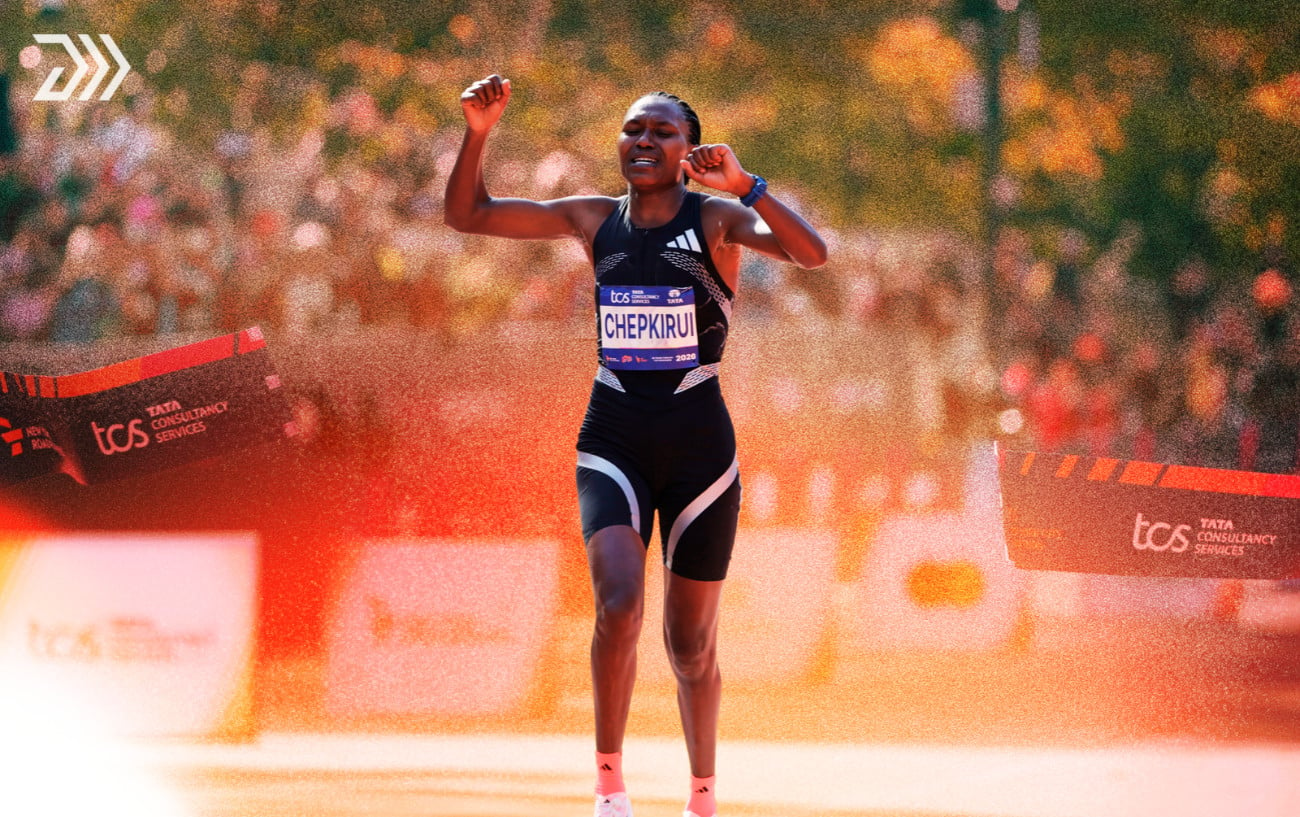
Over the remaining distance she ran 6:59 to Obiri’s 7:04. She crossed the line in 2:24:42, four-tenths of a second ahead of the two-time champion, while Chepkirui won in 2:24:36. (Read our race report.)
| Runner | 40K | Last 2.2K | Finish |
|---|---|---|---|
| Chepkirui | 2:17:39 | 6:57 | 2:24:36 |
| McClain | +3.4 s | 6:59 | 2:24:42 |
| Obiri | 2:17:39 | 7:04 | 2:24:43 |
At the speed they were running, the 3.8 seconds McClain made up on Obiri is about 20 meters of road. Watching the broadcast again, a pattern repeats through the final two kilometers: in one bend after another, the leaders drift toward the outside of the road while McClain stays on the inside.
That raises a simple question. If McClain ran no faster than Obiri, the leaders must have covered about 20 more meters of road than she did between 40K and the finish. This reconstruction measures how much of that the lines they ran can account for, using the race broadcast, photographs and video from the finish, and the city’s survey of the curbs in Central Park.
What the blue line is, and what it is not
A marathon is measured along the shortest route a runner could legally take, about 30 centimeters from the curb or barrier on the inside of every turn. The measurer then adds a margin of 0.1 percent, so a runner who follows that route perfectly covers about 42 meters more than the official distance.
The painted blue line is New York Road Runners’ guide to the measured route. It is painted onto the road to follow that route closely, but it does not have to match it exactly, which means a runner can sometimes take a shorter line than the paint.
Running wide is expensive only where the road turns. On a straight road, the side a runner chooses costs almost nothing. Through a bend, every meter a runner stays outside the shortest line adds distance in proportion to how sharply the road turns: one meter wide through a right-angle turn adds about 1.6 meters.
40K to the finish 2,195 meters
The course
From 40K the race runs south on East Drive, leaves the park at Grand Army Plaza, heads west along Central Park South, re-enters at Columbus Circle and finishes on West Drive beside Tavern on the Green.
Along the way the road turns through eight bends that matter. The sharpest are at the corners of the park, but the longest are the sweeping curves inside it, where a runner can drift wide for 100 meters or more.
East Drive 2:16:49, about 50 seconds before 40K
An S-bend, taken on the inside
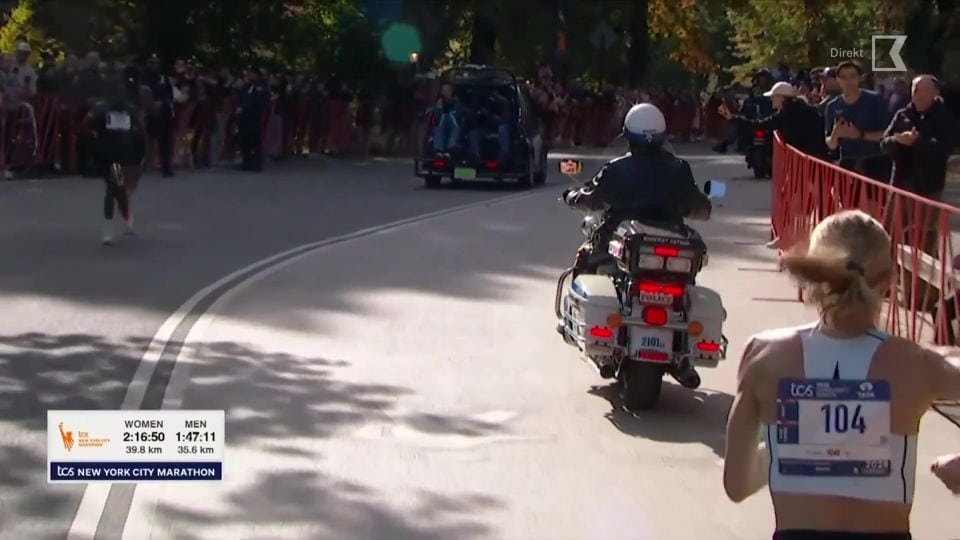
Here the road bends right and then left. McClain is close to the right-hand barrier, on the inside of the first bend, while Chepkirui and Obiri run on the left side of the road ahead of her, on its outside. They are running in the line of the camera car in front of them, which stays left of the center line through the bend.
Over the next 15 seconds, as the road turns left, she angles across toward the center line. Crossing diagonally from the inside of one bend to the inside of the next is the shortest way through a pair of opposite curves.
This bend turns about 60 degrees. Every meter wide of the inside line costs about 1 meter.
40.1 km 2:17:52 to 2:18:02
The leaders drift to the barrier
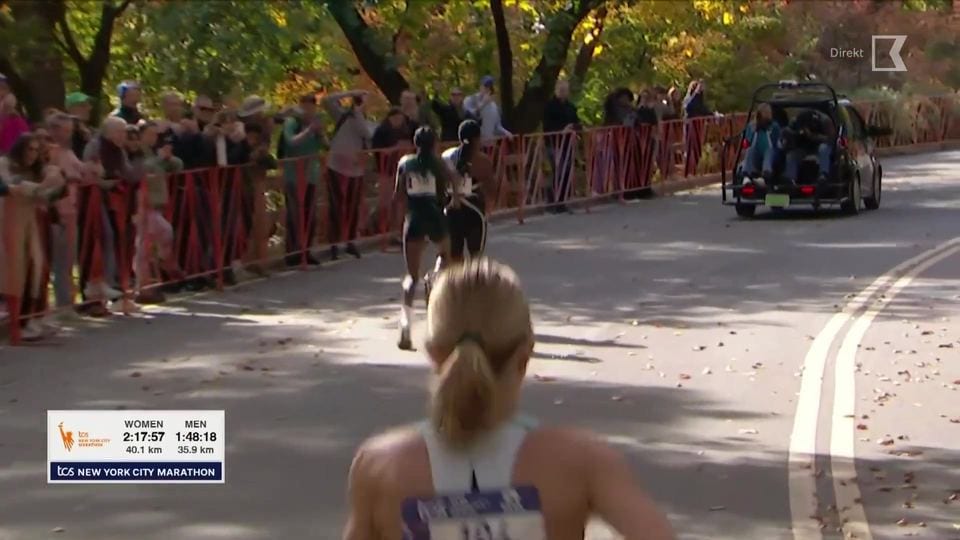
As the road bends right, Chepkirui and Obiri move from the middle of the road to the barrier on its outside, and they stay there through the curve. McClain does not follow them. She holds a line well inside theirs, and by 2:18:02 she has crossed the center line onto the inside of the bend.
For about 10 seconds the leaders and McClain are on opposite sides of the road in the same bend, in a single continuous shot.
As in the bend before 40K, the leaders run in the line of the camera car ahead of them. As the bend begins they are directly in its wake, and through the curve the vehicle stays in the outside half of the road, with the leaders between it and the barrier. The footage cannot show whether they were following it deliberately. It does show that in both bends around 40K the vehicle was not on the shortest line, the leaders ran where it ran, and McClain, farther back, took her line from the road instead.
This bend turns about 43 degrees, so every meter wide costs about three-quarters of a meter. It is the first of the two replays below.
Grand Army Plaza 2:20:11
Closer than she looks
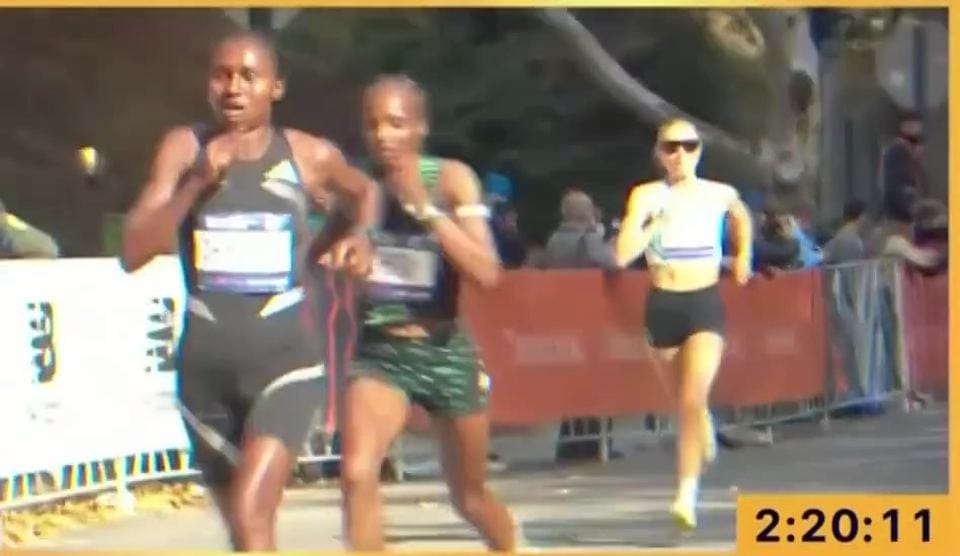
Where the course leaves the park, McClain appears to be right on the leaders’ shoulders. The broadcast’s long lens makes the gap look smaller than it was, so the gaps in this piece are measured by timing each runner past fixed points, not by how close they appear.
The lines here are close. On the approach McClain runs slightly nearer the barrier on the inside than the leaders do, and reaches the corner having covered a little less ground. The three take the turn itself on much the same radius, and McClain settles onto Central Park South on the inside again.
The turn onto Central Park South is close to a right angle, about 89 degrees. Every meter wide costs about 1.5 meters.
Columbus Circle 2:22:58
Wide for one turn, inside for the next
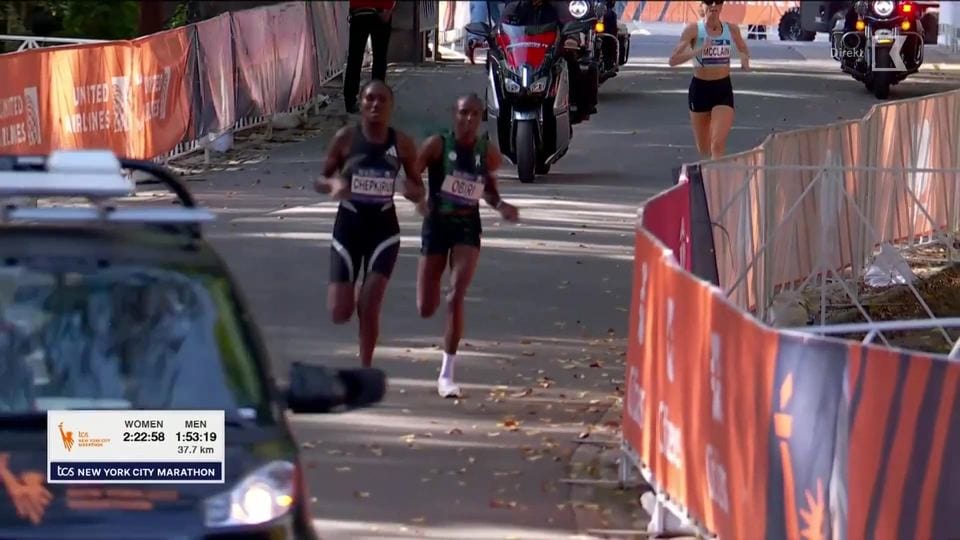
Columbus Circle is the one place where McClain ran wider than the leaders. Coming through the right turn into the park, she is on the outside, nearer the barrier on her left.
The position was deliberate. About 100 meters later the course bends left where it joins West Drive, and McClain moves over early to take that bend on its inside. Chepkirui and Obiri stay in the middle of the road and have to cut across as the left turn begins, while she is already on a clean line through it.
She gave up some distance on the right turn and won some of it back on the left. How the two balance depends on how wide she ran through the corner itself, which the broadcast does not show.
The turn into the park is the sharpest on the course, about 125 degrees.
West Drive 2:23:09 to 2:23:25
The long right-hand sweep
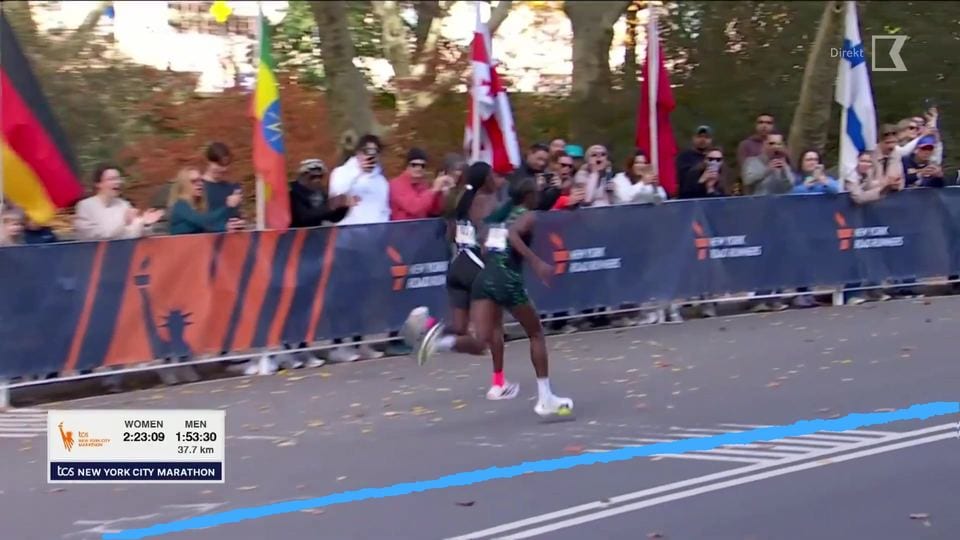
The longest bend in the final kilometer is the sweep up West Drive past the ball fields. According to the city’s survey of both curbs, it turns about 57 degrees over 300 meters, most of it in the first 100. A camera across the road shows the blue line on the near side while Chepkirui and Obiri run beside the barrier on the far side, to their left.
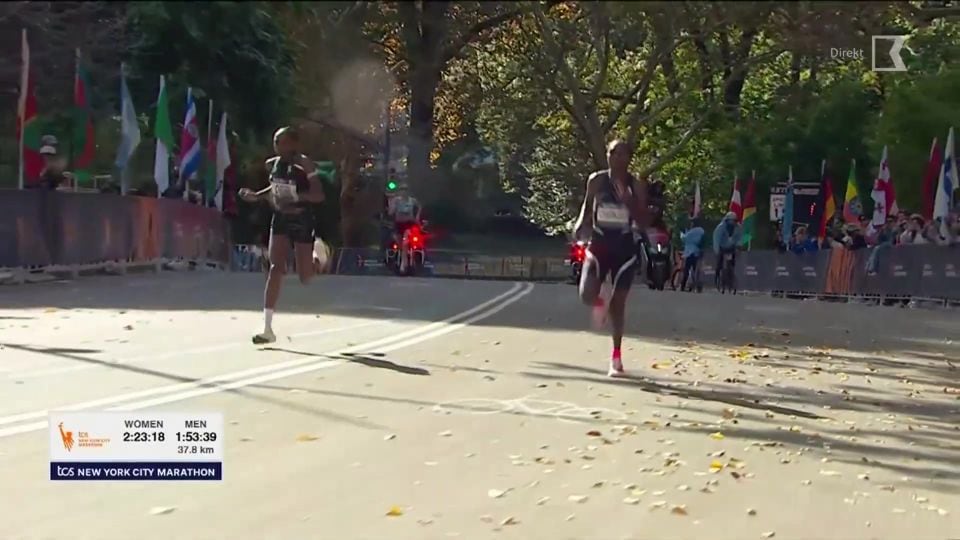
From the head-on camera, the line crosses the road on a diagonal toward the inside of the bend. The leaders follow it through the sharpest part of the curve, around 2:23:21, then drift away from it toward the outside as the road straightens. McClain, behind them, stays close to it.
Every meter wide through this sweep costs about 1 meter. It is the second replay below.
About 300 meters to go 2:23:42
Still on the outside
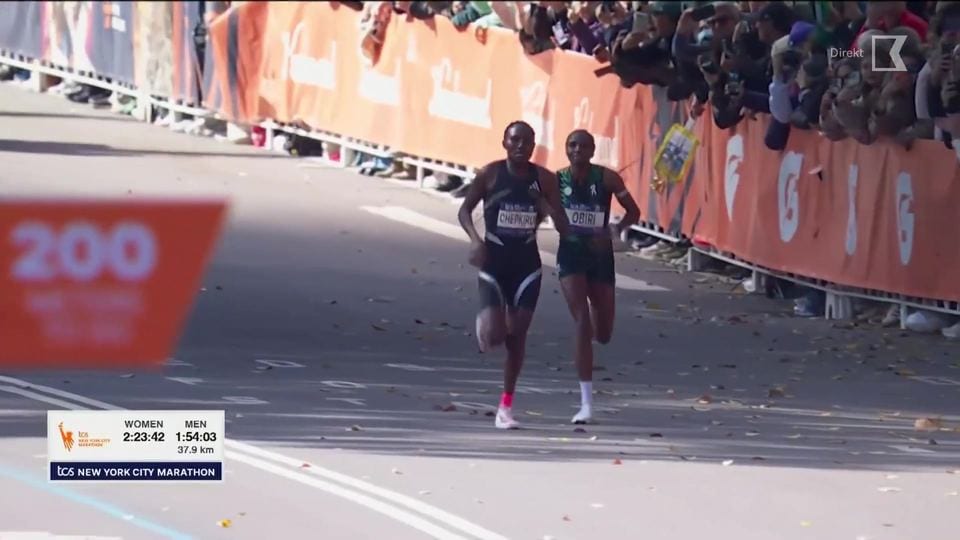
The 200-meter banner is in the foreground, but the leaders are still about 100 meters short of it, where West Drive is still bending right. Both are against the barrier on their left, the outside of the bend, with the blue line at the far edge of the frame on their right.
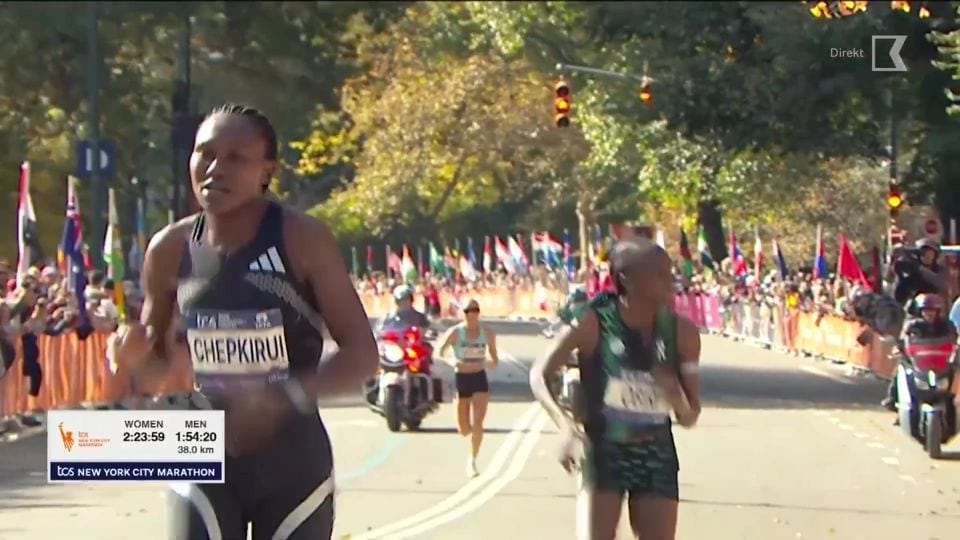
Seventeen seconds later, about 200 meters from the finish, McClain is right of the center line, on the inside of what remains of the bend. Obiri is well to its left, and Chepkirui is near the middle, moving back across toward the line.
The finish 2:24:37 to 2:24:42
The pass
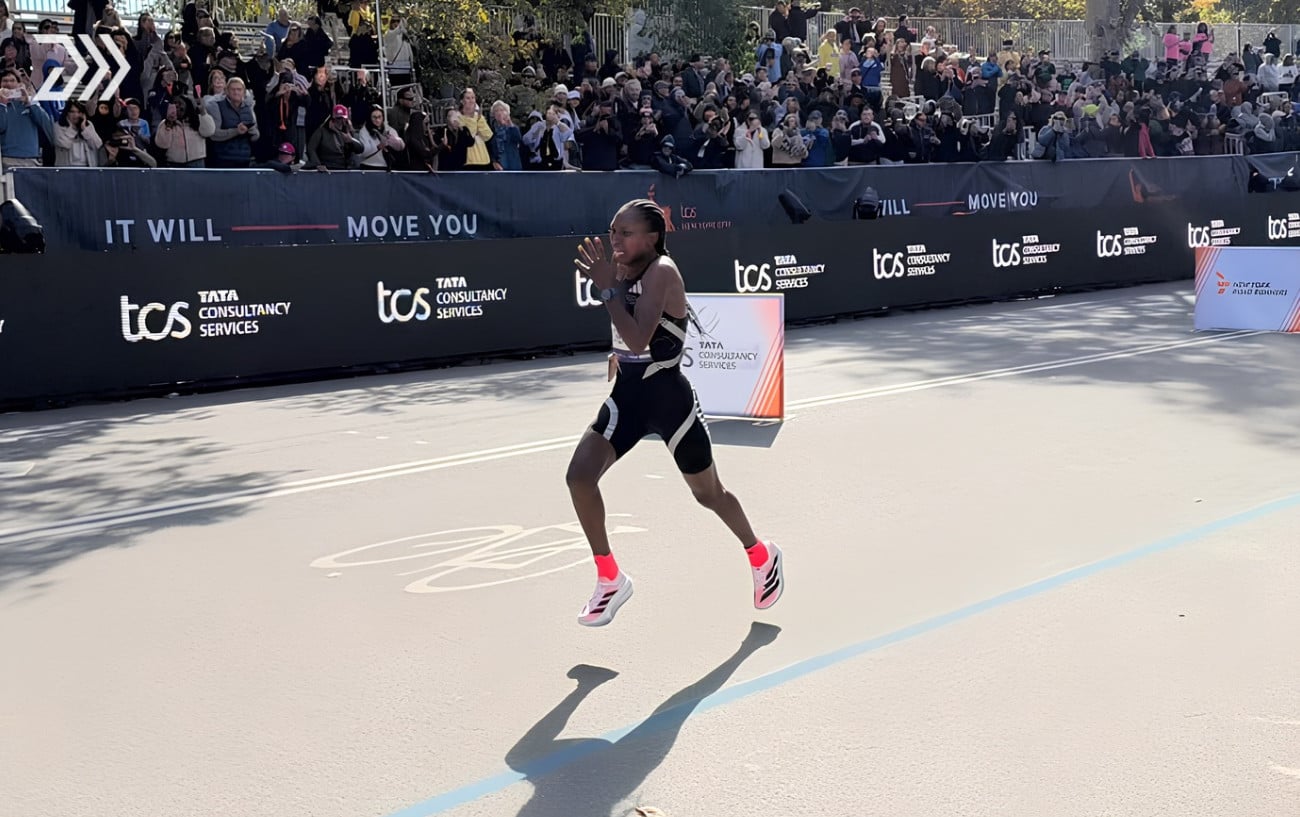
McClain and Obiri arrive at the final curve almost together. In the last seconds McClain angles hard toward the far end of the finish arch and goes past.
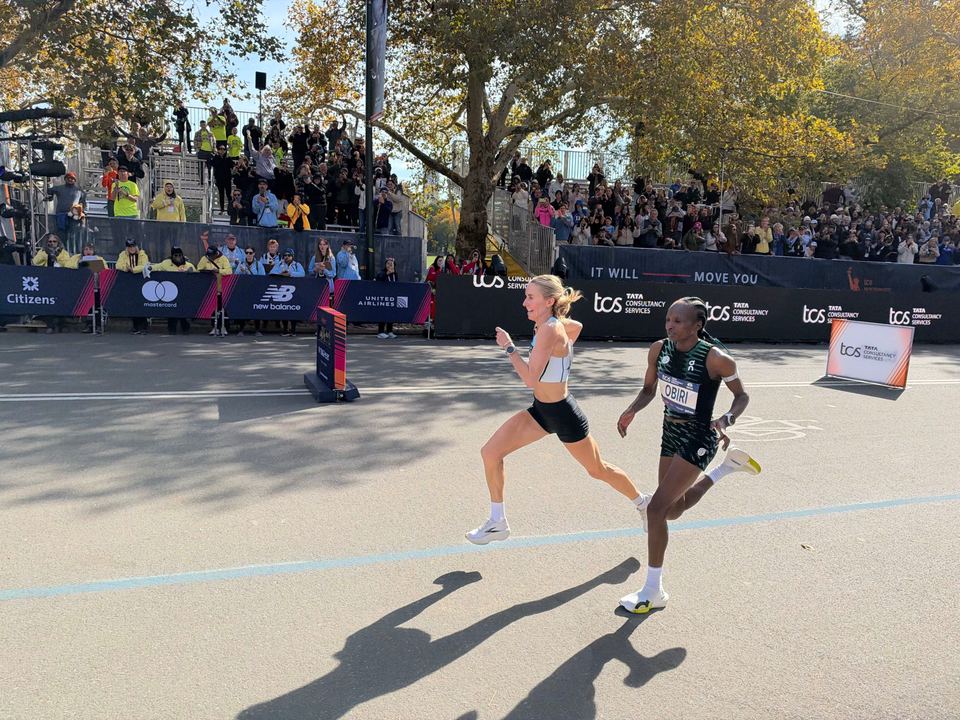
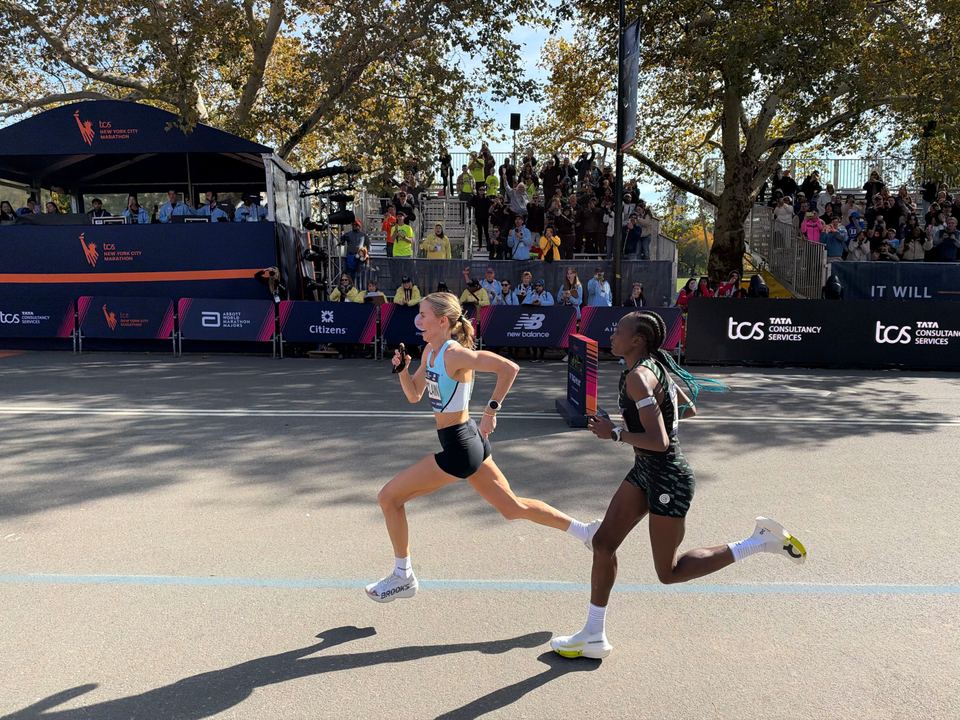
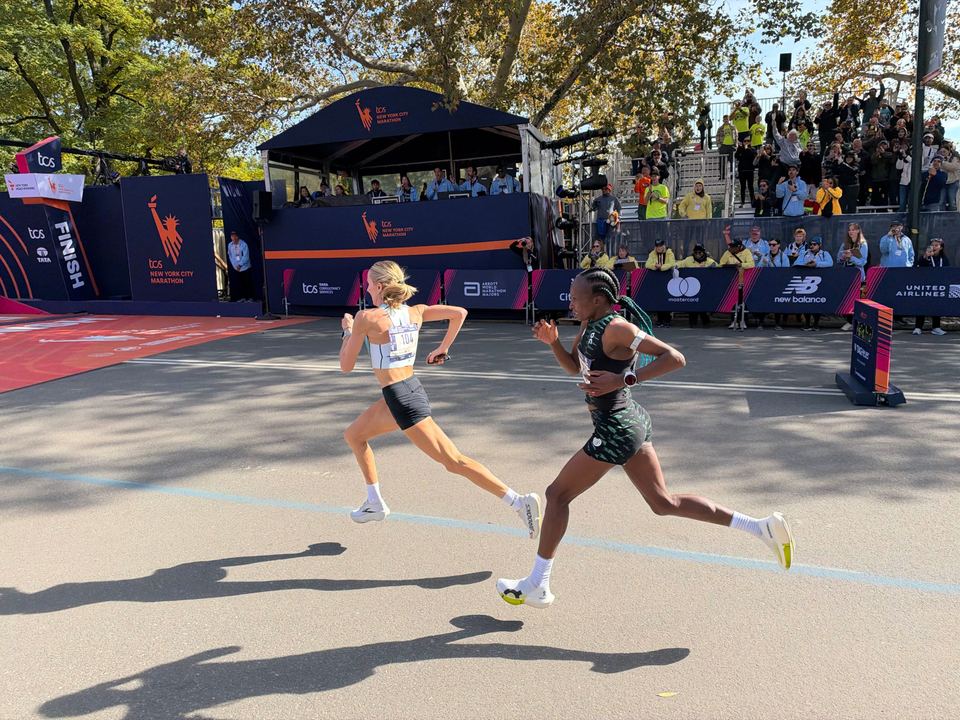
In these photographs McClain runs on the blue line, and Obiri is a meter or two off it. The city’s survey of the curbs shows that the road keeps bending left all the way to the finish, so the shortest way across the line is toward its inside end, on the runners’ left, and not through the middle. Following the middle of the road around the curve from 80 meters out costs about a meter and a half more. Chepkirui and Obiri follow the curve. McClain runs straight for the inside end of the arch.
The painted line heads for the middle of the finish line, so over these last meters McClain’s line is shorter than the paint. It gave her a clear lane past Obiri and up to a meter of road, worth as much as a tenth of a second in a race for second place decided by four-tenths.
Following the car
In the bends on either side of 40K, the leaders ran where the camera car ahead of them ran. The vehicle stayed in the outside half of the road, and Chepkirui and Obiri stayed in its line. McClain, with no vehicle in front of her, took her line from the road.
2:16:50 on East Drive, about 50 seconds before 40K. The camera follows McClain, so left and right match the runners’. The road bends right ahead, and its inside is on the right.
A lead vehicle has no reason to drive the shortest line, and in these bends it did not. Whether the leaders were following it deliberately cannot be seen in the footage. That they ended up where it went, and McClain did not, can.
Two bends, seen from above
Each replay shows a bend from directly above, with the curbs from the city’s survey and the shortest route through it as a dashed white line. Each runner’s line draws itself as she runs it, timed to the race clock, and the counters show how much farther each has gone than the shortest line between the same start and end points.
In the first replay, the runners’ positions are measured from the motorbike camera about every two seconds, against the barrier and the center line, and each runner’s figure is uncertain by about half a meter either way. On West Drive the cameras face the runners from far away with a long lens; positions there are read against the painted center line and are less precise, uncertain by about a meter either way.
The last 480 meters, from above
From the point where the course joins West Drive to the finish line, the map shows the shortest possible line, the painted blue line as far as it can be located, and each runner’s line. Dots mark the positions read from the broadcast; between them the lines are interpolated.
| Line | Distance to the finish | Beyond the shortest line |
|---|
As reconstructed, the blue line itself runs about 3 meters longer than the shortest line over this stretch. It swings wide of the inside through the sweep and heads for the middle of the finish line rather than its inside end. McClain covers about 2 meters less than Obiri and about 4 less than Chepkirui.
The blue line is dashed, with dots where it is visible in the broadcast; between those points its position is inferred. Runner positions near the finish are the least certain, because the cameras there show the runners at an angle.
Where the gap closed
Timing each runner past the same points shows when McClain made up her deficit. At 40K she was 3.4 seconds behind Obiri. By Columbus Circle, 1.6 kilometers later, a camera car facing the runners puts her roughly 1 to 2 seconds back, an estimate based on how much smaller she appears in the frame than the leaders.
By the crosswalk about 80 meters from the finish, the NYRR overhead camera shows her level with Obiri, and she won the last 80 meters by four-tenths of a second. Almost all of the 3.8 seconds, in other words, came before the final sprint, in the bends where the replays show the leaders running wide.
If McClain ran no faster than Obiri, about 20 meters of that gain would have to come from distance. Bend by bend, the lines account for about 5 meters of it. The two replayed bends contribute about 3.3 meters, and on the approach to Grand Army Plaza McClain gains roughly another meter by staying nearer the inside barrier. Over the final 80 meters she gains up to another meter by angling for the inside end of the finish line while the leaders follow the curve. Through the long sweep after Mile 25, all three stay close to the inside. At Columbus Circle, her wide line through the right turn and her tight line through the left bend that follows are probably close to even, though the broadcast does not show enough of the corner to measure it.
Those meters are worth a little under a second, about a quarter of what she made up on Obiri. The rest came from pace. Between 40K and Columbus Circle she closed about two seconds, and between Columbus Circle and the last 80 meters another 1.3, far more in each stretch than her lines can explain, as Obiri slowed on West Drive. McClain ran less, and then she ran faster.
The same measurements show what the lines cost Chepkirui. Through both bends she ran the same wide lines as Obiri, about 4.3 meters more than McClain, and still won by six seconds. On a tighter line, she would have won by more.
What the reconstruction shows
McClain ran less, and then she ran faster. Through the bends of the final 2.2 kilometers she covered about 5 meters less road than Obiri, worth a little under a second. The other 2.9 seconds of her gain came from pace, as Obiri slowed on West Drive.
She ran her own lines. In both bends around 40K, Chepkirui and Obiri ran where the camera car ahead of them ran, in the outside half of the road. McClain, without a vehicle to follow, took the inside.
The blue line is a guide, not the shortest route. As reconstructed over the last 480 meters, it runs about 3 meters longer than the shortest line, swinging wide through the sweep on West Drive and heading for the middle of the finish line rather than its inside end. In the final meters, McClain ran a shorter line than the paint.
And on a course like this one, extra distance is easy to run and hard to notice. No runner who stayed on the course could have covered less than about 42.24 kilometers, the measured distance with its safety margin. In the last 480 meters alone, Chepkirui ran almost 9 meters more than the shortest line, and still won.
What each runner lost, bend by bend
The table lists every bend in the final 2.2 kilometers, how much distance each meter wide costs there, and the extra distance each runner covered beyond the shortest line where it has been estimated so far.
| Bend | Turn | Cost per meter wide | Chepkirui | Obiri | McClain |
|---|
Figures in the runner columns are meters beyond the shortest line. After 40K they are measured from the broadcast; on West Drive they are read from cameras facing the runners and are less precise, marked est. Bend angles on West Drive come from the city’s survey of both curbs; elsewhere they come from a digitized course line and are approximate.
How this was done
Every broadcast frame in this piece was matched to the race clock shown on screen, and each clip was checked against it to within one second. Runner positions are placed on the map by matching fixed features in each frame, such as curbs, crosswalks and lane markings, to the same features in aerial imagery and the city’s survey of Central Park’s pavement edges.
Gaps between runners are measured by timing each of them past the same fixed point in a fixed camera shot, because a long lens makes runners look closer together than they are. Each distance figure will carry a margin of error when the measurements are final.
Splits: New York Road Runners official results. Broadcast footage: Swedish broadcast of the NYRR world feed and ESPN. Overhead finish video: NYRR. Photo montage: Marathon Handbook. Curb survey: NYC Planimetric Database, NYC Open Data. Aerial imagery: New York State Orthoimagery Program, NYS ITS Geospatial Services, 2024.
RunClub
Get more running stories — join RunClub
Daily running news, a community of 300,000+ runners, free training plans for every distance, and a daily running game. Free to join — no card.
Already a member? Log in →


Start the conversation