


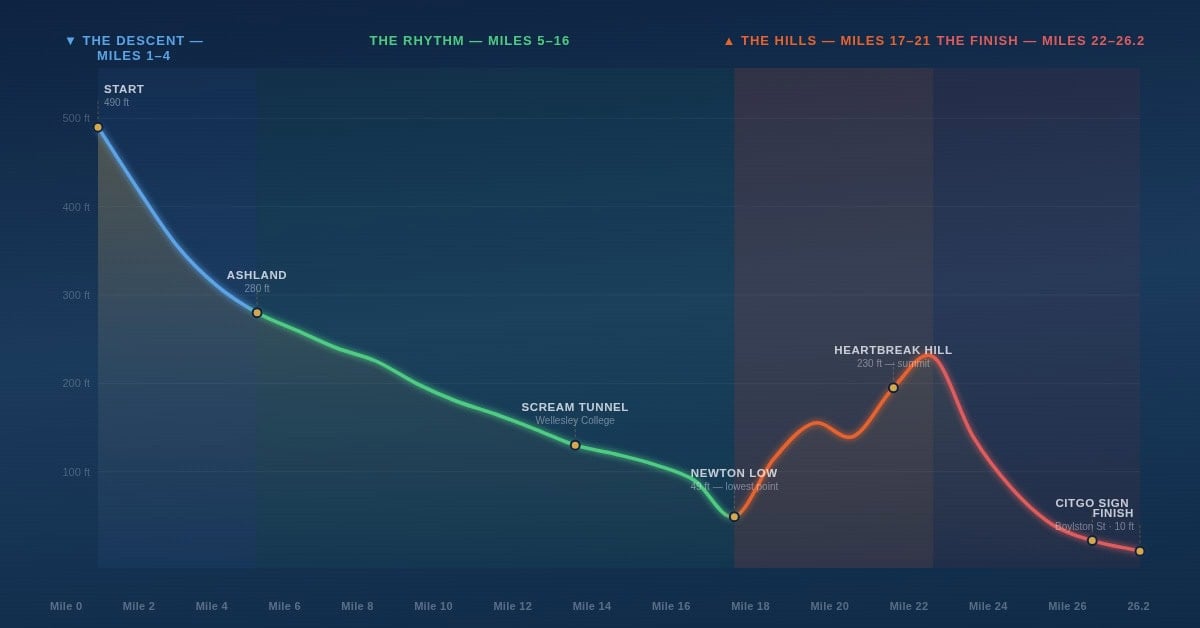
The Boston Marathon is the most bewitching course in all of running. Seemingly every Boston Marathon finisher has the same story to share after the race: the start was exciting and fast, the middle rolled up and down and was surprisingly quick, and then the Newton Hills appeared and everything went sideways.
Race guides will caution to you not to go out too hard, and to save energy for Heartbreak Hill. But the specifics of how to run each mile, how hard, how fast, what to watch for, remain frustratingly vague in most Boston Marathon how-to explainers. This one is different.
Using the complete results data from 2022 to 2025 (all 110,013 finishers) we’ve built a mile-by-mile execution plan grounded in what actually happens on this course, and how you should pace this race for optimal success. The pace recommendations below aren’t aspirational. They’re derived from the patterns of runners who paced well (and those who didn’t), adjusted for the specific terrain challenges of each mile. Crucially, the pacing model adapts to your ability level: a 2:50 goal and a 5:00 goal produce fundamentally different race strategies, because our data shows the course unfortunately punishes slower runners exponentially harder.
Enter your goal finish time in the calculator below, and the tool will generate personalized per-mile pace targets that account for the steep early descent, the undulating middle miles, the Newton Hills climb, and the final push down Boylston Street.
Print it, screenshot it, tape it to your arm, and trust the plan when Heartbreak Hill tells you to panic. Below is the only Boston Marathon course pacing guide you’ll need, regardless of your goal pace.
Your Mile-by-Mile Race Execution Plan
An interactive, data-driven guide to every mile of the 2026 Boston Marathon — with personalized pace targets based on course terrain and the pacing patterns of 110,013 finishers.
Enter Your Goal Finish Time
Full Course Elevation Profile — Hopkinton to Boylston
Your Complete Split Chart
Enter your goal time above to generate personalized splits for every mile of the course.
| Mile | Elevation | Elev Change | Pace /mi | Pace /km | Split Time | Cumulative |
|---|
About This Guide
Pace targets are generated from course-adjusted effort modeling, calibrated against the pacing behavior of 110,013 Boston Marathon finishers across 2022–2025. Difficulty factors for each mile incorporate elevation change, position in the race (fatigue modeling), and the observed pace differential at each course section. The goal-time calculator distributes your finish time across all 26.2 miles using these terrain-weighted factors, so the total of your mile splits always equals your exact goal time. This guide reflects the point-to-point, net-downhill character of Boston while accounting for the Newton Hills section where our data shows the average runner’s pace deteriorates by 12–18%.
Data: Complete BAA results, 2022–2025 (110,013 finishers). Analysis by Marathon Handbook.
RunClub
Get more running stories — join RunClub
Daily running news, a community of 300,000+ runners, free training plans for every distance, and a daily running game. Free to join — no card.
Already a member? Log in →






Join the conversation
Thank you Michael and team for such an informative HOW TO RUN BOSTON, I will be there in 2027 and I will being using the advice stated, this will be my first time running Boston, once I nail down my expected finish time the training will begin this December.
Thanks for all you and the team do for all runners as a whole
.
This is awesome! Been following all the build up on the channel - great work by all the team transmitting the excitement. I feel I have to go and time qualify and experience it first-hand - though I'm guessing it would be for 2028 (which happens to be Easter weekend also, so I imagine the atmosphere would be even more awesome!).....
Awesome review of the route with mile by mile personalised pacing plan based on target finish time. Thank you
Amazing and thankyou . First time running Boston and coming from UK. This will be so helpful. See you in Boston and then London!!!