


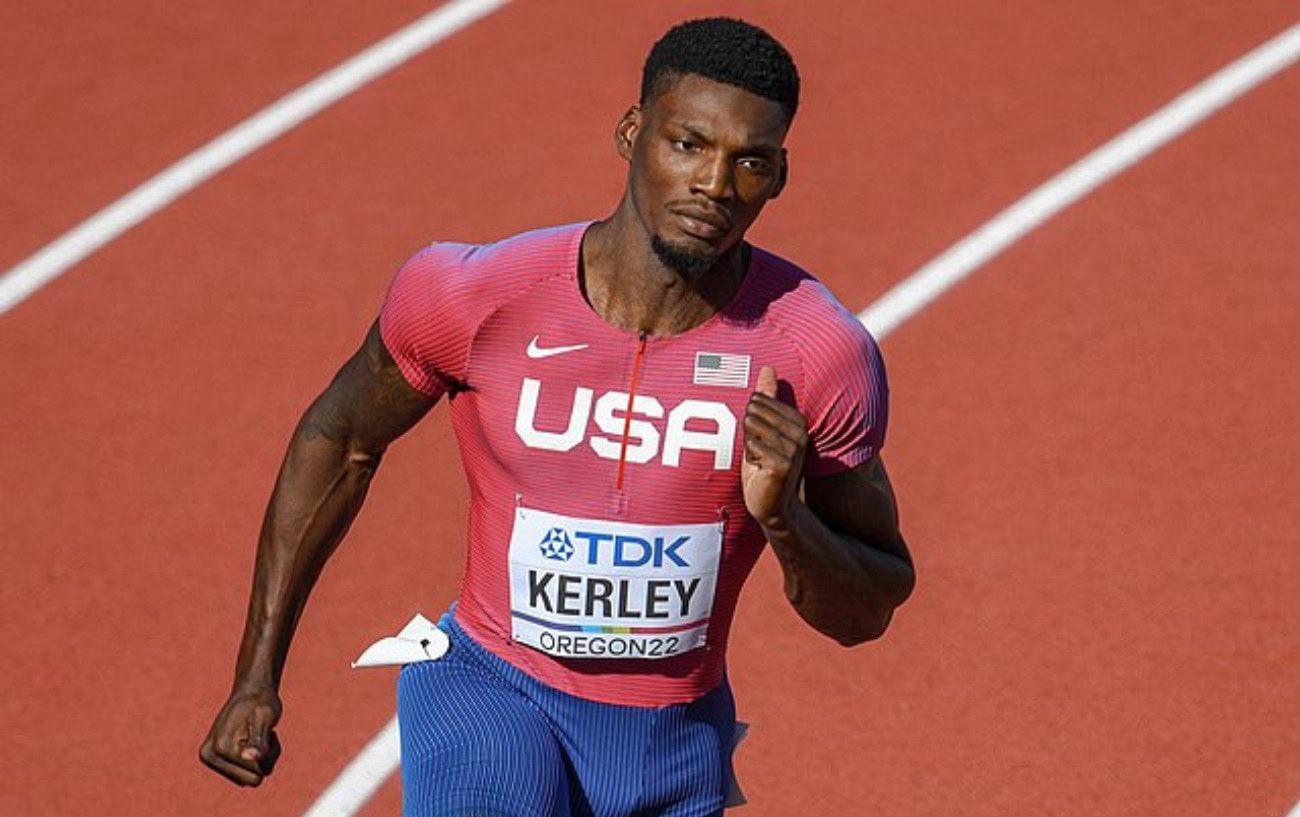
One week from now, Fred Kerley will line up against Reece Prescod and a field of other sprinters in a custom-built arena outside Resorts World Las Vegas. They will run 100 meters. Some of them will be on steroids.
This is the Enhanced Games, an event that has been three years in the making and is about to become real. Fifty athletes from swimming, track, weightlifting and strongman will compete on Sunday, May 24, for a share of roughly $25 million in athlete compensation. Performance-enhancing drugs are allowed, provided they are taken under medical supervision and have been approved by the U.S. Food and Drug Administration.
For the running audience, the most relevant moments will come in two events: the men’s and women’s 100-meter sprints. The headliner is Fred Kerley, the two-time Olympic medalist and three-time world champion, who is the first track athlete and first American man to officially sign on. Alongside him will be Reece Prescod, the British 100m sprinter, and France’s Mouhamadou Fall, a former Tokyo Olympian.
A win at the Enhanced Games pays $250,000. Setting a world record adds a $1 million bonus.
What Athletes Can Actually Take
The list of permitted substances is broad, to say the least. Anabolic steroids, including testosterone, are allowed. So are certain peptides, a category that includes the weight-loss drug Ozempic, and stimulants like Adderall. Human growth hormone is also on the table. Each substance must have an established medical use, and each athlete is monitored through ongoing health profiling.
Whether an athlete is competing enhanced or not is up to them to disclose. Among the announced field, Tristan Evelyn, a two-time Olympian, has confirmed she will compete in the women’s 100 meters as a non-enhanced athlete. American sprinter Hunter Armstrong is also listed in the non-enhanced category.
Max Martin, the chief executive of Enhanced Group, told The Observer that the event will show that “under the right clinical and medical supervision, enhancements can be administered safely to athletes” and that this will let competitors “tap into a new pocket of potential that they couldn’t naturally tap into.”
In a separate interview with Front Office Sports, Martin pointed to other professions where enhancement is already routine. “If you look at Hollywood, every actor is enhanced,” he said. “If you look at some of the top executives in the world, many of them are openly enhanced.” Athletes, he argued, are the “people that actually need it the most, because being an elite athlete is so taxing on your body.”

A Stage Built for Streaming
The competition has been engineered for online viewing. Roku will host the event for free across the United States, Canada and Mexico through its Roku Sports Channel. YouTube, Rumble, Twitch and Kick will also carry the feed. The company has chosen not to sell media rights.
“We decided not to sell our media rights,” Martin told Front Office Sports. “We wanted the games to be as accessible and easy to watch as can be. No subscription, no geographic restrictions.”
Opening events, including weightlifting and select men’s swimming races, start at 6:30 p.m. Eastern (3:30 p.m. Pacific). The main card begins at 9 p.m. Eastern (6 p.m. Pacific), with the 100-meter sprints and the men’s and women’s 50-meter freestyle as the marquee draws.
The night closes with the World’s Greatest Deadlift Showdown between Iceland’s Hafþór Björnsson, who played The Mountain on “Game of Thrones,” and Canada’s Mitchell Hooper, the reigning World’s Strongest Man. Björnsson plans to attempt to break his own world deadlift record of 510 kilograms. The Killers will headline a closing concert immediately afterward.
Joe Franzetta, head of sports at Roku, said in a statement that the company looks forward to “bringing Roku users across North America the excitement and energy of this one-of-a-kind competition.”

The Money Behind It
Enhanced Group, the parent company of the Games, went public on the New York Stock Exchange on May 8 under the ticker ENHA. The merger valued the business at $1.2 billion. Backers include the billionaire investor Peter Thiel and 1789 Capital, the investment firm associated with Donald Trump Jr.
The total budget for this year’s event runs to roughly $50 million, with about half of that going to athletes. Each Enhanced Games event carries a $500,000 prize purse. The company is also building a consumer-facing arm that will sell supplements and offer telehealth services. The intent, Martin said, is for the athlete program to inform a wider product portfolio for everyday consumers.
Martin contrasted the payouts with what Olympic athletes receive. “If you win gold for Team USA at the Olympics, you make $37,500, while the Olympics themselves make billions in sponsorship money and billions in media rights,” he said.

The Case Against
The reaction from anti-doping authorities has been swift and uniform. The World Anti-Doping Agency called the Games “dangerous and irresponsible.” The U.S. Anti-Doping Agency said the event “is being done purely for the entertainment and shock value, with no bearing on the long-term health of the athlete.” The International Federation of Sports Medicine has warned that young athletes risk being exploited in the pursuit of fame and money.
Travis Tygart, the head of USADA who built the case against Lance Armstrong, has been the most pointed critic. He called the Enhanced Games a “dangerous clown show” in remarks to The Observer.
“It should cause us to ask ourselves, ‘Is clean sport something we value?'” Tygart said. “And if it is, then we need to work to ensure that we deliver on the promise to athletes who choose to compete in the Olympic movement, which is fair sport done by the rules.”
Enhanced Group sued WADA, World Aquatics and USA Swimming last August in an $800 million antitrust action after those bodies told their members not to participate. A judge dismissed the suit in November.

Why Some Athletes Said Yes
Several of the 50 competitors have spoken openly about feeling betrayed by anti-doping enforcement. The issue is not new in athletics; the Athletics Integrity Unit’s 2024 statistics revealed a sport still struggling to keep up with sophisticated doping methods. Shane Ryan, an Irish Olympic swimmer who will compete in Las Vegas, pointed to the 2024 case in which 23 Chinese swimmers tested positive for a banned substance, were cleared by WADA, and competed in the Tokyo and Paris Olympics anyway.
“It’s actually not even a fair playing field at the Olympic Games,” Ryan told The Observer. “The Chinese athletes got medals. They weren’t stripped, and some of them were still able to compete in Paris.”
“I’m like, ‘How is this system so rigged?'” he added. “It’s just not a fair thing. It really drove me up a wall, and I felt like I wasn’t being respected or even just given a fair chance.”
WADA told The Observer that it had acted “in accordance with the rules” and had shown “no bias towards China whatsoever.” The agency said it is “independent and apolitical, treating all athletes equally under the World Anti-Doping Code, regardless of where they come from.”
Tygart acknowledged the broader problem. “It pains me when I see athletes join the Enhanced Games, or others who say that the reason they left was because the system let them down,” he said. “That’s incredibly personal to those of us in our organisation. And if it truly did have something to do with that decision, then that’s a call to us to step up and do more to ensure that that doesn’t happen.”
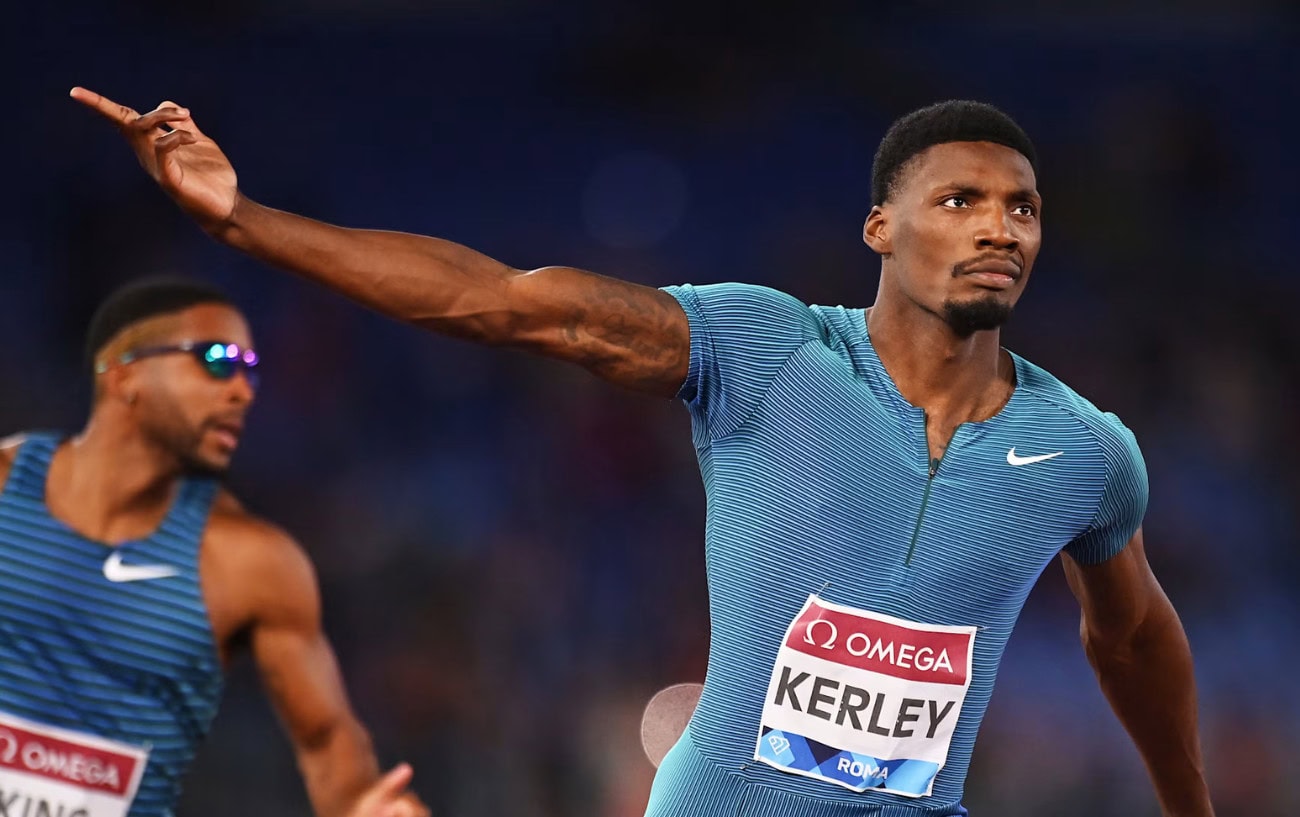
Kerley himself arrives in Las Vegas under a cloud. He was banned for two years by the Athletics Integrity Unit after missing three required drug tests, and his decision to sign with the Enhanced Games has been read by some as the natural endpoint of that conflict.
What Runners Should Watch For
For marathoners and most endurance athletes, the Enhanced Games offers nothing on the program. No event longer than 100 meters is scheduled. But the implications for distance running reach further than the distances on the card.
If a sprinter like Kerley runs well under his personal best in the 100, the result will not be ratified by World Athletics or any other recognized governing body. Records set under enhancement are not record-eligible in any clean-sport context. Yet the public spectacle of a sub-9.7 or sub-9.6 performance, run with full knowledge of what powered it, will reshape how casual fans think about every world-class time they see, including in the marathon.
A precedent already exists in the pool. Last year, Greek swimmer Kristian Gkolomeev posted the fastest 50-meter freestyle time ever recorded, helped by performance-enhancing drugs and a now-banned high-tech suit. The mark was not recognized by World Aquatics. Gkolomeev will swim again on Sunday.
Aron D’Souza, the Enhanced Games co-founder, has framed the event in grand historical terms. “Just as the ancient Olympics were revived and renovated in 1896 for the Victorian world, the Enhanced Games is once again renovating the Olympic model for the twenty-first century,” he said. “In the era of accelerating technological and scientific change, the world needs a sporting event that embraces the future, particularly advances in medical science.”
There is also a broader market context that should not escape running readers. A recent UK Anti-Doping survey, cited in The Herald, found that a third of young people surveyed had taken performance-enhancing drugs deemed “life-threatening” and not approved for human consumption. The Enhanced Games will sell supplements and telehealth services as part of its consumer business. Whether the event functions primarily as a sporting competition or as a marketing engine for that consumer arm is a question several critics have raised.
The Enhanced Games 2026 begin Sunday, May 24, at Resorts World Las Vegas. Coverage streams free on Roku, YouTube, Rumble, Twitch and Kick, with opening events at 6:30 p.m. Eastern and the main card at 9 p.m. Eastern.
RunClub
Get more running stories — join RunClub
Daily running news, a community of 300,000+ runners, free training plans for every distance, and a daily running game. Free to join — no card.
Already a member? Log in →




Start the conversation