


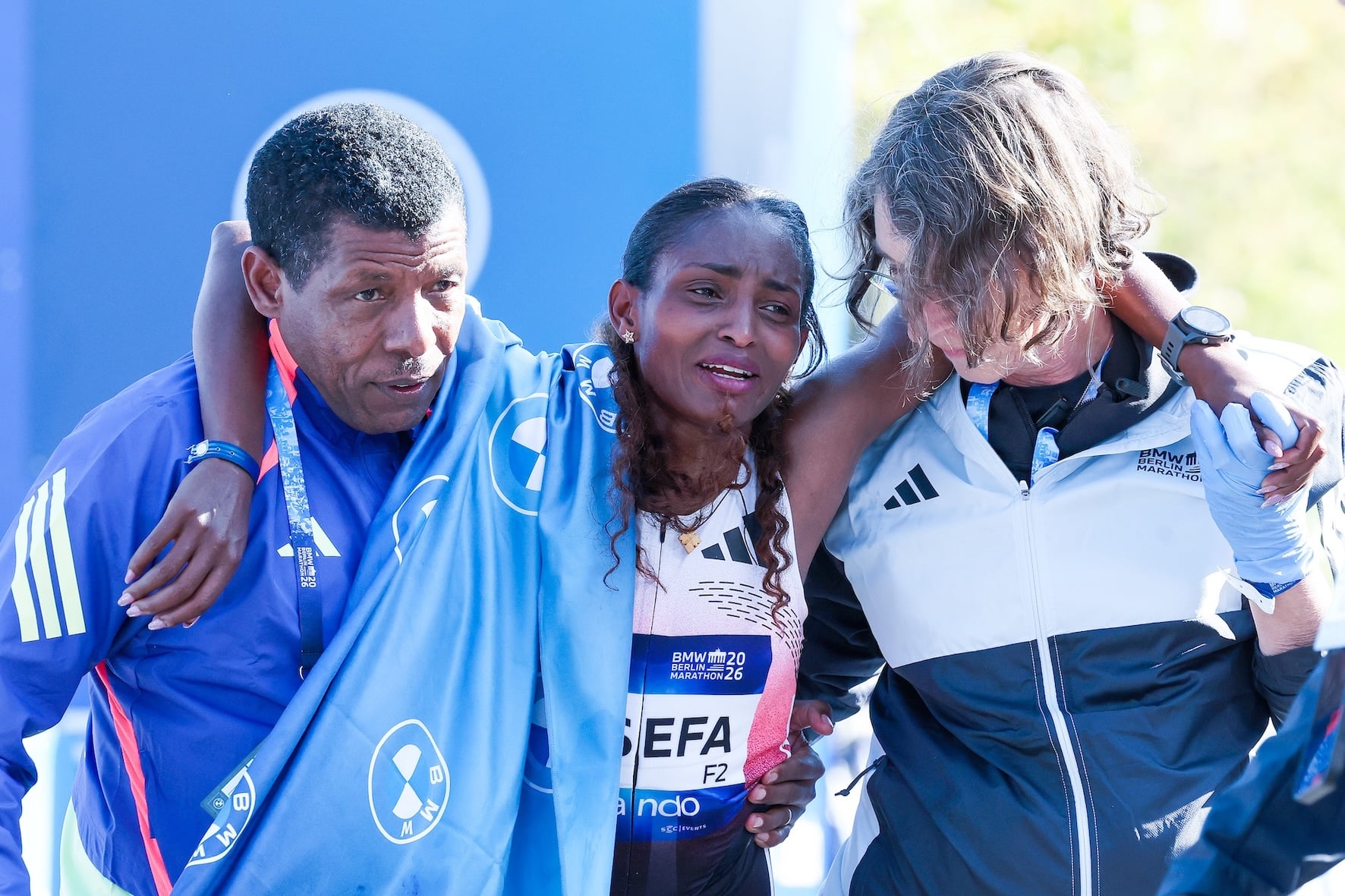
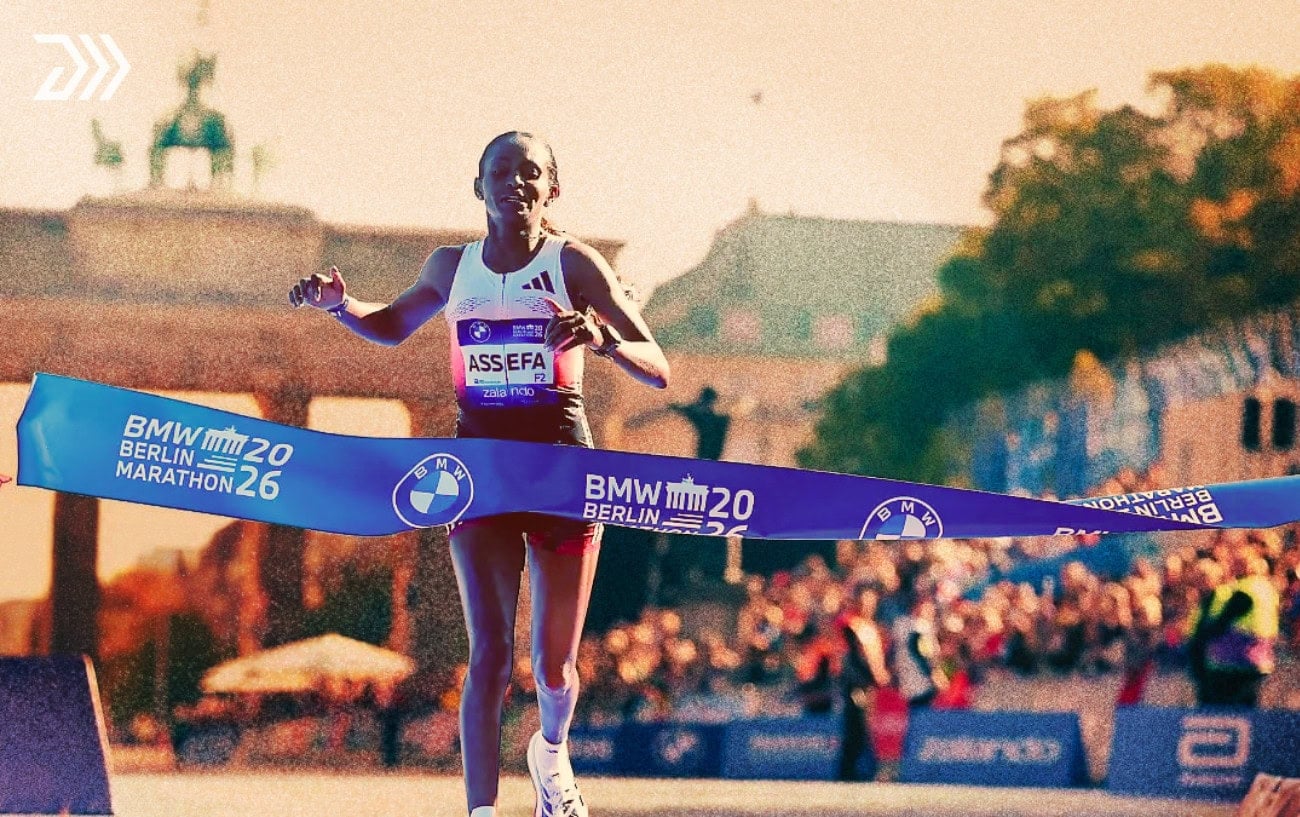
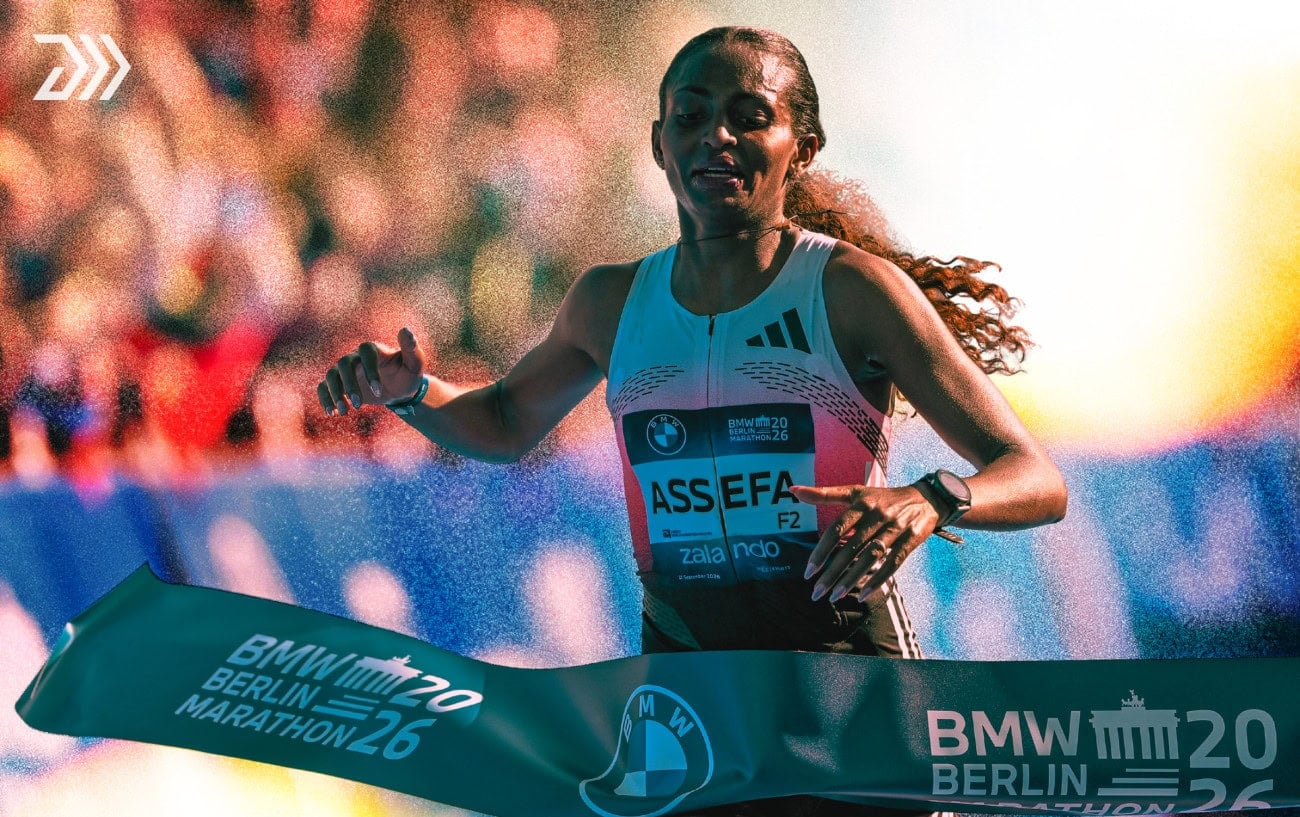
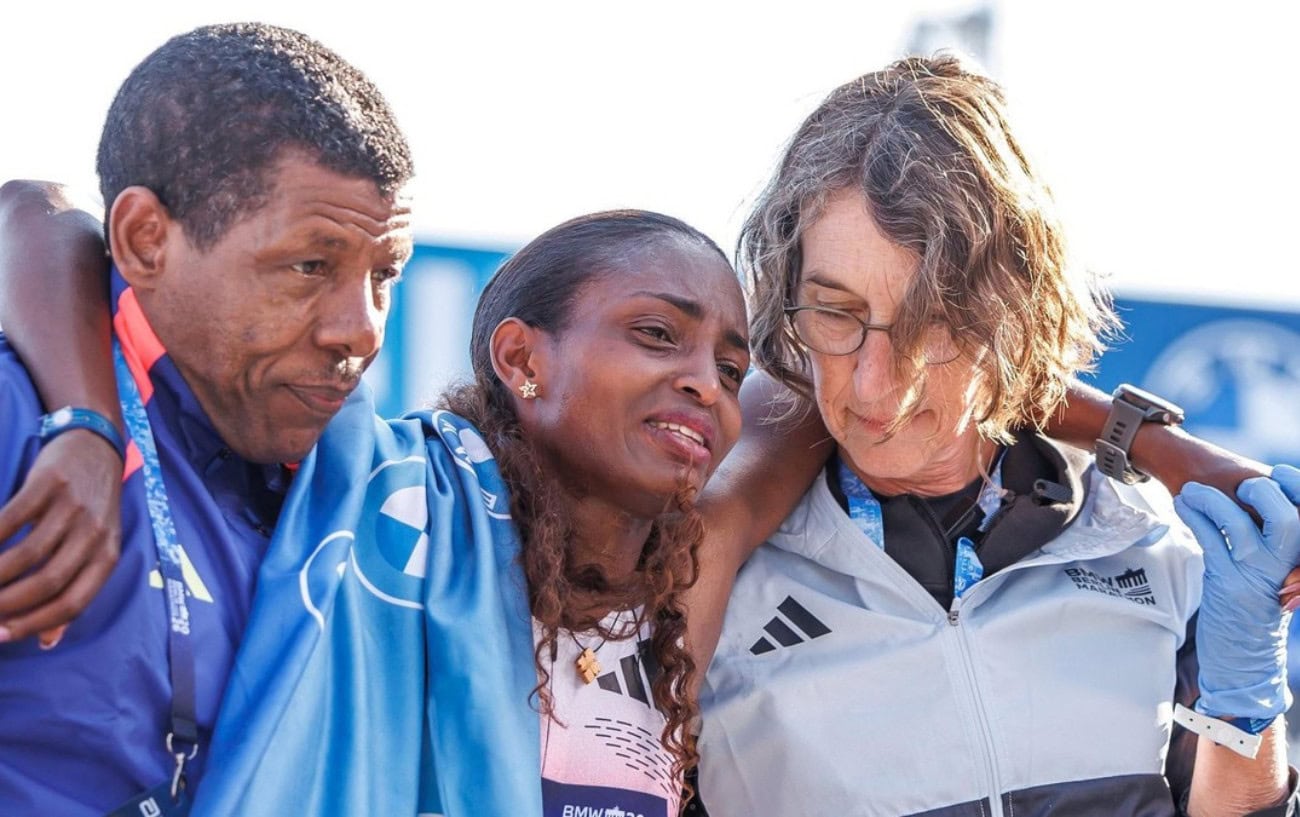
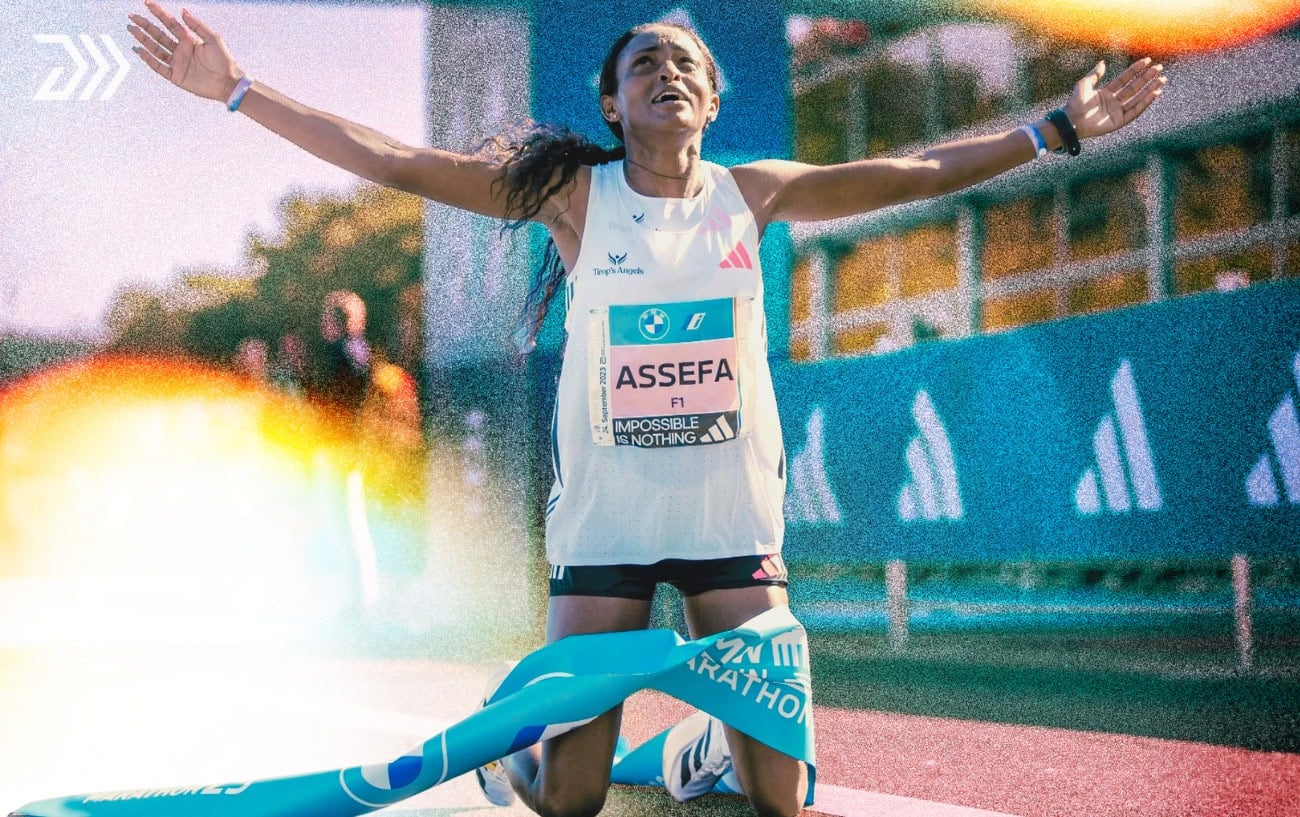
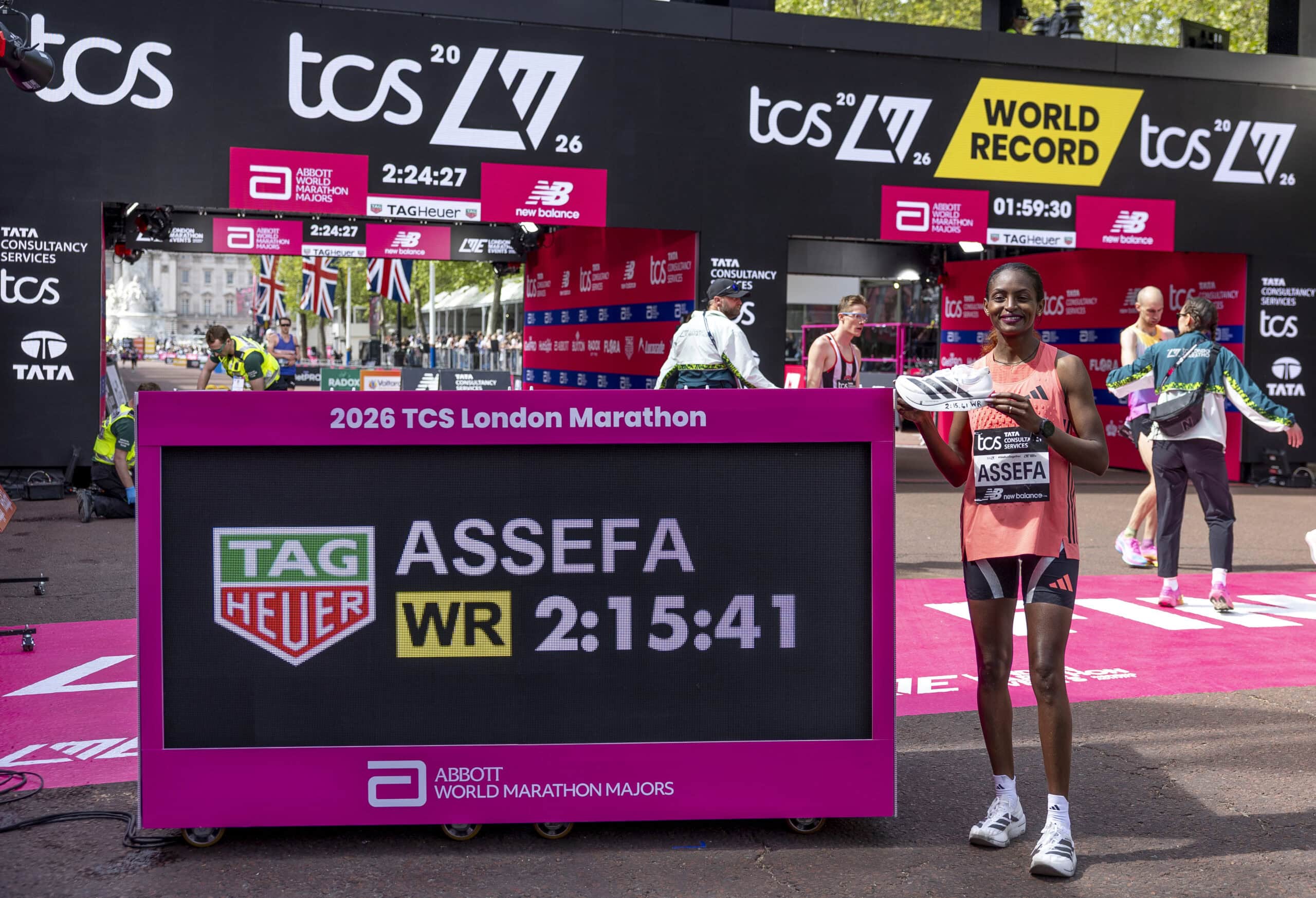
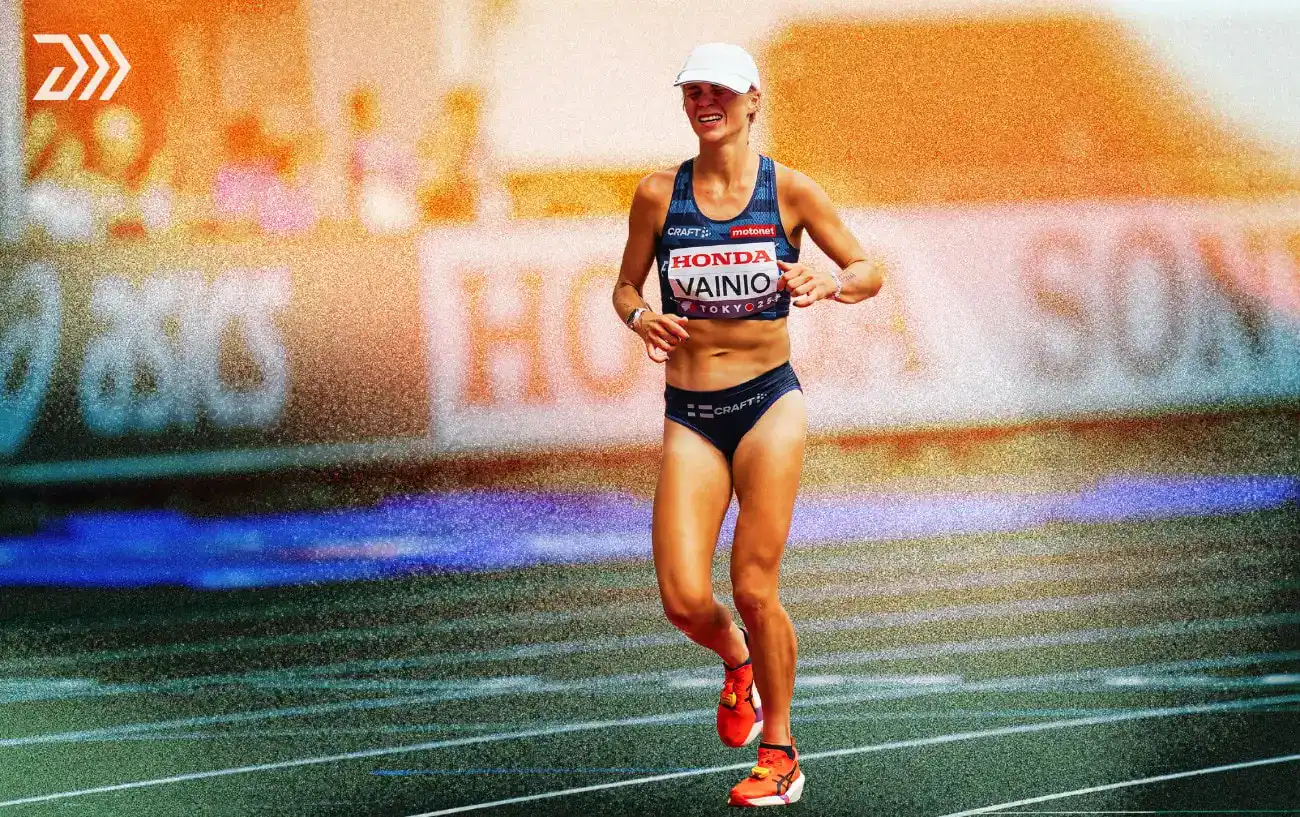
Tigst Assefa passed 40K of the Berlin Marathon on Sunday 10 seconds inside world record pace, then ran the last 2.195K on an injured right Achilles tendon and still won in a course record of 2:11:04. As we reported that evening, her manager, Gianni Demadonna, told Kenya’s Pura Vida Sports Africa that “the right tendon is broken” and that she would have surgery on Monday at BG Unfallklinik Murnau, a trauma hospital south of Munich, where Dr. Johannes Gabel runs foot and ankle surgery. Demadonna thinks it will be “maybe six months before we can see her in competition again.”
How much of the tendon tore has not been made public. Demadonna’s word was “broken,” Austrian broadcaster ORF described a tear, and several outlets have called it a partial rupture, but neither Assefa nor her medical team has released a diagnosis.
The Body’s Strongest Tendon
The Achilles forms where the two main calf muscles, the gastrocnemius and the soleus, merge into a single cord about 15 cm (6 inches) above the heel, and it anchors both of them to the heel bone. No tendon in the body is bigger or stronger, and none ruptures more often, according to a 2013 review in Musculoskeletal Surgery by Thevendran and colleagues.
Running asks a great deal of it. A 1990 study in the Journal of Biomechanics measured the load directly, with a transducer implanted in the tendon under local anesthetic, and recorded peaks of 9 kN during running, 12.5 times body weight. Its midsection, 2 to 6 cm (about 1 to 2.5 inches) above the heel, has the sparsest blood supply, although researchers still disagree over whether that stretch is genuinely short of blood vessels.
Most runners who have had trouble with the tendon know it as Achilles tendinopathy, a painful overuse condition. A rupture is a tear through the tendon’s fibers, and it usually arrives with a pop or a snap and immediate pain. Neither Sifan Hassan’s treadmill injury, which kept her out of London in April, nor the problem behind Jakob Ingebrigtsen’s Achilles surgery in February was described publicly as a rupture.
How the Tendon Tears
In a study of 92 patients that reviews of the injury still cite, Arner and Lindholm found that 53 percent had torn it while driving off the ball of a loaded foot as the knee straightened, a movement that is part of every running stride. Another 17 percent tore it when the foot was jerked up toward the shin without warning, and 10 percent when a pointed foot was wrenched hard the other way.
About two thirds of people who rupture the tendon felt nothing wrong with it before the day it tore, even though tissue from ruptured tendons often shows signs of degeneration under the microscope. Fluoroquinolone antibiotics and corticosteroid injections into the tendon, which can weaken it for up to two weeks, are both recognized risk factors. Nothing about Assefa’s medical history before Berlin has been made public.
Men aged 20 to 39 are the most likely group to rupture an Achilles in the United States, at 5.6 per 100,000 person-years, according to a study of injuries from 2012 to 2016 led by Nicholas Lemme. Sport or recreation accounted for 82 percent of ruptures, basketball alone for 42.6 percent, and men tore the tendon at 3.5 times the rate of women, whose risk peaked between the ages of 40 and 59. Assefa is 29 and was hurt running at a steady pace on a flat road, which makes her an unusual case.
Doctors usually confirm a complete rupture with the Thompson test, squeezing the calf of a patient lying face down: an intact tendon pulls the foot downward, a ruptured one does not. The test picks up 96 percent of ruptures, yet the Thevendran review notes that more than 20 percent are missed by the first doctor who sees the patient. Ultrasound and MRI are used to find incomplete tears, with MRI the better of the two for that job.
How Tears Are Graded
The grading most patients hear about comes from the scale used for muscle strains. A grade 1 injury damages only a few fibers, causing mild pain and little swelling, while grade 2 involves more of the tendon and brings bruising, swelling and some weakness. Grade 3 means different things depending on who is using it. Orthopedic surgeon Poh Seng Yew in Singapore keeps it for a bad tear with some of the tendon still holding, while the Australian clinic Podiatry HQ counts both partial and complete ruptures as grade 3.
Surgeons also work from a more exact system, set out by Kuwada in 1990, which sorts ruptures by how much of the tendon has torn and how far apart the ends sit. A Type I injury is a partial tear through less than half the tendon and is treated without surgery. Type II is a complete tear with a gap of less than 3 cm (just over an inch), which can be sewn end to end. Type III has a gap of 3 to 6 cm and Type IV a gap of more than 6 cm, and both need a graft to bridge it, with Type IV also calling for a procedure to lengthen the calf muscle, according to a 2022 European Congress of Radiology summary.
At one urban trauma center, 17 of 40 ruptures reviewed on MRI were Type I, eight were Type II, 13 were Type III and two were Type IV, according to a poster presented to the American College of Foot and Ankle Surgeons. Ruptures left untreated for more than four weeks are called chronic and graded separately, under Myerson’s 1999 classification, by the size of the defect: 1 to 2 cm, 2 to 5 cm, or more than 5 cm. Assefa’s operation came the day after her race, so hers is an acute injury, and where it sits on Kuwada’s scale depends on a diagnosis her team has not yet shared.
Partial tears have a much smaller research literature than complete ones. In a 1968 monograph on 24 patients, all of them sportspeople and several of them champion athletes between 19 and 29, Rolf Ljungqvist found that 13 had not improved after six to 18 months of conservative treatment, and all 24 recovered fully within a year of surgery.
Surgery or a Boot
The largest trial of the question, published in the New England Journal of Medicine in 2022 by Myhrvold and colleagues, randomized 554 patients with acute ruptures to nonoperative treatment, open repair or minimally invasive surgery. After 12 months there was no meaningful difference between the three groups on the Achilles Tendon Total Rupture Score, the trial’s main measure. The tendon ruptured again in 6.2 percent of the nonoperative group and 0.6 percent of each surgical group, while nerve injuries ran the other way: 0.6 percent without surgery, 2.8 percent after open repair and 5.2 percent after the minimally invasive technique.
A 2019 meta-analysis in the BMJ by Yassine Ochen and colleagues pooled 29 studies and 15,862 patients and came to a similar balance. Re-rupture rates were 2.3 percent after surgery and 3.9 percent without it. Other complications, mostly infection, were more common in the surgical patients, at 4.9 percent against 1.6 percent. When patients were put on accelerated rehabilitation with early movement of the ankle, the gap in re-rupture rates disappeared, and the authors concluded that the choice should be made case by case with the patient.
Karin Grävare Silbernagel and colleagues followed patients through the first year after a rupture and found that the injured tendon had healed 2.6 to 3.1 cm (about an inch) longer than the healthy one. The same patients rose 4.1 to 6.1 cm less on the injured side in a heel raise, and the longer the tendon had healed, the lower they rose, which led the authors to conclude that keeping the tendon from healing long should be a priority of treatment. It was a small study, eight patients measured against 10 healthy controls.
The Road Back
Marrone and colleagues set out the usual course after a repair in a 2024 guide in the International Journal of Sports Physical Therapy. The first two weeks are spent in a cast or boot with no weight on the foot, followed by four weeks of building up from partial to full weight in the boot, with heel wedges. Between six and 12 weeks the patient moves into a normal shoe with a heel lift and starts double-leg heel raises. Running starts “no sooner than 12-16 weeks after surgery,” and only once the patient can do 10 single-leg heel raises and push 1.5 to 2 times body weight through the calf in a seated strength test. A return to sport comes from about 24 weeks, when the operated leg tests at more than 90 percent of the other. Demadonna’s six months sits right at the start of that window.
Across 108 studies and 6,506 patients, a 2016 review in the British Journal of Sports Medicine led by Jennifer Zellers found that 80 percent returned to sport, though the studies that measured return most rigorously reported lower rates. At the professional level, a 2017 study in the American Journal of Sports Medicine followed 62 NBA, NFL and MLB players after surgical repair and found that 30.6 percent did not make it back. Those who came back appeared in 75.4 percent of their usual games in the first year and performed below matched uninjured players, but by the second year there was no measurable difference between them.
The athletes in that study played basketball, football and baseball, sports built on sprinting, cutting and jumping rather than two hours of steady running. Six months from Monday is the end of March 2027. Assefa, who won the London Marathon in April in a women-only world record, has not said which race she plans to come back in.
RunClub
Get more running stories — join RunClub
Daily running news, a community of 300,000+ runners, free training plans for every distance, and a daily running game. Free to join — no card.
Already a member? Log in →


Start the conversation